Charles Dickens, On travel

Charles Dickens, On travel

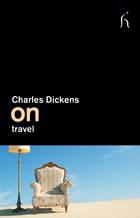
On travel bookcover (Hesperus Press, via LibraryThing)

In the 3rd essay in Hesperus Press’s lovely little volume On travel, which comprises a selection of Dickens’ travel essays, Dickens (1812-1870) makes a reference to Laurence Sterne’s character Yorick. In one of those lovely bits of reading synchronicity, Hungry Like the Wolf posted last week on Laurence Sterne’s A sentimental journey through France and Italy which features said Yorick. In it Yorick lists various types of travellers including Idle travellers, Vain travellers, and Sentimental travellers. Yorick’s type that best suits Dickens would, I think, be his Inquisitive type. However, I think Yorick needed another category to describe a traveller like Dickens: the Observant traveller. (Hmm…I wrote this before checking out the Introduction by Pete Orford. In the first para he praises Dickens’ “talent of observation”. Great minds, and all that!)

There are 6 essays in this slim but rather gorgeously produced volume – don’t you love the allusion to the “armchair traveller” on the cover?:

  • The last cab driver and the first omnibus cab (1836)
  • The passage out (1841)
  • By Verona, Mantua and Milan, across the Pass of the Simplon into Switzerland (1843)
  • A flight (1851)
  • The Calais Night Mail (1863)
  • Some account of an extraordinary traveller (1850)

Reading these reminds me yet again why I love Dickens. I enjoy his acute observation of humankind and his sense of humour. He makes me laugh. Regularly. And then there is his versatile use of the English language. The man can write.

Four of the essays describe train and boat travel, including to America, and to and through Europe. His descriptions of the actual experience of travel and of the various passengers (such as the Compact Enchantress, Monied Interest and the Demented Traveller) he meets on the way are highly evocative. You feel you are on the trains and boats with him because he captures that sense of being tossed about in the sea and of rushing in a train through landscapes and – “bang” (his word) – through stations. But it’s not all sensory – as engaging as that is. There is satire here too – against others, and against himself. For example, in “The Calais Night Mail” he sends up his own love-hate relationship with Calais as well as the behaviour of an English traveller who “thinks it a quite unaccountable thing that they don’t keep ‘London time’ on a French railway”. (It was ever thus, eh?)

The thing about his writing is its diversity – he mixes up his rhythm; he uses allusions, irony and metaphor; he plays with tense and punctuation; and he uses repetition, to name just a few of the “tricks” in his writer’s bag. Just look at the variety in the following examples.

A wickedly satirical description of a man who was transported twice to Australia:

If Mr Barker can be fairly said to have had any weakness in his earlier years, it was an amiable one – love, love in its most comprehensive form – a love of ladies, liquids and pocket handkerchiefs. It was no selfish feeling; it was not confined to his own possessions… (“The last cab driver and the first omnibus cab”)

On a rough crossing to Calais:

I am bumped rolled gurgled washed and pitched into Calais Harbour… (“The Calais Night Mail”)

A description of the Demented Traveller:

Faculties of second Englishman entirely absorbed in hurry. Plunges into the carriage, blind. Calls out of the window concerning his luggage, deaf. (“A flight”)

And then this little pointed comment written in 1863 but alluding to an earlier trip in 1843:

and I recognise the extremely explosive steamer in which I ascended the Mississippi when the American civil war was not, and only its causes were. (“The Calais Night Mail”)

Dickens was, as we realise from the last essay in the collection, more than aware of the horrors of slavery, not to mention the plight of “the fast-declining Indians”. His willingness to express such awareness did not always endear him to Americans but, as Pete Orford writes in the Introduction, Dickens was equally prepared to be satirical of home as abroad.

These essays provide a fascinating insight into how Dickens viewed his world and the people in it, and present wonderful exemplars of his writing. They also demonstrate how widely travelled he was, which, by broadening his understanding of humanity, must have fed his fictional muse too. Orford concludes his Introduction with some lines from the last essay. I can’t really think of a better way to end this than to repeat some of them too. Dickens wrote:

The more man knows of man, the better for the common brotherhood among us all. (“Some account of an extraordinary traveller”)

Some of Dickens’ words and allusions (though there are “notes” in this edition) may be a little obscure now, and some sentence structures are a little complicated to our modern eyes, but if you have any interest in Dickens or travel writing in general, you will enjoy this. I certainly did.

Charles Dickens
On travel
Hesperus Press, 2010
91pp.
ISBN: 9781843916123
(Review copy supplied by Hesperus Press via the LibraryThing Early Reviewers Program)

NOTE: I must apologise for once again hitting the Publish button too early and sending some half-finished gobbledy-gook to your various readers and email accounts. I should either take Tony’s advice and draft in Word or adopt Farnoosh’s recent “Slow down” admonition (to herself), because clearly I’m not getting it right at present! I beg your forgiveness.
Nathanael West, Business deal

This week’s Library of America offering was (or “is” since it’s still this week, but “was” cos I’ve read it – all this tense stuff can be so bothering!) Nathanael West’s Business deal. It’s short, and I’d just finished my novel for bookgroup, so I decided to read it.

I don’t know much about Nathanael West, other than recognising his name, but according to Wikipedia he lived from 1903 to 1940. Another writer who died young – though he wasn’t quite so young as the likes of poor Keats and Stephen Crane, neither of whom even made 30, and he died not of illness but in a car accident. Anyhow, Wikipedia describes West as “author, screenwriter and satirist”. The brief introductory notes accompanying the story say essentially the same thing. These notes suggest that his recognition as a writer comes mainly from his novels, but his money came from his plays. This LOA offering, however, is a short story. It was published in 1933 in a magazine called Americana, which apparently published a lot of satirical writing.

Business deal is about the head of a movie production company, which is rather aptly named “Gargantual Pictures”, planning his next takeovers while at the same time preparing not to pay a very successful young scriptwriter what he’s asking. This is not a subtle story, and neither character is particularly appealing:

The mongoose [the scriptwriter] sat comfortably and waited for the cobra [the company head] to strike again.

Effective image, eh? It is, in fact, a pretty typical negotiation story in which one side holds its ground while the other pulls out all arguments until one of them either capitulates or plays the winning card at just the right moment. I won’t tell which one is which, but if you think of which profession West was you may just work out who wins this particular deal! It’s a humorous if rather predictable story, but it does demonstrate the well-honed skills of a successful satirist. It is worth reading for that.

Andrea Goldsmith, Reunion

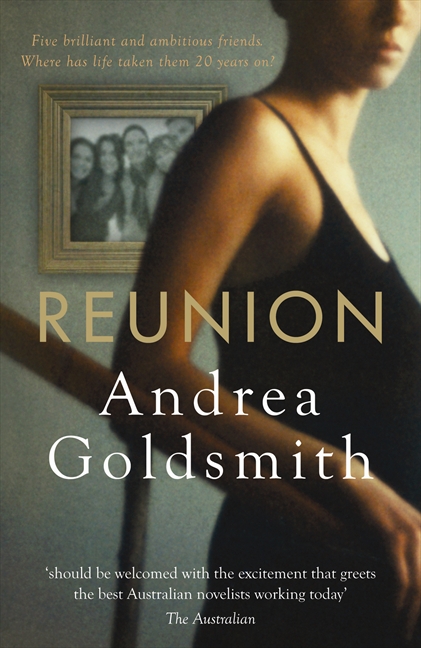
Andrea Goldsmith, Reunion bookcover
Reunion bookcover (Courtesy: HarperCollins Australia)

I wanted to love Andrea Goldsmith’s Reunion. And I expected to, as I remember enjoying the last book of hers that I read. But, somehow, I found it a bit of chore to read, though it did pick up towards the end. I think I understand why it was not listed for the 2010 Miles Franklin Award.

Friendships become swaddled in invisible protective layers and nothing short of a cataclysmic blow can break through to the inevitable stress points beneath.

The plot is fairly straightforward. Four university friends (three students, borderline baby-boomers and now in their mid-40s, and a lecturer, now around 60) find themselves all living in Melbourne again after some 20 years apart. All four had met in Melbourne, had moved together to England to continue studies and work, but had then gone their separate ways. At the beginning of the novel Jack, an academic and Islamic expert, is single and still in love with Ava; Ava, a novelist, is married to the unpopular Harry; Helen, a scientist, is a single parent; and Connie/Conrad, a philosophy lecturer, is on his third marriage but still philandering. Harry, who met them in England, is on the outer, but it is he who has engineered the reunion under the auspices of an organisation he has created, NOGA (Network of Global Australians).

The novel, then, is about this time of reunion: it explores who they are now, and the state of their relationships with each other. Sounds like the sort of thing that would interest me – Melbourne setting, characters with whom I would expect some level of identification, themes exploring love and friendship, and a writer whom I’ve enjoyed before. None of these, I should add, are essential for my reading enjoyment – I also like books set in exotic places and about very different characters – but familiarity often appeals too (doesn’t it?).

And yet, for me the book fell a little flat. It just didn’t feel quite original enough – in either ideas or language. It felt a little same-old-same-old. That said*, I found the characters interesting and convincing, although only one, Jack, changed in any significant way as the novel progressed. The narrative mode is multiple 3rd person subjective, with Jack’s perspective starting and ending it. It is told, chronologically, but with flashbacks to fill in the past. All this is well controlled and keeps the story moving nicely.

Goldsmith ranges across a lot of themes – love and friendship (of course); truth and fiction; secrets and memory; passion and obsession; modern communications; revenge and forgiveness; and science, ethics and politics. It is probably here that the novel palled most for me because many of these themes seem to go nowhere. Take the truth and fiction one. Those of you who read my blog know that I enjoy seeing this issue explored, but in this novel it’s raised, often with a nice level of irony, but is not really developed. For Ava, the novel writer, “there was no better vehicle for truth” than fiction, whereas for the scientist, Helen, “Ava’s work is only fiction – none of it is true”. Well, I thought, Goldsmith will unpack the ironies contained in these, but she doesn’t really. Perhaps that’s OK, perhaps it’s enough for us to notice them, but I wanted more.

At other times, the themes seem more like the author’s soapbox than ideas fully integrated into the story, albeit that the characters are her mouthpieces. Here, for example, is Jack expressing a rather stereotyped view of modern communication:

Whenever Jack looked back to his university experience and compared it with today’s university student life, so much seemed to have changed – even friendship itself. Without computers and mobile phones, face-to-face communication ruled the day.

The implication is that modern friendships are somehow less meaningful, but what does he really know and, further, what does the novel show us about it? Nothing really. Similarly, Helen rages about political interference in science, but the issue, while valid enough, seems a little fabricated in the context of the novel.

There are some funny set pieces, such as the young television make-up artist trying to hide Connie’s aging neck. Goldsmith does irony well – something I, as a Jane Austen aficionado, rather enjoy – and she peppers the novel with a lot of effective literary allusions – to Waugh, Wharton, James, and others. Moreover, there are some lovely descriptions, such as this one on Ava’s discomfort during her first weeks in England: “It was like being stranded on a sheet of clear glass with nothing but blackness underneath”. I’m not sure why I like this, but I do.

I’ve struggled to write this review, really, because there are things to like about this book. I decided to do a quick review of reviews out there and what I mostly found were positive reviews that each had some little reservation: “despite that minor misgiving”, “a rich and at times frustrating novel”, “despite a few stylistic glitches”, and “the novel was marred but not spoiled for me by …”. None though explored these reservations in any depth.

And so, rather than labour any more, I will close with the words of Helen’s teenage son, Luke. He says, in that simple, direct way that the young can do:

The truth can hurt. But that doesn’t make it less right.

The final irony is that Harry is hurt by a truth – but the truth he is hurt by and the real truth of the matter are two quite different things. And that, in the end, made the novel an interesting if not totally engaging read.

For a more positive perspective on this novel, check out Lisa’s at ANZLitLovers.

Andrea Goldsmith
Reunion
London: Fourth Estate, 2009
414pp.
ISBN: 9780732287832

*See my previous post on words to avoid!

Stephen Crane, When man falls, a crowd gathers

Stephen Crane

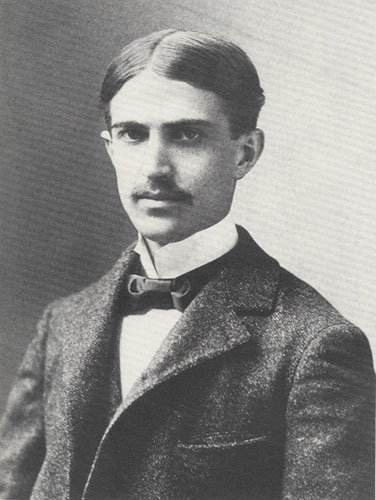
Stephen Crane (Presumed public domain, via Wikipedia)

This week’s Library of America offering is a sketch/article by Stephen Crane. Now, while I suppose most Americans have read what I believe to be Crane’s most famous work, The red badge of courage, I’m afraid I haven’t – and so, when this opportunity to read something by him arose, I was more than happy to take the opportunity. You can too, by reading it here. (It’s well worthwhile, and is less than 5 pages.)

According to the Library of America’s notes, the story was published in 1894 in The New York Press under the following heading:

When man falls, a crowd gathers
A Graphic Study of New York Heartlessness
Gazing with Pitiless Eyes
“What’s the Matter?” That too Familiar Query

That pretty much sums it up really. The notes also say that it was based on a real incident. It’s a simple story: a man and a boy are walking in the street one evening, when the man suddenly falls to the ground. Immediately a crowd gathers, ready to criticise (“Oh, a jag, I guess”) rather than help. The boy indicates, however, that it’s a fit but this still doesn’t result in any obvious sympathy or assistance. Instead, the crowd pushes closer and closer wanting a view. The language used to describe the crowd’s behaviour leaves us in no doubt as to the intent:

Those in the foremost rank bended down, shouldering each other, eager, anxious to see everything. Others behind them crowded savagely for a place like starving men fighting for bread.

This is writing that pulls out all stops to make its point: the rhythm (“shouldering each other, eager, anxious to…”), the word choice (“savagely”) and the imagery (likening their behaviour to that of survival) work together to create a powerful picture in just two sentences. The language continues in this vein building up a tension between the crowd, which shows more interest in the spectacle, and the helpless boy who is unsure what to do to help his companion. It’s not until halfway through the story that someone offers some help – but still the majority stands by:

There were men who nearly created a battle in the madness of their desire to see the thing.

Meanwhile others with magnificent passions for abstract statistical information were questioning the boy. “What’s his name?” “Where does he live?”

Eventually, a policeman (“a man whose life was half-pestered out of him by the inhabitants of the city”) appears, exhibiting “the rage of a placid cow”. (A wonderful oxymoron that reminded me of Tony’s recent post on the subject.) Gradually, but with continued difficulty described in similar evocative language, the man is helped.

This is delicious writing: it’s almost, but not quite, over the top in the way it piles up the imagery. What saves it from being hyperbolic is that it is, unfortunately, all too believable – for then, and for now. It’s not for nothing I think that Crane titles it “when man falls” not “when a man falls”, making it rather clear that this is not a one-off situation. What a shame Crane (1871-1900) died so young.

NSW Premier’s Literary Awards, 2010

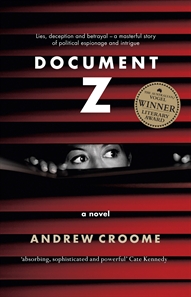
Document Z bookcover

Document Z cover image (Courtesy: Allen & Unwin)

The literary awards season is well and truly here downunder … and last night, just before the opening of this year’s Sydney Writers Festival, the NSW Premier’s Literary Awards for 2010 were announced.

The  full list of winners can be found here, so I’ll just name the critical ones, from my point of view (with links to relevant posts of mine):

  • Christina Stead Prize for Fiction: J.M. Coetzee, Summertime
  • Script writing award: Jane Campion, Bright Star & Aviva Ziegler, Fairweather Man
  • UTS Glenda Adams Award for New Writing for Fiction: Andrew Croome, Document Z
  • The People’s Choice Award: Cate Kennedy, The World Beneath
  • Special Award: The Macquarie Pen Anthology of Australian Literature

Not a bad result from my point of view. I have been meaning for some time to dip into the Macquarie Pen Anthology of Australian Literature properly. I wonder at myself sometimes really. What have I been doing posting on various offerings of the Library of America, when I could (should) in fact be choosing some choice items from this volume to share with you. I really must (want to) rectify this. (That said, another Library of America offering will be winging its way to you soon!)

Anyhow, I’m not going to ramble on about the Awards, but I would like to make one comment, and that is that the People of NSW seem to like what our judges tend to dismiss! Last year, they voted for Steve Toltz’s wonderful A fraction of the whole and this year they’ve gone for Cate Kennedy’s The world beneath. Both these books were longlisted for the Miles Franklin Award in their years, and were well reviewed around the traps, but both were not shortlisted. An interesting state of affairs, n’est-ce pas?

Shaun Tan, Eric

Shaun Tan, Eric cover

Eric bookcover (Courtesy: Allen & Unwin)

When I bought Eric on a whim the other day (as you do!), I didn’t realise that it had been excerpted from Shaun Tan’s Tales from outer suburbia which I haven’t yet read, but have given to others. That’s okay though, because it means  that I’ve finally read a little of Shaun Tan, something I’ve wanted to do for a while.

Shaun Tan is an Australian multi-award-winning artist-writer (or is it writer-artist?) who has published books, worked in theatre and film, and had his work adapted by such luminaries as the Australian Chamber Orchestra. He is one versatile man! His best known works include The arrival (a wordless graphic novel about migrants) and Tales from outer suburbia (an anthology of 15 short illustrated stories about all sorts of strange things that happen in suburbia).

Eric picks up on what I believe is one of Tan’s common themes, that of being different or strange, an outsider. It is about a foreign exchange student who comes to stay with a family in – yes – suburbia, and how they all get along.

Tan’s is not a negative presentation – at least, not here. The mostly monochromatic drawings are whimsical and all focus on Eric, the visiting student, while the text is in the voice of a child of the house. The story is about tolerance and acceptance of what you don’t understand. It’s also about expectations that aren’t met – but accepting the things that happen instead. As Mum says in the book, “It must be a cultural thing”. Overall, it’s about the fact that other can reside with other – and yet it also allows discomfort and incomprehension to be an acceptable feeling.

This sounds like a simple book, and in some ways it is, but it’s not simplistic. Producing it as a gift-edition like this is a lovely idea. It will, I hope, introduce more people to Shaun Tan and his rather unique view on the world. It has certainly whetted my appetite.

Shaun Tan
Eric
Crow’s Nest: Allen & Unwin, 2010
[48pp.]
ISBN: 9781742372921

Alex Miller, Lovesong

Alex Miller, Lovesong

Lovesong bookcover (Courtesy: Allen & Unwin)

Lovesong is my first Alex Miller novel, which is a bit embarrassing, really, given that he has won the Miles Franklin Award twice.

John was the quiet type … Except when he was telling me his story. Even then there was something quiet and private in the way he spoke about himself and Sabiha; as if he was telling himself the story; going over it to find its meaning for himself. Looking for something he’d missed when it was happening to him.

As you can probably tell from this quote, Lovesong is one of those story-within-a-story novels. Its basic plot is fairly simple. John, an Australian, tells the story of his life in Paris with his Tunisian wife, Sabiha, to Ken, a retired novelist. Retired? Well, so he says, but can he resist a good story when he hears one?

John and Sabiha’s love story is not exactly straightforward, which is foreshadowed early in the novel when Ken first meets Sabiha and notes “a sadness in the depths of her dark brown eyes”. He begins to wonder about “her story”. Adding a little complexity to this is a loose parallel in Ken’s life. He lives with his 38-year-old daughter, Clare, who during the novel starts a love affair of her own. Sabiha is, coincidentally, about 38 when the “crisis” in her life occurs. There are other parallels in the novel, such as Sabiha’s aunt Houria and her marriage to Dom, and Ken’s marriage to his wife Marie. Again, these are loose. They provide depth and perspective rather than the direct commentary that parallels often seem to do.

This is a surely structured novel. Miller manages to be simultaneously subtle and obvious so that you are conscious of being led along, but you are not always sure where to or what it might mean. Early in the novel, Clare tells her father that “Love is never simple”. A little later, Sabiha’s father reflects on his daughter and wonders, rather more prophetically than he realises, what “makes some people so different from others that they cannot share a common fortune with them”.  Alongside these early thematic hints is a whole slew of comments about story-telling and writing, about story-telling as “confession”, as “craving for absolution”, as, in fact, catharsis. In other words, the novel is also self-consciously metafictional, which is not surprising given that the first person narrator, Ken, is a novelist.

Meanwhile, there is John and Sabiha’s actual story – and again, the plotting is sure. We learn early that Sabiha wants just one child, “her child. There was only one”. And we learn of her closeness to her maternal grandmother. These two things, dropped lightly in the book, play a significant role in the development of the plot.

The novel is full of irony, starting with the title and its romantic connotations being undercut by other sorts of songs. And there is this from Sabiha’s aunt Houria:

Don’t try sorting out the rest of your life tonight, darling. You’ll see, it’ll all work out in the most unexpected ways.

This is doubly ironic because, eventually, Sabiha does attempt to sort out her life, rather than let it work out, and the result, while giving her what she wants, is also not what she expected. What’s that adage? Be careful what you wish for? And yet, that’s not what the novel is about. It’s not a cautionary tale. Rather, without being coy, it’s a meditation on the mystery and power of love – and, I would say, on innocence and experience in its many guises.

But it’s about other things too, such as the importance of home and place. Both Sabiha and John spend much of their lives living away from their respective homes. Ken, at the novel’s start, has just returned from spending time in Venice and is trying to decide whether to return. It’s also about Life – and the inevitability of change: “Change being forced on them, even as they stood still”. John feels it, Ken feels it.

But again and again, we come back to stories and storytelling. Partway through the novel Ken thinks:

There were things I could have added to his story, but I didn’t want to make it up this time. The truth is … I have never really liked making it up. My imagination, such as it is, needs the facts to feed off. I could see the directions I might go in with John and Sabiha’s story, but I resisted. I wanted to hear the truth from John.

And yet, it is not so simple as it sounds. At the end, he wonders:

I had her story now, but it is one thing to have a story and another to write it. How was I to articulate the delicate complexities that must give weight and depth and beauty to her story, those things that most easily elude us?

I found Lovesong an engrossing read. Its writing engaged me, it’s accessible, and it tells a great story, while also exploring the art and meaning of storytelling. I am left though with one question: Whose story is it to tell?

Lisa at ANZLitLovers also liked this book. You can read her review here.

Alex Miller
Lovesong
Crows Nest: Allen & Unwin, 2009
368pp.
ISBN: 9781742371290

Thea Astley, The multiple effects of rain shadow (Review)

There are two main reasons why I like – actually love – to read Thea Astley. One is her language, her wonderful way with words that may, at times, be over-the-top but that is never clichéd. The other is her passion for the underdog, and thus for social justice in a world where it is often conspicuously absent.

Island, Palm and Sun

Island with palm, because Penguin will not answer emails regarding bookcover use (Courtesy: OCAL, via clker.com)

The multiple effects of rainshadow is Astley’s second last novel. Its overall subject matter is, as one character says late in the book, “the unmoored behaviour of humans”, an effective image given the book’s central motif is an island. It has a very loose plot which is based on an actual event that occurred on Palm Island in 1930. Palm Island was, at that time, essentially a dumping ground for Indigenous Australians deemed to be “problems”, but the event in question concerned the white superintendent, mad with grief at the recent death of his wife, running amok and setting fire to buildings (including his own home in which his children were sleeping). He was eventually shot (and killed) by an Indigenous man under the (cowardly) order of the white deputy superintendent. The novel explores, through multiple points of view and over a period of around 30 years, the impact of this event on six white people who were present on the island at the time – but interspersed between these voices is the voice of Manny, the man who shot the super. This is, I think, a pretty risky thing to do but Astley is not one to shy away from risks in her writing.

The voices are, in chapter order:

  • Manny Cooktown, first person, the indigenous “shooter” and main narrator who commences the story and appears between each voice, but does not conclude the novel
  • Mrs Curthoys, first person, landlady on Palm Island at the time of the incident
  • Gerald Morrow, third person, writer/editor who had gone to the Island to work as a foreman, for which he had no skill or experience, and who was in fact escaping the Island in a boat at the time of the incident
  • Captain Brodie, third person, the Superintendant who ran amok and was shot by Manny
  • Mr Vine, third person, a school teacher on the Island at the time of the incident
  • Father Donellan, third person, priest who visits regularly from the mainland and is responsible for the Island’s religious “needs”
  • Leonie née Curthoys, first person, daughter of Mrs Curthoys and so on the Island at the time of the incident
  • Omniscient author who carries the last chapter

Looks complex eh? But in fact it’s pretty straightforward in terms of knowing who is who, as each voice “manages” its own chapter. The chronology is a little trickier as many of the characters (let’s call them that from now on) flip between their present (some are writing from many years after the event) and the past. Did you notice that the first person voices belong to the two groups most recognised by Astley as disadvantaged: women and indigenous Australians? A subtle but clever use of her narrative structure to give them a voice!

The setting is, after all, very much a white patriarchal world, and marriage is seen in that light. Vine, for example, is told to get a wife  for

‘The boring bits. You know. Meals. Washing. Shopping. Kids. All that sort of thing. A man hasn’t time for that sort of thing.’

‘Why not a housekeeper, then?’

‘You are green. Cost too much …’

Not surprisingly Mrs Curthoys and Leonie do not find marriage much to their liking. The main underdogs in this novel though are the indigenous people, many of whom are brought to the Island – and therefore separated from their country – as problems, and are treated with disdain at best and real cruelty at worst by most of the white residents (from 1918 when the settlement begins to 1957 when the book closes). Astley offers, I’m afraid, little hope. She is not a cheery writer: her goal is to shock us into attention – and that she does. However, I can imagine some critics accusing her of putting contemporary views about feminism and indigenous relations in characters’ mouths. I would argue though that contemporary ideas do not spring from a vacuum, and that therefore the occasional more sensitive/egalitarian views expressed in the novel are historically valid.

I said at the beginning of this review that one of the main reasons I like Thea Astley is her language, so here are some examples of her imagery:

…whistlestop hamlets scattered along briefly tarred roads that led to further sprawls moated by loneliness …  [from school-teacher Vine, heading to a country school]

And I am weary of  a Celtic charm that is shaken like spice over any dish within gulping reach. We bore each other rancid. [Leonie on marriage and her philandering husband]

At least I’ll have tried. At least I’ll be learning to decline the gumleaf, conjugate the seasons. [Vine’s “do-gooder” son Matthew]

She also effectively mixes up the rhythm to make points or convey feeling, using short snappy sentences, repetition of phrases (such as Morrow’s “swing dip drag” as he sails across the sea), and punctuation-free streams of consciousness:

There was an unalterable plane geometry to his movements: the clock the tea/toast the clock the bell the classroom the toted piles of exercise books the bell the repeated texts the stale jokes the texts the bell the common-room bitchings the clock the bell … the … the … [schoolteacher Vine]

Astley is often quite self-conscious about the act and role of writing, and this is certainly the case in this novel. I’ll give just one example, the bitter rant of failed writer Gerald Morrow, who is jealous of the success of another, to him, lesser writer:

There must be a million readers out there who crave boredom! Who love the dangling participle! Who wallow in truisms and fatuous theorisings! … Slap in your popular aphorisms, buddy, but don’t make ’em think!

You could never accuse Astley of not making you think, but there has to be some irony here, some little sense of self-deprecation even, in the fact that she put these words in the mouth of a failed writer, as if she knew that for all her passion there’s only so much you can achieve with words. That may be so, but Astley has given it a darned good try!

Thea Astley
The multiple effects of rainshadow
Camberwell: Penguin, 1996
296pp.
ISBN:  9780143180265

James Thurber, The lady on the bookcase

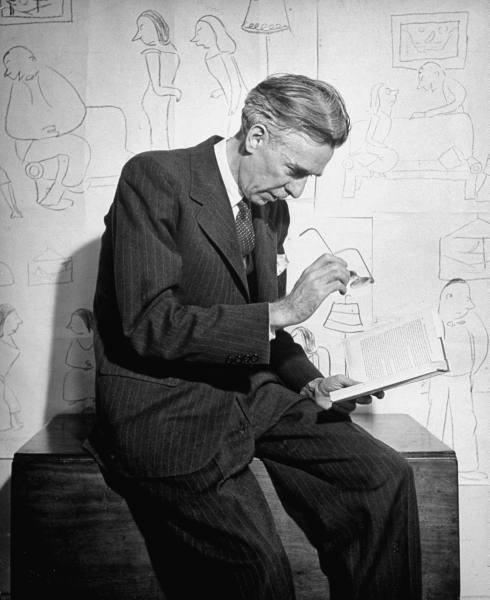
James Thurber, 1945

Thurber, 1945 (Courtesy: life.com, for personal non-commercial use)

If you like to think of yourself as a critic, read this. It is last week’s offering from the Library of America, and is an essay by James Thurber titled “The lady on the bookcase”; it was first published in The New York Times Magazine in 1945 under the title “Thurber as seen by Thurber”. I read it as a general spoof on the art of criticism; the Library of America says he “teases [his] colleagues and editors at The New Yorker.”

The scene is set in the first paragraph when he reports on a cartoonist complaining about being rejected:

“Why is it”, demanded the cartoonist, “that you reject my work and publish drawings by a fifth-rate artist like Thurber?” Ross came quickly to my defence like the true friend and devoted employer he is. “You mean third-rate”, he said quietly, but there was a warning glint in his steely gray eyes that caused the discomfited cartoonist to beat a hasty retreat.

Just this beginning, before I read any more, reminded me of why I had enjoyed Thurber in my baby-boomer youth when many of us read a bit of Thurber. Thurber was a writer and cartoonist, and in this essay he combines the two to poke fun at criticism … and at how editors tend to show a journalistic rather than a critical interest in his work by wanting to know the stories behind his work rather than analysing it.

He writes that:

I have never wanted to write about my drawings and I still don’t want to, but it occurred to me that it might be a good idea to do it now, when everybody is busy with something else, and get it over quietly.

… and, to continue his satire, he talks about “shoving” some of his originals around the floor until they “fell, or [he says archly] perhaps I pushed them, into five separate categories”. He goes on to describe the categories, illustrating each with some of his cartoons:

  • the Unconscious or Stream of Nervousness category
  • the space between the Concept of the Purely Accidental and the Theory of the Haphazard Determination
  • the theory of the Deliberate Accident or Conditioned Mistake
  • the Contributed Idea category
  • the Intentional or Thought-Up category

If you haven’t worked it out by now, you can’t take much of what he says seriously – and that is his point. Don’t, he tells us, try to categorise or apply psychological theories to someone’s work, go for a run instead. Then again, I wouldn’t take this too seriously either, because Thurber is also being disingenuous: in the tradition of the satirist, he sets us up at every point, only to pull us down again. After all, like any creative artist, he wants us to look at and respond to his work.

Have a look at it … I’m sure you’ll enjoy the ten cartoons reproduced even if you don’t want to read the essay.

Jane Austen: Conservative or progressive?

I must admit that, fan as I am of Jane Austen (of her wit and clear-eyed observation of humanity), I have sometimes been conflicted about whether she is, as this post title asks, conservative or progressive.

She was innovative in terms of the history of the novel – her sure use of the third person omniscient narrator and her psychological and social realism were progressive for her time. But, what about her plots and their resolution? The fact that her heroines tend to marry well? Or, well enough, anyhow. I have often felt ashamed about my sorrow that sensible Elinor in Sense and sensibility did not “catch” as wealthy a husband as her emotional sister Marianne did. It’s not the money so much, but the fairness of it! Elinor deserved … but, she got what she deserved didn’t she? The man she loved!

But, I digress. The point is – and this is what seems to put some readers off – that Austen’s heroines always do marry, and they always marry within their class or slightly higher. They don’t throw it all to the wind to follow some passion; they are usually materially “sensible” even though they also determine to follow their heart. And so, there’s the conundrum. Austen’s heroines are independent of mind enough to hold out for a marriage of affection, but they don’t cast their net outside their kind. They seem to affirm the status quo.

However, as I also wrote in a recent post, I and many others see Austen as a protofeminist: while her plots and their resolution can be seen, superficially, to be conservative, there is something else going on. And this was presented from a fascinating perspective the other night by academic Glenda Hudson who spoke at the public library. Her topic was “Sibling love in Jane Austen, revisited” and was an updating of an article she published in 1989. She explored the role of sibling love and incest in Jane Austen – not that “actual” incest ever occurred in her books, but some of the highly sanctioned relationships, such as Fanny and Edmund in Mansfield Park, and Emma and Mr Knightley in Emma, have incestuous overtones (that are consciously articulated in the books).

Hudson claims that Austen promotes the value of fraternal (sibling) love in her novels – and defines this love as being based on shared moral and intellectual values and ideas. She argues convincingly that in many of Austen’s novels this idea is extended to encompass conjugal love, and that marriage in Jane Austen is presented as a meeting of like minds, as an egalitarian partnership between two people who, through the course of the novel, have come to love and respect each other. In fact, she argues that, through these marriages, Austen redefines gender roles in marriage.

Here is a description of Fanny with her brother, in Mansfield Park:

Fanny had never known so much felicity in her life, as in this unchecked, equal, fearless intercourse with the brother and friend [brother William] who was opening all his heart to her, telling her all his hopes and fears, plans, and solicitudes  … An advantage this, a strengthener of love, in which even the conjugal tie is beneath the fraternal. Children of the same family, the same blood, with the same first associations and habits, have some means of enjoyment in their power, which no subsequent connexions can supply … (Mansfield Park, Ch. 24)

Here is Edmund, realising at the end that Fanny just might be the one for him. It is interesting in to look at in light of the above, since Edmund and Fanny were, from the time Fanny was 10 years old, “children of the same family”:

… it began to strike him [Edmund] whether a very different kind of woman might not do just as well, or a great deal better: whether Fanny herself were not growing as dear, as important to him in all her smiles and all her ways, as Mary Crawford had ever been; and whether it might not be a possible, an hopeful undertaking to persuade her that her warm and sisterly regard for him would be foundation enough for wedded love. (Mansfield Park, Ch. 48)

Hudson’s conclusion is that Austen is both conservative and radical – that she confirms the validity of the traditional family in what was a changing world, but that her vision of that family incorporates something new. I found this argument pretty convincing – but then, of course, it doesn’t take much to convince me that Austen was ahead of her times in thought and writing.