Winter has started down under, and don’t we know it. Well, not the way many of you know winter, of course, but it’s been cold and grey where I am over the last few days, and I don’t like it. The only positive thing I can say is that the sooner it starts the sooner it will be over. Yes, irrational I know, but it’s how I get through the dark months. Another way to get through them is to read books and write posts, so on with the show. And today the show is Six Degrees. If you don’t know it and how it works, please check Kate’s blog – booksaremyfavouriteandbest.
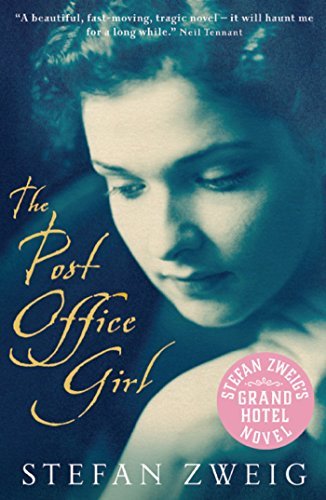
The first rule is that Kate sets our starting book. This month, she nominated another book I haven’t read, though I wish I had. The book is Stefan Zweig’s The Post Office Girl. Kate chose to honour this year’s Eurovision which took place in Vienna, because Zweig is Austrian, born in Vienna in fact.

I had many ideas for my starting link, including Eudora Welty’s short story, “Why I live at the P.O.” but I read it before blogging and I like to link to books I’ve posted on. So, after more thought, I decided to go with the Vienna link, and choose a novel set – at least partly – in Vienna, Murray Bail’s The voyage (my review). It tells the story of a 46-year-old piano-inventor Frank Delage who goes to Vienna to sell his new piano. It’s an audacious thing to do, to try to sell a piano from the New World in one of the great homes of music.
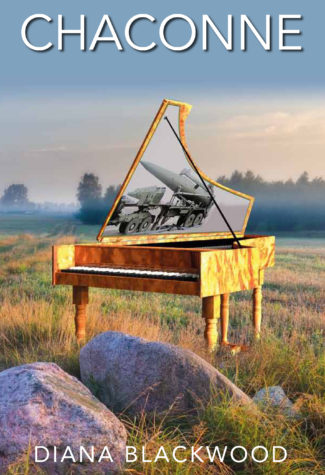
I love books about music, so I am staying with music for my second book, and linking to Diana Blackwood’s Cold War era set novel, Chaconne (my review). It’s a coming-of-age novel about a young woman who follows the man she loves to Paris, only to find he’s not as interested in her as she thought. She ends up in a German village with another young man. She struggles however to find herself, but is grounded by a choir she finds there. Eleanor, in fact, loves music and a resentment she carries with her is that her mother stopped her piano lessons!
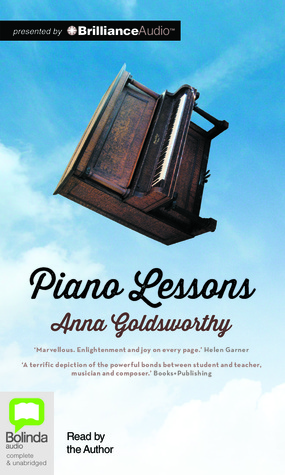
Unlike the fictional Eleanor, the real life Anna Goldsworthy’s parents encouraged her piano talents and made sure she had lessons – with a good teacher. Goldsworthy is now a concert pianist, among other things. So, my next link is to Anna Goldworthy’s memoir, Piano lessons (my review). This piano teacher, Mrs Sivan, is described in the book as “less a character than a force”.

This idea of a teacher being “less a character than a force” reminded me of the teacher Elizabeth Finch in Julian Barnes’ novel Elizabeth Finch (my review). Barnes’ character Neil maintains contact with his teacher long after he has graduated. But, this is not your straightforward novel, as it has quite a quirky form. It has three parts, with the middle one comprising Neil’s “essay” on Julian the Apostate (who was significant to EF’s ideas). The novel is partly about EF and Neil’s thoughts on what we believe and who we rely on, when it comes to history.

In my post on Barnes’ novel, I said it reminded me a little of J.M. Coetzee’s tricksy books, like Elizabeth Costello and Diary of a bad year, because they also tread this strange fiction/nonfiction, novel/philosophy ground. So, my next link is to J.M. Coetzee’s Diary of a bad year (my review). It is even quirkier in form, because its three parts are presented as three concurrent strands running across the top, middle and bottom of the page – and one of those parts comprises essays.
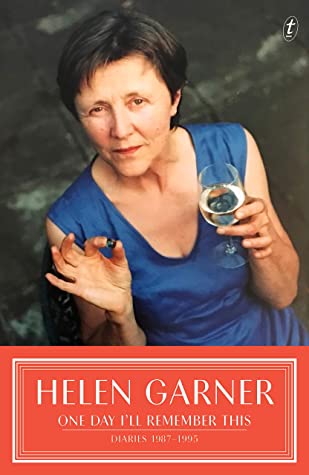
For my final link, I am referencing the idea of diaries, and linking to Helen Garner’s diaries, specifically to Volume 2, One day I’ll remember this: Diaries, Volume 2, 1987-1995 (my review). There are some hidden links here though which tickle me: Helen Garner wrote a gorgeous novella The children’s Bach; Coetzee refers to his love of Bach in his novel; Bach was famous for a chaconne (the fifth movement of his Partita in D minor for solo violin); and, most significantly, volume 2 of Garner’s diaries chronicles the tortuous development of her relationship with Murray Bail (her husband at the time).
So, my books have crisscrossed the seas between Australia, Europe and England and have considered some of the big questions in life. We have also spent a bit of time with music, one way or another. My gender split this month has been even.
Have you read The Post Office girl? And, whether or not you have, what would you link to?


I have not read The Post Office Girl. It seems to me that there are three ways to work here: from Vienna (Musil, Schnitzler, etc.); post office operatives (Trollope, Franklin, etc.); or writers of letters. The latter offers (me) a more even split between the sexes. So, and confining myself to books now or once on my shelves:
Degree one is The Letters of Mme. de Sevigne. They are very readable, often frivolous, and widely admired. Her grandmother was canonized by the Roman Catholic Church as St. Jane de Chantal.
Degree two will be A Habit of Being by Flannery O’Connor. Despite having no acknowledged saints in the family, O’Connor was far more engaged with religious matters than Mme. de Sevigne was. She was also a terrible speller, and had to be informed by Caroline Gordon that it was not “bob wire”, it was “barbed wire”.
Degree three is The Letters of Nancy Mitford & Evelyn Waugh. There you have one Francophile, unengaged with religious matters and one insular Englishman much engaged with them.
Degree four is The Letters of Henry Adams. For all his many flaws, he was an excellent writer, one of the best of the late 19th and early 20th Centuries.
Degree five is The Epistles of Horace, translated by David Ferry.
And degree six will be Love and Freindship by Jane Austen, an epistolary novel.
Love your analysis of potential directions George. They are good ones. Bloggers have come up with some others, including young women staying with relatives. I did think of long hotel stays. After the P.O. idea, I was tempted by that one. But, all that’s irrelevant so I’ll move on. I greatly enjoyed your letter-writing link. You made me laugh re Flannery O’Connor’s spelling. But, the book in your list that would probably grab my attention first (despite my being intrigued by the saint’s grand-daughter) is The Letters of Nancy Mitford & Evelyn Waugh. I hadn’t been aware of that collection. Unfortunately, I have so many letters – and diaries – on my shelves that I will have to restrain myself.
Hi Sue, I have not read The Post Office Girl. But as I know the girls’ name is Christine, my links begin with Christine by Steven King; Travelling in a Strange Land by David Park; Great Expectations by Charles Dickens; Reality and Dreams by Muriel Spark; The Vulnerables by Sigrid Nunez; Floundering by Romy Ash, and The Sense of an Ending by Julian Barnes.
Thanks Meg … and you have a Julian Barnes in there too!
I enjoyed how you were able to find links between all your choices with Helen Garner in the end – a writer whose interests span such diverse topics!
She does – and she did here! Thanks Brona.
A cleverly constructed chain. Chaconne looks interesting. Well … they all do.
I’m glad they do Margaret, thanks.
The Vienna link is a good one. Sadly, I think I’ve exhausted all the books set in Vienna for previous months.
Well you will have to strict rule! Haha! Seriously though Davida,,you came up with a good idea.
Thanks. I didn’t know how many orphans I’d read about before I started this chain.
Something in your subconscious draws you to them perhaps?
HA! Yes, with the father I had… that makes sense! On other chains I found two more books with orphans who move in with aunts – Cold Comfort Farm and Love in a Cold Climate – both of which sound good to me. Gibbons and Mitford… classics, right?
Too right, right!
Great chain! I love Helen Garner’s writing.
Thanks Cathy. I do too.
I love the way your final book links back to so many of the others! I haven’t read anything from your chain this month but all of those books sound interesting.
Thanks Helen. It wasn’t exactly planned but maybe my subconscious led me there!
Good work! Diary of a Bad Year sounds like a challenge to read. Interesting concept though.
It sounds more of a challenge than it is once you decide on a strategy. It’s fun to think about.
If you say so! lol
I do!!!
I haven’t read these, but great links!
Thanks Susan … I must say that I am more surprised to find books I have read in chains, that books I’ve not!
Stefan Zweig’s The Post Office Girl I have never read.
I do know that he wrote a book called Chess Story, but I have never read that either.
Chess Story leads to me back in the day wasting many years of my life attempting to play the game. I read many chess books so will add this one The Amateur’s Mind: Turning Chess Misconceptions into Chess MasterybyJermey Silman. I read it through but in all honesty, it did not turn my mind into mastery of chess.
One book I did read on chess and could not put down was Fischer v. Spassky–Reykjavik 1972 by C.H. O’D Alexander. An amazing story of the genuinely weird Fischer grinding down Spassky. The whole world watched this cold war epic.
Spassky being Russian leads to A Brief History of 1917: Russia’s Year of Revolution by Roy Bainton, and I recommend this for anyone that wants a genuine brief history of a very complex event.
And that leads to Red Fortress. The Secret Heart of Russia’s History by Catherine Merridale that I have had sitting on the TBR for far too long.
And still on the Russian theme is Life and Fate by Vasily Grossman. This is one of the greatest books I have ever read and have no issue calling it a masterpiece. I cannot recommend this highly enough.
A very different chain to others I’ve seen John. The Chess story is the one I most know Zweig for and I have it on my TBR but I’ve not read it. I enjoyed your Russian focused chain. I have heard of Vasily Grossman, of course, but have never read him. I note you strong recommendation.
I’m late to the party, but I enjoyed your links! I have read The Post Office Girl and enjoyed it very much. As much fun as it would be to link to an epistolary novel, I would link to a Discworld fantasy book by Terry Pratchett called Going Postal about reviving the post office in the Disc’s major city. 🙂
Thanks Stefanie … I would love to have gone the postal route … but I couldn’t make it work.
A little aside: as we drove to Melbourne this last trip we spent two nights in a country town where Mr Gums’ cousins had lived. We lunched at a little cafe and during a lovely chat with our server, Mr G mentioned his cousins living there because their father was the Postmaster. The young woman looked at us and said, What’s a postmaster?
Love your inner links! I’ve not read Zweig either, well… a couple of stories here and there… but I have been collecting some, in hopes of changing that. And I find wet/grey winter very tedious; snowy winters are just as winters should be IMO, even though that’s not a popular opinion up here.
Thanks Marcie … I’m intrigued. Why is that not a popular opinion?
I dunno, it puzzles me! The only (other) people who seem to love it are people who love snow-sports. Which makes no sense to me. Lots of people love summer but don’t play summer-sports…
I’m with you … the logic makes so sense. Maybe they don’t like the work snow involves – the clearing their paths? Who knows.
I’ve wondered that as well. But in the summer here, there’s always a watering schedule for the yards (what days you can water, what days you can’t… to do with managing city reservoirs not a climate crisis response) and if you can’t water with the hose on a certain day you have to haul buckets for the trees and plants when it’s droughty… very cumbersome. And there’s grass to cut even if one doesn’t have vegetable or flower/pollinator gardens. It even soooouuunds like more work, than “shovelling”, doesn’t it? lol
It sure does! We’ve had periods of water restrictions like that at times of drought. The last time we had restrictions our city significantly increased its reservoir capacity so we have ridden through low water periods since then. At the same time, we (Mr Gums and I) re-landscaped, completely replacing our large front lawn with gardens and tanbark/mulch, and paving, and planting native plants that need little water. We kept some grass in the backyard for dog and kids. Many Aussies have gradually moved to dry landscape/low water gardening. This garden was also much lower care too which was a huge plus – light weeding and some pruning (which is the one thing I did enjoy).