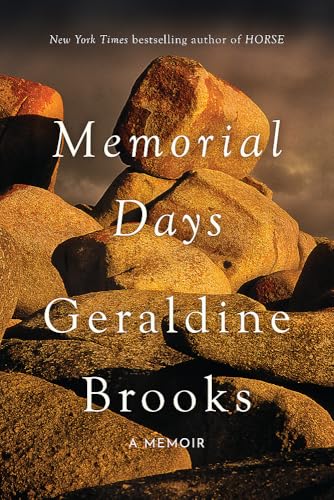
Grief memoirs are a problematic lot. Some of us love them, some of us hate them, while others, including me, sit somewhere in the middle. The most recent I’ve read, Marion Halligan’s Words for Lucy (my review) and Gideon Haigh’s My brother Jaz (my review) were moving, intelligent books that added something to my understanding. Long before them, however, I read one of the gold standards in the genre, Joan Didion’s Year of magical thinking. It is a book I return to in my thinking often. Where does Geraldine Brooks’ Stella Prize shortlisted Memorial days fit in?
I have read four of Brooks’ novels (all historical fiction) and two of her nonfiction works, most before blogging. I particularly liked the two nonfiction books, Nine parts of desire and Foreign correspondence. It’s a long time now since I read them, but both have stuck in my memory, which says something about Brooks’ ability to engage a reader’s interest and say things that matter (to me, anyhow). Nonetheless, I admit I was a bit surprised to see this book make the Stella Prize shortlist. The blurbs sound clichéd, with words like “wise and nourishing”, “raw and gentle”, “moving and inspiring”, “well-wrought heartbreaker”. Even Anna Funder’s blurb on the cover – ‘a beautifully braided memoir of marriage, grief, love and living. It makes you treasure every instant of “normal life”‘ – does not explain why this is list-worthy.
So, what did the Stella judges think? You can read the full description here, but the highlighted excerpt reads:
“As much as this is a grief memoir, it is also the portrait of a long and beautiful marriage. It is a writer grappling with pain and loss and showing it to us.”
In other words, the judges essentially agreed that it is what everyone is saying, a beautifully written grief memoir. Now, in their report on the longlist, they said they were looking for originality, and they defined it, starting with “Originality consists in a book that recognisably inhabits its genre or form, and at the same time purposefully breaks it” (see my longlist post). I ask myself, then, how does Memorial days break the grief genre or form? I am, as I’ve already intimated, no expert in this area, but I’ll have a go at exploring this point.
And, I’ll start with structure … Memorial days has a dual-timeline. One starts with Brooks, at her home on Martha’s Vineyard, answering the phonecall that tells her that her 60-year-old husband Tony Horwitz had collapsed and died on a street in Washington DC. Shocking news for anyone to hear like that. This timeline, which alternates with the later one, is told in chronological chapters that are headed with the date and the name of the place where she is at that time. It goes from Horwitz’s death on May 27, 2019 – ironically, Memorial Day weekend in the US – to the days after the first memorial held for Horwitz in August, 2019.
The second timeline starts in February 2023, with Brooks flying out of Essendon Airpot, heading for Flinders Island. The rest of the chapters in this timeline are told chronologically, but are simply titled Flinders Island.
Two stories, then. One chronicles the shock of such news, and the early days of navigating grief alongside the things that must be done, which included telling two sons, one on a plane flying to Sydney and the other away at school. The other tells how she finally went about experiencing her
own memorial days. I am taking something that our culture has stopped freely giving: the right to grieve. To shut out the world and its demands. To remember my love and to feel the immensity of his loss…
She chose Flinders Island because it represented an alternative life she might have had, had she not met and fallen in love with Tony, and thrown her lot in with him on the other side of the world. It’s a wild beautiful place, and Brooks’ evocation of that is one of joys of this book.
What this structure does is combine – and set off against each other – the practical and the immediate with the emotional and the longterm. I seem to remember the Stella judges saying in their longlist discussion that each book addresses systems – dysfunctional and broken ones – in some way. For Brooks, this includes her experience of death and its aftermath in the USA. At the end of the first chapter, she describes the brusque way she had been advised of Horwitz’s death, identifying it as “the first brutality in what I would learn is a brutal, broken system”. But, this idea of broken systems also encompasses some interrogation of our Western rational ways of handling grief. While on Flinders Island, she ponders other mourning practices and traditions, including those of Australia’s First Nations, Orthodox Jews, and Buddhists, and the space they make for grieving.
Memorial days is raw and honest as the blurb writers say, and it is also a love letter to a precious marriage that ended way too soon. It is about doing what you have to do, but it also recognises that sometime, somewhere, you must give yourself time to properly come to terms with an enormous grief, to release the pent up howl. Memorial days was published 6 years after Tony Horwitz’s death.
By contrast, Halligan’s Words for Lucy was published 18 years after her daughter’s death at the age of 39, and Haigh’s My brother Jaz, 37 years after Jaz’s death at the age of 17. All these people died before their time. Halligan’s and Haigh’s memoirs certainly break the form. Halligan wrote that, despite the time gap, she’d been writing all that time. Hers is not a traditional grief memoir in which she works chronologically through the “stages” of grief. It recognises the complexity of grief, that it’s not linear – so neither is Halligan’s book. It also recognises that it’s not all misery either. Happy, joyful memories are part of it, and need to be remembered and shared. Haigh, with even greater distance, treads a fine line between finally confronting how trying to avoid his grief had impaired his life and a self-conscious questioning of the memoir form, of the self-absorption of writing about self that he eschewed.
Brooks’ book is different again, but like Halligan and Haigh, Didion and Allende (who’s Paula I’ve also read), she is a writer. And like these – like Halligan who wrote “My business is words” – Brooks writes through her pain in order to come to the other side. This does not mean closure because the grief will never end. Rather, it means spending time with grief in order to find a way to accommodate it:
Tony is dead. Present tense. He will be dead, in the present, in my present, for as long as I am alive. I cannot change that story. I can only change myself.
Memorial days is a curious but beautiful book. In a tone that is deeply personal and open-hearted, while also being practical and informative, Brooks treads the terrain of memoir writing in a different way again. In doing so, she has made a meaningful contribution to the genre.
Kimbofo and Kate also liked this book.
Geraldine Brooks
Memorial days
Gadigal Country (Sydney): Hachette Australia, 2025
212pp.
ISBN: 9780733651083


I wonder where Geraldine Brooks will be next Monday, Memorial Day. Thank you for reminding me of why I liked this book so much.
Thanks Carolyn. I’m glad my post did that.
Maybe on MV with her sons??
I like the Stella judges definition of originality: “recognisably inhabits its genre or form, and at the same time purposefully breaks it”. That clarity might be one of the reasons they are our most interesting prize.
I’m not going to read a grief memoir, however original, so that’s all I can say.
I loved seeing that definition. I agree with you re the prize.
And that’s fair enough Bill. As I said, some do, some don’t, and some like me are predictably wish-washy!
I don’t read many grief books but having met Geraldine twice and chatting to her when she last came to Hobart I read it and loved it. I liked the duality of the first half and then the Flinders part. When she was last here one of the staff members at Fullers led me to her for a personal intro. I gave her a Tasmanian ceramic brooch of a black cockatoo and told her to put it in her horse stable. When I hear her name I wonder if she did. It was a lovely little art piece.
That’s a lovely story Pam. I do think she’s a lovely person. I’ve been to a couple of author events but haven’t met her.
I was thinking maybe the book made the list because it is ubiquitous, and readers can deeply relate, but then you wrote that the point is originality—and the Stella Prize folks defined that! Huh… There are few original memoirs I can think of, and two come from the same author: Janice Erlbaum. She wrote Girlbomb and Have You Seen Her. I think the two unique things about the memoir of Horowitz’s death is that the author could have had a whole different life had she stayed in Australia and also that quote about how Tony will never be not dead, and it is only she who can change. That was a great quote.
Again you have said things that make me think back Melanie. Your two points are great. The other point she makes that I’d didn’t really fully explain is that the grief never goes away because at every event in the future that she would share with him including big ones like sons marrying, having kids etc, he will not be there and the grief will come again.
I enjoyed reading your post about this pair and am relieved to not feel any need to read either. I’ve read a few (including Allende’s Paula, which you’ve mentioned) and have a few more on my shelves (for various reasons, none being a desire to inhabit that space) and that will have to do.
Thanks Marcie … I completely understand, but I’m glad you liked my post. Like you I do t have a desire to inhabit this space either but I will read some if I have a particular reason to, usually to do with who the writer is.
I will read this one day.
Kate’s interest in grief memoirs is professional; mine is personal. One day, as one half of a loving couple, one of us will be on our own. I suspect I read these books as a form of rehearsal, taking in all the ways that people die and all the different ways people grieve and the different ways they eventually find some kind of peace.
Yes, true about Kate, Brona, so her insights are interesting but as you say we read for different reasons. I think not just as rehearsals for ourselves but also re our friends because although we are all different the more we understand the better friends we can be too.