 I wasn’t necessarily planning to announce the University of Canberra’s Book of the Year again this year, having written about it three times already – in 2012 when it was initiated, in 2014, when I checked to see how the program was going, and in 2018 to announce this year’s book. However, next year’s book is such a good choice that I felt it worth reminding you again of this initiative, which is now in its 8th year.
The program involves the University providing a selected book, free, to all commencing students across the five faculties. It is “required reading”. The book is “integrated into the curriculum and provides a common conversational topic on campus”. You can see the main goals in my 2018 post, and there is more about the program at the UC Book page. I had to laugh at one of the FAQs on this page. The question is: “What does ‘required reading’ mean? Do I have to read the book?” And the answer:”Yes, all commencing undergraduate and postgraduate students in 2020 are required to read the Barbed Wire and Cherry Blossoms…” I would love to see more on the site about how this actually plays out.
It’s an inspired and inspiring initiative, though I’ve had some quibbles. I wrote last year that it was a shame that the books haven’t always been Australian, because it provides an excellent opportunity to introduce students to Australian literature. I also note that while the genres and subject matter have varied somewhat, there’s not been much diversity in terms of writers. No indigenous writer, no writer from a non-white/non-English language background, for example. Well, that has changed this year!
First though, here are the books to date:
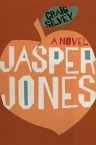
2013: Jasper Jones, by Craig Silvey (my review)
2014: Room, by Emma Donoghue
2015: The Rosie Project, by Graeme Simsion (my review)
2016: The strays, by Emily Bitto (my review)
2017: The white earth, by Andrew McGahan
2018: Do Androids dream of electric sheep? by Philip K. Dick
2019: The natural way of things by Charlotte Wood (my review)
UC Book for 2020
In October, the University announced the shortlist, which comprises, this year, all recent Australian books. But, not only are they ALL recent Australian books, they are ALL by indigenous writers! What a wonderful message that sends.
Here’s the shortlist:
- Tony Birch’s Ghost River (my review): “The highly anticipated new novel from the Miles Franklin-shortlisted author of Blood … The river is a place of history and secrets. For Ren and Sonny, two unlikely friends, it’s a place of freedom and adventure…“
- Claire G Coleman’s Terra nullius (my review): “The Natives of the Colony are restless. The Settlers are eager to have a nation of peace, and to bring the savages into line. Families are torn apart, re-education is enforced…”
- Anita Heiss’ Barbed wire and cherry blossoms: “In 1944, over 1,000 Japanese soldiers break out of the No.12 Prisoner of War compound on the fringes of Cowra. In the carnage, hundreds are killed, many are recaptured, and some take their own lives rather than suffer the humiliation of ongoing defeat. But one soldier, Hiroshi, manages to escape. At nearby Erambie Station, an Aboriginal mission, Banjo Williams, father of five and proud man of his community, discovers Hiroshi, distraught and on the run…”
- Melissa Lushenko’s Mullumbimby: “When Jo Breen uses her divorce settlement to buy a neglected property in the Byron Bay hinterland, she is hoping for a tree change, and a blossoming connection to the land of her Aboriginal ancestors…”
- Kim Scott’s Taboo: “From Kim Scott, two-times winner of the Miles Franklin Literary Award, comes a work charged with ambition and poetry, in equal parts brutal, mysterious and idealistic, about a young woman cast into a drama that has been playing for over two hundred years…”
While I’ve only read two of these books, I have read books by all of these authors, and am thrilled to see them represented here because each has something to offer to the program.
 And the winner is: Anita Heiss’ Barbed wire and cherry blossoms.
The judges have chosen, probably, one of the less challenging reads from the list, but that’s sensible given the diverse readership they are choosing for in interest, skills and background – and it will serve the purpose of raising some necessary issues regarding indigenous history and lives. Sure, it’s about the past, but it can lead from there to discussions about How much has and hasn’t changed since then, and why …
Responding to the news of her win, Heiss told CityNews:
To have the UC community engaging in the story of the Cowra Breakout, and life of Wiradjuri people living under the Act of Protection during wartime, will add to a greater understanding of a significant moment in Australian history.
What do you think about the book choices, or the program itself?
 As for my


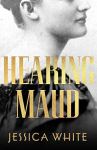 Today’s post was inspired, of course, by my recently reading Jessica White’s memoir-biography, Hearing Maud (
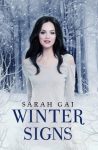 Sarah Gai’s Winter signs (young adult novel, 2017)
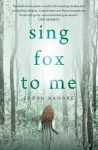 Sarah Kanake’s Sing fox to me (novel, 2016)
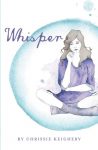 Chrissie Keighery’s Whisper (young adult novel, 2011)
 Kathryn Lomer’s Talk Under Water (young adult novel, 2015)
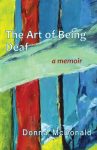 Donna McDonald’s The art of being deaf (memoir by a deaf person, 2014)
 Anne Romer’s Thornwood House (crime fiction, 2013)
 Emma Viskic’s Caleb Zelic series (crime fiction)
  Jessica White
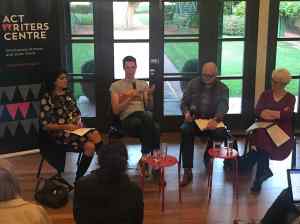 For some reason that I can’t quite explain – a sudden rush to the head methinks – I agreed to be part of a panel being organised by the ACT Writers Centre for this year’s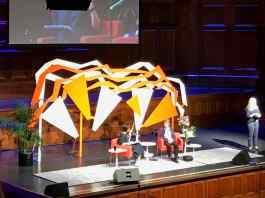
 The conversation centred around the recent release of Garner’s Yellow notebook: Diaries, Volume 1, 1978-1987, so the conversation began by discussing both diary writing and the process of preparing them for publication. Krasnostein, who asked rather long but always thoughtful questions, talked about the role and function of diaries, suggesting they exist for their own sake but are also works in themselves. Garner’s diaries, she said, contain harvested and preserved details from the world, but also show Garner’s “fearless self-scrutiny”, plus “the things one can think but not say”. Garner said that she has always loved notebooks and pens, and how as a child she loved the peace and solitude she got from writing her diaries.
 Indeed, Pegasus says that the Christian Science Monitor writer talks about the enthusiasm of the American reviewers “which is more than I can remember occurring in this country”. The book, they are particularly enthusiastic about is Henry Handel Richarson’s The fortunes of Richard Mahony. Pegasus notes that “there are many in Australia who would agree with the American critic who described this novel as ‘the most important single piece of literature ever to come out of Australia,’ [but] it has never become popular in Australia, either amongst critics or readers”!


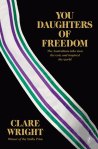
 I love this week of the Challenge, because for as long as I can remember I’ve enjoyed seeing connections between my reading. However, because I’m doing three weeks in one, I’m going to do just one pairing, and it pairs two books I’ve read this year, Clare Wright’s You daughters of freedom (
 Both these books focus on the late nineteenth and early twentieth century, though Ingleton’s ends right at the beginning of the twentieth century. Ingleton’s Dick and Moon weren’t actively involved in the suffrage movement, but they were passionate advocates of the rights of women and of women’s ability to live independent lives, and they, particularly Moon, met and associated with early Sydney leaders of the suffrage movement, like Rose Scott and Louisa Lawson, who feature in Wright’s book.

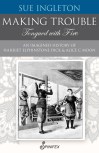 In
In  Sue Ingleton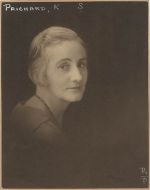
 Saturday, as you would expect, provided more detail, including about the authors chosen to represent the three countries. Saturday reports that McKinnon admitted that “we have in Australia, in its history, and in its great cities excellent material and splendid background” but were not producing literature equal to Canada and South Africa. Saturday writes, presumably reporting McKinnon, that:
 Whispering Gums