By accident, really, I came across an article from the 1930s in Trove about war novels. However, with Anzac Day coming up here in Australia next weekend, it seemed apposite to follow up. So, I did – and was somewhat surprised by what I found.
Not surprisingly, World War 1 was still fresh in people’s minds in the 1930s, and there were many opinions on how war should be written about. Erich Maria Remarque’s now classic All quiet on the Western Front was particularly controversial at the time and discussions about it provide some insight into those opinions. First published in 1928, it appeared in English in 1929 (translated, in fact, by an Australian, Arthur Wesley Wheen, himself a World War 1 soldier.)
“the most graphic picture I have had of the war” (Woman reader)
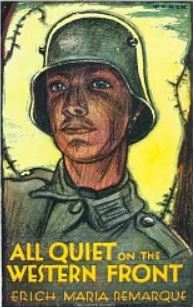
All quiet on the Western Front was a big hit, particularly with women readers. An article in the Port Adelaide News (14 March 1930) reports that “the popularity of the war novel is still maintained in England, where every girl typist seems to have read All quiet“. Apparently one Council Library system had bought a record number of 126 copies of the book, but they had 553 people on their waiting list. Unfortunately, the article said, “borrowers, strong in that possession which is nine ‘points of the law are lending All quiet to relatives and friends before returning it”. (Love it!)
Here in Australia All quiet was also popular with women, as The Herald (14 February 1930) reported in its article, “VC attacks war novels”. Captain W.D. Joynt V.C., speaking at a Legacy Club luncheon, denounced “recent war books” including All quiet. At the luncheon, Captain Peters, of booksellers, Robertson and Mullen’s, said that women “had been the largest buyers and readers of the book”. It had “achieved such success that it was affecting the sale of wholesome [my emph] English novels”. He continued that the boom of interest in war novels “had brought out some good war books, but not many, and unless the protest was made the women and young people would get a wrong impression of the soldiers”. A motion had been put “to deplore” such books, but it failed, not because attendees disagreed but because they feared the motion would increase interest in the book!
So, what was the problem? Wikipedia summarises the controversies in its article, but I’ll share some of what I found in Australian newspapers. The main concern seemed to be that its presentation of war denigrated the heroism of the soldiers. It had too much “muck”. One speaker at the luncheon said that “the book showed contempt for the men who served at the war, and brought grief to dependents of men who fell at the war” while another said that the phrase “give ’em muck” was applicable to the book. He said he had “read one or two chapters and refused to go further. It is full of Continental grossness. The coarse language is superfluous. This type of book should be banned.”
Interesting that women were reading this “muck”.
The writer in Freeman’s Journal (10 April 1930) comments on the new fashion for war novels, saying that for some time people had had their fill of war news but
Now it has come into its own again, and, perhaps under the influence of the peace movement, it concentrates on the most repulsive aspect of war, sometimes deliberately trucking to the appetite of so many readers for word-pictures of the evil aspects’ of human life. Many of these novels are as wide of the truth and as repulsive as Zola’s La Debacle, which professed to give a realist picture of the war of 1870, but was a horrible libel on the people of France, representing her young soldiers as mostly imbecile fools or blackguards.
He goes on to describe another novel – not Remarque’s – that has, as its central figure, an utterly incapable Anglican chaplain. He says:
It was by self-sacrifice and earnest efforts to be helpful that they [Anglican and Non-conformist chaplains] won the respect of the men. It is an insult to their memory to write of them as this novelist does, as if they were either hopeless failures or self-seeking idlers.
Similarly, the Singleton Argus (28 April 1930) reports on one Rev. C. J. Macaulay, who was the principal speaker at the West Maitland Anzac Day service. Macauley made “a scathing attack … on salacious war novels”. He doesn’t name any, but said they “paint vile pictures, not so much of war, as of the men themselves”.
Interesting that women were apparently reading these “vile pictures”.
Were women seeing something different? Were women, like Lady Kitty’s woman reader, appreciative of “the grim reality” that its opponents wanted to hide? Lady Kitty writes that “it is remarkable what a vogue war novels are having now, especially among women. The type of immediate postwar sentimental romance has given way to simple narratives which reveal the common soldier’s point of view.”
Writing about war
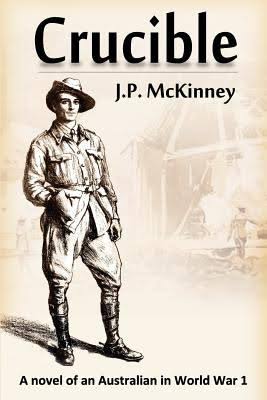
Meanwhile, in 1934, Australia’s RSL instituted a war novel competition. It was “open to all men and women who served abroad during the war as members of the Australian army, navy or nursing services”. The novel had to “depict the life of an Australian soldier during the war, and his reactions to the various conditions and environment through which he passed. The sequence of the story and descriptive matter must be historically and geographically correct”. It was won by JP McKinney (who, alert readers among you may know, was Judith Wright’s husband, though much later.) His novel was published as The crucible, in 1935.
During my research, I came across a letter to the editor written by McKinney concerning his novel, and writing about war. He was responding to reviewers who seemed to criticise his novel for being “largely recollections cast in the form of fiction” or “more or less autobiographical”. (Helen Garner knows the feeling!) McKinney wanted to correct these misconceptions. He writes:
A writer of fiction is permitted, by the canons of his art, to draw for his material upon both his own and other peoples’ experience and upon his imagination, the only demand made of him being, if his work is to be judged as literature, that he keep within the bounds of probability. His accepted function is to illuminate life— or at least that aspect of it which he treats —from all angles. The greater the fidelity to life and actuality the greater his achievement.
But, he says, people seem to see war fiction differently:
In the case of the war novelist, however, it appears to have become unconsciously assumed that he shall write only of what he knows from his own actual, personal experience; and he is either denied, or assumed not to have availed himself of, the privilege of his fellow craftsmen of ranging into the realm of what may be called created fact.
So, he writes, “I granted myself the fiction writer’s full privilege, the only restriction I placed upon myself being that I make no sacrifice of truth to dramatic effect”. The characters are all created he said; they’re “types” not “persons”.
J.P. McKinney did go to war, but, some readers here may be interested to hear the words of T.C. Squire, editor of London Mercury (reported in Tasmania’s Advocate, 10 January 1930). He was critical of the current crop of war novels, like Remarque’s, suggesting that they came out of “hysteria” rather than from thinking, compassionate, “religious” men. He concluded his comments with
And it may be that the novel of this war (there is precedent for it) may come from some Tolstoi or Hardy of the future, who never saw a bullet fired and never looked in the face of the unnecessary dead.
And here, I’ll conclude with Henry Savage from The Port Adelaide Gazette (10 January 1930). He was, I think, a local businessman and religious official. He wrote about war novels:
There is a great difference between the horrors of war and reading of its horrors; between reality, that is to say, and the interpretation of reality in terms of art. Will the story of Eden ever stop simple Adam from being lured to his hurt by curious Eve? Will Hamlet make a man of action out of a dreamer and give him faith and resoluteness? Can it be done?
Ignoring Adam-and-Eve, I pass his question on to you!









 Whispering Gums
