I haven’t reported often on these awards, but they are an example of the literary world’s faith in the value of awards, as any of you who remember their history will know. They are an interesting set of awards because they combine specific state awards and awards for which all Australian writers are eligible. And they have some great categories, including one for short story collections, which appeals to me. The full shortlist is available on their site. I will just list a selection of the categories here, but there are also awards for Poetry, Children’s and YA Books for example, if you are interested.
Queensland Premier’s Award for a work of State Significance($25,000)
Lech Blaine’s Car crash: A memoir
Laura Elvery’s Ordinary matter
Fiona Foley’s Biting the clouds
Patty Lees with Adam C Lees’ A question of colour (Lisa’s review)
Jaya Savige, Change machine
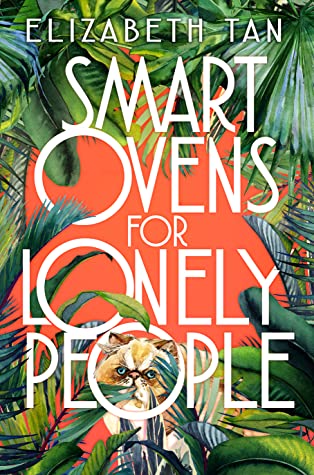
David Unaipon Award for an Unpublished Indigenous Writer ($15,000)
There are books here that I’ve heard a lot about, and that are on my TBR here, and books I haven’t heard of at all. What about you? Any favourites here? Any surprises or tempters?
The winners will be annnounced on 9 September. Good luck to all.
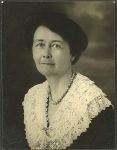
Miles Franklin, c. 1940s (Presume Public Domain, via Wikipedia)
This is my fourth post in a little sub-series looking at the Miles Franklin Award by decade.
As with the first three, written back in 2016, I don’t plan to list all the decade’s winners, as you can find them on the Award’s official site. Instead, I’ll share some interesting snippets, inspired by my Trove meanders. This mostly involved The Canberra Times and The Australian Jewish News, because this period is still within copyright, meaning the NLA can only digitise newspapers which have given them permission to do so.
Men in the ascendant (again)
In my third decade post (linked below), I noted the increase in awards made to women. Just five awards were won by women in the first two decades combined, but in the third decade, four of the nine awards went to women. This reflected, I suggested, the flowering of writing by Australian women in the late 1970s and 1980s. However, it wasn’t to last. In the fourth decade, eight of the nine awards made went to men – and the woman who did win generated one of the Award’s biggest controversies (see below). Without spoiling my fifth decade post, this “bias” towards men continued for another ten years or more, which inspired, among other things, the establishment of the Stella Award in 2012 … but, I’m jumping ahead. Let’s stay in the nineties for the moment.
The skewing towards men, not surprisingly, carried through to the shortlists, with 31 men shortlisted over the decade to 18 women. However, when it comes to multiple listings, four writers, two men and two women, were shortlisted three times: Rodney Hall and David Malouf, Thea Astley and Janette Turner Hospital (who has never won it).
The men who won included previous winners Peter Carey, Tim Winton, and Rodney Hall. The others were Tom Flood, David Malouf, Alex Miller, Christopher Koch and David Foster. I admit that I didn’t know Tom Flood, but Dorothy Hewett was his mother. His winning book, Oceana Fine, was his only novel.
JOLLEY’S latest has just been omitted from the shortlist for the Miles Franklin Award. That is a real shame because The Sugarmother is a great book.
Controversy (1)
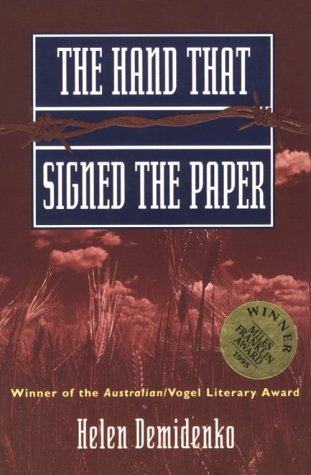
The controversy concerned Helen Demidenko’s novel, The hand that signed the paper, which won in 1995. Bill (The Australian Legend) summarised the controversy beautifully in his post on the book, so why reinvent the wheel? Bill wrote:
For the benefit of non-Australians, the controversy surrounded the awarding of the 1995 Miles Franklin Award to Helen Demidenko for The Hand that Signed the Paper, the story of a Ukrainian family collaborating with the Nazis during the Holocaust. The granting of the Award to an anti-semitic work was justified on the grounds that Demidenko was telling the story of her people, until Demidenko, who would attend speaking engagements dressed in the costume of a Ukrainian peasant girl, was finally unmasked as Helen Darville, a University of Queensland student of entirely English background.
This was a multi-pronged controversy – and Bill explores some of the prongs in his excellent post. There were criticisms of the work itself: it was uneven and poorly written, it was racist/anti-semitic, it distorted history. There were criticisms of the author’s deception regarding her background, with some saying that the only reason they accepted this unpleasant book’s win was because the author was speaking for “her” people. (This feeds into current discussions about who can write what.) There was discussion about literary criticism – about whether it’s all about the text, or whether other considerations, like the author’s background, are relevant to assessing a work. There were discussions about the line between fact and fiction, particularly since Demidenko/Darville herself called her work “faction”. There were criticisms of plagiarism, which were subsequently overturned. There were suggestions that the author, around 24 at the time, was a disturbed young woman to be pitied. And, there were criticisms of the judges – of their decision in the first place, their refusal to admit they were wrong, and their not engaging in discussion. The novel was apparently shortlisted for the Victorian Premier’s Literary Award, and then quietly un-shortlisted before the announcement. The controversy raged for months.
The book, by the way, had previously won the 1993 The Australian/Vogel LiteraryAward for unpublished manuscript, and in 1995 it also won the ALS Gold Medal.
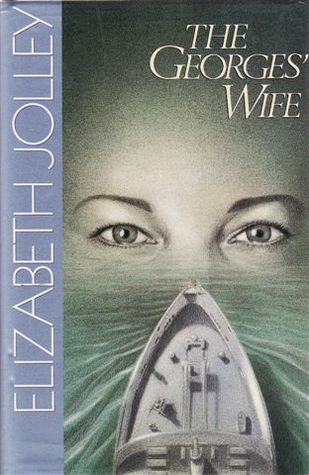
Lest you think, however, that this was the only Miles Franklin Award controversy of the decade, think again. The ongoing issue of the “Australian content” requirement raised its head during the decade too. In 1994, when Rodney Hall won for The grisly wife, The Canberra Times reports that, “The Georges’ Wife [Elizabeth Jolley], and Frank Moorhouse’s Grand Days, were disqualified because the judges decided they did not have enough Australian content”.
No award (again)
In both the second and third decades, there was a year in which no award was made. It happened again this decade but for a purely administrative reason, to do with changing the award’s timing from year of publication to year of announcement!
The value of awards
Given I’ve posted on the value of awards recently, I’ll conclude by sharing a couple of points that came out of this little piece of research.
“An award like this is a bit like the Archibald to painting. Both are extremely well known and important … People who don’t necessarily buy a book when it first comes out are interested to see what books turn up on the short list and which book wins. That kind of interest is always very important.”
He also admits that winning awards offers reassurance:
“Writers are very diffident, basically. They’re always doubtful of themselves and it’s always good when you are offered approval for what you have done”
“I decided it was terrific to be short-listed and that was that, and I just got on with my work, and then when I was told last Wednesday I really couldn’t believe it … It’s enormous validation and acknowledgment, for sure.
It’s a bit of a watershed, isn’t it, winning something like Miles Franklin.”
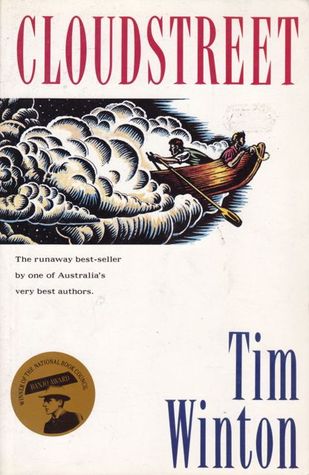
I mentioned above sales for Demidenko/Darville’s book, but that had the “benefit” of controversy. Tim Winton’s 1992-winning Cloudstreet experienced a boost in sales. The Canberra Times reported less than two months after Winton’s win:
… Tim Winton returned recently from a 30-day promotional tour of the United States, where Graywolf’s beautiful hardback edition of his Miles Franklin Award-winning novel Cloudstreet has already sold more than 12,000 copies. In Australia, where it was published by McPhee Gribble and Penguin, sales have topped 60,000.
A few weeks ago, I wrote a Monday Musings on the revival of The Age Book of the Year award. Back then, there was no information about when the shortlist would be announced. Suddenly, however, with no fanfare, it was announced yesterday afternoon – at least that’s when the announcement I saw was posted.
The judging panel comprised Jason Steger (The Age’s literary editor); Susan Wyndham (author and former The Sydney Morning Herald literary editor), and Thuy On (poet and critic).
The shortlist was drawn from books published between 1 June last year and 31 May this year.
The shortlist
I’ve included a brief excerpt for each book of Steger’s (the judging panel’s?) comments:
Robbie Arnott’s The rain heron (Kim’s review): “Its separate but connected narratives are beguiling, beautiful and violent”.
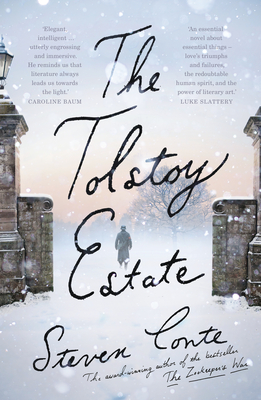
Steven Conte’s The Tolstoy Estate (my review): “restrained, elegant prose that crackles with sexual, moral and political tension”.
Richard Flanagan’s The living sea of waking dreams (Lisa’s review): “provocative story [that] taps into our anxieties with an urgent plea and hopeful flashes of beauty”.
Kate Grenville’s A room made of leaves: “a witty voice that blends echoes of Jane Austen with a contemporary perspective”.
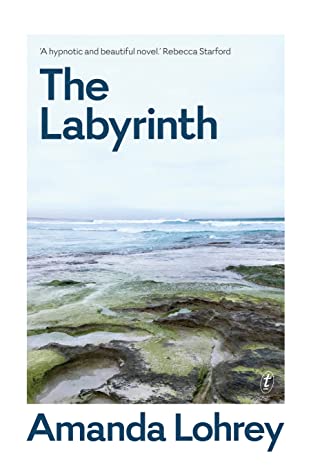
Amanda Lohrey’s The labyrinth (Lisa’s review): “explores the contradictions of human nature and community with wry wisdom”.
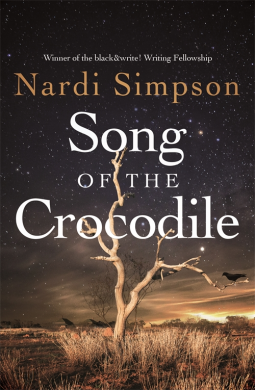
Nardi Simpson’s Song of the crocodile (my review): “its lyricism and attentiveness to language are testament to Simpson’s musicality”.
Adam Thompson’s Born into this (my review): “the past is never far from the present in these nuanced glimpses of complex lives”.
A lucky seven, eh? It’s not a particularly provocative or surprising list. It largely reflects the books currently doing the awards rounds, which is not to say it’s not a reasonable list. It contains four male to three female writers; two First Nations writers; a short story collection; two debut books; two works of historical fiction; four by previous winners of major literary awards. Something for everyone?
I’m thrilled that I’ve actually read – and greatly enjoyed – three of these.
The winner, who will receive $10,000, will be announced on September 3, at the opening of the Melbourne Writers Festival.
Nardi Simpson’s Song of the crocodile is a tight multi-generational saga set in the fictional town of Darnmoor over the last decades of the twentieth century. It tells the story of the people of the Campgrounds, who are ostracised, exploited and abused by the white townspeople. Between the Campgrounds and the town proper, with its ironically named Grace and Hope Streets, is the tip, which was created by knocking down “strangely scratched gums” on the old bora grounds. The road to the tip, and on to the Campgrounds, is Old Black Road. The stage is set …
“trespassers on their own country”
The story is told in three parts which span three generations of the Billymil family – Celie, her daughter Mili, and Mili’s eldest son Paddy. Celie’s part starts, however, with her mother, Margaret. Margaret not only runs the town hospital’s laundry, but also undertakes the major load of nursing the hospital’s First Nations patients. They are housed on “the back verandah” and are mostly ignored by the hospital’s medical staff. In this way, very early in the novel, we get the picture loud and clear about how the town’s Indigenous people are treated. The racism, the omniscient narrator tells us, is “hidden yet glaring. It’s the Darnmoor way”.
But there is a parallel story going on here, too, that of the spirits and ancestors, the “knowledge keepers”, who reside among the stars. They “wait for their loved ones to arrive” but they also introduce an important idea underlying this story – the “connectedness” of “all living or once lived things”. This connection is symbolised in the novel by threads and ropes that join sky and earth through birds and trees to the roots underground. I loved that Simpson shared this, that she trusted her readers to respect a worldview that’s foreign to many of us.
Intrinsic to this connectedness, of course, is the land. Some of the book’s most lyrical writing comes from descriptions of the country – rivers, trees, birds – in which it is set. This country is the freshwater plains of northwest New South Wales, the traditional lands of Simpson’s Yuwaalaraay heritage. In her novel its main feature is the Mangamanga River, “known by some as the wide-bodied, liquid boss of the plains.” It is to this river that Mili and/or members of her family go to refresh their spirits, but the men of Darnmoor want to control it, and protect themselves, by building a levee between the town and the Campgrounds.
Essentially, then, Song of the crocodile is the story of people who are made to feel “trespassers in their own land”. But, it’s also the story of strong, resilient women who forge a community on the Campgrounds. With guts and confidence, Celie turns her mother’s laundry skills into a business called the Blue Shed, providing work for herself and the other women. These women are a joy to read about, but they and their families are barely tolerated by the town, which ensures they know their place. When Mili’s bright young friend Trilpa wins a mathematics prize she is disqualified on trumped-up grounds, and when Mili, herself, applies for permission – permission, would you believe – to continue school past the age of 15, she too is brought down, by Mayor Mick Murphy, in the worst way.
“threads of broken lore”
Needless to say, it’s a difficult story. Too many people, people we’ve come to love, “pass” too young. As the oppression of those left behind builds, creating “hopelessness and grief”, the beast – Garriya, our titular crocodile – starts to stir. Regular hints of his rumbling imbue the novel with a sense of foreboding.
The crocodile is apparently a creator being in Yuwaalaraay country, but his evocation in this novel, as Garriya, is unleashed by the evil that has been visited upon the Campground people, evil that has broken the country’s lore. We feel him coming, and Mili’s alienated son Paddy is the conduit. Desperate to counteract this, spirit songman Jakybird wants to reconnect the “threads of broken lore”. He prepares his spirit “choir” for one last, powerful song, Garriya’s cycle. The climax is shocking, but the ending is cheekily open.
All this sounds grim, but I didn’t find it hopeless. There is delightful warmth and humour in the interactions between the Campground women, and there is humour and hope in the spirit world. Through these, Simpson gives us a complex story of oppression and survival. For all the misery suffered by the Billymils and their community, there is hope in their resilience, in their ongoing connection to country, and in their determination to keep passing on culture. Early in the novel, laundry worker Joyce addresses the parcels for delivery, using drawings that convey “a belonging, a knowledge, a truth of the place on which they walked and worked”:
In most cases the recipients failed to notice the mark, tearing the paper off and crushing it into a ball. It didn’t matter that eventually it was taken to the tip and returned to the earth. What mattered were the boys on the bikes that delivered them, that read the symbols then read the land. The drawings and the washing restored old journeys, countrymen walking on places they knew.
Simpson also, as First Nations writers are increasingly doing, uses Yuwaalaraay language throughout. She doesn’t directly translate it and there is no glossary. This bothered some of my reading group, while others of us felt the meaning was always clear – or clear enough. Here, for example, is Margaret in Chapter 1:
“Yaama. Dhii ngaya gaagilanha. Who wants a cuppa?” Margaret pushed open the door to the hospital’s back verandah, its hingers squealing as she entered. “How are we all today?”
Song of the crocodile was my reading group’s July book, and it resulted in one of our liveliest discussions this year, as we defended our diverse responses to its ideas, style, characters and tone.
For me it was an absorbing read. It is uncompromising in its portrayal of the insidious racism that First Nations Australians confront and the devastating impact of that on the spirit, but it also shows resilience in the face of that, and it affirms that culture is strong. That has to be a positive thing?
Has that got your attention? If it has, I’m sorry if you think I’m going to talk about high society fund-raising parties. I’m afraid it’s a bit more mundane than that … but interesting I hope.
The Stilettos
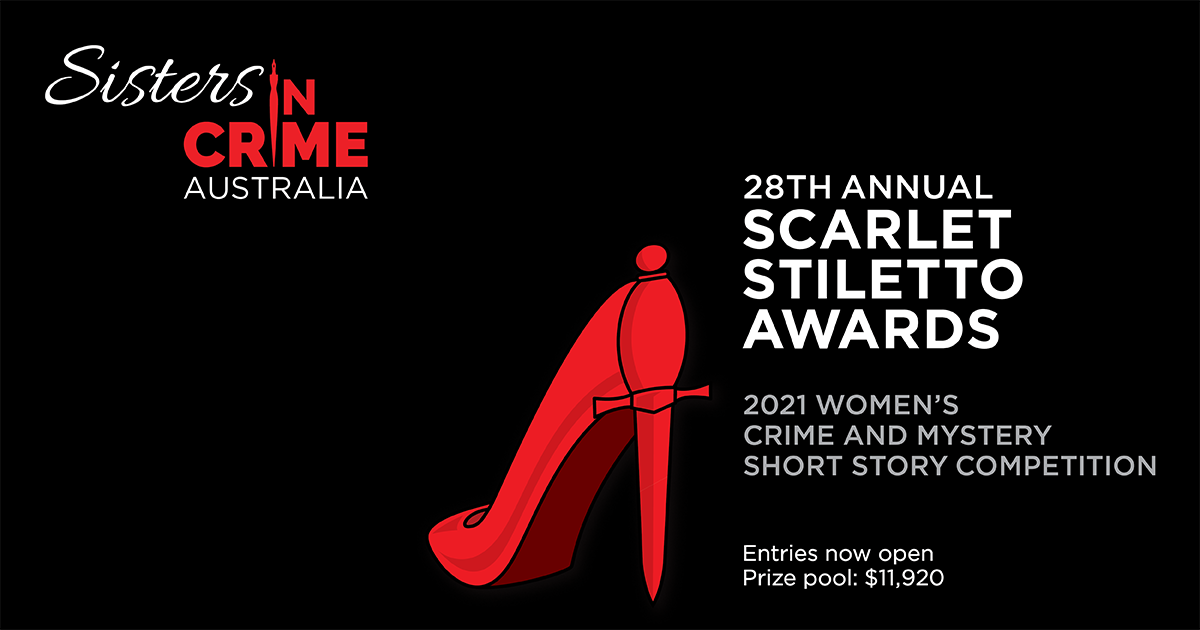
I have in fact written about the Stilettos before, the Scarlet Stiletto Awards to be exact. To recap, they are Sisters in Crime Australia’sannual awards for best short crime and mystery stories by women writers. This year they are offering a record $11,910 in prizes this year. As Carmel Shute, secretary of Sisters in Crime, says
“Crime does pay – at least on the page. And writing is a lot safer than holding up your local service station, especially during a pandemic.”
Fifteen awards are offered:
Swinburne University Award, 1st Prize: $1500
Simon & Schuster Award, 2nd Prize: $1000
Sun Bookshop & Wild Dingo Award, 3rd Prize: $600
Affirm Press Award for Best Young Writer (under 19): $500
Monash University Award for Best Emerging Writer (19-25): $500
Melbourne Athenaeum Library ‘Body in the Library’ Award: $1250 (plus $750 for runner-up)
Booktopia Publisher Services Award for Best Environmental Mystery: $750
Clan Destine Press Award for Best Cross-genre Story: $750
Every Cloud Award for Best Mystery with History Story: $750
Kerry Greenwood Award for Best Malice Domestic Story: $750
Viliama Grakalic Art and Crime Award:$750
Writers Victoria Crime and Punishment Award for the Story with the Most Satisfying Retribution: $660 (Studio Residency, Old Melbourne Gaol)
HQ Fiction Award for Best Thriller: $500
ScriptWorks Award for a Great Film Idea: $500
Liz Navratil Award for Best Story with a Disabled Protagonist Award: $400
There’s a lot of opportunity here, as you can see, for different sorts of stories – and past winners have included writers I’ve reviewed or mentioned here, like Angela Savage. The monetary amount isn’t huge, but it’s something, and, as Shute says:
Since the awards began 28 years ago, 3896 stories have been entered and 30 winners – including winners of the Shoe and category winners – have gone on to have books published.
The closing date for entering this year’s awards is 31 August, 2021. There is an entry fee of $25 (less for Sisters in Crime members), and stories must be 5000 words or less. More information and the entry form can be found at Sisters in Crime.
The awards will (hopefully) be presented in Melbourne in late November.
The sponsors
From the above list of awards, you’ve probably guessed the inspiration for the second part of this post – the sponsors. Most awards – literary or otherwise – are sponsored. Some, like the Prime Minister’s and various Premier’s literary awards, are funded by governments, but many are offered by individuals and organisations. The Miles Franklin Literary Award, the Barbara Jefferis Award and the Kibble Literary Awards, are all funded by bequests which identified the purpose of the award. Other awards or prizes are funded by a range of people and organisations, including philanthropic people and foundations, and like organisations (such as publishers and bookshops).
But, keeping awards funded is a challenge, and something I have planned to write more broadly on for some time. I will still do that. However, Sisters in Crime provided a good introduction to the subject in their promotion of this year’s award, because they say that only one sponsor pulled their funding “despite these financially fraught times” and “two new supporters” came on. Excitingly for them, several sponsors not only continued their awards but increased the amount.
Watch for a future Monday Musings on this and related issues – but no promises when!
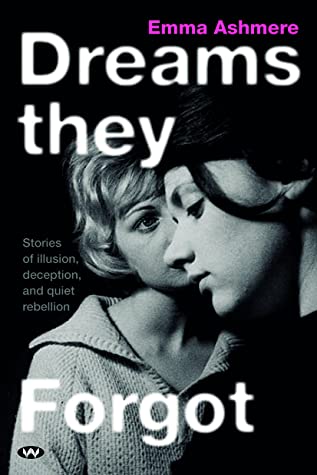
Emma Ashmere’s short story collection, Dreams they forgot, is different again from recent short story collections I’ve read. Certainly very different from the most recent, Adam Thompson’s Born into this (my review). One of the things that makes it different is its breadth in terms of time and place. Thompson’s collection, for example, is mostly contemporary, with occasional forays into the past and a little jump into the future. It is also very definitely centred in Tasmania. Ashmere’s collection on the other hand, while having some grounding in South Australia, has stories set elsewhere in Australia as well as overseas, including London, France, Bali and even Borneo. Furthermore, a significant number of the stories are historical fiction, with some set in colonial Australia, or during the Depression, for example, or post war, or in the 1970s. This is quite unusual in my experience of short story collections.
Unusual I say, but not surprising, because Emma Ashmere’s debut book is an historical fiction novel, The floating garden(my review). It is one of those books that has stuck with me because it tells such a strong story of social injustices that occurred during the building of the Sydney Harbour Bridge.
I could, then, start my discussion with the story in this collection which concerns the Bridge during its construction (“The sketchers”), but instead I’m going to the final story, because it gave me a laugh. This story, “Fallout”, concerns the (not funny) nuclear testing at Maralinga and concludes with the narrator taking her mother to the National Film and Sound Archive (NFSA) in Canberra to show her some relevant treasures. What a great little promo for the importance of collecting institutions like the NFSA. But, that’s not what made me laugh. As some of you know, I spent most of my career at the NFSA, and this is how our narrator introduces it:
I tell her I live with my girlfriend in Canberra and work at the Film and Sound Archive with a bunch of other failed actors, part-time poets and overlooked opera singers.
I wish I could count myself as one of those, but I’m far too prosaic. However, there is probably an element of truth in what she writes. All I can say is that at least the NFSA offers gainful, and valuable, employment! This story, dealing as it does with the “fallout” from nuclear testing – great wordplay here – makes a fitting and strong end to Ashmere’s collection, which deals with all sorts of fallouts in people’s lives.
Take the first story, for example. Titled “The winter months”, it concerns a young woman who, like many young people, is uncertain about what she wants to do with her life, much to her mother’s frustration. She’s in England, and is doing a TEFL course (Teaching English as a Foreign Language) which, she believes, “is going to change everything. It will give me purpose. A goal. A life”. She meets and is attracted to a mysterious and seemingly confident young woman, Aveline, but, unbeknownst to our narrator, Aveline has her own challenges, and suddenly disappears.
“The winter months”, however, is more complex than I’ve described here. It introduces us to several types of characters and relationships which thread through the collection – uncertain young women, lepidopterists (would you believe), mothers-and-daughters, neglected wives, fledgling same-sex attractions, to name a few. The result is that, as the book progresses, some stories start to feel linked, even though in most cases the link isn’t actual. The effect though is to ground the collection because this feeling is supported by recurring concerns.
One of these is Ashmere’s concern for social justice, for overlooked people, for women in particular. “Nightfall” tells the story of a young Irishwoman who arrives in Adelaide during goldfields days:
Most of us here Behind the Wall sailed across the sea with our Billies, Jemmies or Toms. No sooner did they set their boots in the dust, they streaked off like a dog chasing a rabbit across a field, all glint and muscle and hunger and bragging about what they will become. I waited for my Billy to bring back rabbits and gold, but he didn’t come.
And so, girls like her were left behind:
It’s the same in every port for girls like us. You stand with the bones of your back pressed against the wall as sailors rope up their harpoons and aim them at your lower parts, or you go into a tavern for a drink.
She ends up working for an abortionist who is, of course, more concerned about not being caught than her health and safety … This story was shortlisted for the 2019 Commonwealth Writers Prize.
Other stories explore the impact on relationships of PTSD in times when there was no support or recognition (“Warhead” and “Seaworthiness”), and another, as already mentioned, looks at the aftermath of nuclear testing at Maralinga. Many of the more contemporary stories feature children and young adults who find themselves caught in worlds they don’t fully understand or don’t yet know how to handle. “The violin” is a carefully told story about a controlling young man and his bride-to-be.
There is a melancholic or, at least resigned, tone to many of the stories, but most are not completely depressing. While happy endings might be rare, little wins or rebellions or, in some cases, lovely acts of grace lighten the endings. As with most collections, there are stories that didn’t quite work for me, but those that did more than made up for the rest. I particularly loved “Seaworthiness” and “The violin”, but most read well.
This brings me to the title, which is not one of the stories in the collection. What does it mean? It’s certainly true that many of the characters had dreams, and it’s also true that in most cases these dreams do not come to fruition. Did they forget them? Not always, but, for better or worse, other dreams – or, at least events – replace them.
If you’d like a taste of Ashmere’s writing, you can read one of the stories, “Standing up lying down”, online at Overland. I’ll finish with a quote from it:
Apparently she’d heard Laurie’s conference paper on the omissions and silences in Australian history, how particular stories are concreted over, while others are constructed and celebrated in their place.
In Dreams they forgot, Ashmere retrieves some of these concreted over stories – those she feels able to, anyhow – and gives them a darned good airing.
Emma Ashmere Dreams they forgot Mile End: Wakefield Press, 2020 239pp. ISBN: 9781743057063
During one of my forays into Trove, I came across an intriguing little piece by Canberra artist-educator-reviewer, Malcolm Pettigrove. Pettigrove was a regular arts reviewer in The Canberra Times through the 1970s and 1980s, but it was his article published on 31 January 1975 that particularly caught my attention.
It starts:
NO issue in the issue-filled business of literary appreciation has had as much wind and ink spent on it as The Definition of The Novel. Ironically, few issues are of less importance.
I like this, because I think definitions are fun, but ultimately unimportant. Actually, fun is not quite the right word. What I mean is that discussing definitions is a worthwhile exercise because it helps hone our ideas about form and can inform our understanding of creative works, but in the end, the important thing is the work, regardless of what category/form/type critics or reviewers slot it into.
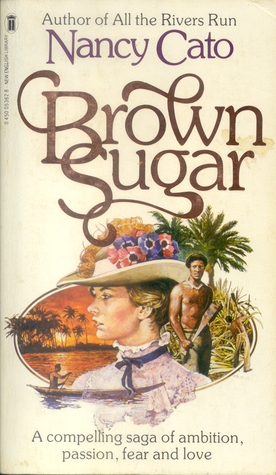
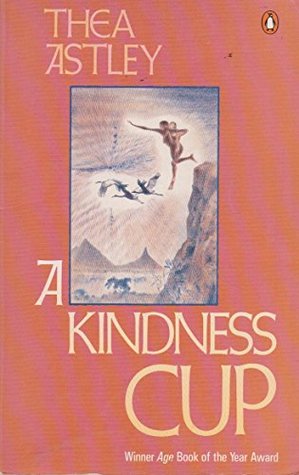
So, with that understanding, let’s look at what Malcom Pettigrove had to say – in his review of three Australian historical fiction novels, Nancy Cato’s Brown sugar; Maslyn Williams’ Florence Copley of Romney, and Thea Astley’s A kindness cup.
He starts, in fact, by saying a bit more about the novel:
Whatever theorists might make of it, the word “novel” remains in reality nothing more than a convenient label for those fictional works of narrative, descriptive, expository, dramatic, or didactic prose which no other label will fit. […] No more comprehesive [sic] definition has ever been coined, and it’s quite likely that none ever will.
Now, I’m not going to engage much more with this. Wikipedia’s writers simply describe the novel as “a relatively long work of narrative fiction, typically written in prose and published as a book”. I could check my various books, but I think I’ll find variations on this theme, so let’s move on. Pettigrove says that this says nothing about a “lack of imagination on the part of the definition-makers”. Rather, “it indicates that the novel has a life and a mind of its own and is determined not to surrender to the definition-makers until it has exhausted all the variations of form, content and style that are available to it”.
The Australian novel, he says, is no different. He writes:
Most novels, whether Australian or not, are conservative, courteous, sociable things, with established habits, moderate expectations, and only a limited inclination to experiment. The bold innovation, being rarely understood and seldom well received, is left to the adventurous minority, some of whom die in the attempt leaving the successful ones to proliferate their own image in more or less conservative, courteous and sociable offspring which are established in their habits, and given to moderating our expectations by being limited in their inclination to experiment further.
I do like this description of how innovation leads to the next “standard” – until, of course, the next innovation comes along. It happens in all the arts, doesn’t it? Of the three novels he’s reviewing, you won’t be surprised to hear that he says that Cato’s and Williams’ novels belong to the majority, while Astley’s is an “offspring of the minority”.
He then discusses the three novels. Nancy Cato has appeared in this blog a few times. Her historical fiction, Brown sugar, is a “novel” he says, and also “a foreshortened saga”, a “history of the rise and fall of the north-coast sugar empires”, and “a romantic tale”. He sees limitations in this novel, particularly in terms of depth of characterisation. The extent of her historical research is evident, he says, but “in the hands of a Martin Boyd this material would undoubtedly have given rise to characterisations of considerable depth and subtle complexity.”
Maslyn Williams’ novel, Florence Copley of Romney, he says, shares with Brown sugar, its “contrast of values”. Overall, though, this story is “pleasantly romantic” rather than offering something interesting and challenging about the Australia in which it is set.
Then, he comes to Thea Astley’s A kindness cup (for which there are reviews by Lisa, Bill and Lou on Lisa’s Thea Astley page). Astley is described on the book’s fly-leaf, Pettigrove says, as “a prose stylist”. It’s clear he’s not a fan – or not entirely a fan – of Astley’s “prose-style”, for which he gives examples, but he writes that:
If this brief and bitter tale succeeds — and I believe it will — it will be in spite of its prose-styling, not because of it. When Miss Astley drops the prose of the stylist and begins to function simply as a writer with a tale to tell her work becomes stark, tense, and most effectively dramatic.
Astley’s writing, he says, would intrigue “the reader who enjoys examining the intricate and often unfathomable relationships between a human action, its setting and its motive”. She evokes her cane-country town setting “with potent economy” and the motives of its characters “are exposed with the precision of surgery”. Indeed, he says,
The total impact of the book is considerably greater than its brevity might suggest possible.
All three books, he concludes, discuss the nature of man in their own way – though their understanding “is wonderfully simplified when the men depicted inhabit the philosophical no man’s land that nineteenth-century rural Australia has become in the minds of so many contemporary novelists”. “Philosophical no man’s land”? A discussion for another day, perhaps?
As for defining the novel? He suggests these novels provide no answers … just, the implication is, more questions. In fact, his piece peters out in terms of its opening salvo, but I did enjoy his perspective on these three writers.
Some of you will know of Jonathan Shaw as the blogger at Me fail? I fly! If you read his blog, you will also know that he loves poetry: he writes it, he reviews it. None of us alone is his first commercially published collection, though he has self-published five collections and has had a number of poems published in journals like Quadrant, Going Down Swinging, and, would you believe, the European Journal of International Law. None of us alone, styled a chapbook, contains 24 poems, selected from his previous collections and published works.
I enjoy reading Jonathan’s* poetry reviews, because he takes us through the poems, sharing his thoughts as he goes. I also like the fact that though he sounds confident, he admits to not always being sure that he’s picked up the nuance or, say, understood all the “metaphorical dimensions” of a poem, so I know he’ll forgive my errors and misses here. Then again, I don’t plan to discuss particular poems in detail, the way he often does, so I may avoid big errors!
However, I will say that Jonathan plays with various forms including sonnets (which seem to be a favourite), free verse and traditional ABAB quatrains. His rhyming is confident and comfortable rather than forced, which is a great start. His allusions are accessible, and his resolutions are usually clear, with the sonnets mostly ending in a rhyming couplet, which make their point. Overall, the tone tends to be neutral or lightly melancholic, with touches of humour, even where the subject is serious. This sort of writing appeals to me.
The poems in None of us alone draw from Shaw’s life, his domestic, artistic and political interests, and so are easily relatable to Australians of a certain age and persuasions. There are gorgeous poems about dogs (“The dogs outside Orange Grove Markets”) and (“She looks out”), for example, that will speak to dog lovers. There are poems inspired by art exhibitions (“Sculpture by the sea”) or attending a play (“This is just to say”). And, most particularly, there are poems responding to the politics of the day (asylum-seekers, same-sex marriage, domestic violence, and climate change.) The first poem, in fact, is a climate change themed sonnet, “Demo”
… We rallied, one link in a chain of rallies all around Australia crying out against the failure of governments who play the role of sycophants to Old King Coal.
I like the cheekiness of another sonnet “Unprecedented again”, which he wrote just last year. You can find it on his blog. However, while looking for it on his blog, I learnt something, which is that his favourite form is not, in fact, a sonnet, as I felt I had ascertained from this collection, but an Onegin Stanza. You’d have to be a poetry purist to know though! Anyhow, the poem plays on the idea that the “unprecedented” just keeps on coming, in one form or another, creating a fine line between the unprecedented and the precedented.
“A pronunciation lesson” – a free verse poem – is one of the poems that has been published before. It has also been read on ABC’s Poetica. I’m not surprised by its success because it lures us into a sense of calm before hitting us in the guts with a stand-alone last line. Its subject is Hiroshima, and it is followed by another free verse poem on Hiroshima, “Correspondence”, this one expressing the cynicism of one who knows how it goes. You can live too long! And indeed, there are poems here that recognise our mortality.
Before I finish, I must mention the beautiful design of this little series, with its classy front-papers, and the cover of this particular work. It features a photograph of a ceramic heart from the “Connecting Hearts Project” by potter (and Jonathan’s partner) Penny Ryan. The collection includes a poem inspired by these hearts, “2 July 2016”. The artwork and the poem address the pain experienced by asylum-seeker detainees, and the “malice” of governments refusing to open their hearts to them:
Unwrapped, this heart confronts that malice: our beating hearts can face our fear – Close down those camps, bring those hearts here.
And here I’ll leave it, because it’s a little book – a chapbook – and you can buy it, as I did, for $5 plus postage and handling. Check Jonathan’s post for details.
* I haven’t met Jonathan in person but have “known” him long enough in the blogosphere that I felt silly using my usual last name style, Shaw, to discuss this book of his.
Jonathan Shaw None of us alone Port Adelaide: Picaro Press (Ginninderra Press), 2021 28pp. ISBN: 9781761091247
Nothwithstanding this week’s Monday Musings posts on literary awards, I still like the Miles Franklin – partly because of its significance in the Australian literary firmament – and so I am sharing today’s announcement of this year’s winner which I watched via You Tube.
Just to recap, from my shortlist post: Each of the shortlisted writers received $5000 from the Copyright Agency’s Cultural Fund, with the winner receiving $60,000 prize. This year’s judges comprised, as always, continuing judges and new ones, providing I think a good mix of experience and fresh ideas: Richard Neville (State Library of NSW), author and activist Sisonke Msimang, and critics Melinda Harvey, Bernadette Brennan and James Ley.
So, more on the winner …
This is Lohrey’s second listing for the Miles Franklin award, but her first win. The panel described the novel as a “profound mediation” on loss, with judging panel chair, Richard Neville commanding the “clarity” of her prose in exploring “loss at so many levels”. (Notably, Neville also mentioned the increasing cultural diversity appearing in the awards, by which I assume he meant, in the books submitted. Ninety-six titles were submitted.)
Amanda Lohrey spoke briefly, thanking various people – including family, publisher, editor, of course. She praised her publisher, the wonderful Text Publishing, for supporting “literary values” and she talked of the award’s benefactor, Miles Franklin, as “the great Australian nonconformist”. She also thanked the readers whom she described as an “indestructible tribe” in a world of Netflix (etc). She characterised the relationship between writer and readers as “an extraordinary exchange among strangers.” I like that.
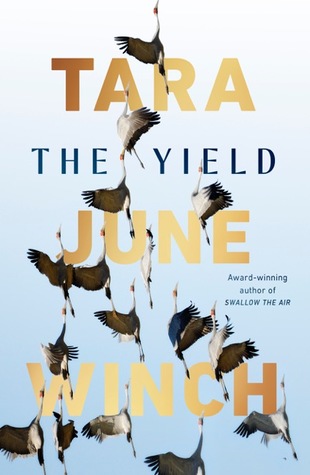
The presentation also included last year’s winner Tara June Winch congratulating Amanda Lohrey. She said that what she gained, in particular, from the award, was “a readership”. Isn’t that great to hear, because that – and the “gift of time” – is what we hope awards like this offer books and their writers.
And, finally, just for fun. Today The Sydney Morning Herald published an article on How to win the Miles Franklin: Analysing 64 years of data, by Pallavi Singhal. It looks at the usual issues like gender, origin (birth location, ethnicity), age, but also other points you may not have considered like length (“write about 400 pages”, it says), title style (“Begin your book title with ‘the’ and keep it short”) and publisher (Allen & Unwin is ahead at the moment)!
This Thursday will see the announcement of the winner of this year’s Miles Franklin Literary Award. It’s one of the more important days on the Australian literary calendar, but it has inspired another of those articles about the value of literary awards.
Now, we have discussed awards here before. Back in 2012, I wrote about them when the Queensland Premier’s Literary Awards were abolished by a new premier. In 2014 I wrote on Unpublished Manuscript Awards. And more recently, I wrote about the return of The Age Book of the Year Award. These posts, and others, have generated discussion about the value of awards, with both readers and writers commenting on whether they like them and why, so I won’t go there again.
Instead, I’ll share a couple of interesting ideas from the article I mentioned above. First, though, having planned this post a couple of days ago, I was surprised to find Stan Grant referring to awards in his book, On Thomas Keneally (my review). In 2016, he says, he was on a judging panel – with Thomas Keneally, in fact – for the NSW Premier’s Literary awards. They were judging the Indigenous writer category:
Keneally and a fellow judge strongly supported Pascoe, but I resisted, arguing instead for the merits of Ellen Van Neerven’s Heat and light, a dazzling work of fiction I considered of greater depth and literary worth than Dark emu. In the end we agreed that Pascoe and Van Neerven should share the prize.
I have reviewed both of these books (links on the titles), and for what it’s worth, I agree with Grant (despite the fact that, as he admits himself, “Dark emu has certainly had the greater cultural impact”).
Regardless, I’m sharing this because it beautifully introduces David Free’s article in last Friday’s The Sydney Morning Herald. Free is an Australian journalist and novelist who is not, I admit, well-known to me, but his provocatively titled article, “Judge a literary prize? No thanks, they’re all a giant waste of time”, makes some points worth sharing.
He starts anecdotally by sharing his experience of being asked to “serve on the judging panel of one of Australia’s most coveted literary prizes”, which he chooses not to identify. This doesn’t really matter in terms of what I want to share. He decides not to accept the invitation, largely because “the prospect of sitting down with a couple of strangers [the other judges] to haggle about our respective tastes in literature struck me as radically unappealing”. You can see why I started with Grant’s experience. Anyhow, he says
My literary taste is unorthodox, by current standards. I happen to think it’s sound and I do my darnedest to defend it in my criticism. But I’ve never been bold enough to imagine that my literary judgements amount to objective, provable truths.
Of course, this idea of suggesting that something is “best” dogs prizes in the arts, whether they be for books, paintings, films, whatever. We all know it, but prizes do have their benefits. Arguably, they can enhance sales, and the big money prizes do give their winners breathing space, an opportunity to devote some more time to their art.
If, however, we put these pros aside, and focus on the idea of prizes identifying works that we might like to check out, then I think Free has a couple of interesting ideas to consider.
The first one is to abolish judging panels and have “one judge only – a different person each year, chosen strictly on the strength of his or her literary expertise.” He knows the idea sounds “farcical”, that “people would denounce such awards as arbitrary”, as just an “expression of some random person’s taste”. He counter-argues, however, that the idea that panels make better decisions is a “furphy”:
It doesn’t matter how discerning each individual judge is. When human beings get together in groups, weird things happen. We feel pressured to conform – to say what we think we’re expected to say rather than what we believe. That’s why the verdicts of literary juries tend to be predictable, wholesome, obedient to the winds of trend.
I think he has a point. Do you?
It’s his other idea, though, that appeals more, because it aligns with my own use of awards. He suggests that we scrap the concept of the lone winner:
Let’s have a prize where there isn’t even a shortlist – a prize where the judges just announce their longlist of the year’s 15 best books, then split the winnings 15 ways.
This is more like it. He continues:
Admittedly this wouldn’t turbo-charge book sales the way our existing awards do, but in the long run it might promote a healthier relationship between fiction and the reading public. If diversity and inclusion are what we want, why not showcase these qualities on a longlist, instead of pretending they can somehow be embodied by a single writer? On longlists there’s room for different writers with different talents, doing all sorts of different things. There’s room for the quirky, the experimental – maybe even the humorous, once a decade or so. Sniff around a longlist for a while and you’re likely to find at least one book that floats your boat.
Isn’t this what all of us who look at longlists (and to some degree shortlists) like? It avoids the whittling down, he says, and all those arguments about which writer’s “turn” it might be, or which identity group has or hasn’t had a “fair shake already”.
Ultimately, he says, the best verdict is posterity. “Either a work lasts or it doesn’t … Crowd wisdom of that sort is very hard to argue with”. Actually, I think you can, because the “crowd” itself is often skewed, but I take his point, theoretically speaking.
Meanwhile, I will continue, as I have said elsewhere, to enjoy long- and shortlists, because that’s where many of the gems truly are.



 Whispering Gums