For voyeurs only – I’m at Scene of the Blog

Scene of the blog graphis

If you want to have a little peek at where I blog, go check out my Scene at Kittling: Books … and while there, do have a look around her blog. I love her Widget headings, such as “Top commenters, Bless ’em”. We do, too, don’t we! Note to self: Try to comment more on other blogs.

Anyhow, thanks Cathy for inviting me to be one of your Scenes. I rather enjoyed preparing my Scene. And it was fun checking out the other Scenes and discovering how many of us are “sofa bloggers”. I discovered, as you assured me, that I wasn’t alone!

Ruth Park, Missus

Missus was the last written in Ruth Park‘s Harp in the South trilogy, but is the first in terms of chronology. The first two novels, Harp in the South and Poor man’s orange, were published in 1948 and 1949 respectively, while Missus was not published until 1985.

These first novels, which met with some controversy on publication, are set in early post-war Sydney, the tenements of Surry Hills, and deal with the lives of Mumma and Hughie Darcy and their daughters. Missus is set in the 1920s, in country New South Wales, and relates Mumma and Hughie’s youth and courting days. I have only just read Missus, partly because I read the first two in my teens which was, I have to admit, before Missus appeared on the scene.

You can tell that the writer of Missus is the writer of Swords and crowns and rings (1977). The latter is larger scale – and deals more consciously with its historical time-frame. That is, it more specifically addresses the wars and the Depression, and their impact on the main characters. However, the First World War and the coming Depression do provide the backdrop to Missus. Both books depict rural life and characters with convincing realism.

WARNING: SPOILER, IF YOU’VE NOT READ HARP IN THE SOUTH

Now, the plot. For those who’ve read the first two novels, the interest here is not whether Mumma (Margaret Kilker) and Hughie get together but how they get together and who they are. The first chapter – after a brief introduction to the town of Trafalgar including how the early settlers cruelly despatched the Indigenous inhabitants – introduces us to Hughie and his family. We meet his brother Jer (Jeremiah), who is born with “his feet back to front”, and we learn of the failure of his parents marriage, his mother’s early death and his being turfed out by his father when he was around 14 years old. Jer goes with him, and becomes both millstone and support from then on.

In Chapter 2, we are properly introduced to Margaret (who makes a brief appearance in the first chapter) and her family. Unlike Hughie, she grew up in a large, loving family, though not one without its stresses and losses. Margaret, we learn, has taken a shine to Hughie, much to her mother’s concern, because she sees Hughie for what he is, “a wild goose of a boy … [who’s] got flighty feet”, a “shifty article”. This mother (Rowena) is, in fact, a powerful presence. I love this description of Rowena after she decided to give up on (“on” being the operative word) her first true love:

Her chest ached as if it had a skewer stuck in it, but she tossed her head more often than she hung it.

From here on the story progresses chronologically as Hughie moves around the countryside obtaining and losing or leaving jobs, while Margaret stays at home waiting for Hughie’s occasional visits. The characters of our characters, if you know what I mean, are illuminated by the actions of, or their interactions with, other characters. Margaret’s younger sister, the jealous Josie, provides an interesting foil for Margaret as well as an opportunity for Park to explore women’s lack of rights. Josie marries young – for the wrong reason to the wrong man – and the marriage fails. She’s intelligent and manages to obtain accountant qualifications, but her attempt to set herself up as an accountant in the town fails because no-one will use a woman accountant. Other characters include Alf, Margaret’s long-suffering but sensible aunt who works as a housekeeper for the local priest and who, at different times, provides shelter and monetary support for Josie and Jer; the Biddles (the mustard-gas damaged Joe and his common law wife) who take in Hughie and then Jer at one time in their lives; and the redoubtable Bids Tookey who … but that might give away what little plot there is.

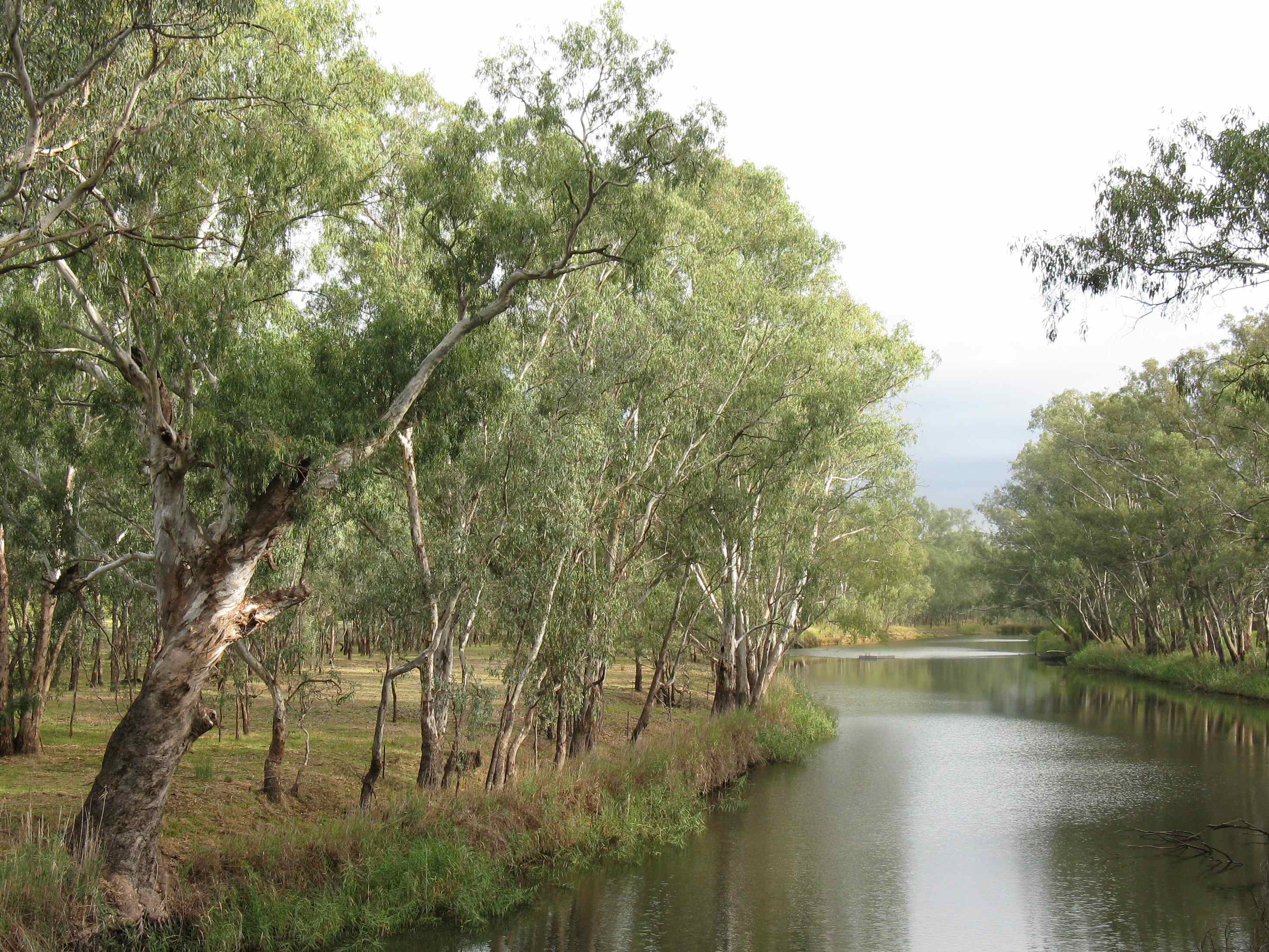
Sunday Creek, near Rutherglen

Australian country creek, lined by eucalypts

In just 250 pages Park paints a rich picture of 1920s life in rural Australia while at the same time developing Hughie and Margaret’s characters. Her characters are all flawed, some more than others, but she draws them with a clear-eyed warmth. She sees them for who they are but she respects them nonetheless. There’s no sentimentality here, but neither is it cynical or bitter. Her themes are universal ones: innocence and experience, familial and romantic love, deception and loyalty, most of it overlaid with that pragmatism that is necessary for survival in a hard place in hard times. As I wrote in this week’s Monday Musings, it’s not surprising that these books still resonate.

Finally, the language is lovely – simple, direct and evocative. Read this from the last few pages of the novel:

In the unkempt garden bloomed freesias and grape hyacinths. The eucalypt twig flushed red, the four creeks overflowed, lambs appeared on the hills, white as mushrooms and as sudden.

‘Them two had better wed quick,’ said Eny ominously, ‘or I won’t answer for Margaret’.

Ha! I think I’ll leave it there – pregnant with possibility …

Ruth Park
Missus
Ringwood: Penguin Books, 1985
247pp.
ISBN: 0140089438

Monday musings on Australian literature: Ruth Park

The muddle-headed wombat, book cover

Wombat book cover (Courtesy: HarperCollins Australia)

For a New Zealander, Ruth Park is a very popular Australian! Not only did she write the much-loved (and studied) Harp in the south trilogy, but she also wrote the hugely popular (in its time) radio serial The muddle-headed wombat, was married to the Australian D’Arcy Niland (now deceased) who wrote The shiralee, and is mother to children’s author-illustrators Deborah and Kilmeny (now deceased) Niland. Ruth Park also won the Miles Franklin Award with her Swords and crowns and rings, and wrote two very popular autobiographies, Fence around the cuckoo and Fishing in the Styx. And this is not all – or even all of the best – that she’s produced in her long career.

Park was born in New Zealand in the early 1920s and first came to Australia in 1940 when she met D’Arcy Niland. She writes that Australian writer Eve Langley*, with whom she had a longstanding friendship, said of Niland:

‘That’s a good face … Do you know what it is saying?’
‘No, what?’
‘It says “Take me or leave me.” I like that.’

So apparently did Park. She returned to Australia in 1942 to work as a journalist, and married Niland. They worked at various jobs in rural New South Wales for some years before Park’s stories gained the attention of the Australian Broadcasting Commission (ABC) resulting in their decision to try to make a living from free-lance writing. They wrote, and wrote, and wrote – anything that would earn money. They wrote, for example, short stories, genre stories (such as romances and westerns), radio talks and radio plays, scripts for radio comics, all the while honing their skills for their more serious writing goals. And they lived during these early years in Sydney’s inner city slum, Surry Hills.

These experiences of living in rural areas and city slums are clearly evident in Swords and crowns and rings (the story of the dwarf Jackie, and his love Cushie Moy) and the Harp in the south trilogy (the story of the Darcy – ha! – family). The thing I love about these books – both of which span the first 4-5 decades of the twentieth century – is the way Park explores gritty issues like poverty, abortion, religious bigotry, unemployment and illness with a psychological and social realism that also encompasses warmth and humour. Her main characters tend to be the quintessential Aussie battlers, but their concerns transcend time and place. It’s not surprising, really, that these works keep being read, re-published, set for study, and adapted for television and film.

Realism though is not the only string to Park’s fictional bow. She wrote in several “genres” for a range of audiences, including fantasy for children. Her Muddle-headed wombat stories ran on the ABC Children’s Session from 1957 to 1971. I have to say that I never have really been one for anthropomorphism, and have read few children’s classics featuring animals (no, not even The wind in the willows) but even I would tune in for the wombat! Park also wrote a children’s time-travel fantasy Playing Beatie Bow, which is taught in schools and has been made into a film.

And yet, for all this, I’m sure she is little known outside Australia … if I am wrong, please let me know!

In the meantime, I will conclude with her description in her first autobiography, Fence around the cuckoo, of her first sighting of Australia as she arrived by boat:

What I saw were endless sandstone cliffs reflecting the sunrise. A chill ran over my skin, my ears buzzed as they had once done when I was about to experience uncertainty about something as yet unknown. The sea fled south, its malachite green changing to beaming blue; the sky was sumptuous with a sun hotter than I had ever known.

This was my first glimpse of Australia Felix, the ancient, indifferent, nonpareil continent that was to become the love of my life.

Ruth Park is not one of those ground-breaking writers who makes you go, wow!, but  she is an excellent story-teller who has an enviable ability to create and develop memorable characters who confront the real “stuff” of life. You could do far worse than read her if you want an introduction to Australian literature. If I haven’t convinced you, read Lisa at ANZLitLovers and Tony of Tony’s Bookworld on Harp in the South, and kimbofo at Reading Matters on her “Top 10 novels about Australia”.

*Park mentions Langley (whom I reviewed early in this blog) several times in Fence around the cuckoo. One concerns Park’s decision to stay with Eve to escape a Peeping Tom uncle but, when she arrived at the windmill in which she believed Eve to be living, she found no Eve but another woman who had heard of Eve but not for some years. “What had happened to that weird girl?”, the new windmill resident wondered. Poor Eve. She was indeed a bit weird and had a rather sad life, but that is another story.

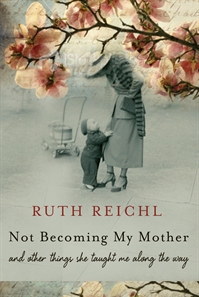
Ruth Reichl, Not becoming my mother

Ruth Reichl, Not becoming my mother
Book cover (Courtesy: Allen& Unwin)

Ruth Reichl and Kate Jennings were both born in 1948, the former in the USA and the latter in Australia. Both had problematic relationships with their mothers and have written about those relationships, Reichl in memoirs and Jennings in her autobiographical novel, Snake. In her first memoir, Tender at the bone (1998), Reichl tells a few (many of them funny) stories against her mother, and describes her urgent need to escape home. Some 20 years later in Not becoming my mother, she revisits her mother – but with the wisdom that time brings. Similarly, in Snake, Jennings’ major focus is “Girlie” and her mother, and particularly Girlie’s desperation to be loved by a woman who was fundamentally unhappy and unable to provide that love.

The thing is that these mothers* were born in the first two or three decades of the twentieth century. They experienced war, depression and, worse still, the awful restrictions imposed on women of that era. Not only were education and work not encouraged, but they were told that marriage was the only life for them. This is the story Reichl tells in Not becoming my mother, and in doing so explores who her mother really was and finally recognises (and appreciates) why her mother behaved the way she did. Here she is on her mother and her mother’s friends:

I have never seen so many unhappy people. They were smart, they were educated and they were bored. Some of them did charitable work, but it wasn’t fulfilling. Their misery was an ugly thing, and it was hard on their families. It was a terrible waste of talent and energy, and watching them I knew that I was never going to be like them.

The mother in Jennings’ novel tells her daughter:

‘She’ll be married at eighteen, a hag by the time she’s thirty’, continues Irene. ‘Don’t let it happen to you’.

Ruth’s mother, on hearing of Ruth’s engagement:

‘Isn’t this very old-fashioned?’ she asked, coolly … ‘I thought that these days people your age just lived together.’

I was certain that Mom would eventually warm to the idea. She did not …

She had introduced me to her friends, shown me the drawbacks of a traditional marriage and offered me what she herself had wanted – permission not to marry.

Both mothers – Ruth’s real one and Kate’s (semi)fictional one – seek meaningful things to do with their lives and to them this primarily meant (preferably paid) work. Both manage it in fits and starts but society was not enamoured of working women and did not make it easy for them. Both mothers experienced some degree of mental illness – which reflects that well documented fact that married women were (and still are, I believe) the highest risk group for mental illness.

These are not pretty stories but they need to be told. Interestingly, Reichl’s story has a positive ending. Late in her life, her mother does find meaning and spends her last years actively involved in her community. Jennings’ fictional story, on the other hand, ends far more equivocally. Despite these differences, both books are powerful reminders of what life was like for a whole generation of women. And they remind us why we need to keep working to ensure self-actualisation for everyone, regardless of gender or other socially imposed limitations.

By the time she wrote Not becoming my mother, Reichl had made her peace with her mother’s memory, had finally realised that much of her mother’s seemingly bizarre or erratic behaviour was borne of the frustration in her life and her desire that her daughter not follow her footsteps. Luckily for me, my mother, also born in the first third of the century, managed to convey similar messages about education, work and marriage, while also providing the love and support that all children need and deserve.

Ruth Reichl
Not becoming my mother, and other things she taught me along the way
Crows Nest: Allen & Unwin, 2009
112pp
ISBN: 9781741757538

* These are just two examples of sad, difficult mothers from those decades. There are many more, such as Jill Ker Conway‘s mother in The road from Coorain.

Anna Krien, Into the woods

How can so many people all be looking at the same thing and see it so differently? The man moseying around in front of me looks at a 300-year old tree and sees a nursing home, while an activist twenty minutes down the road sees a block of flats for furry and feathered creatures.

Vive la différence? Or not! Anna Krien’s Into the woods is an exposé of the decades long battle in Tasmania for its forests, particularly its old-growth native forests. For those who don’t know, Tasmania is Australia’s southern island state. It is famous for its beauty and its wilderness but also, it seems, for its Vs, that is, vitriol, violence and vigilantism. You see, being a small island state, with only 500,000 people, it’s a challenge to keep its economy in the black. Sawmilling and, more recently and more controversially, woodchipping have played an important role in maintaining its economy. It is this controversy – particularly surrounding woodchips – that Krien explores in her book.

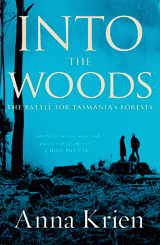
Anna Krien, Into the woods

Cover image (Courtesy: Black Inc

On the cover is a “blurb” by Chloe Hooper who wrote The tall man about the death in custody of an indigenous man on Palm Island. This provides a clue to the book’s style, and that is that the author, like Hooper, engages personally in the situation, meeting with parties on all sides of the conflict. In Krien’s case this meant meeting ferals, environmentalists, politicians, loggers, whistleblowers, craftsmen and businessmen.

Krien has organised the book into five thematic sections:

  • Ratbags: the new generation protesters, or ferals, who live pretty primitively on/near the site  they are protecting and who are often in conflict with older activists
  • Loggers: the logging industry workers who range across a wide range of jobs in the industry and are also often conflict with each other
  • The company: Gunns Ltd, the main player in the Tasmanian logging industry, meddler (if so benign a term can be used) in politics, and initiator of the Gunns 20 lawsuit
  • Groundswell: change agents such as whistle blowers, proponents of the “rights” of nature, and shareholders wanting ethical investments
  • The mill: Gunns pulp mill saga, the beginning of the an end?

The story is a complex one, delving into competing interests within the logging industry itself – sawlogs versus woodchips, old-growth versus regrowth native forests versus plantations, public versus private forests – not to mention dissension amongst environmentalists and some very dirty politics. It is a story about jobs versus the environment and the “rights” of nature, of different value systems that set “unmanned” pristine forests against “manned” ones. It is a story of blaming and buck passing. And it is a story of half-truths and distorted truths, all in the name of defending one’s own patch. “I am on a journey through selective truths”, she writes at one point in the book.

This issue of “truths” is beautifully conveyed in her discussion of the timber industry’s language:

I find myself constantly having to decipher new words. Nature needs “disturbance”, logging is “harvesting”, deforestation is “afforestation”, burning woodchips for electricity is a form of “bio-fuel” or “renewable energy”. Woodchips are “feedstock”, while the non-commercial attributes of a forest are “non-wood values”.

The word-games though work on both sides. As she says, “evoking napalm, Hiroshima and the holocaust to describe logging is manipulative”.

A major argument presented by the logging workers is the economic one – jobs – but Krien estimates from the information given her that forestry “accounts for no more than 3% of the workforce”. In fact, she suggests that machines may be a bigger threat to timber jobs than “any greenie”. The more cynical amongst us might think that it is not so much about “jobs” but about “big business”. Sometimes, of course, big business means jobs, but that’s not always necessarily so, not if much of the work can be automated (or, sometimes, though not necessarily here, moved off-shore).

I can’t begin to convey all the information she presents in this book – the history, the statistics, the science, the criss-crossing relationships, not to mention the people, the overt and covert deals, and the truly horrifying violence (both actual and threatened). There are times when I started to feel bogged down in the complexity of it all, but I was reassured when I realised she was feeling it too. She is, in fact, like Hooper, taking us on a journey – but it is a journey that, despite her very real efforts to explore the whole story, does lean to one side, that of those who wish to protect not destroy. As she says in the last chapter:

I’ve tried to balance my seesaw heart, carefully weighing up each argument. But there is something about this island that wants you to choose sides.

I can understand that – it is, in many ways, a magical place. However, I do have one complaint about the book – my ongoing one for books of this ilk – and that is its lack of an index. It is jam-packed with people, events, places, philosophies and theories but how can the casual reader or researcher find them?

And so, is there a resolution to it all? Well no, but there is, she says, a universal story:

… in the greater scheme of things, the island is nothing but a drop in the ocean. But the story is universal – and what goes on in Tasmania goes on in the Pacific islands, in other continents, until it all comes back over the ice to Tasmania again. … Deep down in our bones we must know – we must know that nothing we do is done in isolation. Cause and effect: how did it get so noisy in between?

How indeed? Read this thoughtful, throughly researched book, and you will, unfortunately, find out.

Anna Krien
Into the woods: The battle for Tasmania’s forests
Melbourne: Black Inc, 2010
302pp.
ISBN: 9781863954877

(Review copy supplied by Black Inc)

Monday musings on Australian literature: Elizabeth von Arnim

Cover of "All the Dogs of My Life"

All the Dogs of My Life (Courtesy: Vintage Books, via Amazon)

This week’s Monday musings is a bit cheeky since Elizabeth von Arnim (or Mary Annette Beauchamp, her birth-name) was born in Sydney in 1866 but her parents left Australia in 1871 for Switzerland and then England. Von Arnim spent the rest of her life abroad. So, why am I writing about her? She didn’t grow up in Australia and doesn’t write about it either. Well, it’s because I love her writing and thought I could use the Australian birth justification to write about her now rather than later. After all, it’s my blog and I’ll do what I want to!

Before I talk about her writing, it’s worth mentioning that she has a famous relation: her first cousin was Katherine Mansfield (born Katherine Mansfield Beauchamp in 1888). But this isn’t the only name-dropping that can be done. The writer E.M. Forster tutored her children at one stage, she had a three-year relationship with H.G. Wells, and she married (but soon regretted it) Bertrand Russell‘s older brother. In other words, she had an interesting life.

I have read a few of her 20 or so books:

And, I have Vera (1921), which some see as her best, on my TBR pile.

So, why do I like her? Well, not only is her main theme, at least from the books I’ve read to date, women’s lack of power in a male-dominated world but, like Jane Austen, she approaches this with wit and irony and with a clear eye for human failings in general. In other words, she empathised with women’s lot but wasn’t blind to their faults and foibles (as individuals, as women and as representatives of humanity). Just read Mr Skeffington, and you will see what I mean.

To give you a sense of her writing, here are the opening paras of her “memoir” All the dogs of my life:

I would like, to begin with, to say that though parents, husbands, children, lovers and friends are all very well, they are not dogs. In my day and turn having been each of the above – except that instead of husbands I was wives – I know what I am talking about, and am well acquainted with the ups and downs, the daily ups and downs, the sometimes almost hourly ones in the thinskinned, which seem inevitably to accompany human loves.

Dogs are free from these fluctuations. Once they love, they love steadily, unchangingly, till their last breath.

That is how I like to be loved.

Therefore I will write of dogs.

How can you not be captivated by such a wry writer? The book continues in this teasing tone. She insists it is not her autobiography (“as this isn’t an autobiography, I needn’t go into that” is a refrain), but a story of her dogs, and regularly tells us so. But of course, through the story of her dogs, we get a pretty good impression of her life. She may not give us all the details, but we certainly learn about many of her “ups and downs”. This book, though, was not my introduction to von Arnim: that goes to the delightful Elizabeth and her German garden.

In a recent post, Max of Pechorin’s journal wrote that “the line between novel and memoir can be a tricky one”. I immediately thought of Elizabeth and her German garden, which I first read back in the mid 1980s. This is, I believe, a novel (in diary form) but it is also rather close to her life. She did, like the Elizabeth of the book, marry a German (count) and she did call him, as she does in the book, “The Man of wrath”. Furthermore, she did have several children. In fact her second book, The solitary summer, is dedicated “To the man of wrath, with some apologies and much love”.  Anyhow, here is the Elizabeth in the novel:

The people about are persuaded that I am, to put it as kindly as possible, exceedingly eccentric, for the news has travelled that I spend the day out of doors with a book, and that no mortal eye has ever yet seen me sew or cook. But why cook when you can get someone to cook for you?

OK, so she is well-to-do … but still, I love her priorities! Here she is in her (aforementioned) memoir, speaking of herself and one of her dogs:

Fortunately we liked the same things. She only wanted to be outdoors in the sun, and so did I …

And so, while some of the facts may differ (though I don’t know which ones), the basic “truth” of her life – her likes, dislikes and, more to the point, her attitudes and personality, come through both books.

Elizabeth von Arnim was a woman who tackled life head on. Her first husband died, she had affairs and a failed marriage; she lived in England, Europe and the USA; and she met some of the significant thinkers and writers of her time.  But, through it all, she never lost sight of “women’s lot” and the psychological ramifications of their powerlessness. Here she is in Elizabeth and her German garden on migrant workers:

From us they get a mark and a half to two marks a day, and as many potatoes as they can eat. The women get less, not because they work less but because they are women and must not be encouraged.

There is also, in the same book, an extended – and infuriating – discussion between Elizabeth, the Man of Wrath, and two others on German women having the same (lack of) rights as children and idiots. But politics was not her main game, I think. Rather, she was interested in women’s lives, in their wish and need to make self-determined, meaningful lives for themselves. So, I might just finish with another little excerpt from All the dogs of my life:

What on earth did I, of all people, want with a lot of husbands? I asked myself in wonder. Besides, by readily sticking to poached eggs for dinner I was getting abreast of my expenses, and the bills of Saturdays held no more terrors for me.

Ha! What indeed (at least in those inequitable days)!
Kate Chopin, Désireé’s baby

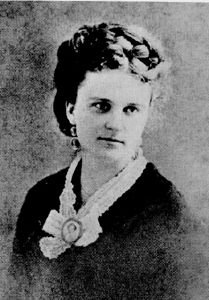
Kate Chopin

Chopin (Public domain, via Wikipedia)

I read Kate Chopin‘s short story “Désireé’s baby” (1893) back in March when Kirsty mentioned it in her comment on my last Chopin post, but I didn’t blog it then. However, when it appeared a couple of weeks ago as a Library of America selection, I felt its time had come. But, what to say? It is, in a word, gut-wrenching.

The first short story to create a lasting impression on me was Guy de Maupassant‘s “The necklace” (1884). It was that short story, really, that launched my enjoyment of short stories. I found them particularly appropriate for my student days when I couldn’t justify reading a novel but wanted some escape from set texts. I was consequently interested to read in the Library of America’s introductory notes to “Désireé’s baby” that Chopin has been compared to such writers as Maupassant and Flaubert. I can see the connection.

“Désireé’s baby” starts off gently – and, more to the point, innocuously:

As the day was pleasant, Madame Valmondé drove over to L’Abri to see Désireé and the baby.

It made her laugh to think of Désireé with a baby. Why, it seemed but yesterday that Désireé was little more than a baby herself…

We then discover that Désireé had been an abandoned baby and brought up by the childless Madame Valmondé and her husband, hence I suppose her name. As this (very) short story unfolds, subtle hints of something not quite idyllic are introduced. A young man of an old wealthy family, Armand Aubigny, falls in love with and insists on marrying the nameless, but now 18-year-old Désireé. He fell in love “the way all the Augibgnys fell in love, as if struck by a pistol shot”. What an odd image to use for love eh?

Then we hear that Aubigny is a strict master of his estate. The home is “sad-looking” with its roof “black like a cowl” and “solemn oaks” growing near it. And, more telling, under his rule “his negroes had forgotten to be gay, as they had been during the old master’s easy-going and indulgent lifetime”. Set against this is Désireé in her “soft white muslins and laces”, so we are not surprised when we read that

Marriage, and the birth of his son, had softened Armand Aubigny’s imperious and exacting nature greatly. This was what made the gentle Désireé so happy, for she loved him desperately. When he frowned she trembled, but loved him. When he smiled, she asked no greater blessing of God. But Armand’s dark, handsome face had not often been disfigured by frowns since the day he fell in love with her.

Now, there is a clue to the dénouement in this excerpt, but if you don’t know the plot I’m not giving it away. All I’ll say is that Chopin’s writing is superb in the way she uses imagery and irony to subtly set the scene and leave the clues so that the conclusion, though shocking, meets Amanda Lohrey’s criteria for endings.

In less than 6 pages, Chopin explores a complex set of themes, including the psychological and social ramifications of young love, old wealth, race and gender, with a clarity that is breath-taking. I’m not surprised that it is a much-anthologised and studied story.

On endings – in novels, that is

Road Ends sign

The End! (Courtesy: OCAL via clker.com)

Australian writer, Amanda Lohrey, was interviewed on this morning’s Bookshow about her new book, a collection of short stories titled Reading Madame Bovary, which Lisa at ANZLitLovers has well reviewed. I’m not going to talk about the interview here in any detail, but I did think she had something interesting to say about endings, particularly given the last two books I’ve read whose endings were a little surprising.

Before getting to Lohrey, though, let’s just recap EM Forster‘s famous (well, I like it anyhow) statement about endings in his Aspects of the novel:

Nearly all novels are feeble at the end. This is because the plot requires to be wound up. Why is this necessary? Why is there not a convention which allows a novelist to stop as soon as he feels muddled or bored? … Incidents and people that occurred at first for their own sake now have to contribute to the dénouement … most novels do fail here – there is this disastrous standstill while logic takes over the command from flesh and blood. If it was not for death and marriage I do not know how the average novelist would conclude.

Oh dear…that is certainly how novels in the past usually concluded isn’t it? Modern – Modernist and, particularly, Postmodernist (but don’t test me too closely on literary theory because I haven’t made a close study of it) – novels are more likely to have an open ending. They don’t necessarily subscribe to the notion that there must be a dénouement that ties everything up (except perhaps for genre fiction?) which creates a challenge for readers. You get to the end of an open-ended novel and are forced to ask “What was that about?”. With a traditionally ended novel, all you have to say is, well, boy met girl, boy lost girl, boy got girl again. Of course, it was usually about something else but a simple, straightforward plot can discourage further thought about the “about” question.

Amanda Lohrey expressed it this way. She said “I think that surprise is absolutely essential to satisfying fiction” but this surprise must not be too absurd, extreme or contrived. Rather it should be something that gives you a “hit of adrenaline”, that you didn’t see coming but makes you think “yes, of course, that must be how it will end”. She goes on to say that “plot isn’t everything” but there must be a journey…

So, where does all this leave us? Take my two recent reads. There was some consternation among my reading friends about the ending of Lionel Shriver’s So much for that. It was pretty much a surprise – but the question is whether it meets the second part of Lohrey’s criteria. For some it was a cop-out and diluted the novel’s intent but that, of course, depends on what you think the intent is. My other example is John Banville‘s The Infinities. It also had a surprising ending that could also be seen as a cop-out but, when I stop to think about it, particularly its somewhat playful tone, the ending did in fact make sense. (It’s telling, I think, that  part of the surprise of these two potentially “copout” endings is that they are reasonably positive!)

All this said, I must say that I often forget the ending of novels I’ve read (unless they’re of the traditional marriage or death variety). What I tend not to forget though is the tone and my emotional reaction – and that is good enough for me. What about you? What do you think about endings and do you have any favourite or problematic ones?

Monday musings on Australian literature: The gum tree in the Australian imagination

In the next week (I hope), I’ll be reviewing Anna Krien’s Into the forest, her investigation into the longstanding conflict over logging native forests in our southernmost state, Tasmania. In the meantime, though, as I’ve been reading the book, I’ve been thinking again of the role eucalypts play in Australian life and culture – and, voilà, this week’s Monday musings was born.

Salmon Gum (Eucalyptus Tintinnans)

Salmon Gum (probably Eucalyptus Tintinnans) at Nitmiluk National Park

But, where to start? Why not with Waltzing Australia, an American blogger who has travelled extensively in Australia, written a book as a result, and is now writing a blog about her experiences? She complained – nicely of course – in our little comment to-and-fro about her visit to my city that “My whole first day there, I didn’t see any gum trees, and that made it almost seem that I’d somehow left Australia”. If that doesn’t tell you something about gums and Australia nothing will!

My first memorable literary confrontation with gum trees came in the childhood classic, Seven little Australians (1894), which is, perhaps, to Australian girls what Little women is to American. It is about a family of children and includes a tragic death, but here the death is caused not by illness but, yes, by a falling gum:

There was a tree falling, one of the great, gaunt naked things that had been ringbarked long ago. All day it had swayed to and fro, rotten through and through; now there came up across the plain a puff of wind, and down it went before it. …They lifted it off the little bodies, the long silvered trunk with the gum dead and dried in streaks upon it… (from Seven little Australians, by Ethel Turner).

Never fails to move me. As for which of the seven is so tragically killed, my lips are sealed, but let’s just say that, in contrast to Alcott’s book, it is not the meek, mild one.

As backdrop or centre front, gums are rarely absent from our literature, but the next most memorable example for me has to be Murray Bail‘s mysterious and beautiful novel, Eucalyptus, which can be read as a modern fairy story: once upon a time there was a father who promised the hand of his daughter to the man who could name each eucalyptus species that the father had carefully and lovingly planted on his property. The book starts as follows:

We could begin with desertorum, common name hooked mallee … and anyway, the very word, desert-or-um, harks back to a stale version of the national landscape and from there in a more or less straight line onto the national character, all those linings of the soul and the larynx, which have their origin in the bush, so it is said, the poetic virtues (can you believe it?) of being belted about by droughts, bushfires, smelly sheep and so on; and let’s not forget the isolation …

It is these circumstances which have been responsible for all those extremely dry (dun-coloured – can we say that?) hardluck stories which have been told around fires and on the page. All that was once upon a time, interesting for a while, but largely irrelevant here.

If you haven’t gathered a sense of Bail’s tone and intent from this, you might when I tell you that the last species mentioned in the book is Eucalyptus Confluens! It is fairy story, a love story, and a meditation on stories, framed by gums in all their diversity: “A forest is language; accumulated years”.

In Peter Temple‘s Truth, which I reviewed here a month or so ago, a running motif is the eucalypt and oak forest planted by Villani and his father. The trees provide an important point of contact for father and son throughout their lives, and the forest’s survival in the fire at the end signifies the survival too of Villani’s relationship with his father.

Often of course, gums are simply the backdrop – the ever-present part of the landscape that makes that landscape recognisably Australian. They are an important part of the landscape in Chambers’ The vintage and the gleaning … just by being there.

The thing is, though, that gums are so ubiquitous that they can become clichéd. The 1930s was an important and active time in Australian literature – and a time when there was enthusiasm for defining and creating literature that was, in a word, Australian. Australian poet, Rex Ingamells wrote, in 1938, an article titled “Conditional culture” in which he explored “the state of the art” of Australian literature. Not surprisingly, gums pop up several times in the article, often to show failures in the Australian imagination, such as when gums are invoked in nondescript ways. However, he also sees them as a barometer for the maturation of our culture:

Before long, the strange, unorthodox beauty of the Australian gum tree, and many other manifestations of beauty peculiar to this country, will find a sure place in the standards of general culture, which will be one stage nearer universality and so much the richer.

All this makes me wonder whether there is anything similar – any motif that has as much universal recognition – in other national literatures? Anyone?

(Oh, and just in case you are interested, there is a pretty extensive listing of eucalyptus species at Wikipedia.)

Books into films

‘Do you mind what they did to your book?’
‘Well, they can’t do anything to my book. They can’t alter a single comma … ‘

I came across the above in an article about P. D. James‘ in the September issue of goodreading magazine. The discussion relates to her non-crime novel The children of men which was adapted into film. What a great response I thought, because …

Pride and Prejudice (1940 film)

1940 film adaptation (Image via Wikipedia - Presumed public domain?)

I tend to take a pretty relaxed view towards adaptations. I see books and films as completely different media. Rather than expect the film to replicate the book, I like to see how the filmmaker has interpreted it. These are the questions I ask myself:

  • First: Did I enjoy the film as a film? Did I like the story? Did I like the way it was acted, directed, photographed, scripted? What did it “say” to me? Did it move and/or entertain me?
  • And then, if I’ve read the book, I think about the filmmakers’ interpretation. What was their take on it? Did it accord with mine? If it didn’t accord with mine, was it an interesting take? Was it a valid take?

And so, for example, I am one of the few Jane Austen fans who likes Patricia Rozema‘s Mansfield Park. Her Fanny is certainly not the Fanny of the book, but she is an interesting creation nonetheless and, as I see it, an attempt by Rozema to “update” her and to invest her more clearly with the strength of mind that she clearly has but that many readers lose because her “issues” (such as not taking part in the play) seem “wimpy” to modern eyes.  (This is not the only point of difference in the film, but discussing these is not the point of my post).

A poster on the Ellen and Jim blog has attempted a “classification” of film adaptations, using Jane Austen as an example. Here it is:

  • Close (or faithful) adaptations (such as the Pride and Prejudice film, 1995, starring Colin Firth and Jennifer Ehle), meaning “literal transposition of plot hinge-points, keeping most major characters, important crises, dialogue, themes”;
  • Intermediate (or analogous) adaptations (such as Patricia Rozema’s Mansfield Park, 1999), in which “the film-makers drop hinge-points or characters, change enunciations, and alter the book’s themes, even radically”; and
  • Free (or loose) adaptations (such as Clueless, 1995), meaning “a transposition into modern or other era terms which keeps only enough idiosyncratic elements of the major story and characters to be recognizably partly derived from the book”.

You will know my approach to adaptations when I say I enjoyed all three examples I selected above – which is not the same as saying that I think all adaptations work. I was less enamoured, for example, of the 2007 ITV adaptation of Mansfield Park. It had the unfortunate effect of making me laugh – at the wrong time for the wrong reasons – and its plot changes did not seem to me to enhance the themes.

Further on in the Ellen and Jim blog post is this from John le Carré on the adaptation of his The Constant Gardener:

the job of the movie … is to take the minimum intention of the novel and illustrate it with the maximum of freedom in movie language in movie grammar.

That sounds very reasonable to me, but now I wonder about you, as I know a few readers here are keen moviegoers. What makes a successful adaptation to you? How important is fidelity – however you define that – to you? And, if you like, what are some of your favourite adaptations?