Monday musings on Australian literature: Two Australian icons

Donald Horne (1920-2005) and Geoffrey Blainey (b. 1930) are Australian icons, not only for their body of work – which is significant – but for phrases they coined which have become part of our national consciousness. Not all Australians today will know who coined them, but most will have heard the phrases themselves.

The lucky country

The lucky country was written in 1964. The title comes from a sentence in the book:

Australia is a lucky country, run by second-rate people who share its luck.

An ironic statement, clearly! From Horne’s point of view Australia had a lot going for it – including its natural resources upon which the boom of the 1950s and 60s was primarily based – but was limited by a lack of innovative and “clever” thinking. Over the years, the phrase has been used in may ways – both ironic and literal – but for Horne the intention was clear. It was a wake-up call to Australia to grow up, throw off its colonial shackles, and start thinking for itself.

Rosa Cappiello used the phrase for the title of her book Oh lucky country. It’s still on my TBR pile, but Lisa of ANZLitLovers reviewed it in 2009. It was published in Italian in 1981, with an English translation being published by the University of Queensland Press in 1984. It is about migrant workers in Sydney … and presents an unflattering view of Australians, particularly in their (our) attitude to and acceptance of migrants. (I referred to a similar attitude in my recent review of The women in black.) Cappiello takes up the irony, albeit from a different perspective, and the book was not particularly popular (here) when it was first published! Here is the opening paragraph:

The sky here compensates for solitude. Blue-clouded. Cloudy blue. Intensely blue. It’s not the promised land. Maybe in the distant future it’ll be the last one on earth – the basis is here for the much-vaunted lucky country – but for the moment it’s neither the realisation of one’s dreams nor the land of milk and honey.

Anyhow, back to Horne. He was a prolific writer and commentator but I have only read two of his books – The lucky country (back in the 1970s) and Dying: a memoir, in which he chronicles his death from pulmonary fibrosis and passes on valuable reflections and practical information while doing so. A teacher and sharer to the end.

Mereenie Loop, Central Australia

Mereenie Loop, Central Australia

The tyranny of distance

Geoffrey Blainey’s Tyranny of distance was written two years later, in 1966, and is subtitled “how distance shaped Australia’s history”.

Australia is a big country, with a relatively small population. There’s a reason for this: much of the centre is excessively dry and barren. Consequently, the majority of the population lives on the coast – mostly in the east, but there are urban pockets and major cities in the south (Melbourne, Hobart and Adelaide), the west (Perth) and the north (Darwin). And there are thousands of kilometres between most of these. Our distance challenges are many-fold: they draw from the immense internal distances, and from geographical isolation from the world’s major centres. The latter though is gradually reducing through improved transportation, increased electronic communications, and shifts in the international balance of power (to, say, China and India).

Given the various discussions we’ve had on this blog, I’m not going to talk a lot here about distance and the Australian landscape, and how this plays out in Australian consciousness and thence in our art and literature. From the beginnings of white settlement in the late 18th century, Australians have been conscious of distance in its many forms. For example, physical distance translated into a psychological tyranny, and there is the distance between urban and rural life and culture (something I’ve touched on elsewhere).

Distance results in loneliness and alienation. It was a practical and psychological issue for pioneer women. Katharine Susannah Prichard captured that well in The pioneers (1915), particularly when the young wife is left on her own for several days while her husband goes to town for provisions:

The air was empty without the sound of Donald’s axe …

The day seemed endless …

She glanced at the child every now and then, laughing and telling him that his mother had found the wherewithal to keep her busy and gay, as a bonny baby’s mother ought to be, and that the song she was singing was a song that the women sang over their spinning wheels in the dear country that she had come from far across the sea.

Patrick White‘s Voss is an eloquent exploration of a relationship, a spiritual connection, maintained between Laura in town and Voss exploring remote regions. Its themes are not so much the tyranny of distance, but it’s under the tyranny of distance that the themes are played out. Here is Voss in a letter to Laura:

… but life and dreams of such far-reaching splendour you will surely share them in your quiet room. So we are riding together across the plains, we sit together in this black night, I reach over and touch your cheek (not for the first time). You see that separation has brought us far, far closer. Could we perhaps converse with each other at last, expressing inexpressible ideas with simple words.

In fact, for Voss and Laura distance has a freeing effect … physical absence encourages spiritual presence as it were. Distance in Australia, then, is a complex issue … it informs the foundations of our society from the mundanities of commerce to the “finest” expressions of culture. You’ve seen it already in this blog … and you’ll see it again.

To return to Blainey, he too has a significant oeuvre including, as Gideon Haigh said in that radio program I blogged about, several works of business literature. He is also known for another well-known phrase in Australian culture, the black armband view of history, but that is a story for another day.

Delicious descriptions from Down Under: Albert Camus on the sun

As I’m an Australian litblogger, I intend my Delicious Descriptions from Down Under to be primarily of Down Under. However, as we in the southern hemisphere come to the end of summer, as my first two Delicious Descriptions were on the sun and, as I am re-reading Albert CamusThe plague, I can’t resist sharing a Camus description of the sun.

Frowning Sun

Courtesy: OCAL via clker.com

Here he is on Oran:

… summer blazed out above the house-tops. First a strong, scorching wind blew steadily for a whole day, drying up the walls. And then the sun took charge, incessant waves of heat and light swept the town daylong, and but for arcaded streets and the interiors of houses, everything lay naked to the dazzling impact of the light. The sun stalked our townsfolk along every byway, into every nook, and when they paused it struck.

This is Camus … so the sun has more than a literal role in this novel. But, at the literal level, I will simply add that I know that Australia is not the only “sunburnt place” in the world. And this, I think, is an effective description of another sunburnt place.

Abraham Verghese, Cutting for stone

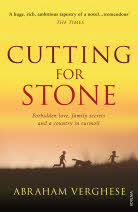
Verghese, Cutting for Stone

Bookcover (Used by permission of the Random House Group Ltd)

I  saw a man under the spell of his own tale, a snake charmer whose serpent has become his turban.

I’m not sure how I want to use the above quote, which comes late in the book, but I just liked it and so decided to start this post with it. Bear with me!

Discounting Dinaw Mengestu‘s short story, An honest exit, Abraham Verghese‘s Cutting for stone is the first novel I’ve read that’s set in Ethiopia (mostly). And for that, as much as for anything else, I enjoyed it. Also, in one of those eerily frequent experiences of reading synchronicities, this is the second book that I’ve read this year to deal with a long-standing dictator – and, even more eerie, is the fact that dictators in Africa are falling (sort of) around our ears at present. How do these things happen?

Anyhow, Cutting for stone is about as different from Mario Vargas Llosa‘s The feast of the goat as it could be. In the latter, dictator Trujillo is central to the story. He is the story really. In Cutting for stone Haile Selassie, and later Mengistu, provide the background. The characters are touched and, eventually, significantly affected by coups and unrest, but Selassie and his reign are not the subject of the novel.

So what is its plot? It is mostly set in an Ethiopian hospital, aptly, metaphorically, named Missing (a perversion of its original name, Mission). To this mission hospital come an English surgeon (Thomas Stone) via India and a young Indian nun (Sister Mary Joseph Praise), with rather cataclysmic results. Some time later (I’ll leave you to draw your conclusions) identical conjoined male twins named Shiva and Marion are born. The story follows their lives as they grow up, living through political upheavals while their adoptive parents, Hema and Ghosh, treat the sick and poor of the region, until one of them moves to the United States. Perhaps the best way to describe it is to quote Psychologies from the back cover: “a sweeping saga of family life, love, betrayal and redemption”.  Get the picture?

This is a traditional nineteenth-century-style novel, reminiscent, say, of Rohinton Mistry‘s A fine balance (1995). It’s about social conditions and family. The back cover (again) suggests it has flavours of Dickens and Waugh. Perhaps, but a weak flavour I’d say. While it has some of the intensity of those writers, it lacks their bite. I also found the fundamental crisis – which, not surprisingly given the set-up, has to do with a betrayal between the twins over a woman – to be not quite convincing. Maybe it’s me, but the narrator kept telling us of his love for the girl-then-woman in question, Genet, and I went along with it to a point. But it was never made clear how mutual this was. Marion is the narrator – this is a first person tale – and so we see it all through his eyes, but the whole “love” storyline did feel a little bit like a house of cards. Perhaps that’s the point? Perhaps it’s about his obsession regardless of whether it was realistic or not. It is, after all, partly a coming of age novel.

Verghese, like his main characters, is a doctor and so there is a lot of detail about things medical – about vena cavas and how they relate to the liver, about fistulas in circumcised women, about volvulus, and so on. More detail really than I needed, and yet most of it was interesting. What was even more interesting was the difference between the medical system in Africa and in the United States, and then the difference in the United States between the “Mayflower” hospitals and the “Port Ellis” hospitals. There are social messages here about the construction of medicine in the developed and developing worlds, and between the haves and have-nots. But this wasn’t the only message. According to Wikipedia, Verghese is passionate about “bedside medicine” and there is certainly a strong message here of caring for patients as well as treating them. Early in the novel the young Marion sits with a woman, Tsige, as her son dies. Much later, he is the one who can answer Thomas Stone’s question “What treatment in an emergency is administered by ear?”. The answer? “Words of comfort”.

Marion, then, as a child and a young doctor is well attuned to the feelings of others and yet he was unable to forgive all those who “wronged” him – Genet, his brother, and his birth father. I found that somewhat inconsistent with his character, and it affected my ability to fully buy  into the angst on which the plot turned.

Nonetheless, I liked the characters and so I kept reading, the story was interesting and so I kept reading, the writing was fine and so I kept reading. It doesn’t quite hang together, is a little melodramatic at times, but it’s a lively tale about characters I couldn’t help caring about. Early in the novel, we are told that Hema, who raises the twins, had:

come close to defining the nameless ambition that had pushed her this far: to avoid the sheep life at all costs.

The novel is full of characters who “avoid the sheep life”.

I started the review with Marion’s description of his father telling the painful tale of his life. I’ll end with the advice Marion’s adoptive father gives him:

The key to your happiness is to own your own slippers, own who you are, own how you look, own your own family, own the talents you have, and own the ones you don’t. If you keep saying your slippers aren’t yours, then you’ll die searching, you’ll die bitter, always feeling you were promised more…

Obvious stuff really, but that doesn’t mean that it doesn’t need to be said.

Abraham Verghese
Cutting for stone
London: Vintage, 2010
541pp.
ISBN: 9870099443636

Why I love Radio National

ABC Canberra radio and TV studios in the Canbe...

ABC studios in Canberra (Courtesy: Bidgee, using CC-BY-SA-3.0, via Wikipedia)

One of the best things about retirement for me is being able to listen to Radio National in the morning. For you overseas readers, Radio National is the national radio station of our national broadcaster, the ABC, Aunty, or, if you want to be formal, the Australian Broadcasting Corporation.

Here is the usual morning line-up:

  • 0830: a Report of some sort: the Health Report on Monday, the Law Report on Tuesday, Rear Vision (a look at matters historical) on Wednesday, Future Tense (change) on Thursday, and Movie Time on Friday.
  • 0900: Life Matters: a wide-ranging interview program devoted to current issues relating to social change and social policy, the things that affect our day-to-day lives such as education, health, the environment, and so on.
  • 1000: The Book Show: all things book-ish
  • 1100: Bush Telegraph: things rural and regional

The Book Show is of course of particular interest to me, and today’s show is a good example. It started with a discussion of the Blake Dawson Prize for Business Literature through an interview with Australian business and sports journalist Gideon Haigh who has won the prize in the past. I pricked my ears up for this one as I hadn’t really thought about business writing until I read Kate Jennings last year. Jennings though focused on business fiction. This prize considers the whole gamut of business writing, most of which is non-fiction. Haigh, for example, won in 2006 with his book Asbestos House about James Hardie Industries and the history of its dealings with asbestos (a topic well-known to Australians). Corporate histories (authorised and unauthorised) are not high on my reading priority, but this interview convinced me that I should not dismiss them (nor other types of business writing) cavalierly.

The next spot in the program was about the recent VIDA report on gender in book writing and reviewing. It shows a strong gender imbalance in both authors reviewed by and who does the reviewing at some of the top literary magazines in the US and UK – like Granta, the London Review of Books, the New York Times Book Review and so on. The Book Show decided to check out the situation in Australia and so approached three of Australia’s top literary editors: Susan Wyndham of the Sydney Morning Herald, Jason Steger of The Age and Steven Rommei of The Australian. These three (two men and one woman) did not do a thorough survey of their respective papers but they all found a gender bias, albeit not as pronounced as VIDA had found (which may be accurate or may be due to their less rigorous methodology). They admitted to not being fully aware of their own unconscious (until now) skewed practices – such as, for example, always offering serious history books to a male reviewer. It’s gobsmacking really just how ingrained this gender stuff is!

The problem, though, is less in the methodology than in interpreting the results – as the literary editors above discussed and as The Reading Ape raised in his post on the topic last week. There are so many questions to ask, such as:

  • are fewer women authors published than men and, if so, why?
  • are the books women write less likely to be reviewed by the mainstream literary papers and journals and, if so, why? (One person suggested that women write more genre books?)
  • are  there fewer women reviewers because they are less likely to put themselves forward as reviewers?
  • who are the literary editors (and their “bosses”), particularly in terms of gender, and what drives their practices?
  • how does the literary culture establishment’s bias (as shown in VIDA’s figures) relate to reading practices in terms of who actually buys and reads the books?

And then there’s the question about us, the bloggers: Who are we, in terms of gender? What are we reading and reviewing? What influence do we have?

(After all this, dare I admit that 60% of the authors I’ve reviewed here to date are male?)

Monday musings on Australian literature: The triumvirate

Flora Eldershaw

Flora Eldershaw, c. 1915 (Presumed Public Domain, from the National Library of Australia, via Wikipedia)

I’ve mentioned Marjorie Barnard in a couple of posts recently, but I suspect few Australians and even fewer readers from overseas (except of course Tony of Tony’s Bookworld) have ever heard of her. Rather than write specifically about her, though, I thought I’d talk a little about the Australian literary scene of the 1920s to 1940s, and about three writers in particular – Marjorie Barnard, Flora Eldershaw and Frank Dalby Davison.

I’m probably cheating here a little because, while I have read quite a bit about them over the last few years, I have read only a smidgin of their actual works. I’ve read (and re-read) Barnard’s The persimmon tree and other stories (1943) and Davison’s Man-shy (1931). I’ve dipped into Barnard and Eldershaw’s collaborative work A house is built (1929) and some of their other writings.

These three writers were part of a pretty active literary scene in Australia at the time. It included writers such as Vance and Nettie Palmer, Miles Franklin, Katharine Susannah Prichard (whom I reviewed recently), Eleanor Dark, Xavier Herbert and, yes, even, towards the end of the period, Patrick White. (Another contemporary, Christina Stead left Australia in 1928.) The reason I decided to start with these three is because of their friendship and “political activism”, mainly through the Fellowship of Australian Writers (FAW), which resulted in their being known for a time as “the triumvirate”. They were liberals who were concerned about the rise of Fascism in Europe – and the potential ramifications at “home”. Through them, in the late 1930s, the FAW engaged in political debate, particularly in relation to the protection of freedoms, such as that of speech. A topic, of course, dear to the heart of writers.

Barnard and Eldershaw wrote three novels, as M. Barnard Eldershaw, but they also wrote literary criticism and history. These days though, they are probably most read (when they are read at all) as early feminists. Neither Barnard nor Eldershaw married, though Barnard had an affair with Davison, and both lived independent lives supporting themselves through whatever work they could find. They were active in professional societies, judged literary competitions and edited anthologies. Eldershaw was a particularly skilled negotiator and worked hard to secure support for writers (via grants, pensions and other mechanisms). Vance Palmer admired Eldershaw for her ability to “neutralise conventional masculine expectations of the threat posed by women in ‘public life'”. At one stage they shared a flat, and held what could only be called a “salon”. It was attended by the literati of the day, including of course Davison.

That’s enough, though, of information you can pretty easily find in Wikipedia and other online sources. My aim here is to whet your appetite (I hope). I’ll finish with a quote from A house is built, which is set in mid-nineteenth century Sydney:

Her life was as full of ‘ifs’ as any woman’s. If she had not been so restricted, if her really considerable powers of mind and character had been given scope, Fanny would not have fallen victim to the first colourful stranger she met.

Barnard, it is reported, once said “Australia is still a man’s world”. I’d love to know what younger Australian readers of this blog think about Australia now – and whether anyone (besides Tony!) has read works by these three authors.

[Note: Some of the information for this post came from writings by Maryanne Dever whose PhD was on M. Barnard Eldershaw.]

Helene Hanff, 84 Charing Cross Road

Before you all (well, those of you of a certain age at least) gasp and wonder how it could be that I haven’t read this delightful little tome before, I assure you that I have. However, on our drive home today from our week at the coast, we listened to an unabridged audiobook version, and I can’t resist sharing some thoughts from this most recent acquaintance with the book.

For those of you who haven’t read it, 84 Charing Cross Road could I suppose be described as a sort of epistolary memoir. It comprises the correspondence between an American writer and bibliophile, Helene Hanff, and Frank Doel of Marks & Co, a London bookshop specialising in secondhand and antiquarian books. The correspondence starts in 1949 and covers the next two decades. Over time, others in the Marks & Co family join in, but the essential relationship is always that between bookbuyer Helene and bookseller Frank. In a horrible bit of blurb writing, it is described on the back of my (almost antiquarian itself) paperback as “the very simple story of the love affair between …”. Well, that cheapens it because it’s not a love affair in the usual sense. It’s a business relationship that also becomes a friendship. He is married, she is not … and no romance ever ensues.

I am not going to write a full review of the “story”, about how Helene sent “care packages” to the staff of Marks & Co to brighten up their postwar rations-ridden lives, about its humour and humanity. Rather, I thought I’d just share a couple of the comments she, a true bibliophile, makes about books and reading.

One is to do with marginalia. Hanff, like me, likes marginalia. She does it herself, and she likes it in the secondhand books she buys. She says in response to a book received as a gift:

I wish you hadn’t been so over-courteous about putting the inscription on a card instead of on the flyleaf . It’s the bookseller coming out in you all, you were afraid you’d decrease its value. You would have increased it for the present owner. (And possibly for the future owner. I love inscriptions on flyleaves and notes in margins, I like the comradely sense of turning  pages someone else turned, and reading passages some one long gone has called my attention to.) (16 April 1951)

Another year, another book gift, and here is her response:

I do think it’s a very uneven exchange of Christmas presents. You’ll eat yours up in a week and have nothing left to show for it by New Year’s Day. I’ll have mine until the day I die – and die happy in the knowledge that I’m leaving it behind for someone else to love. I shall sprinkle pale pencil marks through it pointing out the best passages to some book-lover yet unborn. (12 December 1952).

Hanff was clearly a slow-reader and liked re-reading, but she was not sentimental about books per se. Here she is on managing her books:

I houseclean my books every spring and throw out those I’m never going to read again like I throw out clothes I’m never going to wear again. It shocks everybody. My friends are peculiar about books. They read all the bestsellers, they get through them as fast as possible, I think they skip a lot. And they NEVER read anything a second time so they don’t remember a word of it a year later. But they are profoundly shocked to see me drop a book in the wastebasket or give it away. The way they look at it, you buy a book, you read it, you put it on your shelf, you never open it again for the rest of your life BUT YOU DON’T THROW IT OUT! NOT IF IT HAS A HARD COVER ON IT! Why not? I personally can’t think of anything less sacrosanct that a bad book or even a mediocre book. (18 Sept 1952)

Ellen of Fat Books and Thin Women would agree I think. Check out her recent post in praise of re-reading, and see for yourselves. Those of you who’ve been reading my blog for a while will know that I too am not averse to a bit of re-reading. There is a special joy in revisiting loved books and learning from them anew, isn’t there?

Finally, (only) because I’m missing my Jane Austen meeting today due to the aforesaid travel, I will share with you her discovery of Jane Austen. Hanff, you see, was not one for “stories”. “It’s just stories. I don’t like stories” she wrote in an undated letter around 1963/64. She preferred history (“i-was-there-books”), essays, poetry and the like. However, in 1952, she discovered Jane Austen “and went out of my mind over Pride & Prejudice …”. I’m sure I would have liked Helene Hanff.

Helene Hanff
84 Charing Cross Road (Audio CD)
Read by Juliet Stevenson and John Nettles
Hachette Audio (orig. pub. 1970)
2 hrs (approx) on 2 compact discs
ISBN: 9781405502559

Delicious descriptions from Down Under: Marjorie Barnard on the sun and heat

Marjorie Barnard

Marjorie Barnard (Courtesy: State Library of New South Wales, via Wikipedia)

My first Delicious descriptions post was from Barbara Hanrahan on the sun in Adelaide, so I thought we might travel to Sydney for this one. As it’s still in summer in our neck of the woods, here is Marjorie Barnard in The persimmon tree and other stories (1943), also on the sun – and its enervating effect:

In the wealthy suburbs of the North Shore and Vaucluse a change had taken place too. It was as if the earth had been squeezed so that all the fine houses that had nestled so comfortably in the contours and in the greenery, were forced up to the light. They bulged out, exposed, and the sun tore at them. The gardens that had embowered them were perished. Tinder dry, fire had been through many of them, scorching walls and blistering away any paint that remained. Most of these houses were empty or inhabited as if they were caves, by people who had come in from the stricken country. The owners had fled, not so much from present hardship, as from the nebulous threat of the future, the sense of being trapped in a doomed city. The shores of the harbour were lion-coloured or drab grey. Sandhills showed a vivid whiteness. Only the water was alive and brilliant. And it was salt. (from “Dry spell”)

I like her point that nature doesn’t discriminate (even though we know that, in reality, the well-off do often have the wherewithal to avoid its worst effects). And I love the last sentence – the short finality of it.

POSTSCRIPTS:

  1. I have been at the coast this week, and so scheduled my first two Delicious Descriptions for this time. I promise I won’t be bombarding you bi-weekly with these. (The dictionaries are confused! I looked up “bi-weekly” and it can mean both “twice a week”, as I mean here, of course, and “every two weeks”. How silly is that! Anyhow, perhaps “semiweekly” is the preferable term.)
  2. And Sarah (you Devoted Reader you), this one’s for you. May you experience no more such heat in Sydney this summer.

Delicious descriptions from Down Under: Barbara Hanrahan on the sun

When you read do you come across passages that you just want to hang onto forever – but (if you’re a blogger) when you go to write your blog review you can’t quite make them fit? I do, and have been pondering for some time what to do about it. Then, suddenly, it came to me. How about a series of posts comprising favourite bits from books (and other writing)? And so, “Delicious descriptions from Down Under” was born. The posts will be occasional – and some times more occasional than others – but I’ll just see where it takes me.

For my first one, I couldn’t go past Barbara Hanrahan‘s The scent of eucalyptus (1973) which I reviewed recently. It’s full of “delicious descriptions” but the one I wanted to share has to do with the Sun, with, specifically, hot sunny days in the city of Adelaide. I was in Adelaide on a scorchingly hot long January weekend many moons ago, and haven’t forgotten it. Here is Hanrahan:

Myilly Point, Darwin, shutters

Shutters

The sun is everywhere.

It is in the garden: peering huge-eyed over the berry bush, roosting behind the chimney, floating like a fried egg in puddles. It mocks me when I burn my bare feet on the earth and scorch my fingers on the iron fence. It peels my nose to jigsaw puzzles, gilds my skin with freckles, turns the hair on my arms to gold.

It is in the house: spangling the passage with leopard spots, turning the sheepskin rug tawny, casting zebra stripes through the shutters. It curdles the milk, melts the butter, shows the dust, fades the curtains. It steals into vases and drinks their water; creeps up the cold tap and turns it hot.

Such intense summer heat that goes on for days is typically – though not solely I know – Australian. I love the way she gives the sun life, the way she mixes up her imagery and yet consciously but not rigidly uses a symmetrical structure to make it read more like poetry than prose. It works beautifully – for me, anyhow.

Monday musings on Australian literature: The lost child motif

Lost

Lost, by Frederick McCubbin (Presumed Public Domain, from National Gallery of Victoria, via Wikipedia)

In his rather notorious review (1955) of Patrick White‘s The tree of man, Australian poet, A.D. Hope, at his caustic best, described the requisite features of the Great Australian novel (GAN). One of these was that it must include a child lost in the bush, a reference to the prevalence of this motif in Australian literature. The tree of man did not have such a plot line … but that wasn’t the reason Hope discarded its claims to be the GAN. Why he discarded these claims though is not the subject of this week’s Monday Musings, so let’s move on. The lost-child-in-the-bush motif can, in fact, be found throughout 19th and 20th century Australian cultural output – in literature, art and film.

My first introduction to “the lost child in the bush” story was through Banjo Paterson‘s tragic poem, “Lost” (1887):

The old man walked to the sliprail, and peered up the dark’ning track
And looked and longed for the rider who would never more come back.
The rider was a boy who had fallen from his horse and was never found, “for the ranges held him precious, and guarded their treasure well”. Oh the pathos! Around the same time that this poem was written, Australian artist Frederick McCubbin painted “Lost” (1886). It was inspired by the disappearance of 12-year-old Clara Crosbie, who was lost in the bush near Lilydale, Victoria, in 1885, but was found alive three weeks later.

One of my favourite representations of the motif is in John Heyer’s award-winning docudrama, Back of beyond (1954). It is about Tom Kruse, the Birsdville Track mailman who, every fortnight or so, made the 325-mile trip from Birdsville to Marree to deliver the mail. Inserted into this chronicle of a “typical” journey (it includes re-enactments to convey Tom Kruse’s “experience” rather than recording one actual trip) is a fictional story about two little girls becoming lost in the desert. The movie was sponsored by the Shell Oil Company with the aim of associating the company with Australia and Australianness! And so myths are made (or entrenched!).

A book I have not read (but have read about) is Charles Rowcroft‘s novel Tales of the Colonies (1843). It “features the tropes of the Aborigine as a flawless tracker or a treacherous murderer, as well as the already well-worn motif of the lost white child who falls into the hands of bushrangers and blacks”. I mention it because this idea – the lost white child and the Aboriginal tracker – is found in the most recent example I’ve experienced of the lost-child-in-the-bush idea, the short film One night the moon (2001) which was directed by indigenous Australian filmmaker, Rachel Perkins, and stars, among others, Australian musicians, Paul Kelly and Ruby Hunter.  This film’s main message is the refusal of white Australia to respect the skills and knowledge of its indigenous inhabitants – with tragic consequences. Rachel Perkins says that she wanted to make a film “about the space between black and white Australians”. How appropriate to use an age-old Australian motif for such a purpose.

Why this motif became particularly common in the Australian cultural landscape is a topic of much discussion, but the most common reasoning relates to the discomfort the early European settlers felt when confronted with a landscape that seemed harsh and alien. The fact that many of those children who actually became lost were those most familiar with the bush is perhaps the truth that spoils the story!

I’d love to hear about the motifs that run through your nation’s cultural representations – and from Australians who would like to add to my discussion here of the “lost child” motif. Do you have other examples to share?

Madeleine St John, The women in black

The women in black, Madeleine St John, book cover

The women in black bookcover (Courtesy: Text Publishing)

One thing mystified me as I started reading Madeleine St John‘s The women in black and that is why she would write a book in 1993 about 1950s? It seemed an odd choice. And then, as I read further, it started to become clear. The time period represents one of those cultural watersheds that nations experience. In this particular case, it was a time of social change: not only were things starting to change for women, but the “reffos” or “Continentals” (as the post-war European refugees were disparagingly called) were beginning to impact Australian culture.

St John chronicles these changes lightly, with warmth and gentle humour, but also with determination. It’s not a coincidence, I think, that St John, born in 1941, would have been around the age of the youngest character, Lisa/Lesley Miles, at the time the book is set.

Hmm … having introduced a character now, I’d better talk briefly about the plot. It centres around the women who work in the Ladies’ Cocktail Frocks and the more exclusive Model Gowns sections of a fictional (but thinly veiled DJs) upper crust department store in Sydney called Goode’s, and takes place over the few weeks before and after Christmas. Model Gowns is staffed by one woman, the Continental or reffo, Magda, while Ladies’ Cocktail is staffed by the middle-aged Miss Jacobs, the 29-year-old almost-on-the-shelf Fay Baines, the 31-year-old married-but-so-far-childless Patty Williams. There is also the buyer Miss Cartwright. Overseeing them all is, of course, a man, Mr Ryder. Into this mix is thrown 17-year-old Lesley (who changes her name to Lisa) Miles, who has just finished her Leaving Certificate.

The story is told in short chapters, each one devoted to one or more of these characters. The tone is (almost conspiratorially) conversational, which invites the reader in. St John draws her characters effectively through brief sections of perfectly caught dialogue and succinct but apt descriptions. The style is witty, with light wordplay and irony. Here are some excerpts from Chapter 2:

Mrs Williams was a little, thin, straw-coloured woman with a worn-out face and a stiff-looking permanent wave. Her husband Frank was a bastard, naturally.  [ …]

At the weekends she visited her mother or one of her sisters; Frank drove her there and fetched her, and while she was ‘jaw, jaw, jawing’ he played golf on the public course at Kingsford or drank in the pub. He was a bastard of the standard-issue variety, neither cruel nor violent, merely insensitive and inarticulate.

[…]  as she left the surgery, the physician looking idly at her back view thought, she’d clean up quite well with a new hairdo, some paint on her face and a black nightie; but the husband probably wouldn’t notice, the bastard …

By the end of chapter 2 I was hooked. In three and a bit pages we were told all we needed (and probably more than we wanted) to know about poor little Patty Williams and her bastard of a husband. But Patty’s is just one story. There’s also Fay Baines who’s desperate to be married but meets all the wrong men through her well-meaning night club manager friend, Myra; and Lisa Miles who expects to do well in her end-of-school results but whose father thinks women have no business at university. Into this mix are thrown the outgoing, confident (but “god awful” to the women in black) Magda and her also Continental/reffo husband Stefan.

Magda takes an interest in Lisa and invites her home. She also tries a little matchmaking with Fay. Meanwhile, Patty does try that black nightie, with consequences she would never have foreseen. It could all go horribly wrong but, without spoiling anything too much, I’ll simply say that St John’s book follows, loosely and more lightly, the Jane Austen tradition, that is, it’s a comedy of manners. Unlike Austen though, she’s writing in an historical, rather than contemporary, time-frame, and so has a slightly different goal in mind – and that is documenting the social change I mentioned in my opening paragraph.

Two simple examples of this are “kissing” between friends, and food. Here is Lisa on “kissing”:

And she [Magda] kissed her on the cheek. Lisa smiled shyly at her. I’ve heard she thought, that Continentals kiss each other much more than we do: it means nothing. They do it all the time, even the men. The men even kiss each other.  But how strange I feel.

This little paragraph struck me; I realised that my friends and I kiss each other in greeting but it was not, I think, the norm among my parents’ generation. In one or two generations, in fact, the often-maligned (in the book and in reality at the time) Continentals had effected quite a change. And then there’s the food. By the end of the book, Lisa, Fay, and even Lisa’s father had tasted and enjoyed such exotic foods as salami. And again I reflected on the immense change in diet from my parents’ to my generation.

I won’t tell you more of the story. It’s a gentle one, but there is a drama concerning Patty, and some little tensions surrounding Fay and Lisa, that keep the book moving while it observes a society in change. There are some perfect descriptions of Sydney, such as this of the women coming to do their last minute Christmas shopping:

From the wooded slopes of the salubrious North Shore to the stuccoed charm of the Eastern Suburbs, from the passé gentility of the Western ditto to the terra incognita of the Southern had they travelled by train, bus, tram and even taxi cab to this scene of final frantic activity.

It’s a book almost of vignettes than of fully realised stories, and there’s the odd clumsy or heavy-handed bit, but St John has nonetheless managed to convey a convincing picture of Australian society at the time, while also telling an engaging and generous tale. And, just to show she has a sense of humour, St John, who was a libertarian at university, injects near the end her own little in-joke. Here is Lisa’s father on the possibility of her going to university:

But I’ll tell you one thing: if I decide you can go, and you do go, if I ever hear of you being mixed up with any of those libertarians they have there, you’re out of this house like a shot and I never want to see you again, is that understood? Right then. If you go, no libertarians, not even one.

I wonder what St John’s father – the prickly politician Edward St John – said to her!

Lisa at ANZLitLovers has also reviewed the book.

Madeleine St John
The women in black
Melbourne: Text Publishing, 2010 (orig. 1993)
234pp.
ISBN: 9781921656798

(Review copy courtesy Text Publishing)