Monday musings on Australian literature: The beach

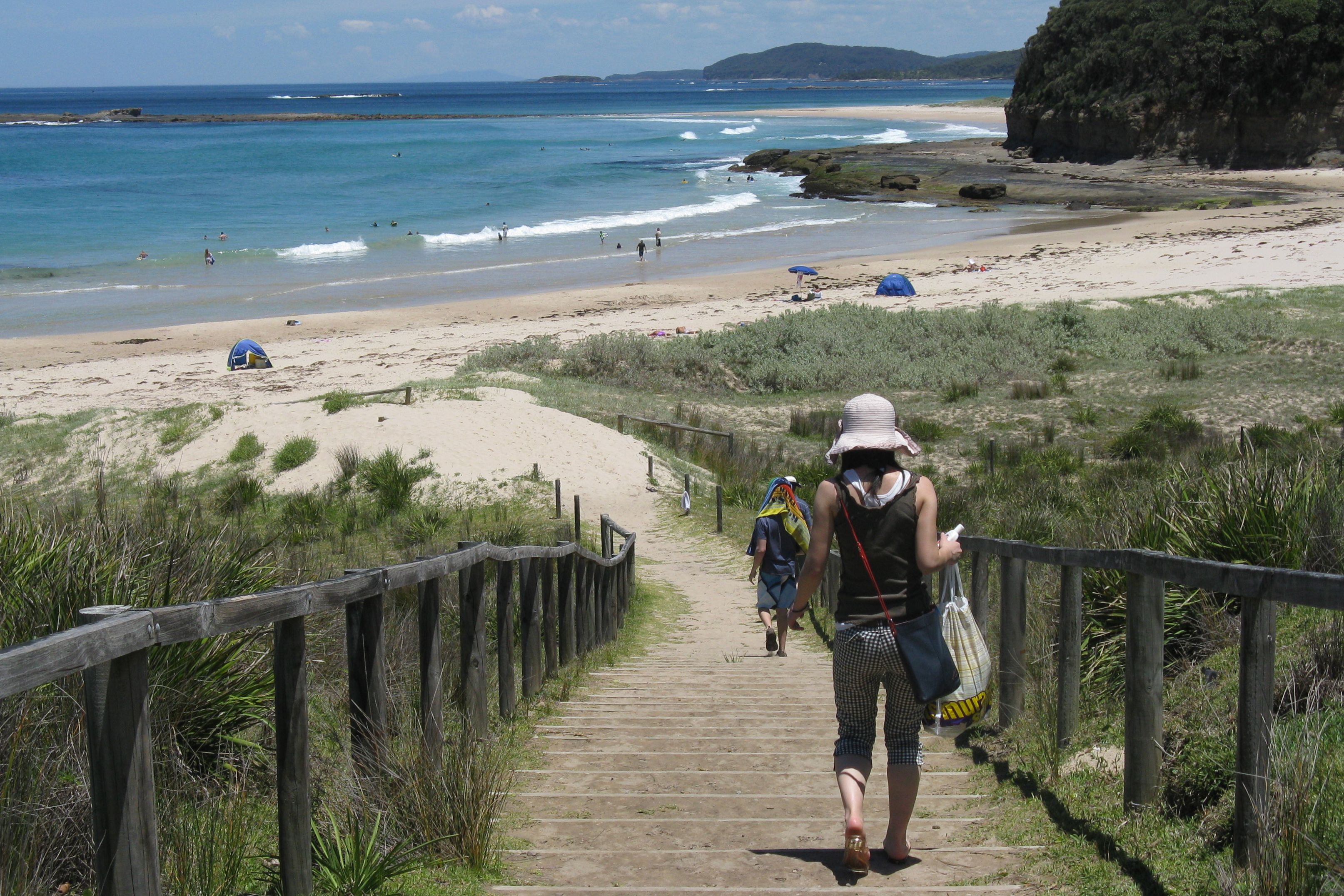
South Coast Beach, NSW

South Coast Beach, NSW

Not only do the majority of Australians live in urban areas but, given that much of Australia is dry, the majority of these urban areas are on the coast. You can guess what’s coming next – yes, the majority of Australians live near the sea. And, if they don’t, they gravitate to it in their holidays. (Australia has, it must be said, one of the highest skin cancer rates in the world.)

The sea and the beach therefore are another significant aspect of Australian cultural identity … and probably the best known contemporary writer about the beach is Tim Winton. Breath is his most recent novel, but most of his works are set in coastal areas and deal in some way with their characters’ relationship to the beach. For Winton, the beach and the surf stand for – not to beat around the bush – the meaning of life. In an interview with surfing writer Tim Baker, he says:

To me, surfing has always been soul-business. It’s the pointless things that give your life meaning. Friendship, compassion, art, love. All of them pointless. But they’re what keeps life from being meaningless. Catching a wave and turning and dancing and looping in toward the beach is one of the nicest forms of pointlessness I can think of.

That’s not to say that the beach is always positive in his work. The people who populate the stories in The turning, for example, live pretty disappointed lives in their coastal town/s. Nonetheless, when we think of Winton, it’s the love that tends to come through in the end. This love has apparently been explained in his recent memoir Land’s edge (2010), in which, according to the promos, he “records his life-long affair with the sea”. This is a book I must read.

Robert Drewe, like Winton, is based in Western Australia and writes regularly about the beach. His memoirs, novels and short story collections include The shark netThe bodysurfers, The drowner, and the The rip. He also edited The Penguin (originally, Picador) book of the beach. He, like Winton, claims to be drawn to the beach, but his books and stories explore the dangers and traps (as is pretty obvious from some of the titles!) of the beach and sea, as well as the beauty. Here is one character in The bodysurfers:

Parnell gave the impression he was king of the beach as well as of the mutton birds. He was what used to be known as a man’s man, meaning that he was a hearty male chauvinist … (from “The silver medallist”)

and, another

The coast is not what I expected. Not only is the pace faster, but there is a careless violent hedonism that astonished me at first. … When I can’t face the beach night-life, the coarse aimless lives, I close my window … (from “Shark logic”)

This mention of hedonism reminds me of the way the beach can draw into sharp relief our Western culture’s obsession with body image. Here is poet Les Murray in “On Home Beaches”:

Back, in my fifties, fatter than I was then,
I  step on the sand, belch down slight horror to walk
a wincing pit edge, waiting for the pistol shot
laughter …

So far this post has been male-dominated but there is one particularly well-known “beach” book (and later film) by women writers, and that is Puberty blues by Gabrielle Carey and Kathy Lette. It’s about two teen girls who want to become part of the cool, in-crowd on the beach, the surfie gangs, and is pretty critical of peer group pressure and male chauvinism. It’s a long time since I’ve read (and seen) it but I still remember the pain of their desperation to belong.

Hmmm … I think I have somehow managed to convey more negatives than positives about the beach and beach culture in Australia, so perhaps I will return to Winton (and Breath) to end on a high note:

I will always remember my first wave that morning … I leant across the wall of upstanding water and the board came with me as though it was part of my body and mind. The blur of spray. The billion shards of light. I remember the solitary figure watching on the beach and the flash of Loonie’s smile as I flew by; I was intoxicated. And though I’ve lived to be an old man with my own share of happiness for all the mess I made, I still judge every joyous moment, every victory and revelation against those few seconds of living.

Now is the time for me to ‘fess up. I am not really a beach person – but if anyone could convince me, it would probably be Winton.

Wikipedia wants YOU (if you’re a woman)

Wikipedia has turned 10 – as I’m sure you’ve heard by now. Like all good organisations celebrating an anniversary, it is engaging in a little navel-gazing – and discovering some interesting things. To wit …

Gender symbols

Gender symbols (Courtesy:CKSinfo.com)

Yesterday the thoughtful Stefanie of So many books emailed me an article from The New York Times because she remembered that I’d mentioned being a Wikipedia contributor. Thanks a bunch Stefanie. I  thoroughly enjoyed the article, which is titled Define gender gap? Look up Wikipedia’s contributor list.

It turns out that I’m a rare beast. According to the article, only about 13% of Wikipedia contributors (editors) are women, and the average age of contributors is the mid-20s. I cannot tell a lie. I am in fact somewhat older than that and, if you haven’t guessed already, I am a woman.

How does this finding accord with my experience? I have, over the last three years, attended two Wiki meet-ups in my city. At both there were two or three women to the ten or so men. Hmm … a bit better than 13% but not much. It was certainly a disproportion I noticed. As for age, I would have to say that the majority were over 30 years old …

Anyhow, Sue Gardner, the executive director of the Wikimedia Foundation suggests that her goal to increase the percentage of women contributors is

running up against the traditions of the computer world and an obsessive fact-loving world that is dominated by men and, some say, uncomfortable for women.

There is probably some truth in this. Contributing to Wikipedia is not hard, technically speaking, but it can be daunting if you are a little unconfident and nervous around technology. And, I suppose, the whole premise of an encyclopedia is to provide facts – not opinions – about subjects, though really it’s a little more organic than that. Some subjects – at least those I’m interested in (but I’m a woman of course!) – are not black and white. Take literature, for example. An article about a writer needs to provide the facts of that writer’s life – a general biography – but it should also provide a sense of their work and here there is some opportunity to explore a range of ideas about that writer’s style, themes, and so on. These ideas need to be researched and cited so that users can trust it, but it is more than a simple recitation of facts. Wikipedia’s principles require that your work not be “original” but that doesn’t mean that it has to be a dry recitation of facts.

However, there are other factors, besides these two, that may discourage women – and one is that Wikipedia can be a fairly aggressive place. While there are a lot of enthusiastic, friendly and helpful contributors and administrators in Wikipedia, there is also more aggro than I expected. It is not pleasant when you are a new contributor to be rather abruptly or rudely called to task for what is a misunderstanding or an honest mistake. It is also not pleasant – whether you are new or not – to get caught up in an article controversy where contributors spend more time insulting each other than working out a compromise. I have experienced both. These are things that women, perhaps, are less willing to put up with? I’ll say no more on this – but hope that Wikimedia executives, trolling the web, might just come by and add it to their things to think about.

All this, though, begs the question: Does it matter if most of the contributors are young males? Well, yes, I think it does. And Sue Gardner does too. She gives several examples of “gender disparity” in terms of emphasis. I’ll repeat just one that would interest litbloggers. She checked the article, she says, on one of her favourite writers, Pat Barker (the author, readers here probably know, of the Regeneration trilogy). Barker’s article at the time comprised three paragraphs. By contrast, the article on Niko Bellic was about five times as long. Niko Bellic, if you don’t know, is a character in the video game Grand Theft Auto IV! Need I say more? (Get your value judgements free here!)

So, what does Sue Gardner plan to do about the problem? Well, she plans “to use subtle persuasion and outreach though her foundation to welcome all newcomers to Wikipedia, rather than advocate for women-specific remedies…”. She says:

Gender is a hot-button issue for lots of people who feel strongly about it … I am not interested in triggering those feelings.

Doesn’t that just about say it all!

Freedom, a postscript

In one of those wonderful bits of reading synchronicities, I woke up this morning to read about US District Judge Roger Vinson declaring ObamaCare unconstitutional. Florida Governor Rick Scott (among others) agrees, saying that: “ObamaCare is an unprecedented and unconstitutional infringement on the liberty of the American people”. Those of us in other parts of the world wonder how much America is, in the end, willing to pay for this liberty. I hope it won’t be too much.

Anyhow, I did a little digging around … and came across an undated YouTube interview with Michael Badnarik on the blog of the Foundation for a Free Society. He was asked what Freedom means to him, and this is what he said:

It means not having any government involvement … I don’t need and don’t want the government helping me, making decisions it thinks are in my best interest.

And in the next sentence or two he mentions various apparently un-free things like drivers’ licences. Hmm …

He goes on to mention a wide range of issues, many of which bear good discussion but not, it seems, in his mind. Freedom, I know, is not a simple thing. I value it, but …

… here’s the thing (as I see it) – Jonathan Franzen touches on it but just doesn’t quite nail it – and that is that “no (wo)man is an island”. John Stuart Mill said that:

That the only purpose for which power can be rightfully exercised over any member of a civilised community, against his will, is to prevent harm to others …

and

The only freedom which deserves the name, is that of pursuing our own good in our own way, so long as we do not attempt to deprive others of theirs, or impede their efforts to obtain it.

In other words, Freedom is not an absolute concept … we are human (read “social”) beings and that, to me, involves responsibilities as well as rights. Responsibilities that, by definition, limit our freedom. Don’t they?

Finally, I write this post nervously – it is simple, and the concept is complex. I know that, and have no answer except one. Freedom cannot be absolute and surely must be discussed in that context. Otherwise, isn’t it a little paradoxical for the proponents of freedom to be arguing it absolutely?

Jonathan Franzen, Freedom

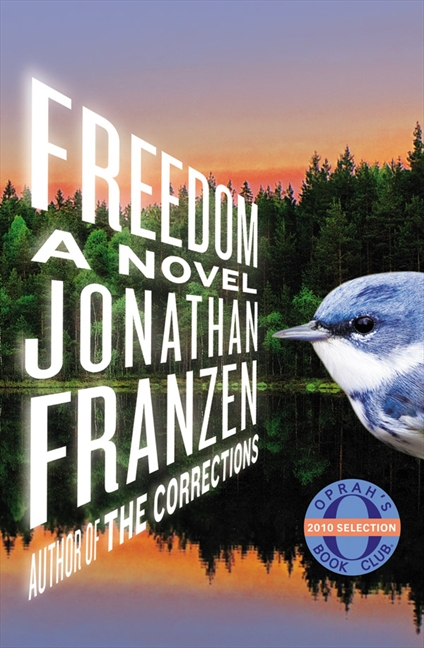
Freedom bookcover, by Jonathan Franzen

Freedom bookcover (Courtesy: HarperCollins Australia)

Hmm … where to start? Half way through this book I was tiring. I wanted to say to Franzen “Enough already” (which, if you’ve read the book, has a certain appositeness). I also started to think of those song lines, so well-known to my generation:

Freedom’s just another word for nothing left to lose.

In fact, I thought of starting this post with that quote, but decided it would be just a little too twee – but somehow it ended up in the first paragraph nonetheless.

In some ways, Jonathan Franzen‘s latest novel, Freedom – which I must be the last blogger to read – is an interesting companion piece to Peter Carey‘s Parrot Olivier in America. They are wildly different in tone, style and historical setting but both explore the foundation upon which America is based, that of freedom of the individual. America tends to parlay this word about a little too, shall I say, freely, a little too unaware at times that freedom is not a simple concept but one that needs to be modified by a few “ifs” and “buts”. It’s these “ifs” and “buts” that confront Franzen’s characters, and that are recognised in those now immortal song lines. In other words, what Franzen’s characters find is that freedom in and of itself is no great shakes. It cannot exist in a vacuum …

But first, the plot. It chronicles the relationship of nice-guy Walter and mixed-up Patty Berglund (and, along the way, their family and friends). The opening paragraph starts around the middle of the chronology, with a rather teasing statement that Walter “had made a mess of his professional life” and then tracks back a few years to the early years of Walter and Patty’s marriage, before tracking back further to their youth and courtship, and then returns to the starting point and on to their future. Through this journey, Walter and Patty, residents of the Twin Cities, grow up, get married, have children, move east, get into a range of “pickles”, and … but that would be telling so I’ll leave the plot there.

It’s a rather complicated structure that owes a lot to postmodernism with its forwards-backwards movement, stories within a story (that is, Patty’s autobiography, told third person, in two distinct parts), a certain intratextuality (such as Patty’s autobiography being read by characters in the novel), the odd font change, and shifting points-of-view. It’s not, however, postmodern in its concerns – and is instead rather earnest, which is part of its problem. I’m not saying that it needs to be postmodern – we don’t need more self-conscious irony and clever playing with the idea of fiction – but it needs something fresh and challenging in characterisation, language and/or tone to carry it right through its 560 pages. Instead, it gets bogged down in too much earnest detail about life in modern America. It’s as though Franzen had a lot of things he wanted to say – about middle-class life, parenting, education, the environment, gentrification, politics, and music – and he was darned sure he was going to say them. We get, therefore, references to 9/11, Cheney and Bush, the war in Iraq, Obama, hints about the GFC, and so on. It’s a bit like Dickens, but without the sustained satire.

That said, there are some funny set pieces, such as the interview Richard (Walter’s friend and rival, and also lately successful rock star) gives to a young fan who wants to use Richard to attract a girl. Richard likens rock music to making chiclets, to being part of not against corporate, capitalist America. And I did love the description of why Walter preferred the aggressive driving of his young assistant, Lalitha, to driving himself:

Walter had come to prefer the anxiety of being her passenger to the judgmental anger that consumed him when he was at the wheel – the seemingly inescapable sense that, of all the drivers on the road, only he was traveling at the right speed, only he … [and on it goes for a page of road-rage inducing complaints].

But, getting back to the main game, what is this “freedom” all about? Most of the characters yearn for and/or experience freedom of one sort or another – they want to live their own lives their way. This can include not working, following one’s own heart regardless of the needs of those around you, having sex with whomever whenever you please, not being responsible for others, not doing the hard yards. And most find that the end result is not a satisfying one.

Walter, whom I presume is Franzen’s main mouthpiece, says:

The reason the system can’t be overthrown in this country … is all about freedom. The reason the free market in Europe is tempered by socialism is that they’re not so hung up on personal liberties … The Europeans are all-round more rational, basically. And the conversations about rights in this country isn’t rational. It’s taking place on the level of emotion, and class resentments, which is why the right is so good at exploiting it ..

This makes sense to me … but, the thing is that there are so many references to freedom that it is hard to locate the main message. This one is political. There are also more personal messages. Here is a description of Walter’s grandfather:

(The personality susceptible to the dream of limitless freedom is a personality also prone to, should the dream ever sour, to misanthropy and rage.)

And of Walter’s father:

He hated the blacks, the Indians, the well-educated, the hoity-toity, and especially, the federal government, and he loved his freedoms (to drink, to smoke, to hole up with his buddies in an ice-fishing hut) the more intensely for their being so modest.

We see parents giving children a “free pass” only to find those children, such as Walter’s brother Mitch, being a “free man” in the sense that he has no home, no secure job, no responsibilities. We see men, like Richard and Joey, thinking the freedom to have sex with anyone anytime will make them happy, but Joey, for example, after an amusing (to the reader!) scene in which he tries to live his fantasy, discovers who he really is:

This wasn’t the person he thought he was, or would have chosen to be if he’d been free to choose, but there was something  comforting about being an actual definite sometime …

And at this point he starts to grow up …

There is a lot to enjoy about this book, despite its bagginess. The characters do engage, flaws and all, and Franzen’s heart is, for me, in the right place. When I got to the end, I smiled and felt that Franzen had achieved something, even if it is simply to show that Freedom is a far more complicated concept than people like to think.

Jonathan Franzen
Freedom
London: Fourth Estate, 2010
562pp.
ISBN: 9780007318520

Monday musings on Australian literature: Outback continent, urban culture?

I am sitting in my dingy little office, where a stingy
Ray of sunlight struggles feebly down between the houses tall,
And the foetid air and gritty of the dusty, dirty city
Through the open window floating, spreads its foulness over all

(From “Clancy of the Overflow“, by Banjo Paterson)

Sydney Skyline

Sydney Skyline

In “Clancy of the Overflow”, Banjo Paterson opposes the freedom of Clancy’s droving life to the narrator’s dull life in the city: “For the drover’s life has pleasures that the townsfolk never know”. This poem popped into my mind recently and made me realise that it was time I came clean. You see, I suspect I’ve been misleading my non-Aussie readers with all my posts about our sunburnt (or not) country, our gum trees, bell-birds and the like. You might, just might, have been led to believe that we Aussies are an outback, country-sort of people, but that is far from the truth. We are in fact a highly urban nation: while our population density is around 2.6 people per square kilometre, some 89% of us live in urban areas (capital and regional cities).

So, how is this reflected in our literature? Well, I’m going to look at just five examples, chronologically, starting with the late nineteenth century.

1892: William Lane’s The workingman’s paradise

is set in Sydney, though the two protagonists come from the bush, and one still works primarily on the land. It’s a political novel focusing on improving conditions for the poor in Sydney, and for shearers in the outback. The bulk of it though is about Sydney where “the streets, some wider, some narrower, all told of sordid struggling”, a Sydney that is somewhat similar to that described by Ruth Park half a century later. That is, one in which the poor struggle, in which the beauty so loved by tourists is rarely seen.

1943: Marjorie Barnard‘s The persimmon tree, and other stories

is not her most famous work but is one of that small number of books that I’ve read twice. The themes are universal – love, loss, disappointment – but they are mostly told in an urban setting. A newly widowed woman buys a new hat, a young girl buys a new dress for a special date, people meet in buffets and tea rooms, a woman goes to a party in a

block of flats. The imitation stone stair-case, mock baronial, mock grandeur, and behind the closed doors with their heavy antique knockers the same ordinary little flats … it is shattering to go up to a smug, unknown door and ring the bell, knowing that a party lurks behind it.

1948: Ruth Park‘s Harp in the south

which is set in the slums of Sydney, was controversial when it was published because of its realistic portrayal of urban poverty and the struggles that accompany living in such conditions. There were those who felt she was fostering a “cult of ugliness” and that no good could come of it. Little did they know that 60 years later this book would be regarded as an Australian classic.

1977: Helen Garner‘s Monkey grip

is also now regarded by many as an Australian classic. It’s set in inner city Melbourne, in the “bohemian” home of musicians, students, actors and, yes, drug-takers. Helen Garner’s characters – particularly her women – strive to live independent lives that are not bound by societal constrictions, the sort of lives that are hard to live in the more conservative country or the ‘burbs.

2009: Christos TsiolkasThe slap

is, by contrast, set in the ‘burbs – of Melbourne. It explores a wide range of “issues” typical (more-or-less) of middle-class suburbia. You know what they are:  relationships, employment, education and politics, not to mention aging, drugs and sex. And they are played out in backyards, workplaces, carparks, bars and all sorts of homes ranging from modest bungalows to the mansions of the nouveau riche. The setting is modern Australia – but many of us hope that the people are rather less so!

According to the Australian Government Culture Portal, Australia was well-urbanised by 1910 … and our literature to some degree reflects that. Yet, the idea of “the bush” doesn’t go away – and is still highly visible in our literature. I can think of no better recent example than Murray Bail‘s The pages (2008) in which sophisticated city meets pragmatic country. Paragraph 2 starts with two women setting out from Sydney:

They were city women. Comfortably seated and warm they were hoping to experience the unexpected, an event or person, preferably person, to enter and alter their lives. There is a certain optimism behind all travel. The passenger, who wore a chunky necklace like pebbles made out of beer bottles, had never been over the mountains before. And she was forty-three. Directions had been given in biro, on a page torn out of an exercise book. It would take all day getting there. Over the mountains, into the interior, in the backblocks of western New South Wales, which in the end is towards the sun.

Need I say more?

Mario Vargas Llosa, The feast of the Goat

Mario Vargas Llosa, signing books

Mario Vargas Llosa signing books in 2010 (Courtesty: Daniele Devoti, via Wikipedia, using CC-BY-2.0)

If Nobel Laureate Mario Vargas Llosa‘s The feast of the goat had been a traditional historical novel, chances are it would have started with the assassins concocting their plan and then worked chronologically to its logical conclusion. But, it is not a traditional historical novel, as is reflected in the structure Vargas Llosa has chosen to tell his story.

Before we get to that though, the plot. The central story revolves around the dying (literally) days of the 30-year Trujillo (“the Goat”, “the Benefactor”, “the devil”) regime in the Dominican Republic. This means the main action takes place in 1961. However, overlaying this is the perspective of Urania, the daughter of one of Trujillo’s head honchos. She’d left the country days before the regime ended and cut herself completely off from her father – for thirty-five years, until her sudden return at the novel’s start. The novel is told from these two time perspectives – 1960/61 and 1996 – and from multiple points-of-view*, the main ones being:

  • Urania
  • Trujillo
  • The conspirators/assassins

But this isn’t all there is to this novel’s structure and narrative style. I’m not quite sure how Vargas Llosa gets away with it, but he has written a book that is very accessible (once you get across the intricacies of Latin American names) and yet also rather complex. This complexity is found, primarily, in the structure. The book can, essentially, be divided into two parts. Chapters 1-16 proceed pretty systematically, cycling through, in turn, the stories of Urania, Trujillo (usually with one of his offsiders), and the Conspirators (usually focusing on one of them in particular). By Chapter 16 the two major crises of the book have occurred or been introduced. The last 8 chapters continue to cycle through different points-of-view but not in the same systematic order. In other words, the narrative structure becomes erratic and the rhythm more urgent, as chaos and uncertainty take over.

And yet, there’s more. For example, the novel is told primarily in third person, with the point-of-view changing chapter to chapter. But, every now and then, for just a sentence or two, or maybe a paragraph, the voice lapses into second person. This happens most often with Urania and conveys the sense that there has been some trauma that she hasn’t been able to fully integrate/recover from. We discover the origins of this trauma in Chapter 16, but it is not fully revealed until the last chapter.

… You were still a girl, when being a girl meant being totally innocent about certain things that had to do with desire, instincts, power, and the infinite excesses and bestialities that a combination of those things could mean in a country shaped by Trujillo. She was a bright girl … (Chapter 16)

This little slip into second person in Urania’s story is telling.

Okay, so this is the architecture, the behind-the-scenes technical stuff, but why write it this way? Well, the reasons are intellectual and emotional. Intellectual in that the multiple alternating points-of-view enable us to get a number of “stories” first hand. Through the eyes of the perpetrators and the disaffected, we explore the regime, and how, as happens so often with dictatorships, the early benefits are gradually (but surely) overshadowed by the corruption and violence perpetrated to maintain power, and how this leads to the assassination conspiracy. And emotional in that the constant shifting in perspective, particularly from people we can trust to those we can’t (to the best of our knowledge), and back again, unsettles and discomforts us … just as those who lived through the regime were kept on edge.

It’s impossible, without writing a thesis, to cover all the angles in this book, so I’m just going to look at one more – the characterisation of Trujillo himself. A historical novelist (rather like a biographer) has to choose what to include and what to exclude when describing a person. Vargas Llosa was lucky, really, that Trujillo had some traits that made this choice rather easy, traits that work on both the literal level and the ironic and metaphoric. Fairly early in the novel is this description of Trujillo

…that master manipulator of innocents, fools, and imbeciles, that astute exploiter of men’s vanity, greed and stupidity.

Fairly typical, wouldn’t you say, of a dictator? But, Trujillo was also fastidious about cleanliness and appearance, believing that

Appearance is the mirror of the soul.

If that’s so, then Trujillo’s “soul” is a very superficial thing because his disdain for the rights and feelings of others is palpable. Throughout the novel, Vargas Llosa sets Trujillo’s obsession with personal care (“the man who did not sweat, did not sleep, never had a wrinkle on his uniform, his tuxedo, or his street clothes”) against the coldness of his mind. That his mind is cold is made perfectly clear through his attitude to his offsiders (whom he liked to scare – “it cheered him to imagine the sizzling questions, suppositions, fears, suspicions he put into the head of that asshole who was the Minister of the Armed Forces”) and to women. This regime values machismo above all: it’s brutal to those those less powerful, and has careless disregard for the innocent. Women, of course, bear the brunt:

Again the memory of the girl at Mahogany House crossed his mind. An unpleasant episode. Would it have been better to shoot her on the spot, while she was looking at him with those eyes? Nonsense. He had never fired a gun gratuitously, least of all for things in bed. Only when there was no alternative, when it was absolutely necessary to move this country forward, or to wash away an insult.

Trujillo was nothing if not a master of self-justification.

How it all falls out, what happens after Chapter 16, is both expected and unexpected as those involved do or don’t do what they’d committed to. The end result is a devastating portrayal of how the political becomes the personal! Not a new message, perhaps, but The feast of the Goat is a compelling read that engaged my heart and mind. I recommend it.

Mario Vargas Llosa
(Trans. by Edith Grossman)
The feast of the goat
London: Faber and Faber, 2002
475pp.
ISBN: 9780571207763

* As in most historical fiction, the novel is peopled with historical characters and fictional ones. Most, in fact, are historical but Urania and her father, though based, I understand, on real people, are fictional.

David Mitchell, Earth calling Taylor

Fist full of money

Money, money, money (Courtesy: OCAL from clker.com)

And now for something a little different from novelist David Mitchell, a short story titled “Earth calling Taylor”. You can read it online at FT.com. FT.com is the online version of the Financial Times, so it’s not surprising that Ryan Taylor, the protagonist of the story, works in the finance industry. The story starts with Ryan waiting to hear whether he has received the promotion to portfolio manager that he’s expecting.

The scene then shifts to a hospital, where Ryan joins his mother and step-siblings to visit his father who is recovering from a fall. It seems to be a happy and supportive family – they are sitting around the bed, squabbling with the father, who is clearly “on the mend”, over a game of Scrabble. His brother, Jason, is (“only”, says Ryan) a speech therapist and his sister is a successful lawyer in human rights areas, while Ryan, as we know, works at the more self-centred, self-serving end of the occupation spectrum.

And, he’s edgy, so he leaves them, on a flimsy excuse, to go check for messages on his Blackberry. He’s not a very appealing character – he blatantly and unrepentantly fantasises about a nurse in the lift, he wishes for a little cocaine to settle himself down while swigging some hard liquor from his hip flask, he jumps to the wrong (read, negative) conclusions about people, he throws a tantrum when the expected message doesn’t arrive, and so on.

Running through the main narrative are intonations by his boss Calvin Hathaway on such subjects as “wanting” (in an uber-capitalist meaning of the word) and a little third person, somewhat mock-heroic, tale in which Ryan stars as himself:

The crowd went wild. King Ryan is anointed.

Rather puerile, eh? When he reads his Blackberry messages and, with only one to go, still hasn’t received the hoped-for message, he thinks “suddenly I’m down to my last life”. An appropriate pop culture allusion that mocks his intensity.

Fortunately, our Ryan is not all bad. Set against his comparatively minor concerns are some characters with real miseries in their lives, providing a nice contrast with his petulance over the “will-I-won’t-I” promotion problem. And, he shows that he can in fact evince some empathy for others, such as for an old, sick woman in hospital. “I’ll be her, one day” he thinks, and responds kindly to her. However, when she calls him “a very kind young man”, he thinks that that’s not an “accusation” he hears at his workplace.

The resolution, though formally open-ended, is somewhat predictable and yet, due to the various undercurrents Mitchell has injected into the story, you want to keep thinking after you’ve finished reading. By rounding out Ryan just a little, Mitchell encourages us to feel some sympathy for him at the end, even though we think that his values are rather skewed.

The irony is that the story takes place on New Year’s Eve – but, we wonder, will Ryan make the most of his new start (whatever that turns out to be)?

Monday musings on Australian literature: the Great Australian Novel, or?

Henry Handel Richardson in 1945, a year before...

Henry Handel Richardson, 1945 (Presumed Public Domain, via Wikipedia)

First, a confession. I am not one who believes we need to define such a beast as “The Great [name your country] Novel”. However, just to be perverse, I thought that for this week’s Monday musings it would be interesting to look at what might qualify for such a label – and, in doing so, consider what might constitute an Australian canon.

A canon gets us away from having to define the “Great Australian Novel”*, from having to decide whether it must be written by an Australian, must reflect “Australia” in some sort of specific way. In fact, on the latter, Professor Gelder, a literature professor from Melbourne argued in 2009 that globalisation and transnationalism make “the great Australian novel” “almost impossible”. This is because he defines the GAN in terms of being “a nationalist project”. And, perhaps, that’s the only way you can define a GAN. A canon, on the other hand, can be more diverse, can reflect the variety – in space, time, theme, and so on – that makes up our – and, any, really – national literature.

Without getting into the pros and cons, rights and wrongs, of polls, I thought I’d list the top ten Australian books (mostly novels) from  three different and reasonably recent polls to see what they tell us.

Poll 1: The Australian Society of Authors Top 10 as voted by their members in 2003:

  1. Cloudstreet (1991), Tim Winton
  2. The man who loved children (1940), Christina Stead
  3. The fortunes of Richard Mahony (1930), Henry Handel Richardson
  4. Dirt music (2001) Tim Winton
  5. Voss (1957) Patrick White
  6. The tree of man (1955), Patrick White
  7. The magic pudding (1918), Norman Lindsay (children’s)
  8. An imaginary life (1978), David Malouf
  9. Tirra lirra by the river (1978), Jessica Anderson
  10. My brother Jack (1964), George Johnston

Poll 2: The Australian Broadcasting Corporations’s Top 10, as voted by Australians via ABC promotions in 2003:

  1. Cloudstreet (1991), Tim Winton
  2. A fortunate life (1981), AB Facey (memoir)
  3. Dirt music (2001),Tim Winton
  4. My brother Jack (1964), George Johnston
  5. The magic pudding (1918), Norman Lindsay (children’s)
  6. The tree of man (1955), Patrick White
  7. Seven little Australians (1894), Ethel Turner (children’s)
  8. The fortunes of Richard Mahony (1930), Henry Handel Richardson
  9. Tomorrow when the war began (1993), John Marsden (young adult)
  10. My place (1987), Sally Morgan (memoir)

Poll 3: The Australian Book Review’s (ABR) Top 10, as voted by Australians via ABR promotions, 0ver 2009/10 (and reported by me last March)

  1. Cloudstreet (1991), Tim Winton
  2. The fortunes of Richard Mahony (1930), Henry Handel Richardson
  3. Voss (1957), by Patrick White
  4. Breath (2008) Tim Winton
  5. Oscar and Lucinda (1988), Peter Carey
  6. My brother Jack (1964), George Johnston
  7. The secret river (2005), by Kate Grenville
  8. Eucalyptus (1998), by Murray Bail
  9. The man who loved children (1940), by Christina Stead
  10. The tree of man (1955), Patrick White

Hmm … accounting for the fact that the third poll was taken several years after the first two and so includes a couple more recent books, the noticeable thing is the remarkable congruence between the three. You would have to say that, in the early twenty-first century, Tim Winton’s Cloudstreet would get the GAN gong, though Professor Gelder would disagree. He argued that only Patrick White would qualify. He said that

Tim Winton’s ‘Cloudstreet’ got close to being a ‘great Australian novel’, but at a cost. It was nostalgic, homely, remote from reality, and conservative.

Oh dear, maybe these are the very reasons the novel is popular with readers (though authors, too, liked it!)!

Anyhow, the appealing thing to me is that, despite the to-be-expected inclusion of recent authors, these lists do also take a relatively (given the youth of our country) long view. It’s good to see the inclusion of Henry Handel Richardson, Christina Stead and George Johnston, alongside the also to-be-expected inclusion of our only literary Nobel Laureate, Patrick White. And, it’s satisfying to see a goodly number of women writers recognised – not only Richardson and Stead, but also Jessica Anderson, Ethel Turner, Kate Grenville and the artist/memoirst Sally Morgan.

You might think that such agreement might be reflected in what is being taught in Australian universities but you’d be wrong, at least according to the Teaching Australian Literature website. Its Top Ten texts (that is, those appearing on most reading lists) are:

  1. The secret river (2005), Kate Grenville
  2. My brilliant career (1901), Miles Franklin
  3. Remembering Babylon (1993), David Malouf
  4. Loaded (1995), Christos Tsiolkas
  5. Carpentaria (2006), Alexis Wright
  6. True history of the Kelly Gang (2000), Peter Carey
  7. Summer of the seventeenth doll (1953), Ray Lawler (play)
  8. The monkey’s mask (1994), Dorothy Porter
  9. My place (1987), Sally Morgan (memoir)
  10. Swallow the air (2006), Tara June Winch
    True country (1993), Kim Scott

A (generally) more “edgy” list and, in its own way, rather encouraging. But, where does that leave the canon? Perhaps as a work-in-progress … to which we might (or might not!) return to in Monday musings.  Meanwhile, talking about works-in-progress, Lisa at ANZLitLovers is working on a somewhat different tack. She is developing a List of Australian/New Zealand Books You Must Read. Go check it out – and if you’d like to make a suggestion, please do …

Do you think there is value to the idea of a canon? Or does it discourage wide and open-minded reading and coincidentally encourage a too narrow view of the culture it refers to?

* the GAN, not to be confused with another GAN, the “Great American Novel”.

Mary Church Terrell, What it means to be colored in the capital of the United States

Mary Church Terrell

Mary Church Terrell (Public Domain from the National Park Service, via Wikipedia)

I heard a radio interview this week with Jane Elliott of the brown-eye-blue-eye experiment fame, and she suggested that racism is still an issue  in the USA (through the efforts of a vocal minority) and is best demonstrated by the determination in certain quarters that Barack Obama will not win a second term*. It’s therefore apposite (perhaps) that my first Library of America post this year be on last week’s offering, “What it means to be colored in the capital of the United States” by Mary Church Terrell (1863-1954). This essay originated, according to LOA’s introductory notes, in a talk Terrell gave at a Washington women’s club in 1906. It was then published anonymously, LOA says, in The Independent, in 1907.

Now, I’d never heard of Terrell, but she sounds like one amazing woman. Not only did she live an impressive-for-the-times long life, but she had significant achievements, including being, it is believed, the first black woman to be appointed to a Board of Education (in 1895). She also helped found the National Association of Colored Women. On a slightly different tack, she was a long-time friend of H.G. Wells. Interesting woman, eh?

I have a few reasons for being interested in this essay, besides Jane Elliott’s comment. I lived in the DC area – in Northern Virginia – for two years in the early-mid 1980s and was surprised by some of my own experiences regarding race there. And, as a teen in the 1960s and early 1970s, I was aware of and fascinated by the Civil Rights movement in the USA. I was surprised but thrilled to hear, late last year, an audio version of John Howard Griffin‘s book, Black like me, that I read and loved back in those days.

But enough background. To the essay… I’ll start by saying that I’m not surprised that it began as a talk, because it seemed to ramble a bit. However, as I read on, some structure did start to appear. She starts by listing the various areas in which she, as a black woman, was (or would have been if she’d tried) discriminated against in the national capital. These include finding a boarding house and a place to eat, being able to use public transport, finding non-menial employment, being able to attend the theatre or a white church, and gaining an education. She introduces her section on transport as follows:

As a colored woman I cannot visit the tomb of the Father of this country, which owns its very existence to the love of freedom in the human heart and which stands for equal opportunity for all, without being forced to sit in the Jim Crow section of an electric car …

The irony here is not subtle – but she’s in the business of education where subtlety would not get her far!

She then returns to many of these issues – and this is where I started to wonder about her structure – but what she does is move from introducing the issues by using herself as an example to exploring each one using real examples of people she knows or has heard of. She describes, for example, how employers might be willing to employ a skilled black person, but are lobbied by other staff and threatened with boycotts by clients and so take the easy path of firing (or not hiring) the black person in favour of a white person. In one case the employer is  a Jew,

… and I felt that it was particularly cruel, unnatural and cold-blooded for the representative of one oppressed and persecuted race to deal so harshly and unjustly with a member of another.

You can guess why, in 1907, this was published anonymously!

Anyhow, I won’t repeat all the examples she provides to demonstrate the extent of prejudice at play, because you can read the essay yourself. I will simply end with her conclusion:

… surely nowhere in the world do oppression and persecution based solely on the color of the skin appear more hateful and hideous than in the capital of the United States, because the chasm between the principles upon which this Government was founded, in which it still professes to believe, and those which are daily practiced under the protection of the flag, yawns so wide and deep.

Some 100 or so years later, the US sees itself as the leader of the free world and yet it seems that this chasm is still rather wide. What are the chances that it will completely close one day?

* Please note that this is not a holier-than-thou post. We Aussies have our own problems with racism and prejudice, and so I am not about to throw stones at anyone else.

On being a taxonomical reviewer

I was reading a review this morning of a poetry anthology, and the reviewer, one Dr. Martin Duwell I believe, said that the book “encourages the taxonomist in me”. Ah, I thought, a person after my own heart … because I too have a taxonomical bent in my approach to literature. (I am, it has to be said, a librarian/archivist by training/profession, but I suspect the choice of profession followed the bent, rather than vice versa!). Anyhow, back to the topic in hand.

It is natural I think to apply some level of taxonomical* thinking to reviews of anthologies. How have the poems/stories been organised? It’s rarely random. Sometimes it’s simply chronological or alphabetical (as in The best Australian poems 2009 that I mentioned in a recent Monday musings); sometimes there’s a clear thematic grouping, with headings perhaps (as in Dorothy Porter‘s The bee hut); sometimes it’s more subtle, more organic, with the component parts flowing from one to the other, in which cases the reader may or may discern the connection; and sometimes, perhaps, it really is random. The challenge for we taxonomical reviewers of course is to work out whether the last truly is the case – or, have we missed something? It can exercise the brain exceedingly!

Cahill Expressway loop

Cahill Expressway loop - not the painting but this image can be used! (Courtesy: Angus Fraser, via Wikipedia, using CC-BY-2.0)

Having considered the organisation issue, the next thing the taxonomical reviewer thinks about is: are there over-riding themes or styles or [pick your issue]? Sometimes, there is and it’s very clear, such as in those short story collections specifically gathered around a theme. I have a few in my collection, including Sisters compiled by Brigid McConville (in which the writers explore – well – it’s obvious from the title, isn’t it?) and Expressway compiled by Helen Daniel (in which the writers were invited to respond to Jeffrey Smart‘s painting “Cahill expressway”). But sometimes it’s not so obvious, as in, say Nam Le‘s highly-varied-in-voice-and-subject matter collection, The boat. Besides the possibly cop-out but nonetheless valid-enough idea (given the author’s personal history) that it’s about the diversity of human experience, I did glean a theme of survival running through the collection. I may be right, or I may be wrong, but it satisfies my need to comprehend the work as a whole, as well as its component parts.

But, the truly taxonomical reviewer (reader), will also approach a single work like a novel, taxonomically. And I – we, I presume – do this largely by looking at the structure. How has the work been put together, and why. Is it told chronologically in one voice? Is it a multiple point-of-view novel? Is the voice first-person, third person or even, occasionally, second-person? Where, in particular, writers have diverged from the more traditional chronological-one voice structure, why have they done so?  And, more importantly, has it worked? Why did Martin Amis write Time’s arrow in rewind? Why did Jim Crace use his four-part backwards-forwards structure in Being dead? Why did Jane Austen set up her “sense” and “sensibility” (or “pride” and “prejudice”) dichotomy? Why, and I will be discussing this in a coming review, did Mario Vargas Llosa use the rather complex multiple-point-of-view structure in The feast of the goat? The answers to these questions often help me locate the essential meaning of the work. That is, the meaning of the work for me.

I realise that this may all sound rather mechanistic and, if applied rigidly, it could be – but I think that for we taxonomical reviewers this approach is just one of the pens in our pencil-case. Sometimes there is nothing really to categorise/dissect or the categorisation/dissection is straightforward, but sometimes it can help. Sometimes, in a large, complex, unwieldy and/or diverse work, it can help us get to the core. The trick, though, is to be flexible. Elinor and Marianne in Sense and sensibility may, respectively, stand generally for those two character traits, but if we try to bind our analysis too closely to those dichotomies, not only will we tie ourselves in knots, but we’ll miss the fundamental humanity of Austen’s worldview. In other worse, to paraphrase Hamlet, it doesn’t do to think too “precisely on th’ event”. Rather, keep it loose, and meaning just might appear …

* I define “taxonomical” loosely to mean, categorising, ordering, structuring.