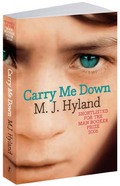
MJ Hyland, Carry me down

MJ Hyland, Carry me down bookcover

Book cover (Courtesy: Text Publishing)

If you like writers who unsettle, then MJ Hyland is a writer for you. Carry me down is my second Hyland. I read, loved and reviewed a later book of hers, This is how, nearly a year ago, and said then that I’d like to read more. I finally have, and am not disappointed.

Carry me down is a pre-coming-of-age story. John Egan is an 11-year-old boy living in Ireland with his parents. He’s an only child and is keen to be special, different. He is clearly pre-adolescent – he’s naive, for example, about some of his 15-year-old cousin’s behaviours. He’s an unreliable narrator: the world he sees and describes is rather skewed but the unsettling thing is that we, the readers, know it is skewed but we are not quite sure in which way. What is going on in this family is the question in our minds from beginning to end.

Like This is how, the novel has a vaguely unsettling beginning. The first paragraph sets up what looks like a cosy family scene. The three are sitting, companionably it seems, around the table on a Sunday evening. The third and fourth paragraphs read:

From time to time we stop reading to talk. It is a good mood, as though we are one person reading one book – not three people apart and alone.

These kinds of days are the perfect ones.

That “alone” is a little jarring, though not dramatically so. But then comes this on page 2:

“John,” she [his mother] says, “please come with me. “She is taking me out to the hallway, away from my father. She is taking me out of his sight, as though I am rubbish.

“Rubbish”? Now, that’s a strong word. What she tells him in the hallway is to stop staring at her:

“You were staring at me, John. You shouldn’t stare like that.”

“Why can’t I look at you?”

“Because you’re eleven now. You’re not a baby anymore.”

There seems to be something slightly strange going on here, or is there? Is this just a pre-adolescent bumping up against the adult world he is about to join, or is something far more complicated going on? As the book progresses, John’s relationship with his mother verges on “too close”. He seems a little too emotionally and physically needy, and she seems unsure of how to manage it. Is his need normal, is the question we ask. Meanwhile, his relationship with his father seems more typically adolescent. He wants his father’s approval and love, but he wants to be independent too. And, he wants to be special. He is an avid reader of the Guinness Book of Records, and decides early in the novel that he has a gift for lie detection for which he’d like to be included in the Guinness. He reads up on lie detection, and starts his own Gol of Seil (Log of Lies).

The situation is complicated by a number of facts which come out in the first chapters of the novel. John is unusually tall for his age and is under medical care for this. He regularly scratches a spot on his head until it bleeds. And he is bullied at school, because he is clearly a little different. His father is out of a job and studying for exams to be admitted to Trinity College. The book his father is reading at the start of the novel is Phrenology and the Criminal Cranium. Is this a hint to us – or a red herring? His mother works with a puppet show. This is interesting, too, as the idea of puppets subtly undercuts the desire for control and independence that John, like any pre-adolescent, is starting to strive for. The family lives with the paternal grandmother, with whom John’s father has a prickly relationship, mainly around money. And, underlying all this is John’s growing obsession with truth and lies.  This obsession is the framing motif in the book. John catches adults lying and takes them to task for it, all the while telling lies himself. He does not, by the end, come to a real understanding of how lying functions, of the difference between white lies and more serious ones. For this reason I don’t see it as a true coming-of-age story.

And now I come to my problem. How do I write about this book without giving it away? There are events – powerful, troubling ones – that occur in the book and that can be “read” in different ways. I’d rather like to analyse or explore the possible meanings, but that would require giving away some significant plot points. I don’t want to do that because this is a book that you need to discover for yourself, sentence by sentence.

What I’ll say though is that this is one of those books that has an open ending. (Indeed, giving nothing away, the last word of the book is “open”). How we read it depends on our own world view, on the weight we give to the various events in the novel, on how we read the specific words and images used by Hyland to describe the events and characters, and our personal understanding of adolescent and family psychology. The way I see it, the book’s ending hints at a number of possibilities but we do not know, at the point in their lives that we leave these characters, which of these possibilities will eventuate. And that, as they say, is life!

MJ Hyland
Carry me down
Melbourne: Text Publishing, 2007 (orig. 2006)
313pp.
ISBN: 9781921145780

Monday musings on Australian literature: Contemporary poetry and music

telegrams tremble like leaves from a wintering tree
and the spider grief swings in his bitter geometry
– they’re bringing them home, now, too late, too early.
(from “Homecoming” by Bruce Dawe)

Last night I was lucky enough to attend a private function at which a small, local, male a capella group, the Pocket Score Company, performed. Their repertoire is primarily early music (medieval and Renaissance) but last night they also sang one modern composition set to a poem by Australian poet Bruce Dawe. The poem, bitterly titled “Homecoming” (1968), is about the bodies of soldiers being brought home from Vietnam. The composer is, I believe, Philip Griffin. As far as I can work out, he was born in England, grew up in Western Australia and now lives in New Zealand but info about him is pretty minimal.

My main point here, though, is not Philip Griffin but the close relationship between poetry and music. I often hear people who love to read say they’d like to read poetry, particularly contemporary poetry, but find it difficult … and it sure can be, but, set to music, poetry can suddenly become way more comprehensible. There is a lot of synergy between poetry and music – just think ballads, for a start – and I have touched on the poetry-music relationship in past posts on musical ensembles. Today, though, I decided to do a quick Internet search to see what else I could find. One exciting idea I discovered was the Pure Poetry Project  which was established by Bronwyn Blaiklock and the Ballarat Writers Inc.

The first Pure Poetry event occurred in 2004 and focused on the performance of new poetry and new music rather than expressly requiring a crossover between the two. However, this year, it was decided to specifically encourage integration between the two art forms:

selected poets and composers have been asked to write specific new works in a two-part process. In the first part composers have been asked to musically respond to recently written poems, whilst poets have been asked to respond to recently composed works. The second part of the process is more of a direct collaboration where poet and composer work together to create a new work. (Anthony Lyons, composer)

The recital took place in May this year, in Ballarat. It sounds like an exciting event and I would love to have been there.

Australian poet Les Murray, photographed at hi...

Les Murray, 2004 (Courtesy: Brian Jenkins, using CC-BY 3.0, via Wikipedia)

Another exciting project combining contemporary poetry and music is that between The Song Company (whom I’ve reviewed here before) and Australian poet Les Murray, in which composers from around the world have set selected Murray poems to music. One of the composers, Andrew Ford, asked Murray many years ago about an early collaboration with the Song Company and his view on the relationship between poetry and music. Murray said:

… My wife’s very musical, and some of the family are, and I think all of the Murrays believe that music was the art that mattered. I’ve always had rather a poor ear I think and tried to make music out of words. But I have this instinct to stretch words out to the edge, where they start crumbling away in music. […] I’d love to write a good song, and particularly a good hymn before I check out of this profession. But yes, we’re all hovering on the edge of music, we’re always hovering on the edge of all the other arts I guess. Dance, for one; a lot of dance underlies poetry.

Finally, another musical ensemble I have reviewed here before, the Griffyn Ensemble, also regularly performs modern poetry set to music, and sometimes poetry recited alongside music, at their concerts.

None of these ideas are new of course. Poetry has been set to music for centuries and it clearly still is – but it can be hard to find, party because it may not be promoted as such. I’d love to hear of other collaborations and events, in Australia or elsewhere.

Delicious descriptions from Down Under: Of wine and bushrangers

Moondyne Joe

Joseph Bolitho Johns (1830-1900) aka Moondyne Joe. (Presumed public domain, from the Fremantle Prison website, via Wikipedia)

Now this is something literally delicious and I couldn’t resist sharing it with you. It is the description of a wine from Houghton Winery in Western Australia. The wine is The Bandit Sauvignon Blanc Pinot Gris 2010, and here is the description* from the back label:

The Bandit was Western Australian Moondyne Joe who earned notoriety for his elaborately planned jailbreaking. Moondyne’s good taste was to be his undoing. His final capture occurred when he broke into the Houghton Winery in 1869. The Bandit wines are daring blends of tremendous character which immortalises the legend. Aromas of passionfruit and lemon lead to a juicy palate complemented by hints of nashi pear.

I wonder if Moondyne had ever tried Nashi Pear? I do love wine labels – this was a pleasant wine but I can’t say I noticed the nashi, much as I love that fruit.

Anyhow, as with many of our Australian bushrangers, Moondyne Joe has been “celebrated” in fiction, verse and film. His being Western Australian and my being an easterner, he is less well-known to me than our eastern bushrangers, but now I have heard of his “good taste” I feel inclined to investigate him further. A bandit who breaks into a winery surely can’t be all bad!

* I do hope I haven’t breached copyright by quoting this at length.

Monday musings on Australian literature: Indigenous Australian autobiographies

When I was a child my father told me to be proud I was of “aboriginal descent”. Perhaps it was the silence surrounding his words that made them resonate as they did; I’d certainly heard no such thing anywhere else in my life, certainly not in my reading or schooling. There didn’t seem much in the way of empirical evidence to support my father’s words. A child, and unable to either calibrate injustice and racism or identify its cause, I sensed the legacy of oppression. (Kim Scott in Kayang and me)

Indigenous autobiographies are finally, I think, starting to make their mark in mainstream Australian publishing. The first so-called indigenous autobiography I read was Douglas Lockwood‘s I, the aboriginal. It sounds like an autobiography but in fact it was written about an indigenous man, Phillip Roberts (Wailpuldanya of Alawa tribe), by a white writer. It was published in 1962 – though I read it later in the 1960s – and it introduced me to a world I knew little of but recognised as important to my life as an Australian.

Through the 1970s I read various books about indigenous Australians, but it was the poetry of Oodgeroo Noonuccal, which most conveyed to me the experience of being an Aboriginal Australian. And then, in 1988, came the hugely successful Sally Morgan’s My place which was, I think, the first “real” indigenous Australian autobiography I read. Unlike Kim Scott, Sally was not told to be proud of her “Aboriginal descent”. Rather, it was hidden from her – or, at least, she was oblivious of it though, as I recollect, her sister had cottoned on to something of their derivation. Her family did not promote their background – for obvious reasons in a society where, as Scott says, there was (is) a “legacy of oppression” – but Sally worked her way through it to find her own place as an indigenous woman, writer and artist in Australia.

One of the first posts on this blog was on Boori (Monty) Pryor’s autobiography Maybe tomorrow. It’s a short autobiography by a man who has geared his life towards educating young people – white and indigenous – about what being indigenous means. His aim is twofold – to encourage pride in indigenous people and understanding and respect in white people. In a later post, I referred to Leah Purcell‘s Black chicks talking which tells the lives of a number of indigenous women in Australia. They are written by Purcell but are based on interviews she conducted with the women. Her goal is similar to Pryor’s: she sees her women subjects as role models for young indigenous Australians but also wants white Australians to recognise and understand the lives and achievements of indigenous women. Both books are good reads.

Rabbit-proof fence

Rabbit-proof fence, including the route taken by the three young girls (Courtesy Wikipedia, using CC-BY-SA 3.0)

The Stolen Generation – that is, the generation/s of Aboriginal people in Australia affected by the government practice of taking mixed-race children away from their families – has resulted in pretty much a whole new genre of indigenous autobiography. The Stolen Generation report itself contained many stories (or case studies) to prove its case. For white Australians, though, the best known Stolen Generation story is Doris Pilkington‘s Following the Rabbit Proof Fence (which was also made into a film). It tells the story of three young girls who, in 1931, escaped the settlement they were taken to, well over 1500kms from their home, and followed the rabbit-proof fence to return to their families. Doris is the daughter of one of the girls – and she, too, like her mother was stolen.

I have only recently come across Hazel Brown and Kim Scott’s 2005 book Kayang and me. Kim Scott is an award-winning Western Australian indigenous novelist and Hazel is his aunty. Together they have written this story of the Wilomin Noongar people in southwest Western Australia. I have only started it, but it is the book that inspired me to write this post. It describes a region of Australia I know little about, so I look forward to making its acquaintance!

I am aware that I have barely scraped the surface of a genre of writing that I would like to delve more into. This will not, I hope, be the last I write on this topic – but, in the meantime, I’d love to hear comments and recommendations from you on the topic.

Whispering Gums on Deformed Pines

Black Pine overhanging pond, Korakuen, Okayama

Black Pine over hanging pond, Korakuen, Okayama

I am slowly but surely working my way through Isabella Bird‘s Unbeaten tracks in Japan. While we were still in Japan, and enjoying its wonderful gardens, I came across the following passage from early in Bird’s travels:

After running cheerily for several miles my men bowled me into a tea-house, where they ate and smoked while I sat in the garden, which consisted of baked mud, smooth stepping-stones, a little pond with some goldfish, a deformed pine, and a stone lantern. (From Unbeaten tracks in Japan, 1880, Letter VI)

Hmm, I thought, was the pine really “deformed” or is this a case of Bird’s anglocentric eyes missing the beauty of Japanese pines? Because for me, besides of course the overall design, the three things I love about Japanese gardens are the stones, the lanterns and the pines. I cannot resist photographing these “objects”, particularly if I see them in combination. The stones, though, are stones, albeit beautifully chosen and carefully placed. And the lanterns – usually made of stone – come in a range of sizes and forms but are recognisably lanterns. The pines, however, are something else. They come in two main varieties – Red and Black. They are often supported by poles tied to the tree with rope, and their trunks may be protected by a bamboo “coat”. And, they are very particularly pruned, to shapes that I suppose could be described as “deformed” if you didn’t realise there was a plan and a purpose.

Korakuen scene, Okayama

Lantern, stones, pine and water at Korakuen, Okayama

Water, stones and pines are the critical elements of Japanese gardens. And each has its meaning. For now though I’ll just focus on the pine. Pines, we were told by our Korakuen guide, represent longevity. My research for this post confirmed this but added that they also express happiness. I suppose happiness goes with long life? (At least it would be nice to think so!). I also discovered that Japanese red and black pines represent in and yo, “the soft, tranquil female forces and the firm, active male forces in the universe” (From the UCLA Hannah Garden Center). I would have expected from this that red and black pines would usually be found (more or less) together in Japanese gardens, but while we certainly saw both types of pines I wasn’t aware of their being in any obvious relationship with each other or even of regularly being in the same garden. Perhaps I’m reading this symbolism a little too literally. I will do some more research on this one … but, if any of you readers out there are experts in Japanese pines I’d love to know more.

Alex Kerr, in his award-winning book Lost Japan, has some critical things to say about modern Japanese gardens, but as I haven’t finished that book  (either) I will reserve comments for now. Meanwhile, though, I hope you have enjoyed this admittedly little foray away from gums into the world of the Japanese pine!

Monday musings on Australian literature: Writers from our north

David Malouf picture at book meeting. (Taken b...

David Malouf, 2006. (Courtesy: Dariusz Peczek, via Wikipedia, using CC-BY-SA 3.0)

Queensland is the state of my birth, and that makes it special to me! It is a large state and one of our most geographically diverse, ranging from the tropical north to the arid west, from the subtropical south to the temperate inland southeast. It has one of Australia’s most popular tourist destinations, the Great Barrier Reef, and our best-known commercial tourist (and, retirement) mecca, the Gold Coast. It is unlikely, though, to be the first state people think of when asked about Australian writers …

Nonetheless, many significant writers have come from Queensland, including the indigenous poet Oodgeroo Noonuccal.

Of our contemporary writers, though, the best known Queenslander has to be David Malouf. Like most Queenslanders, he “emigrated” from there long ago and has lived in England and Tuscany as well as Sydney, but that doesn’t mean that his ties aren’t strong. Johnno, his first novel and the first one I read, is, like so many first novels, somewhat autobiographical. It describes a young boy growing up in Brisbane in the 1940s and 1950s and, as I recollect, evokes the place and time well. One of my favourite novels of his, Fly away Peter, is partly set in the (above-mentioned) Gold Coast and partly on the Western Front during World War 1. It’s a beautiful novella which explores friendship, love and life, not only against the challenges of war but also of class. And, while his most recent novel, Ransom, re-explores the story of Priam and Achilles, it was inspired by his introduction to the story of Troy in his schoolboy days. It seems, with Malouf, that you can take the boy out of Queensland but you can’t take Queensland out of the boy!

Like Malouf, Janette Turner Hospital left Queensland in early adulthood, and has spent most of her life in the United States and Canada, though she does return down under occasionally. She’s a writer who’s not afraid to take risks, and can push metaphors, sometimes to their limits (as in Charades and Borderline). Her novels range over the countries in which she’s lived, including for example, southern India in The ivory swing. Due preparations for the plague is one of those post 9/11 novels that deals with terrorism, and Orpheus lost also explores what happens when people get caught up, inadvertently for the most part, in political action. Few of her novels are set in Australia, but there’s often an Australian character.

By contrast, Andrew McGahan has remained in Australia, even if not in Queensland. He currently lives in Melbourne (I believe). His first two books, Praise and 1988, are the only books I’ve read in the “grunge” style – and I liked them. His Gen X characters are pretty aimless, and were an eye-opener for baby-boomer me. They are primarily set in Queensland. His novel The white earth won the Miles Franklin award, and is set in the Darling Downs of Queensland. It’s a coming-of-age story in which the protagonist is caught between his (white) uncle’s obsession with land and his growing awareness of indigenous people’s connection to land.

And this brings me to Alexis Wright, an indigenous Queensland writer whose larger-than-life wild-ride of a novel Carpentaria also won the Miles Franklin award. It deals with indigenous disenfranchisement, with how disconnection from the land results not only in conflict with white society but also within indigenous groups. Wright cleverly marries tragedy with comedy, and tosses in a little surrealism and magic, to demonstrate just how complex the situation is. The following excerpt captures something of the tone of the novel:

Old stories circulating around the Pricklebush were full of the utmost intrigues concerning the world. Legends of the sea were told in instalments every time you walked in the door of some old person’s house. Stories lasted months on end, and if you did not visit often, you would never know how the story ended.

That’s probably enough really, except I can’t finish without briefly mentioning two writers who were not born in Queensland but have strong associations with it. One is Thea Astley who wrote several novels set in Queensland including The multiple effects of rainshadow which I reviewed some time ago, and the poet Judith Wright about whom I must post in future. Wright used poetry not only to celebrate the landscapes she loved, but to promote issues of concern to her, including indigenous rights and environmental degradation.

Have you noticed the high proportion of women writers in this post? Queensland is often the butt of jokes in Australia for being conservative and yet, without design, I have come up with more women than men to represent writing in this state. Go figure (as they say)!

Delicious descriptions from Down Under: Adrienne Eberhard on stones

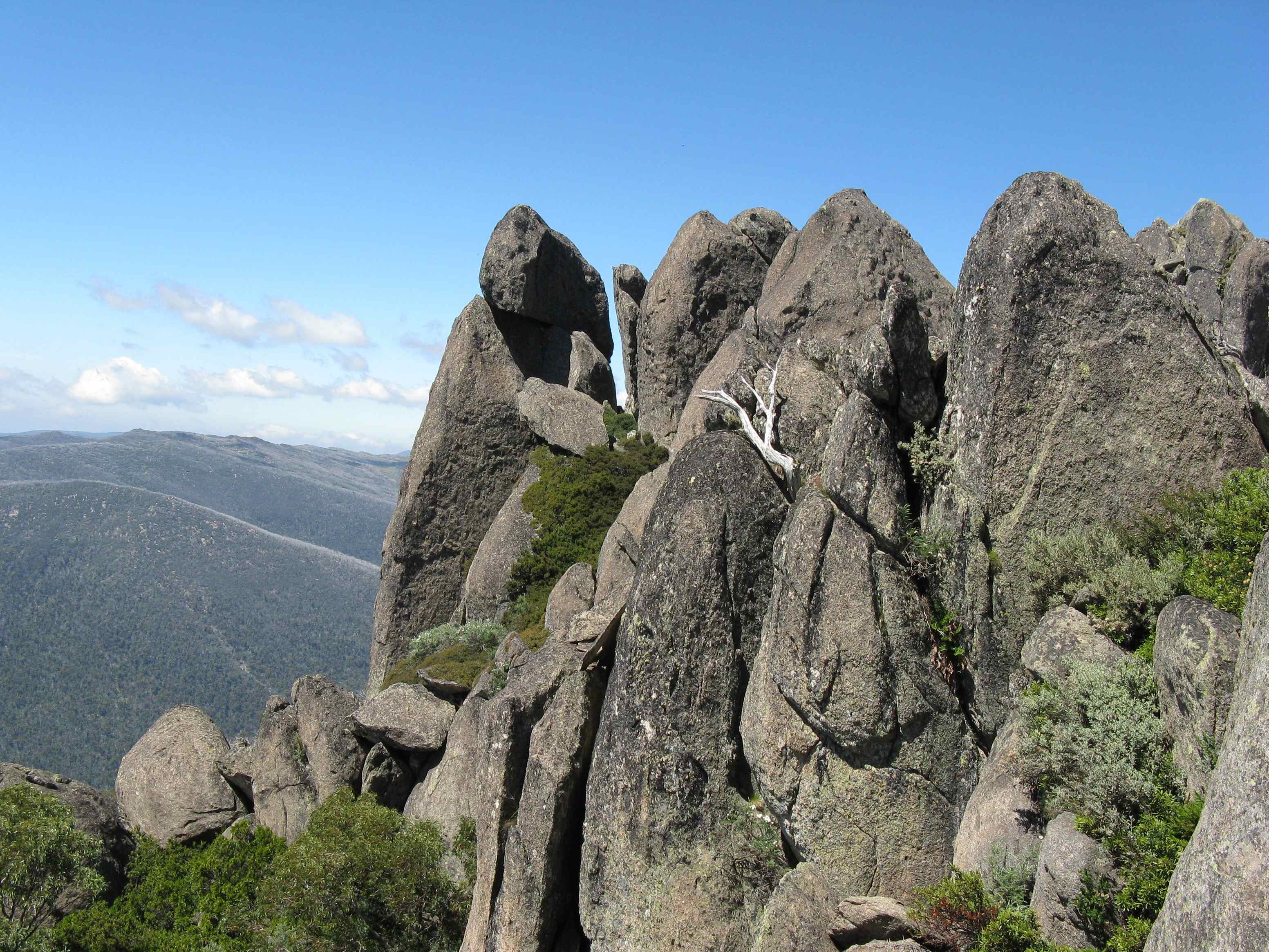
Porcupine Rocks, Kosciuszko National Park

Porcupine Rocks, Kosciuszko National Park

Having just returned from Japan where stones are revered, I thought it might be apposite to share one of the poems from Adrienne Eberhard’s section “The Magic of Stones” in her suite of poems about Jane, Lady Franklin.

Blocky, grain-growing, cast in the stance
of a thousand others
Embedded, spore-emblazoned, lying in layers
of limb-lost wist
Forging, fossil-jawed, timing the hours
of a mute universe
Gravelled, facet-shattered, your end
is never nigh
Stoning the earth, shelving the soil
(“Rock”)

It’s not my favourite poem in the book, but I like the way it conveys the paradoxical nature of rocks – their longevity and their mutability. Their time, geological time, is almost beyond human (at least, my) comprehension and yet they do change, which gives an organic (life-like) dimension to their inorganic nature. Lichen grows on them, water and wind act upon them, trees and other plants force their roots into them. The original shape-shifters perhaps!

Anyhow, it’s no wonder, I think, that stones/rocks are a common symbol across time and space. They feature, for example, in the Arthurian legend (with the sword-in-the-stone) and in Christianity (with Peter, the rock). A well-known Australian representation is in the book/film, Picnic at Hanging Rock, where the rock has multiple meanings from the earthy (sexuality and loss of innocence) to the mystical/spiritual. Paradox again … but that’s rocks for you.

Kate Chopin, A morning walk

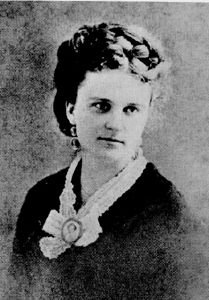
Kate Chopin

Kate Chopin (Public domain, via Wikipedia)

It’s been some time since I read (and therefore reviewed) a Library of America offering, but when I saw another Kate Chopin offering pop up a few weeks ago, I couldn’t resist it. And so, I printed it off, but have only just managed to read it. Well, what a surprise…

I thought about starting this post with “And now for something completely different” because this story, “A Morning Walk” (1897), is significantly different from my previous three Chopins – her novel The awakening, and the two short stories I’ve previously reviewed here. All is explained though in the brief but useful introductory notes from LOA:

Chopin gained fame (and notoriety) during the 1890s startling readers with her handling of topics considered bold for the era, but she also continued to publish light or pleasant fiction for local magazines. Among these latter stories are several holiday tales – a genre whose prevalence, along with its promise of good pay, proved attractive to writers during the nineteenth century on both sides of the Atlantic, from Charles Dickens and Washington Irving to Robert Louis Stevenson and Willa Cather (who published under a pseudonym).

And so to “A Morning Walk”. It is a short short story about Archibald’s morning walk. It was originally published under the title “An Easter Day Conversion” which gives a clue to its meaning. Archibald is around forty, not concerned about looking older than he is, and inclined to focus on the practical rather than emotional or sentimental things in life. In the fifth paragraph we are told that:

Archibald has started out for a walk, not because the day was beautiful and alluring but for the healthful exercise, and for the purpose of gathering into his lungs the amount of pure oxygen needed to keep his body in good working condition.

However, the language in the third paragraph hints at something else going on around him, even if he’s not consciously aware of it: the irregular streets “cuddle up” to the houses, “riotous colours” are abroad, and there is “a velvety gust” which “softly” beats his face. And in the fourth paragraph we are told that these sensations of spring “for some unaccountable reason … were reaching him to-day through unfamiliar channels”. Instead of his usual interest in flowers being “to dismember their delicate, sweet bodies for the purpose of practical and profitable investigation”, on this morning “he saw only the color of the blossoms, and noted their perfumes. The butterflies floated unmolested within his reach …”.

On this walk, and in this frame of mind, he meets a young woman, carrying lilies. His thoughts take a sensual turn as she reminds him of “peaches that he had bitten; of grapes that he has tasted; of a cup’s rim from which he has sometimes sipped wine”. The references to the lilies – which tend to symbolise innocence and purity – are even more pointed: their “big wax-like petals” risk being “bruised and jostled”.

And so he accompanies her to church, surprising the congregation with his presence, and hears the beginning of the traditional Easter sermon, “I am the Resurrection and the Life…”. Life seems about to change for Archibald, for the better, as he senses and accepts “the poet’s vision, of the life that is within and the life that is without, pulsing in unison, breathing the harmony of an undivided existence”. The aforementioned “lilies” – and their bruising – add a little edge which I’d expect of Chopin, but the reading is, I believe, intended to be a positive one.

Note: My other Kate Chopin reviews are A respectable woman and Désirée’s baby.

Monday musings on Australian literature: Where are our women writers?

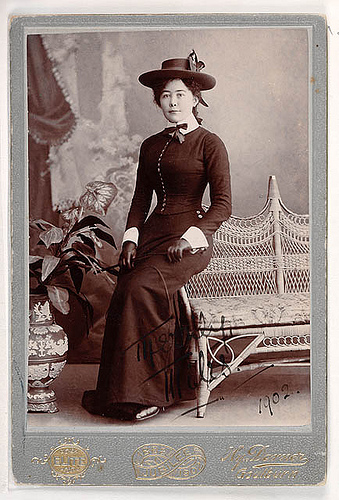
Miles Franklin, 1902, by H.Y. Dorner (Presumed Public Domain, from the State Library of New South Wales)

It might be just me, but it seems that women writers (I know the adjective should be female but it just doesn’t feel right in this context where “women writers” is short-hand for “women who are writers” or “writers who are women”) are somewhat thin on the ground in Australia at present, at least in terms of major visibility on the literary scene. There have been two, I think, significant flowerings of women’s writing in Australia in the last century. The first occurred in the first three to four decades of the twentieth century, and the second from the 1970s to 1990s.

My simplistic – read, not thoroughly researched but off the top of my head – explanation for these two bubbles is that they represent responses to the two major phases in the women’s movement of the last century – the suffrage movement of the late ninetheenth-early twentieth century, and the second wave of feminism which occurred in the 1960s-1970s. Certainly, in Australia, women writers were highly visible in the 1920s to 1940s, with writers such as Miles Franklin, Katharine Susannah Prichard, Marjorie Barnard, Eleanor Dark,  and Christina Stead. And again, in the 1970s to 1990s, we had Thea Astley, Elizabeth Jolley, Jessica Anderson, Kate Grenville, Helen Garner, to name a few. These women were all highly visible in literary circles and they managed to win some of the prizes going. In the last decade or so, though, women seem to have fallen behind again … though they are there, such as Eva Hornung who took out last year’s Prime Minister’s Literary Prize, Joan London, Gail Jones, and Amanda Lohrey to name a few. Grenville and Garner are still around. And yet, overall, these writers are just not highly visible. And visibility is the clue. I would hazard the “wild” guess that the first names off the tip of the tongue when people think current Australian literary writers would be Malouf, Winton, Carey, Miller, to name a few. Great writers all, but not, I think the only great writers we are producing.

I’m not the only one concerned. After deciding to write a post on this, I did a little research and there’s been quite a bit written recently on the issue. In fact, just earlier this month Angela Meyer of Literary Minded wrote a post titled Let’s read writing by women in which she reports on a new committee being set up:

to pursue equal rights for women writers in Australia. Besides research, lobbying and setting up mentorships, the committee is looking at establishing a literary prize for Australian women writers, along the lines of the UK’s Orange Prize. The steering committee (including novelist and publisher Sophie Cunningham, critic and former Miles Franklin judge Kerryn Goldsworthy and novelist Kirsten Tranter) feel the move is unfortunately, necessary, due to the unequal recognition of books by women in major literary award shortlists and in the book pages of the major newspapers in this country.

It’s unfortunate that this is needed … but I agree that it is needed. Gender shouldn’t matter. After all, what we like to read is good writing. But it’s hard, when you look at the facts (percentage of women published, shortlisted for awards, winning awards, being set for study) not to feel that there is some gender bias going on in the literary fiction world. I’m not going to second guess here how it happens, or what’s the chicken and what’s the egg, but I don’t like feeling that I may be missing out on good writing. Nor do I like to think that women writers are missing out on the opportunities their male peers are obtaining.

Do women only become “visible” – and achieve accordingly – when feminist movements flourish? Do you agree there is an issue regarding women writers on the literary scene (that is, not the genre scene) if you are Australian and, if you’re not, how do you see the situation in your country*? Do you agree that “affirmative” actions like gender-based awards are the way to go? Let’s get talking…

* Back in February, I reported on the VIDA Report on book writing and reviewing in the UK and the USA, so the “problem” is being noted elsewhere.

On the literary (and linguistic) road in Japan: 3, Matsue and beyond

This will be my last post on our Japanese adventures (unless something specific inspires me to write again – always leave yourself an out is my motto) and I’m going to share a few particular experiences, so here goes.

Matsue and Lafcadio Hearn

Our prime reason for going to Matsue was to visit the Adachi Museum of Art, and its famous garden. However, Matsue is also famous for having one of Japan’s best original castles, so we visited that on the day we arrived – and then explored the castle environs. And here we found a house and museum devoted to Greek-born Irish writer Lafcadio Hearn (1850-1904). He only lived in Matsue for a short time, but he met his wife there and the town has taken him as their own. I have downloaded the eBook version of one of his best known books, Glimpses of unfamiliar Japan (1871) which was published just a little earlier than Isabella Bird‘s Unbeaten tracks in Japan.

For now though, I’ll just share two little tidbits that attracted my attention in the museum. The first is that Lafcadio Hearn was apparently the person who introduced the word “tsunami” to the rest of the world. He wrote, in 1897:

From immemorial time the shores of Japan have been swept, at regular intervals of centuries, by enormous tidal waves – tidal waves caused by earthquakes or by submarine volcanic action. These awful sudden risings of the sea are called by the Japanese “tsunami”. The last one occurred on the evening of June 17, 1896, when a wave nearly two hundred miles long struck the northeastern provinces of Miyagi, Iwaté, and Aomori, wrecking scores of towns and villages, ruining whole districts, and destroying nearly thirty thousand human lives. (from “A living god”)

The second is another quote the museum included from Hearn, this one on Japanese gardens:

Now a Japanese garden is not a flower garden, neither is it made for cultivating plants. As a rule a Japanese garden is a landscape garden. Another fact of prime importance to remember is that, in order to comprehend the beauty of a Japanese garden, it is necessary to understand – or at least to learn to understand – the beauty of stones. Not of stones quarried by the hand of man, but of stones shaped by nature only. (From “Glimpses …”)

He’s right, though I hadn’t quite thought of it that way, but stones are a significant part of Japanese gardens and you can’t help but notice and ponder them when you stroll around gardens here. At Korakuen in Okayama, an English-speaking guide told us that stones represent “prosperity” and would often be given as gifts.

Okayama and folk tales

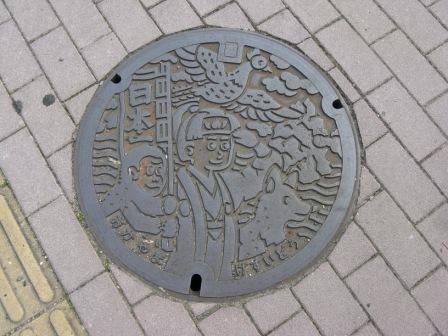
Okayama manhole cover featuring Momotaro, the Peach Boy

Momotaro and friends on Okayama manhole covers

Japan, like many countries, is rich in folktales, and we came across several during this trip. There was one particular story, though, Momotaro, the Peach Boy, that I think is somewhat known in the west – at least, I came across it when our children were young – so it was rather meaningful to meet him in his home, Okayama. The Momotaro story involves his fighting marauding demons with the help of a dog, monkey and pheasant. The demons may, according to Wikipedia, have been from the island of Megishima – and we did visit the demon cave there some days later (but that’s a whole other story). What I want to introduce here instead is the topic of Japanese manhole covers. Each town seems to have its own design (or two) – and if you search Flickr you will find a goodly number of them. They are appealing and are just one of those little details that make Japanese travel fun. Anyhow, for Okayama the design is based on the Momotaro story.

Ogishima and John Masefield

One of the most surprising literary experiences of the trip was finding, within sight of the lighthouse on the little island of Ogishima, a beautifully polished marble stone monument engraved with the three verses of John Masefield’s famous poem “Sea fever” . I haven’t been able to find out what Masefield has to do with Ogishima, and perhaps it’s simply that it’s an applicable poem for a little sea-focused island, but with Japan’s close relationship with the sea I would have thought it had its own famous sea poems to use in such a situation. Whatever the case, this westerner rather enjoyed coming across something familiar in an unfamiliar place.

Onomichi and the Path of Literature

Engraved writings by Suiin Emi, Onomichi

Suiin Emi's stone on the Path of Literature

There is, as the Rough Guide to Japan will tell you, a long temple walk you can do in Onomichi, that takes you up and down the hillsides that line this little port town. We decided to follow the Rough guide’s advice and just do selected components of the walk, which happened to include the Path of Literature. According to an Onomichi Travel Guide the path was developed because Onomichi is known to have inspired many poets/writers because of its “beautiful scenery and quiet life style”. The walk contains 25 stones (stones, again), each inscribed with some words from a particular writer and each accompanied by an interpretative sign which includes the writer’s name in English. (Nothing else was in English, but the name’s a great help for later research.)

I have chosen the Suiin Emi stone to illustrate this post because he was born in nearby Okayama. Basho is, of course, represented … as he is also in the little fishing town of Tomo-no-ura.

An apparent incongruity

Japan is a country of contrasts, paradoxes even you could say, and so I thought I’d illustrate this with something from our second day in Japan when we visited the quiet little town of Obuse (which I mentioned in my first post for its Hokusai connection). We walked out of the station and across the rather empty little street to discover what appeared to be a restaurant (albeit closed at the time) with the following sign on its door:

We have NO relation with Yakuza.

We are still pondering that one …