Every folkie knows … Leonard Cohen

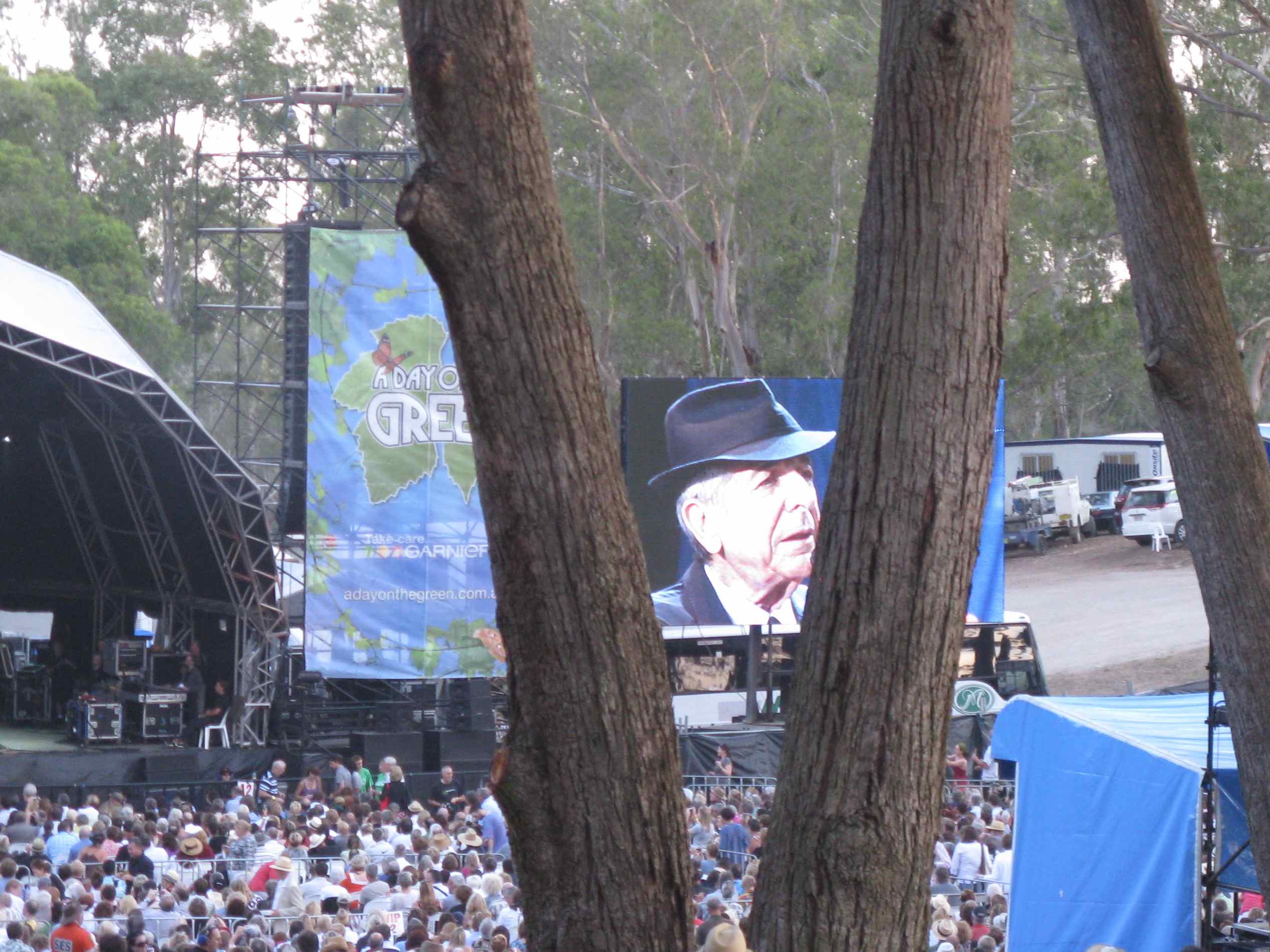
Leonard Cohen at Centennial Vineyards

Leonard Cohen at Centennial Vineyards, 2009

I recently wrote about the National Folk Festival in relation to Australian stories and history, but I can’t resist also writing a little post about “the man” because he was, it seemed, everywhere. I’m exaggerating of course but he – Leonard Cohen, of course – did seem to keep popping up.

There were performers who sang his songs, such as Ami Williamson who commenced her show with “Hallelujah”. You might think that is a little cliched but nothing about Ami is cliched … she put her own stamp on the song and got us in the mood for an energy-packed show that ranged through pop, folk, country and opera, both covers and her own original creations. Her “Daughter-in-law’s lament” is a hoot. She is a versatile gal.

Ruth Roshan, with Tango Noir, also did a Cohen song, though her choice was “Everybody knows”. The ambience was more 1930s French salon, and the dusky, sensual mood of the tango, but somehow Cohen fit right in there and Ruth pulled it off, despite her gentle voice and inviting smile.

Other performers though struck out into something different – into songs inspired by and/or featuring Cohen. Margret RoadKnight sang a whimsical song by Canadian singer songwriter, Nancy White, titled “Leonard Cohen’s never gonna bring my groceries in”. In case you don’t know it, here are a few lines to give you a flavour:

I’ve a husband and a baby, there’s another on the way.
And, like Leonard, I am aching in the place I used to play.
But really, I’m enjoying all this domesticity.
Hey, I never have to deal with Warren Beatty’s vanity.
But there is one thing I regret, and my regret is genuine.
Leonard Cohen’s never gonna bring my groceries in.

Since RoadKnight – and most of her audience – were of a certain age, this song went down very well!

And finally, it wasn’t only Australian performers who paid homage to the man. There was also (the rather lovely, I must say) English performer, Martha Tilston. She spoke of her envy of Cohen’s songwriting ability and said his line from “The stranger song”, “He was just some Joseph looking for a manger”, made her feel like hanging up her songwriting hat”. Instead though, she wrote a song about her inspiration, “Old Tom Cat”. Its opening lines are:

The tilt of your hat
Old tom cat
You wear truth like a necklace
It hangs around your poetry.

… and it includes references to Suzanne, Maryanne, Hallelujah and, of course, Joseph.

Funny how all these performers all women! That’s how it goes …

Delicious descriptions from Down Under: Elizabeth Jolley on gums

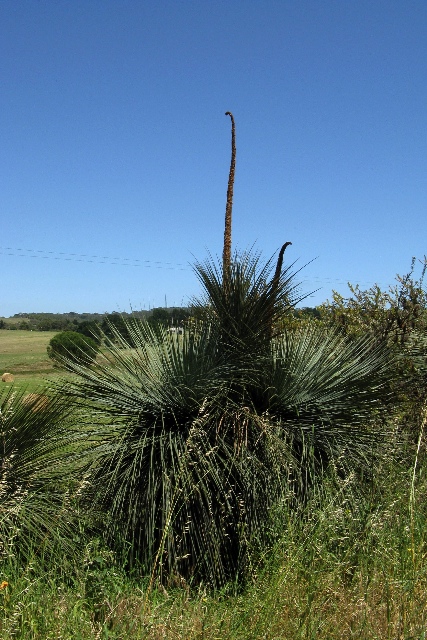
Xanthorrhoea

Xanthorrhoea (once called Blackboys)

Just a little one today from Elizabeth Jolley‘s somewhat quirky memoir, Diary of a weekend farmer:

For some reason the great trees have been left standing and the bush, the blackboys and the wild flowers have not been cleared on our 5 acres. The wandoo trees very beautiful also jarrah and something called Black Butt? Red gum has white flowers? White gum which has red. Rough wild bark. Leaves fall all the time and new leaves come, stained bark. (from 11th November 1970)

Jolley learning the land …

Monday musings on Australian literature: Travel writers on Australia

Art installation-restaurant, Teshima

Don't panic (or, art installation-cum-restaurant by Tobias Rehberger, Teshima)

Don’t panic, I told myself, the universe with still continue if I miss one week’s Monday musings. You see, after having been in Japan for over two weeks now, my thoughts have strayed rather far from Australian literature. But then, necessity being the mother of invention, an idea came to me. While I’ve been travelling, I’ve been dipping into travel literature about Japan, such as Isabella Bird‘s Unbeaten tracks in Japan (1880), Donald Ritchie’s The inland sea (2002 Ed.), and Alex Kerr‘s Lost Japan (1994). And that made me wonder about travellers to Australia and what they read.

This is not an area I’m expert in. After all, being Australian, why would I actively read up on travel literature about my own country unless, of course, I want to see what others are saying about us? And of course sometimes it’s good to hear what others are saying, and so I have read some writers on Australia (foreigners, of course, because travel literature is, by definition, written by those foreign to the shores they write about). I’ll share a couple I’ve read though it’s been a while since I read them, and I don’t have them in my backpack to refer to now. I would love to hear if you know of others, and whether you would or would not recommend them.

Bruce Chatwin‘s The songlines (1987)

Most of you have probably heard of Bruce Chatwin and his travel writing. I have his In Patagonia on my virtual TBR though when (or if) I’ll get to it is a good question. I did enjoy The songlines, which I read about twenty years ago now, though I recollect that as a travel book it’s a bit problematical. How much of it is nonfiction, how much fiction? But perhaps you could say that about much travel writing? Anyhow, I particularly liked his discussion of indigenous songlines in Australia, and his use of that as a motif for his own travels. I also enjoyed the “snippets” he presented in the second half of the book comprising various thoughts generated by his experiences… They reminded me a little of a “commonplace book”, albeit one composed primarily of one’s own thoughts.

Bill Bryson‘s In a sunburned country (or, Down under) (2000)

Bryson’s book was published under different titles in Australia and overseas I believe. It’s a hoot of a book really and not to be taken too seriously. For example, he made it sound as though Australians face dangers everyday – from snakes, spiders, crocodiles, sharks, and various poisonous sea creatures – but that, while being good for a laugh, is of course an exaggeration. These creatures and associated dangers do exist and most Australians will come across some of them in their lives but we are far more likely to die on the roads or from melanoma than we are from dangerous animals.

What Bryson does well though is, in his lighthearted manner, give you a flavour of the Australian character and what you can expect to see and enjoy on your Australian travels. (You can take this as great praise from one whose city he rather panned, but Aussies themselves pan it too so what’s new?)

These are two recent books, but there has been a long tradition of people writing about Australia, from the First Fleet on. One of the earliest is Watkin Tench’s A narrative of the expedition to Botany Bay (though my copy is titled 1788). It’s an insightful read but perhaps a little too specific to be of interest to the general traveller.

So, do you read travel literature (as opposed to travel guides) when you travel and/or do you read travel literature to armchair travel? I’d love to hear your thoughts.

Helen Garner, Postcards from Surfers

Helen Garner is a fiercely honest writer – and a prolific one too. She has written novels, short stories, essays and non-fiction books. All are generally well-acclaimed, though not always without controversy (as I mentioned in my recent Monday musings). Certainly, I haven’t always agreed with her … but I do admire her honesty and the quality of her writing. The book I’m reviewing here, Postcards from surfers, is a collection of short stories and provides an excellent introduction to her writing and her (fictional, anyhow) concerns.

Helen Garner, Postcards from Surfers

The collection was first published in 1985, but it has been recently rereleased (2010) by Penguin in their Popular Penguins at a Perfect Price series. Penguin also did an edition in 2008. That says something, I think, about the standing of this collection.

Unlike the last short story collection I reviewed, Leah Swann’s Bearings, this one takes its name from one of the stories in the book, the first to be precise. There is nothing in my copy to indicate whether the stories were written for this collection or whether some or all had been published before. The Resident Judge in her review said that several of the stories had appeared elsewhere before being collected here. I’d like to know when and where: I’m one of those people who always reads that part of the front or end matter for short story collections.

Anyhow, on with the stories. There are 11 of them and while there is an overall theme – the theme that we expect of Garner, that is love and relationships, particularly from the point of view of failure and loss – they are surprisingly (and wonderfully) varied. They vary in length from the little 4-page “The dark, the light” to more hefty first one (the title story) that runs for over 20 pages. The point of view varies: six are told in first person, and five in third person. So does the voice, from a girl child to a male drunk in a bar, from a female friend to a rejected lover. And the style varies. This was its most surprising aspect for me. There is, for example, the seamless flow across place, time and ideas of the first story (which is the more typical Garner), the disjointed vignettes of “The life of art” chronicling a long standing friendship, and the nicely sustained drunken first person rave of “All those bloody young Catholics”.

The subject matter varies too. The title story is about an adult woman coming to visit her retired parents and aunt at Surfers Paradise, leaving a broken relationship and a not fully successful life behind her. I was ready for something more discontented in this story, but the sense we’re given is that she’s matured and has learnt to be content with (tolerant of, perhaps) her imperfect family:

If I speak they pretend to listen, just as I feign attention to their endless looping discourses: these are our courtesies: this is love. Everything is spoken, nothing is said.

(Doesn’t that have a lovely flow to it? Garner’s writing is delicious.) This being Garner, several stories are about broken or past relationships, but there are also stories dealing more generally with families and parenting (“Little Helen’s Sunday afternoon” and “A happy story”) and friendship (“The life of art”).

I once heard Garner in an interview express admiration for the way Elizabeth Jolley reused and retold stories. I felt (though my memory may be failing me here) that she admired Jolley’s risk-taking in doing this (would it irritate or bore readers?) as well as her ability to spin more out of a character or situation. It seems Garner decided that if Jolley could do it, so could she. There is a character, a previous lover, Philip, who appears twice in this collection. He sounds very much like the Philip in Cosmo cosmolino. He represents the lost true love and often appears in her work (under that name or others). Where he is, some pain is usually there too. Here are two excerpts from “Civilisation and its discontents”:

He [Philip] woke with a bright face. ‘I feel unblemished’, he said, ‘when I’ve been with you’. This is why I loved him, of course: because he talked like that, using words and phrases that most people wouldn’t think of saying.

and

I wanted to say to him, to someone, ‘Listen, listen, I am hopelessly in love’. But I hung on. I knew I had bought it on myself, and hung on until the spasm passed.

Helen Garner wears her emotions openly. She’s never afraid to hang out the dirty laundry, to show the darker, more unpleasant sides of human relationships – the selfishness, the jealousy, the unkindness, and of course the pain – but it is always underpinned by a willingness to understand and accept our humanity rather than condemn it. Garner’s world is very much the real world. It’s not hard, I think, to find something in it you recognise (whether you like it or not!)

Helen Garner
Postcards from Surfers
Camberwell: Penguin Books, 2010 (orig. 1985)
ISBN: 9780143204909
154pp.

POSTSCRIPT: I wrote and scheduled this a couple of weeks before my Monday musings post. When I came back to check it I was rather relieved to find that I had not contradicted myself.

On the literary (and linguistic) road in Japan: 2, Kanazawa and Kyoto

Isabella Bird (Unbeaten tracks in Japan, 1880) doesn’t appear to have visited Kyoto or Kanazawa, which is a shame as I would have enjoyed reading her comments. However, I thought I’d quote from her anyhow, from Letter I. It covers her arrival in Yokohama harbour on May 21 which is close in time of year to now:

The day was soft and grey with a little faint blue sky, and, though the coast of Japan is much more prepossessing than most coasts, there were no startling surprises of colour or form.

She’s right. Japan is a subtle country. When I, an Australian, see a weather forecast for a fine day, I expect bright blue skies, but in fact that’s pretty rare in Japan. Even when there are blue skies they aren’t particularly bright. I am gradually getting used to it … and this softness goes, as Bird says, for colour in general here. It’s mostly muted, subtle … variations of green in the countryside, and beige and grey in the cities and towns. It’s quite a shock to see bright colours (in anything but flowers, which are of course blooming now that it’s late spring).

Anyhow, onto the subjects of this post, Kanazawa and Kyoto. By the end of this trip, our third in Japan, there will be three cities that we have visited every time: Tokyo, Kanazawa and Kyoto. Tokyo, primarily because we pass through it; Kanazawa because we fell in love with it on our first visit; and Kyoto because who doesn’t love Kyoto?

Kanazawa
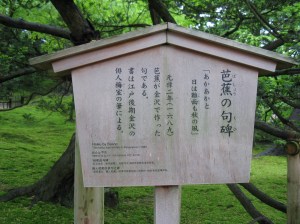
Plaque in Kenrokuen containing Basho's Haiku

Sign containing Basho’s Haiku in Kenrokuen

Haiku by Basho. In my first post I quoted a haiku by Issa, one of Japan’s four haiku masters, so this time I’ll quote one from Basho, another of the four. A major reason people visit Kanazawa is to see its famous garden, Kenrokuen. In the garden is a stone monument engraved with a Matsuo Basho haiku in 1689. I had a tricky time trying to find the actual haiku because it is, of course, written in Kanji (on the stone and the wooden sign). But after some googling I found haikugirl who has kindly agreed to my copying from her post the translation given to her. Here ’tis:

Aka aka to
Hiwa tsure naku mo
Aki no kazu

This roughly translates to “How brightly the sun shines, turning its back to the autumn wind”, which sounds pretty appropriate to me, regardless of the accuracy of the translation. So thankyou haikugirl.

Carson McCullers in Japan. It took three trips to Kanazawa for us to finally visit its impressive 21st Century Museum of Contemporary Art. They were running two excellent exhibitions, but I’ll just mention one, “Silent echoes”. The curator’s notes start with the following quote from Carson McCullers’s The heart is a lonely hunter:

How did it come? For a minute the opening balanced from one side to the other. Like a walk or march. Like God strutting in the night. The outside of her was suddenly froze and only that first part of the music was hot inside her heart. She could not even hear what sounded after, but she sat there waiting and froze, with her fists tight. After a while the music came again, harder and loud. It didn’t have anything to do with God. This was her, Mick Kelly, walking in the daytime and by herself at night. In the hot sun and in the dark with all the plans and feelings. The music was her – the real plain her.

Murata Daisuke, the curator, goes on to explain that the centrepiece of the exhibition is “L’echo” by Tse Su-Mei, a Luxembourg artist whose work “resonates deeply with the world of music and human life conveyed by the above quote”. The aim of the exhibition, Daisuke writes, is to highlight “an artistic world created through a complete fusion of self, technique and the world”.

We found the exhibition appealing and accessible, and demanding engagement. It occupies 8 galleries/spaces, with each space containing only one or two works of art. This gives the viewer a wonderful opportunity to engage with the work, to contemplate its meaning for herself without being overwhelmed by surrounding works. The pieces range from three-dimensional sculptures and installations to two-dimensional pictures. One, for example, by Brazilian-born Vik Muniz, is a cibachrome print of an image of a (sky)diver he’d created using chocolate sauce. It’s two-dimensional but is tactile and free-spirited. It’s titled “Picture of Chocolate: Diver (After Siskind)”. Most of the works are monochromatic or use minimal colour, which also forces us to engage more deeply with the work I think.

But the exception to this muted colour use, and also the highlight for me, was “L’echo”. It’s a video projection showing a rear view of the artist playing a cello in a mountain landscape. She wears a red vest, while sitting on a stool on bright green grass and facing a very high dark green/blue forested mountain. She plays short simple sequences on the cello and pauses while the echo comes back. Sometimes she starts playing again before the echo finishes, so it sounds almost like a round. Sometimes the echo doesn’t quite replicate what she has just played. It’s mesmerising and beautifully evocative of the way humans and nature/landscape can engage on a level beyond reason and logic. I found it moving, and hard to leave.

Other works in the exhibition work at a similar level, and generally complement each other well, but I’ve not the time to dwell more on this now.

Kyoto

Our main reason for revisiting Kyoto this trip was to see Ginkaku-ji again and re-walk the Philosopher’s Walk because last time we’d done these it was late in the day and we had not “done” them justice. It was worth the effort. Ginkaku-ji is a lovely comparatively subdued temple with smallish but beautiful grounds which incorporate a dry landscape garden as well as “strolling garden” of paths, trees and shrubs.

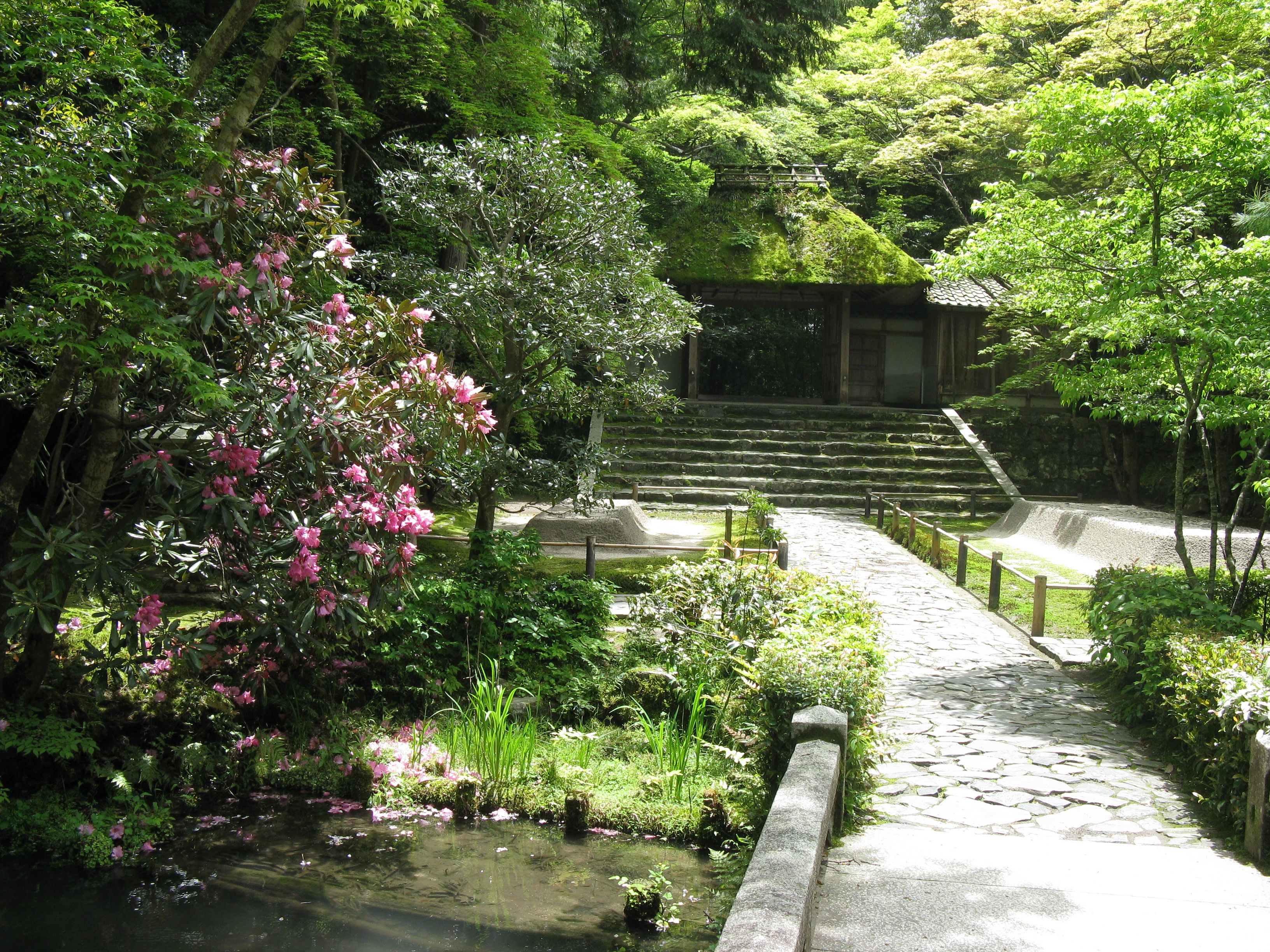
In the grounds of the Honen-In, Kyoto

In the grounds of the Honen-in, Kyoto

The literary connection I want to refer to was not here though, but along the Philosopher’s Walk from which you can detour to visit a number of other temples. One of these is Honen-in and I was rather thrilled to discover that Junichiro Tanizaki is buried in the grounds here. We visited the cemetery but of course couldn’t read the tombstones. However, I rather liked knowing he was there, since this sort of literature-spotting is not such an easy thing to do in Japan (though I’m sure I could do more if I put my mind to it!). I read Tanizaki’s The Makioka sisters about 20 years ago, and found it a real eye-opener. It introduced me to a more multi-cultural Japan than I was aware of, while also conveying the challenges of maintaining traditions in a changing world. Max of Pechorin’s Journal recently wrote a post on a book by Tanizaki on reconciling tradition and modernisation in Japan. Do read his post – and the following discussion.

A little more Japlish

And just for fun, I’ll conclude with one bit of Japlish. It comes from some instructions for hotel guests:

Washing machine: 300 yen
Desiccator: 30 yen for 10 minutes.

I decided not to find out how long it would take to desiccate our clothes, and so left the washing for another day and hotel. Funnily enough, the “desiccator” itself was well labelled by the manufacturer as “dryer”. Clearly though the translator chose a dictionary over the object itself … and I’m rather glad s/he did.
Monday musings on Australian literature: Helen Garner on writing about self

I have mentioned Helen Garner several times in this blog, and the word I tend to use about her is “honest”. Her fiction is very much about “self”. And in her non-fiction that I’ve read – Joe Cinque’s consolation and The first stone – her “self” is an integral part. She is not what you’d call an objective writer. In fact, in a talk she gave in 2001 at the National Library of Australia’s conference titled “The Secret Self: Exploring Biography and Autobiography” someone who writes “helplessly about the intimate”.

This started with her first novel, Monkey Grip, which, though published to general overall acclaim, did attract some demurrers who argued that all she’d done was publish her diaries. That was in 1977. In her address at the National Library conference she spoke of how she’d been initially defensive about these criticisms but that in the succeeding years she’d thought about it and would now “come clean” because that’s exactly what she’d done. She’d cut out the boring bits, written bridging passages and changed names. And, she said, there’s craft in all that. “Why the sneer?” she asked,

…as if it were lazy. As if no work were involved in keeping a diary in the first place: no thinking, no discipline, no creative energy, no focusing or directing of creative energy; no intelligent or artful ordering of material; no choosing of material, for God’s sake; no shaping of narrative; no ear for the music of human speech; no portrayal of the physical world; no free movement back and forth in time; no leaping between inner and outer; no examination of motive; no imaginative use of language.

Sounds like a novelist’s manifesto to me! Anyhow, she goes on to say that she wrote it because she’s not such a narcissist as to believe that her story was so “hermetically enclosed in a bubble of self” that it could offer no value to anyone else. She’s talking, of course, about some level of universality.

Further, she says, when writing (whether from a diary or not), she has to find a persona … and it is different for every work. These personas may draw from her life but they are not identical with her. She cannot write until she finds this persona. (An aside. I love hearing from authors about what they need to get started. Australian young adult writer John Marsden says he must find “the voice”. Australian children’s writer, Paul Jennings, said he started with a “what if?”. Alan Gould about whom I posted recently starts with a sentence – which may or may not be the first in the book – and Helen Garner needs her persona.)

Garner’s persona, she admits, usually draws from herself, from “the intimate”. This inevitably results in some level of self-exposure, which, given our interdependent lives, can’t help but involve others. And so she has struck a deal with herself:

… if I’m rough on myself, it frees me to be rough on others as well. I stress the unappealing, mean, aggressive, unglamorous aspects of myself as a way of lessening my anxiety about portraying other people as they strike me.

She certainly keeps to her deal … and it often gets her into trouble, in both her fiction and non-fiction. Her latest novel The spare room is a raw exploration of a friendship between two women, one of whom is dying of cancer but refuses to accept it. The main character, the one not dying and who is challenged by her friend’s attitudes and demands, is called Helen! Life and art are very close in this book it seems, but she knows what she is doing. Her ethical challenge is about the “other” people in her life who get pulled into her exploration of “the intimate”. She says:

Writing, it seems, like the bringing up of children, can’t be done without damage.

Some time ago I reviewed a short story titled “The young painters” by Nicole Krauss. In it she explores the impact of writing from other people’s stories, and presents her case:

In the publicity interviews I gave, I emphasized that the book was fiction and professed my frustration with journalists and readers alike who insist on reading novels as the autobiographies of their authors, as if there were not such thing as the writer’s imagination …

Helen Garner has no real answer to the problems she poses (any more than Krauss’s fictional character does in the short story), except to say that

… if I can write well enough, rigorously and imaginatively enough, readers will be carried through the superficial levels of perviness and urged into the depths of themselves. I hope we can meet and know each other there further down, where each of us connects with every other person who has ever been loved, hurt and been wounded …

In other words, she’s looking for readers who can tell the difference between fiction and reality. This may not, I suspect, reassure all those close to her who may not want their lives to be caught up in such a risky writer-reader venture but, theoretically, I like what she says and the honesty with which she says it. I’d love to have been in the audience that day to hear the Q and As.

Delicious descriptions from Down Under: Alan Gould on the Monaro (and thereabouts)

Tharwa - Angle Crossing, New South Wales
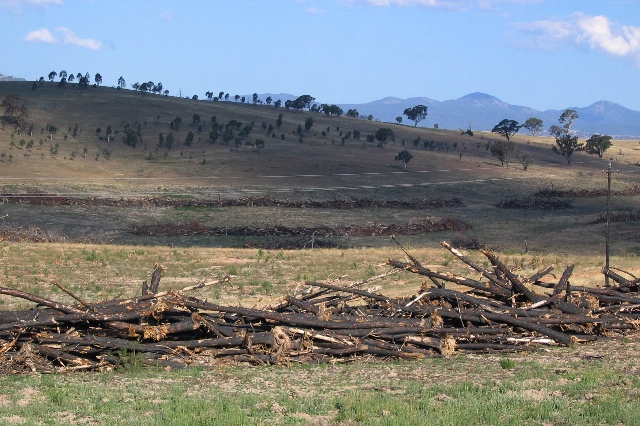
Monaro country after the 2003 fires

While I love reading to escape to other places and times, other cultures and ways of being, I also enjoy reading about the familiar, about places I know and experiences I’ve had. Alan Gould, whose The lakewoman I reviewed recently, is a local writer. The lakewoman, in fact,  is primarily set in England, France and Germany, but  the hero Alec Dearborn does return to Australia towards the end, and before that often thinks or talks about it. His Australia is the country surrounding where I live, an area we call the Monaro, to be exact.

Here are some descriptions from The lakewoman that describe this region;

He went on to describe the Murrumbidgee River that flowed beside The Dad’s place, how it used to run flush after rain, with the brown waters mounting each other like so many panicky sheep in a pen. How it might be a trickle at the end of a summer without rain, like glassy infrequent spillages between rocks.

and

Sometimes he would try to describe his part of Australia, the streaky, silvery, airy, dry spaces of his pastured and lightly timbered country, sheep standing immobile in fog as the crows called mournfully through the whiteness.

and

How, for instance, a Monaro mist would transform a big brittlegum into a delta of pale grey veins against the white. Or how the last hour of sunlight in this airy woodland could angle so searchingly under the foliage to suffuse the planet’s surface with aureolin gold.

This is not verdant country, nor is it particularly welcoming. But, it is spacious, golden and airy – and it lifts my heart whenever I drive through it. Gould captures its particular variety perfectly.

On the literary (and linguistic) road in Japan: 1, Central Honshu

Given this is primarily a litblog, I like my travel posts to have some literary or, at least, linguistic interest. And so in this first post about our current trip to Japan, literary and linguistic observations and thoughts will be my focus.

Linguistic challenges

Japanese language has a pitch-accent system which can provide particular challenges for English-speaking foreigners who try to use some Japanese words when communicating. For example:

  • Kaki: Oyster or Persimmon, depending on, to me, a very slight difference in intonation
  • Sake: Salmon or, well, Sake, with the same proviso as above
  • Hana: Flower, Nose or a Girl’s name with, I think, no variation in pronunciation. So, when you see a shop, as we did the other day, called Hana No Hana (‘no’ denoting ‘possession’), you wonder whether it means ‘Hana’s Flower’ or’ Hana’s Nose’ or ‘Flower’s Nose’ or, Flower’s Flower’, or … well, you can see where I’m going can’t you? You can have fun playing word games with Japanese people.

Japlish

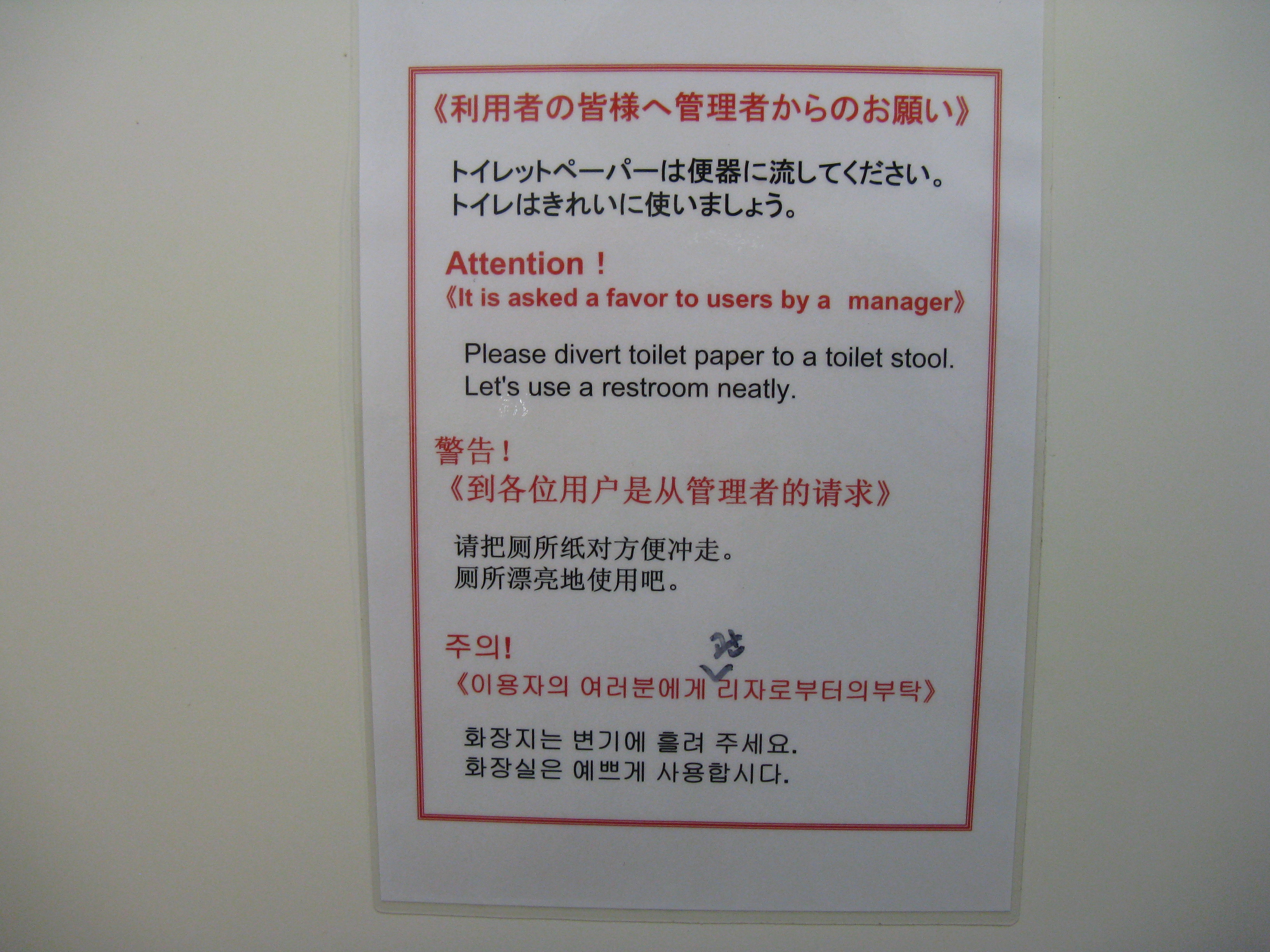
Sign in toilet, Japan

Sign in toilet, Japan

English-speaking foreigners, as you probably know, love to “catch” Japanese out in their English usage … and so for fun I’ll share just a couple that we’ve come across to date with you. But, please note that these are shared in a sense of fun not ridicule. After all, most Japanese know more English than I do Japanese, and at least they try.

  • On a special English menu in an izakaya that I shall leave unidentified to protect the innocent:

It is necessary to enjoy oneself over meal after it acknowledges though it is thought that the mistake of the word is somewhat found in the menu.

  • Inside a toilet door. For some reason, hotels and tourist venues often feel the need to tell you what to do with your used toilet paper. This one is particularly (unconsciously, we presume) entertaining:

Attention!
(It is asked a favour to users by a manager)
Please divert toilet paper to a toilet stool. Let’s use a restroom neatly.

Literature

I like to read Japanese writers, and have reviewed a couple on this blog to date, but here I’ll share something different.

A little haiku written by the poet Koyabashi Issa (1763-1827), one of Japan’s four haiku masters. It was inspired by a frog mating battle at Gansho-in Temple in the lovely little town of Obuse, and was written to encourage his sickly son. (Unfortunately, his son died a month later. In fact, Issa was pre-deceased by all his children and his wife).

Yase-gaeru,
Makeru na! Issa,
Kore ni ari.

It roughly translates to:

Skinny Frog,
Don’t give up! Issa
Is here.

English traveller-explorer Isabella Lucy Bird‘s* letters, titled Unbeaten tracks in Japan, published in 1880 about her trip to Japan. I downloaded an eBook version and have been dipping into it during our trip. In Letter XVIII she talks about her travels in the alpine region of Central/Western Honshu through which we travelled a day or so ago. Here is an excerpt:

It is an enchanting region of beauty, industry, and comfort, mountain girdled, and watered by the bright Matsuka. Everywhere there are prosperous and beautiful farming villages, with large houses with carved beams and ponderous tiled roofs, each standing in its own grounds, buried among persimmons [kaki, remember!] and pomegranates, with flower-gardens under trellised vines, and privacy secured by high, closely-clipped screens of pomegranate and cryptomeria.

She then names a number of villages, including the gorgeous Takayama which we have now visited on two occasions. She describes the farms as “exquisitely trim and neat”, and nothing has changed today.

I was also struck by a comment on food from the same letter. When she asked her hosts whether they drank milk from their cow, she learnt that they didn’t, that they thought it was “most disgusting” the way foreigners put into their tea something “with such a strong smell and taste”. Tea is of course a significant part of Japanese culture, but from a country which eats the oddest things to our western minds – salmon nose anyone? – this did make me laugh. Each to her own, as they say!

And here ends, my first little travel piece. More to come (probably).

*In the interests of full disclosure, I must add that according to Wikipedia, her first adventure was to Australia but she apparently didn’t like it.

Monday musings on Australian literature: Guest authors at the Sydney Writers’ Festival

Regular readers of Monday musings will remember that a recent post in the series was inspired by the Qantas flight magazine, The Australian way. Well, I’ve been in the air again … this time for a longer trip, as Mr Gums and I have again left daughter and dog in charge at home, and are holidaying in Japan. Of course I read The Australian way again, and in the May 2011 issue found an article about guest authors who will be attending this month’s Sydney Writers’ Festival. Now this, I thought, could make for an interesting Monday musings post. It’s not really about Australian literature but it is about some writers who’ll be attending an Australian literary event. The premise of the article is that its author, Paul Robinson, asked the authors to share their “literary discoveries”, and so I thought I could share them with you. I’ll say straight off though that I’m not familiar with all the authors mentioned. Would love to hear if you are, and what you think of them.

  •  Ingrid Betancourt, author of Even silence has an end: Mario Vargas Llosa’s The feast of the goat. Having read this one recently, I can concur with this discovery!
  • Fatima Bhutto, author of Songs of blood and sword: Colombian author Hector Abad’s Oblivion.
  • Philippa Fioretti, author of The fragment of dreams: Gay Talese’s The sons (1992).
  • Emma Forrest, author of Your voice in my head: Tom Rachman‘s The imperfectionists. I’ve seen this one reviewed around the blogs and have my eye on it for my TBR.
  • A A Gill, author of Here & there: Collected travel writing: Simon Sebag Montefiore‘s Jerusalem: A biography, and the complete works of H L Mencken.
  • A C Grayling, author of The good book: Dale Peterson’s The moral life of animals, and Michael Shirmer’s The believing brain.
  • Howard Jacobson, author of last year’s Booker Prize winner, The Finkler question: Milan Kundera‘s essay “The curtain”, and Ian Mackillop’s F R Leavis: A life in criticism.
  • David Mitchell, author of The thousand autumns of Jacob de Zoet: Simon Lelic’s The facility.
  • Favel Parrett, author of Past the shallows: Chris Wolmersley’s Bereft. (Ah, someone has nominated an Australian book.)

There you have it. Not much about Australian literature, but these are the people who’ll be speaking about books and writing to Australians this month – and that has to be interesting, hasn’t it?

POSTSCRIPT: This was supposed to have been published on Monday, but I made a mistake in the scheduling, so it is now Monday musings on Wednesday. Traveller’s brain!

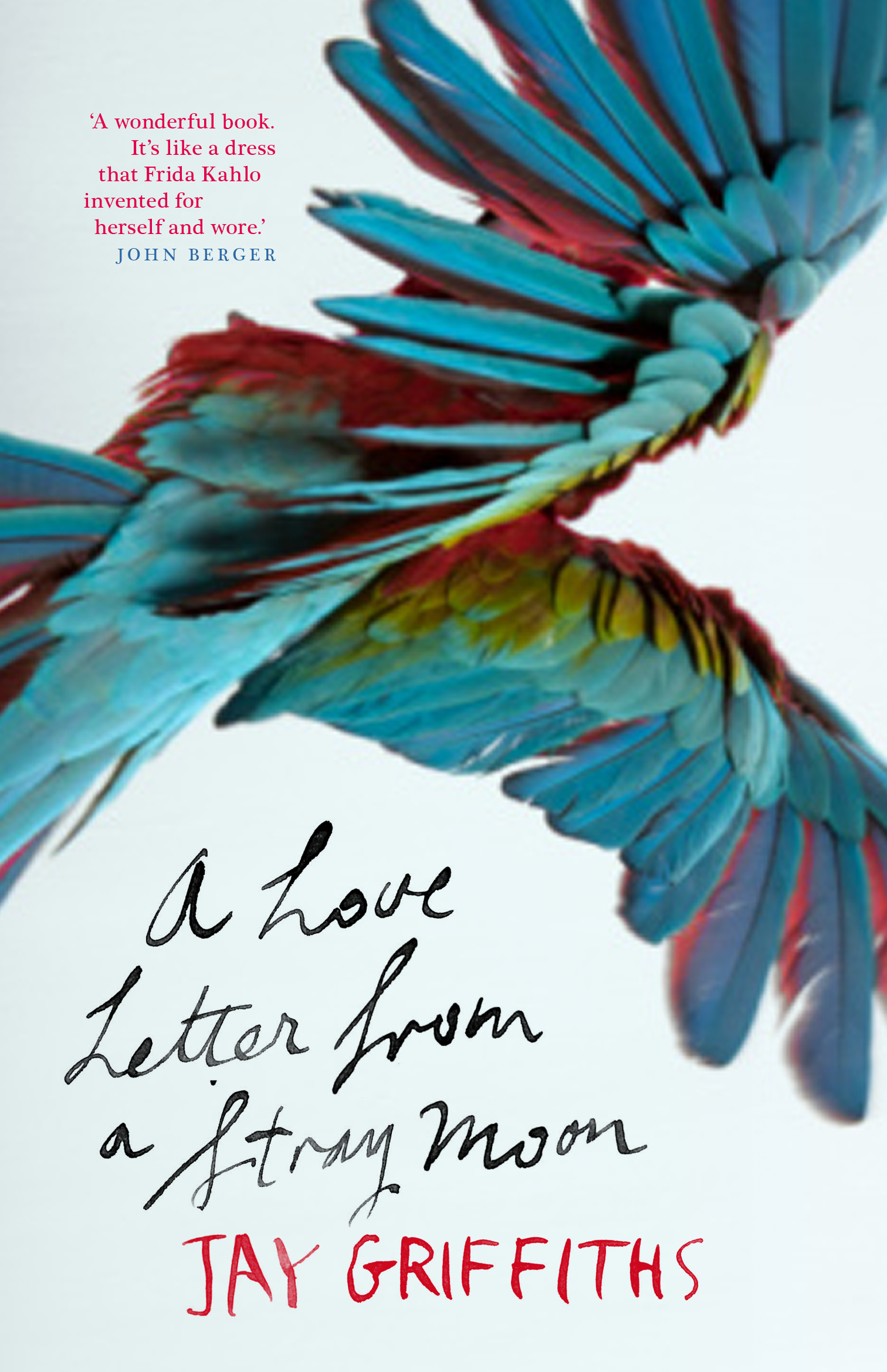
Jay Griffiths, A love letter from a stray moon

Jay Griffiths, A love letter from a stray moon cover

Book cover (Courtesy: Text Publishing)

I have always wanted wings. To fly where I belong, to become who I am, to speak my truths winged and moon-swayed.

I’m not sure I can do justice to this poetic, passionate novella by Jay Griffiths. Titled A love letter from a stray moon, it’s a first person outpouring in the voice of Mexican artist Frida Kahlo. I don’t use the term “outpouring” pejoratively, but rather to describe the full-on passion with which it is told. This is a book with confronts the senses with its power – the imagery is strong but beautiful, the story raw and honest (or so it seems to me.) It’s a book you want to describe as a “tour-de-force” but that would be too clichéd.

The opening lines of the novel quoted above introduce us to its two main metaphors – wings/flight and the moon. For Frida, flight equates with hope and with magic. The moon, though, is a far more complex image, and I’ll try to tease it out a bit as I go on. First though the story. This is biographical fiction (historical fiction?) in the form of a prose poem, told in the first person voice of Frida. The facts of Kahlo’s life are conveyed – such as the terrible accident when she was 18 which left her unable to bear children; her falling in love with, marriage to and divorce from Diego Rivera; her relationship with Trotsky; and even her death and cremation which requires some suspension of disbelief but that’s not hard to do given the novel’s style and tone. If you didn’t know much about Frida you could, I think, read this piece of fiction and feel you’ve got the basic facts, as well as a good understanding of the woman who “lived” those facts.

Woven through all this is the Mexican Revolution which started in 1910 (three years after she was born), discussions of the rise of Fascism, and her ideas on love, art and life (and particularly on how they interrelate). There are also, though this seems a bit anachronistic, some strong references to climate change. In fact, at the end of the novel, Griffiths dedicates her book to two groups of people, climate change activists and Zapatistas. Frida died in 1954. Was climate change an issue then? In the book Griffiths has Kahlo expressing concern about the Amazon and Tuvalu:

But the  Amazon will die of thirst, she will seize up with drought … One island nation, five atolls and four islands, pacific and named by doves, Tuvalu, is silently submerged as the quiet waters lap its shores, past the fishing boats, up its beaches, up, to the houses at the coastline, on, on, the gentle sea, the sea murmuring in quiet amazement at itself, on, until the centre where it can see itself coming, reflecting its rise, it meets itself in a full circle of embrace and Tuvalu will only be a story of mythic islands beneath the waves.

Let’s though get back to the moon. The motif is sustained throughout the novel. It’s appropriate of course for a woman, with its implications for women’s reproductive cycle, but Kahlo draws so much more from it than this single meaning. She layers meaning upon meaning for the moon, some of them superficially paradoxical but together they form a whole. Throughout the novel, for example, she opposes the ideas of gold, earth, sun and matter to silver, moon, and myth. The moon represents for her the mythical, the immaterial and creativity but it also connotes coldness and barrenness. I did say it was a complex symbol – but it’s fittingly s0 for a complex woman. In the first chapter, “Exiled from Casa Azul” she talks of wanting to fly to the moon, describing it as “pure idea” versus the sun which, more pragmatically, “lights the earth”. In the next (very short) chapter, “The moon’s instructions for loss”, she expands on her idea of the moon a little further:

And the moon? In the revolution of the earth’s turning – and I was a revolutionary – a shard of earth was flung off, coalescing, reforming further and later, far off as the moon. But shard is the wrong word, too hard and substantial; so immaterial was this moment, so unearthly the earth, so unanchored the moon, what word could be better? The moon was more like Idea, more like Metaphor, or Time, Flight, or Potential or Longing. A highly strung intensity of latency.

In the rest of the book, these ideas about the moon are explored, teased, stretched as far as they will go to convey the wild, free essence of her life. In her mind the moon is closely related to the idea of flight. She refers to Icarus (whose downfall of course was the sun), arguing that the important thing was not the fall but that he dared to fly.

In one of many references to flight she says:

… flight’s true reality was never in its being made material. What is real need not be material at all.

Given the challenges of her physical life (polio as a child and a leg amputation late in life in addition to her accident), it’s not surprising that Frida found significance in the life of the mind, the spirit and the soul.  “The mind needs myths, good ones”, she says.

And then there’s art. She was known for her self-portraits, in which she painted her passion and her pain. Her art was an extension of her “self”:

…so I make this as a votive painting, a prayer, a vow, a plea, painting to win him back to me…

Frida was a rebellious soul … whose passions were personal and political. Somehow Griffiths has managed to capture all this in a novel which could so easily have been over-the-top. It isn’t, because her Frida’s voice sounds authentic. Frida says, towards the end, ‘I would re-enchant myself with mankind, nothing less … I will promise to find the god of new beginnings.”

I have not done justice to this wonderful, complicated little book – but I hope I have conveyed something of its magic. After that, it’s up to you.

Jay Griffiths
A love letter from a stray moon
Melbourne: Text Publishing, 2011
117pp.

(Review copy supplied by Text Publishing)