Monday musings on Australian literature: Australian Poetry Library (online)

Henry Lawson

Henry Lawson, circa 1902. (Presumed Public from the Sydney University library, via Wikipedia)

It seems appropriate now, when I’ve been exploring the iPad app for TS Eliot‘s The waste land, to introduce the Australian Poetry Library website that was launched in late May. Essentially a digital library, it contains over 42,000 poems from over 170 poets. That’s a pretty good start, particularly when the poets range from pioneers like Henry Lawson to current poets like Les Murray, Tracy Ryan and Alan Gould (whose novel, The lakewoman, I reviewed recently).

The home page is clean and bright, if a little busy. Here is the main content (of which some is dynamic ensuring new content for each return visit):

  • Talking poetry: a selection of poems. Click on a poem and you are taken to a page for that poem where you can hear it read, and follow further navigational links. When I looked at it today, two of the six poems were by Gould, and one was by Rosemary Dobson whose late husband used to work in the office next door to mine (way back when). These readings must surely engage more people in poetry.
  • Featured glossary term: a definition of a poetic term – sestina when I looked – plus the opportunity, a click away, to explore the glossary further. I can see myself checking this out in future.
  • Features: a selection of poets. Click on a poet and you are taken to his/her page containing an image; a biography, bibliography and a further reading list; and a list of poems that you can click on to read. I would love it if the further readings – particularly journal articles – were hyperlinked to the full content, but I didn’t find any that were. I expect copyright is an issue.
  • Review: a review of a poem
  • Poems: a couple of poems from the site
  • Themes and occasions: a list of categories to help find poems on likely topics such as Animal poems, Anniversary poems, Love poems and so on. A nice idea.
  • Poetic forms: a list of forms and styles, such as Iambic Foot, Haiku, that can be clicked on for a definition. (Strangely, the clicked-to page contains some empty clickable headings for titles, surname, and first name, as well as the definition.)
  • Search

There are also useful menu bars/tabs. The main one for the site contains the following self-explanatory options regarding the content: Home, Poets, Poems, Guest collections. The other is geared to the users of the site: For teachers, Glossary, Poetry resources, FAQ and My selections. Overall, the site is easy to navigate, and should appeal to (and be useful for) the general public, educators and students, and the poets themselves.

So that’s the rundown. It’s a lovely site. I checked for several poets and most of them were there – with access to extensive lists of their poems. For Geoff Page, whose verse novel The scarring I reviewed here, there are 857 poems. That alone would keep me well occupied for the next little while! But, not all poets are there. Bruce Dawe and Kevin Hart, for example, are not. Chances are, as the FAQs tell us, this is because permission was not given (by the poet, or the publisher, or whoever owns those rights) to reproduce the poems. This is a POETRY not simply a POET site, so providing the poems is integral – and must have been a challenge to negotiate. The site does, however, allow for some monies to be paid to the poets, when visitors to the site choose to download their “My selections”.

There is an issue though regarding updating. According to the FAQs, no more poems are being added at present. They say: “It is intended that subject to funding, the editorial team will open the site for inclusion of more poetry”. This runs a little counter to the media release on the site’s launch. It says: “The site will continue adding new poets as well as critical and contextual material including interviews, photographs and audio/visual recordings which will be a boon for students, teachers and other researchers.” Hmm … according to this release, the project received the highest ever ARC Linkage Grant for a humanities project and yet, ongoing funding is clearly an issue. I do hope that this great start is not all it is!

And now, just because I do like a bit of nonsense, and because this poem is about poetry and is out of copyright, I’m going to end with “Who wrote the Shakespere plays”, by W.T. Goodge (1862-1909):

No lover of poetry, I,
For the qualification is lacking,
And indeed it were vain to deny
That I couldn’t tell Browning from Blacking.

But Shakespere’s the author, I’ll vow,
And nothing my faith can be shakin’,
For it would be ridiculous, now,
If we talked about “Lamb’s Tales of Bacon”.

With thanks to Lisa of ANZLitLovers for drawing my attention to this site.

Weekends with TS Eliot

Reading TS Eliot's SELECTED POEMS

Reading TS Eliot's Selected poems (Image: Courtesy RubyGoes via Flickr, using CC-BY 2.0)

Breakfast in bed is my weekend treat. It’s when I kick back with a book and simply relax – except this weekend and last I kicked back instead with my iPad and app for TS Eliot‘s The waste land. What fun I am having and intend to have over a few more weekends.

So, what have I been doing?

Fiona Shaw’s performance

Well, last weekend I pottered around the app checking out what’s there and how to navigate it, trying a couple of the readings (but not listening to the whole), and so on. And then I listened to/watched Fiona Shaw‘s performance of the poem. This is a performance rather than a reading. She uses gesture and limited movement (around the upper storey room in a house in Dublin somewhere) to convey the drama, humour and mystery of this rather tricky poem. If you hold the iPad in landscape orientation, Fiona Shaw’s performance fills the screen. However, if you rotate it to portrait orientation, the poem appears below the image with the text synchronised to the performance. This is what I did and, being a textual person, I preferred it this way. I loved seeing the words played out on the screen – and she was almost word-perfect.  I didn’t time it properly but it took, I’d say, 15-20 mins. I’d recommend this as a good way to start re-acquainting yourself with the poem if, like me, it’s been an embarrassing number of decades since you last read it.

Perspectives, from Seamus Heaney, Paul Keegan, Jim McCue and Craig Raine

I said above that I am a textual person and that’s true but, paradoxically I suppose, the thing that most grabs when I’m reading is rhythm and sound (something I’m loving in my current read, Kim Scott‘s That deadman dance, but that’s for later). And so, I have always loved TS Eliot:

In the room women come and go
Talking of Michelangelo
(from ‘The love song of J. Alfred Prufrock”)

And now a gusty shower wraps
The grimy scraps
Of withered leaves about your feet
And newspapers from vacant lots.
(from “Preludes”)

We are the hollow men
We are the stuffed men
[…]
This is the dead land
This is the cactus land
(from, of course, “The hollow men”)

Here is no water but only rock
Rock and no water and the sandy road
The road winding above the mountains
Which are mountains of rock without water
(from “W. What the thunder said” in The waste land)

…  and so on. Staccato or sing-song, repetition or not, rhyming or not. It gets into your bones.

This weekend I decided to explore the Perspectives section of the app which is where various luminaries talk about aspects of Eliot and the poem. I listened to/watched Irish poet Seamus Heaney, poetry editor from Faber and Faber Paul Keegan, Eliot expert Jim McCue, and English poet and academic Craig Raine …. and I gained some new perspectives! I’m not going to comment on all they say since you really should explore this app yourself (if, that is, you have access to an iPad). I’ll just focus on an aspect that most comment on, one way or another – Eliot and sound.

Heaney comments on the “musicality” of the poem. Paul Keegan goes a little further. He suggests that
“acoustic things, tonalities” are what attracts people more, today, to the poem than the “monolithic meanings”. These “acoustic things” though do convey meaning, don’t they, particularly when the allusions elude us. I do not, I admit, “get” all the allusions, but I love the sound of the poem and can sense his concerns even if I may not be able to articulate them in an analytical way.

Somewhat related to this, Keegan argues that Eliot showed it was possible for a poet to write without knowing exactly what larger meanings he was conveying. He suggests that Eliot didn’t necessarily know what he was getting off his chest and that he was more interested in “what poems do than in what they say”. This rather ties back to sound doesn’t it? Or, it does for me. What his poems “do” to me is complex – they move me emotionally but can often mystify me intellectually. They can sound at times like nonsense and yet you “feel” or “hear” something profound. How does he do that? Anyhow, Keegan expands his point, suggesting that Eliot’s poetry encouraged a new fearlessness about poetry “having to make sense, forensic sense”. It freed up, he says, some of those questions*.

Jim McCue’s contribution is a short but interesting one on the history of the poem’s publication. And then, Craig Raine takes up the sound issue again, but from a slightly different perspective. He describes Eliot, the American born English poet, as, really, a world citizen. The waste land is full of “voices” – something conveyed well by Shaw in her performance – from around the world including, most obviously, Germany, France and India. It’s like, Raine says, changing the radio dial (which was still a fairly new technology then.) He also describes the poem as “a fantastic operatic selection”, a not surprising description, I suppose, for a poem which Eliot considered titling “He do the police in different voices”!**

A technical (sort of) note

The app doesn’t always behave exactly as I would expect or like. Changing the orientation will sometimes bring a surprising result and take you away from where you were. It’s not hard to get back as there’s always the Home icon available at the bottom, but it can be disconcerting.

* I will though come back to meaning in my next post after I’ve finished the “Perspectives” section of this App.
** From Dickens’ Our mutual friend

Winners of the 2011 Prime Minister’s Literary Awards

National Library of Australia, photo taken by ...

NLA, 2004 (Image courtesy John Conway, via Wikipedia, using CC-BY-SA 3.0)

Brought to you straight from the afternoon presentation with Caroline Baum in the National Library of Australia Theatre:

  • FictionTraitor, by Stephen Daisley
  • Non-fictionThe hard light of day, by Rod Moss
  • Young adult fictionGraffiti moon, by Cath Crowley
  • Children’s fictionShake a leg, by Boori Monty Pryor and Jan Ormerod

This afternoon’s panel discussion followed the formal announcement and presentation of the awards this morning. The afternoon session, chaired by journalist and broadcaster Caroline Baum, involved a panel of three winning authors (Stephen Daisley, Rod Moss and Boori Monty Pryor) and one shortlisted author (Laura Buzo).

Baum led off her discussion with a question to the authors about their use of technology. It turned out that they were generally a conservative lot though Pryor did admit to having, and using, a laptop. A later question from the audience brought the response from Moss that while he did not use technology in a sophisticated way he was happy for publishers to apply whatever technology they saw fit to get the works out there. Our audience member was wanting more though. Perhaps aware of the recent apps for TS Eliot’s The waste land and Jack Kerouac’s On the road, he was hoping the authors were thinking more imaginatively about using technology in the creative process rather than for distribution after the fact … but these authors were not quite there yet it seemed.

Another question Baum asked was to Stephen Daisley on writing about place. She said that roughly 50% of authors writing about foreign places say they must visit a place to write about it, while the other half argue that visiting the place isn’t necessary. Daisley admitted that he had not visited all the places he’d written about in his novel Traitor, which of course led Baum to ask how one can write about a place without going to it. Daisley’s answer? One word: Google!

I won’t summarise the full discussion, but will mention one other issue Baum raised, and that was to do with indigenous Australians and the problems they – and we – are facing. Pryor (an indigenous Australian) and Moss (whose book is about his experience as an artist working amongst indigenous Australians) answered along similar lines. Moss suggested that he had no “answer” but that what is missing is “genuine friendship” between black and white Australians. Pryor said that it was up to each person to make their own journey but that a true recognition of the special nature and importance of indigenous language, land, art and storytelling would have a ripple effect. In other words, what I “heard” them both saying – and what I’ve heard others say – is that more important than such things as health and education programs is, simply, the showing (or, should I say, feeling of) real respect. Not lip service, not a “send them here, send them there” attitude, but a true respect for the people and their culture. From that all else should logically flow. A sobering but not negative conclusion to what was a fascinating hour or so spent in the company of some very thoughtful people.

Postscript: Some interesting changes are occurring in the literary prize community. This year the Miles Franklin award and the Prime Minister’s Literary Awards included prize money for the shortlisted books too. This is, don’t you think, a great step, recognising, if in a small way, that such awards do have a strong subjective element. So, in the Prime Minister’s Literary Awards the overall prize money remains the same in 2011 as it was last year: $100,000 for each of the four categories. But this year the winning book in each category will win a tax-free prize of $80,000, and each short-listed book (to a maximum of four in each) will receive $5000. I do hope the winners are happy with their reduced purse!

Amazon: The good, the bad and the …

Book Stack

Books, where next? (Courtesy: OCAL, from clker.com)

Well, let’s not go there because, really, we all want convenient, economic access to good books don’t we? And Amazon has done a great job of forging/championing a whole new world of book distribution – both through their online service for  selling traditional books and then their development of the Kindle and eBook distribution. (I know Amazon was not necessarily the first in all these services, but it has certainly brought them into the mainstream.)

This is not to say I haven’t had my grumbles –  about such things as freight costs (no supersaver deals for we downunder) and the more limited availability of eBook titles for our market – but I am glad such online services exist. I have been able to purchase books that would previously have been difficult if not impossible to get any other way. Similarly, readers overseas (that is, over the seas from me!) who find it hard to locate Australian literature can purchase Australian titles from Amazon, including more obscure works like those from Sydney University Press‘s Australian Classics Library. Now that’s what I call a good Amazon deal! And then there’s the fact that people living in remote areas where bookshops don’t exist and housebound people have been able to purchase books far more easily than they could before. There is a lot to like.

But of course, it’s not all good. What change is? Monopolies (and near-monopolies) are rarely beneficial in the longterm (for consumers anyhow), so the news of an Amazon-Book Depository merger is rather concerning. But it’s not a fait accompli (yet). And the continuing loss of traditional face-to-face book stores is also disappointing – but I don’t understand the economics enough to know where and how this one can be resolved. We like to browse bookshops but we also like the convenience, and sometimes cheaper prices, of online and/or eBook purchase. Can we have our cake and eat it too? If someone knows the answer to this one, I’d love to hear it.

I am not defending Amazon per se. Nor am I cheering on their Book Depository merger plans. We should feel concerned. We are right to question. But, I’d like to recognise what Amazon has achieved and what we have gained. I (selfishly) wish I knew how we can keep the industry (authors, publishers, distributors) strong so that we readers can get what we want, when we want it, at a price that is reasonable for all. Ideas anyone?

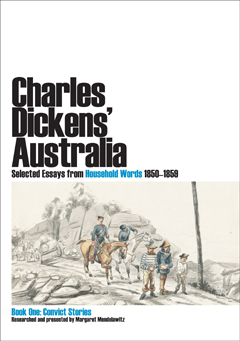
Margaret Mendelawitz, Charles Dickens’ Australia. Book 1, Convict stories

Charles Dickens' Australia, Book 1

Book cover (Courtesy: Sydney University Press)

So true may fiction be in the hands of a genius
(from “Convict in the gold region”, by Richard Horne)

Richard Horne, in his article “Convicts from the gold region”, describes a scene from Don Quixote in which Quixote meets and sets free some convicts by driving away their guards, only to have his generosity (which included delivering them “a noble speech”) met by ridicule and “a volley of stones”. Horne suggests that the convicts he met would do “the same thing to any eccentric philanthropist in a broad-brimmed hat who should set them free and make them an address on liberty and humanity”. An interesting analogy to draw and one, I might add, that he doesn’t test, but I did like the way he used it to see the truth in fiction!

Anyhow, I have now read Book 1 in this fascinating set of books from the Sydney University Press, and it pretty well does what Mendelawitz says in her introduction. That is, it provides a first-hand, informative and entertaining insight into mid-19th century Australia – in this case, relating to the role of convicts in that society. The focus is on social conditions and social justice but there’s no heavy-handed proselytising. Dickens’ aim was to create a magazine that would be “cheerful, useful and always welcome” but that would also “assist the reader’s judgement in his observation of men”. Badness and wrongdoing aren’t glossed over but, wherever possible, mitigating circumstances are also provided.

There are 15 articles in the book, written by 9 different authors, some in collaboration. The last 6 are written by Australian-born barrister, journalist, novelist John Lang and are short case studies of individual convicts, including those who were unjustly (or, at least, unfairly) transported, those who deserved what they got but made good, and those who couldn’t give up their criminal ways. Representing this last group are the convicts described in “Three celebrities”. Fox, Pitt and Burke were three thieves who were “transported under the names of the three most celebrated orators of their time”. For whatever reason, they did not knuckle down to honest work in the colony, but instead escaped and operated as bushrangers. Even in their story, though, a positive is given: by the time they were captured they had set up a well-stocked farm with an abode that “was in the neatest order” and land that “was very well-tilled”. At the opposite end of the spectrum is the rather melodramatic tale of star-crossed love and a stolen horse resulting in the transportation of young “Kate Crawford”. Noticed by Mrs Macquarie, the wife of Governor Macquarie, and placed in the home of the chief constable in Parramatta, she was pardoned within three years and (eventually) died a very wealthy woman. These 6 stories are told with a light touch and in a conversational tone as tales relayed by a woman who knew the convicts in question.

A few of the articles are set in – or tell of – the Norfolk Island penal colony, a colony I have written about before in reviews of Jessica Anderson‘s The commandant and Price Warung‘s Tales of the early days. Both of those were written after the events and people they describe, and it is reassuring to our search for the “truth” that the articles here basically confirm the worst and best of the colony as conveyed by Anderson and Warung in their fictional pieces.

The centrepiece of this volume though is the story of William Henry Barber, who was transported to Norfolk Island in 1844. The story, told over two articles “Transported for life [Part One]” and “[Part Two]”, chronicles his imprisonment, trial and conviction for a crime he claims he did not commit,  his transportation to Norfolk Island (including details of the long boat journey) and subsequent removal  to Van Dieman’s Land from where he was, in 1847, released. Not long after, he received a free pardon with acknowledgement of his innocence. The articles are told first person but in fact were written by journalist and novelist William Moy Thomas. The Notes on Contributors suggest that the articles were based on the account Barber wrote in 1853 of his experiences, an account which is known to have been in Dickens’ library. The aim, as stated at the beginning of the first part, was to show “what transportation, at the present time, really is”.

In my overview of this set I wondered whether Dickens’ tight control over style would result in the articles being somewhat formulaic but I’m pleased to say that they aren’t. While the tone is overall more light than heavy and the content informative with a light persuasive edge, the style does vary. Some are factual chronicles of a life or situation while others have a more literary bent, some use dialog while others comprise descriptive prose, some are a little more obviously didactic while others simply present the situation for the reader to draw conclusions. The message, though, is always there, whether stated or not, and it is essentially this:

It is no miracle that has been here performed; men bred to crime in England by the ignorance and filth we cherish, are bred out of crime again in Norfolk Island, by a little teaching and a little human care. (from “Norfolk Island”, by Irwin and Henry Morley).

I must add, in the services of “truth”, that Norfolk Island had a mixed history regarding treatment of convicts but there was a short period, under Alexander Maconochie, when rehabilitation was taken seriously.

To conclude I can’t resist a quote from pickpocket Barrington in another of John Lang’s case studies, “An illustrious British exile”:

There was a time when ladies boasted of having been robbed by Barrington. Many whom I never robbed gave it out that I had done so; simply that they might be talked about. Alas! such is the weakness of poor human nature that some people care not by which means they associate their names with the name of celebrity.

And we thought the celebrity culture was new? Once again history tells us otherwise!

Margaret Mendelawitz
Charles Dickens’ Australia: Selected essays from Household Words 1850-1858. Book 1, Convict stories
Sydney: Sydney University Press, 2011
187pp
ISBN: 9781920898670

(Review copy courtesy Sydney University Press)

Monday musings on Australian literature: the National Centre of Biography

What is life? Life itself, as you will realise if you consult a dictionary, is hard enough to define. But what is a life? And why does it matter? For itself (a question of honour)? Or for what one can make of it as a biographer (which may mean trespass)? I am old-fashioned enough to believe that it matters for and in itself. But what precisely is it that I am trying to honour and how do I do that? (Veronica Brady, on writing about Australian poet Judith Wright)

Do you like to read biographies? I do, though I don’t read as many as I would like to because fiction tends to have the edge in my reading priorities. Nonetheless, it is a form (genre?) that fascinates me. How do you structure the story of a person’s life? What do you do about the gaps in knowledge? (Even in a well-documented life you are not going to “know” all of your subject’s feelings and motivations.) How do you handle the ethics (not to mention legalities) of revealing perhaps “uncomfortable” truths? How do you make it readable? And so on …

Biographies of course take many forms – from the brief overview documenting the key points in a person’s life to a narrative telling the story of someone’s life. In Australia, one of the best examples of the former is the Australian Dictionary of Biography (ADB) from the Australian National University (ANU). First published in 1966, the ADB now contains “concise, informative and fascinating descriptions of the lives of over 12,000 significant and representative persons in Australian history” (from the website), and is also available online. The online version largely parallels the printed version. In other words there is a long lead time (we are talking years, here) between when the articles are written and their appearance in print and online. (Surely this has to change?) Currently, ADB is working on entries for people who died between 1991 and 2000, with the edition covering those who died between 1981 and 1990 due for publication in 2012! It is, however, despite this lag time, a useful starting point for research into Australians.

In 2008, the ANU established the National Centre of Biography (NCB). It is now responsible for the production of the ADB, but it has a wider mandate, relating to fostering and encouraging expert and innovative biographical writing in Australia through such activities as teaching, conducting public lectures and symposia, and inviting international scholars to the Centre. Exciting stuff, eh?

This year, the NCB also launched Obituaries Australia. Their stated aim is to “collect every obituary that has been published and to index them so they can be searched by researchers”. Currently though the site contains only around 2000 entries, which is why almost every search I tried came up blank. You have to start somewhere though …

All this suggests that biography is, in fact, alive, well and taken seriously in Australia. In addition to the work being fostered at the ANU, there are a number of literary prizes here for biographical or life writing. They include:

There are also several non-fiction awards, such as The Age Non-fiction Award and the non-fiction and history categories in the Queensland Premier’s Literary Awards, for which biographies are eligible and have in fact won.

I will come back to biography again in a future Monday musings, but, in the meantime, would love to know whether you read biographies and how well you think the form is supported by the literary or cultural establishment in your country.

Delicious descriptions from Down Under: Melbourne scenes, 1850s

One of the contributors to Charles Dickens‘ weekly magazine Household Words was Richard HorneAccording to the notes on Contributors in Margaret Mendelawitz’s five-volume set, Charles Dickens’ Australia, which I reviewed last week, Horne was an English-born author who lived in Australia from 1852 to 1869. He agreed to write travel pieces for Household Words “in return”, say the notes, “for advances to equip the expedition and for regular payments to his wife”. (Apparently Dickens refused to have anything to do with Horne when he returned to England due to the minimal contributions Horne had made to his wife’s support while he was away. Given Dickens’ own less than admirable treatment of his wife this smacks a little the pot calling the kettle black, methinks)

Anyhow, one of Horne’s articles for Household Words is included in the first book of Mendelawitz’s set. The article, published in 1853, is titled “Convicts in the gold region” and discusses convicts in the Melbourne area. I enjoyed some of his descriptions and thought I’d share a selection with you.

on Melbourne

… Melbourne, famous, among other things, ever since it rose to fame two years ago, for no roads, or the worst roads, or impassable sloughs, swamps, and rights of way through suburb wastes of bush, and boulder stones, and stumps of trees …

I was going to use this to talk about how stereotypes start but in fact Melbourne’s roads aren’t particularly bad these days, even though it does have a reputation for its strange road rule, the hook turn. The next description, however, is more typical of Melbourne:

It is night; a cold wind blows and a drizzling rain falls.

And yet again I jest a little when I say typical. Melbourne is famous for having four seasons in a day so cold and rain are not the only weather you experience there!

at the Pentridge Stockade

Pentridge prison was built in 1850 to cater for the growing number of prisoners resulting from increased crime due to the gold rush. Horne had a reason for describing Melbourne’s roads at the beginning of his article, because the road to Pentridge itself was a beautiful one. It was built using convict labour.

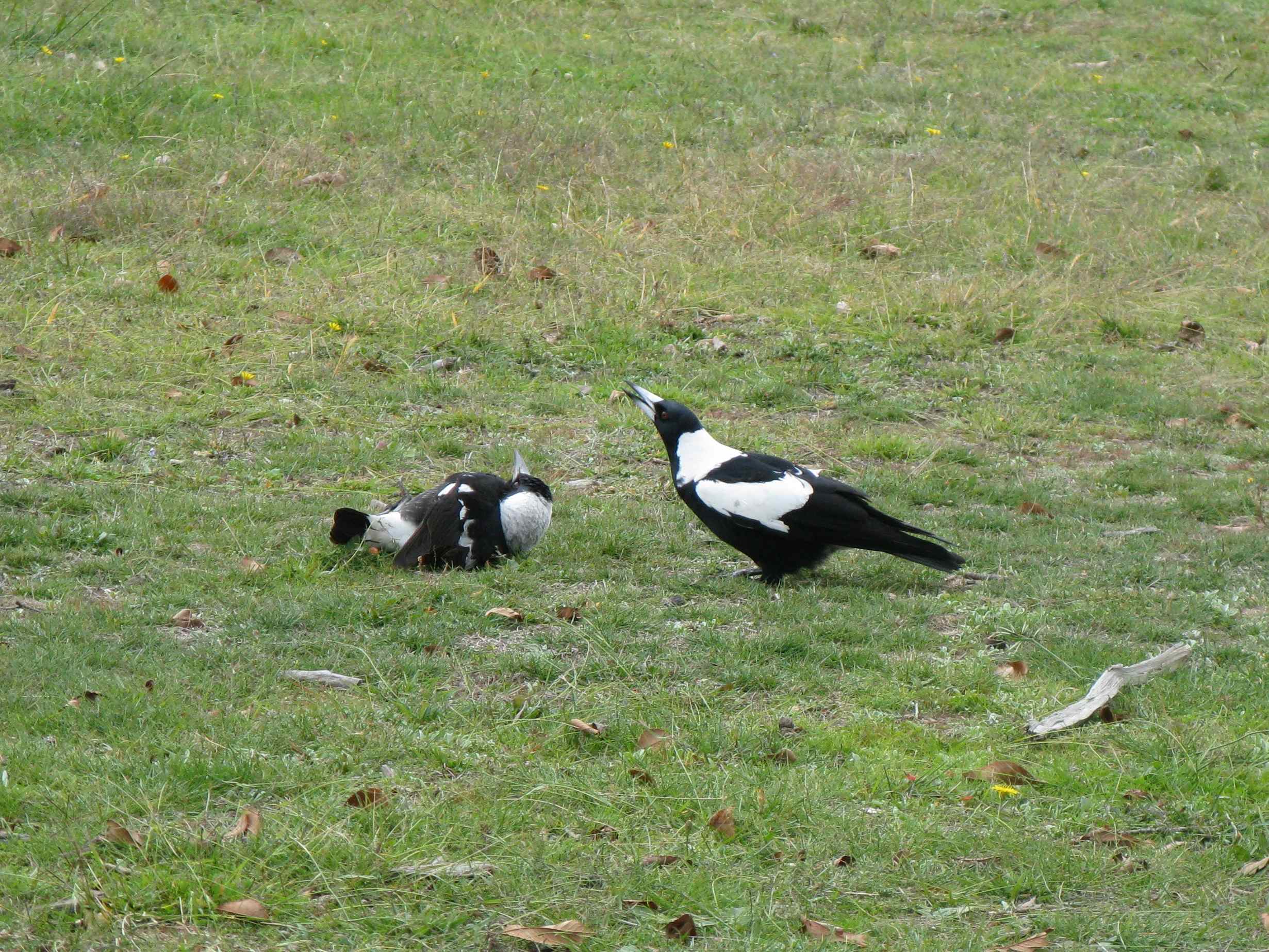
Magpies at Tidbinbilla

Not on broken granite, but magpies nonetheless

The yard is covered with loose stones of broken granite; and I notice close to my feet and looking directly into my face, a magpie. He also, holding his head on one side interrogatively, seems to ask my business here. I take a fresh breath as I look down at the little thing, as the only relief to the oppressive nature of prison doom that pervades the prison scene.

This man is clearly a writer … the contrast he draws here is both pointed and poignant.

I have taken a stroll around the outskirts of the Stockade, and, while gazing over the swampy fields, now wearing the green tints of the fresh grass of winter which is near at hand, and thence turning my gaze to the bush in the distance, with its uncouth and lonely appearance, I hear …

And now we’re really talking … because this description of the Australian bush as uninviting and unappealing was widely held by our 19th century colonials. And, I’d venture to say, Australian culture didn’t really start to come into its own until we started to appreciate the beauty of our bush!

TS Eliot’s The waste land, app-style

TS Eliot plaque SOAS London

Would Eliot have liked this new way of publishing? (Image, via Wikipedia, released into Public Domain by Man vyi)

Hands up if you’ve seen Touchpress‘s gorgeous iPad app for TS Eliot‘s poem The wasteland? Now, if your hand is up, why didn’t you tell me about it? Luckily, though, I have a real-life, dinky-di librarian friend who told me what my online friends didn’t!

This is not going to be a proper review as I only downloaded it yesterday, but it’s worth sharing sooner rather than later. At least , I think it is, because it’s a great example of how technology can enhance our reading experience, particularly of complex texts. The app comprises the following menu items:

  • Poem (the full text)
  • Performance (a filmed performance of the full poem by Fiona Shaw. You can watch the performance on its own, or with the text synced to it!)
  • Manuscript (facsimile of the original typed manuscript showing Eliot’s handwritten edits)
  • Perspectives (commentary on the poem and Eliot, by various people including Seamus Heaney and Jeanette Winterson)
  • Readings (several audio renditions of the poem, including two by Eliot himself, and others by Alec Guinness, Ted Hughes and Viggo Mortenson)
  • Notes (annotations and references explaining the poem)
  • Gallery (images relating to the poem).

There is a Home icon so you can quickly return to the menu screen to navigate around the app. And there are also well thought through navigations on other screens. For example, on the screen containing the straight text of the poem are icons linking directly to the annotations (Notes) and the list of audio versions (Readings).

I feel like the proverbial child in a lolly shop. Where do I start? Do I simply read the poem? Probably not, since if that’s all I wanted to do I’d have taken my lovely old Collected Works down from my bookshelf. So, what do I do? Do I read it with the annotations? Or listen to TS Eliot read it or watch Fiona Shaw perform it? Or do I play around with the edited manuscript facsimiles? Whatever I do, though, I’ll be in good company. The app – for a rather challenging poem, remember – was one of the topselling apps the week it was released and was named “app of the week” in the US.

I read, much of the night, and go south in the winter
(line 18, The waste land)

It will take many nights to read, watch and absorb this terrific production, but it’s winter here so I’m starting now…

TS Eliot
The waste land
iPad app (AUD16.99) 
Touch Press and Faber and Faber, 2011
951mb

Margaret Mendelawitz, Charles Dickens’ Australia: Selected essays from Household Words 1850-1859

It was not to be a high-brow intellectual periodical. Above all he wanted to reach and entertain the masses and, at the same time, help shape discussion and debate on the important social questions of the time. (from Introduction, by Margaret Mendelawitz)

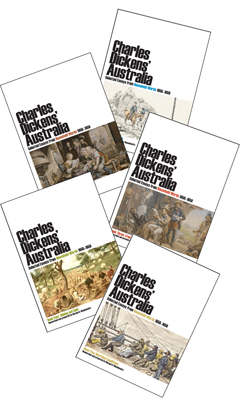
Five covers for the Charles Dickens' Australia set

Set book covers (Courtesy: Sydney University Press)

Charles Dickens‘ Australia is a set of five volumes containing essays, stories and poems relating to Australia from the magazine, Household Words, that Dickens established and editedThe magazine was published from 1850 to 1859 which, as Margaret Mendelawitz says in her introduction, was an “extraordinary decade in Australian and British history”. The discovery of gold in Australia (and California) transformed the world. Social justice was becoming a serious issue for debate and action. And it was when “the age of capital” really began.

So, it is rather fortunate that a writer of Dickens’ calibre produced a magazine in this period – and that he was sufficiently interested in Australia (as I described in a post last year) to actively seek and commission articles about life and social conditions here for his magazine. As you might expect, the magazine is available online (in gorgeous facsimile and for electronic downloading) but the value of these five volumes is that they have been carefully researched by Mendelawitz and contain the articles specifically relating to Australia. According to the Sydney University Press website, of the 3000 articles published in the magazine over its lifetime, only 100 dealt with Australia in some way. Unless you like the fun of the chase, these volumes are an excellent way to get to the Australian content without having to do the searching and sifting yourself.

This isn’t the only reason though for reading the articles via this set. It is a beautifully conceived anthology. Firstly, the articles have been thematically organised into five manageable volumes:

  1. Convict Stories
  2. Immigration
  3. Frontier Stories
  4. Mining and Gold
  5. Maritime Conditions

And there’s more. Each article  starts with a small panel containing a brief description of its content, its publication details (the volume and issue numbers, pagination, and date) and the amount paid for it! The articles are footnoted, with those original to the article clearly identified as such. Curiously, the editorial additions – the introduction, etc – are referenced differently, with the notes placed at the end of each piece rather than in footnotes. The additions are: a foreword by Geoffrey Blainey; an introduction by Mendelawitz; a list of contributors providing a brief, targeted biography and a list of their articles included in the set; and, a short but appropriate bibliography. These are all repeated in each volume, presumably so the volumes can stand alone.

I was initially perturbed that the article authors are not named in the table of contents, but then I read the introduction which tells us that “regardless of their source, all articles appeared anonymously”. Mendelawitz has followed that practice in her table of contents, but has identified the author/s on the articles themselves, providing another reason for reading this set because knowing the authors and their backgrounds adds a further dimension to the reading.

Mendelawitz covers a lot of ground in her introduction. She talks a little about Dickens himself and about the history of Household Words, she describes the era in which it was written, and she discusses the writers, the content and the “house” style. I found these last two particularly interesting. The articles, as I’ve said, were published anonymously. They were also carefully edited to meet what Elizabeth Gaskell called a “Dickensy style”. This meant they had to be bright, regardless of how dry the subject, and would characteristically start with a snappy, provocative paragraph. It also meant that those that did not accord with Dickens’ views were rewritten. I can’t help thinking that, if slavishly enforced, this adherence to a set style could result in the articles feeling formulaic. It’s something I’ll check out as I read the volumes in depth.

The final point I’d like to make in this overview concerns the issue of fact versus fiction. Mendelawitz argues that the articles are “literature, not history”. They are valuable, she says, for the insight they provide into 19th century Australia but this “does not depend on them being the literal truth”. She writes:

As a collection they demonstrate the complementary nature of storytelling between the writing of history and fiction. The stories in Household Words frequently draw a fine line between fact and fiction, giving voice to characters and events that could easily go unrecognised and unrecorded. In many ways they exemplify the fundamental problem  encountered by historians through the ages of how to separate and present fact, fiction, myth and truth.

Regular readers of this blog know that this issue interests me. I expect to come back to it when I review the first volume in the near future … from what I’ve read so far, I think I’m in for a fascinating ride.

Margaret Mendelawitz
Charles Dickens’ Australia: Selected essays from Household Words 1850-1858
5 volumes
Sydney: Sydney University Press, 2011

(Review copies courtesy Sydney University Press)

Monday musings on Australian literature: What value writers’ homes?

DKS, in a recent comment on this blog, and Lisa of ANZLitlovers, in a post last week, have brought to my attention the threat to Christina Stead‘s home, Boongarre, in Watsons Bay, Sydney. As a lover of the “literary road”, I’m concerned and so decided to explore it a little more.

The facts, as I understand them, are there is a draft heritage listing on the house, but there is also a development application currently before the Woollahra Council to add “modern extensions and excavate the historic garden” (Street Corner Staff, 6 June 2011). The house was a major inspiration for Stead’s novel, The man who loved children. The Watsons Bay Association has set up a petition to save the home. Their arguments are that the house:

  • will (do they know this?) be a heritage item “within months”;
  • represents 70 years of history of Christina, and her conservationist father and step-mother, David and Thistle Stead; and
  • is one of a “dwindling number of important historic houses in Watsons Bay”.

The Association provides strong supporting evidence for these arguments (which you can read via the link I privoded). They also say that the cause is being supported by such contemporary writers as Jonathan Franzen (who wrote an introduction for a recent edition of The man who loved children), Alex Miller and Nikki Gemmell.

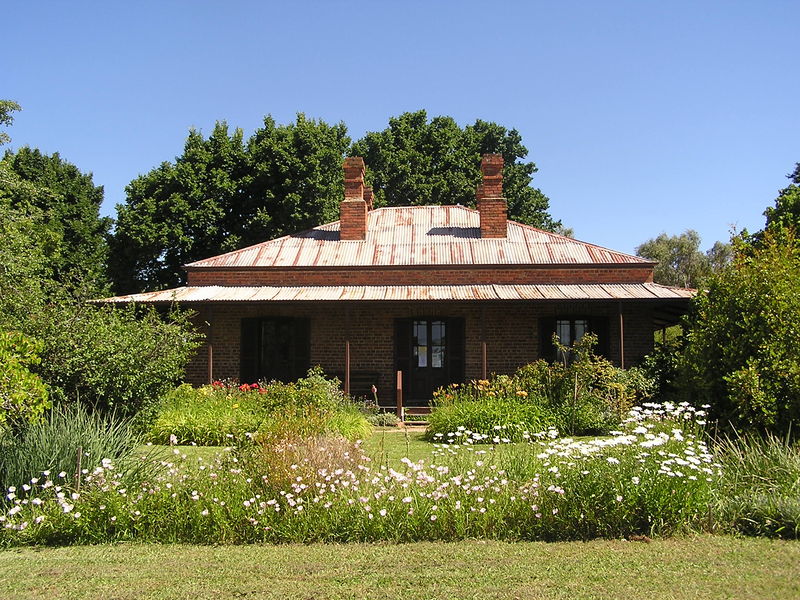
Lake View House, Chiltern

Lake View House, Chiltern, in which Henry Handel Richardson lived (Courtesy Golden Wattle, via Wikipedia, using CC-BY-SA 2.5)

There are those, however, who aren’t so quick to leap to the defence of the house. Over at The Australian newspaper’s A pair of ragged claws litblog, the issue was discussed earlier this month by Stephen Romei and his commenters. Stephen posed this:

I’m leaning towards saying it doesn’t bother me, that Schwarzer spent $10 million to buy the place, which is a house not a museum, so he should be able to do some renovations if he wants, that swimming pools are great when you have kids, and that he’s not, as far as I know, also proposing to burn the last copy of The Man Who Loved Children.

But I’d like to hear other opinions on the matter. The fact that Alex Miller, for one, does care, is more than enough to give me pause. So, apparently, does Jonathan Franzen, who is Stead’s literary champion in the United States.

Romei goes on to suggest that seeing a writer’s house, say Hemingway’s, is interesting in a “touristy” way but that he wouldn’t care if it weren’t there the way he would if Hemingway’s books no longer existed. Several commenters agreed with him: it’s the books that matter, they said; and there must be other ways to remember and promote interest in Christina Stead. But, argued others, there is value in keeping and celebrating writers’ houses. My favourite arguments are:

  • When a home and/or museum is done well, it can provide wonderful insights into the writer’s life and serve as a repository for archives and artefacts, as well as a focus for dissemination of the writer’s work and a resource for scholarship. (Nathanael O’Reilly); and
  • Maintaining a house for prosperity is more than a gesture. It is an important anchor point for a culture which says “this is us, this is valuable.. see why”.  It speaks volumes to those coming on, even if they don’t visit.  A writer’s home may seem inconsequential, say compared with Monticello (tell me if that experience doesn’t impact, and last!*), and upkeep payments may seem misplaced or prohibitive, but little by little these things infuse society and enrich us here, and by overseas acknowledgement through visitation, in ways immeasurable.  We really do need to understand these values and to move away from the transigent [sic] “she’ll be right” approach to our “culture” and begin taking a more hands-on approach. (Lobster)

Wow! I didn’t need convincing, but Lobster has nailed it on the head as far as I’m concerned. What about you?

(* It sure does!)