Toni Jordan, Nine days (Review)

Jordan's Nine Days

Book cover (Courtesy: Text Publishing)

Toni Jordan’s latest novel, Nine days, is somewhat of a departure from her first two novels which are more in the chicklit vein, albeit chicklit with a difference. The thing is, I don’t generally read chicklit, but I did enjoy Addition and Fall girl, so I was more than willing to read Jordan’s next offering. I was not disappointed.

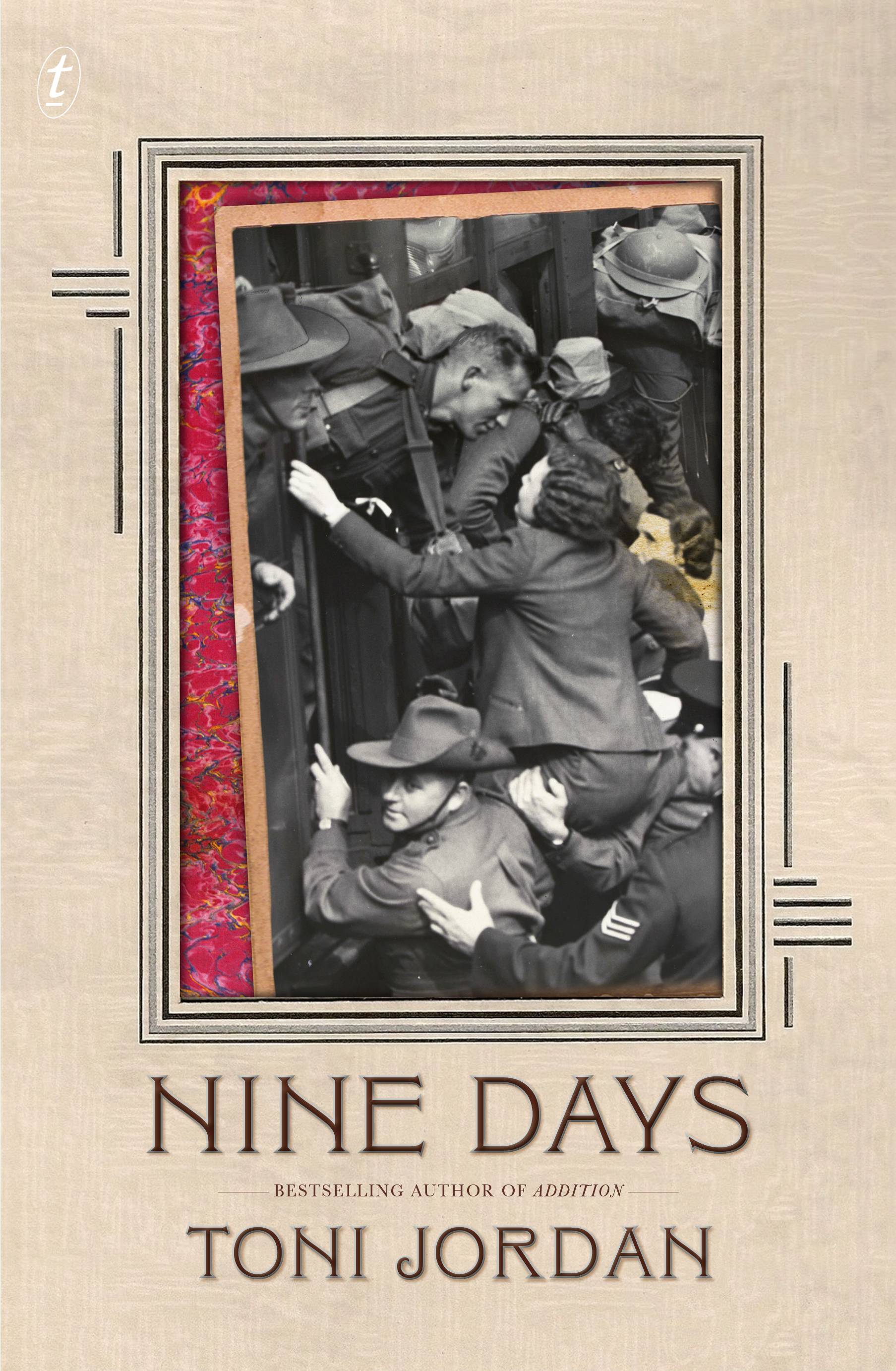
Nine days was, according to the Author’s note, inspired by a photograph from the State Library of Victoria’s Argus collection. The photograph forms the cover of the book’s first edition: it depicts an unidentified soldier leaning out of a train window to kiss an also unidentified young woman. Jordan has woven around this photo a multi-generational story that spans six decades or so from the eve of world war 2 to the present. The title refers to the nine days upon which the book’s nine chapters are built – with an added complexity. This is a multiple point of view novel like, say, Christos TsiolkasThe slap and Elliot Perlman‘s Seven types of ambiguity, but while those two novels progressed their narratives in a linear chronology via the changing voices, Jordan’s chronology jumps around in a seemingly chaotic manner. However, there is method to it, because careful reading reveals thematic or structural connections, even if not chronological ones, between each chapter.

That’s the basic structure, but the real interest of course is in what the novel’s about. How, though, to describe the plot of such a novel succinctly? The best way is to simply say that the novel tells the story of three generations of one family, which is, by the way, an impressive thing to attempt in 250 pages. There is a central mystery – for the reader and for the family though they aren’t necessarily aware of it – to do with the two figures in the photograph. Each chapter is named simply for the character in whose first person voice it is told. The first is Kip, a nearly 15-year-old boy in 1939, who has just had to leave school and go to work because of the recent death of his father. Other chapters are told by his twin brother Francis/Frank (who gets to stay at school), his mother Jean, and his much loved big sister Connie. Interspersed with their stories are those told by Kip’s wife, Jack who lives next door, Kip’s twin daughters, and even his grandson. For each person something happens – some choice must be, or is, made – in the particular day they describe, which impacts their life’s direction.

It’s an ambitious structure, but Jordan succeeds, for a few reasons. A big one is her ability to create strong, believable characters who are likable despite their faults. It helps that the first character, Kip, is particularly engaging. He’s easy-going and generous-hearted, but is also endowed with a good dose of wits and common-sense. He plays an important role in the denouement. His daughters, the overweight, rather uptight Stanzi, and the hippy-alternative-eco-warrior Charlotte, are clearly differentiated and provide a touch of humour with their (mostly) good-natured sibling bickering and point-scoring. Most contemporary female readers will see bits of themselves or people they know in these two. And, while I’m speaking of women, I can’t resist quoting Kip’s young, restless sixteen-year old grandson Alec:

I’ve wasted my whole entire existence up to now. I’ve done absolutely nothing with it. I’ve just been counting down the months of my life. Sixteen years, totally useless. I live with three women. A big night at my place is when the ABC runs a Jane Austen marathon. God I hate that Bennet chick. Marry him already, and spare us the drama.

Another reason the book works is that Jordan manages place and time well. Counterbalancing the seemingly erratic chronology is the fact that place is kept simple. The whole novel occurs pretty much in one suburb in working class Melbourne. This helps keep we readers grounded, as do two little motifs – a “lucky” shilling and a purple pendant – which appear on and off throughout the novel. I was initially concerned, after the first couple of chapters, that the shilling was going to be a little heavy-handed or mechanistic – particularly given the shilling graphic commencing each chapter – but it’s not. Like the pendant, it appears in some, but not other, chapters, and in so doing helps keep us focused without irritating us.

In other words, the book is handled very well technically. But, that’s not what makes a book, in the end, is it? What makes a book good is its heart – and the heart of this book is warm but real. Its particular subjects are war, abortion, religious and class difference, social conscience and social mobility, but it is also a universal tale about how love (marital, romantic, sibling, parental, and so on) forms the glue that keeps us going. This might sound corny, but that’s not how it comes across. The novel has its share of grittiness; and relationships have their tensions, conveying the message that love (whether marital, sibling or parental) is not a simple endpoint but something to be worked at.

This may not be the book for readers who like long family sagas they can lose themselves in, but for those like me who enjoy works which tease and leave ties undone, much like life really, Nine days has plenty to offer.

Toni Jordan
Nine days
Melbourne: Text Publishing, 2012
245pp.
ISBN: 9781921922831

(Review copy supplied by Text Publishing)

Andrew Blackman, Nights on Fair Isle (Review)

You probably know by now that I occasionally like to review short stories that are available online, most often those published by the Library of America.  So when author and blogger, Andrew Blackman, recently posted that one of his stories had been published online, I thought I’d check it out.

“Nights on Fair Isle” is, he says, the first time he has had a short story available free on the internet, but he expresses uncertainty about the value of reading online and asks his readers’ opinions. Good question and one I’d like to answer … somewhat anyhow, and then bat it on to you. I don’t as a rule read fiction online. I read novels on an e-Reader but I don’t think that’s the same as online, or is it? And I read short stories and essays that are made available online. But, here’s the rub. I don’t read them online. I print them out and read the hard copy instead. This might just be the product of my babyboomer-dom… I could in many cases, I suppose, download stories and essays onto my e-Reader, but mostly I think what’s the point. It’s just as fast to print it out.

Anyhow, the story. It’s a little story … And I mean that literally in terms of its length not as a comment on its quality. In just three pages (in my printout version), Blackman tells a tightly controlled story of loneliness and how one woman goes about soothing her soul to enable her to keep on going day after day in a big city, London to be exact. We don’t know where Aurelia is from, but we do know that she wasn’t an English-speaker when she arrived in London. Not long after her arrival, she stumbles on the shipping  forecast on the radio and hears a “gentle male voice intoning” words like “Low, Fastnet, nine seven three, falling slowly”. Each night she tunes in to the same words, and thinks it’s a nightly prayer that she’s hearing. Eventually of course she’s put right, but she goes on tuning into the forecast for its soothing sound …

And for the way it reminds her of her mother’s “sweet lullabies … that chased away the shadows and fears”. Blackman neatly segues from the shipping forecast to the sea and Aurelia’s favourite sea-based fairy story, and effectively uses the paradoxes inherent in sea/water imagery to convey both fear and calm. I won’t relate more of the story though … after all it’s short enough for you to read yourselves via the link below. I’ll just say that I liked the way Blackman gently explores the power – and limit – of dreams and reverie to keep you going. It’s a realistic rather than grim or depressing story.

Meanwhile, do you read online? And if so, do you think it changes the way you read, or what you read?

Andrew Blackman
“Nights on Fair Isle”
SolquShorts, 2012
Availability: Online

Queensland Literary (Fiction) Awards, 2012: Woo-hoo

Readers of this blog might remember that earlier this year the new premier of Queensland axed his state’s Premier’s Literary Awards … to a great outcry from literary aficionados around the country. However, with a wonderful can-do attitude and the support of private sponsors, a group of volunteers revived the awards, rebadged as the Queensland Literary Awards, just over 4 months ago. The prize purse was much reduced but the important thing is that the awards went ahead … And the winners were announced this week.

The awards group kept the full raft of awards that had been part of the original awards, a wide range that had made these awards particularly significant, but they are too numerous for me to list here. I will though report on the main ones of interest to me:

  • Fiction Award: Frank Moorehouse’s Cold light, the third in his trilogy, of which I’ve read the first, Grand days. This award rather breaks the stranglehold that women writers, Anna Funder and Gillian Mears, have had on this year’s awards to date.
  • David Unaipon Award for Unpublished Indigenous Writer: Siv Parker’s Story. This is a significant award for giving opportunities to and showcasing indigenous Australian writers. I’ve read some winners and have a couple more on my TBR.
  • Steele Rudd Award for Short Stories: Janette Turner Hospitals’s Forecast: Turbulence, which has been patiently waiting for me on my Kindle for a few months now. I’m a Hospital fan.
  • The Courier-Mail People’s Choice Book of the Year: Simon Cleary’s Closer to stone

A full list of the awards can be viewed here. Reviews of several of the winners listed above can be found at ANZLitLovers.

Monday musings on Australian literature: Some favourite Aussie television adaptations

Today’s Monday Musings is the third in my series on filmed adaptations of Aussie literature, though this time I’m talking television adaptations. The television adaptation of books – mostly into miniseries – has become big business over the last few decades. You only have to look at the BBC and the success it’s had with the so-called bonnet dramas to know that.

A miniseries seems to me to be a more natural form for novel adaptations than movies, if only because the additional length offered by the miniseries caters for more character and plot development. It’s not only for its wet shirt scene that the 1995 adaptation of Pride and prejudice starring Colin Firth and Jennifer Ehle is so beloved!

Anyhow, here are some of my favourite Australian television series that were adapted from novels*:

  • A Town Like Alice (1981) was one of my favourite novels of my teen years – that and anything by Jane Austen, not to mention Voss from my late teens. Written by Nevil Shute, it’s a wartime romance on a grand scale about English rose Jean Paget, her experience as a prisoner-of-war in Malaya, her initial not always harmonious meeting with Aussie bloke Joe Harmon, and her post-war life in the Aussie outback. We “colonials” loved the idea of an Englishwoman preferring life with a dinkum Aussie bloke to one with the toffs over the sea! Mythmaking perhaps, but there’s nothing wrong with a bit of that every now and then!
  • Harp in the South (1986) was based on the novel of the same name by Ruth Park about whom I’ve written before on this blog. The book was another teen favourite of mine. Published in 1948, it’s a gritty realistic though sympathetic novel set in the slums of Sydney and is one of several books by Park that dealt with “battlers”. It’s some time since I’ve seen the series but I recollect that it effectively conveyed the world of the novel that Park created.
  • My Brother Jack (1965 and 2001) was adapted from the Miles Franklin Award winning novel of the same name by George Johnston. Published in 1964, it is the first of a trilogy, and is regarded as an Australian classic. The 1965 adaptation was written by Johnston’s wife, Charmian Clift, but if I’ve seen it I don’t recollect it. I did however see the 2001 adaptation. I enjoyed its depiction of between the wars Australia, and its exploration of Aussie masculinity through the uneducated, hardworking Jack as seen by his educated, more obviously successful but less happy journalist brother.
  • The Slap (2010) was adapted from Christos Tsiolkas‘ Miles Franklin Award winning novel of the same name. This is a multiple point of view novel with each chapter being  told from a different character’s point of view. It’s not always sensible for adaptations to follow the style and structure of the original but in this case the producers did, and it worked well. It was gripping viewing.
  • Cloudstreet (2011) was also adapted from the Miles Franklin Award winning novel of the same name, but this time by Tim Winton. It’s a big novel in which realism and something more magical are used to tell the story of two families who find themselves sharing a house at no. 1 Cloud Street. The adaptation did a wonderful job of capturing what is a complex novel with a large cast of characters and spanning several decades. The script, the visuals, the music work together to create something accessible but thought-provoking at the same time.

Interestingly, all of the above adaptations used the same title as their original novel. I guess there’s a good reason for that! And the last three were all based on Miles Franklin Award winning novels. Anyhow, these are just a few of the many Aussie novel television adaptations … there are way too many, and many that I’ve enjoyed, to discuss here – such as Nancy Cato‘s All the rivers run, the audiobook of which I am currently listening to.

Do you watch television adaptations of favourite novels? And if so, do you have favourites?

* Some of these books have also been adapted for film, but I am only focussing on the television versions here.

Alexander McCall Smith, The Saturday big tent wedding party (Review)

I have a number of tenets – if that’s not too grand a word for it – according to which I read. These include that I don’t read series books and I don’t read crime. However, the best rules are made to be broken, aren’t they? And so, I break mine for our family holiday tradition which is to read the latest book in The No. 1 Ladies’ Detective Agency series. We are now behind though. We should have read The Saturday big tent wedding party (the 12th of now 13 books in the series) last September. But that annual family holiday as well as our February holiday this year were cancelled due to health reasons. We finally got away in August … I have now read the book and am about to pass it on to the next eager reader.

So, what to say? If you know the series you’ll know what it is about and may have read this one already. If you don’t know the series, then I’d say if you are looking for something warm and charming, with a touch of humour, to fill in a quiet time you could do worse than spend a few hours with Precious Ramotswe and her family and friends. Or, if you prefer to spend your reading time on different fare, watching the miniseries on DVD could be just the thing. It was an enjoyable adaptation.

I said that I don’t read crime. However, these are probably not books leapt on by aficionados of that genre. There is always a crime to investigate of course … but while the crimes in these books have, on occasion, involved violence or real danger for the victims, their resolution never depends on violence, guns, car chases and the like. Rather, Precious (and her assistant, Mma Makutsi) use common-sense, psychology, simple observation and forthrightness to determine the perpetrator. Police, courts and jails are rarely if ever invoked.  The denouement, instead, usually entails natural justice and/or negotiated restitution. If only life could be managed this way …

Which brings me to McCall Smith and his philosophy. These books espouse a life based on moral and ethical behaviour, on forgiveness and humility, and on understanding where the other is coming from. It might seem (and is) a little cutesy at times, but the heart is real and the lessons seriously intended. In resolving the crime in this 12th book, Precious Ramotswe thinks:

There would be no further attacks – that was clear, and the damage had been set right by the one not responsible for it. All that was lacking was the punishment of the one responsible. But punishment often did not do what we wanted it to do …

And the one responsible … well, that would be giving it away. Suffice it to say that it’s not as simple as it might have looked at the beginning.

The rest of the book – like its predecessors – continues the story of Precious and her family. The apprentices are growing up (at last), a wedding finally occurs, the tiny white van is not totally lost – and Mrs Potokwani continues in her well-meaning but organising way.

And now onto the next holiday read …

Alexander McCall Smith
The Saturday big tent wedding party
London: Little, Brown, 2011
248pp.
ISBN:  9781408702598

Anna Funder, Stasiland (Review)

Anna Funder's Stasiland bookcover

Funder’s Stasiland (Courtesy: Text Publishing)

Anna Funder‘s Stasiland, which won the Samuel Johnson Prize for Non-Fiction, is one of those books that can be reviewed from multiple angles, and I know that when I get to the end of this review I’m going to be sorry about the angles I didn’t get to discuss. But, I can only do what I can do, eh?

I found it interesting to read this book immediately after another non-fiction book, Brenda Niall‘s biography True north, because the contrast clarified for me why I liked True north but loved Stasiland. To put it simply, True north is a well-written but pretty traditional biography, while Stasiland is what I’d call “literary non-fiction”. In other words, in Stasiland, Funder uses some of the literary techniques – relating to structure, voice and language – more commonly found in fiction to tell her story. It’s not surprising really that this is the case, because when I heard her speak last month, she said that she had initially planned to write Stasiland as a novel but, having done the research and interviews, it “didn’t feel right” to turn those people’s stories to another purpose. She was also aware that there were things in these stories that might not be accepted, that might seem too far-fetched in fiction! Such is the fine line we tread between fact and fiction.

At this point, I should describe the book, though its broad subject is obvious from the title. Funder (b. 1966) has a long-standing interest in things German, from her school days when she chose to learn German, and has visited and/or lived in Germany several times. She writes of travelling through the former German Democratic Republic, a country that no longer exists, that comprises “tumble-down houses and bewildered people”, and she describes feeling a sense of “horror-romance”:

The romance comes from the dream of a better world the German communists wanted to build out of the ashes of their Nazi past; from each according to his abilities to each according to his needs. The horror comes from what they did in its name.

And so she decides to try to understand this dichotomy and places an ad in the paper:

Seeking: former Stasi officers and unofficial collaborators for interview. Publication in English, anonymity* and discretion guaranteed.

This is, depending on how you look at it, either a very brave or naively silly thing to do. Funder, who sees writing as an act of empathy or compassion, interviews several Stasi men who answer her ad, as well as other East Germans who suffered at Stasi hands. It might be coincidental, but essentially all her subjects who suffered were women, while the perpetrators were men. In fact, when she visits the Stasi HQ in Berlin, she’s told it only had toilets for men! All this is not to say, however, that men didn’t suffer (or, even, that there weren’t women perpetrators). Indeed, some of the Stasi men she interviewed were themselves bullied, blackmailed and otherwise stood over to keep them in line.

What makes this book compelling are the stories she gathers, partly because the stories themselves are powerful and partly because of Funder’s own voice. Funder places herself in the book. This is not a third person “objective” recounting of the interviews she conducted but a journey we take together to find some answers. When she interviews Herr von Schnitzler, who hosted the Black Channel, a television program in which he presented a Communist commentary on excerpted programs from the West, we are in the room with her, hearing not only what he says, but getting a sense of his personality alongside her. We see her being fearless in sticking to her questions in the face of a man who frequently shouts. “I recognise”, she writes, “this pattern of unpredictable shouting followed by bouts of quiet reason from other bullies I have known”.

It is particularly in the von Schnitzler section that the GDR paradox becomes most clear. Von Schnitzler was, Funder tells us, molded by the injustices of the Weimar Republic. We see how the drive to create a new society not bedevilled by the iniquities – that is, the inequalities – of capitalism (or imperialism as many of the Stasi men call it) resulted in the creation of an authoritarian society where freedom was minimal (or non-existent) and dissent not allowed. In stark contrast to von Schnitzler and his refusal to see any error in, or critique, the GDR, is Julia, one of the “victims”, who had believed in the GDR but, through having an Italian boyfriend, had become caught in the Stasi net. She discovered that the “state can be so dangerous, so very dangerous, without me having done anything at all” and was completely traumatised by the extent of surveillance and loss of privacy she experienced. And yet, having experienced the East and the West, she can still say

you see the mistakes of one system – the surveillance – and the mistakes of the other – the inequality – but there’s nothing you could have done in the one, and nothing you can do now about the other … and the clearer you see that the worse you feel.

The GDR story is, as Funder tells it, one of grand humanitarian aims but one also riddled by paradox and irony. She asks Herr Bock, a recruiter of informers, what qualities he looked for in an informer:

‘… and above all else,’ he says, looking at me, his eyes distorted and magnified through the glasses, ‘he needed to be honest, faithful and trustworthy.’

I look back at him. I feel my eyes too, getting wider.

How can you resist a writer who tells a story like this, who shows without telling exactly what is going on, who can inject sly touches of wit and humour into the tough stuff?

I can’t possibly relate all the stories – many quite horrendous – in this book. All I can say is that it is a book that manages to show how history writing can be intimate while at the same time conveying facts and hard truths. It is a memorable book, and worth reading if you have any interest at all in politics and human behaviour.

Anna Funder
Stasiland
Melbourne: Text Publishing, 2002
ISBN: 9781877008917
282pp.

* I’m intrigued by the promise of anonymity because it seems that in some, if not in all, cases, real names are used. I presume the people involved agreed to this.

Monday musings on Australian literature: Two favourite literary journals

I’ve been wanting for some time to write about two of my favourite Australian literary journals (that is, not specifically book review journals). I don’t  read every issue – too much to read, too little time, and all that – but I’d love to. I admire people who manage to subscribe to magazines and journals and read every issue through and through.

Before I talk about the two I’ve chosen I should say that there are others I know I’d love too. I go into bookshops, pick them up, put them down, pick them up again and then realise I just can’t manage any more so I put them down again. For a useful list of  some of Australia’s best literary journals, check out this Australia Council webpage listing the journals* the Council supports.

Anyhow, back to my two current favourites. Both can now be bought in e-versions, including for the Kindle. They can be followed on Twitter and have Facebook pages, and both make some of their content available free online. And, here they are …

Griffith Review

The Griffith Review is a quarterly journal of “new writing and ideas”, and is now 8 years old. It is published by the Griffith University. Unlike most journals, it takes a thematic approach, with each issue being devoted to a theme. For example, the current issue, no. 37, is themed “Small World”, which its website says “broadens the mind with postcards and intelligence from everywhere at a time when the growth of international air travel has shrunk the definition of proximity and the internet has enabled the globalised media industry to bring distant events and places tantalisingly close”. The contributors on this issue include writers I’ve reviewed here: Murray Bail, Melissa Lucashenko and Chris Flynn.

What I love about this journal, besides the overall quality of the writing of course, is the variety of forms it encompasses on a regular basis – Fiction, Poetry, Essays (including photographic essays), Reportage and Memoir. I love that they include memoir as a regular part of the journal. And, in 2009 (at least I think it was then), they commenced an annual fiction edition. These editions contain more short stories than the other issues, and the rest of the content (essays, memoirs, etc) focuses on fiction. Not quite Granta, but perhaps moving in that direction?

Kill Your Darlings

I’m not an expert on the economics of journal publishing, but the Griffith Review does have a pretty major university behind it. Kill Your Darlings (KYD) on the other hand is a much smaller – braver – affair. First published in March 2010, it is now up to issue No. 10 (which, in print, costs $19.95, but at $7.96 from Amazon for the Kindle, it’s a great deal). This current issue has an interview with Aussie writer Andrew McGahan (whom I like but haven’t read since starting this blog) and an article on one of my favourite Aussie writers, Jessica Anderson, so I let my fingers do the walking at Amazon and in seconds I had it on my Kindle. Gotta love this new technology!

Like most literary journal, KYD’s content is diverse, with its regular sections being Commentary, Fiction, Interview, Reviews – and, sometimes, a Cartoon.

Kill Your Darlings is a smaller, somewhat plainer publication than the Griffith Review, but it is gorgeous with a stylish retro look that catches the eye. It’s lovely to hold. Hmm, why did I buy that Kindle version, again?

I’ll conclude on another article in Issue 10, which comes from Gideon Haigh whose discussion on literary reviewing in the first issue I blogged about back in 2010. In Issue 10, he writes on the economics of writing. Early in the article he says:

Here is a disjunction in Australian publishing: the most enthusiastic and imaginative publishers are the ones with no money; caution grows with size.

That seems an appropriate thought to leave you on methinks.

Meanwhile, I’d love to hear from you – Aussie or not – whether you have any favourite literary journals, what they are and why you like them.

* I’m not sure how up to date this list is, but it’s a start if you’d like to check others out.

Brenda Niall, True north: The story of Mary and Elizabeth Durack (Review)

‘Of course we are mad,’ Bet wrote to Mary, ‘but we live in a mad place.’

Brenda Niall's True North
Brenda Niall’s True North (Courtesy: Text Publishing)

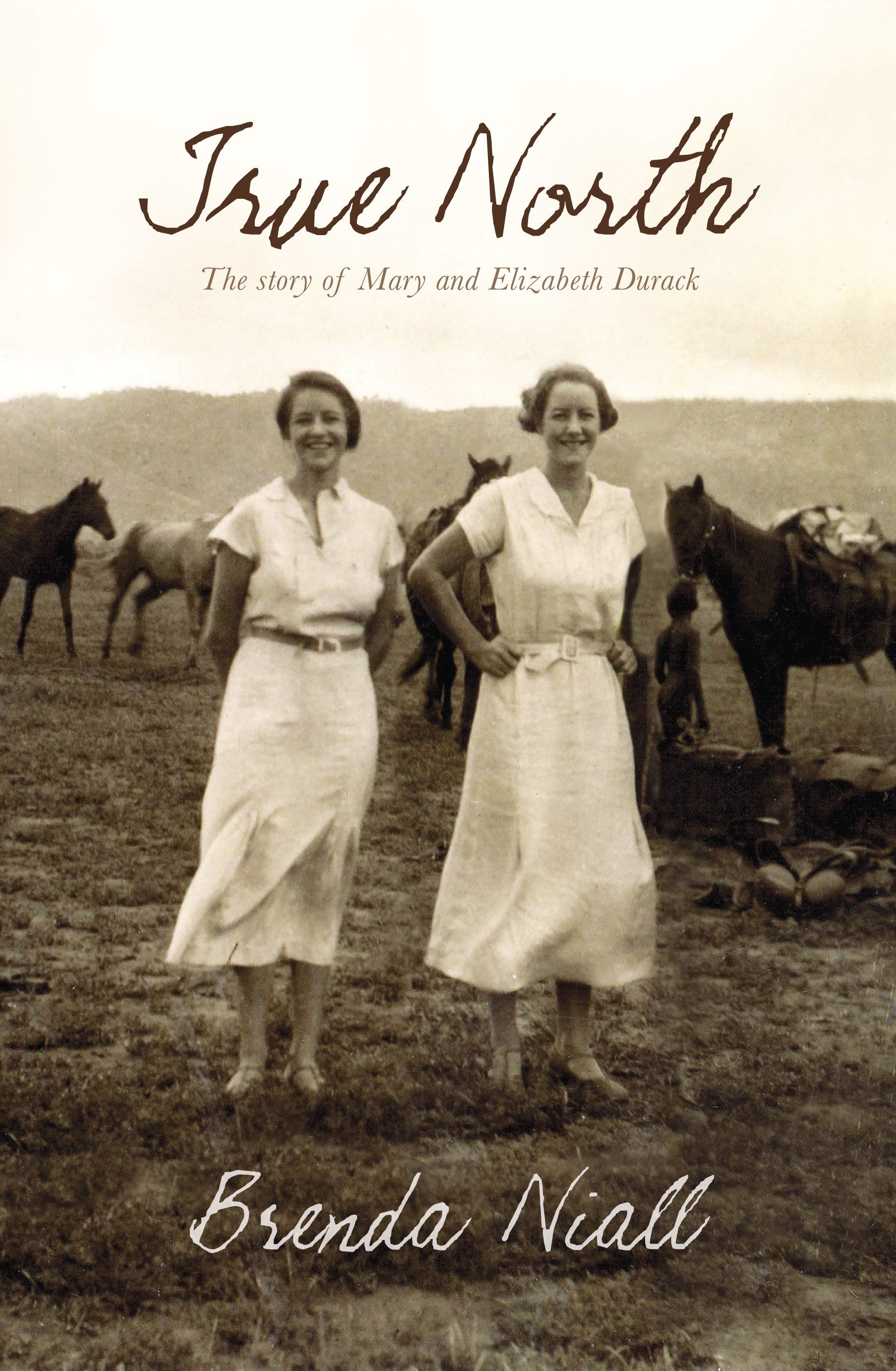
The mad place that Bet – Elizabeth Durack – refers to is the Kimberley region of north-west Australia and the book this quote comes from is biographer Brenda Niall‘s True north: The story of Mary and Elizabeth Durack.

Brenda Niall, along with the late Hazel Rowley, is one of Australia’s best regarded biographers. True North, her most recent book, tells the story of writer Mary Durack (1913-1994) and her younger sister, the artist Elizabeth (1915-2000). I must say that it took me a long time to read this book. I was fascinated by the story but it lacked, in the beginning at least, some of the punch that I found in Rowley’s Franklin and Eleanor: An extraordinary marriage which I reviewed last year. I think this is because Niall’s style here is a little flatter, a little more like reportage, than I found in Rowley’s book. Both books have two people as their subjects and both books have an overriding theme – the Roosevelts’ extraordinary marriage for Rowley and the sisters’ fascination with the remote north for Niall – but, for me, Rowley’s had a stronger narrative drive which resulted in a more cohesive “argument”. However, I did settle into True North and, in the end, enjoyed it for what it did do.

Mary and Elizabeth, for those of you who don’t know, belonged to the pioneer pastoralists, the Duracks, who had  emigrated from Ireland in the 1850s. They farmed in Goulburn (NSW), then moved to Coopers Creek (Queensland) in the late 1860s, before droving their cattle nearly 5,000 kms cross-country to settle in the Kimberleys (WA) in 1882. Mary told this story in her best-selling (now classic) history, Kings in grass castles, and its sequel Sons in the saddles.

Niall’s book, though, is not about that, but about the two sisters and their lives in the 20th century. Mary and Elizabeth spent most of their childhood and youth in Perth, while their father managed the northern properties, returning south each year in the off-season. However, both separately and together spent time on their father’s properties, particularly in their late teens and early twenties. Niall’s title, “true north”, expresses the sisters’ identification with the north. In 1929, for example, Mary said she returned to the north “like a homing pigeon”. Elizabeth described it, a few years later, as “that wild, wonderful country”. The north was, in fact, the inspiration for their creative output.

Niall characterises the two sisters well. Mary was the calmer, more sociable, reliable one who struggled to find time to write between raising children, supporting various family members, and playing a significant role in the literary life of Perth. Elizabeth was more unsettled, more fiery and perhaps more ambitious. She was frequently poor and depended on the family, particularly Mary, for monetary and emotional support throughout much of her life. Theirs was a close relationship, and included several collaborative books for which Mary wrote the text and Elizabeth did the illustrations. Neither made wonderfully successful marriages – and both, despite their challenges, produced significant bodies of work.

Several themes run through the book, but the most interesting one for me concerns the Duracks’ relationship with Aboriginal people. From early on the family employed indigenous people. According to Niall, the sisters’ father, Michael Patsy Durack, “stressed their value as allies”. For the sisters, their early experiences were positive and resulted in a lifelong interest in and awareness of indigenous people and their issues. Elizabeth spoke many years later about “how lovely it was to go walking with them and to learn about the bush” while Mary wrote of being disturbed by “the shadow people in their humpies on the river banks, humbly serving, unknowing, unquestioning”.  Mary wrote a short story, “Old Woman”, about the harsh treatment of an Aboriginal woman by a station wife. It was published in The Bulletin in 1939 and nearly resulted in a libel suit. Elizabeth wrote in a letter, around 1935,

It’s a question of either opening one’s eyes to the situation and grappling with it with whatever instruments lie within one’s reach or shutting one’s eyes to the whole business and getting the hell out of it.

I don’t have time to fully explore it all now, but I was intrigued by this comment on Mary late in her life:

She found the Aborigines surprisingly objective about the past ‘recalling events with no hint of bitterness’, talking about the white people with neither praise nor blame.’

This brought to mind indigenous writer Kim Scott’s That deadman dance, which I reviewed last year and in which he presents (albeit in a novel but borne out by the records, I believe) a similar generosity or openness of spirit. But, back to True north. Niall argues that the Duracks were respectful and sympathetic employers and friends. Big brother Reg in the 1930s was aware of “the social injustice of use of Aboriginal labour”. Mary, in the 1960s, argued persistently for equal pay, and even though, when it came, indigenous station workers were displaced in droves, she still believed in the principle. Ah, that tricky conundrum: principle versus reality, idealism versus pragmatism.  Why are they so often at loggerheads with each other?

Elizabeth, however, did get into hot water later in her life when, going way further than Mary who wrote a poem in the voice of an indigenous woman, she took on the name and persona of an Aboriginal man, Eddie Burrup, as a nom de brush. Niall discusses the issue at some length teasing out artistic and personal issues versus cultural trespass. She is sympathetic in the end to Durack and her somewhat mixed motivations. The situation was certainly complicated and, while some of Durack’s motivations give me pause, I’d rather not pass judgement, except to say that in the late 20th century it was not a wise thing to do.

The insight Niall gives into an albeit specific pastoral family’s experience of and response to their relationship with indigenous people makes this book worth reading. We do of course only get Niall’s presentation of the Duracks’ experience. Besides a few scattered references to indigenous people’s responses, we know little of the indigenous perspective. The sad thing is that we may never know their side, since few people are left to tell it, and not much is likely to have been documented.

Oh dear, I’ve written a lot about one theme and there’s so much more to tell, but I won’t retain you much longer. Two other major themes permeate the book. One revolves around love of and identification with place, with how place can get under the skin and drive one’s life. The other concerns the challenge women creators face in serving their art while juggling families and the need for financial support.

While I didn’t find Niall’s book as compelling as I’d hoped, the more I think about it, the more I appreciate what she has attempted to do. The Duracks’ story is a complex and somewhat contradictory one. Mary, Elizabeth and their brothers were the children of a “cattle king”, and being such their public image was “one of effortless privilege”. The reality was, in fact, rather different – and it resulted in lives that were challenged and challenging. Niall’s book will not, I suspect, be the last we hear of them – but it makes a valuable contribution.

Brenda Niall
True North: The story of Mary and Elizabeth Durack
Melbourne: Text Publishing, 2012
Kindle edition
272pp (Print ed.)
ISBN: 9781921921421 (eBook)

Monday musings on Australian literature: Some favourite Aussie film adaptations (2)

A couple of Monday Musings ago I shared some of my favourite Australian films adapted from novels. Today, it’s the turn of Aussie plays. I’m no expert in adapting works but it seems to me that it would be easier to adapt a play to film than it would be a novel. I wonder if that’s true in reality? Does anyone know?

Anyhow, here are some of my favourite Australian films that had their genesis in theatre:

  • Don’s Party (1976) is one of many plays written by satirist David Williamson that have been adapted to film, and I have enjoyed most of those I’ve seen. I’ve chosen Don’s Party because it was one of the first. The play was written in 1971 and is set during a post-election party held by Don for his Australian Labor Party friends. They expect their party to win but things don’t quite go to plan, and tensions develop. The film was directed by prolific Australian director, Bruce Beresford. It beautifully but rather excruciatingly captures the new educated, socially mobile middle class, their (our!) pretensions and the gap between reality and their dreams.
  • Breaker Morant (1980) is one of my favourite Australian films from our film renaissance of the 1970s to early 80s, partly because I am a bit of a fan of courtroom dramas and this is a good one! The film was adapted from a play (first produced in 1978) by a playwright I don’t know, Kenneth G. Ross, and was directed by Bruce Beresford. (Told you he was prolific!). The subject is the court-martial of Lieutenant Harry “Breaker” Morant and two other officers for murders during the Boer War. The film plays to an historical tension between the colonial Aussies and the colonist Brits, as well as to Australians’ reputation for larrikinism or anti-authoritarianism, and it makes a strong anti-war case. It starred Edward Woodward, Bryan Brown and Jack Thompson – and, writing about it now, makes me want to see it again.
  • Lantana (2001) was adapted from the play, Speaking in tongues, by Andrew Bovell. It’s a tense drama centred around a murder, but it’s less a crime story than an exploration of relationships and trust/betrayal. The film was directed by Ray Lawrence. It has a moody atmosphere and an insistent soundtrack (composed by Paul Kelly) that makes it hard to forget.
  • Blessed (2009) was adapted from the play, Who’s afraid of the working class?, written by Andrew Bovell (again), Patricia Cornelius, Melissa Reeves, Christos Tsiolkas (author of The Slap) and Irene Vela. The playwrights, with the exception of Vela, also wrote the film script. As I wrote in my review on this blog, it’s a gritty exploration of mothers and their often neglected children.

There are many other Australian films adapted from plays, including several by Williamson, The Summer of the Seventeenth Doll (from Ray Lawler’s classic play of the same name), and The Sum of Us (from a play by David Stevens, who also wrote the filmscript for Breaker Morant!).

When films are adapted from books, we often know because the books tend to be republished (often with a movie image on its cover). The movies provide a great opportunity for books to get another airing. With plays, though, its a different situation. We don’t, as a rule, read plays and we often don’t know, I suspect, whether a film has been based on a play or not (even if it has the same title).

How often are you aware of the theatrical origin of films you like, and do you have any favourite films that are based on plays?

(BTW, My next post on the topic of adaptations will be on television adaptations.)

Dame Mary Durack, Lament for the drowned country (Review)

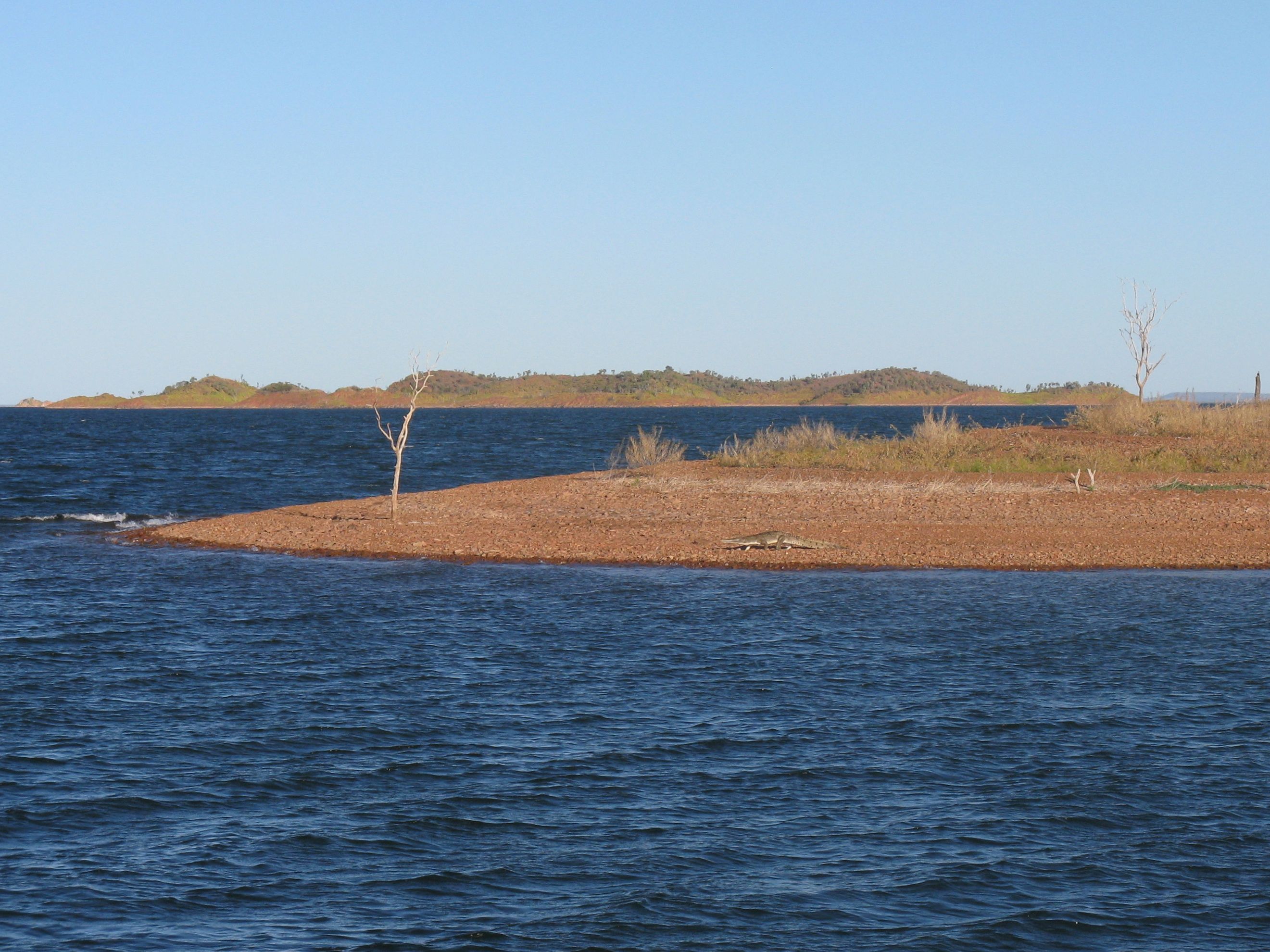
Lake Argyle with Crocodile

Freshwater crocodile heading into Lake Argyle

Near the end of her book True north about Mary and Elizabeth Durack, biographer Brenda Niall writes of Mary Durack‘s poem, “Lament for the Drowned Country”, which she says “has been judged her finest poem”.  Of course, with such a statement, I had to read it. I could have Googled* it, but I decided to check my Penguin Book of Australian women poets and, hallelujah, it was there. (Once again this book didn’t let me down!)

“Lament for the drowned country” is a long poem and is presented in the voice of an Aboriginal woman, Maggie, mourning the drowning (for the Ord River Irrigation Scheme) of her “born country”. It’s a poignant poem – for obvious reasons – as it’s about the loss of country (for the indigenous people) and home (for the Duracks, whose Argyle homestead went under the water). But, there’s something else too – an irony, because the idea of damming the Ord River was first proposed by Mary’s brother Kimberley Durack in the 1940s. Mary supported her brother** at the time … but the reality many years later, after her brother’s death, was sad for her.

The interesting thing about the poem is that Durack chose to write it in the voice of an Aboriginal woman. Niall writes of this that:

At a later time, her creation of a first person voice for Maggie Wallaby might have been questioned. In 1972 it was taken as she intended it, as a work of empathy and imaginative identification.

This made me think of Thomas Keneally‘s The chant of Jimmie Blacksmith which was shortlisted for the Booker Prize in 1972. It was written in the voice of the Aboriginal protagonist, but Keneally has since said that he wouldn’t presume to do that now, and would tell the story from a white point of view. This says something, I think, something positive, I hope, about Australia’s cultural development. In the 1970s and before, indigenous voices were hard to find. This is less so now – and will hopefully only get better bringing us more voices, and a greater variety of story representing the diversity of indigenous experience.

Anyhow, back to the poem. According to Niall, the poem was inspired by Mary seeing Maggie “catching fish and unaccountably throwing them back into the [new] lake”. Mary saw this – realistically or romantically, who’s to say? – as signalling hope. She has Maggie saying:

I sit along river coming down from my born country.
That heart place! I got to talk to that water.
I got to tell that fish: ‘You go back – you go back now –
talk strong my country. You tell him that spirit can’t leave ’em.
You tell him – Wait! Hang on! This is not the finish!
…’

Later in the poem, Maggie talks of the land drying, the sun coming once again to warm it, and the animals and birds returning. Maggie also makes a reference to the Durack homestead:

You go back up there, that old station – Argyle station –
(poor fella my old boss, my old missus. Nothing left that
house, where I sweep’m every day!) You look out that house,
you look out
windmill, tank, garden, kitchen, saddle shed.

The remarkable thing about the poem is how well – or so it seems to me – Mary Durack captures the cadence, the intonation even – of Aboriginal speech and story-telling. I shouldn’t be surprised though, because Durack spent much of her childhood playing with Aboriginal children and spent her adult life, when she could, not only arguing for but working with indigenous people in their fight for equal rights. According to Niall, as Mary Durack left the north for the last time, “the Aboriginal women, knowing they would never see her again, began to beat their heads and wail inconsolably”. We all know the psychology of master-servant/white-black relationships is a complex one, but that doesn’t deny the fact that amongst it all there can genuine feelings and mutual respect.

I’ll be writing more on the Duracks, and particularly on Mary whose love for the land of her birth was, like Maggie Wallaby’s, absolute:

she can’t forget ‘im, my country, she all day heart-crying.

Meanwhile I recommend this poem …

Mary Durack
“Lament for the drowned country”
In Susan Hampton and Kate Llewellyn (ed)
The Penguin Book of Australian Women Poets
Ringwood: Penguin, 1986
pp. 65-68.

* I did Google it too, to provide a link for this post, but I only found excerpts rather than the whole poem. Hence no link here. I guess it’s too recent to be in the public domain.

** Kim Durack was an agricultural scientist. He apparently loved the land and was committed to improving it after the damage caused by years of over-grazing.