Neel Mukherjee’s The lives of others, and those epilogues

MukherjeeLivesOthersChattoWhen my reading group discussed The lives of others questions were raised about the meaning of the two epilogues, specifically in terms of what they contributed to the meaning of the book. Not having finished the book in time, I wasn’t able to join in, so I’m having a go now.

As I mentioned in my review, the two epilogues are dated much later than the main action of the book, the first occuring in 1986, and the second in 2012. Let’s start with 1986 …

Epilogue 1

It’s about Sona, the youngest grandson in the house and the son of the youngest, and most ill-treated, daughter-in-law Purba. At the end of the novel, before the epilogue, we learn that his mathematical skills have resulted in his being offered a scholarship to go to America. He’s 15. In 1986, he is 30, and a Professor of Pure Mathematics at Stanford University – and he has won a special Mathematics Prize. What has this to do with the novel?

Tricky. At one level, it shows that the lowest in the family hierarchy did manage to get away and “make good”. It’s lovely seeing poor Purba, even before they left, suddenly being recognised and appreciated by the family. But, it’s how they got away that is also significant, which is through skill, ability and education. Education is one of the novel’s themes. Early, daughter Chhaya sees a niece (another grand-daughter in the family) displaying signs of immodesty and defiance:

This is what happens when one has an uneducated mother, Chhaya thinks …

Then again, the rather unpleasant Chhaya is unmarried. Some say that

being a graduate, having a BA degree, had harmed Chhaya’s chances of finding a husband.

Even given that Chhaya is not the most sympathetic character, the message seems to be that for women education is a complicated issue – at that time, in that society. For men, though, it is a way out. For Sona (our Professor), education was critical to escaping a controlling family. For Sona’s grandfather, Prafullanath, however, education was unnecessary to his achievement, and he doesn’t see its value. His oldest son Adi though does, as does second son Priyo, who wishes he’d been born into a different family, one comprising “fierce reformers; progressive, educated people”. Go down another generation, to Sona’s that is, and we find Prafullanath’s oldest grandson and Adi’s son, Supratik. He is, in today’s parlance, radicalised at university to the point that he becomes a Naxalite.

I could go on, but for me it’s clear that a major point of Epilogue 1 has to do with education, and with the fact that with education you can escape.

But, what about maths? Why maths in particular? Is this significant? I think it is, and it deserves further study. For example, here is Supratik near the end, when he is under arrest and being confronted by his surely hypocritical decisions and actions:

The calculation at that time, he remembers, had been strictly mathematical – if one have-not had to be sacrificed so that fifty have-nots could be benefited, nothing trivial such as emotions could stand in the way.

I’ll leave you with that thought! Maths, like education, itself, or almost any idea in the book, has no intrinsic value. It is how it is used that is important. In other words, as I said in my review, Mukherjee doesn’t seem to want to give answers, but to show different ways of being. I think I know what he thinks, just by the fact that he has told this story, but he certainly doesn’t ram it down our throats.

Epilogue 2

This Epilogue is dark. It describes a terrorist act that will result in mass murder, and it is conducted by new revolutionaries, revolutionaries who see Supratik as a hero, a martyr to their cause. Their technique is his:

The trick is more than forty years old, she has been told during her training. Someone had come from Chhattisgarh to show them the ropes, and he had mentioned that according to local Maoist lore it was a Bengali invention, the work of a man known as Pratik-da in the late Sixties in some district bordering West Bengal and Bihar.  […] his gift to his future comrades survived and, for those who cared to or were old enough to remember, he lived on in his bequest …

Our young Maoist revolutionary knows what she is fighting for:

The tribal people knew what fate awaited them outside their land – daily wage-labourer in the city, maidservant in someone’s home, prostitute.

And she’s pragmatic about the implications of her role:

They would all die one day – and it will come a lot sooner in their lives than in others’ – but it was better to die fighting, like a cornered wildcat, than crushed underfoot like an unseen worm.

But what is Mukherjee saying? That it’s ok to continue to calculate, to sacrifice the lives of others for some better future?

I’m not sure, but going back a few chapter to when Supratik is under arrest, he thinks

The questions of feelings and principles and inhuman betrayal that he has had to wrestle with surge back, this time without the soul-destroying arithmetic to balance them out: did he . . . did he go down that route because of reasons of class, because a servant stealing is so much more credible, so much more natural, than a member of the family? Was it to make the theft believable to the police that he had framed Madan-da, or was it because it had cost less to betray a servant than one’s own kind? The questions are so unbearable …

And so now, I think, I understand the novel a little more. The questions are, indeed, unbearable … and the basic one is: when are the answers absolute and when do they require calculation, that soul-destroying arithmetic? The risk is, I suspect Mukherjee is saying, that when we apply that arithmetic we are more likely to sacrifice the lives of others than those of our own.
Monday musings on Australian literature: Some Aussie lit links

Well, folks, I’ve been back in Sydney over the last four days working on my aunt’s house. With that, and with Christmas looming, I’ve not have much time to think about Monday Musings for this week – or, more to the point, to spend time researching and writing it. I did have an idea, but that will have to wait.

So, instead, I’m just going to share a few interesting links that you may like to check out in any spare moments you have:

  • 25 Aussie books by Australian women to read right now (published in The Guardian online, and written by Melbourne’s independent bookstore, Readings): This is a useful list, organised into categories like “If you like novels that transport you into the past…” and “If you prefer your fiction with some fantastical elements…”. The list includes the book I’ll be reviewing next, Eleanor Limprecht’s Long Bay; the book that I mentioned last week as being the most frequently picked best Aussie read this year, Charlotte Wood’s The natural way of things; one of the most reviewed books this year in my section of the Australian Women Writer’s Challenge, Robyn Cadwallader’s The anchoress; and two wonderful sounding short story collections, Abigail Ulman’s Hot little hands and Tegan Bennett Daylight’s Six bedrooms. All this says to me that it’s a list well worth checking out!
  • Your summer reading guide for 2015 (from some RN, that is ABC Radio National, presenters): Last year I wrote a post on picks from RN presenters, picking out just the Aussie books. This year I’m just giving you the link, and you’ll have to pick out the Aussie ones yourselves – but you can look at the non-Aussie selections too, while you are at it! The Aussie picks include two memoirs that interest me, writer Gerald Murnane’s Something for the pain, which I hope to get to in the next month, and comedian Magda Szubanski’s Reckoning, which is garnering a lot of positive vibes.
  • How Australian dystopian young adult fiction differs from its US counterparts was written in August this year, but I came across it when I was looking for links about Australian cli-fi in honour of the Paris Climate Change Conference. However, I’ve talked about cli-fi before, and so when I came across this article I thought I’d share it instead of looking further. I’m not an expert in this area at all – in YA fiction, I mean – and so I won’t say whether the conclusions drawn by writer, Diana Hodge, are valid or not, but I found her argument that Australian YA dystopian fiction resorts to “magical” abilities and a return to nature for resolution while American books are more likely to look to technical skills and knowledge in their protagonists rather interesting. I’d love to know what readers versed in YA dystopian fiction think.
  • Susan Wyndham, the Sydney Morning Herald’s literary editor, wrote about Aussie literary trends also back in August. She briefly looked at trends in Australian fiction through 2014 and into 2015, and identified issues like domestic violence and child abuse, and dystopias, as featuring in recent Australian literature. This makes sense given our society’s current preoccupations. But there are other issues too – like religious (in)tolerance, the plight of refugees and asylum-seekers, and racism? Are many books exploring these? I can think of a couple, but not many. What about you?  (The rest of this pretty brief article is worth a read too.)

And there, I’m afraid, I’ll leave it … hope it’s been of some interest to you!

This is, of course, the last Monday Musings before Christmas. I do hope you all have an excellent holiday season, that you receive some exciting books, if you celebrate Christmas, and/or that you are able to make lots of wonderful time to read whatever books you have. Next week, I will do some annual reviews. Watch this space, if you are interested!

Neel Mukherjee, The lives of others (Review)

MukherjeeLivesOthersChattoBefore I talk about Neel Mukherjee’s Booker Prize short-listed The lives of others, I want to briefly mention the experience of reading it on the Kindle. I probably haven’t told you my little reading rule of thumb before, which is that I aim to buy Australian books in print, and overseas books electronically. It’s my measured foray into downsizing!

However, I don’t greatly enjoy reading on my Kindle. I like the Kindle itself. It handles pretty much like a book, the e-ink technology is easy on the eye, it’s light and portable, and with this particular author whose vocabulary is impressive, I did find the in-built dictionary to be very useful. But, I don’t find reading books in e-formats particularly pleasurable. It’s not easy to get the measure of a book, to flick through it and see what’s what. Consequently, I didn’t discover the family tree until I’d read the first couple of chapters. Now, if you’ve read this book, you will know that the three generations of the Ghosh family who live in a four-storey house are introduced in one chapter. Their names are unfamiliar to a westerner’s ears making it hard to remember who’s who, so that family tree was a godsend. But, I only found it when a a reading group friend mentioned its existence. The diagram’s small print was, though, very hard to read, and could not be enlarged like e-text can, so I hand-drew a family tree, photographed it, and shared it with my group. Then there were the many specifically Indian words that were not in the dictionary. They were in the glossary at the back, but it’s tedious flipping between glossary and text in an e-book environment, so I didn’t. How hard would it have been to hyper-link those words to the glossary?

“the very quicksands of family” (Suranjan)

Rant over, let’s talk about the book! The lives of others is set in West Bengal from 1966 to 1970, with two epilogues set much later, one in 1986 and the other in 2012. It centres on the aforementioned Ghoshes, a well-to-do family whose wealth comes from paper mills. By the time the novel opens, business is starting to fail, so there is tension in the air, exacerbating the rivalries, envies and secrecies which characterise the family’s relationships. That’s the personal, but this book is also political, because one of the characters, a grandson of the old couple, becomes a revolutionary with the Naxalites, a section of the Communist Party of India (Marxist) (or, CPI-M). In 1967, they commenced radical action to redistribute land to landless farmers and labourers. The book’s chronology mirrors the early years of this movement.

Indeed, the book is chronologically structured, with each chapter labelled by date. The first thirteen of its nineteen chapters comprise two sections – a third person story about the family in the Calcutta house, and a first person epistolary story (presented in a different font – unless your e-book was on an iPad, but that’s another story) by Supratik, the revolutionary grandson who is in the countryside “where the real politics lay”. This first person story finishes in chapter 14, when Supratik returns to Calcutta. The effect of this structure is to parallel manipulative behaviour and power plays in the family with the societal/political power imbalances against which Supratik fights. Just before he leaves the family, Supratik says to his mother, Sandhya:

Are you happy with the inequalities of our family? Of the power-on-top-ruling-people-below kind of hierarchy? Do you think it’s right? Has the thought ever crossed your mind that the family is the primary unit of exploitation?

This structure is just one example of how carefully the book is crafted. There are also allusions – and I’m sure there are many that I didn’t get – to literary classics. Chapter 4’s opening line that “not all family bonds are equal” must surely allude to the opening of Anna Karenina, which is also both about family and land/farm reform. And there’s a scene reminiscent of Sense and sensibility. In it the Ghosh patriarch, Prafullanath, is done out of the inheritance his father wanted him to have by a half-brother, who is spurred on by his wife. This reminded me of Fanny Dashwood talking husband John out of properly helping his stepmother and half-sisters, despite his dying father asking him to do. One of the themes of Sense and sensibility is economic power and inequality, and how families can wield power.

“this unvarying calculus about the worth of one’s own kind measured against the lives of others ” (Supratik)

Mukherjee, however, takes these themes to another level. The lives of others is a powerful and often brutal book. The prologue, which tells of a murder-suicide enacted by a poor sharecropper after consistently receiving no help from his landlord for his starving family, establishes the two main themes – economic inequity, and the inhumane treatment of “others”. These themes are played out in the way various members of the family treat each other, their workers and those with whom they come into contact, and are paralleled in the farm politics which engage Supratik’s passion. While the themes can be simply stated, the story-telling is sophisticated. Complex links and parallels, together with concrete and abstract motifs, evocative images and targeted allusions underpin the novel’s layers to expose human capacity for cruelty, self-preservation and self-deception. In a devastating conclusion, Mukherjee shows what happens when idealism loses sight of the humanity it is trying to protect, when calculation over-rides empathy. He offers no answers, makes no judgements, but simply shows.

The result is tough, and sometimes very uncomfortable, reading, but what drove me on was Mukherjee’s language. It is truly delicious. The imagery is accessible, often referencing the very ordinary, but it is so fresh that it takes its mark perfectly, again and again:

… if you fail an exam, it decreases the chances of getting out of the system that will slowly crush you to a flat piece of cardboard

AND

Two things with the power to scrunch Prafullanath’s plans into a shapeless paper bag had not occurred to his myopic mind.

AND

His voice has the serrations of a knife in it.

Cardboard, paperbags and knives. All so mundane but, in Mukherjee’s hands, so on the money. Here’s one more, describing one of the daughters-in-law:

Haranguing the servants at last gave Purnima a point of convergence for all her diffuse days and energies to focus on, and she took to it like a spindly, undernourished sapling to rich loam.

Mukherjee’s ability to capture people and place with such vividness and clarity is impressive. It’s not a perfect book, being weighed down at times by detail that, interesting though it is, doesn’t always seem essential.

However, Mukherjee’s compassionate but unsentimental understanding of human nature, combined with his clear-eyed analysis of how the personal interacts with the political, reveal uncomfortable truths about our dealings with other, and make him, unlike Supratik, a more trustworthy “defence counsel for humanity”.

Neel Mukherjee
The lives of others
London: Chatto & Windus, 2014
ISBN (e-pub): 9781448192182

Monday musings on Australian literature: Aussie writers name their pick reads of 2015

It’s the month of the lists, and so, while I’ll be saving my lists until the END of 2015, I thought today I’d share some of the lists that have already been published. I appreciate that there’s value in publishing these lists now, as they might just help people with their Christmas shopping (or with compiling their Santa lists for other people’s shopping!).

Because my Monday Musings series is about Australian literature, I’m only going to list the favourite Australian books chosen by Australian writers. Most of the books nominated were published in the last 12 months or so, but writers were allowed to choose the best of what they’d read during the year, so some have chosen older books.

So, here’s the list of books, in alphabetical order (with the nominating author/s in parentheses at the end):

  • ***Robert Adamson’s Net needle (poetry) (Luke Davies, Jennifer Maiden, Gig Ryan)
  • Debra Adelaide’s Letter to George Clooney (short stories) (Christos Tsiolkas)
  • Nigel Bartlett’s King of the road (crime novel) (Debra Adelaide)
  • Tony Birch’s Ghost river (novel) (Omar Musa) (reviewed 2016)
  • Stephanie Bishop’s The other side of the world (novel) Susan Johnson)
  • Frank Bongiorno’s The eighties (non-fiction) (Tom Keneally)
  • Margaret Bowman’s (comp. & ed.) Every hill got a story (history) (Alexis Wright)
  • James Bradley’s Clade (novel) (Luke Davies)
  • Tania Chandler’s Please don’t leave me (novel) Graeme Simsion)
  • **Tegan Bennett Daylight’s short story collection, Six bedrooms (Susan Johnson, Charlotte Wood) (reviewed later) (reviewed 2016)
  • Ceridwen Dovey’s Only the animals (novel) (Chris Wallace-Crabbe)
  • Peter Doyle’s The big whatever (crime novel) (Debra Adelaide)
  • **Ali Cobby Eckermann’s, Inside my mother (poetry) (Robert Adamson, Jennifer Maiden)
  • Delia Falconer’s The lost thoughts of soldiers (novel) (Luke Davies)
  • Michael Farrell’s Cocky’s joy (poetry) (Gig Ryan)
  • **Martin Flanagan’s The short long book (biography) (Anita Heiss, Favel Parrett)
  • Bill Garner’s Born in a tent (non-fiction) (Don Watson)
  • Lisa Gorton’s The life of houses (novel) (Chris Wallace-Crabbe)
  • Barbara Hanrahan’s The scent of eucalyptus (novel) (Peter Goldsworthy) (my review)
  • Lesley Harding and Kenneth Morgan’s Modern love (biography) (Steven Carroll)
  • Natalie Harkin’s Dirty words (poetry) (Anita Heiss)
  • **Martin Harrison’s Happiness (poetry) (Robert Adamson, Lisa Gorton)
  • Elizabeth Harrower’s A few days in the country and Other stories (short stories) (Joan London) (reviewed 2016)
  • Sonya Hartnett’s Golden boys (novel) (Robert Adamson) (reviewed 2016)
  • John Hawke’s Aurelia (poetry) (Gig Ryan)
  • Antonia Hayes’ Relativity (memoir) (Graeme Simsion)
  • Lisa Heidke’s The Callahan split (self-published novel) (Anita Heiss)
  • Marty Hiatt’s Hard-line (poetry) Gig Ryan)
  • **Sarah Holland-Batt’s The hazards (poetry) (Chris Wallace-Crabbe, Fiona Wright)
  • Chloe Hooper’s The tall man (non-fiction) (Abigail Ulman) (read before blogging)
  • Clive James’ Poetry notebook (essays) (Peter Goldsworthy)
  • Karen James’ On purpose: Why great leaders start with the PLOT (non-fiction) (Anita Heiss)
  • **Gail Jones’ A guide to Berlin (novel) (Debra Adelaide, Fiona Wright)
  • Mireilla Juchau’s The world without us (novel) (Fiona Wright)
  • **Leah Kaminsky’s The waiting room (novel) (Graeme Simsion, Clare Wright)
  • Krissy Kneen’s Eating my grandmother (poetry) (Kristina Olsson)
  • **Malcolm Knox’s The wonder lover (novel) (Christos Tsiolkas, Don Watson)
  • Lee Kofman’s The dangerous bride (Clare Wright)
  • **Ramona Koval’s Bloodhound (memoir) (Shane Maloney, Clare Wright)
  • Anna Krien’s Night games (non-fiction) (Abigail Ulman) (my review)
  • Chip Le Grand’s The straight dope (non-fiction) (Steven Carroll)
  • Joan London’s The golden age (novel) (Don Watson)
  • Alan Loney’s Crankhandle (poetry) (Gig Ryan)
  • Tim Low’s Where song began (non-fiction) (Don Watson)
  • Helen Macrae’s Dinner with the devil (history) (Favel Parrett)
  • Jennifer Maiden’s The fox petition (poetry) (Fiona Wright)
  • Chris Mansell’s avian triptych, Aves (poetry) (Jennifer Maiden)
  • Drusilla Modjeska’s Second half first (memoir) (Joan London)
  • Gerald Murnane’s Something for the pain (memoir – and on my actual TBR) (Gregory Day) (reviewed 2016)
  • Les Murray’s On bunyah (poetry) (Peter Goldsworthy)
  • **Pi O’s Fitzroy: The biography (poetry) (Maxine Beneba Clarke, Gig Ryan)
  • Kerry O’Brien’s Keating (biography) (Tom Keneally)
  • Anthony Reid’s Southeast Asia in the Age of Commerce, 1450-1680 (non-fiction) (Omar Musa)
  • Michael Robotham’s Life or death (crime novel) (Shane Maloney)
  • Margaret Simons’ Six square metres (gardening, with reflections) (Helen Garner)
  • Rebecca Starford’s Bad behaviour (memoir) (Abigail Ulman)
  • TGH Strehlow’s Journey to Horseshoe Bend (memoir) (Lisa Gorton)
  • **Magda Szubanski’s Reckoning (memoir) (Graeme Simsion, Christos Tsiolkas)
  • **John Tranter’s Heart starter (poetry collection) (Jennifer Maiden, Gig Ryan)
  • Ellen van Neerven’s Heat and light (fiction/short stories) (Omar Musa) (my review)
  • Abigail Ulman’s Hot little hands (short stories) (Omar Musa)
  • Ann Vickery’s The complete pocketbook of swoon (poetry) (Gig Ryan)
  • Susan Whelan’s Don’t think about purple elephants (children’s) (Anita Heiss)
  • Petra White’s A hunger (poetry) (Chris Wallace-Crabbe)
  • Anne Whitehead’s Betsy and the emperor (history) (Tom Keneally)
  • Jessica L Wilkinson’s Suite for Percy Grainger (poetry) (Jennifer Maiden)
  • WoodNatural*****Charlotte Wood’s The natural way of things (novel) (James Bradley, Maxine Beneba Clarke, Susan Johnson, Kristina Olsson, Fiona Wright) (reviewed 2016)
  • Fiona Wright’s Small acts of disappearance (essays) (Luke Davies) (reviewed 2016)
  • Beth Yahp’s Eat first, talk later (memoir) (Drusilla Modjeska)
  • Ouyang Yu’s Fainting with freedom (poetry) (Alex Miller)

There are some surprises for me here, that is, some books and/or writers I’ve never heard of, such as Abigail Ulman, not to mention some of the poets. I was also surprised – or, perhaps just interested – in the variety of books chosen, that not only is there fiction and poetry, but also quite a diverse selection of non-fiction. I had never heard of Anne Whitehead, for example, until I did some research on the New Australia movement in Paraguay, during which I discovered that she’d written a book about Mary Gilmore, and now, here’s Tom Keneally nominating a recent book of hers. Hmmm … poor TBR.

Unless I’ve made a mistake, a few Australian writers didn’t choose any Aussie books – Geraldine Brooks, Jessie Cole (though she did mention several Australian literary journals), Malcolm Knox, Tim Flannery, and Michael Robotham. I’m naming them to shame them! Well, not really, but still … I do hope they read their peer Aussie writers.

On the other hand, there’s Alex Miller who only chose ONE book, and that was Chinese-born Australian writer Ouyang Yu’s poetry collection, Fainting with freedom. Miller describes it as “some of the finest poetry ever written this century”. No beating about the bush there, no feet in multiple camps as I’ll do with my list – when I get to it! I love such bravery!

Finally, it’s very clear I need to read Charlotte Wood’s The natural way of things.

And now, over to you: Do you read top pick lists in your neck of the woods (no pun intended!)? And if so, have you been surprised, delighted, or perhaps, shocked?

________________________________________________________________

Source: Panorama section, The Canberra Times, 12/12/2015

* Asterisks denote those books nominated more than once – the number of asterisks identify the number of nominations.

The Griffyns experiment with Utopia

In a recent Monday Musings, I referred to the fact that the Griffyn Ensemble’s last concert for 2015 would be about the New Australia Movement’s Utopia experiment in Paraguay. That concert took place this last weekend, and what a concert it was. The Griffyns – yes, I’m a fan – just keep getting better. Well, actually, they’ve always been good musicians, but the concerts are becoming tighter, more coherent perhaps, while still retaining the freshness, inventiveness and intimacy that we members so enjoy about them.

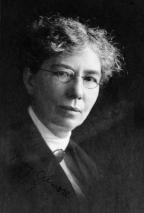
Mary Gilmore, 1927 (Public Domain, at State Library of QLD, via Wikipedia)

Mary Gilmore, 1927 (Public Domain, at State Library of QLD, via Wikipedia)

The Griffyns do like to move around town, so this concert was held in the foyer of the National Portrait Gallery. Not surprisingly, there were a couple of portraits of Dame Mary Gilmore on the wall behind the performers. The venue worked nicely (even though we do like the Belconnen Arts Centre’s friendly little bar!) The acoustics – to my ears – were excellent, and the natural, early evening light coming in through the big windows was just delightful.

But now, the music, which, appropriately, all came from Australian and South American composers. At the start, musical director Michael Sollis announced a change in the program, swapping the third piece, Gerardo Dirié’s Ti xiuhtototl, with the fifth piece, Eric Gross’s Rondino Pastorale. I wondered why – and whether it might become evident as the concert went on. It did, because Gross’s work and the piece preceding it, George Dreyfus’ Mary Gilmore goes to Paraguay, are lyrical, pastoral pieces evoking idyllic scenes appropriate to the ideals of the new Utopia. By contrast, Gerardo Dirié’s piece is more plaintive, sombre, even a little discordant. In terms of the story being told, it fit better towards the end of the concert as the Utopian dream is starting to fail. The story, in other words, was conveyed musically as well as through words spoken and sung by Susan Ellis who, with a twinkle in her eye, played an older Dame Mary Gilmore looking back on her Paraguayan experience.

The program was, at roughly one-hour, shorter than many Griffyn programs, but it ran without a break, transitioning seamlessly from piece to piece. The concert opened with Sollis speaking a promo for New Australia – “Start your life afresh”, he exhorted. This was followed by Laura Tanata on harp and Chris Stone on violin playing Nigel Westlake’s Beneath the midnight sun. It was beautiful, with Tanata’s gentle, lyrical harp offset by the more plaintive violin, suggesting to me a little uncertainty (for the new colony, I mean, not the musicians. Their playing was mesmerising, and set a high standard, which was fortunately maintained).

Ellis then took up the story from Gilmore’s point of view, and we heard the ensemble play Dreyfus’ accessible, melodic piece which, with its hints at times of a rousing, western movie theme, conveyed the excitement and enthusiasm of pioneers. I loved Kiri Sollis’ flute and Stone’s violin here. It’s a crowd-pleasing sort of piece, and was played with a verve which carried us all along. Gross’s piece continued this positive tone, while Ellis, as Gilmore, told us nostalgically that “I wish I was back in Cosme” (Cosme being the name of Lane’s second settlement in Paraguay).

This was followed by the central piece of the concert, Vincent Plush’s “The Paraguay songs” from The plaint of Mary Gilmore. It’s a rather tricky piece requiring Ellis to sing words from Gilmore’s letters. Yes, you’ve read correctly, from letters – that is, not from verse, but from prose. I sat up. Good prose, of course, does have rhythm, but these were letters, not crafted fiction. Here are a few lines from the program:

Communism as we have it is alright, Harry*, and we are getting on — slowly, of course, but in a year or two what is now is, will have gone, so beautiful, so rich in bird-life, and plants. And the history! And the story of the war. If you were only here Henry.

See what I mean? It takes some singer and composer to make that work. I was impressed by how well and expressively Ellis, not to mention the full ensemble, rose to the challenge.

The aforementioned rather sombre Dirié work followed this, and was performed, with a melancholic soulfulness, by the four female Griffyns who sang some lovely harmony, in addition to playing their instruments. Really moving. This was preceded by Gilmore telling us about some of the troubles in the colony, and was followed by another sombre-sounding piece, The freedom of silence by Alcides Lanza.

The concert concluded with Gilmore expressing sadness that Cosme did not turn out to be what she expected. She left in 1900, five years after she arrived, because of the pettiness and squabbles. Nonetheless, she never regretted the experience, arguing that while it was not a success, neither was it a complete failure:

… we failed the harshly scornful say … [but] we sowed a seed.

Villa-Lobos’s wistfully sad Song of the black swan (with hints, if my ears didn’t mistake me, of Swan Lake), played by Tanata and Downes, concluded what was a satisfying, well-performed and nicely conceived concert. Roll on 2016 I say … if you are in Canberra, and would like to know more (and even buy tickets), check out their website.

You can hear different versions of two of the pieces online:

Griffyn Ensemble: Michael Sollis (Musical Director and Mandolin), Susan Ellis (Soprano), Kiri Sollis (Flutes), Chris Stone (Violin), Laura Tanata (Harp) and Holly Downes (Double Bass).

* Henry Lawson

Monday musings on Australian literature: Aussie writers on writing

As I was writing my review of Carmel Bird’s Fair game yesterday, I was reminded that in addition to novels, short stories, and essays, she has also written a book on writing, titled Dear writer. I’ve dipped into it, but not being a professional writer – and having no plans myself to write a book – I must say I haven’t specifically sought out these sorts of books. Nonetheless, I thought it might be interesting to suss some out and share them with you – partly because I think they may have something to offer readers, and partly because it’s interesting to see who has chosen to write about writing.

Here goes (in chronological order of publication):

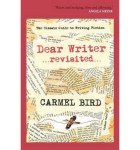
BirdDearWriterSpinelessCarmel Bird’s Dear writer (1988, republished 1996). This book comprises writing advice in the form of a series of letters. As Bird writes on her website, it’s been used by students and teachers, individually and in courses, as well as by readers “interested in the writer’s art”. An updated edition, Dear writer revisited, was published in 2013. This is the one I’ve been dipping into. In addition to her own advice, she includes advice from other writers, such as America’s Mark Twain and Australia’s Marion Halligan. In Letter 2 she discusses the use – or, non-use, more like it – of adjectives and adverbs. She says:

Perhaps you thought that you, as the writer, were the one who had to do all the imaging, and that the reader was to get every detail of the picture from your words. The reader of fiction takes pleasure in doing some of the work, and will more readily believe you and trust you if there is work to do. Strangely enough, the strength of fiction seems to lies much in what is left out as what is included …

Hmmm … I thought a book on writing fiction mightn’t be relevant to me but this, this is. I struggle with avoiding cliches, and particularly with trying to find fresh adjectives, but perhaps I should think about avoiding them altogether? Something for me to think about, as I try to describe in my posts the impact or value of a work.

Bird has also written Writing the story of your life.

Kate Grenville’s The writing book (1990) is, if can remember that far back, the first of these books to come to my attention. Grenville, about whom I’ve written several times, lists it on her own site. She says it has become a classic, being used, like Bird’s book, by individual writers and in writing courses. She shares some of her advice on this page. I particularly like this response to a popular notion:

‘Writing has to have a strong story.’

How interesting is it to have someone tell you the plot of a book they’ve just read? Not very. This means that plot alone isn’t what makes a book interesting. What makes it interesting isn’t what’s told but the way it’s told. In some of the best stories, almost nothing happens.

I think she’s right – and I have always said so! Plot is not necessarily the main or only point.

Grenville has written other books on the topic, including Writing from start to finish: A six-step guide.

John Marsden’s Everything I know about writing (1993, republished in 1998). For those of you who don’t know, Marsden is best known as a writer for children and young adults, including the bestselling Tomorrow, when the war began series. I’ve loved some of his YA books, including the unforgettable Letters from the inside. I found this advice from his book on GoodReads:

Use strong words sparingly – less is more. Minimise your use of qualifiers. Recognise words that are at the limits already (e.g. Boiling, delicious, evil), there is nothing you can do to strengthen them.

My family will tell you that one of my favourite mantras is “less is more” so, as I said of Bird’s advice above regarding the use of descriptive words, I love this.

As with Grenville’s book, you can find excerpts on Marsden’s own website.

Mark Tredinnick’s The little red writing book (2006). Of the writers I’ve mentioned here, Tredinnick is the one I know the least, that is, I know of him, but have not read him. He is a poet and essayist, and teaches writing, particularly “creative nonfiction” according to the GoodReads biography. He also edited Inkerman and Blunt’s Australian love poems. (You may remember that I reviewed their Australian love stories). Anyhow, Scott Downman, reviewing this book, says that it is pitched to “a broad audience who simply desire to write better”. Tredinnick says that he aims not to teach students to be writers but to teach them how to write. Summing up the book, Downman writes:

Tredinnick in the opening chapter urges the reader to not just tell a story but to make their writing sing: ‘In song, it’s how you sing, not just what you utter, that counts. And so it is with writing’

This, of course, is similar to what Grenville, above, said – the content is only part of the point.

Do you read books about writing? And if so, what are your favourites or, what are the most important lessons have you learnt?

Carmel Bird, Fair game: A Tasmanian memoir (Review)

Courtesy: Finlay Lloyd

Courtesy: Finlay Lloyd

As I started reading this next fl smalls offering, an essay this time, I was reminded of one of my favourite Australian writers, Elizabeth von Arnim. Von Arnim was a novelist, but she also wrote several pieces of non-fiction, including her delightful non-autobiography, All the dogs of my life. The similarity stems from the fact that both writers play games with the reader regarding their intentions or subject matter – “This not being autobiography, I needn’t go much into what happened next”, writes von Arnim at various points – but this similarity fades pretty quickly because Bird’s piece, despite its similarly light, disarmingly conversational tone, has a dark underbelly.

I thought, given its subtitle, that Fair game was going to be a memoir of Bird’s growing up in Tasmania. But I had jumped too quickly to conclusions. The subtitle “a Tasmanian memoir” means exactly what it says, that is, it’s a memoir of Tasmania. Her interest is Tasmania’s dark history – “the lives of convict slaves, and the genocide of the indigenous peoples”. The title Fair game, you are probably beginning to realise, has a deeply ironic meaning.

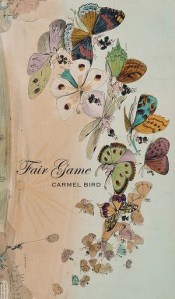
However, getting back to my introduction, Bird does start by leading us on a merry little dance. Her essay commences slyly with a discussion of epigraphs – hers being taken from one of her own books – and the cover illustration. She doesn’t, though, identify the illustration at this point, but simply describes it as “an image of a flock of Georgian women dressed as butterflies, sailing in a glittering cloud high above the ocean”. She then takes us on all sorts of little digressions – about birds, and gardens, and collectors, about her childhood and such – but she constantly pulls up short, returning us to “the story”, or “rural Tasmania”, suggesting that the digressions are “not relevant to this story”. Except they are of course, albeit sometimes tangential, or just subtle, rather than head on. Indeed, she even admits at one stage that:

I have wandered, roving perhaps with the wind, off course from my contemplation of the butterfly women of 1832, they roving also with the wind. It must be clear by now that frequently in this narrative I will waver, will veer off course, but I know also that I do this in the service of the narrative itself. Just a warning.

I love reading this sort of writing – it’s a challenge, a puzzle. Can I follow the author’s mind? One of the easier digressions to follow – and hence a good example to share – is her discussion of a 1943 book published by the Tasmanian government, Insect pests and their control. Need I say more? Bird does, though – quite a bit in fact – and it makes for good reading.

Anyhow, back to the image. A few pages into her essay she tells us more. It’s an 1832 lithograph by Alfred Ducôte, and it is rather strangely titled “E-migration, or a flight of fair game”. On the surface it looks like a pretty picture of women, anthropomorphised as butterflies, flying through the air with colourful wings, pretty dresses and coronets. However, if you look closely, you will see that what they are flying from are women with brooms crying “Varmint”, and what they are flying to are men, one with a butterfly net, calling out “I spies mine”.  Hmm … I did say this was a dark tale, didn’t I? The illustration’s subject, as Bird gradually tells us, is that in 1832, 200 young women were sent from England to Van Diemen’s Land on the Princess Royal. They were the first large group of non-convict women to make the journey, and their role was to become wives and servants in a society where men significantly outnumbered women. As Bird says partway thought the book, “it is not a joyful picture; it is a depiction of a chapter in a tragedy”.

I’d love to know more about Ducôte, and why he produced this work, but this is not Bird’s story. Her focus is the history of Tasmania, and these particular women – who are they, what were they were going to? It appears that Bird has been interested in this story for a long time, since at least 1996 when Lucy Halligan, daughter of Canberra writer Marion Halligan, sent her a postcard with the image. Since then Bird has researched and written about the story. In fact, as she tells us, her research led to the creation of a ballet by TasDance in 2006. They called it Fair Game.

Finally, she gets to the nuts and bolts, and the so-called digressions reduce as she ramps up the story of how these women were chosen, their treatment on the ship, and what happened on their arrival. It is not a pretty story, but represents an important chapter in Australia’s settlement history. I commend it to you – for the story and for the clever, cheeky writing.

awwchallenge2015Carmel Bird
Fair game: A Tasmanian memoir
(fl smalls 7)
Braidwood: Finlay Lloyd, 2015
63pp.
ISBN: 9780987592965

(Review copy courtesy Finlay Lloyd)

Monday musings on Australian literature: Utopia, Paraguay and Australian writers

The workingman's paradise (Courtesy: Sydney University Press)

The workingman’s paradise (Courtesy: Sydney University Press)

Utopia, Paraguay, Australia? I’m referring, of course, as many Australians will know, to the Utopian colony, New Australia or Colonia Nueva Australia, which was established in Paraguay in 1893 by the New Australia Movement, with the support of the Paraguayan government. This movement was founded by William Lane, whose novel The workingman’s paradise I reviewed quite early in this blog. The settlement did not succeed. According to Wikipedia (linked to above), conflict started early “over prohibition of alcohol, relations with the locals and Lane’s leadership”. Colonist Tom Westwood is quoted as saying, “I can’t help feeling that the movement cannot result in success if that incompetent man Lane continues to mismanage so utterly as he has done up to the present”. Oh dear.

The settlement has been written about by historians (Gavin Souter’s A Peculiar People and Anne Whitehead’s Paradise Mislaid) and at least one novelist, Michael Wilding‘s The Paraguayan Experiment. Australian travel writer Ben Stubbs has written about his trip to talk to “remnants” of that settlement in his Ticket to paradise: A journey to find the Australian colony in Paraguay among Nazis, Mennonites and Japanese beekeepers. Several musicians have also written songs about it, according to Wikipedia.

Mary Gilmore, 1927 (Public Domain, at State Library of QLD, via Wikipedia)

Mary Gilmore, 1927 (Public Domain, at State Library of QLD, via Wikipedia)

So why am I mentioning all this now? Well, it has to do with those creative Griffyns and their last concert for the year, titled The Utopia Experiment, which is inspired by this settlement. I’ve known, of course, all year that it was coming up, but an article in today’s Canberra Times, which reminded me of other (contemporary) literary links besides Lane, encouraged me to write this post. The main link is Dame Mary Gilmore (née Mary Jean Cameron) who, in the first half of the twentieth century, was regarded Australia’s greatest woman poet. According to NSW’s Migration Heritage Centre website, she said of Lane’s The workingman’s paradise that:

 the whole book is true and of historical value as Lane transcribed our conversations as well as those of others.

Gilmore, in fact, became one of the 200-odd settlers, but returned after 5 years. She said in an interview over 60 years later that:

It was purely communistic. I wouldn’t say it was a success, but I certainly wouldn’t say it was a failure. The reason it had to break up, or disappear, is because William Lane would only have British people in it…

The aforementioned Anne Whitehead has written a book specifically on Gilmore’s Paraguayan story, Bluestocking in Patagonia: Mary Gilmore’s quest for love and Utopia at the world’s end, suggesting, says reviewer Sarah Macdonald, that Gilmore joined the settlers as much in search of a prospective husband as for the socialist ideal. Perhaps so, but she must have been looking for a particular type of husband to take such a trip!

A 1911 newspaper article quotes Renmark Pioneer editor, who knew Gilmore at the time, as stating that she:

joined the Cosme Colony in Paraguay, where a number of us, under the leadership of William Lane, were giving communism a trial. We were at that time a very happy family, and Mary Gilmore entered into the life whole-heartedly. She rendered good service to the colony, not only taking charge of the school (thereby releasing the former teacher, John Lane, for work in the fields), but doing much to add to the success of the social gatherings that were a marked feature in the life of our little community.

Mary Gilmore went on to live a long and highly productive life, dying in 1962 when she was 97. She was a socialist and activist, a poet and journalist, who argued for better conditions for working women, children and indigenous Australians. (Critic A.G. says in the Age in 1941 that “Her association with the early days of the Australian Labor movement has deepened and widened her social outlook … she speaks especially for the “little” people”).

Her Paraguay experience followed her for the rest of her life, as the National Library of Australia’s Trove reveals. Here is a description of her in a 1923 newspaper, Melbourne’s Advocate, when she would have been 58:

Mrs. Gilmore, who was one of the band that went to Paraguay with the late William Lane on the New Australia adventure, is a proven Irish sympathiser as well as a good Australian.

“A proven Irish sympathiser as well as a good Australian”. What I love about reading old newspapers is the insight they give into the thinking and values of the times.

The literary links don’t end here, however, because Gilmore was very keen for that other great Australian poet-writer of the time, Henry Lawson, to join the settlers. Certainly Lawson had the appropriate socialistic leanings. In 1893, he wrote a poem, “Something better” supporting the Paraguayan vision:

Give a man all earthly treasures – give him genuine love and pelf* —
Yet at times he’ll get disgusted with the world and with himself;
And at times there comes a vision in his conscience-stricken nights,
Of a land where “Vice” is cleanly, of a land of pure delights;
And the better state of living which we sneer at as “ideal”,
Seems before him in the distance — very far, but very real.

However, he didn’t join the settlers.

I could explore these two writers more, but life is busy right now – and, you never know, I might return to the subject after the Griffyns have presented their musical version.

Paul McDermott, Fragments of the hole (Review)

"Paul McDermott DAAS" by Canley - Own work. Licensed under CC BY-SA 3.0 via Commons.
“Paul McDermott DAAS” by Canley. Licensed under CC BY-SA 3.0 via Wikimedia Commons.

If you’re an Australian, you are sure to know who Paul McDermott is. If you are not Australian, you may not, and this book in fact would not enlighten you, because nowhere on the book is it made clear that “this” Paul McDermott is indeed “that” Paul McDermott. It doesn’t take much reading though to realise that indeed it must be. Have I intrigued you? I hope so.

Fragments of the hole is the first of the second set of fl smalls released by small independent publisher Finlay Lloyd. I mentioned them in my recent post on small books, and said then that I’d review them individually as I read them, so here I am.

I’ll start, having already mentioned him, by telling you about the author. Wikipedia describes him as “an Australian comedian, actor, writer, director, singer, artist and television host”. I knew about most of those, but I didn’t realise that his writing included more than writing scripts for his shows, or that he was an artist too. He first came to public notice as a member of the satirical musical comedy group the Doug Anthony All Stars. The Doug Anthony in their name refers to the longtime leader (1971-1984) of the National Party of Australia, which will, perhaps, give you a sense of his political leanings. However, Fragments of the hole is not political satire, so let’s get onto it …

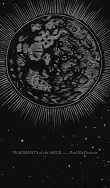
McDermottFragmentsFinlay

The jokes start pretty much on the title page when we are told that the book comprises:

a collection of previously unpublished work from various writer/artists:

Young Master Paul, The Nymbus Art Collective, The Marvellous Mr Me, The Generator, Paul McDermott, Ol’ Miss Daisy & The Caravan King.

Hmm … the way I read it they were all written and illustrated by Paul McDermott but, you know, I could be wrong! Whoever wrote them, though, they are delightful – dark, whimsical, and a little cryptic. The collection comprises one prose story, followed by five in verse form, and most read a little like fairy stories or fables. There’s usually a little point to ponder at the end, even if that point raises another question.

Take, for example, the first poem, “The Bread Girl and the Sparrow”. It is reminiscent of “The Gingerbread Man” which, Wikipedia tells me, is just one of many folktales about “runaway food”. Who’d have thought?  Anyhow, in McDermott’s story, in addition to the issue of trust, there are layers of sacrifice and loyalty between food and predator which adds quite an interesting philosophical twist.

There’s a Roald Dahl-esque edge to the stories. The humour is dark. These are not for (most) children. “Asleep/Awake”, for example, is about the sleeping (real) self meeting the dream self. The exhortation at the end, if you are suggestible, could very well bring on a nasty case of insomnia. You have been warned. I loved too “The man who thought (he was a fog)”, and McDermott’s suggestion that perhaps the initial assumption was not the right one at all. “You look for answers where you may/You find them when you can” he says, but, are you asking the right question?

If any single idea underlies the stories it is something about “self” – what is your “self”, do you protect it, how does it interact with others? Sacrifice – sometimes chosen, sometimes inadvertent – appears in a couple of the stories; the idea of alternative selves appears in others. There is also a sense of life not going to plan. It may not always be –

That evil and sorrow await the naive
At every twist and turn

– but it doesn’t hurt to always have your wits about you.

The poems are told in a fairly simple a-b-c-b rhyming pattern, but the line lengths vary at times to change the pace. McDermott, a comedian who lives by his words, is sure in his language, which is clear and unforced. The pencil drawings are delightful. You can feel the twinkle in his eye – the fun he is having – as you read the stories and look at the pictures. They made me chuckle.

And here I will end because this is a book that is best experienced rather than described or analysed. It’s a cheekily clever but also delightfully charming “little book”. It would, dare I say it, make a perfect stocking stuffer for the discerning reader on your gift list.

Paul McDermott
Fragments of the hole: an illustrated collection (or, Odds and ends, bibs and bobs, and little bits of nothing)
(fl smalls 6)
Braidwood: Finlay Lloyd, 2015
[60pp.]
ISBN: 9780987592958

(Review copy courtesy Finlay Lloyd)

Monday musings on Australian literature: Novels set in Sydney

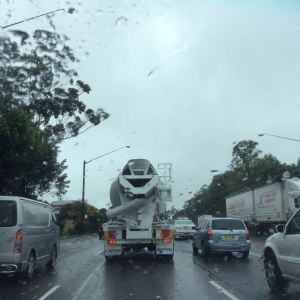
Oh, it's fun driving on Pennant Hills Road!
Oh, it’s fun driving on Pennant Hills Road! (With apologies to Sydney-lovers)

My life has been rather topsy-turvy in recent weeks. My aunt died on 30 October, as regular readers here know, which has necessitated two five-day trips to Sydney, not to mention other related work in between.  Consequently, I haven’t had much time for reading or, even, for thinking about Monday Musings, but I have been thinking a little about Sydney … particularly since these trips have been to the part of Sydney in which I spent my teen and university years.

My family moved to Sydney in 1966, and it was from this time that my relationship with my aunt was really established, although I have many memories of her before that. Alison loved having two teen nieces in town to take out and show off her beloved Sydney to. And we loved having an aunt who was fun company and keen to take us out. It was she who taught us about Sydney’s history and culture. She took us to the Sydney Rocks area, long before it was cool, where she showed us old buildings like the Garrison Church. She took us to an early settlement re-enactment on historic Fort Denison (aka Pinchgut, or Mat-te-wan-ye, as it was to local Aboriginal people). And, being a beach lover, she took us frequently to Sydney’s famous beaches.

It suddenly occurred to me that one way I could honour my aunt would be to share some novels about her city, so that’s this week’s plan. I will list them in chronological order of their setting (not of when they were written). They are of course a very small selection of the books I’ve read, and an even smaller selection of those written about the place.

  • Kate Grenville’s The secret river, despite the controversy it engendered, made a significant contribution to our understanding of Sydney’s origins, because Grenville, finding a dearth of detailed evidence, tried to imagine what may have happened at an individual level between the European immigrants/settlers and the indigenous people when those settlers “took up” land in the Sydney region. (Grenville followed her exploration of early Sydney in the other books in the trilogy, The lieutenant and Sarah Thornhill). I appreciate that Grenville’s novel is not “history”, but I liked her attempt to present a possible scenario of how things may have gone, and why.
  • William Lane’s The workingman’s paradise (my review) is probably the least well-known of the books I’m listing here, but I’m including it not only because it’s one that I’ve read and reviewed on my blog, but because it’s set in the late nineteenth century, just prior to Australia’s Federation, during a time of social and political unrest when socialist ideas were being explored. It contains some gorgeous physical descriptions of Sydney in that time, as well as providing insight into contemporary intellectual debates about how to improve conditions for workers.
  • Emma Ashmere’s The floating garden (my review) captures Sydney at one of the most significant times in its life, physically speaking that is. Set in the late 1920s to early 1930s, it tells of the dispossession of working class people of their homes to make way for the Sydney Harbour Bridge. Funny, isn’t it, how so often it’s those who have the least resources who end up wearing the biggest costs of “progress”.
  • Kylie Tennant’s Tell morning this is set in Sydney during World War 2. Tennant wrote several novels about Sydney in the 1940s and 1950s, but the first that I read was Tell morning this. I enjoyed it for the vivid picture Tennant paints of Sydney at a time when young women met American servicemen. She doesn’t pull any punches in her story of Rene who is jailed for living with one of these Americans, and of David who is also jailed, but for being a conscientious objector. The irony of this – of jailing those who were practising the freedoms we were apparently fighting for – may not be lost on contemporary audiences!
  • Ruth Park’s The harp in the south tells the story of a poor working class family living in Sydney’s Surry Hills in the immediate post-war era. It’s a good example of the social realist novel – the sort of novel some criticise for being “too” documentary and not imaginative enough, but which, when well done, can starkly show what life is like for the have-nots, that is, for those whose hold on employment is tenuous, and for whom, therefore, survival can be a daily struggle. Harp’s picture of Surry Hills is warm and vivid, and remains popular today. As novelist Delia Falconer wrote in The Griffith Review, it “still bludgeons us about the heart”.
  • Madeleine St John’s The women in black (my review) is set in the 1950s in a Sydney department store. Its characters tend to be middle-class, but they range from conservative suburban Australians through aspirational working women to educated European immigrants. All, though, face pressures – to do with acceptance, aspiration for improvement, and/or escaping stultifying expectations. St John’s book is more a comedy of manners, than Tennant and Park’s social realist approach, but nonetheless presents a thoughtful picture of a city in flux.
  • Melina Marchetta’s Looking for Alibrandi is a young adult novel that is fast becoming a classic. Published in the early 1990s, it is set in what had become by then a well-established multicultural Sydney. Marchetta explores the tensions experienced by the children born of immigrant parents, as they negotiate the expectations of their parents’ culture and those of the culture into which they’ve been born. Marchetta also touches on class, unrealistic expectations, and the public-private school divide.
  • Michelle de Kretser’s Questions of travel (my review) continues the theme of immigration, among other ideas, through the alternating stories of travel-writer Laura and Sri Lankan immigrant Ravi. De Kretser analyses from multiple angles, and for both characters, the idea that “geography is destiny”. She looks at the role of place in modern life: to what extent is it a physical construct, and what role does it play in a virtual world in which we travel by choice or necessity in order to find our lives? Sydney, Australia’s first settler city, seems a perfect place from which to base such exploration – for Kretser who has set her previous books in France, Sri Lanka and Melbourne.

These are just a few of the novels I’ve read that are set in Sydney. Other favourites include Shirley Hazzard’s The transit of Venus, Elizabeth Harrower’s The watch tower (my review), and Patrick White’s The solid mandala, to name a few. You can find more ideas in Wikipedia’s list of novels set in Sydney (though interestingly not all of mine are there).

Reviewing my list, I see that each book explores Sydney at a time of change – social, cultural and/or economic. Perhaps that’s a fact that differentiates cities – they never stand still?

Do you have favourite books about a city that’s been significant to you?