Paul Hetherington and Jen Webb, Watching the world (Review)

Hetherington and Webb, Watching the worldI hope it’s not condescending to suggest, at this time of year, that a book would make a good Christmas present? I know some publishers, and fair enough too, choose around now to release certain types of books deemed to be good gift material. That, however, is not the case with this book, Watching the world, as it was in fact published back in July. It’s just that I’m reviewing it now and, quite coincidentally, I think it would make a good Christmas book. This is not because it’s a light, easy summer read, as it’s not your typical beach book, but because it’s a very attractive book that is priced reasonably and that can be enjoyed in multiple ways. You can meander through it sequentially, stopping to ponder, or dip in and out, exploring what catches your fancy.

Subtitled Impressions of Canberra, Watching the world comprises poems by Paul Hetherington paired with photographs by Jen Webb. It has a rather interesting genesis, as the Introduction explains, in that it’s the “result of an extended collaboration” between the poet and the artist. Their aim was to explore Canberra as a place in which people live and work, rather than, as is usually the case, as a planned city that is also the national capital. I like that idea. Too often Canberra is used as shorthand for the federal government – as in “Canberra said today ….”. But, as we who live here know, there is far more to Canberra than that.

Hetherington and Webb’s method of working was interesting too. They worked, they say, semi-independently:

Jen took photographs, which Paul then used as springboards into poems. Paul’s poems led, in turn, to Jen taking new photographs, or editing existing ones.

They continued this “iterative process” until they found “enough poem-photo pairs” that would satisfy their intention. They suggest that in this method of working a new “reality” appeared, one that was somehow separate both from themselves as individuals and from their partnership, a reality which confronted them with ideas about “the incommensurability of world, image and word”. That makes sense to me – I think! At least, it makes sense to me that we never can completely or exactly capture in one form – say poetry – that which is in another form – in this case life in Canberra. It seems both obvious and sophisticated at the same time to make this point! And so, when you have a poem and a photograph both “commenting” on each other and on life in Canberra, then the meaning (or the “reality”) surely becomes multi-layered? Hmmm … I think I’ll leave the philosophising here, but I hope that I’m making sense and that I’ve understood what Hetherington and Webb are saying.

Now, I’ll get to more concrete stuff (a very poetic word, that), starting with the wider project. In the Introduction, again, we are told that it was initially produced as an installation for the Imagine Canberra exhibition during Canberra’s 2013 centenary celebrations. It then had a couple of other iterations – at a conference, and as a set of scholarly essays – before finding its way into this book form this year. I love that they have managed to achieve such varied mileage out of their work.

And finally, the book itself. The poem-photo pairs are divided into three sections – Where we live, Memory places, and Paddocks and perambulations. They are, as you’d expect from the process described, idiosyncratic, although there is logic too to the groupings. The first poem-pair is titled “Waltz” and captures the physical sense of Canberra. I was amused by the poem’s opening:

Like algebra, these straight-drawn streets,
curves, crescents and rounding circles

Starting with the “straight-drawn streets” must surely be a little provocative gesture to the popular cry from tourists that they get lost in Canberra’s circles! We do, I’m sure, have far more traditionally designed streets than circular ones. It’s just that the circular pattern is a feature of the inner, early Canberra where tourists focus. The accompanying image is a low aerial shot of a warm, cosy looking Canberra suburb in autumn. The poem suggests that there is magic in Canberra, that for all the apparent “algebra” in its straight lines and curves, there is much here that cannot be easily defined or narrowed down to simple formulae.

The poems vary in tone. There is, for example, a subdued reference to indigenous inhabitants in “Ainslie”, whimsical self-deprecation in the simply titled “Canberra”, and wry or defiant humour in “Letter”. At least, it made me laugh: a woman hands her letter to someone, perhaps a husband she is leaving:

‘I know it’s not done
to be so formal
but just this once
I’d like the last word’

The accompanying image shows the back of a blue car driving away in light rain.

Sometimes the meanings of the poems and the connections with the photography are clear and unambiguous, more literal perhaps. Other times they are more tenuous, or abstract, as in “Handkerchief” with its accompanying leaf-litter image, encouraging the reader-viewer to delve further. I enjoy these challenges. It would be interesting to see whether different combinations challenge different readers.

The images are, of course, important, though being primarily a verbal/textual person, my focus tends to be the words. However, there are some gorgeous images here. I’ve mentioned a couple already. I also like the mystical tone of the poem-photo pair titled “Boundaries”, the sense of coming into and out of our different spiritual and physical selves, our individual and our social selves, and so on. A simple image and a two-line poem. Perfect.

Some of the pieces are universal, that is, they could apply to a lot of places in which people live, but many draw on signs and symbols familiar to Canberrans – the circles, the balloons, and Black Mountain Tower, for a start. We are a bush capital, and along with our trees come the birds. I enjoyed the cheekiness of the poem titled “Birds” (and the accompanying image setting movement against stillness) which suggests that for all the planning, life in the city might have other ideas. If you are now intrigued, have a look at the sample provided online by Blemish Books. That will probably speak louder than my 1000 words!

Watching the world is a quietly subversive work that looks at Canberra from an insider’s point of view – with a lot of affection but a willingness to cast an acerbic or questioning eye at times too. And remember, it’s Christmas soon!

Paul Hetherington and Jen Webb
Watching the world: Impressions of Canberra
Canberra: Blemish Books, 2015
79pp.
ISBN: 9780994250827

(Review copy courtesy Blemish Books)
Monday musings on Australian literature: More on small books

Why is it that when we humans see change, we tend to prognosticate doom? I’m thinking how it was argued that TV would be the end of radio, and videos the end of cinema. It hasn’t happened has it? These older industries may have had to rearranged themselves a little but they have survived. Then a few years ago, with the advent of e-books, it happened again with commentators forecasting the end of the printed book. That hasn’t happened – yet, anyhow, and I really don’t think it will happen anytime soon. What drives all this? Fear I suppose. Enough of that, though, as my aim here is not to philosophise about change. Rather, I want to talk about the small book …

Yes, I know that I wrote about them only a couple of weeks ago, but since then I’ve come across more discussion of them, and more initiatives. Short books, it seems, are gaining in popularity – or at least a number of publishers seem willing to give them a go, and not just for publishing cheap classics which they can expect to have an audience. No, as I wrote in my previous post on the topic, some are publishing contemporary material, sometimes specifically commissioning or putting a call out for contributions or even holding competitions.

Giramondo, an independent Australian publisher, started their Shorts program back around 2012. Giramondo Shorts is, they say:

a new series of short form, short print run books, designed to take account of the new technologies of digital printing, and to appeal to a community of literary readers. The series carries a quote from Les Murray’s poem ‘The Dream of Wearing Shorts Forever’: ‘it is time perhaps to cherish the culture of shorts.’

There are now 8 books in the series, and the books have an unusual square format. At $19.95 each, they are priced a little higher than many small books, but the fact that they are continuing suggests some level of success. It seems like digital printing technologies are enabling Giramondo to produce their books more efficiently.

One of the reasons that I decided to write this follow-up post was because in my role as Literary and Classics coordinator for the Australian Women Writers Challenge, I came across Jonathan Shaw’s review (for his blog Me Fail? I Fly!) of the Going Down Swinging Longbox. This is a set of  “five slim books” containing pieces the literary magazine had rejected for publication in its magazine. Shaw calls this little collection “a beautiful artefact”. It is for this reason that I particularly wanted to mention it, because not only are these small books, but beautiful design is an important part of their production. In other words, they are a long way from the cheap Penguin 60s initiative. After all, there’s nothing like holding a beautifully designed book is there – something that is hard to experience in the e-format. (Going Down Swinging is a literary magazine that has been publishing in print, and later also online, since 1979.)

Finally, for this post anyhow, there’s Griffith Review’s novella project. Including this is a bit of a cheat, really, because in this case the book itself is not especially small, and these two posts have been focussed on physical smallness, not just smallness (or shortness) of content. However, I thought it was worth mentioning because it represents a commitment to the novella form, which as you know is a favourite form for me. Here is what they say:

In 2012, Griffith Review 38: The Novella Project played a major role in enabling Australian and New Zealand authors to gain a foothold in the English language revival of the novella underway internationally. In 2014, Griffith Review 46: Forgotten Stories – The Novella Project II published five novellas with an historical dimension in a confronting, moving and provocative collection.

And so, Griffith Review 50: Tall Tales Short – The Novella Project III has just been published. It contains five novellas which were selected in a blind-judged nationwide competition.

The printed book, in other words, looks to me like it’s not going anywhere soon. There might be a bit of a shake-down as publishers explore what is going to work best and for whom, but it is exciting to see them continuing to explore the possibilities of print, including producing short works in new forms and formats.

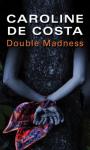
Caroline de Costa, Double madness (Review)

De Costa, Double madnessI’m not a crime reader as most of you know, and in fact most of the crime novels I’ve read here have been review copies sent to me. Caroline de Costa’s Double madness is one of these. I accepted it for a couple of reasons. It’s a debut novel by a doctor, indeed a professor of Medicine at the James Cook University in Cairns, who has been shortlisted for a nonfiction work in the Queensland Premier’s Literary Awards. And it is set in beautiful far north Queensland, my home state.

Not being an expert in crime writing, I can’t really compare it with other novels, but I’d say it’s in the sub-genre known as police procedural. According to Wikipedia, in police procedurals the detective is a police officer and the story depicts the activities of the police investigating the crime. Tick. However, Wikipedia also says that in police procedurals the perpetrator is often known to the reader, but this is not the case here, and that the novel will often deal with a number of unrelated crimes, which is also not the case here, though several references are made to one other crime. None of this matters, really thought, does it? Categories can be helpful in analysis, but in the end what counts is the work itself. I was just intrigued.

Double madness opens with the victim’s body being found, by accident, in a secluded part of the north Queensland rainforest, by a doctor and his wife who are driving home the scenic way. Finding the body is, I presume, a pretty traditional opening for a crime novel of this sort. The dating, like the setting, is also precise – 27 February 2011, which is three weeks after the category-5 Cyclone Yasi hit northern Queensland, causing significant destruction. The novel is told in almost straight chronology, with each chapter titled by a date, the last being 17 March 2011. Early in the novel, though, there are a few flashback chapters – mostly to 2009 – which flesh out a few characters for us.

Our main detective is the 30-something now-single mother, Cass Diamond. She’s of indigenous Australian background. Ah, so we have a non-indigenous writer, as far as I know anyhow, writing an indigenous character. You may remember discussions we’ve had here on this topic. I’ve quoted writer Margaret Merrilees, “To write about Australia, particularly rural Australia, without mentioning the Aboriginal presence (current or historical) is to distort reality, to perpetuate the terra nullius lie”. De Costa is writing about Far North Queensland, a place with a significant indigenous population, where it would indeed be poor form to ignore indigenous characters. My assessment is that de Costa has done it well. Cass makes some references to her indigeneity, and to some of the challenges she faces, but this is not her defining characteristic in the novel. She is “just” another police officer, and is defined as much, if not more, by being a single mother whose “fridge was a temple consecrated to convenience foods”. In other words, she’s in that band of job-jolly detectives who struggle to keep their personal life going, though Cass does a better job than most (that I’ve seen on TV anyhow). She does, for a start, seem to have a good relationship with her teenage son. Moreover, she’s not drunk, middle-aged or unduly cynical – yet, anyhow!

Back now, to the plot. Tucked into the copy sent to me was a slip of paper containing a short interview with the writer by reviewer Fiona Hardy. De Costa tells Hardy that she had “for some time been interested in the concept of folie-à-deux [share psychosis]”. Folie-à-deux translates as double madness – hence the book’s title. De Costa also tells Hardy, when describing the sort of detective she has created, that she has to write what she knows. And she knows medicine. Consequently, not only does the investigation and resolution of the crime involve some medical knowledge, but the story is set largely amongst the community’s medical fraternity. In other words, the good doctors of Cairns have been getting up to a bit of mischief with our victim, so when the murder is committed they find themselves in the frame. They are not, however, the only ones. There be a husband, and sons, and sundry other possibilities. All I’ll say is this is a tricky plot with a goodly dose of red herrings. For more, you’ll have to read the book.

I wouldn’t call Double madness a ground-breaking or particularly innovative detective novel, but it’s an enjoyable read. The writing is clear and straightforward, keeping to the point and moving along at a fair pace. There’s no unnecessary description, but where it is needed, such as to describe the bush or, say, a doctor’s experience of working through a cyclone, it feels real and authentic. Hardy, in her interview, notes that the cyclone Yasi makes an effective metaphor for the havoc wrought by the victim, Odile Janvier, on those around her. She’s right, it does.

When I read fiction, as I’ve said before, I look for some underlying messages or themes or issues being explored because I like my reading to further my understanding of humanity. Double madness is not, in this sense, a deep or enquiring book, but it is quietly subversive in the way it handles race and gender. Its indigenous characters are not defined by their indigeneity, and women detectives and medicos play important, but accepted and unremarked, roles in the investigation and resolution of the crime. Moreover, while the murder victim is a woman, she is far from the norm of murdered women victimhood. Good on de Costa.

So, if you are looking for a new crime author for your crime fan friends this Christmas – because yes, it’s that time of year again – then Double madness is well worth putting on your list.

awwchallenge2015Caroline de Costa
Double madness
Witchcliffe: Margaret River Press, 2015
359pp.
ISBN: 9780987561565

(Review copy courtesy Margaret River Press)

And so another great Musica Viva year ends

Musica Viva has done it again: it has produced another year of splendiferous, inspiring concerts. Mr Gums and I have been subscribing to Musica Viva (or its predecessor here in Canberra, the Canberra Chamber Music Society*) for nearly four decades – albeit with a gap in the middle for child-rearing and overseas posting. We love it, which of course is not surprising given we subscribe year after year!

I don’t know how Musica Viva runs in other cities, but we have a vibrant community here, fostered by an enthusiastic committee (and no, I’m not a member) and a small but creative office led by Michael Sollis (he of the Griffyn Ensemble). All of this is underpinned by the intelligent programming of Australian composer and Musica Viva artistic director Carl Vine.

Before I talk a little about the concerts I want to say something about timing. Canberra’s concerts have commenced at 7pm for over a decade now. I loved it when I was working. Of course, it may have helped that the concert hall was across the road from my workplace, though it wasn’t for Mr Gums. He’d drive over to me, we’d have a light meal on the ANU campus, go to the concert and be home by around 9.30pm. Perfect for a work night. Now we are retired, we are perfectly happy to do the European thing – eat our main meal in the middle of the day, then have a light snack before the concert, and perhaps a dessert afterwards. Works well for us.

Now to the concert experience. Over his years as office manager, Michael Sollis (who only turned 30 this year!) has worked hard to add value to the Musica Viva experience. We have pre- and post-concert events, and interval performances. To give you an example, this year’s pre-conference events have included a courtyard performance by local early music specialist Ian Blake before Renaissance group Tafelmusik, a tour of the Canberra School of Music’s historical piano collection before piano soloist Paul Lewis, a pop-up choir before a cappella group I Fagiolini, and even a wine tasting by Musica Viva’s local wine sponsor, Eden Road Wines. That of course could go before any concert!

During Interval, we can hear a performance on the School of Music’s café floor by young music students, usually mirroring the main act. So, for example, our last concert was the Eggner Trio, and the interval recital was by a young student trio. We enjoy checking out the next generation, and hopefully they enjoy performing for an appreciative audience.

The post-concert event is usually a Q&A with the performers or a CD signing. For the final concert of the year, Sollis and the committee tried something different. The Q&A was held in one of Canberra’s oldest brewpubs, the Wig & Pen, which is located in the School of Music’s ground floor. An inspired idea. At least Eggner Trio, comprising three brothers aged from their late 20s to mid 30s, seemed to think it was! And I think we audience members who joined in found it a fun, relaxed end to our Musica Viva year.

I don’t know what you think about all this, whether it would appeal to you, but I love the commitment to engaging and inspiring the community that lies behind all this.

Beethoven statue, Bonn

Beethoven statue, Bonn (his birthplace)

So, you are probably wondering, who (or what) did we actually hear in 2015. In Canberra, we get 6 of the year’s 7 touring performers. Our numbers don’t, apparently, quite support receiving all 7 yet. A goal for the future! This year, we had:

  • Tafelmusik Baroque Orchestra from Canada which presented a staged/choreographed multimedia show called House of Dreams, in which the musicians took us through the art, architecture and music of Europe through works by Handel, Vivaldi, Purcell, Telemann, Bach and Marais. It was an exciting show though perhaps not quite as coherent as their Galileo Project which we saw a few years ago.
  • Goldner String Quartet, from Australia and comprising two married couples, played Ligetti, Beethoven and a new crowd-funded piece by Australian composer Paul Stanhope. Lovely music – and I can never say no to Beethoven who, if I were forced to choose, would be my favourite composer.
  • Cellist Steven Isserlis with pianist Connie Shih. We always love Steven Isserlis (with his wild curly hair) – but Shih more than held her own in what was a Gallic-inspired program.
  • I Fagiolini is an English a cappella group which specialises in “Renaissance and 20th-century vocal repertoire”. They were impressive and very entertaining, particularly in their staging of Janequin’s “La Chasse” which they performed from memory. It’s “a nightmare to memorise” says their leader Robert Hollingworth. They also performed a new work by Australian composer Andrew Schultz titled “Le Molière imaginaire; Or, Keep Your Enemas Closer”. You had to be there really. (I hope you didn’t think chamber music is all toffee-nosed seriousness!) Their concert ended on a more respectfully serious note, though, with another 20th-century piece, Adrian Williams’ “Hymn to Awe”.
  • Paul Lewis is an English solo pianist. In the spirit of gender equality, I’m going to talk about male appearance. I do like a male musician with curly hair, so I’m automatically partial to Steven Isserlis and Paul Lewis! Luckily they are excellent musicians too. Lewis, as I recollect, played his whole program – all Beethoven and Brahms – from memory, something we discussed with him at the post-concert Q&A.
  • Eggner Trio, comprising three young brothers from Austria, closed out the 2015 season with a beautiful program featuring Robert Schumann, Australian composer Dulcie Holland (her trio composed in 1944 but not performed until 1991!), and Dvorak.

Musica Viva’s four core values are “quality, diversity, challenge and joy”. We certainly had all that 2015. A huge thanks to all the paid staff, volunteers and performers who made it happen.

* The Canberra Chamber Music Society was founded in 1956 and for more than two decades presented chamber concerts in Canberra, in association with Musica Viva Australia which was established in 1945.

Monday musings on Australian literature: Fiction about death and dying

Today’s Monday Musings is more personal than these posts usually are. Ten days ago, the last aunt of my aunts and uncles died. She’d been failing for some time, really, but she fought death to the end. Indeed, when we were in her house last week starting that awful job of clearing a house, we were told we needed to find five library books. We found four but where was the last? We searched all the likely places but to no avail – and then it came to light. She’d packed it in her hospital bag. Just hours before she died, in a state described as “gravely ill”, she went to hospital and took a book, of course! This got me thinking, once again, about the role of literature in our lives – and, particularly, what we can learn from reading.

So, what have I learnt about death and dying from books? I’ve read several non-fiction books – mostly non-Australian, but one, Bianca Nogrady’s The end: The human experience of death, is by an Australian and I’ve reviewed it here. These books have been interesting, but they tend not to get to the heart of things. For that, think, we need fiction (or, poetry, but I’m limiting my discussion here to fiction). Learning, though, is perhaps not quite the right word. Experience might be better, because when we read fiction, we don’t so much “learn” facts, as “feel” or “experience” the emotions and ideas being shared. A memorable dying scene for me comes from English writer Penelope Lively’s Moon tiger. Claudia is seized by joy and wellbeing at the sight of the sun catching raindrops on trees, sending out sparks of colour, and then:

The sun sinks and the glittering tree is extinguished. The room darkens again. Presently it is quite dim; the window is violet now, showing the black tracery of branches and a line of houses packed with squares of light. And within the room a change has taken place. It is empty. Void. It has the stillness of a place in which there are only inanimate objects: metal, wood, glass, plastic. No life. Something creaks; the involuntary sound of expansion or contraction. Beyond the window a car starts up, an aeroplane passes overhead. The world moves on. And beside the bed the radio gives the time signal and a voice starts to read the six o’clock news.

Maybe it’s just me … but I found this sense of the person being there one minute and then gone the next, and of life continuing regardless, quietly powerful. It has framed my ideas of dying ever since, I think.

Fiction about death and dying tends to deal with three broad aspects: fighting or rejecting death, reflecting on it, and accepting it. Most books, naturally, encompass two or three of these aspects. Anyhow, here is a small selection of Australian novels that deal with death in some way, that don’t simply have deaths “in” them but tackle in some way the meaning or implication of death. I’ve listed in alphabetical order by author:

  • Peter Carey’s The chemistry of tears (my review) tells the story of two people – a contemporary museum conservator who is devastated by the loss of her (secret married) lover and a 19th century father who commissions an automaton to entertain his consumptive son. Grief, and how to live with it, underpins this novel, though it explores many other issues too.
  • Brooke Davis’ Lost & found (my review) was inspired by the untimely, freakish death of her mother. Its three characters, a young girl and two old people, are all facing the death of a significant person and end up on a quest together searching how to live with loss – something we all face at least once, and mostly many times, in our lives.
  • Helen Garner’s The spare room is an uncompromising novel about a woman caring for a friend with terminal cancer. The friend is fighting her prognosis, including trying some alternative treatments that seem to be having no beneficial effects whatsoever, though the friend maintains the faith. The narrator – significantly called Helen – becomes increasingly frustrated with her friend’s inability to accept the facts, and finds it increasingly difficult to maintain her caring role. It’s a confronting story. I admire Garner’s honesty in presenting a story that is not pretty.
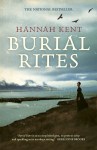
  • Hannah Kent, Burial Rites bookcover

    Courtesy: Picador

    Hannah Kent’s Burial rites (my review) was inspired by the story of Agnes Magnusdottir, the last woman executed in Iceland. The book takes place between the time when Agnes is convicted and sentenced and when the sentence is actually carried out. Kent explores the reactions of people to Agnes, and Agnes’s own sense of who she is. Death hangs over this novel, in the way it forces people to confront mortality, their own values, and justice.

  • David Malouf’s The conversations at Curlow Creek is set in the 1820s and concerns the conversations that occur between a military officer and an arrested bushranger who is to be executed in the morning. It’s about the connections made between the two men, between the captor’s reflections on his own life and the condemned man’s concerns about death, God and forgiveness. It’s a long time since I read this book, but it has a mesmerising quality, a sense of grace, that has stuck with me.
  • David Malouf’s Ransom was inspired by the section of the Iliad which chronicles Achilles’ revenge killing of the Trojan prince Hector and Priam’s visiting Achilles to ask for his son’s body back. The story plays out much the way it does in the original, except that Malouf’s Priam does attempt to cut through the brutal, revenge-fuelled pattern of behaviour to something more humane. I am always attracted to works which question the revenge code.
  • Marcus Zusak’s The book thief (my review) is quite different altogether. A Holocaust novel, it is about state-sanctioned death. It is also, and some reviewers find this a little twee, narrated by Death, who is fascinated by what defines humanity. He concludes that there is no simple answer, that humans are capable of wondrous things and of heinous things. Zusak takes that idea that it is death which defines life, which gives it meaning, and runs with it in a pretty audacious way.

Ella Berthoud and Susan Elderkin’s book, The novel cure, includes dying as one of the “ailments” they deal with. Their focus of course, given their therapeutic goal, is on literature “which consoles and stills, while gently encouraging acceptance”. However, what I like about the books I’ve listed here is the way they look at wider issues – from managing grief to how the presence of death helps us understand humanity. I’m reminded of a favourite line from Marion Halligan’s novel, The fog garden, which was inspired by her grief over her husband’s death. She wrote “read a wise book and lay its balm on your soul”. Amen to that!

I’d love to know if you have any favourite books about death.


Delicious descriptions: Emily Bitto’s The strays

In my recent post on Emily Bitto’s The strays I commented on the quality of the writing but didn’t really exemplify it – so I’m doing so now. But just sharing without in-depth commentary, as I’ve been tied up this week with family matters.

Here is a description of Evan Trentham, the leading artist in the Melbourne Modern Art Group:

Evan Trentham was put together from mismatched stuff. The sinews were too short for the long bones. The tendons behind his ankles and the bald stones of his knees stuck out, hard as catgut on a tennis racquet. He was like a rubber band stretched tight and close to snapping. He wore blue work pants cut off at the knee and a white undershirt that was yellow beneath the armpits. He was paint-stained and sweat-smelling.

A taut, highly strung artist?

And here is a description of the night of on of the Trenthams’ bohemian parties:

The night that followed was a slip down the rabbit hole. Summer was taking up its place like a chestnut seller setting up his stall, lighting the coals and letting the scented smoke drift down the street before he begins to call out to passers-by. It was not too hot by the fire in the centre of the garden clearing, nor too cold away from it in the darker, leafier peripheries.

Interesting imagery here given when chestnut season is, but I like the scene she is setting.

Then there’s her description of Helena Trentham’s three daughters:

I believe she envied her daughters their relationships with one another, just as I did. And so she brought three girls into the world and let them roam it without telling them to fill the pockets of their pinafores with bread and to leave a trail of crumbs that would lead them, in a crisis, home.

Love the allusion to Hansel and Gretel here.

And finally (though it appears some time before the above quote in the book), Lily describes that moment that comes in most girl friendships when puberty reaches one before the other:

She’s leaving me behind, I thought. I felt tricked. With Eva, I had given no thought to the world of adulthood that awaited us. But she had crossed some secret threshold while I was facing the other way, absorbed still by the childish fantasies she had cultivated for us: our talk of travelling the world together […] Now, I saw so clearly that all of that had been a silly game. She had a lover, presumably, while I did not even truly know what this vague and glamorous term entailed. She had become a woman, with no thought to warn me that I should be packing away my own childhood, dismantling it piece by piece like a rotten treehouse, and preparing myself for the new world.

I remember the feeling!

Overall, I thought Bitto’s writing was nicely evocative, without being overblown.

Monday musings on Australian literature: Little books

Christmas is coming and those stockings are wanting inspiration. I know I’m jumping the gun a little in terms of the traditional round of Christmas book talk, but it’s never too early to think of book gifts, and I’ve been wanting to write about little book initiatives for a while now. I can’t wait any longer!

Do you remember those Penguin 60s, the little books that Penguin published twenty years ago, in 1995, to celebrate its 60th anniversary? The books were around 80 pages and, before the days of smart phones, they were handy little items to carry around for those reading moments that suddenly open up out of the blue. I loved them, and still own several. I particularly remember reading Edith Wharton’s Madame de Treymes and Jean Rhys’ Let them call it Jazz. They were so popular that they spawned – at least I think it was the Penguin initiative that came first – similar small books by other publishers like Bloomsbury. I have some of those too. Anyhow, for its 80th birthday this year, Penguin has published a Little Black Classics series – and again they have proved successful, according, at least to The Guardian, which concluded that, even in this era of the e-book, it “proves people like their reading matter cheap… and portable”.

I hope they’re right about this because a few Australian publishers are producing their own “little” books, and I thought I’d share them here, as I don’t think they have the same visibility as Penguin – funnily enough!

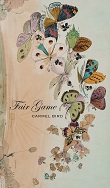
FL Smalls 7: Carmel Bird's Fair Game

FL Smalls 7: Carmel Bird’s Fair Game

FL Smalls  are published by a small independent publisher in Braidwood about an hour’s drive away from me, Finlay Lloyd. Finlay Lloyd describes the project as

an ongoing project where we give its authors sixty pages to create a book. Published together in groups, the first five Smalls came out in 2013, and now we have commissioned another five to be released in early September this year, shoulder to shoulder, as an offering of vital writing by Australian authors.

You might have picked up a difference here between these and Penguin’s little books. FL Smalls are not classics, and are not reissues of works published elsewhere. They are commissioned, meaning of course that they provide a publishing opportunity for living writers. I love that. They include fiction, non-fiction, poetry, graphic works. I have the recent set, kindly sent to me by Finlay Lloyd. They are priced at $10 each. Reviews will start appearing here, soon. Meanwhile, you can check out Lisa at ANZLitLovers’ discussion of them.

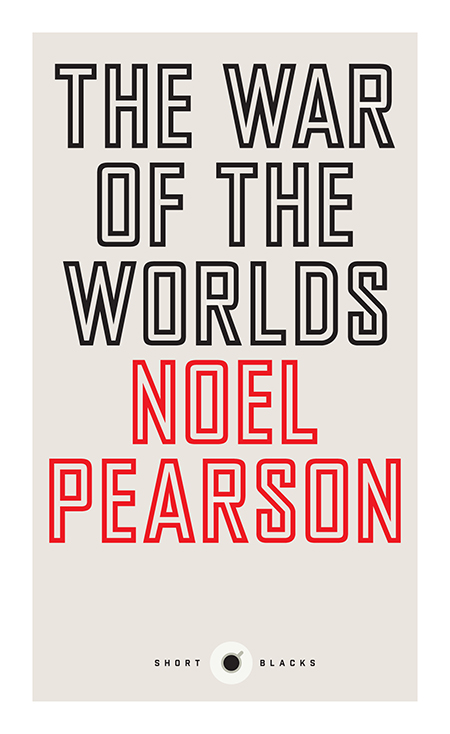
Short Blacks – isn’t that a great name – are published by another Australian independent publisher, Black Inc. They describe the project as being

gems of recent Australian writing – brisk reads that quicken the pulse and stimulate the mind.

Noel Pearson in Short Blacks

Noel Pearson in Short Blacks

These then have been published before – but they are not classics. They are recent works, and seem to be non-fiction. They include Robyn Davidson’s No fixed address which was originally published by Black Inc as a Quarterly Essay, David Malouf’s One day about ANZAC Day, and Noel Pearson’s cleverly titled The war of the worlds about the “colonial project” and genocide in Australia. I bought a couple of these from the wonderful, independent Hobart Bookshop on my recent visit to Tasmania. Twelve have been published and it’s not clear from the website whether it’s an ongoing project. Like FL Smalls they are appealingly, if more simply, designed, and cost only $6.99 each. What a bargain.

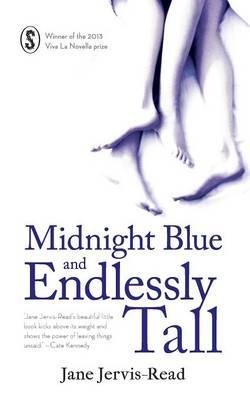
Viva La Novella is a slightly different project. An initiative of the online publisher Seizure Inc, it is a prize that was established in 2012

Jane Jervis-Read, Midnight blue and endlesslly tall

First Viva La Novella Winner

to celebrate and promote short novels – because we like them and believe some of the greatest works in the English language are actually novellas.

I wouldn’t argue with that! Since 2012, Seizure has, with the support of the Copyright Agency Cultural Fund, expanded the award to produce more than one “winner” each year. Like FL Smalls, these are new works, but unlike the Smalls, they are all fiction. Also, unlike the previous two initiatives they are not a standard size, due to the wide the definition of a novella. For Seizure, the range is 20–50,000 words, which means that some books some books are 100 or so pages while others might be 190.  I’ve included them here, however, because they are priced at the cheaper end of the Australian paperback market, $14.95 each, and it is a project dedicated to the shorter book. I have bought one of the 2015 winners, so you will see a review of that too in the coming weeks or months.

Do you like little books? I’d love to hear if you have any favourites – and of any initiatives, in Australia or elsewhere, that you’ve come across.

Emily Bitto, The strays (Review)

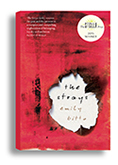
Emily BItto, The strays, book coverLet me start by saying I really enjoyed reading Emily Bitto’s The strays. It was scheduled for my reading group the day after my return from Tasmania, and I suddenly found myself in the last day of my Tasmanian holiday without having started the book. Wah! I read it in two days, helped by several hours in a couple of airports. I haven’t done that for a long time, and what a joy it was to have a real length of time to commit to a book. It helped, of course, that having both a strong plot and an intriguing set of characters, The strays is compelling to read. It reminded me, albeit loosely, of Evelyn Waugh’s Brideshead revisited and Ian McEwan’s Atonement.

This is a debut novel, which also won this year’s Stella Prize. Set primarily in the 1930s, with the last of four parts set in the 1960s, The strays is both historical fiction and a coming-of-age novel. It is also a classic outsider story. Lily, who tells the story first person, is befriended when she is 8 years old by schoolmate Eva, the middle daughter of the Trenthams who, early in the novel invite a number of artist “strays” to form a utopian-bohemian artistic community. The Trenthams are inspired by the Reeds and their Heide group, but The strays is not a Heide story*.  This may be the strength of the novel, but also perhaps its weakness – a strength because it frees Bitto to tell her own story, but a weakness because it removes potential ideas on which to hang her story.

Before I get to that, though, a little more about the story. The first three parts follow the Trenthams for 8 years, from when Lily is 8 to 16. During this time Lily becomes increasingly involved with the Trenthams, in preference to her boring, conservative, middle-class parents, eventually living with them full-time. Some members in my reading group found her parents’ relinquishing of their daughter unbelievable, but this was during the Depression, and Lily’s parents did have some problems of their own to manage. I could suspend my disbelief. From Lily’s point of view, she was in thrall to the excitement of the Bohemian life, telling her parents, “I love you both but I want to be different”.

Her parents, however, should have been concerned, because the Trenthams are rather casual, neglectful parents and the four girls more or less run their own lives, sometimes being fed properly, sometimes not, sometimes, in the case of one in particular, going to school, and sometimes not. The story is as much about them, as about the artists, though we do hear about the artists too. There’s exploration of experimental art and its acceptance or otherwise by society, obscenity charges, mentee supplanting mentor, and so on. There are parties, and other occasions, where artists and children come together. Bitto, through Lily, paints all this beautifully. Indeed, I loved her ability to evoke scenes, people and places with effective, yet tight imagery.

Bitto’s use of Lily as her narrator works nicely. Through most of the novel, we see the story through her child’s point-of-view, but occasionally, with a “later I realised” type of comment, we are reminded that this is an adult telling the story of her childhood:

When was it that I became a voyeur in their midst? I was the perfect witness, an unsuspected anthropologist disguised within the body of a young girl, surrounded by other young girls who were part of the family. Yet I was cuckoo in the nest, an imposter who listened and observed, hoarding and collecting information.

This narrative style keeps the story grounded. We see the dysfunctional dynamics and its effects before Lily, wooed by the excitement, does – though she does have moments of clarity. When the youngest daughter goes missing on one occasion, she writes:

I drew in my breath. These adults were no use in a crisis.

The subtext is that her parents would be.

But, here’s the thing. The book tackles a lot of ideas. There’s the exploration of society’s reaction to experimental art; the idea of coming to terms with the past (for Lily); the utopian artist community and whether it can really work; indulgent or neglectful parenting, creating a dysfunctional family life that comes back to bite; the exploration of girlhood friendships and the whole coming-of-age thread; not to mention those big issues like loyalty and betrayal, envy, sexuality and sensuality. It’s not that these were uninteresting, or even that they weren’t well developed. It’s more that I struggled to find Bitto’s main focus, and I guess I like some sort of central idea on which to hang my understanding of a book.

My reading technique is that when I finish a book I go back and reread the beginning. This usually puts the whole into context, pinpointing what the author was about. However, this technique didn’t work wonderfully with The strays. Bitto’s Prologue starts by discussing the mystery of instant attraction between people, and then moves on to the idea of past life connections and that people’s souls can be twinned from one life to the next. These ideas are used to explain Lily’s relationship with Eva, but I’m not sure that this is fundamental to the book’s meaning. The prologue then discusses the past. Three decades after the main events, Lily receives a letter:

and I become aware of an old compulsive pain I have pressed like a bruise again and again throughout the years.

AND

I feel a tenderness in my chest, and the past rushes in as a deluge I can no longer hold back …

AND

I let my mind turn back once more, to recreate again that distant, still wracked past.

Is it this, the idea of coming to terms with or resolving the past, that binds the book together? It is partly. By the end of the novel, Lily has come uneasily to terms with what happened those three decades ago, and its impact on her life. I say uneasily because – and here we come to the epigraph, by William Pater, which expresses a different idea again to those in the prologue: “To burn always with this hard, gem-like flame, to maintain this ecstasy, is success in life”. Lily’s uneasiness is that she has chosen “conventionality”, but recognises that part of her “is still drawn to the romance of the fully lived life”. Then we have the book’s concluding paragraphs, which are more concerned with mothering and family in Lily’s recognition that it was the Trentham children who paid the debt for their parents’ experiments. See my problem regarding central idea? Or, is it just that I’m being boringly 20th century?!

Whatever it is, they are just niggles. As a read, The strays is up there as one of my most enjoyable for the year – for its lucid writing, for the story and a setting that had such appeal, and, yes, even for that whole raft of ideas that she throws so determinedly at us. Even for that.

Lisa at ANZLitLovers enjoyed the book too.

* Interestingly, a couple of “real” people are mentioned, one being politician and later judge, Herbert Evatt – as a supporter of modern, experimental art.

awwchallenge2015Emily Bitto
The strays
South Melbourne: Affirm Press, 2014
290pp.
ISBN: 9781922213211

Don Miller, Will to win: The West at play (Review)

Sport is probably not the first subject you expect to find here, but it is in fact the focus of my latest read, Don Miller’s Will to win: The West at play. Published by independent Melbourne press, Hybrid Publishers, it was offered to me after my Monday Musings post a few months ago on Australian Rules in literature. In that post, I wrote that Australian Rules “can over-emphasise competitiveness to the point that winning overrides being fair and just”. I said this of Australian Rules because that was the subject of my post, but the statement is true of much sport – that is, of elite, professional sport – and it’s this “truth”, this issue of winning, that Don Miller examines in Will to win.

Who is Don Miller? He’s not familiar to me, but he apparently worked in the Department of Political Science at the University of Melbourne for 30 years until 1995, and then in 2006 he established an organisation called the Melbourne Centre of Ideas. I’m not sure what his academic credentials are, exactly, but “creative thinking”, particularly on society and values, is his mantra.

Miller writes in his Introduction that the book was inspired by two ideas. One is anthropologist Claude Lévi-Strauss’s statement in his book The savage mind that when football was introduced to New Guinea the locals changed one rule: the game was to be played until both teams were equal. Love it! Miller read this a few decades ago, but the second notion is far more recent: it’s the “failure” of Australia’s swimmers at the 2012 London Olympics. There was such a hue-and-cry about this during and after the Games, including blaming post-mortems, apologies galore, and the commissioning of a review! I remember being horrified. Well, so was Miller. He had, unsuccessfully, tried to write about sport many times before, but the London situation gave him the angle he was seeking: he would write about “contemporary professional sport” and frame it with a reference to New Guinea.

So, this is what he does, approaching it, he says, in a spirit of enquiry:

to follow my own thoughts; to see where they take me; to consider new questions as they periodically erupt. A journey of discovery, clarification, and pleasure.

Several themes run through the book, the main ones stemming from Western culture and civilisation, from the way the West looks at the world. Western thinking he argues tends to be dichotomous (that is, to see issues as black/white, or, in this case, win/lose). The West is focused on the measurable, believes actions should be purposeful, and admires progress. He explores these ideas in terms of their relationship to sport – of how they frame the way we view, practice and understand sport. 

Sport’s excesses

The overriding motif is – as you can tell from the title – that winning is everything. The logical extension of this is the idea of “excess”. To win, sportspersons push themselves – physically, emotionally and mentally – to a point beyond endurance, to, in fact, self-harm. Take hurdler Sally Pearson, who, Australians know, is a tough, determined competitor. She said after the London Olympics:

My back was killing me. It’s just a matter of telling your body that you have to do it, no matter what – I know I am not an old athlete. I’m only 26, but just the way my body is ageing at the moment and my disc is degenerating, it’s just a matter of trying to keep it intact so I can compete at least until Rio.

But, the more sensible (value judgement here!) of us think, what about your post-sport life?

So, there are the punishing regimes athletes put themselves through in order to be the best, to win, regimes that Miller likens to training for and partaking in war. Is such self-harm worth it, he poses. He quotes the infamous Lance Armstrong who famously said “losing and dying; they’re both the same”. Tour de France athletes, we know, undertake punishing training to compete in a gruelling race. But mention of Armstrong of course raises another by-product of competitive sport, that of cheating and corruption. There is a fine line between “winning” and “winning at any cost”, with the latter referring not only to the aforementioned physical and mental cost to the athlete, but to crossing over the line of fairness and ethics to something more ruthless. Armstrong epitomises this crossover, but is by no means the only sportsman to have been so lured. In his discussion of Armstrong’s behaviour, Miller suggests that his behaviour could be seen as “the exemplary model of a Western businessman”. A fair analogy?

Sport’s truths

Miller also explores some “truths” that have been promulgated about the value of competitive sport, arguing that some are false (such as “the practice of sport is a human right*”) and others overstated (such as that sport will set you up for life). Really, he questions? Sport a human right, like food, shelter and security? As for setting you up for life, Miller asks that, even if we agree that sport can have these benefits, “does it have a monopoly?” What about being an oboe player in the Australian Youth Orchestra, or part of a multidisciplinary team pushing the boundaries of science, or even being a wheat farmer or apprentice plumber? Don’t the skills learned here also train you for life? Life, he suggests, is complex, and to propose otherwise, to propose there is a “singular model or formula”, is grossly misleading.

Then there’s that ultimate “truth” about losers, that they are, well, losers, that even second place is losing. Miller quickly puts paid to that idea. We all know winners who do not “succeed” and losers who learn valuable skills. Indeed, it’s worth considering, he says, Jean Cocteau’s statement that “to succeed is to fail”, a statement that “breaks from conventional dualistic thinking”.

Will to win is not so much an academic work, as a clearly written, personal investigation of a topic that has long interested Miller. It is not footnoted, though he does cite sources as he goes, particularly from newspapers, and there is a bibliography. Does it have a conclusion? Yes, and no. This is what he says near the end:

This book returns again and again to the excess in modern sport – to its ubiquity and impact. Whatever it does, it goes too far, and the cumulative consequences can be disturbing. The book is a call for moderation of all its qualities, a change of emphasis, a shift towards a more expansive range of values.

The challenge is to think and imagine other ways of engaging in sport – a challenge that he suggests we should take up now. Can we Westerners, for example, see our way to a win-win value? I enjoyed the read – but, in me, he was preaching to the converted. I’d love to know what those more passionate about competitive sport think, those who expected and accepted the apologies of Australia’s 2012 London Olympics Swimming Team. What would they answer to Miller’s questions?

* The Olympic Charter

Don Miller, Will to win, book coverDon Miller
Will to win: The West at play
Melbourne: Hybrid Publishers, 2014
123pp.
ISBN: 9781925000580

(Review copy courtesy Hybrid Publishers)

Monday musings on Australian literature: Serendipitous finds in Tasmania

Well folks, I’ve not posted here for a week. As I wrote last Monday, I’ve been travelling in Tasmania, and have only returned home this afternoon. I have some ideas for future Monday Musings, and could have researched one for today, but I can’t resist sharing a few more of my Tasmanian literary experiences.

Tasmania is home to many Australian writers including Booker Prize winner Richard Flanagan (see my review of his The narrow road to the deep north), National Biography Award winner Alison Alexander, commentator and memoirist Robert Dessaix, and novelist Danielle Wood (see my review of her Mothers Grimm). But there are other, quieter, literary treasures to be had here.

Take gravestones for example …

We visited the historic Bothwell Cemetery, and read some poetically poignant (or, do I mean, poignantly poetic?!) gravestones. Poor Elizabeth, wife of Edward Simon Arnett, died in 1841 at the age of 33. Here are the words on her gravestone:

Now husband dear my life is past
My love was true while life did last.
Bereaved of me no sorrow take
But love our children for my sake.

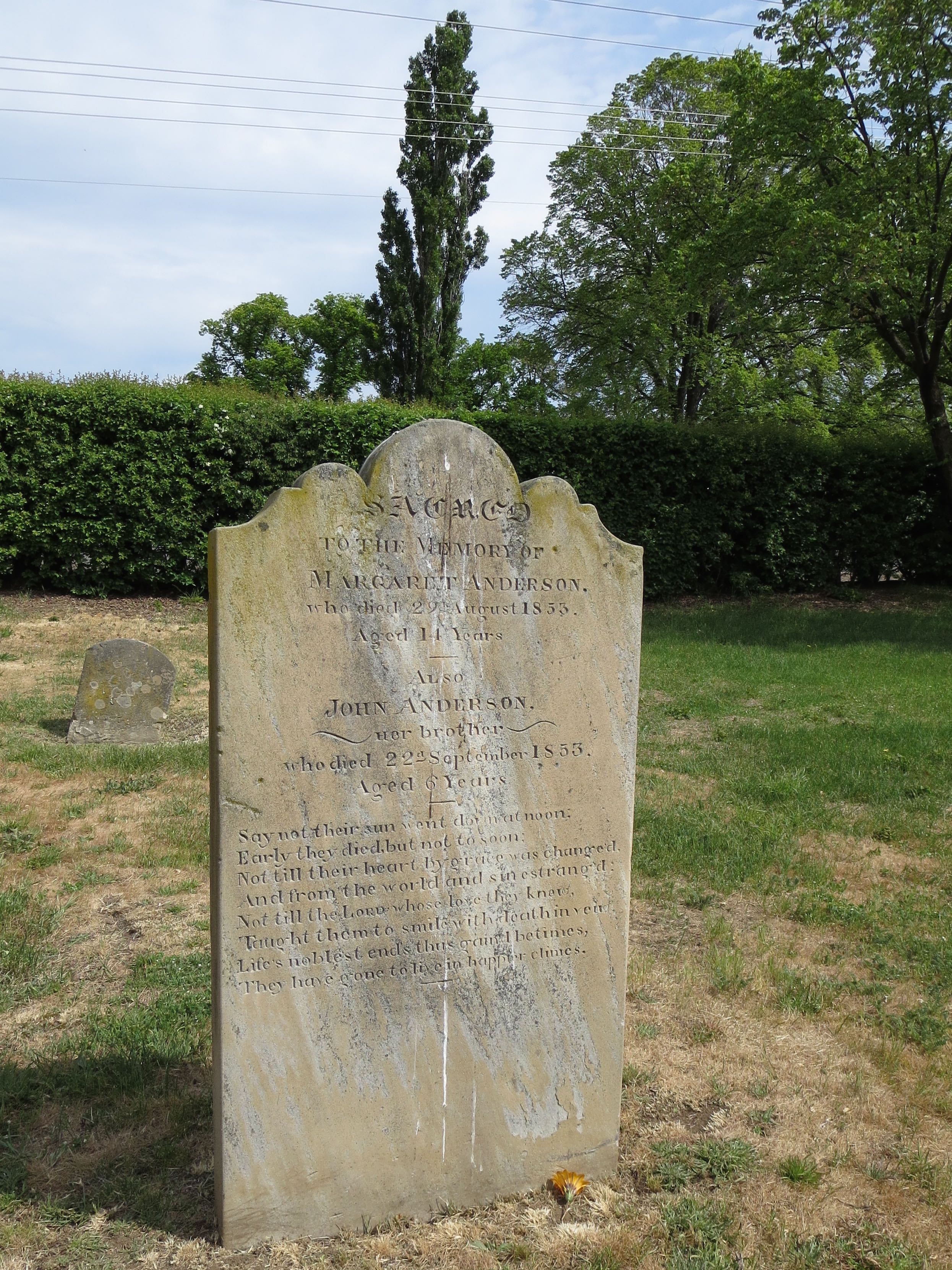
I wonder who wrote that? Did she, knowing she was dying, write it? So sadly, but probably, typically, self-effacing if she did. And then there’s the grave for siblings Margaret and John Anderson, 14 and 6 years old respectively, who died within a month of each other in 1853. On their grave is:

Margaret and John Anderson, Bothwell Cemetery

Margaret and John Anderson, Bothwell Cemetery

Say not their sun went down at noon.
Early they died, but not too soon,
Not till their heart by grace had changed
And from the world and sun estranged.
Not till the Lord whose love they knew
Taught them to smile with death in view.
Life’s noblest ends thus gain’d betimes
They have gone to live in happier climes.

Poor little things. Presumably they died of an illness contracted one from the other, but did they really learn to “smile with death in view”? These and the other gravestones – and I know I’m not telling you anything here – provide such insight into nineteenth century life and thinking.

Then there’s the urban environment

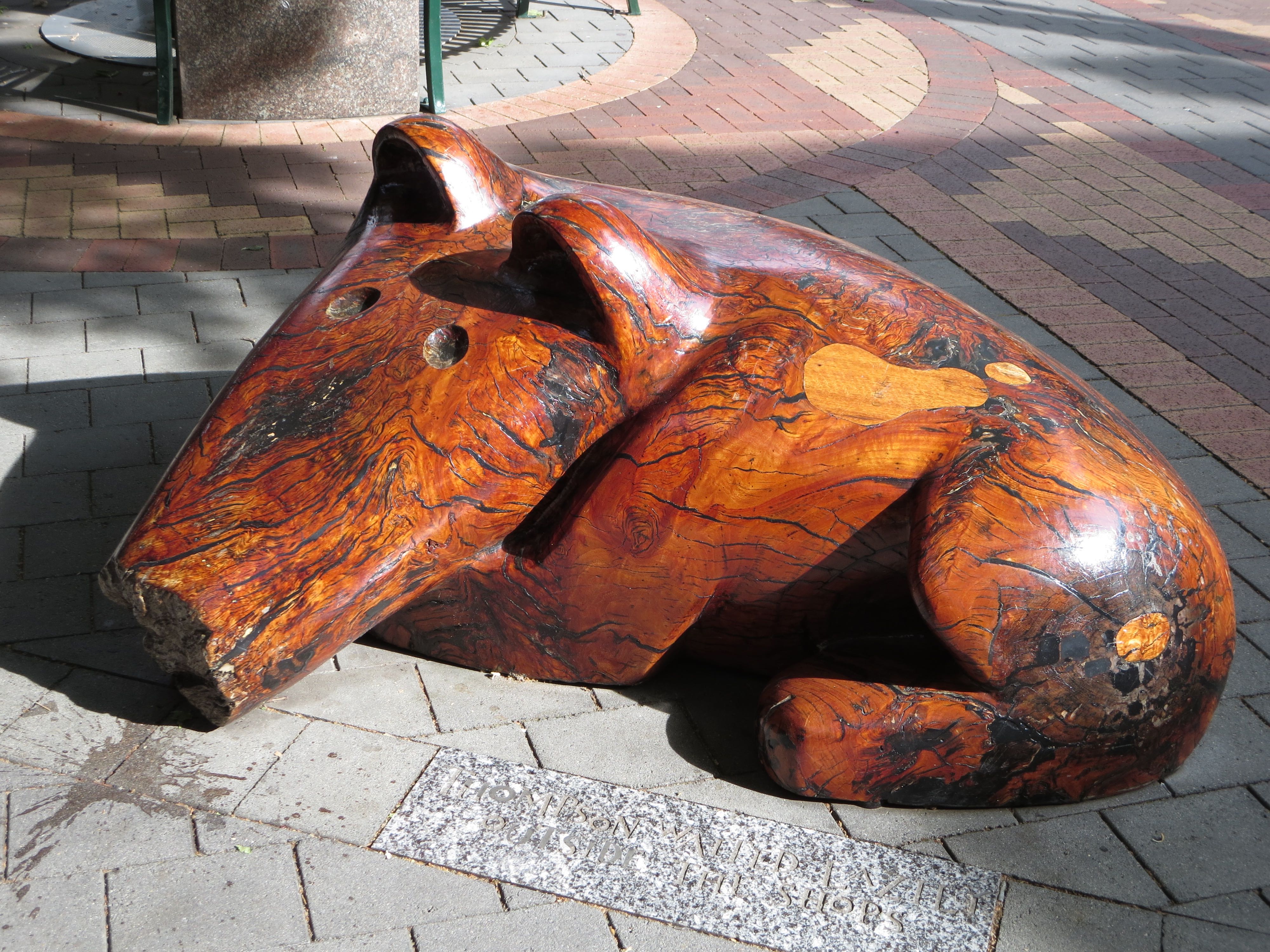
Wooden dog sculpture

Thompson waited lazily outside the shops

The redevelopment of Elizabeth Street Mall in Hobart’s CBD in the 1990s was carried out with a view to humanising the space, to, if I understand correctly, making it aesthetically appealing and artistically interesting, not to mention fun and a little bit provocative too. Much of the art was, I understand, commissioned from the versatile Tasmanian artist Patrick Hall. He did street signs, sculptures, and “granite stories”. The sculptures include a “fish out of water” drink fountain (metalwork), Maurice the pig (moulded hebel) and Thompson the dog (woodcarving).

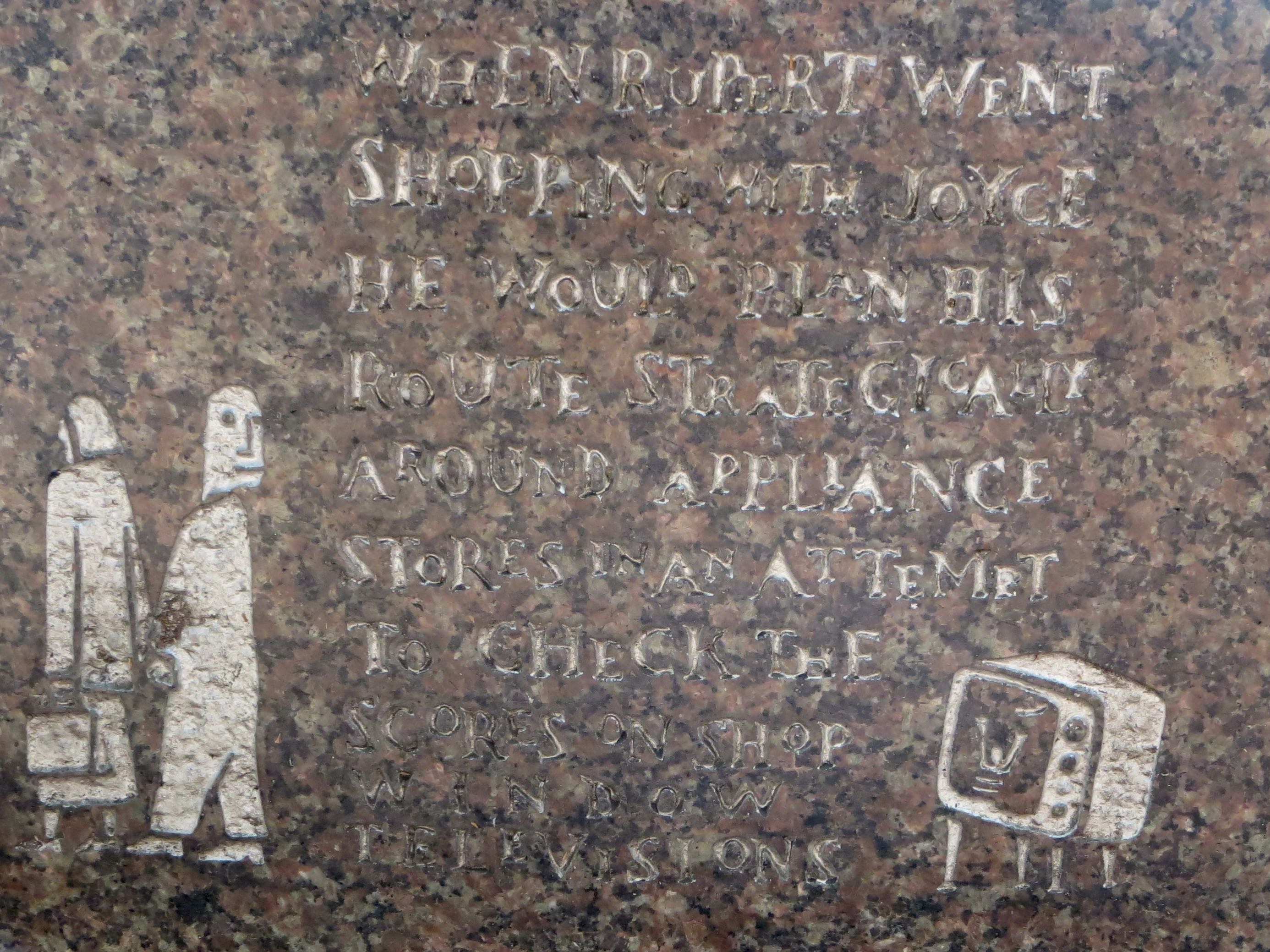
The sculptures would be hard to miss by anyone walking through the mall, but not so obvious are the tiny stories and images etched into the granite pedestals supporting the mall’s public seating. I suspect these are mostly discovered by word of mouth, but they are addictive once you discover them – that is, you want to find and read them all. Here are a few:

Rupert going shopping etching

Rupert going shopping

Beneath their feet lay buried the intersecting tracks and paths of the lives that went before.

AND

To the casual observer Hubert seemed lost in thought, when in fact he was trying not to tread on the cracks.

AND

Zoe tied her bicycle next to a pole and said “stay” before she went shopping.

AND

When Rupert went shopping with Joyce he would plan his route strategically around appliance stores in an attempt to check the scores on shop window televisions.

AND

They would sit with their collars rolled up against the chill winds & imagine they could peer over the edge of the planet.

I love the mix of whimsy, commentary and philosophy here. They are universal, but also seem to be very much of Tasmania.

Just around the corner, more or less, from Elizabeth Street Mall is Mathers Place. Unfortunately I didn’t have my camera when my trusty guide took me through it, but displayed there, on large billboards, are some of the stories by young writers produced under the Young Writers in the City program, which is run by the Tasmanian Writers Centre and the City of Hobart. The idea was that the young writers (under 30 years old) would sit somewhere in the city, and “compose an essay between 1500 to 5000 words … in an observational or experimental style inspired by the [chosen] space”. Not surprisingly, I enjoyed Claire Jensen’s piece about a space where older people meet. Only the beginning of it is displayed on the billboard:

In Hobart’s CBD there is a place where retired women and men meet their friends. They play scrabble, take art and writing classes, computer and ukulele lessons, hold book clubs, discuss family history and grey nomad road trips. For the last few weeks I have been invited into this secret society. They tell me stories, let me eat lunch with them, and beat me at scrabble. In the quiet afternoons, I escape the chatter to sit typing by the windows.

Ben Armstrong, in his piece, “Unified Mall Theory”, tackled the challenge to be inspired head on. (I can’t recollect whether his is displayed in Mathers Place). I like his tongue-in-cheek-up-frontedness:

I have a set of assumptions about the form my benefactors hope this inspiration will take. They want me to contribute to the cultural landscape. They expect me to write about history and stories and the interweaving of history and stories. The phrase “nooks and crannies” has not been explicitly mentioned, but I feel it is implied. Place and context also seem like things I should probably mention. Probably something about David Walsh* as well.

And now, since it is half-an-hour or more into Tuesday on my clock, I shall publish this, without a proper conclusion but hoping you have enjoyed my two little idiosyncratic Tasmanian posts. Normal Monday Musings will resume next week!

* David Walsh is the owner/benefactor of Hobart’s famous, and very popular, private art museum, MONA.