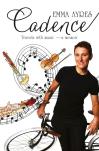
Emma Ayres, Cadence: Travels with music (Review)

Emma Ayres, CadenceAlthough Emma Ayres’ memoir Cadence had been passed around my reading group with much enthusiasm over the last year or so, I wasn’t intending to read it – not because I wasn’t interested, but because there were other books I wanted to read more. However, when I found the audiobook at my aunt’s house while we were clearing it out, Mr Gums and I decided to listen to it on our trips to and from Sydney. It proved to be a great car book. However, a warning: we listened to it intermittently over two months, so this will be more a post of reflections than a coherent review.

Emma Ayres is probably known to most Australian readers of my blog, but perhaps not to others so let’s start with a potted bio. Born in England in 1967, Ayres is a professional musician – a viola player in fact – who has also worked as a radio presenter. She lived in Hong Kong for eight years, playing with the Hong Kong Philharmonic Orchestra, but in 2000 she rode a bicycle, fundraising for charity, from Shropshire, England, through the Middle East and central Asia, to Hong Kong. She moved to Australia in 2003, and worked as an ABC Classical Music radio presenter for eight years, from 2008 to 2014.

Now to the memoir. Cadence is ostensibly a travel memoir, but it covers a lot of ground within its seemingly narrow construct of chronicling her year-long bicycle journey. The ground it covers, besides the story of her travel, which is exciting enough given the regions she rode though, includes her childhood, her reflections on her life as a musician, and her analyses of classical music. Some of her technical descriptions went over my head, but I found her discussions of composers to be not only accessible and eye-opening, but deeply interesting. And it’s all told with a thoughtful philosophical underpinning.

Cadence is an excellent title for a musician’s memoir, and she plays with its meanings throughout, referring, for example, to a “perfect cadence”, or a “slow cadence”, or more frequently to  “interrupted cadences … moments when the direction is changed”. Indeed, the memoir could be seen as comprising almost continuous interrupted cadences because, although the bicycle trip provides her memoir’s chronological backbone, she skips around frequently, going backwards to her childhood and early years as a musician and forwards to her life after the trip when she briefly toyed with being a cellist. It can take a little concentration to keep track of exactly which part of her life she is writing about at any one time, but it’s not too hard. After all …

Cadences are waypoints in the music, places where you can take a breather, readjust your instrument and hurtle on to the next bit of the adventure.

I greatly enjoyed Ayres’ reflections on life and travel. The book is full of her insights, many learnt on the road. For example, regarding the challenge of deciding whether to do the trip she says:

If you are not sure whether or not you should do something, ask your ninety-year-old self.

At another point she discusses how much she loved Pakistan despite all the nay-saying she had received when she was planning her trip. She was treated, she writes, almost without exception, with kindness and generosity everywhere she went. “Do we make our own welcome?” she wonders, and goes on to suggest that before we criticise another country, we should perhaps look at ourselves first.

Being a woman cycling alone is risky business, particularly in some of those male-dominated countries through which she travelled. She frequently took advantage of her androgynous look, helping it along by keeping her hair very short and wearing non-feminine clothes (where she could). Consequently, she was regularly taken for a man. She discusses gender often, commenting on how we are ruled by it and its associated expectations. She sees herself as “a border dweller in the world of gender”, writing:

I do admire people who are by birth penumbral but have the courage and desire to be firmly one or the other and go through a sex change, but I like the fluidity of being able to float around the middle. I really to think that the basic this or that of male and female is shallow and limiting. How simplistic to think, with all those opposing hormones flowing in each of our bodies, that we are one and therefore not the other. And how much better in countries like India and Thailand that they recognise more than two sexes. More variations in the octave, more variations in gender.

Another theme that runs through the book is the idea of being in the moment. She tells the story of being taken to task for reading Anna Karenina when on a bus in Pakistan. Her young seat-mate is mystified by her passionate rendering to him of the story, saying to her “but you are here!” She genuinely sees his point, and puts the book down. Later in the trip, she regrets not spending more time with a fellow-traveller who crosses her path because “I was too focused on destination and again forgot the importance of the here and now”.

Cadence is a generous, warm-hearted book which abounds with travel anecdotes to delight any lover of travel literature. There are scary moments, and funny ones, and others that are just plain interesting. It also contains intelligent, considered insights into music, some of which I plan to share in a follow-up post. For now, I’ll conclude with a comment she makes early in the book:  “Travel”, she says, “goes inwards as much as outwards”. That is exactly what she demonstrates with this book. I can see why all those in my reading group who read the book urged it onto the next person.

awwchallenge2016

Emma Ayres
Cadence: Travels with music – a memoir
Sydney: ABC Books (by HarperCollins), 2014
284pp.
ISBN: 9780733331893

Emma Ayres
Cadence: Travels with music – a memoir (audio)
(read by Emma Ayres)
ABC Commercial, 2014
8 hours (approx) running time (on 7 CDs)
Delicious descriptions: Stephen Orr’s farm family

When I reviewed Stephen Orr’s farm-set novel, The hands, last week, I didn’t share many quotes as the post was getting rather long. I decided I’d use my Delicious Descriptions series instead! So, here are three excerpts to show you more of what I so enjoyed about Orr’s writing.

One aspect I really enjoyed was his dialogue, but it’s tricky choosing something that works out of context. However, here’s a discussion between parents Trevor and Carelyn, and their eldest son Aiden about whether he continues school to Year 12. Young brother Harry is there too:

‘Maybe there’s no point starting Year Twelve,’ Aiden suggested, looking at his parents.
‘Why not?’ Trevor asked, not entirely surprised.
‘Not if I’m gonna fail things.’
‘Why are you going to fail?’ Carelyn asked.
‘Maybe not fail, but get through with Cs.’
She crossed her arms. ‘You’re not a C student.’
‘It’s getting harder.’
‘So? You work harder. Year Twelve is minimum for anyone now.’
‘But what’s the point if —’
‘You. Will. Continue.’ She decided  against the lecture. How he (Yes, you, look at me when I’m talking to you) was, for seven years, the best student in his School of the Air class; how he used to finish maths worksheets in minutes and spend half an hour waiting for others; always scored an A on tests and had a spelling age five years above his actual age.
‘It’s only another year,’ Harry said to his brother.
Aiden gave him his shut up, Shit-for-brains look. ‘It’s none of your business.’
‘You’re meant to set a good example.’

I don’t know about you, but I love this. It’s so “true”. I love the “gonna” for Aiden, and the “going to” for his Mum; I love big brother’s condescending-irritated-but-love-you-all-the-same “shit-for-brains” response to  his brother; and I love the whole set up of the argument regarding the importance of education.

And here, without spoiling anything, is a description of what comes after an affair:

… It was more a case of what came next: the small wedding, in a small park; the moving van; the bathroom reclaimed by lavender soap and fresh towels; her, inserted into his life like a deep splinter; opinions floating through the air and settling on the floor like talc; fine words butter no parsnips; her laugh; bright dresses on the line beside their overalls and pyjamas …

A little north of Orr's "Bundeena" but you get the picture.

A little north of Orr’s “Bundeena” but you get the picture.

But finally, of course, you need a description of the land:

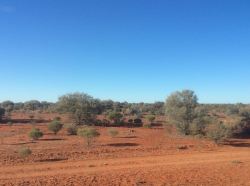
Bundeena was marginal country. It could carry cattle, sparsely. To Trevor, this was where Australia became desert, where man — following the east-west railway, before it seriously set its sights on the Nullarbor — had given up on agriculture. Most men, at least. Except for them: sixth generation Beef Shorthorn producers who’d wrestled with the land for 130 years. This was country that hadn’t asked for farmers but had got them anyway. On the southern edge, the railway line, and to the north, nothing. They had neighbours to the east and west, but they may as well have been living in New Zealand.

So evocative.

Monday musings on Australian literature: Regional differences in Australian English

Thredbo Village

Thredbo Village

While dining in Thredbo this weekend, we were served by a waiter who, when I asked for a certain ingredient to be excluded from my dish, repeated it back with the order, “and no to-mAY-to” she said. Her accent wasn’t strong but this stood out, so when she returned to our table, we asked whether she was from North America. Yes, Vancouver, she said, but sixteen years ago. She thought she’d covered her origins up but, when we explained, she realised she’d make a slip and pronounced that she would not make that mistake again! What a shame I thought …

When we watch movies or television programs from countries like England and the United States, we tend to be very aware of accents and linguistic differences. Is this set in the north of England, we ask? Or, oh, she’s a New Yorker, we’ll say. The accent is a big part of it, but vocabulary and expressions also contribute. Interestingly, despite Australia’s geographic expanse, with some populations quite remote from others, such differences are far less pronounced.

There are some differences, of course. Indigenous Australians can often be distinguished by a particular way of speaking, as can country versus city people. Traditionally, South Australians have had a reputation for sounding more English, for rounding their vowels in words like “dance” and “branch”. (South Australia was not a convict colony like most of the other states!) These differences tend to be subtle, and are probably not well noticed by those from other countries.

Linguistic differences in Australia are, though, something I’ve been aware of, largely because I’ve experienced the impact. You see, as an early teenager, I moved from living in northwest Queensland (Mt Isa to be exact) to the big smoke in New South Wales (aka Sydney). I learnt very quickly to say “recess” at school, not the childish sounding “little lunch” for the first break of the day. I learnt that the bag I took to school was a “case” or “bag” not a “port”. (These days I suppose it’s a “backpack”!). And I learnt that my “togs” were “swimmers”.

I was therefore fascinated to read a recent theconveration.com article titled “Togs or swimmers: Why Australians use different words to describe the same things”. It was written by three linguists at the University of Melbourne, Jill Vaughan, Katie Jepson and Rosey Billington. They provide some maps showing different word usages around Australia, swimwear being one. (If you are interested, they include a link to more maps on their Linguistic Roadshow site).

What is particularly fascinating about this from my point of view is not so much the differences but the fact that different states agree on different words. For example, with some words there’s general agreement in Queensland and New South Wales (“ice-block”) but not Victoria (“icy-pole), while for another word Victoria and New South Wales will concur (school “canteen”) with Queensland (the “tuckshop”) the odd one out. How did/does this happen? The authors don’t cover it – though perhaps they do in a longer academic article.  They do, however, note that some usages align quite closely with state lines, and that this can be observed in border towns, like Albury-Wodonga. Words, they say, become part of one’s regional identity and so Wodonga residents are more likely to use the Victorian-preferred “bathers”, while those from Albury will use the New South Welsh “swimmers”.

The thing is, of course, that vocabulary usage varies (and changes) over time as well as space. When we read Australian novels, it’s the change over time that I suspect we notice, more than the regional ones. One of the aspects I enjoyed in Madeleine St John’s 1950s-set The women in black (my review) is St John’s recognition of new words being introduced to Australians via post-war European immigrants, words like “salami” for example! She also used the word “reffos” which was contemporary Australian slang for “refugees”. Salami is here to stay, but “reffos” has been replaced by new slang.

Current writers like Tim Winton and Christos Tsiolkas very self-consciously, I think, closely reflect contemporary vernacular in their novels. It’s important to the milieu they are describing. Kristen Krauth’s just_a_girl (my review) is replete with contemporary teenage vernacular, including Americanisms like “skanky”, reflecting America’s influence on contemporary Australian English (if not on contemporary English!). In indigenous Australian writing, we hear the different rhythms and language of (to generalise somewhat) indigenous people. “Deadly”, meaning “great” (and similar), is an obvious example.

Hmm … I’ve moved a little away from what inspired this post but it did get me thinking about how I read Australian writing and what I notice. Works which use contemporary language – words, expressions, grammatical constructions – can seem fresh and alive, and very specifically of their place and time. Historically, but I’m generalising here and it’s a matter of degree rather than being absolute, the vernacular was (and is?) more common in genre writing than in literary works, that is, the works that go on to become “classics”. There are exceptions, of course. Some of Barbara Baynton’s stories in her Bush studies collection are nigh impossible to read for the vernacular she uses, and yet are deemed classics. And CJ Dennis’ Songs of a sentimental bloke remains popular despite its colloquial language.

I’d love to know what you think about the use of vernacular – as against more formal writing – in the fiction you read. When does it engage you, and when not?

Stephen Orr, The hands: An Australian pastoral (Review)

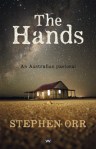
OrrHandsWakefieldAs promised, here is my review of a farm novel, Adelaide-based Stephen Orr’s The hands: An Australian pastoral. It is his sixth novel but the first that I’ve read. Where have I been? The hands is such a good read I wonder why I haven’t read him before.

Among the review excerpts for his previous novels provided at the beginning of my edition is one for his fourth, Dissonance. It says the book prompts us “to ponder the deep nature of familial relationships and their hold over one’s life”. This must be Orr’s milieu because I could write exactly the same about this book. It is set on a remote cattle property called Bundeena, in western South Australia. At the start of the novel, six people live there: 74-year-old Murray who holds the deed to the farm; his sister Fay and her not-quite-right son Chris; and Murray’s son Trevor, his wife Carelyn, and their 11-year-old son Harry. The seventh member of the family, 17-year-old Aiden, is at boarding school. In the first of the novel’s three chronologically titled (2004, 2005, 2006) parts, we shift between the third person perspectives of those at Bundeena, and that of Aiden at school.

Like most farm novels I’ve read – such as Alice Robinson’s Anchor point (my review), Jessica White’s Entitlement (my review) and Gillian Mears’ Foal’s bread (my review) – The hands, depicts the hard life of the farmer, the struggle to survive, and the uncompromising emotions that often attend such lives. You have to be tough to survive is the implication. But, do you? Sometimes, perhaps, you can be too tough. Orr’s characters have to contend with much – not just ongoing drought and debt, but grief that is layered upon layer through the generations, from the World War 1 related suicide of Murray’s grandfather, through the farm accident which damages Chris, to another accident which rocks the family and sparks the tension that finally brings it all to a head. Secrets will out and truths, emotional and practical, must be faced.

This sounds pretty thickly laid on, doesn’t it? World War 1, suicide, farm accidents, drought, and more. How believable is it all? Fortunately, Orr’s control of his plot is sure, and the tone never shifts into melodrama. The story elements fit logically, with the necessary groundwork carefully laid. It pays to notice the details. Is there a hint, for example, in the first film we find movie-mad Chris watching, The Great Escape?

The hands is not a challenging novel to read, and it doesn’t break ground in terms of the form, but from the first page I was fully engaged – because it’s authentic. We reviewers can throw that term around rather loosely, but you’d better believe me when I use it for this novel. Orr’s ability to capture characters and the way they interact with each other is truly impressive. The uneasy relationship between Trevor and his unbending father, the love and loyalty between Aiden and Harry that lies behind the teasing and bickering, Trevor’s conversations with his sons. It’s pretty darn perfect.

Orr’s control of his story starts with the title. “It’s all in the hands” we read, and hands feature consistently throughout the novel – working on the farm, driving, sculpting. Sculpting? Yes, Trevor sculpts son Harry’s hands. Fittingly, the novel concludes as the sculpture is completed. And then there’s the subtitle. I love the use of the word “pastoral” and its multiple connotations. There’s the literal meaning relating to land used for grazing sheep and cattle. That describes this book. Then there’s the Christian church sense of providing spiritual guidance. Hmm, there’s a dearth of good guidance (spiritual, emotional, however you like to frame it) offered in this novel, particularly by patriarch Murray. In the end it’s Murray’s powerless, down-trodden sister Fay who comes good. And then there’s “pastoral” used to describe works of art which portray country life in a romantic or idealised way. But, this is not a romantic or idealised story, making the subtitle pointedly ironic.

This is a novel about a lot of things. Specifically, it’s about farms and farm families, about how farms and the responsibility for them are handed down through families. It’s about the expectation that succeeding generations will farm, and it’s about one generation letting go to allow the next to continue. The trouble is that at Bundeena, Murray will not let go. He holds the deed, and Trevor feels trapped. More than that, he feels unvalued and without autonomy. Aiden notices it too:

The word was with Murray, and Murray was the word … There wasn’t much love or compassion in him. He was a sort of farmer shell, a hollow man full of regrets and knowledge and skills he couldn’t use any more, except as a sort of walking opinion that no one wanted to hear.

Talking with him, feels Trevor, is like “arguing with a rock”.

The specific farm themes, though, encompass bigger themes to do with familial love and responsibility, choices and autonomy, guilt and shame. It is these that lift The hands from a good, but exotic to most of us, farm story to something that applies to us all. In this context, though, it must be said that women play only a small role, and the role they play could be seen to be a little idealised, in that much of the warmth or perception comes from them. However, this is not overdone. They are not sentimentalised, and their relative absence is not a flaw: this is a book about men, about generations of farming men, their lives and their decisions.

Still, it’s to Fay that I’d like to give the last word:

Family, she realised, was the most difficult thing of all. It never reached a point of completion and what was there never seemed satisfactory. But one thing, she realised: there was always a pivot, one person at the centre holding it all together.

In The hands, this turns out to be Trevor. It is he who must make the tough decisions for himself and his sons. This novel is satisfying on so many levels – story, style and subject matter. I comment it to you.

Lisa (ANZLitLovers) loved the novel too.

Stephen Orr
The hands: An Australian pastoral
Mile End: Wakefield Press, 2015
351pp
ISBN: 9781743053430

(Review copy courtesy Wakefield Press)

Mark Twain, How to cure a cold (Review)

I haven’t reviewed anything by Mark Twain on this blog, though I have posted on an interview with him by Rudyard Kipling, so when his story “How to cure a cold” appeared in December as a Library of America Story of the Week, I figured it was time.

Mark Twain, by Matthew Brady, 1871 (Public Domain in the US, via Wikipedia)

Mark Twain, by Matthew Brady, 1871 (Public Domain in the US, via Wikipedia)

According to LOA’s notes, “How to cure a cold” was written in response to a serious cold followed by bronchitis that Twain suffered through the summer of 1863 – during the American Civil War, in fact, though you wouldn’t really know it from the story. He wrote several letters and reports detailing his experiences to newspaper editors in Virginia City (Nevada) and San Francisco, but didn’t write this dedicated piece until he arrived in San Francisco in September of that year. LOA says that this is one of the few pieces from his early years that he republished, revising and polishing it several times. He included it in his first book, The celebrated jumping frog of Calaveras County (1867), and in a collection of his sketches published in 1875.

As you can probably imagine, given the topic and the Mark Twain factor, the piece – barely 6 pages in my version – is replete with all sorts of weird and wonderful cures. LOA tells us that the editors at the University of California Press,  which publishes Twain’s writings, say that ‘the remedies described by the author, although they seem ludicrous today, “were standard prescriptions of folk medicine …”‘.

I’m not going to write a long post about this piece, because it is short enough that you can read it quickly yourselves – at the link below, if you are interested. But, what I particularly love about this article – besides Twain’s trademark humour, and its careful construction – is that whole plus ça change thing. After taking a page to tell us how he got the cold – a page full of tongue-in-cheek humour – he tells us:

The first time I began to sneeze, a friend told me to go and bathe my feet in hot water and go to bed.

I did so.

Shortly afterward, another friend advised me to get up and take a cold shower-bath.

I did that also.

You can see where this is going can’t you? What follows is a chronicle of remedy after remedy that he tries – “feed a cold and starve a fever”, take the waters, apply a mustard plaster – and so on. He tries them all, to no avail, but the telling is entertaining. Some remedies are pretty harmless, some are rather enjoyable (like gin, and gin and molasses, not to mention whisky), but some are downright unpleasant, such as the warm salted-water one. He writes:

It may be a good enough remedy, but I think it is too severe. If I had another cold in the head, and there was no course left me but to take either an earthquake or a quart of warm salt water, I would cheerfully take my chances on the earthquake.

He did not like the warm salted-water much!

But honestly, nothing has changed has it? As soon we get sick, our family and friends are ready with remedies. All very kindly meant, but the offerings can be confusing, contradictory, and often ineffective. And if it’s not advice from friends and family, we do it to ourselves by finding concoctions over the counter or natural health remedies over the internet. I love the universality of this – the urge to help, the wanting to get better, and the desire to not offend one’s loving advisers. I’m not surprised Twain kept this story, and that LOA chose it as one to share.

I will leave it there, but before I finish I can’t resist sharing a comment on that opening page where he describes a house fire in which “I lost my home, my happiness, my constitution and my trunk”. He discusses the relative import of these, saying of losing his happiness that

I cared nothing for the loss of my happiness, because, not being a poet, it could not be possible that melancholy would abide with me long.

Ya gotta love it (no offence to poets intended). I do recommend this article.

Mark Twain
“How to cure a cold”
First published: In the San Francisco Golden Era, September 20, 1863.
Available: Online at the Library of America

NB I did say that my first review of 2016 would be for a farm novel. I lied! But it will be coming soon …

Monday musings on Australian literature: Best books of 1975

Given we’re all looking at best reads, I thought it might be fun to look at best reads of a past time? My initial thought was 1965, a neat 50 years ago, but I couldn’t find any appropriate lists. Google found a 1965 New York Times bestseller list on Wikipedia and a couple of 1965 lists in GoodReads, but they weren’t quite what I was looking for. I wanted Australian lists, but my first port of call, Trove, wasn’t helping. However, not being quite ready to give up, I thought I’d try ten years later, 1975, which is the year I moved to Canberra. Eureka! This time Trove produced two lists …

And they are nicely representative. One is by classics collector, “book reviewer and litterateur”, Maurice Dunlevy, writing in the Canberra Times (woo hoo!) on December 26. Dunlevy wrote a book review page for the paper for 30 years, to 2000 apparently. The other is by one Nina Valentine. A brief search hasn’t turned up much about her except that she was clearly a writer for the Australian Women’s Weekly, which is where I found her December 31 article. Given their different publishing environments, you won’t be surprised to hear that their styles, not to mention their recommendations, are rather different. Both, though, focus on books for summer reading – and, although this post is dedicated to Australian literature, I’m going to break my usual rule and include some non-Australian picks. After all, they were writing for Australian readers.

“… books to help you enjoy lazy, long summer days to the full”

Let’s start with Nina Valentine. Her circa 700-word article focuses on books that tell a strong story, though not all are fiction. Since there’s only five of them, I’ll list them all:

  • Evelyn Anthony, The Persian kingdom (an error, I think, for Persian ransom) A British writer, Anthony is, she says, “one of my favorite writers of sculptured novels”. Sculptured novels? That’s a new term for me, but she does define it. They are novels which – wait for it – have “form, character and situation”. Hmmm. Anyhow the novel has an interesting setting, Iran. It’s about the oil crisis, the Palestinian Liberation Army, and a secretary who, Anthony’s heroine knows, threatens her marriage. “Thrilling holiday reading”, Valentine says. According to Trove, many Australian libraries hold it, so there’s no excuse for not adding it to your summer pile!
  • Kenneth Harrison, Dark man white world. This, however, is something completely different. It is a biography of famous indigenous Australian tenor, Harold Blair. In addition to singing, he became an Aboriginal activist fighting, she writes, “for better education, better understanding and a better lifestyle for his people”. I love that Valentine chose this as a holiday read.
  • James Quartermain, The diamond hostage. Part of a series, this book she says is “tailor-made for holiday escapist fare”. Set in Frankfurt, it features Raven, who is security chief for Mrs Diamond, a very wealthy “diamond-hard business woman”. She’s kidnapped (as is the heroine’s child in Anthony’s book), setting up, presumably, an exciting read.
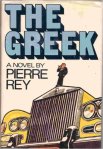
  • ReyTheGreekAmazonPierre Rey, The Greek. Translated from French, it’s about a “Greek shipping magnate whose affair with a concert singer finishes when he marries the widow of an American who has been assassinated”. Ring a bell, anyone? Rey swears it’s fiction, says Valentine, but for her the point is that it’s “racy” in the style of Harold Robbins and Jacqueline Sussan. (Love the cover.)
  • The Saturday Book sounds a little more interesting (to me). It’s an “elegant, gift-boxed collection of stories, poems, drawings, photographs and nostalgia”. Annually published, it may, she writes, be the last due to production costs. She describes it as “a book to beguile you while on holidays, and to enchant you at all times”.

So, overall, an interesting mix of the usual beach holiday plot-driven fare combined with a couple of other options for those looking for something a little different. Minimal Australian content, but interesting to see a translated – genre – book in the mix.

Doing “your bit in the grit to further your cultural education”

Dunlevy’s article is the same length as Valentine’s but he packs more into his by spending less time describing the books. He discusses his selections under categories, recognising his (surely) more diverse set of readers than Valentine’s.

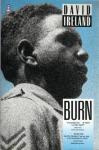
  • IrelandBurnLiterary fiction: I love that he starts with Australian literary fiction naming Xavier Herbert’s doorstopper Poor fellow my country, David Malouf’s autobiographical novel Johnno (the only one I’ve read), Thomas Keneally’s Gossip from the forest, David Ireland’s “fine novel about the Aborigines” Burn, Michael Wilding’s The short story embassy, and Laurie Clancy’s A collapsible man. I haven’t in fact heard of these last two. His foreign literary fiction choices are the last volume in Anthony Powell’s Music of Time sequence Hearing secret harmonies, Iris Murdoch’s A word child, and Saul Bellow’s Humboldt’s gift.
  • Poetry (or Verse, to him): This is his second category! Love it. His selections are all from established poets he says: A. D. Hope’s A late picking (which I actually have), David Campbell’s Deaths and pretty cousins, and Gwen Harwood’s Selected poems.
  • Australian literary criticism: If I was surprised by poetry being his second group, this third one made me really sit up. He recommends poet Judith Wright’s Because I was invited and poet Douglas Stewart’s The broad stream, describing them as fine successors to poet A. D. Hope’s Native companions, published in late 1974. The final critical work he names is again by a poet, Vivian Smith’s Vance and Nettie Palmer. I know a couple of these – but am mightily intrigued by the others.
  • Biographies: Here we move away from a focus on Australian works. He lists several books, including Hilary Spurling’s Ivy when young: The early life of I. Compton-Burnett, describing it “as a fine re-creation of the Victorian family life of an oddball novelist”; Michael Holroyd’s Augustus John; R. M. Crawford’s life of fellow English-Australian historian G. Arnold Wood A bit of a rebel; and Scottish-born Australian Mary Rose Liverani’s autobiography The winter sparrows. According to AustLit, this last book “has been acclaimed as a landmark in Australia’s migrant literature”. Onto the TBR list it goes.
  • Histories: Dunlevy says he’d read so many good popular histories in the year that he “would not know where to begin if I were not now reading the most diverting of all, William Manchester’s narrative social history of the United States 1932-72, The Glory and the Dream”. He describes it as “a huge journalistic history which reads like a massive newspaper written by a single brilliant journalist”. He offers two other social histories suitable for holiday reading: John Ritchie’s Australia as once we were and Michael Cannon’s “third volume about Australia in the Victorian Age, Life in the Cities“. I don’t know any of these historians.

Having gone to the trouble of listing all these worthy works, he then admits that he doesn’t “very often see people reading high quality fiction or poetry or criticism or biographies or history on the beach”! Not sure I do either. The “best-selling paperback” is probably the better bet, he thinks, and to that end he suggests P. Benchley’s Jaws, Harold Robbins’ The Pirate (‘which includes lots of stirring sex scenes, including one in front of a mirror”!), Frederyk Forsyth’s The dogs of war, and Irving Wallace’s The fan club. Personally, though, I’d be looking at those books in his first category. I reckon they still make perfectly good recommendations today.

Blogging highlights for 2015

So, I’ve done my Australian Women Writers’ Challenge wrap-up, my Reading highlights, and now, to complete what’s become my annual trifecta, my Blogging highlights. I hope I’m not boring you – but I’m doing this partly for my own record!

Top posts for 2015

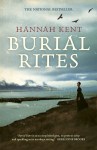
Hannah Kent, Burial Rites bookcover

Courtesy: Picador

As in 2013 and 2014, my most “hit” post for 2015 was a short story by Virginia Woolf, her “The mark on the wall (posted March 2012). I presume it’s a set text for schools/universities.

However, for the first time in my blog, Australian works occupied 2nd to 5th place:

Last year’s fifth highest hit, Barbara Baynton’s “The chosen vessel” (posted November 2012), continues strongly at 9th, and I’m thrilled that indigenous writer Tara June Winch’s Swallow the air (posted July 2014) ranked 10th. My most popular non-Australian novel post was Jeanette Winterson’s Oranges are not the only fruit (posted April 2010), which came in 8th. My most popular 2015 post – albeit 45th in the list of top posts – was for Fyodor Dostoevsky’s Crime and punishment.

As last year, many of my top hits are for older posts, which suggests that there’s some longterm value in litblogging.

Random blogging stats

Kim Scott That Deadman Dance

(Courtesy Picador Australia)

I always love to share some of the searches that find my blog, and this year, as always, there were some interesting ones:

  • what new stories does that deadman dance tell: an interesting question – I’d love to know why it was being asked
  • how useful are hachette writers retreats: now, there’s someone doing their research
  • custard apple cultivation in india: I have no idea
  • chic lit gum: I suppose this found chick lit reviews (such as for Toni Jordan’s books)
  • unrevised japanese girl adult pictures: again, keine Ahnung

My busiest day this year was November 19th with 611 views. The most popular post that day was Don DeLillo, Midnight in Dostoevsky. Last year, my busiest day was October 28th with 436 views. Guess what the most popular post that day was? Yes, Don DeLillo’s Midnight in Dostoevsky. It must surely be a first semester set text in the US somewhere?

Other stats tell the story of my year. As many of you who read my blog regularly know, it was a very disrupted year, and this shows starkly in my posting stats. This year I wrote 133 posts, some 19 fewer than last year’s 152 (neither of which is anything like Lisa’s rate of posting!) This didn’t stop you visiting though – and for this I thank you. According to WordPress, my blog visitors came from 168 countries, and my most active commenters this year were: Stefanie (So Many Books, So Little Time), Lisa (ANZLitLovers), Ian Darling, M-R (author of the memoir, And then like my dreams), and Meg. Thanks to everyone who reads and comments on my blog. I love “my” little blogging community (and I worry when some of you disappear at times! I want to know you’re OK. You are allowed not to comment, of course, but …)

Monday Musings on Australian Literature

I have been posting Monday Musings since August 2010. WordPress tells me that Monday was my best posting day with 51 posts. Funny that! To be honest, I’m surprised I’ve managed to keep it going this long. It’s an interesting challenge, and makes me appreciate even more those newspaper columnists who have to keep producing to get paid! However, as I said in last year’s highlights post, it’s all of you who read and comment on my musings that encourages me to keep going, so, rest assured, you’ll see another one tomorrow!

Australian Women Writers’ Challenge

awwchallenge2016As I wrote in my AWW Challenge wrap up, I will participate in the Challenge again this year, so let this be my announcement post. I plan to stick to the top level – Franklin, read 10, review 6 – though, for fun, I may have a go at a Bingo Card challenge. (See here for the Sign Up page). I will read more of course, but I’m not in this for the challenge so much as for the community and supporting Aussie women writers.

And finally …

I’ve already said it in my Reading Highlights post, but I’ll say it again: thanks to everyone who read, commented on and/or “liked” my blog in 2015. You demonstrate what a positive place cybersphere can be. I wish you all happy reading in 2016.

And, of course, thanks to all the wonderful bloggers I visit, the authors who wrote the books that make it all possible, and the publishers who get the authors’ works out there for us to read. May 2016 be a stellar one for you all.

Reading highlights for 2015

Well, dear readers, we have turned the calendar to 2016 so I can now reveal my highlights for 2015. As usual, I won’t be naming top picks. I find that too hard to do. Instead, I’ll discuss highlights which combines best reads with those that were interesting for other reasons. I’d love to mention every book I read, as every one had something to commend it. I have too little time for reading to read books that have no value!  (Seriously. I know I’m retired, but …)

First, though, this year’s …

Literary highlights

By literary highlights I tend to mean literary events, and I went to a few this year (though no writer’s festivals. One day!) What I did attend, though, gave me such pleasure, not to mention new things to think about:

  • Carmel Bird’s launch of Marion Halligan’s latest novel, Goodbye sweetheart, at one of Canberra’s best independent bookshops, Paperchain. This was particularly a thrill because, out of the blue, Carmel Bird emailed me asking me if I’d like to post her launch speech on my blog. I would and I did. I’m embarrassed to say though that the book is still on my TBR. This has been a bad reading year. Bird and Halligan are two of Australia’s literary treasures. Unfortunately, I was travelling in Tasmania when Bird returned to Canberra later in the year for an In Conversation event with Halligan. (And here, I’ll sneak a reference to Carmel Bird’s clever, delightful essay Fair Game which I did read and review!)
  • Jane Austen Society of Australia’s biennial weekend conference titled this year, Emma: 200 years of perfection. I wrote three posts on this wonderful weekend, here, here, and here. No matter how often I read Austen, or how many academics write about her, there’s always to something new to learn.
  • Robert Drewe’s talk titled Who, me? for the National Library of Australia’s Seymour Biography Lecture. Halligan* needn’t feel too badly about her book still being on my TBR pile, because Drewe’s second memoir, Montebello, that I bought at this event, is there too.
  • Author talk with Kate Llewellyn, Barbara Hill and Ruth Bacchus, focusing on Hill and Bacchus’ edition of selected letters written by Llewellyn (my review).
  • Griffyn Ensemble’s Utopia Experiment concert was a musical event, but its focus on poet Dame Mary Gilmore made it, for me, a literary musical event – and a most enjoyable one at that.

Reading highlights

As I’ve done in previous years, I’m going to discuss this year’s reading under categories which reflect this year’s experience.

Literary trends … in my reading, anyhow

  • ScarfeHungerWakefieldHistorical fiction: I don’t see myself as a reader of historical fiction, and yet it seems to feature significantly in my reading fare. I guess it’s a case of interesting stories will out, no matter when they are set. Not surprisingly, most of these stories deal with the poor, or disadvantaged, such as Eleanor Limprecht’s Long Bay about a young woman gaoled for manslaughter in early 1900s Sydney, Wendy Scarfe’s Hunger town set on the Port Adelaide docks in the 1920s-30s, and Emma Ashmere’s The floating garden about a woman losing her home through construction of the Sydney Harbour Bridge in early 1930s Sydney. Emily Bitto’s The strays is not about disadvantaged people, but her Bohemian arts community of 1930s Melbourne comprises people on the edge of society in another way. I’d happily recommend all these books for the way they evoke their respective eras – and for the variety of their subject matter.
  • Farm stories: Although Australia is one of the world’s most urbanised nations, we do have farmers! Given climate change, concerns about food security, not to mention, here in Australia, the dispossession of indigenous people from their land, it’s good to see “literary” authors tackling these issues, such as Jessica White in Entitlement and Alice Robinson in Anchor point. Coincidentally, my first review for 2016 will probably be a farm story …
  • Climate change: Speaking of climate change, I’m keen to continue reading novelists who tackle this issue, and have created a cli fi tag to identify them. This year, in addition to the above mentioned Anchor point, I loved Jane Rawson’s inventive A wrong turn at the Office of Unmade Lists.
  • Danielle Wood, Mothers Grimm, book cover

    Courtesy: Allen & Unwin

    Is it a novel?: I love it when writers play with form, and two Australian books I read this year thrilled me with their use of the short story/long short story/novella forms to produce fascinating works: Ellen van Neerven’s Heat and light and Danielle Wood’s Mothers Grimm. And then there was Julian Davies’ Crow Mellow, with its exhortation on the back page that “This book is a novel. It has drawings on every page”. It is a novel – but the drawings add another dimension to the reading experience.

  • Short stories rule: I read some excellent short stories this year, and particularly enjoyed John Clanchy’s Six and Paddy O’Reilly’s Peripheral vision. Angela Meyer’s collection of flash fiction, Captives, also captivated me!
  • From over the seas: Contrary to how it might look, I did read some books that weren’t Australian. The three standout novels were Vincenzo Cerami’s A very normal man, Aminatta Forna’s The hired man, and Neel Mukherjee’s The lives of others.
  • It wasn’t all fiction: While fiction is my main fare, I do enjoy non-fiction too. Standouts this year were Karen Lamb’s biography Thea Astley: Inventing her own weather, Richard Lloyd Parry’s true crime work People who eat darkness, and Biff Ward’s memoir In my mother’s hands.
  • Mark Henshaw, The snow kimonoSpecial mentions: I can’t complete this list without mentioning two books that don’t fit the above categories but must be mentioned: Mark Henshaw’s The snow kimono and Fiona McFarlane’s The night guest. Both take their readers on a merry (or not so merry really, but you know what I mean) dance, and are very satisfying reads.

Serendipitous Reading Stats

Just because I like them (these percentages are for this year of course):

  • 67% of the authors I read were women.
  • 27% of the works I read were not by Australian writers.
  • 73% of my reading was fiction (short, long or in-between!)
  • 20% of the works I read were published before 2000
  • 30% of the works I read were published in 2015
  • I reviewed multiple (2) works by two authors – Jane Austen, and Ellen van Neerven

I did not achieve my one real goal for the year, which was to read more from my TBR, and, for reasons which regular readers here know, I did not manage to read more books. But, I had a great reading year, nonetheless, and I want to thank you all for joining me in my journey – for reading my posts, engaging in discussion, recommending more books to read and, generally, being all-round great people to know (cyberly, anyhow). I wish you all a wonderful 2016, and hope to see you here whenever the spirit moves you.

What were your reading or literary highlights for the year?

* I nearly missed the autocorrect of Halligan to Halogen!

Vincenzo Cerami, A very normal man (Review)

Vincenzo Cerami, A very normal manAnd now for something very different from my recent fare here, a modern Italian classic. Originally published in 1976, A very normal man was, the back cover blurb says, Vincenzo Cerami’s first novel – and it brought him instant acclaim. I can see why. At least, this is the sort of writing that gets me in, but more on that anon.

Now, you may have heard of Cerami (1940-2013). I know I should have, because he was the co-screenwriter on that wonderful 1998 film La Vita è Bella (Life is Beautiful). He was also a poet, commentator and a writer on writing. In other, words a very interesting man! (Couldn’t resist that.)

But now, the book. It is, as you might have realised, a translation, which is always a challenge from my point of view, because I know I’m reading a mediated work. And, as I started this book, I felt it must have represented a very particular challenge because this is a satirical, darkly humorous and deeply ironic work. That must be hard to translate across languages and cultures – and it apparently was, starting with the title. Wakefield Press says on its website that “the complex word play of the Italian title is untranslatable in English; it means literally a very little, very middle-class man”. Does this remind you of Camus’ L’Etranger, and its publication in English as both The stranger and The outsider?

So, who is this very little, very middle-class – or very normal – man? He is Giovanni Vivaldi, living in Rome during the Years of Lead. He’s married, happily enough it seems, with a  20-year-old account-trained son, Mario, of whom he is very proud. He’s been a public servant in the Ministry, the Office for Retirement Pensions, for 40 years, and at the start of the novel he is about to retire. First, however, he wants to get Mario a job in the Ministry. It’s the least he deserves, he believes. Italian novelist Italo Calvino, who apparently negotiated the novel’s publication, also wrote the preface to the original Italian edition. My Wakefield edition’s preface quotes from it:

You would expect a story about office workers to be drab, short on events — the inevitable caricature. Not this one. Extraordinary events abound: a ludicrous initiation ceremony into Freemasonry; an incursion into the savage world of the daily crime columns; revenge that is the stuff of nightmares […] What we see is reminiscent of the precision effects of a magnifying glass angled over the unredeemed ugliness at the heart of civilised society — and over the tenacious lust for living which clings on in a world emptied of meaning.

Hmmm, what more can I say? These excerpts convey a little of the story and the main theme, without giving away too much of the plot. I wouldn’t want to give away any more, but I can talk a little about the character, the style and tone.

“the common sense of an ordinary decent man”

About a quarter of the way through the novel, during his application to become a Freemason, Giovanni is described as having “the common sense of an ordinary decent man”. Sounds lovely doesn’t it? Except that we have already seen quite a bit of not-so-decent behaviour from him, including the very reason he is applying to become a Freemason, which is to obtain favour to help his son beat the civil service exam for the Ministry job. On the first page of the novel, he tells his son that “the sign of a really smart young man is a total focus on career and nothing else. Let the rest of the world go and hang themselves”. On page 2, Giovanni, out fishing with his son, kills a fish in a cruel, violent way. At the beginning of chapter 2, his normal drive to work is described: he’d “deal out vicious abuse to anyone he thought was trying to get in his way, rant and rave against everything and everyone”.  Pretty quickly then, we are clued in to the fact that he is not a very humane man – and yet, he is also presented as a “normal”, responsible family man. He’s (arguably) a good father, a decent husband and a diligent employee.

What happens in the novel is, in fact, shocking, and the way Giovanni responds is even more so, but it is all told in matter-of-fact prose, and this is what I like. I love writing that is integral to the meaning of a work, that is, that isn’t just there to carry the story and ideas. In this case, the calm tone of writing that conveys a grotesque story reinforces the themes of hypocrisy and corruption, of mismatch between the surface and the subterranean (if that makes sense).

The tone might be matter of fact, unemotional, but the imagery leaves us in no doubt as to Cerami’s view of life in 1970s Rome:

The city had all the signs of a Sunday: greasy roller blinds down on the shops; apartments with their entrances yawning open mockingly; parked cars lining the footpaths like the embalmed corpses of family pets; the slow, tentative caterpiller-weaving of empty trams. Against an unbroken infinity of apartment blocks that crossed the city from end to end, branching off in every direction, rows of bristles on a hairbrush for a scabby head.

Cerami mixes up descriptions of mundane detail (“he got his raincoat, grabbed his car keys … found himself a clean handkerchief from his sock drawer”) with descriptions that stop you in your tracks:

In person: young maybe Mario’s age, except that this one reminded you of rusted-out tools and coffee dregs.

At times there is a sense of the mock-heroic: Giovanni “sprang into the saddle of his charger”, that is, his Fiat 850. And there is plenty of humour (dark and otherwise), such as when Giovanni, in a police station, tries various Freemason secret signals, to no avail. Giovanni thinks he’s “mastered the art of living” but his view of living is not an appealing one.

For all this, there are moments when he seems human – he is a loving father and responsible husband – and can tug, albeit briefly, at our sympathy. Overall though, the novel is a devastating indictment of middle-class life that is superficial, self-centred and morally corrupt in a society which seems to be not much better. A fascinating read.

Vincenzo Cerami
A very normal man
Translated by Isobel Grave
Mile End: Wakefield Press, 2015
117pp.
ISBN: 9781743053713

(Review copy courtesy Wakefield Press)

My encounter with Encounters

I rarely write about museum exhibitions, and when I do it’s usually in the context of a travel post, but I do want to share with you our National Museum of Australia’s current exhibition, Encounters. Subtitled “Revealing stories of Aboriginal and Torres Strait Islander Objects from the British Museum”, it is described by the Museum as “one of its most important exhibitions”. That could sound, of course, like your typical promo-speak, but in this case I’m inclined to agree. Encounters is a very interesting and, yes, important exhibition – one that is not without its controversy.

The foundation pieces of the exhibition are 151 Aboriginal and Torres Strait Islander objects, including masks, shields, spears and spearheads, didgeridoos, baskets and head dresses, which were collected by a wide range of people – settlers, explorers, administrators, and so on – between 1770 and the 1930s, and which are now held by the British Museum. Complementing these are 138 contemporary items, some specially commissioned for the exhibition. The objects are supported by excellent interpretive labels which convey both the history of the objects and contemporary responses to them. The end result is a conversation between past and present that is  inspiring and mind-opening.

I’m not going to formally review the exhibition. You can read a thoughtful one published in the Sydney Morning Herald last month, including a discussion of the repatriation controversy. (Thanks to brother Ian for pointing me to this review). Instead, I’m just going to comment about its impact on me. So, here goes …

One message I took from the exhibition is not a new one at all, really, but more a confirmation: it’s that indigenous people, like all of us, are not one! It is way too easy for us (no matter who “us” are) to simplify “other” (no matter who “other” are). We tend to think that “they” all think the same, but obviously, like “us”, “they” don’t! This is made patently clear in Encounters where we see different responses by different indigenous communities to the objects. Some are adamant that their objects should be returned to them. Others may agree with that, but that’s not their priority (perhaps because they realise such a goal may not be realistic, in the short term at least!) They, such as Robert Butler, a Wangkangurru man from the Birdsville area, believe that the objects should not have been taken in the first place but recognise that the fact that they were now means they are available once again. Still others argue that the important thing is not the object itself, but the knowledge and skill they can obtain from it. Obtaining knowledge and practising skills that can be passed on, they argue, are the crucial thing, because they are critical to indigenous people’s identity and mental health.

I was consequently interested, for example, in a comment from the Noongar community regarding objects that had been collected by a young Englishman Samuel Talbot in the 1830s. He made detailed notes about the objects, demonstrating his keen interest in understanding Noongar culture. Present day Noongar woman, Marie Taylor, says:

I want to acknowledge the white people who sat down with the Aboriginal people, who wrote the stories down, who collected this information that still exists today. Down here in Noongar country, we may have lost all of that had it not been for many of these people.

Talbot is one of many such people. Lieutenant Dawes, about whom Kate Grenville wrote in her historical novel The lieutenant (my review), is another. Taylor’s response is, though, a generous one, since had there been no white people, they would not have lost (or been at risk of losing) their culture in the first place!

Bagu figures, contemporary objects from the Girringun Aboriginal Art Centre, Cardwell, north Queensland

Bagu figures, contemporary objects reflecting the past, from the Girringun Aboriginal Art Centre, Cardwell, far north Queensland

A very different story comes from far north Queensland. The panel that accompanies a shield, club and basket is titled “Guerrilla warfare”. The objects were collected in the 1860s by settler John Ewen Davidson at Rockingham Bay. He’d gone there, we’re told, “in 1866 to establish a sugar plantation. He began as a shocked observer of the violence of the occupation, yet within six months he was part of it”. Coincidentally, this story reminded me of another Grenville novel, The secret river, in which her fictional protagonist commenced with the aim of being peaceful but he too got caught up in violence.

Then there’s a comment that touched me on a more deeply personal level. It comes from Aunty Barbara Vale, a Dieri elder in South Australia. She says:

When I visit Killalpaninna I get a strong feeling of belonging. It’s our land, Dieri land. I feel safe and relaxed and always come away feeling good for having been there.

Now, I know my connection to the land is nothing like that of an indigenous person’s sense of belonging to and responsibility for their country, but Vale describes perfectly how I feel each year when Mr Gums and I go to Kosciuszko National Park – safe, relaxed, and a lovely sense of well-being. I don’t presume at all that my feeling is the same – it’s not – but her statement did give me a sense of connection, and, in that, of the validity of my own “truth”.

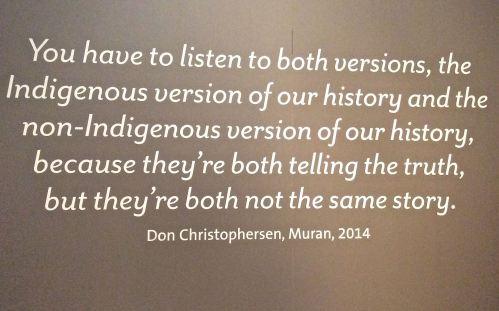
Towards the end of the exhibition, I came across a recent statement by Don Christopherson, a Muran man. He said:

Christopherson

And that is the spirit I’d like to think we all have in Australia today. It is surely the only real way we can move forward. Objects like the ones in this exhibition are crucial to this process, because, as one elder said, they bring the past into the present, which then enables us to move into the future. And, I’d say, they provide an excellent basis for a conversation.

A wonderful exhibition that I’ll try to visit again.

POSTSCRIPT: Here is a link to short films included in the exhibition. Many depict the way contemporary indigenous Australians are making objects today – some making traditional objects, some making modern ones commenting on contemporary relationships and concerns (like the ghost net project on Darnley Island – Erub – in the Torrest Strait).