Monday musings on Australian literature: The Banjo Prize

I have just caught up with a new literary prize – the Banjo Prize – which is not to be confused with the Banjo Paterson Writing Awards I guess it’s to be expected that one of Australia’s favourite bush poets might be honoured by more than one award being named for him.

Before I get to the new one, I’ll briefly mention the older one. The Banjo Paterson Writing Awards were established in Orange in 1991 “to honour Banjo Paterson [of course], a great Australian writer and favourite son of Orange.” They seem to be run by the Orange City Library, the Central Western Daily and ABC Central West Radio, and have three categories: Short Story, Contemporary Poetry and Children’s Writing. The entries, they say, don’t have to be written in Banjo’s style, but must be Australian in content. Fair enough. The winners receive cash prizes ($2000 for each of the first two, and $200 for the children’s award.)

The Banjo Prize is a different thing altogether. Firstly, it’s a manuscript award, and secondly it’s offered by a publisher, HarperCollins. The winner will receive a $15,000 advance and a chance of a publishing contract, while two runners-up will receive written assessments of their manuscripts which could also result of course in their books achieving publication down the track.

Most of the articles I read about the award seemed to be based on HarperCollins Press releases or came from HarperCollins itself. The articles announced the prize in March, the shortlist in August, and then the winner at the end of August. The winner, from 320 submissions, is Tim Slee with his manuscript, Burn. HarperCollins’ Head of Fiction Catherine Milne, whom you’ve met here before, said of the winner:

Burn is a novel that sneaks up on you, and takes you by surprise – and before you know it, you’re deep in its world and don’t want to leave. Burn is a thought-provoking, heart-warming, quintessential Australian novel like no other, and I’m just thrilled that it is our inaugural Banjo Prize winner.

Tim Slee, Charlie JonesThe two runners-up were Ruth McIver for Nothing Gold and Gregory James for Bordertown.

It’s unlikely that any of these authors will be well-known to us because the whole point is to discover new Australian storytellers. However, Adelaide’s The Advertiser provides some information about Slee. He is an “Adelaide-born expatriate writer”, and has previously self-published science fiction and historical novels. The Advertiser says that “he was thrilled that the book that ‘broke through’ for him was one about the ‘unbreakable spirit’ of Australian people.” He’s apparently lived abroad for more than a decade – they don’t say where – but “has returned regularly” to Australia. His author bio at Amazon.Com tells us he’s also won the 2016 US Publishers Weekly BookLife Prize for Fiction and was a past winner of Allen & Unwin’s INK prize for short fiction.

Anyhow, Burn was apparently inspired by a father and son he met five years ago during a family camping holiday in southeast Victoria. The two had sold their farm and the father was heading to Melbourne to look for work because

making a living on the land was too bloody hard. I remember the pain in his eyes. Watch any news bulletin about the drought today, you’ll see that pain.

Burn starts with “the death of a bankrupt dairy farmer who sells his herd and sets fire to his house rather than hand it over to the banks.” Slee calls it a warning that “a lot of people in this country have had a gutful and it’s ready to go up in flames.” Sounds like a book that grapples with some confronting contemporary issues. We’ll just have to wait now for it to be published …

The write stuff

Before I leave this prize, I’d like to share some points made by Denise Raward in the Sunshine Coast Daily in an article titled “Have you got the write stuff?” She wrote it in April after the award was announced. I like that she took the press release, did some research and produced a thoughtful commentary. She notes that Australia is undergoing “something of an amateur writing boom.” Evidence for this includes, she says, the Sydney-based Australian Writers’ Centre [AWC] saying that there’s been “a huge surge in interest in its online and classroom writing courses in just the last five years.” AWC’s national director Valerie Khoo, she continues, attributes this “to the very thing that was supposed to kill the written word as we knew it, the internet.” Khoo said that “people have discovered it’s easy to tell their own stories on platforms like Facebook, Instagram, blogs and so on … It’s given them a voice – and an audience.” It has, in other words, encouraged the art of storytelling.

Raward responds with a note of caution, reminding us that “if it’s the lure of fame and fortune spurring the growing ranks of part-time writers, they may well be disappointed. A 2015 study of 1000 Australian book authors found the average income from their writing was $12,900 a year.”

She then goes on to say that unlike some of its rival publishing houses, HarperCollins hasn’t accepted unsolicited manuscripts for some time because the strike rate was too low. Allen & Unwin, for example, accepts unsolicited manuscripts, receiving about 1000 a year. Publishing rates for first time authors in Australia, Raward says, “are infinitesimal but it doesn’t seem to deter the punters.” HarperCollins’ Milne wants to open the door, hoping that the prize “will become a fixture on the writing community’s calendar and give new authors something to work towards every year.”

Raward then asked – logically – what publishers look for in a manuscript:

Milne says there are some definite pointers but there’s also some magic involved.

“My first piece of advice is to read, read, read,” she says. “Have a notion where your work is going to sit within the genre you’re writing in. Be familiar with the well-known authors and how they’re telling their stories and also the niche authors. Know the territory.”

And then:

The next tip is one she can’t emphasise enough – to make sure the beginning is compelling. Milne says she can often tell whether a manuscript is going to captivate her just by reading the title, first paragraph and synopsis.

There’s more, but you can read it all in the article. Raward does report though that Milne says they’re not looking for science fiction and fantasy, but are for other genres that are currently very popular: “great historical fiction, romantic comedies, family sagas, gritty crime – domestic noir and psychological thrillers.”

Milne, however, makes the point that in the end

it’s always the more intangible qualities that make manuscripts leap out of the pile: a unique voice, passion in the writing and good old-fashioned story telling.

She wants to be “kept up late at night because I can’t stop turning the pages. I want to feel the passion that went into writing it.”

Burn must have done that!

It’s an interesting initiative from HarperCollins, if only because it represents a very public commitment to reading manuscripts. A prize to watch – will it continue, and will it unearth some exciting new storytellers?

What do you think?
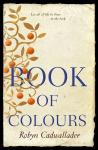
Robyn Cadwallader, Book of colours (#BookReview)

Robyn Cadwallader, The book of coloursWhat makes historical fiction worth reading for me is the exploration of universal ”truths”. Fortunately, Robyn Cadwallader’s second novel, Book of colours, does this, albeit I wish that some of the universals – gender inequity, class (meaning social and economic inequity), and fear of foreigners – were no longer universal! The book explores other more general universals, too, such as love, friendship, loyalty, courage, suspicion, fear. However, historical fiction needs something more of course. It needs to authentically evoke an historical time and place, preferably through engaging characters. Cadwallader does this too.

Book of colours is set in mediaeval England, specifically between 1320 and 1322, and concerns an illuminated book of hours. The narrative is structured into two main chronological threads – the story of the book’s creation and the people creating it, from late 1320 to 1322, and that of the noblewoman who commissioned it, Lady Mathilda Fitzjohn, after she has it in her hands, from May to September 1322. She lives in Hertfordshire, while the limners’ atelier is located in London, so we also see city and country life during this period. As the limner Gemma writes:

…let all of life be there in the book, from high to low, animal and monster, story and joke, devotion and dance … (from The art of illumination)

Now, I particularly like it when historical fiction writers provide some historical context to their story, preferably in an afterword, along with some references or sources. This Cadwallader does, with a four-page Author’s Note and two-plus pages of Further Reading. She explains the historical background, including that the period she chose encompasses the Great Famine and the Dispenser War, and she discusses where the facts are less well documented. The meaning of those bawdy or confronting marginal images in books of hours, for example, is little understood. Also, says Cadwallader, no women limners are listed in this period, but there is evidence that women did, in fact, undertake illumination. These notes support the novel’s political, socioeconomic and sociocultural context.

The story is told third person through three main perspectives: Mathilda’s and those of two of the atelier workers, journeyman-near-master Will Asshe and master-in-work-if-not-in-name Gemma Dancaster. The atelier is owned by Gemma and her husband John – well, actually, given the times, it is “owned” by her husband, but he inherited it from her father. Prefacing the atelier-based chapters are sections from the book The art of illumination which Gemma secretly writes for her apprentice son Nick.

“both beauty and chaos”

Towards the end of the novel, the widowed Mathilda – her rebel Marcher husband having been killed while fighting the Dispensers – realises that life is not “ordered” as she had thought but is, like the “delicate, bawdy and capering creatures” in her book, “both beauty and chaos.” It is this “beauty and chaos” that Cadwallader captures through her vivid characters. The atelier thread starts with the arrival in London of Will, a limner who is escaping something that happened in Cambridge where he had lived and done his training. As the story progresses we discover, of course, what that was, but all I’ll say here is that he’d been associating with a student named Simon who had filled his head with ideas about equality. These ideas make Will angry about “the rich and their ambitions” and resentful about “the marks of privilege” requested for the book of hours. He’s a bit fiery, our Will, and gets himself into several scrapes, all the while watched over by an animated gargoyle who represents, I’d say, Will’s conscience.

Meanwhile, Gemma, the would-be master limner, is frustrated about the inequalities she faces as a woman – particularly a woman having to cover for her husband who is, we soon discover, no longer able to draw and paint. Gemma, too, is aware of economic inequities. Southflete, the stationer and middleman who handles the commission, tells them that

the calendar pages must be beautiful scenes of life on the demesne, you understand … Chubby infants, well-fed peasants, colour, beauty …

Gemma is not impressed:

Beautiful. How, in a village farmer’s wife, would January be beautiful? Snow if the weather was kind, ice if it was not. And this past year, colder than ever. Frost that rarely lifted, and then only to snow or rain. London had clenched its teeth, frozen to the marrow, too cold to move. At least the cramped lanes and houses blocked some of the wind; what it was like in the country, she couldn’t bear to think.

She, like Will, makes her assumptions about their patron Mathilda’s life and values, but as is often the case, assumptions aren’t always completely right – and these too Cadwallader teases out as the book progresses.

There are other characters – including Gemma’s gentle husband, their quietly wise apprentice Benedict, and their son and beginning apprentice Nick. These, plus other residents of London’s book trade area, Paternoster Row, flesh out the story, adding depth to the narrative and to the history of this fledgling industry struggling to establish itself as a guild.

So, there’s beauty and chaos in life, but it is through their drawings that the limners convey their feelings and ideas. As the world changes around them – for reasons I can’t fully divulge – the limners draw and paint their reflections and reactions, their messages even, into the book. Both Gemma and Will remind Mathilda of who she is and of her responsibilities to herself and others, responsibilities that become more nuanced and more personal than their original simplistic view of the world at the start of the novel. The interplay between the artists’ ideas as they paint and Mathilda’s reflections as she considers their paintings is one of the joys of the book. It is as much through these, dare I say, “virtual communications” as anything, that our three main characters grow in understanding. It is through them, for example, that Gemma shares her feelings – feelings Mathilda doesn’t recognise as coming from any sermon she knows – about women’s need to stand strong in the face of men’s power.

Book of colours, in other words, is a delicious read, imbued with the life of a long-ago time but filled with people whose emotions, hopes and frustrations are very much our own. Latish in the novel, Mathilda realises that Will’s friend “Simon’s simple borders of right and wrong won’t hold. They leave no space to breathe.” This is the book’s message: to grow and change we need to expand beyond simple conceptions of right and wrong. We need to let each other breathe and be. Only then can true selves, true relationships and, hopefully, a true understanding of equity develop.

Note: Lisa (ANZLitLovers) loved this book, and Angharad Lodwick (one of last year’s Litbloggers) was also impressed. I also reported, back in April, on a Conversation with Robyn Cadwallader about this book.

AWW Badge 2018Robyn Cadwallader
Book of colours
Sydney: Fourth Estate, 2018
360pp.
ISBN: 9781460752210

(Review copy courtesy HarperCollins)

Monday musings on Australian literature: Writing NSW

Today’s Monday Musings is the fifth in my little series on Australia’s writers centres, and it’s New South Wales’ turn. Originally called the NSW Writers Centre, it was renamed this year as Writing NSW.

Writing NSW was founded (under its original name) in 1991, as a not-for-profit organisation providing services to writers. On its Our History page, it says that it was created when writer Angelo Loukakis and others from the literary community “lobbied the government to establish a facility for the development of writers.” Clearly they were successful – and the Centre was officially opened in Garry Owen House in Callan Park in 1991.

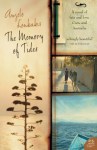
Angelo Loukakis, The memory of tides

I’m embarrassed to say that I don’t really know Angelo Loukakis, but Wikipedia does! Besides being a writer, and besides being the Centre’s founding Chair, he was also Executive Director of the Australian Society of Authors from 2010 to 2016. He’s been a teacher, editor, publisher and scriptwriter, and has written three novels, two collections of short stories, as well as several non-fiction works.

But now, let’s get to the centre itself. Like other writers centres, Writing NSW is largely a membership organisation, but also obtains funding from the government and donations. Its aim from the start was to support writers, particularly emerging writers. Emily Maguire (whose An isolated incident I’ve reviewed here) and fantasy/historical fiction writer extraordinaire, Kate Forsyth, credit it as playing a significant role in their early development.

Here are some of the things the centre does:

Courses

Courses – whether on-line or in-person, single workshops or over a period of time – seem to be the main services offered by writers centres, and Writing NSW is no different. Some of the courses coming up are:

Bianca Nogrady, The best Australian science writing 2015
  • The Year of the Novel, Phase 3 (with Emily Maguire, no less!): it starts tomorrow, and runs for 8 sessions. Members get a whopping 30% off the price, which more than covers the annual membership fee! The course is about making “your very good novel … brilliant.”
  • Finding the Detail: Research Tools for Writers (with Eleanor Limprecht whose novels Long Bay and The passengers I’ve reviewed): a 2 1/2 hour seminar about research (for fiction and non-fiction). The description says it will cover “how to organise your research, the ethics of research and how to put your research aside and just start writing.”
  • The Secrets of Science Writing (with Bianca Nogrady who has also appeared in my blog):a 6-hour course on such topics as finding good science stories, the basic principles of science writing, and interviewing and pitching to editors.

These are just three of many, many courses, workshops and seminars they offer on topics that include, in addition to the above, playwriting, poetry, comedy, writing for schools, marketing, speculative fiction … you name it, in other words …

Events

  • Festivals: Writing NSW runs various festivals, including, the new biennial Boundless Festival, first held in 2017 and focusing on” Indigenous and culturally diverse Australian writers and writing”, and, coming up, Quantum Words, a one-day festival on the meeting of science and writing. Its speakers include astronomer Fred Watson (who has appeared here a few times, with the Griffyn Ensemble) and cli-fi novelist James Bradley.
  • First Friday Club: a monthly, free, members-only event that runs on the first Friday of the month from March to October. The event involves a guest speaker – such as an author, editor, publisher, journalist – and, they say, “a delicious morning tea.” October’s speaker is Bronwyn Mehan from the innovative Spineless Wonders.
  • Talking Writing: ad hoc panel discussions (as far as I can tell) on various subjects relating to writing. One held in April this year, for example, was called Make it Funny.
  • Ad hoc events: such as an all-afternoon Open House event with publishers HarperCollins and Harlequin at which members will get an opportunity “to meet one-on-one with a publisher to get feedback on your submission.”

Prizes and Grants

  • Quantum Words Poetry Prize: established in 2018 this prize is for “science poems”, that is, they must “include or address some aspect of science.” Pretty broad.
  • Boundless Indigenous Writer’s Mentorship: supported by Writing NSW and Text Publishing, for “an unpublished Indigenous writer who has made substantial progress on a fiction or non-fiction writing project.” It pairs the “emerging Indigenous writer (from anywhere in Australia) with a senior Indigenous writer in the same genre for a structured year-long mentorship.”
  • Writing NSW Varuna Fellowships: awarded annually for writers with a work that is “ready for the next stage of development.” It involves a week-long residency at Varuna (Eleanor Dark’s old home which I’ve mentioned here before.) Two will be awarded this year, with one specifically for a writer under 30.

The above is just a selection of what Writing NSW offers. Like most writers centres they offer a wide range of services, including a library, newsletter, manuscript assessment, all sorts of mentorships, space for writers groups to meet. They aim to specifically support regional writers, Indigenous writers, and writers with a disability. A lovely service that I suspect not all writers centres have the resources to provide is their Space to Write. This enables writers who have trouble finding quiet places in which to write the opportunity to book space or a room at Gary Owen House (some are free, and some involve rent.)

Oh, and they have run workshops on blogging (such as Power Your Blog), since at least 2012, though I couldn’t find any for this year. It’s good to see this type of writing and publishing also being recognised by writers centres.

… and that’s about it for another busy, active Writers Centre.

Writers Centres covered to date: the ACT, the Northern Territory, Queensland, and Tasmania.

Vance Palmer, Battle (#Review)

Meanjin AnthologyVance Palmer’s short piece “Battle” is the first piece in this special Meanjin anthology. Meanjin is one of Australia’s longest lasting literary journals. It was founded by Clem Christesen in 1940. As publisher Melbourne University Press says, it has, since then, “documented both the changing concerns of Australians and the achievements of many of the nation’s writers, thinkers and poets.” This anthology contains, they say, “a broad sweep of essays, fiction and poetry published in Meanjin since the magazine began” which will give its readers “a sense of the debates waged in print over those seven decades and the growing confidence of the Australian written voice.”

I read Vance Palmer’s piece when I bought this anthology a few years ago, but planned then to review the anthology as a whole. Now, though, I think that some of the writers are worth featuring here on their own – just like those writers I choose to read from the Library of America offerings – so here is Vance Palmer!

I was first introduced to Palmer in my first year of high school when I read and enjoyed his best known novel, The passage. I have not, however, reviewed Palmer’s writing here (except in a Monday Musings), but he has appeared in this blog many times because of the significant contribution he (and wife Nettie) made to Australian literature in the first half of the twentieth century. They vigorously supported and defended the development of an Australian literature. They were also political – egalitarian, anti-Fascist. There’s a good introduction to him in the Australian Dictionary of Bibliography (ADB), which describes him as “a liberal socialist of the broad left.”

So, “Battle”. ADB’s biographer describes “Battle” as “a noble statement of war aims”. It is interesting to look at “Battle” now, from today’s perspective. Published in 1942, at the height of World War 2, its main point is to define what makes Australia and to argue that it is worth fighting for – all of which ties in with his interest in encouraging and promoting Australian literature.

However, despite his documented interest in and awareness of indigenous Australians, he falls into the trap of many of his time of thinking that Australia is a “young” country:

We have no monuments to speak of, no dreams in stone, no Guernicas, no sacred places. We could vanish and leave singularly few signs that, for some generations, there had lived a people who had made a homeland of this Australian Earth. A homeland? To how many people was it primarily that? How many penetrated the soil with their love and imagination? We have had no peasant population to cling passionately to their few acres, throw down tenacious roots, and weave a natural poetry into their lives by invoking the little gods of creek and mountain. The land has been something to exploit, to tear out a living from and then sell at a profit. Our settlements have always had a fugitive look, with their tin roofs and rubbish-heaps. Even our towns . . . the main street cluttered with shops, the million-dollar town hall, the droves of men and women intent on nothing but buying or selling, the suburban retreats of rich drapers! Very little to show the presence of a people with a common purpose or a rich sense of life.

“We have had no peasant population to cling passionately to their few acres, throw down tenacious roots…” No, we don’t but we have something more … we have indigenous people who have clung passionately to, and tended, this land for 60,000 plus years. (This is something that a young non-Indigenous Aussie school girl stood up for last week by refusing to stand for the Australian national anthem with its lines “for we are young and free.”)

It would have been good if Palmer had recognised this point too, but … that was then, I suppose.

Anyhow, he goes on to describe what makes Australia and Australians. There is, he says,

an Australia of the spirit, submerged and not very articulate, that is quite different from these bubbles of old-world imperialism. … And it has something to contribute to the world. Not emphatically in the arts as yet, but in arenas of action, and in ideas for the creation of that egalitarian democracy that will have to be the basis of all civilised societies in the future.

And here’s the other point I want to make – his faith in Australia as an example of “that egalitarian democracy that will have to be the basis of all civilised societies in the future.” That caught my eye, because it is something I believed of Australia, something that I thought, back in the 1970s and 1980s, we were actively working towards and achieving. Not so anymore, it seems.

Palmer concludes that he believes Australia will survive the war,

that we will come out of this struggle battered, stripped to the bone, but spiritually sounder than we went in, surer of our essential character, adults in a wider world than the one we lived in hitherto.

I wonder what he would think now? Perhaps he would remember that in the penultimate paragraph he admitted that we have “a share of the decadent that have proved a deadly weakness in other countries – whisperers, fainthearts, near-fascists, people who have grown rotten through easy living.” Some of these “have had power in the past and now feel it falling away from them.” However, “we will survive,” he believes, “according to our swiftness in pushing them into the background and liberating the people of will, purpose, and intensity.” Who are those people “of will, purpose, and intensity” now?

Vance Pamer
“Battle”
in Meanjin Anthology
Melbourne University Press, 2012
ISBN: 9780522861563 (eBook)

Delicious descriptions: Laurie Steed’s divorced mum

Laurie Steed, You belong hereI don’t do many Delicious Descriptions these days, but I did want to share another quote from Laurie Steed’s You belong here which I reviewed recently. The book concerns a marriage break-up and its impact on the family. This quote comes from the point-of-view of the daughter, Emily, who’s around 19 at the time, thinking about her mum:

Her mum hit-and-miss, since, well, the break-up. Better than before, but still not great. Emily thinking maybe she’d turn a corner. But she’s a mum, not a Transperth bus, and so she never made the left, the right, or the shift to second gear. Instead, she’d stalled, middle lane, hazards flashing, with her daughter and two sons in the back; the family coping, surviving as you do, when you’ve broken a window, but you don’t yet have the money to fix it.

I enjoyed so many of Steed’s metaphors throughout the book, not to mention the way he captures the vernacular of the time. Such enjoyable reading despite the subject matter (as I think I’ve said before!)

(And, isn’t it a great cover? All credit to the lovely little Margaret River Press)

Monday musings on Australian literature: The Copyright Agency’s Cultural Fund

Australia’s Copyright Agency has been referenced here several times in this blog, mostly regarding the work it does via its Cultural Fund, but I wonder how many of us (besides artists) know just how much it does to support Australian writing and writers?

The Copyright Agency is a non-profit organisation (company) which describes its mission as being:

to provide simple ways for people to reproduce, store and share words, images and other creative content, in return for fair payment to creators. We are committed to encouraging the development of lively and diverse markets for published works…

Its main services to authors are to:

  • collect and distribute copyright fees for educational and government use of works. It manages, on behalf of the government, the education and government copying sections of the Copyright Act which allows educational institutions and governments to use content without permission, provided they make fair payment.
  • license writer’s content to corporations and others (though writers can also license their works themselves.)

It does other things too, one of which is to fund “writers’ projects and skills development” through its Cultural Fund, which is my focus for this post.

Cultural Fund

The Cultural Fund is the Agency’s philanthropic arm, and aims to support “cultural projects and creators’ professional development.” Its priority includes “to ensure that artists are better supported and are paid appropriately for their creative endeavours.” It is funded by members agreeing to 1.5% of the licence fees collected on their behalf being retained for the Fund. In the financial year, 2016-2017, they disbursed well over $2m through the Cultural Fund to “114 projects, 23 professional development grants and 5 fellowships.”

Fellowships

The fund offers various annual fellowships, with this year’s including:

  • Author: one offered each year, worth $80K. Open to novelists, playwrights, poets, non-fiction writers, children’s and young adult writers, and journalists to develop and create a new work. (Non-Fiction writers, this year could also apply for the non-fiction writing fellowship.) I noted in a previous post that the inaugural author fellowship went to Canberra-based author Mark Henshaw (who wrote The snow kimono.)
  • Non-fiction writing: worth $80K, and with more specific requirements than the author fellowship above. It’s “to develop and create a new work of creative non-fiction writing which will engage with key issues and topics for a broad readership” which means it’s not for academic or scholarly writing. They list the acceptable genres, which include biography, memoir, autobiography, environment, and history.
  • Publisher: two were offered in 2018, each worth $15K.
  • Reading Australia Fellowship for Teachers of English and Literacy: worth $15K, and self-explanatory from the title I’d say.

CREATE Grants

This year’s CREATE grants were recently announced, five going to writers and one to a visual artist, from over 135 applications. The writers were Peggy Frew ($20K), Jennifer Mills ($20K), Josephine Rowe ($10K), Jane Rawson ($15K), Lenny Bartulin ($20K).

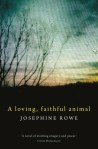
Josephine Rowe, A loving faithful animalThe works of fiction these authors will be creating cover a variety of topics, “from xenophobia, self-interest and individualism to post-war migrant life in Tasmania during the 1950s, to cross-cultural friendships and ghost stories.”

Two of these authors have appeared here before, Jane Rawson with A wrong turn at the Office of Unmade Lists (my review), and Josephine Rowe with A loving, faithful animal (my review).

IGNITE Grants

These are smaller grants, of up to $5K each. They are “to support individuals working in the writing, publishing and visual arts sectors to develop skills and progress their careers.” They include things like “mentorships, internships, residencies, leadership opportunities, and strategic promotional opportunities” but not academic or tertiary study.

Grants for Organisations

These seem to be more ad hoc grants – at least in the dollar-amounts offered, because they are not always specified. The grants themselves are not ad hoc, however, in the sorts of things that qualify, as the Agency defines on the webpage the sorts of things it will fund. These grants can be for single projects or for up to 3 years. They spread far and wide, from the Djilpin Arts Aboriginal Corporation (in the Katherine region of NT) to the Melbourne Writers Festival, from theatrical companies to libraries, from community groups to education departments, from supporting fiction to history. No wonder they have popped up regularly in my Monday Musings posts!

Some of the grants awarded under this banner, as far as I can tell from their 2017 Annual Report include:

  • Festivals and the like: These range from small symposiums and workshops to the big festivals, and include Australian Authors Week 2017 (by the Australia’s Embassy in Beijing), a craft and design writing symposium (by Craft ACT, in my town), the AALITRA Symposium (Australian Association for Literary Translation), the StoryArts Festival (by the Ipswich District Teacher Librarian network), the Canberra Writers Festival, and the Melbourne Writers Festival. Sometimes the grant is for a specified aspect of the festival, such as the “Getting it Write” workshop in Geelong Regional Library’s Word for Word Festival.
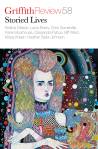
  • Griffith Review 58 Novella Project (2017)

    Griffith Review 58 Novella Project (2017)

    Journals: Several journals are listed as receiving grants – including The Big Issue, Griffith ReviewInside Story, Island magazine (to increase payments to writers), Meanjin, Westerly. Some of these are for specific editions, such as the Big Issue’s fiction edition and Griffith Review’s novella project.

  • Prizes: Some of these grants seem to support the administration of the prize rather than the prize purse itself, such as a three-year grant to the Stella Prize for “promotion of the winners.” Also listed are the David Unaipon Award, the Miles Franklin Award (also three years), and the National Indigenous Story Award. In the past, they’ve supported the CAL Scribe Fiction Prize (which seemed to only run from 2009 to 2012), and the Finch Memoir Prize (which is not being offered in 2019 because of lack of funding)
  • Writing projects: Like many other of their grants, these cover a variety of forms, such as Belvoir Theatre’s “Investing in Australian Stories” commissions.
  • Other: Such as supporting a stipend for the Children’s Literature Laureate, or the Early Career Researcher Scheme (organised by the Australian History Association). Smaller fellowships, in addition to the large ones listed above are also supported through organisations such as Queensland University Library’s Creative Writing Fellowship, the Sydney Review of Books Emerging Critics Fellowships, and the Eleanor Dark Foundation’s Fellowships for Indigenous Writers.

Reading Australia

Reading Australia is a service established by the Agency and partly (mostly?) funded through the Cultural Fund. Its focus is the education sector, aiming “to create in depth teaching resources on Australian literature, to encourage homegrown stories to be taught in schools.” Among other activities, they produce book lists, and resources for the primary, secondary and tertiary education sectors.

I first wrote about Reading Australia five years ago, and again last year when I posted on the Reading Australia-Magabala Books partnership. Education is so fundamental to the health of our literature (and our culture) that this seems a good point on which to conclude this post.

If you’re Australian, are you aware of the Copyright Agency and/or its Cultural Fund? I’d love to know how well-known it is.

Monday musings on Australian literature: National Child Protection Week 2018

National Child Protection Week 2018If you are an Australian, you will be aware of our recent Royal Commission into Institutional Responses to Child Sexual Abuse. That Commission only looked into one aspect of child sexual abuse in Australia. Arguably the bigger issue lies in the sexual abuse of children outside institutions – abuse of children by family members, by so-called family “friends” and others known to the child, and by, far less common, strangers. The bigger issue also encompasses child abuse that’s not sexual – physical abuse, emotional abuse, neglect, abandonment. This week, September 2 to 8, is National Child Protection Week. Co-ordinated by NAPCAN, it aims to encourage all Australians “to play their part to promote the safety and wellbeing of children and young people” in all ways.

What has this to do with Monday Musings? Well, as I was listening to a discussion about the week on ABC Radio National this morning, I was reminded of all the books I’ve read since blogging, which refer in some way to child abuse. Some are memoirs, and others are fiction. Some may function partly as therapy for the writer. However, because I believe that literature has an educational, awareness-raising, empathy-developing function, I thought I’d share a selected few books here. I appreciate that reading this material can be unpleasant – and I know that it can be triggering for some. If you are among these people, please stop reading now. Otherwise, I offer these wide-ranging books as my contribution to the week …

Links on the titles are to my reviews.

Memoirs and biographies

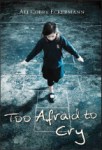
Ali Cobby Eckermann, Too afraid to cryAli Cobby Eckermann, Too afraid to cry: indigenous poet, memoirist and novelist, Eckermann beautifully (if you can use the work “beautiful” in this situation) captures the impact on her of being sexually abused from a young age by an uncle. Not knowing having the words to describe what was happening to her, she can only describe her feelings: it felt like an “icy wind”. This becomes a metaphor for the abuse, for her memory of it, and for its impact on her psyche until she can no longer cry – “the ice block had turned to stone, and now there was no moisture left inside me”.

Jelena Dokic, Unbreakable: I haven’t read this memoir but it chronicles the emotional and physical abuse she, a gifted young tennis athlete, experience at the hands of her father. The terrible thing is that much of this happened under public gaze, but nothing was done. (I attended a conversation with her about this book.)

Sarah Krasnostein, The trauma cleaner: Sandra Pankhurst, the transgender woman who is the subject of this biography, was physically and emotionally abused and neglected by her adoptive parents, after naturally born children appeared. It’s an unbelievable story of inhuman behaviour by people trusted to care for the young boy she was at the time.

Betty McLellan, Ann Hannah, my (un)remarkable grandmother: A psychological biography: A biography about McLellan’s grandmother who was born in 1881, and whose second husband was violent to and sexual abused his step-daughter, as well as Ann Hannah, herself, and one of their daughters. McLellan describes the lack of recourse women had during the time Ann Hannah lived, and concludes that her grandmother’s only choice, really, was to “accept her lot”. She reports that Ann Hannah said it was “the ‘appiest day of my life when ‘e died”!

Marie Munkara, Of ashes and rivers that run to the sea: Like Eckermann and Pankhurst, Munkara (who also happens to be a member of the Stolen Generations), grew up with adoptive parents, neither of whom gave her the love due to a child they offered to care for. Her mother was hard, unaffectionate, but her father was a pedophile who sexually molested her from a young age.

Fiction

Anne Buist, This I would kill for: a crime novel in which Buist’s ongoing character, the forensic psychiatrist Natalie King, investigates whether eight-year-old Chelsea is being abused, and if so, by whom. Chelsea is, apparently, being abused by someone she knows. As Buist, a perinatal psychiatrist who is expert in this area, says, those who abuse children are “very, very rarely a stranger.” You can read more about this book at the ABC website.

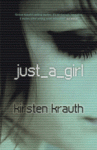
Kirst Krauth, Just a girlKirsten Krauth, just_a_girl: a modern novel about a 15-year-old girl who thinks she’s more sophisticated than she is, with a mother who is struggling with her own problems. The result is a sexualised young girl at risk.

Sofie Laguna, The choke: first-person novel about a young girl who lives in a physically and emotionally impoverished situation – albeit she is loved – and who is violently assaulted in an act of revenge. You can see it coming – and you know exactly why she’s at the risk she is, and who might be the one to help her out of it.

Mirandi Riwoe, The fish girl: a retelling of Somerset Maugham’s short story “The four Dutchmen”, which explores young women’s lack of agency, at the hands of colonial masters but also within their own traditional communities.

Lest you are unsure about the value of this post, I should tell you that there are several similar lists out there, including at the New York Public Library (2014); Wikipedia; GoodReads; and ParentBooks (Canadian organisation offering resources to use with children).

Canberra Writers Festival 2018, Day 2, Pt 2: Words (Last ones) and Music

My last Canberra Writers Festival event was, in a way, a little left field, because it primarily comprised a musical performance – but one with a strong literary element …

Turning Last Words into Music

I chose this one, for a couple of reasons, but mainly because it involved music and was at a time that would work for Mr Gums to join me. It featured a composition by Australian composer, writer and radio presenter, Andrew Ford (who appeared here long ago in my post on the Voss Journey). The session was MC’d by Jane O’Dwyer, Deputy Chair of the Canberra Writers Festival Board.

So, what was it about? Well, it was a performance of Ford’s 30-minute song cycle titled, yes, Last words. It comprises “the final poems, letters and diary entries of some of history’s most iconic figures” set to music. However, before we heard the music, Ford talked about its genesis and some of the challenges he faced in creating it.

He started by describing music as the most abstract of the arts, and song as the most ubiquitous type of music. But, he said, listeners will only pay attention to the words if the music attracts them first. He then explained that his wife suggested the project – that he set people’s last words to music, for soprano Jane Sheldon, and that he include Captain Scott’s last words.

Then the challenges started. For example, he said, “last words” tend to be very short which is hard for song, but then a friend suggested “last poems”, which he took up. Another challenge was the order, and structure. Given the topic, the mood/tone of course tended to the slow and mournful. Something fast, some relief, was needed to prevent its becoming tedious, but what? He lit upon the idea of including a fiction character, and chose Fish Lamb’s death from Tim Winton’s Cloudstreet. Then there was Virginia Woolf’s suicide note. What sort of music would work with that? In the end, he decided it didn’t need music (though in fact some minimal cello and piano did sound occasionally during that song.)

Goethe's bed, Goethe House, Weimar

The bed Goethe died in, Goethe House, Weimar

Finally, there was the challenge of his opening “last words” from Goethe: “Mehr licht, mehr licht” (More light, more light.) He was reading them as portentous, but then his wife suggested that perhaps they could be read simply – as Goethe simply wanting more light!

Responding to a question from moderator O’Dwyer, he talked a little about music and emotion. Debussy apparently said that music is “pure emotion” but Ford said that he didn’t consciously try to “embed” emotion in the music, because that would be manipulative. In composing this piece he tried to find the notes that would approximate how he would say the words. Simple, eh?

Anyhow, then the concert started, and I found it engrossing and moving. It’s not easy music, but neither is it hard – and it was performed beautifully, even though the performers had their first and last rehearsal only two hours before they took to the stage. The lyrics were provided to the audience, and are available on line at Andrew Ford’s website.

Some of the things I liked included the structure (or order). I liked, for example, that it starts with some of those brief last words …

Mehr licht, mehr licht … (Johann Wolfgang von Goethe)

Now comes the mystery. (Henry Ward Beecher)

Auftakt! Auftakt! (Alban Berg)

… and ends with some more brief last words:

Mehr licht, mehr licht …

Goodnight, my darlings. I’ll see you tomorrow. (Noël Coward)

Last Words trio and sopranoI think these beginning and endings gave the cycle a bit of a narrative arc, albeit the actual plot is death, death and death – if you know what I mean.

I also liked that Goethe’s words are used as a refrain, appearing intermittently to provide a transition between some of the songs – but sung with different dynamics or emphasis in different places.

I was particularly moved by Captain Scott’s last words, and thought that Ford, and singer Sheldon, handled its prose form very well. (As they did Fish Lamb’s faster piece, And Woolf’s suicide note.)

Appropriately, Emily Bronte’s last words were set to heavier more dramatic music, and ended in a screeching “Me”, which surely alluded to Cathy (from Wuthering Heights.)

And, I loved that texts included a favourite (last or otherwise) poem of mine, Dorothy Porter’s “View from 417”, with its final lines:

Something in me
despite everything
can’t believe my luck

The music here was more lightly lyrical. In other words, the mood and tone of the music did shift during the piece, despite the repeating death motif.

Performers: Jane Sheldon (Soprano), Helen Ayres (violin, replacing the advertised Tor Frømyhr), David Pereira (cello) and Edward Neeman (piano).

Q & A

There was some time for Q&A at the end, during which people asked:

  • does some writing “fit” music more easily than others (yes)
  • can music create new emotions (are there new emotions to be found?)
  • why does the voice occasionally get lost in the music, where mostly the music was subtle (it got “lost” in Fish Lamb’s scene because he’s drowning, so here the voice becomes another instrument.)

This was, for me, a delightful last session of the Festival – despite its theme!

Canberra Writers Festival 2018, Day 2, Pt 1: Art, Books and Politics

For my last day of the Canberra Writers Festival I chose two quite different sessions, as you will see! This post is on the first one …

(Note: these two posts will be in lieu of this week’s Monday Musings.)

The Art of Books

Chong, Bowers, Katsoukas
Chong, Bowers, Katauskas

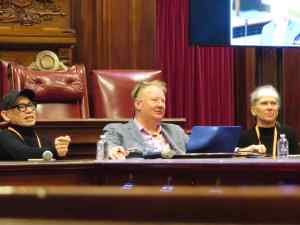
I chose this session primarily because one of the participants was the multi-award-winning book designer, WH Chong (from Text Publishing) and, woo hoo, he was there, even though, once again, one of the advertised panelists, cartoonist-illustrator Jules Faber, was not. The other panelist was political cartoonist Fiona Katauskas, and the session was moderated by The Guardian Australia photographer and Talking Pictures presenter, Mike Bowers. It was, I must say, a hoot of a session – and it was held in the old Senate Chamber in Old Parliament House. I was keen to attend an event in one of the parliamentary chambers there and so that was an added plus.

Bowers was an lively moderator, sharing the questions, back and forth, between the two panelists, which was a bit of a challenge given they work in somewhat different fields. Still, Chong had started in journalism – working in The Age’s newsroom – and maintains an interest in political cartoonists, and Katauskas has illustrated books, so the disjunction wasn’t too great. For this post, I’m going to organise my discussion by person, though the actual session see-sawed between the two.

WH Chong

Jonathan Galassi, Muse

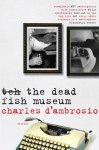
Bowers, who had also known Chong in earlier days, focused most of his questions, and examples, on Chong’s covers that feature typewriters and typewriter-style fonts. This gave Chong a chance to share his love of typewriters, and the fact that for most of those covers he used typewriters for the font, not digital fonts. One of the covers discussed was for Jonathan Galassi’s Muse, a novel about a poet. The letters of the word Muse are created with the letters for the word Poet (ie the M is made using “p”s, the U “o”s, etc). A concrete poem, in a way. A clever, striking design.

Janet Frame, In the memorial room

Bowers asked Chong whether he thought the online world is causing the death of good design, but Chong felt not, arguing that the ratio of good to bad design, remains the same. There’s some great design online he said. Bowers also asked him whether the rules of design changed for online books versus print. Chong wanted to know what those “rules” were! But then said that they were basically the same, regardless of form: you make author’s name and the title as big as possible, and use as much colour as possible!

Another question concerned fonts, and whether Chong had favourite and disliked fonts. Chong admitted to having changing favourite fonts, but quoted someone (whose name I didn’t catch) as saying that there is “no such thing as a bad type, just type badly used”. Chong added, with a straight face, that typeface (or font) is a serious matter and he ”won’t be typecast.” Haha.

D'Ambrosio, The dead fish museum

Some process issues were discussed, such as who approves covers. Chong said, basically everyone, including the author’s hairdresser, dog, etc etc! Haha, again. But, he did say that Text works collegially, which was lovely to hear. Bowers then asked how important is the cover. Chong seemed to think that it’s not that important, but that marketing and publishers believe “it is important in our noisy world” so  “who is he to complain?”

Bowers, you can see, did well at asking all those questions we’d like to ask. Another one was whether he looks back – perhaps in horror – at old work. Again Chong quoted someone else, this time I did get the name, Bob Dylan, who said “Never look back, you might catch up.”

Finally, before we leave Chong, Bowers asked him whether he reads the book first. He prevaricated a bit here saying “y-e-e-s” which meant, I gathered, “mostly but not always.” He’s a slow reader he says, and he only sees the draft.

This was a frustrating session because almost every book cover shown introduced me to a book I want to read.

Fiona Katauskas

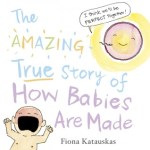
Fiona Katauskas, The amazing true story of how babies are made

Now, Katauskas. Bowers started by asked her about her book The amazing true story of how babies are made. She wrote it, she said, because when needing to answer her 5-year-old son’s questions she discovered the only book around was the now old Where do I come from? The book has been very successful, shortlisted for both the CBC and ABIA awards, and is now being animated. It was a different project she said from her more usual work of political cartooning. For one thing, it was not cynical! Bowers then asked her to share the shock! horror! furore that developed in the UK and USA after someone posted some images from the book on Facebook. Katauskas has written about the story in July’s The Monthly article. The ridiculous thing is that the book hadn’t even been published in those countries. It was a good lesson in clickbait, she said, but the result is that a US book deal now looks likely!

John Birmingham, Popeland

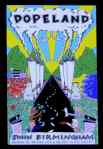
Bowers then asked Katauskas about her cover for John Birmingham’s Popeland. She loves doing book illustrations, even though it’s one of the worst-paid jobs, but unfortunately, she said, this sort of work is drying up these days. Anyhow, her illustrations – cover and inside – were inspired by books like Captain Goodvibes, boys’ own adventure books and The Beano. She described researching the fun of 1930/40s Beano books in the State Library. These commissions tend not to come with briefs. She receives the manuscript, and a statement that, say, there’s a budget for 10 illustrations. She talked about the process of ensuring there’s a “visual cadence” underpinning the illustrations through a book.

The conversation then turned to political cartooning which forms the bulk of her work. You really had to be there and I’m afraid I’m going to say that, to some degree, what happened in the room – such as stories about (very) contemporary (if you know what I mean) Australian political figures – will stay in the room.

I will however share some of the discussion about modern political satire. Katauskas admitted that the “best of times for satire is worst of time for everyone else.” Ouch! Chong asked whether we were beyond parody and satire, to which Katauskas replied (not perhaps answering Chong’s question) that “it’s hard to take the piss when they’re giving it away.” (You can guess who some of “they” were!) Bowers shared that satirist comedian Bryan Dawe is so concerned about politicians moving into the satirists’ domain that he’s considering bringing a class action against them. You can see what fun we had.

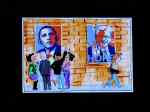
Fiona Katauskas, Obama and Rudd
Fiona Katauskas cartoon

Katauskas commented on the importance of publisher Scribe’s annual Best Australian political cartoons publications because they recognise that political cartoons are historical documents. She also talked about her job of researching cartoons for the annual exhibition of political cartoons, Behind the lines, and how she sees some recurring themes over the last fifteen years, the two major ones being asylum seekers and climate change.

Chong then asked whether we are beyond (or past) hope – but that question just hung.

Q & A

There were several questions, but I’ll just share the one about what media or technology Chong and Katauskas use. Both, interestingly, prefer to work in an analog way. Katauskas said she’s “old school”, and loves working with her pen dipped in ink. Chong said he was “very analog.”

Moderator, and photographer, Mike Bowers talked about the joy of working with good journalists, and named some of those he loves working with –  Paul Daley (with whom he has produced the book Armageddon), Katherine Murphy, Gabrielle Chan, and Lenore Taylor. With the breakup of the media and more people working alone, these important relationships are being lost.

He ended with the plea to us to “pay for your journalism.” I do, I wanted to say.

Canberra Writers Festival 2018, Day 1, Pt 4: Indigenous Australians (2)

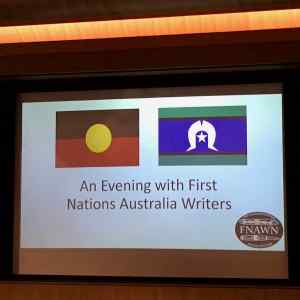
FNAWN screenMy first day of the Canberra Writers Festival ended with a bang – two hours with several of Australia’s top indigenous writers, organised by FNAWN (First Nations Australia Writers Network). It was a not-to-be-missed event, and was divided into two parts:

  • “Because of her I can”: poetry readings with Ellen van Neerven, Yvette Holt, Jeanine Leane and Charmaine Papertalk Green
  • Sovereign People – Sovereign Stories: a panel discussion with Kim Scott, Melissa Lucashenko, Alexis Wright, and moderated by Cathy Craigie

I liked this structure: the poets provided a emotive introduction to panel’s intellectually-focused discussion (not that the poems weren’t underpinned by intellect, mind you.)

“Because of her I can”

I’m just going to list the poets and their poems, as well as I can, as I did for the Canberra poets session earlier in the day. You may like to research them, though I’ve provided some links …

Jeanine Leane

Leane, whose unforgettable novel Purple threads I’ve reviewed here, started off – after acknowledging “the land never ceded” – with four poems:

  • Lady Mungo speaks“: first person poem about the egregious removal in a suitcase of Lady Mungo’s bones: “They spread me out like a jigsaw –/each piece an important part of their/puzzle of landscape and history.” Their puzzle!
  • “Evening of the day”
  • “River memory”: clever poem inspired by Gundagai’s Prince Alfred Bridge representing the idea of Australia’s “longest bridge, shortest history”, and subverting that to an indigenous perspective of “short bridge and long history”
  • “Canberra 100 years on”

Yvette Holt

Holt, a David Unaipon Award winning poet and academic, also read four poems:

  • “Progenitor”, an unpublished poem for her mother
  • “Through my eyes” (from Anonymous premonition), suits this year’s NAIDOC theme
  • ‘My mother’s tongue”, an unpublished poem about her mother who has dementia, exploring the issue of passing language between generations. I loved the line, “mother begins to scribble in her tongue in a language I do not understand”
  • “Motherhood”, a poem dedicated to her daughter Cheyenne Holt, when she was 7

Ellen Van Neerven

Van Neerven is a younger writer who has appeared several times in my blog. She dedicated her poems to black women in her life whom “she loves”:

  • “Orange crush”, for her mother: a found poem using lines from an inflight mag. (That got a laugh.)
  • “Bold and beautiful”, for her nanna: a humorous poem playing on her nanna’s love of the soap opera
  • “Home”, for her girlfriend Tia: a gorgeous love poem
  • “Queens”, for “the black women here tonight”

Charmaine Papertalk Green

New-writer-for-me Green hails from Western Australia. She read published and unpublished poems to honour women in her family:

  • “To the women of the land understand”: encouraging women to “remember your ancestors, remember your elders”
  • “My mother belonged to me”: included lines in language.
  • “Mothers letters”: I love writing letters, so loved this poem about her mother’s letters and the idea of “papertalking” but also that it’s “not just letters on paper”
  • “Grandmothers”: about mining ruining country
  • “Honey lips to bottlebrush”: about intergenerational cultural teaching.

You can hear her on ABC’s The Hub.

Jeanine Leane then returned to the podium, with the other poets, to pay tribute to Kerry Reed-Gilbert for her work with FNAWN, the Us Mob Writing Group, and in organising the Workshop coinciding with this Festival. She then read Oodgeroo Noonuccal’s poem “Song of hope.”

Sovereign People – Sovereign Stories

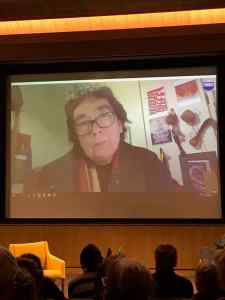
How lucky we were to have the above highly-respected poets, followed by, as moderator Cathy Craigie said, “three of Australia’s most dynamic writers”, Melissa Lucashenko, Kim Scott, and Alexis Wright (on the screen). The auditorium, which seats 300, must have been around three-quarters full, comprising indigenous and non-indigenous people from a range of ages. I hope they were pleased with the turnout. It certainly felt good to be part of it, which brings me to an important issue that came up in the Q&A and was also on my lips. It concerns what “white allies” can do. We can, of course, attend and support events like this, we can listen and learn from these events, and we can read the authors. It’s a challenge, though, I find to do this with the right tone – to not sound condescending, for example, when we try to “help” or empathise; to not assume we know or understand things we really don’t; to know how to communicate what we do know. It’s a fraught (though I recognise privileged) space to be in … but the important thing is to keep trying, isn’t it?

Anyhow, Cathy Craigie introduced the session, explaining that its focus was FNAWN’s theme for the week, intellectual sovereignty. She reminded us of the long history of Aboriginal and Torres Strait Islander writing in Australia – dating back to Bennelong’s letter to the Governor, and Maria Lock in the 1820s – and talked about the négritude movement in 1930s France, which promoted pride in racial identity.

The discussion then to-and-fro’d, with Craigie injecting questions regularly. I loved, again, the calm respect with which ideas were shared. There seemed to be a strong bond of “knowing” between the writers.

Melissa Lucashenko started by sharing some motivational quotes: “we are the authors of our lives” and James Baldwin’s statement that “freedom is not given, you take it.” She said Baldwin’s statement expressed an existential position – don’t wait, take power, and use it wisely.

Alexis Wright

Alexis Wright

Alexis Wright spoke about Tracker (the subject of her Stella-prize-winning book Tracker) and his focus on sovereignty. He was a visionary, she said, who wanted a stable Aboriginal economy, to ensure a secure culture, a secure future. She, like Lucashenko, emphasised the “sovereignty of the mind.”

She then talked about writing Tracker, which she calls a “collective biography”. She couldn’t do a conventional biography, she said, because he was a community man, because “his archive, his filing cabinet was in the minds of other people”.

There was much discussion about Tracker, who was clearly powerful, and significant in the indigenous community, albeit not everyone always agreed with him. Wright said he was a complicated person, with a sharp mind, which he was happy to express. He said, for example, that Native Title was “not big black stallion but a donkey”.

“Stories, songs, language are sovereign” (Scott)

Scott then talked a little about his latest novel Taboo. He said he tries hard not to think about politics and Aboriginal discourse when he writes his fiction, but he is interested in reclaiming older Noongar narratives and bringing in deeper resonance of place. “Stories, songs, language are sovereign” he said, and communities need to keep them strong so they’ll survive. There has been a long attempt to destroy stories and songs but we are moving from “denigration to celebration”.

Lucashenko raised the issue, currently being nutted out, regarding cultural restrictions on writing about other people’s country. I pricked up my ears of course at this, because it’s related to the cultural appropriation issue concerning white people writing black stories. Lucashenko said when she writes her own country she’s writing with rich knowledge. Writing about anywhere else would be superficial.

Wright was more circumspect about this restriction/limitation. Carpentaria, which is based in her country, was the book she wanted to write, but she is still learning about what she wants to write. Her 26 January story could, she said, be set anywhere.

Scott said he wrote Taboo in the “language of the default country”. He feels accountable to the past, to the fragile massacre area he comes from. He wants to build it up, strengthen its heritage. (He spoke about this in last year’s Ray Mathew lecture.) Perhaps we should all deepen our regions he said.

It was interesting here, because Scott clearly feels the need to strengthen Noongar culture, particularly his own area of it, while Lucashenko believes the culture in her country in northern NSW is strong. She lives in a progressive region, and they have “good white allies”. (See “white allies” discussion in the Q&A.)

Wright said that her country, her people, are strong, making it hard to encourage people into militant fighting for rights.

“Pay attention, tell the truth, write towards power” (Lucashenko)

At this point, Lucashenko teased out more about her notion of sovereignty – which she also expressed in the GR 60 session I attended: it doesn’t have to be politics but “can grow inside our heads.” She then said the job of the writer in these times is to pay attention, tell the truth, write towards power.

Scott suggested that sovereignty of mind involved (included) being accountable to ancestors and descendants. He talked about Australian Renaissance being “not digging up shards of pottery but texts buried in the landscape.”

The writers discussed language, words, and meanings – the importance of unpacking language – around this point.  Lucashenko said that the Bundjalung word for river is also the word for story, making the river, in her novel Too much lip a powerful metaphor for stories. Wright said that river means many things in her country too.

Craigie asked whether there was a change in how people are seeing intellectual and cultural sovereignty. Lucashenko seemed positive about young people’s sense of sovereignty within themselves and in their relationship to country, but said the young need to be nurtured with vigilance. She believes the thing is to avoid being reactive, because reaction puts you in a powerless position. She also said it was important not to become distracted by people who “don’t understand us.” Focus, instead, she said, on learning your own civilisation.

Survival

In a way, the whole session was about survival, but around here it came into sharper focus. Wright agreed that young people understand sovereignty and can teach older people about being gutsy. She emphasised the importance of nourishing story, of making story and of keeping it straight. Indigenous people are going to need strong storytellers. We’ve been an oral culture, she said, and need to learn from how the ancestors survived.

Scott agreed that indigenous people need to look after themselves, to “learn the game” (at which point Craigie quoted an African writer on learning to assimilate without assimilating.)

Lucashenko argued that indigenous culture is a knowledge-seeking culture, which is how they have survived. Indigenous people have done what they needed, learnt what they needed – such as learning English – to survive. (This reminded me of my recent Arnhem Land trip, during which we learnt about interactions between indigenous Australians and the Macassans for a few centuries. Indigenous people learnt skills, such as making dugout canoes, and incorporated Macassan words into their languages.)

Lucashenko concluded that indigenous people need to cultivate confidence.

Q & A

One questioner asked an excellent question regarding being good white allies: How best do we consume indigenous stories while preserving their integrity:

  • This is the nub, said Scott. There’s no easy answer, but: be conscious, and have a desire to listen. There is a real issue for Scott in getting the balance right to ensure indigenous people aren’t disempowered by non-indigenous people becoming more knowledgeable about culture than indigenous owners.
  • Lucashenko said there’s a simple test: Who benefits? If the answer is not the indigenous person, then go away and think again.

There were more questions, but I’ll leave it here – with the reminder to myself to always ask:

Who benefits?