Phillip Stamatellis, Growing up café: a short memoir (Review)

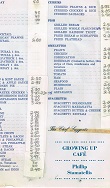
StamatellisGrowingFinlayLloydPhillip Stamatellis’ Growing up café is the third book I’ve read in publisher Finlay Lloyd’s fl smalls collection. Unlike the previous two, by established creators Paul McDermott and Carmel Bird, it is a debut work by an unknown writer. According to the author bio provided at the beginning of the book, Stamatellis is studying writing at the University of Canberra. What an achievement to have this work published, while still studying.

Growing up cafe is an enjoyable read. It tells the story of his growing up in his family’s cafe, the Radnor, in Goulburn, which is just 100km from Canberra. I used to visit cafes there regularly on trips to Sydney, that is, until it was bypassed by the highway. Now, if we go off the highway for a cuppa – and we do – it is not usually to the centre of Goulburn, but that’s another story. Back to the book …

Stamatellis has structured his short memoir cleverly. It is not told chronologically, and nor is it told in one voice. The story of his boyhood is told third person (“the boy”) via anecdotes that shift backwards and forwards across the years between 1965 and 1982. Reflections from adulthood are told first person, from the present, that is from 2014 and 2015. Whilst on the face of it the anecdotes from the past look rather higgledy-piggledy, careful reading shows that there is always a connection. There is method in the madness, in other words – and anyhow, as his friend says to him when he worries about his book making sense, “it doesn’t have to make sense, it’s not like life does.” Fair enough.

Things I enjoyed about the book include the nostalgia factor (the memories of Greek and Italian cafes or milk bars that I grew up with, though not “in” like Stamatellis) and the social history (the documenting of such cafes and the lives that surrounded them). Stamatellis captures all this nicely, from a young insider’s perspective. Phillip is, as far as this memoir tells us, the youngest of three boys born to Greek parents. The boys all grew up “in” the cafe, and they all worked in it from the moment they could. “I’ve lost count of the number of tables I’ve cleaned”, he writes, “I could do a three-plate carry by the time I was eight.”

The book opens at “Lunchtime, Summer, 1977”. The opening sentence – “The midday sun was stark in the street, and the small chirruping of cicadas almost drowned the rumbling of a passing Holden GT” – captures Australian country towns in summer perfectly, noisy cicadas and noisy Holden cars. It also reminded me of a song written in 1975 about another regional Australian city, Newcastle. The song, by Bob Hudson, includes the lines:

All the young men of Newcastle
drive down Hunter Street
in their hot FJ Holdens
with chrome plated grease nipples
and double reverse
overhead twin cam door handles,
sitting eight abreast in the front seat,
and they lean out of the window
and say real cool things to the sheilas
on the footpath, like ‘Aah g’day’.

Stamatellis, in his opening paragraph, describes teenagers in the cafe: “Cigarettes hung from their lips, the girls with their arms around their boyfriends’ waists.” It’s all so 1970s Australian – as is, unfortunately, the racism. “Thanks wog“, says a customer. A little further on is an anecdote in which “the boy’s” mother confronts racist graffiti on the cafe’s toilets, and then treats an indigenous person generously. All she says is to her son is:

‘Life is hard for some people but the sun shines for everyone, not just the wealthy’.

It’s not all serious though. There are funny, family anecdotes here too – brothers getting up to mischief, for example. There are stories about local characters, such as fun parlour owner Uncle Con, jeweller Ange Zantis, and the priest Father Sinesios, not to mention the challenge of serving the annual influx of an often unruly snow crowd. (If you are from this region you’ll know all about the trek to the snow through Goulburn, Canberra and Queanbeyan each winter). And there are the reflections from the present. These modern chapters round it out nicely. Through them we learn a little about where “the boy” is now, but overall I most enjoyed the chapters focusing on the past. They provide insight into a life now gone, and yet the lessons – such as tolerance, hard work, family cooperation – are timeless.

In the last chapter – set in 2015 – Stamatellis reflects on nostalgia:

I suppose at this very moment I’m feeling nostalgic and it seems that nostalgia makes a point of highlighting the good stuff and even finds positives among sadness – but my nostalgia is burdened by an unseen weight, a sense of entrapment …

Stamatellis doesn’t expand upon this, but I wonder if this little “small” is the beginning of something larger. It’s certainly a time and place that could do with some further scrutiny because we haven’t yet, I think, properly documented the experiences (and contributions) of that wave of southern European immigration.

(Note: I did find several typos, which is rare in my experience from Finlay Lloyd.)

Phillip Stamatellis
Growing up café
(fl smalls 8)
Braidwood: Finlay Lloyd, 2015
63pp.
ISBN: 9780987592972

(Review copy courtesy Finlay Lloyd)
Delicious descriptions: Emma Ayres on music

If the bicycle trip gives Emma Ayres’ travel memoir Cadence its chronological spine, it is music which provides its skeleton.

However, before I discuss music, I need to respond to those commenters on my review who noted that “cadence” is also a cycling term. As I’d heard the book rather than read it, I couldn’t quite recollect her mentioning this but felt she must have. I have now checked the book itself and indeed she did. For example, near the end of the book is a paragraph which starts:

Cadence on a bicycle is a vitally important thing. Turn your pedals too slowly, with too hard a gear, and you wear out your muscles and your chain. The trick is to have a light, quick cadence, an allegro cadence, not andante, one where your lungs do the heavy work and your muscles hardly have to strain at all …

But, see how even here some musical imagery slips in! Anyhow, she talks about cadence on the bicycle at other times too, such as the “perfect cadence” when riding downhill one day in Pakistan.

It’s all about the keys

The book’s chapters are named for groups of keys starting and ending with C major/minor, the simplest keys. She writes at the beginning of the last chapter:

Here we are, back at the beginning. The flats have gone and the sharps are yet to come. It is a moment of stillness, before the journey begins again.

This is the aspect of the book that was least familiar to me. What playing one key versus another means to a musician, and how playing different keys varies from instrument to instrument, are not things I can experientially relate to.

That didn’t stop me, however, finding many of her descriptions interesting, if not moving at times. Here she is on C sharp major/minor/D flat major/minor:

This is it. It’s the end of the road for the sharp keys. Every single note is a sharp – FCGDAEB … We have travelled all the way from simple open G major, through the brightness of E major to the unearthliness of B major, and we have arrived in a key that stretches and strains on every instrument, even somehow the even-tempered piano. Music written in C sharp major has a wildness to it, a frenzy even. C sharp major is used by a composer who has seen a new super reality from an escarpment. They are looking through a high window. It’s a shocking key at first, but ultimately I find it very spiritual. It is an extremely brave and rare key.

I suppose it makes sense, then, that this is one of the keys she uses for her trip through Pakistan, the country she’d been warned against, and the one she fell in love with. Another key in this chapter, D flat major, is, she writes, great for the piano:

Easy, like breathing out.

I felt like Pakistan was the right key for me. I didn’t want to ever leave Pakistan, or at least lose the feeling Pakistan had given me.

It helped, of course, that much of her time in Pakistan she travelled dressed as, and was in fact believed to be, a man, Emmett. As a woman, she may not have found it quite so easy, as she implies through one of her musical analogies:

Women in Pakistan, though, were like absent notes in the scale. D naturals in a D flat world.

On composers

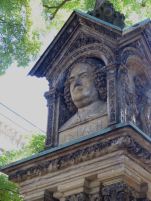
Bach statue in Leipzig, where he wrote the violin pieces!

Bach statue in Leipzig, where he wrote the violin pieces!

Accompanying Ayres on her trip was Aurelia, a 3/4-sized violin, because, she says, “you never feel truly alone, anyway, if you have an instrument with you”. She decided she needed a musical journey to parallel the cycle one. Her choice? To learn Bach’s cello suites, violin sonatas and partitas.

Consequently, throughout the journey she gave little impromptu Bach concerts. It seems Bach is loved the world around. She shares wonderful stories and gives insights into all sorts of composers, not just Bach, but the one I want to share here is Shostakovich. She spends a few pages on his 13th quartet, which was written in B flat minor. She writes, and I’m excerpting furiously:

His thirteenth, though, depicts the horror of life in a way that is unrelenting from beginning to end. In our life, the police often protect us from knowledge of the most horrific crimes, but in this B flat minor work Shostakovich offers us no protection. If you are going to listen to this piece, make sure you have a friend to call afterwards. Seriously.

… This piece is written in one dreadful movement. Listening to and playing this piece dozens of times, I can find no moment of joy, no moment of exhilaration, no relaxation, no optimism.

[…]

… it is a hell on earth. It is a hell of small-minded, picky, tight-mouthed people, people who decide matters of life and death and art; a hell of the violins as they pick out mean, starved sounds from their instruments while the others around them mock and sneer; a hell of music for all the ugly-souled, unthinking, self-serving people in the world, of whom many had power over Shostakovich. This hell never ended for him, neither in his life nor in this piece; it just kept on getting worse.

And she says more – about Shostakovich’s life and this piece. I loved reading these sorts of insights from a practising musician. I also enjoyed her explanations of the modern composers many love to hate, Webern and Schoenberg. She talks of Schoenberg using music’s power to unsettle, and Webern distilling emotion (even if reading a Webern score is “like poring over an ordnance survey”!)

Viola to Violin to Cello to …

The other musical thread I wanted to mention is her discussion of her musical career. The book starts with her mother asking her “the most important question of my life”. What was it? It was to ask her what instrument she wanted to play! She chose cello, but got a violin! Paralleling the story of her cycle journey is the story of her musical life: how she started with violin, then moved to viola – her professional instrument at the Hong Kong Philharmonic Orchestra – but always hankering for the cello. She returned to the violin for the trip, after which she eventually got to play cello. I won’t tell you where, after all that, she has ended up …

I will tell you, though, that for Ayres music saves people’s souls, and it saved her. As a musician, she says, you take people into your care. You won’t be surprised, then, to hear that “to share the value of music is the resolve of my life”.

Ayres is warm, yet fearless, a woman who marries action with reflection, all of which make Cadence the excellent read my friends told me it was.

Monday musings on Australian literature: June Wright, Crime novelist

Regular readers here may be surprised to see this subject for a Monday Musings given I’m not known as a crime aficionado, but never let it be said that I’m not open-minded. I came across June Wright last year in my role as convener of the Literary and Classics area of the Australian Women Writers Challenge, and was reminded of her again when I wrote my 2015 wrap-up for the challenge. It occurred to me then that she was worth introducing to you!

Dorothy June Wright, née Healy, was born in 1919, and died only recently in 2012. She wrote six crime novels in the middle of the twentieth century. According to the Sydney Morning Herald‘s obituary, she was born in Melbourne, and went to school at Kildara Brigidine and Vaucluse convents, Loreto (in Adelaide), and Mandeville Hall (in Toorak). She worked from 1939 to 1941 as a telephonist at Melbourne’s central exchange – a significant fact as you will soon see – before marrying Stewart Wright in 1942. They had six children.

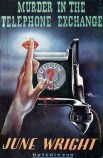
WrightTelephoneExchangeHutchinsonNow, here comes the significance of her job: her first novel, published in 1948, was Murder in the telephone exchange. Wright told a reporter at Melbourne’s Advocate that one of her co-telephonists at the Exchange had once said to her “‘You know you could write a book about this place!” The Advocate goes on to tell her publication story:

June Wright wrote her novel in the midst of busy household duties and a toddling, growing family. When the English publishers, Hutchinsons, announced a £1000 detective story competition Mrs. Wright sent along her manuscript, with a sceptical and open mind on its chances. The competition closed on June 30, 1944, but no manuscript, of the thousands submitted, was awarded the prize. Several, however, were recommended for publication by the judges … Among them was June Wright’s “Murder in the Telephone Exchange”. The publishers are evidently so impressed with her gifts as a story-teller that they have not only signed a contract with her for the immediate publication of the competition manuscript, but have also signed options on her next two novels.

Hmmm … not good enough for a prize but they chose to publish? Still, I’m sure the authors were happy to be published. The next two novels were So bad a death and The devil’s caress. Wright went on to be, apparently, more popular in Australia than Agatha Christie – and yet died pretty much unknown.

Reissued in 2015

The reason Wright has come to our attention now is that her novels are being reissued by US publisher Verse Chorus Press under their Dark Passage imprint, with three published in 2015. That’s not how I learnt about them, though, as I don’t have my ear to the crime genre ground. I heard about Wright through Karen Chisholm’s article on her in The Newton Review of Books.

However, before I tell you about Chisholm’s article, I want to share an excerpt from an article in Perth’s The Daily News. It describes an address June Wright made to the Housewives’ Association:

‘Yes, I have four small children, do my own house-work, and am now writing my third book,’ she told association members. ‘I began my telephone exchange murder story when my first child was a year old, entered the novel for an English competition and was delighted when it was selected for publication.’ Mrs. Wright thinks that housewives are well qualified for writing. They are naturally practical, disciplined and used to monotony — three excellent attributes for the budding writer.

Haha, love it!

I shared this first because it provides a good lead-in to Chisholm’s article. Chisholm, unlike fraudulent me, has read the three reissued novels, and she makes some interesting comments. She says, for example, of Murder in the telephone exchange that the protagonist, Maggie Byrnes “is the first of Wright’s strong female protagonists and we can’t help but assume that there is much of the author herself in Byrnes”. Nagaisayonara, writing at the Crime Fiction Lover website, argues that “it’s a complex, dark novel with a female detective who was far ahead of her time”, and believes that Wright is more like Dorothy L Sayers than Christie. Moving on to So bad a death, Chisholm tells us that Maggie is now married and looking for housing. She writes:

Wright’s family of six children is often remarked upon in interviews when she talks about the workload of writing she maintained, as are the connections between the life of her first character, Maggie, and her own life. Certainly that search for housing during the post-war shortage, and the slightly desperate search for distraction from the day-to-day sameness of childraising and housekeeping, is informed by experience.

Chisholm adds that the new Foreword for So bad a death states that Wright “would joke with interviewers how writing bloody murders was a good way to avoid infanticide”! She sounds like a woman with confidence and presence, doesn’t she?

Adelaide’s The Mail reviewer writing in 1952 about her third novel, The devil’s caress, says that

Mrs. Wright’s new and third work, which concerns odd doings on a Victorian peninsula, is outstanding in one respect. It has a powerful character study of a woman doctor — a commanding, aloof, and in some ways completely misunderstood person, who is married to a surgeon, the antithesis of herself. …  Mrs. Wright’s reportage is as ever brisk and competent. But I eagerly await the day when she concentrates more upon genuine, plausible detection and less upon melodramatic situations.

I wonder if this is why this book was not the third to be re-released last year, although I understand all will be eventually?

Meanwhile, Chisholm writes that in all the three books released so far, the third being the previously unpublished Duck season death, “there has been an underlying sense of fun being poked” and “hints at a wicked, very Australian sense of humour”. She concludes that June Wright was “one of the writers who forged the way for an Australian crime fiction scene that’s vibrant, varied and extremely engaging” and argues that she deserves to be “better remembered and more accessible”.

I must say I’m tempted … are you?

Emma Ayres, Cadence: Travels with music (Review)

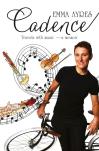
Emma Ayres, CadenceAlthough Emma Ayres’ memoir Cadence had been passed around my reading group with much enthusiasm over the last year or so, I wasn’t intending to read it – not because I wasn’t interested, but because there were other books I wanted to read more. However, when I found the audiobook at my aunt’s house while we were clearing it out, Mr Gums and I decided to listen to it on our trips to and from Sydney. It proved to be a great car book. However, a warning: we listened to it intermittently over two months, so this will be more a post of reflections than a coherent review.

Emma Ayres is probably known to most Australian readers of my blog, but perhaps not to others so let’s start with a potted bio. Born in England in 1967, Ayres is a professional musician – a viola player in fact – who has also worked as a radio presenter. She lived in Hong Kong for eight years, playing with the Hong Kong Philharmonic Orchestra, but in 2000 she rode a bicycle, fundraising for charity, from Shropshire, England, through the Middle East and central Asia, to Hong Kong. She moved to Australia in 2003, and worked as an ABC Classical Music radio presenter for eight years, from 2008 to 2014.

Now to the memoir. Cadence is ostensibly a travel memoir, but it covers a lot of ground within its seemingly narrow construct of chronicling her year-long bicycle journey. The ground it covers, besides the story of her travel, which is exciting enough given the regions she rode though, includes her childhood, her reflections on her life as a musician, and her analyses of classical music. Some of her technical descriptions went over my head, but I found her discussions of composers to be not only accessible and eye-opening, but deeply interesting. And it’s all told with a thoughtful philosophical underpinning.

Cadence is an excellent title for a musician’s memoir, and she plays with its meanings throughout, referring, for example, to a “perfect cadence”, or a “slow cadence”, or more frequently to  “interrupted cadences … moments when the direction is changed”. Indeed, the memoir could be seen as comprising almost continuous interrupted cadences because, although the bicycle trip provides her memoir’s chronological backbone, she skips around frequently, going backwards to her childhood and early years as a musician and forwards to her life after the trip when she briefly toyed with being a cellist. It can take a little concentration to keep track of exactly which part of her life she is writing about at any one time, but it’s not too hard. After all …

Cadences are waypoints in the music, places where you can take a breather, readjust your instrument and hurtle on to the next bit of the adventure.

I greatly enjoyed Ayres’ reflections on life and travel. The book is full of her insights, many learnt on the road. For example, regarding the challenge of deciding whether to do the trip she says:

If you are not sure whether or not you should do something, ask your ninety-year-old self.

At another point she discusses how much she loved Pakistan despite all the nay-saying she had received when she was planning her trip. She was treated, she writes, almost without exception, with kindness and generosity everywhere she went. “Do we make our own welcome?” she wonders, and goes on to suggest that before we criticise another country, we should perhaps look at ourselves first.

Being a woman cycling alone is risky business, particularly in some of those male-dominated countries through which she travelled. She frequently took advantage of her androgynous look, helping it along by keeping her hair very short and wearing non-feminine clothes (where she could). Consequently, she was regularly taken for a man. She discusses gender often, commenting on how we are ruled by it and its associated expectations. She sees herself as “a border dweller in the world of gender”, writing:

I do admire people who are by birth penumbral but have the courage and desire to be firmly one or the other and go through a sex change, but I like the fluidity of being able to float around the middle. I really to think that the basic this or that of male and female is shallow and limiting. How simplistic to think, with all those opposing hormones flowing in each of our bodies, that we are one and therefore not the other. And how much better in countries like India and Thailand that they recognise more than two sexes. More variations in the octave, more variations in gender.

Another theme that runs through the book is the idea of being in the moment. She tells the story of being taken to task for reading Anna Karenina when on a bus in Pakistan. Her young seat-mate is mystified by her passionate rendering to him of the story, saying to her “but you are here!” She genuinely sees his point, and puts the book down. Later in the trip, she regrets not spending more time with a fellow-traveller who crosses her path because “I was too focused on destination and again forgot the importance of the here and now”.

Cadence is a generous, warm-hearted book which abounds with travel anecdotes to delight any lover of travel literature. There are scary moments, and funny ones, and others that are just plain interesting. It also contains intelligent, considered insights into music, some of which I plan to share in a follow-up post. For now, I’ll conclude with a comment she makes early in the book:  “Travel”, she says, “goes inwards as much as outwards”. That is exactly what she demonstrates with this book. I can see why all those in my reading group who read the book urged it onto the next person.

awwchallenge2016

Emma Ayres
Cadence: Travels with music – a memoir
Sydney: ABC Books (by HarperCollins), 2014
284pp.
ISBN: 9780733331893

Emma Ayres
Cadence: Travels with music – a memoir (audio)
(read by Emma Ayres)
ABC Commercial, 2014
8 hours (approx) running time (on 7 CDs)

Delicious descriptions: Stephen Orr’s farm family

When I reviewed Stephen Orr’s farm-set novel, The hands, last week, I didn’t share many quotes as the post was getting rather long. I decided I’d use my Delicious Descriptions series instead! So, here are three excerpts to show you more of what I so enjoyed about Orr’s writing.

One aspect I really enjoyed was his dialogue, but it’s tricky choosing something that works out of context. However, here’s a discussion between parents Trevor and Carelyn, and their eldest son Aiden about whether he continues school to Year 12. Young brother Harry is there too:

‘Maybe there’s no point starting Year Twelve,’ Aiden suggested, looking at his parents.
‘Why not?’ Trevor asked, not entirely surprised.
‘Not if I’m gonna fail things.’
‘Why are you going to fail?’ Carelyn asked.
‘Maybe not fail, but get through with Cs.’
She crossed her arms. ‘You’re not a C student.’
‘It’s getting harder.’
‘So? You work harder. Year Twelve is minimum for anyone now.’
‘But what’s the point if —’
‘You. Will. Continue.’ She decided  against the lecture. How he (Yes, you, look at me when I’m talking to you) was, for seven years, the best student in his School of the Air class; how he used to finish maths worksheets in minutes and spend half an hour waiting for others; always scored an A on tests and had a spelling age five years above his actual age.
‘It’s only another year,’ Harry said to his brother.
Aiden gave him his shut up, Shit-for-brains look. ‘It’s none of your business.’
‘You’re meant to set a good example.’

I don’t know about you, but I love this. It’s so “true”. I love the “gonna” for Aiden, and the “going to” for his Mum; I love big brother’s condescending-irritated-but-love-you-all-the-same “shit-for-brains” response to  his brother; and I love the whole set up of the argument regarding the importance of education.

And here, without spoiling anything, is a description of what comes after an affair:

… It was more a case of what came next: the small wedding, in a small park; the moving van; the bathroom reclaimed by lavender soap and fresh towels; her, inserted into his life like a deep splinter; opinions floating through the air and settling on the floor like talc; fine words butter no parsnips; her laugh; bright dresses on the line beside their overalls and pyjamas …

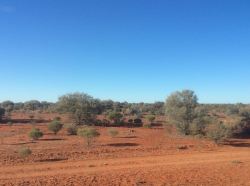
A little north of Orr's "Bundeena" but you get the picture.

A little north of Orr’s “Bundeena” but you get the picture.

But finally, of course, you need a description of the land:

Bundeena was marginal country. It could carry cattle, sparsely. To Trevor, this was where Australia became desert, where man — following the east-west railway, before it seriously set its sights on the Nullarbor — had given up on agriculture. Most men, at least. Except for them: sixth generation Beef Shorthorn producers who’d wrestled with the land for 130 years. This was country that hadn’t asked for farmers but had got them anyway. On the southern edge, the railway line, and to the north, nothing. They had neighbours to the east and west, but they may as well have been living in New Zealand.

So evocative.

Monday musings on Australian literature: Regional differences in Australian English

Thredbo Village

Thredbo Village

While dining in Thredbo this weekend, we were served by a waiter who, when I asked for a certain ingredient to be excluded from my dish, repeated it back with the order, “and no to-mAY-to” she said. Her accent wasn’t strong but this stood out, so when she returned to our table, we asked whether she was from North America. Yes, Vancouver, she said, but sixteen years ago. She thought she’d covered her origins up but, when we explained, she realised she’d make a slip and pronounced that she would not make that mistake again! What a shame I thought …

When we watch movies or television programs from countries like England and the United States, we tend to be very aware of accents and linguistic differences. Is this set in the north of England, we ask? Or, oh, she’s a New Yorker, we’ll say. The accent is a big part of it, but vocabulary and expressions also contribute. Interestingly, despite Australia’s geographic expanse, with some populations quite remote from others, such differences are far less pronounced.

There are some differences, of course. Indigenous Australians can often be distinguished by a particular way of speaking, as can country versus city people. Traditionally, South Australians have had a reputation for sounding more English, for rounding their vowels in words like “dance” and “branch”. (South Australia was not a convict colony like most of the other states!) These differences tend to be subtle, and are probably not well noticed by those from other countries.

Linguistic differences in Australia are, though, something I’ve been aware of, largely because I’ve experienced the impact. You see, as an early teenager, I moved from living in northwest Queensland (Mt Isa to be exact) to the big smoke in New South Wales (aka Sydney). I learnt very quickly to say “recess” at school, not the childish sounding “little lunch” for the first break of the day. I learnt that the bag I took to school was a “case” or “bag” not a “port”. (These days I suppose it’s a “backpack”!). And I learnt that my “togs” were “swimmers”.

I was therefore fascinated to read a recent theconveration.com article titled “Togs or swimmers: Why Australians use different words to describe the same things”. It was written by three linguists at the University of Melbourne, Jill Vaughan, Katie Jepson and Rosey Billington. They provide some maps showing different word usages around Australia, swimwear being one. (If you are interested, they include a link to more maps on their Linguistic Roadshow site).

What is particularly fascinating about this from my point of view is not so much the differences but the fact that different states agree on different words. For example, with some words there’s general agreement in Queensland and New South Wales (“ice-block”) but not Victoria (“icy-pole), while for another word Victoria and New South Wales will concur (school “canteen”) with Queensland (the “tuckshop”) the odd one out. How did/does this happen? The authors don’t cover it – though perhaps they do in a longer academic article.  They do, however, note that some usages align quite closely with state lines, and that this can be observed in border towns, like Albury-Wodonga. Words, they say, become part of one’s regional identity and so Wodonga residents are more likely to use the Victorian-preferred “bathers”, while those from Albury will use the New South Welsh “swimmers”.

The thing is, of course, that vocabulary usage varies (and changes) over time as well as space. When we read Australian novels, it’s the change over time that I suspect we notice, more than the regional ones. One of the aspects I enjoyed in Madeleine St John’s 1950s-set The women in black (my review) is St John’s recognition of new words being introduced to Australians via post-war European immigrants, words like “salami” for example! She also used the word “reffos” which was contemporary Australian slang for “refugees”. Salami is here to stay, but “reffos” has been replaced by new slang.

Current writers like Tim Winton and Christos Tsiolkas very self-consciously, I think, closely reflect contemporary vernacular in their novels. It’s important to the milieu they are describing. Kristen Krauth’s just_a_girl (my review) is replete with contemporary teenage vernacular, including Americanisms like “skanky”, reflecting America’s influence on contemporary Australian English (if not on contemporary English!). In indigenous Australian writing, we hear the different rhythms and language of (to generalise somewhat) indigenous people. “Deadly”, meaning “great” (and similar), is an obvious example.

Hmm … I’ve moved a little away from what inspired this post but it did get me thinking about how I read Australian writing and what I notice. Works which use contemporary language – words, expressions, grammatical constructions – can seem fresh and alive, and very specifically of their place and time. Historically, but I’m generalising here and it’s a matter of degree rather than being absolute, the vernacular was (and is?) more common in genre writing than in literary works, that is, the works that go on to become “classics”. There are exceptions, of course. Some of Barbara Baynton’s stories in her Bush studies collection are nigh impossible to read for the vernacular she uses, and yet are deemed classics. And CJ Dennis’ Songs of a sentimental bloke remains popular despite its colloquial language.

I’d love to know what you think about the use of vernacular – as against more formal writing – in the fiction you read. When does it engage you, and when not?

Stephen Orr, The hands: An Australian pastoral (Review)

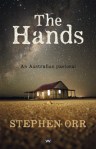
OrrHandsWakefieldAs promised, here is my review of a farm novel, Adelaide-based Stephen Orr’s The hands: An Australian pastoral. It is his sixth novel but the first that I’ve read. Where have I been? The hands is such a good read I wonder why I haven’t read him before.

Among the review excerpts for his previous novels provided at the beginning of my edition is one for his fourth, Dissonance. It says the book prompts us “to ponder the deep nature of familial relationships and their hold over one’s life”. This must be Orr’s milieu because I could write exactly the same about this book. It is set on a remote cattle property called Bundeena, in western South Australia. At the start of the novel, six people live there: 74-year-old Murray who holds the deed to the farm; his sister Fay and her not-quite-right son Chris; and Murray’s son Trevor, his wife Carelyn, and their 11-year-old son Harry. The seventh member of the family, 17-year-old Aiden, is at boarding school. In the first of the novel’s three chronologically titled (2004, 2005, 2006) parts, we shift between the third person perspectives of those at Bundeena, and that of Aiden at school.

Like most farm novels I’ve read – such as Alice Robinson’s Anchor point (my review), Jessica White’s Entitlement (my review) and Gillian Mears’ Foal’s bread (my review) – The hands, depicts the hard life of the farmer, the struggle to survive, and the uncompromising emotions that often attend such lives. You have to be tough to survive is the implication. But, do you? Sometimes, perhaps, you can be too tough. Orr’s characters have to contend with much – not just ongoing drought and debt, but grief that is layered upon layer through the generations, from the World War 1 related suicide of Murray’s grandfather, through the farm accident which damages Chris, to another accident which rocks the family and sparks the tension that finally brings it all to a head. Secrets will out and truths, emotional and practical, must be faced.

This sounds pretty thickly laid on, doesn’t it? World War 1, suicide, farm accidents, drought, and more. How believable is it all? Fortunately, Orr’s control of his plot is sure, and the tone never shifts into melodrama. The story elements fit logically, with the necessary groundwork carefully laid. It pays to notice the details. Is there a hint, for example, in the first film we find movie-mad Chris watching, The Great Escape?

The hands is not a challenging novel to read, and it doesn’t break ground in terms of the form, but from the first page I was fully engaged – because it’s authentic. We reviewers can throw that term around rather loosely, but you’d better believe me when I use it for this novel. Orr’s ability to capture characters and the way they interact with each other is truly impressive. The uneasy relationship between Trevor and his unbending father, the love and loyalty between Aiden and Harry that lies behind the teasing and bickering, Trevor’s conversations with his sons. It’s pretty darn perfect.

Orr’s control of his story starts with the title. “It’s all in the hands” we read, and hands feature consistently throughout the novel – working on the farm, driving, sculpting. Sculpting? Yes, Trevor sculpts son Harry’s hands. Fittingly, the novel concludes as the sculpture is completed. And then there’s the subtitle. I love the use of the word “pastoral” and its multiple connotations. There’s the literal meaning relating to land used for grazing sheep and cattle. That describes this book. Then there’s the Christian church sense of providing spiritual guidance. Hmm, there’s a dearth of good guidance (spiritual, emotional, however you like to frame it) offered in this novel, particularly by patriarch Murray. In the end it’s Murray’s powerless, down-trodden sister Fay who comes good. And then there’s “pastoral” used to describe works of art which portray country life in a romantic or idealised way. But, this is not a romantic or idealised story, making the subtitle pointedly ironic.

This is a novel about a lot of things. Specifically, it’s about farms and farm families, about how farms and the responsibility for them are handed down through families. It’s about the expectation that succeeding generations will farm, and it’s about one generation letting go to allow the next to continue. The trouble is that at Bundeena, Murray will not let go. He holds the deed, and Trevor feels trapped. More than that, he feels unvalued and without autonomy. Aiden notices it too:

The word was with Murray, and Murray was the word … There wasn’t much love or compassion in him. He was a sort of farmer shell, a hollow man full of regrets and knowledge and skills he couldn’t use any more, except as a sort of walking opinion that no one wanted to hear.

Talking with him, feels Trevor, is like “arguing with a rock”.

The specific farm themes, though, encompass bigger themes to do with familial love and responsibility, choices and autonomy, guilt and shame. It is these that lift The hands from a good, but exotic to most of us, farm story to something that applies to us all. In this context, though, it must be said that women play only a small role, and the role they play could be seen to be a little idealised, in that much of the warmth or perception comes from them. However, this is not overdone. They are not sentimentalised, and their relative absence is not a flaw: this is a book about men, about generations of farming men, their lives and their decisions.

Still, it’s to Fay that I’d like to give the last word:

Family, she realised, was the most difficult thing of all. It never reached a point of completion and what was there never seemed satisfactory. But one thing, she realised: there was always a pivot, one person at the centre holding it all together.

In The hands, this turns out to be Trevor. It is he who must make the tough decisions for himself and his sons. This novel is satisfying on so many levels – story, style and subject matter. I comment it to you.

Lisa (ANZLitLovers) loved the novel too.

Stephen Orr
The hands: An Australian pastoral
Mile End: Wakefield Press, 2015
351pp
ISBN: 9781743053430

(Review copy courtesy Wakefield Press)

Monday musings on Australian literature: Best books of 1975

Given we’re all looking at best reads, I thought it might be fun to look at best reads of a past time? My initial thought was 1965, a neat 50 years ago, but I couldn’t find any appropriate lists. Google found a 1965 New York Times bestseller list on Wikipedia and a couple of 1965 lists in GoodReads, but they weren’t quite what I was looking for. I wanted Australian lists, but my first port of call, Trove, wasn’t helping. However, not being quite ready to give up, I thought I’d try ten years later, 1975, which is the year I moved to Canberra. Eureka! This time Trove produced two lists …

And they are nicely representative. One is by classics collector, “book reviewer and litterateur”, Maurice Dunlevy, writing in the Canberra Times (woo hoo!) on December 26. Dunlevy wrote a book review page for the paper for 30 years, to 2000 apparently. The other is by one Nina Valentine. A brief search hasn’t turned up much about her except that she was clearly a writer for the Australian Women’s Weekly, which is where I found her December 31 article. Given their different publishing environments, you won’t be surprised to hear that their styles, not to mention their recommendations, are rather different. Both, though, focus on books for summer reading – and, although this post is dedicated to Australian literature, I’m going to break my usual rule and include some non-Australian picks. After all, they were writing for Australian readers.

“… books to help you enjoy lazy, long summer days to the full”

Let’s start with Nina Valentine. Her circa 700-word article focuses on books that tell a strong story, though not all are fiction. Since there’s only five of them, I’ll list them all:

  • Evelyn Anthony, The Persian kingdom (an error, I think, for Persian ransom) A British writer, Anthony is, she says, “one of my favorite writers of sculptured novels”. Sculptured novels? That’s a new term for me, but she does define it. They are novels which – wait for it – have “form, character and situation”. Hmmm. Anyhow the novel has an interesting setting, Iran. It’s about the oil crisis, the Palestinian Liberation Army, and a secretary who, Anthony’s heroine knows, threatens her marriage. “Thrilling holiday reading”, Valentine says. According to Trove, many Australian libraries hold it, so there’s no excuse for not adding it to your summer pile!
  • Kenneth Harrison, Dark man white world. This, however, is something completely different. It is a biography of famous indigenous Australian tenor, Harold Blair. In addition to singing, he became an Aboriginal activist fighting, she writes, “for better education, better understanding and a better lifestyle for his people”. I love that Valentine chose this as a holiday read.
  • James Quartermain, The diamond hostage. Part of a series, this book she says is “tailor-made for holiday escapist fare”. Set in Frankfurt, it features Raven, who is security chief for Mrs Diamond, a very wealthy “diamond-hard business woman”. She’s kidnapped (as is the heroine’s child in Anthony’s book), setting up, presumably, an exciting read.
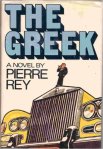
  • ReyTheGreekAmazonPierre Rey, The Greek. Translated from French, it’s about a “Greek shipping magnate whose affair with a concert singer finishes when he marries the widow of an American who has been assassinated”. Ring a bell, anyone? Rey swears it’s fiction, says Valentine, but for her the point is that it’s “racy” in the style of Harold Robbins and Jacqueline Sussan. (Love the cover.)
  • The Saturday Book sounds a little more interesting (to me). It’s an “elegant, gift-boxed collection of stories, poems, drawings, photographs and nostalgia”. Annually published, it may, she writes, be the last due to production costs. She describes it as “a book to beguile you while on holidays, and to enchant you at all times”.

So, overall, an interesting mix of the usual beach holiday plot-driven fare combined with a couple of other options for those looking for something a little different. Minimal Australian content, but interesting to see a translated – genre – book in the mix.

Doing “your bit in the grit to further your cultural education”

Dunlevy’s article is the same length as Valentine’s but he packs more into his by spending less time describing the books. He discusses his selections under categories, recognising his (surely) more diverse set of readers than Valentine’s.

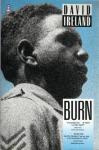
  • IrelandBurnLiterary fiction: I love that he starts with Australian literary fiction naming Xavier Herbert’s doorstopper Poor fellow my country, David Malouf’s autobiographical novel Johnno (the only one I’ve read), Thomas Keneally’s Gossip from the forest, David Ireland’s “fine novel about the Aborigines” Burn, Michael Wilding’s The short story embassy, and Laurie Clancy’s A collapsible man. I haven’t in fact heard of these last two. His foreign literary fiction choices are the last volume in Anthony Powell’s Music of Time sequence Hearing secret harmonies, Iris Murdoch’s A word child, and Saul Bellow’s Humboldt’s gift.
  • Poetry (or Verse, to him): This is his second category! Love it. His selections are all from established poets he says: A. D. Hope’s A late picking (which I actually have), David Campbell’s Deaths and pretty cousins, and Gwen Harwood’s Selected poems.
  • Australian literary criticism: If I was surprised by poetry being his second group, this third one made me really sit up. He recommends poet Judith Wright’s Because I was invited and poet Douglas Stewart’s The broad stream, describing them as fine successors to poet A. D. Hope’s Native companions, published in late 1974. The final critical work he names is again by a poet, Vivian Smith’s Vance and Nettie Palmer. I know a couple of these – but am mightily intrigued by the others.
  • Biographies: Here we move away from a focus on Australian works. He lists several books, including Hilary Spurling’s Ivy when young: The early life of I. Compton-Burnett, describing it “as a fine re-creation of the Victorian family life of an oddball novelist”; Michael Holroyd’s Augustus John; R. M. Crawford’s life of fellow English-Australian historian G. Arnold Wood A bit of a rebel; and Scottish-born Australian Mary Rose Liverani’s autobiography The winter sparrows. According to AustLit, this last book “has been acclaimed as a landmark in Australia’s migrant literature”. Onto the TBR list it goes.
  • Histories: Dunlevy says he’d read so many good popular histories in the year that he “would not know where to begin if I were not now reading the most diverting of all, William Manchester’s narrative social history of the United States 1932-72, The Glory and the Dream”. He describes it as “a huge journalistic history which reads like a massive newspaper written by a single brilliant journalist”. He offers two other social histories suitable for holiday reading: John Ritchie’s Australia as once we were and Michael Cannon’s “third volume about Australia in the Victorian Age, Life in the Cities“. I don’t know any of these historians.

Having gone to the trouble of listing all these worthy works, he then admits that he doesn’t “very often see people reading high quality fiction or poetry or criticism or biographies or history on the beach”! Not sure I do either. The “best-selling paperback” is probably the better bet, he thinks, and to that end he suggests P. Benchley’s Jaws, Harold Robbins’ The Pirate (‘which includes lots of stirring sex scenes, including one in front of a mirror”!), Frederyk Forsyth’s The dogs of war, and Irving Wallace’s The fan club. Personally, though, I’d be looking at those books in his first category. I reckon they still make perfectly good recommendations today.

Monday musings on Australian literature: Australian Women Writers’ Challenge 2015

awwchallenge2015For the fourth year now, I’m devoting the year’s last Monday Musings to the Australian Women Writers Challenge*.

The challenge continues to be supported by a wide range of reviewers. This year we moved to a self-hosted site which enabled us to produce a single searchable database of all reviews logged since the challenge started in 2012. We now have reviews for nearly 3,000 books across all forms and genres of Australian women’s writing. An impressive resource, I’d say, for its breadth and accessibility.

As usual, the Challenge ran some special events during the year, including a focus on Lesbian/Queer women writers,  author Q&As, and an In Conversation With series. These were organised by some wonderful challenge volunteers, particularly Jessica White, Marisa Wikramanayake and Annabel Smith. I think these posts deserve more air, so will share them here:

The Australian Women Writers’ Challenge is the only challenge I do (or have ever done). This year I posted 27 reviews for the challenge, three fewer than last year. I managed a similar variety in my reading, but unlike last year, I didn’t manage to read one book from my TBR pile. It was, I must say, an erratic year for me and I feel that I lurched from book to book, scrabbling to keep up. If I set myself one goal for next year it would be to tackle the TBR pile a little! On the plus side, three Australian women feature in my top ten posts for the year – Hannah Kent, Barbara Baynton, and Tara June Winch. What a diverse group that is!

Anyhow, here’s my list of works read for this year (with links to the reviews):

FICTION

SHORT STORIES

NON-FICTION

There are some subtle differences from last year’s list to this. For example, last year nearly all the non-fiction reads were memoirs, whereas this year only two are. I read a similar number of novels as last year, but twice the number of historical fiction novels, 4 versus last year’s 2. I will talk more about that in another end of year post. I would like to have read more classics/older books.

Anyhow, if you are interested in the challenge, you can check it out here. I don’t believe the sign up form is ready for 2016, but watch the site. You are most welcome – whether you are female or male – to join us. The challenge is also on Facebook, Twitter (@auswomenwriters), GoodReads and Google+.

Finally, a big thanks to Elizabeth and the rest of the team – including Lewis, our wonderful database developer – for making it all such a cooperative, and enjoyable experience. Roll on 2016.

* This challenge was instigated by Elizabeth Lhuede in 2012 in response to concerns in Australian literary circles about the lack of recognition for women writers. I am one of the challenge’s volunteers – with responsibility for the Literary and Classics area.

Eleanor Limprecht, Long Bay (Review)

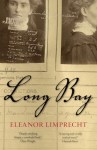
LimprechtLongBaySleepersOne of the things that interests me about historical fiction, of which Eleanor Limprecht’s Long Bay is an example, is why the author in question chooses to write his/her story as fiction rather than non-fiction. As I’ve written before, this is an issue with which Kate Grenville grappled when she wrote The secret river. That book was initially going to be non-fiction about her ancestor Solomon Wiseman. However, for various reasons which she outlines in Searching for The secret river, the book ended up as fiction. Her reasons included gaps in the historical record, and finding the story – and particularly the voice – within the facts she had. I wondered, as I read Limprecht’s Long Bay, what her reasons were.

Long Bay, which draws its name from Sydney’s Long Bay Gaol, tells the story of Rebecca Sinclair, a young woman who in 1909, at the age of 23, was gaoled for manslaughter after a botched abortion. Limprecht describes on her website how she came to write the story: she was hunting for first person stories from the gaol when she came across two letters about Sinclair from the Prison Comptroller. Both those letters are reproduced in the book. Limprecht writes that she became obsessed with Rebecca Sinclair’s life, and started seeking out her story:

I found out everything I could and then began looking for living relatives in the hope they could tell me more. I joined an online genealogy site and made contact with a woman who had Rebecca on her family tree … she was Rebecca’s granddaughter.

Not only, it turned out, was she Rebecca’s grand-daughter, but the daughter of the baby Rebecca had had in goal. That baby, Freda, never did tell her daughter where she was born and why. Grand-daughter Christine

said that she wanted to honour her mother, who never felt she could share the story of her birth with anyone. She gave me permission to use her grandmother’s name and story for the novel, Long Bay.

Limprecht doesn’t specifically discuss why she chose to tell this story as fiction. Most likely it’s because she’s a fiction writer. Duh! (She does say on her site that Rebecca’s “story told me to look deeper, to understand bad choices, and to see beyond the razor wire, to the messy, real truth that fiction can reveal”.) But it may also be because, while there are several official records relating to Rebecca, there are major gaps in the record of her life. The lives of poor people, Limprecht implies, are not well documented. At the back of the novel, Limprecht notes the specific sources she quotes in the novel, but she does not, as some historical fiction authors do, discuss the historical basis of her story in any other detail – such as how much she has assumed, and how much she is confident of as “fact”. I’m interested in this, though it’s certainly not critical to analysis of the book as a piece of fiction.

So let’s get to the fiction! Limprecht tells the story straightforwardly. She starts with the letter – the one which inspired her story – from the Prison Comptroller to the Royal Hospital for Women advising of the arrangements for admitting Rebecca Sinclair. This is followed by a Prologue describing Rebecca’s admission and taking us to the beginning of labour. The novel then flashes back to her childhood (Chapter 1) and her story is told chronologically from this point.

Limprecht carefully sets up Rebecca’s character as a hard-working young woman who has a pretty good head and can be resourceful, but who in youthful naiveté let herself be taken in by Donald Sinclair, the only son of Nurse Sinclair, an abortionist, and a man who is, let us say, “an operator”. While there does seem to be love between them, Rebecca also slowly becomes aware that he is not to be trusted. Limprecht sets up a motive, to do with her sexuality, for Rebecca’s early willingness to accept Sinclair’s attentions. To modern minds, it could seem a little unrealistic but for the time it’s probably valid enough.

Rebecca is presented as responsible, and having integrity. As she imagines her trial, she realises that her

family will sit in that courtroom and watch her be led up into the cage. They will listen to all of the horrible things she has done. She did them with Don, for Don, but he did not force her hand.

I liked that self-awareness – though it’s true that her options if she did not go along with the plan, like those of poor women of her time, were few. I was intrigued to read in a contemporary newspaper report in Trove that she “caused a painful scene when she was sentenced. She sobbed and clung to her husband, the other prisoner, and appealed piteously to the court not to separate her from him.” Without giving too much away, this is not quite the Rebecca depicted by Limprecht, but perhaps her court-side Rebecca is drawn from what she knows was the trajectory of Rebecca’s life after her release.

Overall, while I enjoyed reading Rebecca’s story, she didn’t fully come alive for me – and I think back to Grenville’s challenge with her novel, that of finding the story, the voice, within the facts she had. I wonder whether having the permission of the family to tell this story hampered Limprecht in some way. Did she feel a little constrained to be sympathetic to Rebecca? Grenville decided to break free of her “real” subject and invent a character based on him. Not all historical fiction writers do this of course – Hilary Mantel didn’t for Wolf Hall (my review) and neither did Hannah Kent for Burial rites (my review) – but in this case, it may have freed Limprecht to fly a little more with the character, to have been, perhaps, a little less laboured about justifying her actions and decisions.

Nonetheless, the novel does make excellent reading. The plotting is confident and coherent, with the ground carefully laid for the “crisis” point. There’s some lovely imagery. Here, for example, is Rebecca feeling shame:

Like a hem on a dress that is too long, it drags behind her, gathering dirt, there for everyone to see.

And Limprecht’s description of turn of the century Sydney, and of the lives of poor women in particular, feels authentic. Rebecca’s mother, with six children, falls on hard times when her husband dies. She makes her money as a seamstress, which is a skill Rebecca learns. Her other daughters find different paths in life – one respectable, another not so. Limprecht is careful not to moralise on the abortion issue, preferring to show, rather than exhort. Nurse Sinclair is clear and unsentimental about why she does what she does – women need the service and they need it done safely, and she needs an income (“a trade that turns a pretty profit”). Rebecca sees the sorts of women coming through – servant women abused by their master, poor women with too many children, unmarried women. A prison guard shows rare kindness because she understands the issues.

Rebecca Sinclair’s story is a fascinating one. Notwithstanding my little equivocation, Limprecht has done it justice and brought to our modern times the story of a woman whose story is worth telling. A perfect one for the Australian Women Writers Challenge.

awwchallenge2015Eleanor Limprecht
Long Bay
Collingwood: Sleepers, 2015
313pp
ISBN: 9780987507044

(Review copy supplied by Sleepers Publishing)