The genres – or, perhaps I mean sub-genres – keep coming. Recently, I’ve started hearing about something called tech noir. I’ve heard for some time of rural (or outback or drought) noir, and have read some in that genre because I love books with a strong sense of place. I am also interested in technology and where it is taking us, but as you probably know I don’t gravitate to futuristic stories, so I am not at all familiar with trends in such writing.
Definition
I’ll start with definitions, and with my go-to source, Wikipedia. What I found there surprised me, though it shouldn’t have, because this sub-genre, like many is not limited to fiction. Wikipedia says that it is a
hybrid genre of fiction, particularly film, combining film noir and science fiction, epitomized by Ridley Scott’s Blade Runner (1982) and James Cameron’s The Terminator (1984). The tech-noir presents “technology as a destructive and dystopian force that threatens every aspect of our reality”. It can be characterized by dark, urban settings, while depicting technology ranging from retrofuturism to classic futurism. Tech noir combines the high-tech worlds of sci-fi with the dark, gritty, and bleak atmosphere of film noir.
It then says that it is “also known as cyber noir, future noir, neo-noir science fiction and science fiction noir”, and that James Cameron coined the term, via the name of a nightclub in The Terminator. It provides some pre-history, but of course origins are always murky because these movements never appear out of nowhere. Do check out Wikipedia’s article if you are interested. I’m leaving it here because, although Wikipedia describes tech noir as a “genre of fiction, particularly film” it does not talk about any other type of fiction besides film, and of course, I am interested in prose fiction (aka novels).
So, regarding novels, I’ve seen the genre described in various ways. There’s tech noir, of course. Indeed, it was references to Australian author Ashley Kalagian Blunt being “Australia’s queen of tech noir” that inspired this post. But, I’ve also seen terms like electronic crime and high-tech crime. The point is that this genre blends traditional 1940s noir elements, like cynical investigators, moral ambiguity, and atmospheric settings, with futuristic or high-tech elements like AI, cybercrime, and the dark web. The stories tend to be urban, and focus on modern concerns about privacy, identity, and security, not to mention issues like corporate greed. The misuse of technology is common and stories will often confront existential questions about what it means to be human. Like 1940s noir, tech noir is grounded in anxieties about the future, which is usually seen as bleak.
Just how far this bleakness extends can vary. Noir stories are by definition bleak or dark. The world, if not always doomed, is seen through a dark lens. But there can be humour, most likely satirical, and the endings aren’t necessarily depressing. Or, so I believe!
Tech noir’s precursors can be found in cyberpunk, with books like Philip K Dick’s 1968 Do androids dream of electric sheep and William Gibson’s 1984 Neuromancer. (Classics now, I know, but I haven’t read them.) According to Wikipedia, Neuromancer is “set in a near-future dystopia [and] follows Case, a computer hacker enlisted into a crew by a powerful artificial intelligence and a traumatised former soldier to complete a high-stakes heist”. I must say, this feels a bit like a case of today’s tech noir is yesterday’s cyberpunk? Wikipedia describes cyberpunk as “using elements from crime fiction—particularly hardboiled detective fiction and film noir—and postmodernist prose to describe an often nihilistic underground side of an electronic society”. What do you think?
Tech noir in Australia
My research into Australian writers in this field brought up Dorothy Johnston (see my posts on her). Wikipedia says that her 2000-published novel, The Trojan dog “was one of the first Australian novels to give electronic crime a central place”.
However, despite those references I found to Ashley Kalagian Blunt as Australia’s tech noir queen, I have to say that my internet searches did not produce a large number of writers in this field, and most of those I list below do not seem to write exclusively or even mainly in this field. But, I am out of my comfort zone, so I might have missed something big.
Selected Australian tech noir novels:
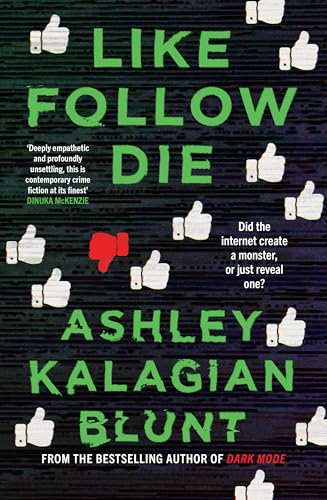
- Ashley Kalagian Blunt: Dark mode (2023, Sydney-based thriller about a series of murders linked to the dark web); Like, follow, die (2025, psychological thriller examining the impact of online radicalism, cybercrime, and online forums on real-world violence)
- Andrew Croome: Midnight empire (my review) (2012, thriller about drone warfare fought in the Middle East from the Nevada desert)
- Dorothy Johnston: The Trojan dog (2000, Canberra-set crime about computer fraud and bureaucracy)
- Zane Lovitt: Black teeth (2016, Melbourne-based noir with a tech focus, featuring a computer geek whose day-job is to search the internet to confirm that people’s CVs are real)
- Jonathan Macpherson: Brazen violations (2016, high-tech thriller about a cop who has a bugging device implanted in his chest allowing him to be controlled by a criminal family)
As you see a small list. I did find a couple of others, but not many. Except for Blunt’s novels, these are ten or more years old. I know some readers of my blog – I’m looking at you Bill, in particular – might know more. I’d love anyone who has read in this area to leap in and correct any misconceptions I have and/or expand on what I have said.
So, over to you. Do you read “tech noir”? And if so, I’d love to hear your thoughts and your favourites?
 Whispering Gums
I took Noir to mean Black in French so therefore film, TV and books that are labelled as such are dark in a moral and/or psychological sense. I have read many a book I suppose that can be considered as such (and the odd TV/film though I am not much of a watcher) but we do have a propensity to label genres and the music has a lot of labelling when it comes to that. I watched The Terminator on release, and it was nothing more to me than a Sci Fi film. But I suppose that with an ever-changing world we need these labels and labels can be useful.
Yes, you are right John, that “noir” comes from the French for “black” or “dark”. Those film noir films were characterised by dark light, weren’t they, and by the use of shadow, which is so evocative in The third man. As I’m sure you know the physical “darkness” symbolised political, personal, existential darkness which is what underpins tech noir.
I take your point about labels. They are a two-edged sword. I don’t think we should ever become slaves to them, but they can be a useful starting point. I do like thinking about them in terms of literary movements/styles but I don’t want to focus on whether something perfectly matches a label, because that starts getting us too close to formula.
Tech noir as a subject doesn’t really appeal at first glance. I hadn;t heard the term either.
Thanks Pam. It’s amazing what Google can throw up isn’t it!?
It sure is.
Hi Sue, I don’t think I will be a fan of Tech Noir novels. Though, Lisa put me on to an okay read, Saturation by William Lane. It might fit as a Tech Noir novel or Dystopian novel, or even both!
Thanks Meg. I’m with you. I can imagine reading the occasional one – like I did like Croome’s novel – but not being a fan. I have Saturation on my TBR. I’ll see what I think when I get to it. I think Tech Noir can overlap with Dystopian. When I think about it I think that Dystopian may not be a genre but a sort of descriptor like tragic, comic, dystopian? I need to think about that more.
I also didn’t know of Tech Noir, but I am sure it will be a theme in the next 52 Book Club Challenge for 2027.. lol. We have deus ex machina, domestic fiction, and grumpy sunshine this year, so a bit of tech noir for next year would be just the ticket!
What is grumpy sunshine, Rach!! I understand the other two.
It is a trope, grumpy sunshine is a grumpy person who is actually adorable. So Ove (in a Man Called Ove), or Harold Fry (in the Pilgrimage of Harold Fry). Actually Vera would be a good grumpy sunshine character 🙂 And you are great, I didn’t know what deus ex machina was, and I also had to look up what a kangaroo word is and what book face constitutes… lol. This year’s challenge has been quite educational!
I can think of plenty of movies that would fit this genre – The Terminator, Blade Runner, Looper and Matrix – but I’m not likely to read the genre. But with my booksellers hat on, perhaps some of Matthew Reilly’s books would be considered Australian tech noir?
I wasn’t sure what this subgenre meant until you compared it to Blade Runner and The Terminator. I knew then exactly what you meant. What surprised me is I never put two-and-two together to realize that the reason this subgenre is always set in the city is because we typically have a massive delay due to lack of infrastructure to support modern technology. Case in point, back in the 90s my mom worked for the cable company but WE didn’t have cable because the lines didn’t go all the way down the dirt road to our house. You could see where they ended, though! Sweet, sweet TV.
Also, not sure if you knew, but Blade Runner is the film version of Do Androids Dream of Electric Sheep.
I see some examples of novels:
Altered Carbon (Altered Carbon #1) by Richard K. Morgan
The Caves of Steel by Isaac Asimov
The Body Scout by Lincoln Michel
The Berserker Series by Fred Saberhagen
Certain Dark Things by Silvia Moreno-Garcia <<<probably the most well known here.
All My Sins Remembered by Joe Haldeman
Thanks Melanie … I thought of you with this post thinking you would know some. I did know about Blade Runner but I haven’t seen it or The Terminator!! I know! Hopeless.
You are right about the urban setting I think. Technology always hits there first. But perhaps there’s some good subject matter there for what that delay does in the country!
Thankyou for sharing those examples. Of course Asimov would feature! I’m glad you included him.
I’m reminded of Robopacalypse by Daniel Wilson, a writer I “discovered” via aiming to choose only Indigenous and First Nations writers for a library challenge last year (you can correctly guess the nature of the story via the title). It was decent, and read quickly like a movie script, but I wouldn’t necessarily reach for another of his books either (although I appreciate the fact he’s also written NF about robotics)! Stefanie’s read one of his NF publications I think…
Oh yes, Marcie I remember that one now! I think we discussed how to pronounce the title. I think I initially read the title incorrectly and had a funny pronunciation!