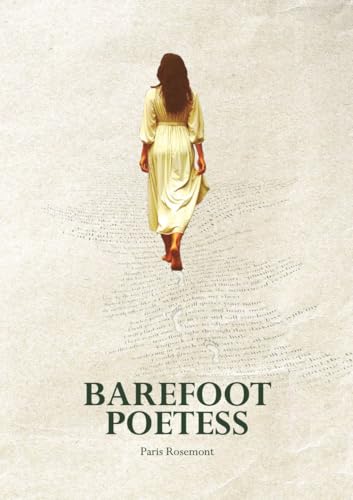
Fierce, raw, honest are all clichés used to describe strong, powerful writing, but when it comes to Paris Rosemont’s poetry collection, Barefoot poetess, they are hard to go past. However, I prefer to avoid review clichés, so let’s start again …
Paris Rosemont’s second poetry collection, Barefoot poetess, turned out to be quite the page-turner for me. This is not something I expect to experience with a poetry collection, albeit I admit to having read some page-turner verse novels. The thing is that it was a page-turner as much for its language, tone and formal inventiveness, as for its content, though the content engaged me too, from the opening poem which I excerpted in my recent World Poetry Day post. Indeed, it was that poem which convinced me to choose this book next from my review copies TBR pile.
Rosemont is a Sydney-based, second-generation Asian-Australian performance poet, and Barefoot poetess is her second collection of poetry. Her first, Banana girl (2023), was listed for several awards nationally and internationally, and won the “Distinguished Favourite” award in the 2025 NYC Independent Press Awards. My sense is that writing as a performance poet is partly what makes her poetry so accessible. Poetry really is best read aloud. Performance poets know this. They know how to infuse their poetry with the sort of power that can quickly draw their audience in. A generalisation – yes – but like most generalisations it has a basis in truth.
As I wrote in my World Poetry Day post, poet Tim Loveday describes Barefoot poetess in his Introduction as “confessional poetry in all its glorious exhibitionism”, which means that, almost by definition, they will embody the cliches of “raw” and “honest”. Certainly they appear to capture something of Rosemont’s life to date, the pain of broken relationships and the thrill of finding new ones, the experience of being Asian in a non-Asian world, the difficult act of balancing motherhood against finding her creative self. It unapologetically confronts living in a complex world. Take the title. We second-generation feminists eschewed gendered nomenclatures like, well, to be blunt, “poetess”. However, in her opening note Rosemont respects the fortitude of women who paved the way for her – which included losing terms like this – but then reclaims “poetess as an act of rebellion”. It feels, she says, “wild and whimsical, seductive and a little dangerous. I like the illicit feeling of it in my mouth… “.
I like this too. I like it because it reclaims this word with intention, because being a poetess in the past could be dangerous. Any woman who was clever with words, who self-expressed with little care for the niceties of feminine expectations, was at risk. This word encompasses that history and Rosemont uses it with vigour. So, back to that opening poem that got me in, “Mama’s flown away with the mockingbirds”. It’s a heartbreaker about mothering when you are broken, about the wisdom of kids who “know”, and about a mother’s recognition of the costs:
I pity these wretched orphans. Imagine
how unsettling it must feel to be sung
to sleep by a ghost who knows
their favourite lullabies and looks so
like someone they once knew.[But]
… their mother has brokered a fool’s-
gold escape. She has mortgaged her heart.
The cost of her wings. Two tiny souls.
What an opener.
“making poetry tutors blush”
There is a trajectory to the collection, though it’s not simply chronological. It picks up on themes and moves us through aspects of her life – her childhood as a migrant’s daughter, her failed marriage and other relationships that brought pain or joy or both, passion and sexuality, motherhood, not to mention the act of becoming a poet (“paris rosemont: making poetry tutors blush since 2022”, from “(ii) poetry with pip”). The opening poem is followed by poems expressing her anguished questions, before we move back into an earlier chronology – her migrant father’s arrival in Australia (“The Colombo Plan”) and her marriage (“Foot and spouse disease”) – and then out again. Words (like “kawasakis” and “koels”) and people (like her father and lovers, the various yous) link poems and ideas across the collection, while the ordering of the poems leave us in no doubt about intent. Life is complex. Painful poems about fractured and destructive love, are followed by poems about love’s experiments, which are followed by love found. Prose poems, which convey story more straightforwardly (but never simply), are interspersed with wilder poems and quieter ones, encapsulating more emotional responses. The prose poem “Evaporated milk” about motherhood’s dilemmas is followed by poems about the pains and dangers of love, home and childhood. Punches are not pulled, knuckles are bared, in “Terracotta knuckles”, “Home is where the dark is”, and the later “Simon says” (which starts as a prose poem but splinters at the end).
The ideas and feelings in this collection are personal and powerful. They keep us reading – often with hearts in mouths. But what makes the reading exciting is, as I’ve already said, the language, the variety of and experimentation with form, and the wit. Wit underpins many of the poems, regardless of how serious the content. “Lila’s Mixtape of Lovers” comprises 6 stanzas in what Rosemont calls a 69-er, her “contemporary twist on the form 9x9x9”. Each stanza is inspired by songs, ranging from a sitcom theme song to one from alternative rock band Garbage. They document love’s failures, and are part of a group of poems in which innuendo and explicit sexual wordplay bounce against each other to convey love’s power to inspire and destroy. “Fierce” is right for these poems, which can be both shocking and funny at once.
But there are also graceful poems expressing joy (and, admittedly, its uncertainty) and more lighthearted poems (like the self-deprecating “(i) tea with tony”). I enjoyed – partly because I love these cactus and the deserts they are found in – “We are Saguaro”. It’s a reverse poem which neatly questions the speaker’s ability to love. If you read it forwards and then in reverse, the nuance is hopeful. However, if you only read it forwards … It jolts rather than flows, but the point is made.
The poems in Barefoot poetess are accessible but not simple. They require attention – but they repay that attention with surprises of recognition (“is that …? is she really …?”, from “(iii) shooting stars”), and with an energy that is infectious. These are poems I can imagine reading again to see what more they might say.
Paris Rosemont
Barefoot poetess
Parramatta: WestWords, 2025
87pp.
ISBN: 9781923044456
(Review copy courtesy WestWords)
 Whispering Gums
I don’t deny that poetry can grab me sometimes, but it takes so much work! And that’s time I would mostly rather spend elsewhere.
I understand Bill … it’s exactly how I feel about something like The Aeneid or The Odyssey. I would rather read some contemporary poetry or verse novel than put the effort into the classics, but mostly I choose modern (as in 19th century on) prose of course.
For me, part of the issue is that poetry had a good run during which it was written for the activist and the laborer. We took it out of the hands of those folks and put it up in the ivory tower where it’s now completely inaccessible. In recent years, it seems, young people are taking poetry back. I know some of it seems rather juvenile, the stuff that gets published online on a Tumblr account, for example, but I do sense an act of rebellion. I’ve heard more about poetry in the last few years than I have in my entire life because of these Twitter poems or Tumblr poems or whatever. Got to have a gateway, right?
Interesting Melanie. I haven’t seen any of those poems but I have heard a a bit of activist poetry about injustice from performance poets. They probably mostly speak within an echo chamber but as we know it’s the echo chamber which needs to keep informed and engaged. My sense is there probably always has been the ivory tower poetry and the poetry of the people, the storytelling poetry and the sentimental poetry, etc. But it feels to me as you say that there might be an increasing energy?
I’m not sure what it’s like in Australia, but especially in the ’60s we used to have poetry for the people in the US. Now, if you use Goodreads at all, you’ll notice that the collection of poetry that wins every year is something that’s been pulled off of Tumblr and made into a book. One title in particular that I remember because it’s a reference to Super Mario Brothers is Your Princess Is In Another Castle.
I don’t remember anything that I would call poetry for the people Melanie though I remember protest poetry. I do use GoodReads but clearly not the way you do. I take no notice of GoodReads awards though I’m vaguely aware they exist. I don’t really engage with GoodReads I guess as a community.
Oh! I just mean their yearly awards.
I guessed you meant that but I don’t look at them. I’m sort of aware they exist (because some books I think have a big bold award statement in GR’s intro to them) but I have no idea of how many there are, or how they are decided.
Melanie makes a good point. The one poetry I buy from time to time is Indigenous, where people who are not always poets first make their point with a limited number of well-chosen words.
Yes, some are I agree, but there are many First Nations poets too who are every bit as abstract as other poets.
This sounds amazing and that first poem, yes is mighty! But I am a little like wadholloway, poetry is a lot of work.
Thanks Rach … poetry can be more work but I do like including it in my reading.
My reading group has on a few occasions had a poetry night where we have all shared one or two favourite poems. They have been enjoyable evenings.
Actually I can see how that would be fun, when you have a team of people deciphering the poems and their meanings 🙂
It is fun Rach. I’m so glad you can see the possibilities.
I don;t read enough poetry. I have such basic reading needs to keep me happy I need poems that aren’t so abstract it goes over my head. I enjoy nature poetry where I can visualise landscape. I also enjoy some comic poems. Poems that tell a story are fun too. See what I mean? Basic‼️😃
And there’s nothing wrong with that, says she who grew up with a father reading Banjo Paterson. But I also like witty poems and poems with words that flow in my mouth and sing in my ear even if I don’t fully “get” them.
Hahah I would like your father.
He was great … my parents complemented each other with their contribution to our love of books and reading.
It’s interesting now that ABC Sydney has moved out of their inner city-based premises in Ultimo to their new digs in Parramatta that we (I) am hearing more about the arts and culture of Western Sydney, including WestWords. And for the first time a few of the SWF events will be held in Penrith. It’s a positive development I feel.
Yes I agree Brona … it certainly has been sounding like a wonderfully vibrant culture being encouraged and supported in the west. So good to see the recognition of what the arts can do for community, isn’t it.
I love the idea of a book of poetry being a pageturner. I can recall a few instances like that, where I thought I’d just look at a poem but ended up gobbling one after the next, feeling a little like I’d peered into someone’s diary and their inner thoughts and feelings just pooling on the pages had invited me to sit a little closer to them for a while. But often I have the feeling of “well, that’s exceedingly clever” (and… I am not exceedingly clever… obviously) so, clearly not for me. When poets are able to include their notes or describe the writing process, I feel like I can tease out some understanding though, and I enjoy that (but I suspect it’s costly to include all that material, extending the page count and all of that, and likely requires a whole other kind of expertise editorially, as it would need to be edited differently than the poems themselves for publication).
Again, your experience is similar to mine Marcie. I agree with you about notes. I suppose they think their poetry should be able to stand alone. But I think it’s a bit like those artist’s statements that art students are sometimes asked to do – it would help a lot!