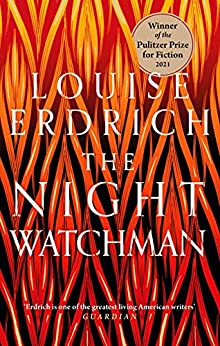
Louise Erdrich’s Pulitzer Prizewinning The night watchman is historical fiction about a community fighting back against a government set on “terminating them”. Erdrich, whom I have reviewed before, is an enrolled citizen of the Turtle Mountain Band of Chippewa Indians of North Dakota and it is the story of this community’s response to something called the House Concurrent Resolution 108 that she tells in The night watchman.
Passed by Congress on August 1, 1953, this Resolution would, says Erdrich in her Afterword, “sever legal, sacred, and immutable promises made in nation-to-nation treaties”. Or, as Wikipedia explains, it would “end reservations and tribal sovereignty” and “integrate Native Americans into mainstream American society”.
As it happens, Erdrich’s grandfather, Patrick Gourneau, was Chairman of the Turtle Mountain Band of Chippewa Advisory Committee at the time and recognised this resolution for what it was. He is the inspiration for Thomas Wazhushk, one of Erdrich’s two protagonists. Thomas is a man of two cultures:
Watching the night sky, he was Thomas who had learned about the stars in boarding school. He was also Wazhashk who had learned about the stars from his grandfather, the original Wazhashk. (p. 17)
Throughout the novel Thomas strategically draws on these two selves in order to perform his role, which is to keep the community safe (or, at least, safer, than they would be if the Government’s plans came to fruition).
This is both a sophisticated and a grounded novel. Grounded in the way Erdrich uses her storytelling ability to create a compelling narrative peopled by a large cast of wonderfully individuated characters. We are interested in them all, and this makes the novel a darned good read. Sophisticated in how Erdrich subtly layers her story to enrich its meaning. The overall structure comprises two parallel but related stories or journeys: Thomas’s fight for his community’s survival, and his niece Patrice’s journey to find both her missing sister and her own path in life. Erdrich’s writing is simple, plain, but also imbued with gorgeous lyricism, metaphor and symbolism. The novel is threaded, for example, with physical holes, wells, caves, ship holds, and falls, which never let us forget the precariousness of these people’s lives.
She also peppers the story with humour, which reminds us no matter how serious things are, people can still have a laugh. There are many laugh-out-loud moments, alongside a recognition of humour’s role in how we navigate the things we confront. In Minneapolis, Patrice finds herself in a strange and potentially dangerous situation, and has
the sort of feeling and thinking that could only be described in Chippewa, where the strangeness was also humorous and the danger surrounding this entire situation was of the sort that you might laugh at, even though you could also get hurt… (p. 131)
“Survival is a changing game” (Biboon)
Overlaying all this is Erdrich’s exploration of how language works, how it can be used to clarify or obfuscate, to inspire or deflate. Her writing embodies this knowledge. So, for example, Thomas receives the Resolution papers and reads them carefully. He sees
their unbelievable intent. Unbelievable because the unthinkable was couched in such innocuous dry language. Unbelievable because the intent was, finally, to unmake, to unrecognize. To erase as Indians … his people, all of us invisible and as if we never were here, from the beginning, here. (p. 79)
His people were being targeted, the papers said,
for emancipation. E-man-ci-pation. Eman-cipation. This word would not stop banging around in his head. Emancipated. But they were not enslaved. Freed from being Indians* was the idea. Emancipated from their land. Freed from the treaties that Thomas’s father and grandfather had signed and that were promised to last forever. (p. 80)
Later, the once dapper but now frequently drunk Eddy Mink cuts to the chase, stunning officialdom with his plain language statement:
The services that the government provides to Indians might be likened to rent. The rent for use of the entire country of the United States. (p. 200)
Meanwhile, as Thomas builds his case, Patrice, who works in the Turtle Mountain Jewel Bearing Plant where Thomas is the titular night watchman, sets off for Minneapolis to look for her sister. Vera had gone there with her new husband but had not been heard of since. What Patrice finds in the city, how people can be exploited, is shocking, and she returns home somewhat wiser but with more to learn about herself and the ways of humans.
Surrounding Thomas and Patrice is a large community of people – family, friends, neighbours, work colleagues, teachers, coaches, visiting missionaries, and even a ghost. The interactions between these people build up a picture of a community that functions despite external stresses and the usual internal disagreements. This makes engrossing reading because these characters are so real, including the two Mormon missionaries who not only add humour and pathos but also represent the naiveté of supporters of a faith – in the form of Utah Senator Arthur V. Watkins – that was driving the Resolution.
Similarly, our protagonists’ interactions with specific individuals make great reading while also advancing the narrative and the ideas. When Thomas is with his father Biboon and Patrice with her mother Zhaanat, we feel their spiritual connection with their culture, and their desire to learn from their elders. When Thomas is with the white teacher and boxing coach, Barnes, we see how little non-Indian society understands the existing situation and the implications of the Resolution. Thomas patiently – and generously – explains to the clueless Barnes why Indians are not, and can never be, “regular Americans”. And, why he, Barnes, cannot be an Indian! Just look at this writing:
“If I married an Indian woman,” said Barnes, “would that make me an Indian? Could I join the tribe?”
He was awed at the possible sacrifice he could be making.
Thomas looked at the big childish man with his vigorous corn-yellow cowlicks and watery blue eyes. Not for the first time, he felt sorry for a white fellow. There was something about some of them—their sudden thought that to become an Indian might help. Help with what? Thomas wanted to be generous. But also, he resisted the idea that his endless work, the warmth of his family, and this identity that got him followed in stores and ejected from restaurants and movies, this way he was, for good or bad, was just another thing for a white man to acquire.
“No,” he said gently, “you could not be an Indian. But we could like you anyway.”
In statements like “he was awed at the possible sacrifice he could be making”, Erdrich conveys more about cultural superiority than just this man’s thoughts.
When Patrice is with her girlfriends and workmates, Valentine and Doris, we see how her goals diverge from their more girlish ones, and when she is with Wood Mountain we see her inner conflict about her chosen direction. As a young person, her journey is more personal than Thomas’s but they coalesce when it comes to saving the community.
“Assimilation. Their ways become your ways.” (Roderick)
I loved spending time with these characters. In fact, so did most of my reading group, as this novel was our September read. We enjoyed her vividly drawn characters – and their perfect names, like Juggie Blue, Wood Mountain, Louis Pipestone, Millie Cloud, and Patrice not Pixie. We teased out the complexity of the storytelling, the way Erdrich seemed to effortlessly incorporate complex ideas into a compelling narrative. This starts right at the title, The nightwatchman, which is both literal, Thomas’ job, and metaphorical, in his role of keeping watch as the community’s Chairman. I was reminded a little of Melissa Lucashenko’s novels, in which tough stories are told with compassion and humour to paint a picture of real people confronting a world that’s against them.
Early in the novel, Thomas moves that the Committee call the Resolution the “Termination Bill [because] Those words like emancipation and freedom are smoke”. This bill heralded what is now called the Termination Era (1953-1968). As Erdrich explains in her Afterword, this is what happened to 113 tribal nations. Although some regained recognition, “31 are now landless” and “24 are considered extinct” (p. 447).
The night watchman is one of those books that hits the spot – the heart spot and the mind spot. Recommended.
* The novel is set in 1953, and Indian is the term most commonly used when the specific Chippewa is not.
Louise Erdrich
The night watchman
London: Corsair, 2020
453pp. (Kindle edition.)
ISBN: 9781472155337
 Whispering Gums
Have just got back online, ST – by myself, with the amazingly patient help of Aussie Broadband’s Support people. But as I have a new NBN box, and the phone connection is one of those ancient cream-coloured small sideways thingies with a screw in the bigger end !!!, I believe this pertickler flat hasn’t actually been online before !! It were challenging, but it were fun (in the end).
Now. This very lengthy but remarkably appealing and fascinating review of a story that tells all you need to know about the US and its trustworthiness is the book they made a movie of, yes ? Didn’t see it, and it’s probably nothing like the book. Dunno why I even said that. 😦
Would I be expected not to scream at the Mormons ?
Would I cry at the end ?
Did my comment not come through ?
Yes, it came through, MR! I’ve been wondering how your move went. I’m not surprised you managed to work it all through. You have technological nous!
There are films called The night watchman, but this novel has not been adapted as far as I can tell. I wonder how it would go as an audiobook. It is such a great story, but told in many many small chapters. When you are reading it, seeing the start of a new chapter alerts you to the change in perspective but in audiobook it could be more abrupt. I wonder.
It is a lengthy review I agree. But I wanted to also say something about the reading group, and I still didn’t include so much!
I only said ‘lengthy’ because it’s unusual for you, and therefore there’s an underlying theme — you really like it ! 🙂
Haha, I did MR, though length of review shouldn’t necessarily be taken as an indicator of degree of liking.
Now that’s true, because I’m pretty sure I’ve seen a somewhat longer-than-normal but politely scathing review, somewhere along the way …
Who moi? Surely not! Hmm, perhaps yes, while I have never reviewed a book that I didn’t think had anything to offer, there’s been the odd one that didn’t sing to me.
PS I have my fingers crossed that you’ll be happy in your new abode.
Thank-you, dear ST: I haven’t been as happy with a place and environment for a very long time.
That’s wonderful to hear MR.
I’m so hit and miss with Erdrich that I hadn’t even considered reading this, but now you have me rethinking that 🙂
Thanks Stefanie … I think this is a standout but I know this is a region you know so I’d love to know your thoughts on it.
I’ve only read one Erdrich to date (LaRose) but I thought it was magnificent, so I would like to read more. Will add this to my list of possibilities.
Oh I’m glad Brona … if you’ve read and liked her before I can’t imagine you wouldn’t like this.
I have been reading a bit of North American FN writing over the past year, though no Erdrich recently, fiction and non-fiction. It is clear that over and over north American governments signed treaties to gain for themselves a particular piece of land, then ignored them as soon as they wanted more land. I think the ambition all along was to turn FN from separate peoples to a more manageable underclass.
That’s certainly how it seems to have turned out Bill … though I suspect the specific goals probably changed as they saw how things were playing out. I guess I’m saying the ambition was the land, rather than the mechanism (manageable underclass).
Yep and they will justify as to why as well.
They will!
What’s funny is that the book review that I read just before this one is Erdrich’s newest novel, which was reviewed by a Canadian blogger friend. I was telling her my thoughts about the night watchman book. I felt a little overwhelmed by how many subplots and characters there were, but as I was reading your review, I realized that if she had written it and advertised it as a collection of stories that had an overarching theme, I might have had a better sense of how to approach it. Instead, I just felt like I was falling into one chapter after the next with no sense of where we were going. I’ve read a couple of story collections that were linked in some way, well, actually, both collections that I’m thinking of right now we’re laying to buy a neighborhood. Each story was about a certain house or neighbor. Anyway, I think Erdrich could have done something similar, and I would have had a better sense of where we were going in a more enjoyable experience. This is not to say that I dislike her writing. She’s engaging for sure.
That’s interesting Melanie. A few in my group took a little while to get into it and I think you’ve explained what many of them felt. I didn’t find that an issue. However, I do I hear what you are saying. It has a lot of mostly short chapters that keep switching characters, but for me it still worked as a novel because there’s a strong chronological narrative running through all those little chapters. I’m glad though that you like her writing. She is engaging I agree.
I believe she has another book that’s set during covid that I would like to read.
I’ve just heard about a new one but hadn’t realised it was set during COVID. That interests me even more. Thanks!
Ah, it’s not new. It’s called The Sentence. I had to Google it.
This and The Mighty Red (the one Melanie refers to being reviewed recently by a friend-in-common) are the only two I haven’t read. When there was only one, I wanted to save it, but now I’ll have to choose which of them comes next for me. The dialogue you’ve quoted here seems to fit perfectly with the bulk of the content in Tanya Talaga’s The Knowing: I think I’ll aim for this one next.
Thanks Marcie … I wondered what the book was. Hadn’t looked it up yet. I’d love you to read this one to hear your thoughts, particularly in the light of Melanie’s comments re form.
One of the reasons that I love Erdrich and have been relatively dedicated to her fiction (whereas more typically I say that I do WANT to read more of an author’s books…but I don’t make time for it) is that there is a mass of characters and voices. Because so many of her books are actually linked (in small ways, not the kind where it’s necessary to understand the connections in order to enjoy the books separately as standalones, but connected all the same) and the characters overlap. But I think it’s fun to sort all that out and see the community take shape across several books. So I’m just not likely to be thrown by even the messiest of shifting-POV novel in her oeuvre: I’m used to it. But there are lots of things that do throw me off in reading, like world-building in SF or FAN or speculative fiction, which we chatted about recently: if I read more, I’d feel more comfortable with it, but I need more experience to feel more comfortable.
Oh that’s interesting Marcie re connections across books. This is only my third and the first was her collaborative novel with her ex and late husband. The other was The bingo palace. I’ll have to check re any connections.
As for world building I think my response to your saying you “need” more experience is, but do you “want” it. I’m not sure I do! I’ll keep reading some speculative fiction but I will probably focus on those that aren’t too different in worlds, like Arboreality for example.
Hmm, curious question. Do I need it for the sake of it? No. But I would need more experience reading that kind of fiction, enough to feel a certain ease, in order to gauge whether an author has handled the mechanism (i.e. world-building) effectively or competently or poorly or briliantly. Like with the new Nalo Hopkinson, I mentioned that I was slow to settle into the story, found it took effort to orient myself in it, because I don’t read a lot of world-building fiction. My hunch is that she did everything right and that another reader could fall seamlessly into her story, but I would need to be more familiar with other stories like it, to assess how much of that is a result of how I read and how much of it is a result of how she writes.
I’ve thought about paying more attention to worldbuilding fiction, following new releases and catching up on some prize-winners, but so far it’s all thought (a little talk) and no action! hehe But, hey, did you see that Rebecca Campbell has a new book coming soon?
Last point first … no I didn’t. But I’ll be interested to see what she does.
Re the first. My question was partly tongue in cheek but also serious. You (as in one) need more experience if you really want (or need, say, professionally) to understand and/or enjoy these books. With the time I have for reading I don’t have that need. Which is not to say I don’t want to be challenged but that I prefer different sorts of challenges. I think for me plot is so unimportant – though I do like a story – that having to focus on understanding a different world in order to follow the plot is not among my reading preferences.
Never read her, but I do have Future Home of the Living God that my sister insisted I read.
I think I like your sister, John. Sounds like she has good taste. I’d love to read more of her than the three I have.