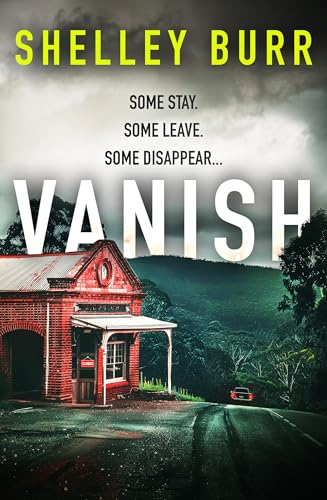
With Vanish, the third novel in her Lane Holland series, Burr mixes it up yet again, which appeals to me because my main reason for not liking genre fiction is that it can be formulaic. I know this is why many like it, and I understand that need for comforting reading. It’s just not my need.
So, a brief recap. In Wake (my review), we are introduced to a private investigator, Lane Holland, who arrives in a remote, outback, fictional town to investigate an old missing persons case. He’s keen and caring, but he also has his own agenda – and the resolution is shocking. The next book, Ripper aka Murder town (my review), is set in a different country town. It initially looked like something different, as Lane is in prison from Wake‘s fallout, but it soon becomes a dual investigation story that coalesces when it turns into both a murder and a missing persons case.
And now, book 3. It seems you really can’t keep a good PI down, even if he is in prison! Vanish is set a few years later. Lane is still in prison but, because of prison governor Carver’s vested interest, he soon manages to get himself on a pre-parole release program in order to continue the unsolved investigation from Ripper. If you’ve read Ripper you’ll know what that is, and if you haven’t, it becomes clear very soon. My point, though, is that once again Burr has produced a highly readable crime novel that manages to be a bit different from the preceding book, while retaining enough familiarity for those invested in her characters and worldview. It’s a fine balance that Burr has trodden nicely.
Like its predecessors, Vanish belongs to the rural noir sub-genre, and is consequently, noir-ish – or Australian Gothic – in tone. It features characters we have met in the previous novels, including Lane Holland, his sister Lynnie, and his first client Mina McCreery. Further, its plot centres again on a missing person. In Vanish, however, there’s more than one missing person. A serial missing persons case!
Some stay. Some leave. Some disappear.
“Some stay. Some leave. Some disappear” appears above the title in the book’s first Australian edition (as you can see in the cover pic above). What it references is the main setting of the novel – a farm near Hume Weir, southeast of Albury, an area Burr knows well. At the novel’s opening, Lane has tracked down several missing people as having visited this farm, then disappearing from view – hence the tag line. What is this farm, and why have some people disappeared? Lane wants to find out and Carver, with his daughter still missing, is happy to help him do so.
Consequently, with ankle bracelet, a prison guard minder, and an agreement for him to work at the farm, Lane arrives – but not without a mysterious-sounding death having just happened on the road in. This, of course, captures Lane’s attention – and we’re off.
Now Lane is, of course, your suspicious type. He takes nothing at face value, and he closely observes all that’s going on around him. There’s something about this farm that doesn’t feel right. Is it a community of like-minded people who want to escape their old lives and live more simply, growing their own food and reducing their energy impact on the world? Or is it a cult? How genuine is the owner Sam Karpathy, not to mention his recently deceased father? What do the people in the nearby township know, and why do they seem evasive when Lane tries to find out? And, why is a certain person from a previous novel there too?
Oh, and who is the trapped, sick, or injured person whose story is told in short italicised sections interspersed with the main narrative? (It added to the intrigue, and I didn’t guess it at all.)
As in her previous novel, Burr’s builds her crime story around wider issues. In Ripper for example it was “dark tourism”. Here, it is the idea of people wishing to live eco-minded, sustainable lives. So, as the investigation progresses, Burr also interrogates what this sort of life means in terms of whether or not you compromise and why, whether you stockpile for an end-of-world scenario, whether you eschew western medicine, and so on. These are questions Lane considers as he tries to understand the community he is living in. And it starts with the controlling Karpathy.
Lane, as he needs to be, is a trustworthy narrator for us. The novel is told third person, through his eyes, and he brings us along with him, sharing his thoughts and explaining his processes. His awareness of body language and his experience of human behaviour guide his actions. I loved those details. There’s risk and tension, some creeping around the farm at night, a locked room, magic mushrooms, and more. I didn’t find it edge-of-the-seat suspenseful, but I don’t like that anyhow, so the level of stress was just about right for me. The plot builds slowly, sending us off in various directions, and keeping us uncertain as we consider what Lane sees and questions. Is Karpathy, for example, coercive or simply wanting to keep control of a dream he is vested in. The denouement, when it comes, unfolds quickly, and at just the right time.
I enjoyed the read. I have been invested in Lane from the beginning, and he continued to interest me in this book. He’s conscientious, intelligent and decent, but, appealingly, is not always sure of himself, particularly when it comes to relationships. Also, Burr evokes place well. The farm, which is set in mountains just far enough from a little town to feel isolated, feels believable, as do the natural disasters – flood and bushfire – which threaten it.
My only question now is, will we see more of Lane? As a convicted felon he will not be able to renew his investigator licence. There is a hint at the end that there might be a way around it. Time will tell, but if you are a Lane Holland fan, I think you can have hope.
Shelley Burr
Vanish
Sydney: Hachette Australia, 2023
384pp.
ISBN: 9780733652158
(Review copy – an uncorrected book proof, hence no quotes – courtesy Hachette Australia)
 Whispering Gums
Hmm … I missed your previous review, ST; and I regret that.
But never mind: now I have a most interesting trio of books to explore ! 🙂
Great MR – I know you are a crime aficionado so I’ll be interested to hear what you think.
Uh-oh – WordPress playing up again …
I have posted.
Now I wait to see …
You waited … I saw!
I was afeared nobody would. 😦
As a Victorian (and a pedant) I would say the farm is south east of Wodonga.
I read lots of crime fiction because that’s what libraries stock, and if it’s mostly set overseas then I am less likely to pick faults with it.
No results for Shelley Burr in Borrowbox (I assume that’s just for WA)
Hopefully, Bill. Because I’ve read them o have t looked.
I actually had Albury-Wodonga in my original post Bill but then realised that Albury is the place she mentioned because he was in a NSW prison so his pre-release program had to be run out of Albury correctional centre!
As for picking faults I thank that’s awfully unfair of you to pick on Aussie writers!!
I like the sounds of the italicised bits from another character…and particularly like the fact that you didn’t manage to guess its significance. Well-done crime fiction, especially that which highlights social issues of importance, is a wonder to me.
To me too Marcie.
I’m guessing he goes rogue! Or, at least that’s what keeps happening in my Lucy Kincaid books. I love that we’re both reading detective-type books right now and enjoying ourselves. I will say I’m intrigued about reading a book that’s set in Australia and really evokes the setting. Part of my intrigue comes from the fact that I’m currently listening to a new season of my horror podcast, in which the podcaster is covering what he calls “nature bites back.” The last few episodes have been about Australia, so he gets guests who know the landscape and who live there, who can talk about what it’s like to live in a place that is so extremely barren, as far as humans go, except for a few cities on the coasts. He’s covered Wake in Fright, Picnic At Hanging Rock, Long Weekend, and Razorback.
We’ll see what happens next Melanie.
I like the sound of your podcast … Australia, like the US, has some great landscapes in which to imagine horror.
According to the podcaster and his guests, Australian horror is often commentary on colonialism and disrespecting the landscape.
How did I miss this? I think the podcaster makes a fair point.
Does anyone think Shelley Burr when writing Vanish could have been influenced by the Erin Patterson mushroom murders?
Not me Mimi… I don’t really see much crossover but have I forgotten some critical detail? Vanish has a very different scenario.