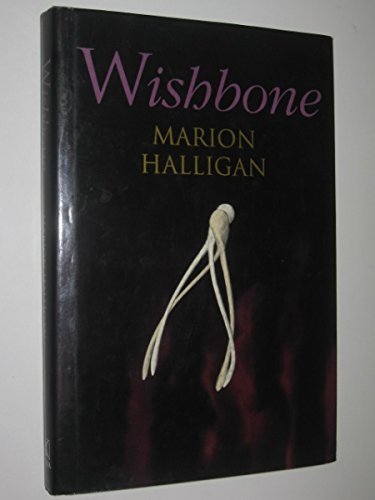
My reading group’s last meeting of the year took the form of a tribute to Marion Halligan, who died earlier this year and who had generously attended our meeting when we discussed her Valley of grace (my review). We have done this once before with Helen Garner (albeit she hadn’t died) and it worked well. The process is that we choose something we want to read and share our thoughts with the group. I have read several of Halligan’s books, but I have a few on my TBR, so of course I chose one of those, Wishbone, her fourth novel, published in 1994.
Before I share my thoughts on that, I thought you might like to know what everyone read. Ten members attended the meeting. Some read two books, while others chose a short story or article. It is, after all, a busy time of year. The novels read were, in chronological order, Wishbone (1), The golden dress (2), The fog garden (1), Valley of grace (1), Goodbye sweetheart (2). Three people read her most recent memoir, Words for Lucy, while others read selections from Canberra tales (“Most mortal enemy”), The taste of memory (the first piece), Canberra Red (“A city of mind”), and Shooting the fox (“Shooting the fox”). In other words, we read widely across her oeuvre, resulting in an enjoyable – and occasionally excitable – meeting as we teased out some of her themes and ideas, including how much of her fiction was drawn from life!
“who knows what the hell is going on”
So now, Wishbone. It tells the story of a woman, Emmanuelle, her “motley family”, and the wishes they have for themselves. The novel starts with a young, passionate Emmanuelle having an affair with a married man, but it soon jumps some years hence when she is now married (to a man named Lance), and living in well-heeled Sydney with two children, Maud and William. The rest of the novel follows a period in the lives of these four and others in their close circle – friends, family and employees. During this time, we experience a life-threatening stroke, extra-marital affairs, mistaken assumptions, and a suspicious death, all set within perfectly rendered scenes of domesticity. Halligan can make you gasp with her audaciousness.
As I was reading this novel, a light dawned for me about why I so often use Jane Austen as a benchmark for writing I love. I do like all sorts of writing, but I am particularly drawn to writing that exposes human nature with wit, irony and a generous spirit. This is what Austen does, and this is also what Halligan does. Wishbone is a generous story about messy human lives. Halligan writes with a knowingness about those deep-down thoughts, wishes, and desires we all have, but she is also forgiving about her characters’ foibles and less admirable traits and behaviours. In Wishbone, she explores the tension between our wishes – particularly regarding love – and living with what you’ve got.
There’s something of a fatalist element, here, in the sense that we think we have choice in all this, but choice proves in fact to be elusive. Things happen that we have no control over. Late in the novel, as Emmanuelle sits around the kitchen table with her two children and au pair Mel, in what looks to be a cosy domestic scene, a question – which is both literal and existential – is suddenly proffered, “who knows what the hell is going on”. Who indeed? (And who is asking the question? Emmanuelle, surely, but there’s also an omniscient voice overlaying the characters’ perspectives. At least I believe so. Wishbone slides seamlessly between voices and perspectives in a way that never loses the reader, but that ensures we see multiple sides of things.)
This brings me to style, and how Halligan does what she does. Halligan is a born short-story writer. As I started Wishbone, I almost wondered whether I was reading a book of short stories. Every chapter is gorgeously titled and most felt like they could stand on their own as little nuggets from a life. The opening chapter, The Glade, tells of Emmanuelle’s youthful affair with her married man. It starts:
The difficulty of a love affair between a young woman and a married man may be its logistics. Where can they go? He lives with his wife. She lives with her parents.
They can’t afford hotels, and anyhow it’s too risky as the town is small, but Brian knows “a good place”, a little glade under a cliff. Whenever Brian thinks of going to the glade, he whistles Handel’s tune, “Where e’er you walk”, which “always gladdened his wife’s heart, because she knew her husband was feeling cheerful”. Halligan’s discussion of this song, Brian’s behaviour, and the wife’s response is delicious in more ways than this little irony, but I will just share Halligan’s nailing the point, with “the song told her about the walking and the sitting but what she didn’t know about was the lying”. Just think of the double meaning in that last word! This writing just makes you splutter.
From here, the plot unfolds quietly but surely. Hints are dropped but aren’t heavy-handed, so we are still surprised when certain events occur, which brings me to the title, and its reference to wishes. In the third chapter, The Man in the Train, there is a mostly mundane discussion about wishes until the chapter’s titular, and unnamed, “man” asks Emmanuelle what she would wish for. Her answer?
I would wish for the gift of making dangerous choices.
As the novel progresses, various characters express their wishes. Emmanuelle’s friend Susie idly wishes she were a widow, while au pair Mel wishes she were beautiful. Emmanuelle wants more passion from her husband, while chauffeur Stuart wants money. And so on … What these characters learn, you won’t be surprised to hear, is that their seemingly ordinary, or common, wishes often carry a danger that is not expected. You know that saying, “be careful what you wish for”. But Halligan’s book is no simple moral tale. What Emmanuelle realises near the end, in fact, is that all choices can be dangerous. Susie asks her:
Have you ever wished Lance dead?
I’ve wished him different.
And did that come true?
Not in ways that I’d have chosen.
Where does this leave us? We won’t stop wishing, and we certainly can’t stop making choices, but we can think about our choices and be realistic about the outcomes, whether they are the expected or unexpected ones. In the end, Emmanuelle probably has the answer:
being alive is like reading a book. You might think you’ve got a fair idea of the plot but you don’t actually know what’s going to happen next, you’re as much a mystery to yourself as a character in a novel. Perhaps the secret is just to keep turning the pages.
Reading Wishbone has reminded me how much I enjoy Halligan. I must get back to that TBR.
Marion Halligan
Wishbone
Port Melbourne: William Heinemann Australia, 1994
235pp.
ISBN: 0855615974
 Whispering Gums
Crikey, but you guys are bold !! – having an author to a reading group meeting ?!
And … HELEN GARNER ???
[gasp !]
I don’t know Halligan, as you deduce. But your review indicates that I oughter. 😀
Oh no MR we didn’t have Helen Garner! She lives in Melbourne. She was the other one we did one of these choose-a-book nights for. Yes you oughter read Halligan. I think some will be available in audible. The golden dress would be a good one I think, but she also did two crime – cosy crime I think though I’ve not read those – novels.
We’ve had a few authors at our meetings and will have another next year.
Marion Halligan is among my favourite Australian writers. I still have a few of her books on my TBR. My favourites (so far) are Valley of Grace and Hanged Man in the Garden. I am fortunate to own a copy of her now out of print children’s book The Midwife’s Daughters, which is a delight. I bought it in the late 90s in an independent bookshop in Sydney. I blogged an excerpt of it here: https://theslowacademic.com/2019/04/12/always-interruptable/
Lovely to find another fan Agnes. I’ll check out your post. Valley of Grace is the book she attended our meeting for. She was wonderful. I wrote a post on the book but also one on her from that meeting. You can find them on the Marion Halligan tag on this post. She was so warm-hearted and generous.
What a perfectly beautiful account of Wishbone. It is so good to see that the group has had a session where dear Marion was honoured. It sounds like a festival of her own.
Reviews like this are so very relaxed and enjoyable.
As for the titles of the chapters – she used to give them a quick identity as she was writing, and then she would often find that this was just right for the heading. When she came to Goodbye Sweetheart, the titles she had given each section, and which she used as the chapter headings, were particularly laconic. They are in fact often hilarious – for example: ‘Aurora Drinks Vodka’, ‘Ferdie Takes the Bus’.
Thanks Carmel … and thanks for that insight into her chapter heading – cum writing – process. That’s fascinating, but so real sounding.
I have a first edition of this book, bought from the wonderful, but now closed Muse (which you might know was graced by that lovely painted portrait of Marion). Muse sold mostly new books, but Dan the bookseller also had a small selection of secondhand books on his shelves. Anyhow, all this is to say that on the back is a snippet from your Age review in which you described it as “at once sharp, witty, serene and disturbing; it is strong and tender”. Perfect. I also like the snippet from Helen Elliot which includes that Halligan is “the most eagle-eyed novelist on the continent celebrating and catching life as millions have known it”. Also true.
There was also a fabulous review of Goodbye Sweetheart by Felicity Plunket – in the Australian.
Thanks Carmel …
Just want to make sure we haven’t got confused, though. When I said “this book” I was referring to Wishbone (and your and Helen Elliot’s review of that), not Goodbye sweetheart which you mentioned in your comment. Regardless, I’m always please to know about good reviews.
Yes – that’s why I named ‘Goodbye Sweetheart’ – since it was not the novel you were discussing – I think the Felicity Plunkett review is a superb analysis of Marion’s work, generally. I am sorry if I was not clear enough.
Oh great … thanks for clarifying Carmel. I just wasn’t sure. I will try to find that review as I’d love to see her thoughts about Marion’s overall work.
I think you were clear enough, but I wanted to make absolutely sure!
Thank you for your tribute, WG. A marvellous writer and a wonderful friend.SaraSent from my iPhone
Thanks Sara … it was a good meeting. She went too soon didn’t she!
I read a couple of Halligan’s back in the 90’s and have been meaning to read more ever since, but I have forgotten everything about Wishbone, so perhaps I should simply reread the ones I have kept all these years!
I’d like to know what the ‘excitable’ bits of the meeting were about when you have the time 😀
I don’t think it matters a lot, in a way, Brona whether you reread one you have forgotten or read a new one. I think all her writing – that I’ve read so far – is delicious. I don’t remember a couple of the ones I read very early on in detail but I don’t have those because they were the days we got books from a book club service (Victoria’s CAE).
The excitable bits revolved around that issue of how much of fiction is drawn from life. I’m very much a “this is fiction” person. Of course, I know a lot of fiction is drawn from life, but I’m very happy to leave it at “drawn from” and not assume anything more unless, perhaps, the author tells me.
“I love a sunburnt nipple.” That’s the line that always brings a smile to my dial when I think of Halligan. It’s Richard speaking to Martha in one of the stories in the Hangman in the Garden collection. She was a brilliant writer of short stories, capturing so much with so few words.
Thanks Karenlee … I’m glad I’m not the only one who remembers some of her lines. I haven’t read that collection so don’t recognise your line.
After all these fine comments I have to admit Marion Halligan is not an author I know. (re Carmel Bird’s original comment about chapter headings – I struggle to write posts if I haven’t first given them a title).
Oh Bill … this is terrible but not surprising. She’s a wonderful Australian woman writer who won or was shortlisted for enough awards to be better known than she is. I don’t understand it. I think you’d like her.
I take your point re writing posts. I’d like to write creative post titles but in terms of search engines, I understand that author-title titles are the best, so I decided long ago that that was my approach. For me then it’s the first sentence or the first sentence about the book that I need to get in order to write my post. I can spend a lot of time trying to get that.
“Wishbone is a generous story about messy human lives.”
Sold!