My first reading group book of the year, Amy Witting’s Isobel on the way to the corner shop, nicely doubles as a (late) contribution to Bill’s AWW Gen 4 week. Winner of the 1993 Patrick White Award, Amy Witting is one of those much-admired Australian writers who had not then and still has not received the full recognition she deserves. In her lifetime (1918-2001), she was admired by Patrick White, himself, and Thea Astley. Australian poet Kenneth Slessor is recorded as having said “tell that women I’ll publish any word she writes”.
Another admirer, Australia critic Peter Craven, argued that her form of realism wasn’t really accepted by the reading public until Helen Garner appeared on the scene, but for him “Witting was a great master of realism, a naturalist who could render a nuance in a line that might take a lesser writer a page”. Take for example this two sentence paragraph from our socially unconfident protagonist early in the novel:
The prison of other people’s eyes. No prison narrower.
So now, the book. Isobel on the way to the corner shop (1999) picks up the story of Isobel Callaghan that Witting had started in I for Isobel ten years earlier. You don’t need to have read the earlier book to enjoy and appreciate this one, because enough of Isobel’s past is given for us to have a sense of why she is the person we meet here.
“I have to step out into space”
The person we meet is a 21-year-old woman who, having received some encouragement from an editor, is struggling to establish herself as a writer. She’s poor, starving and isolated, having left her job after screaming at a colleague in “a rage”. She fears she’s going mad. I was engaged from the start by her strong sense of self, her vulnerability, and her determination to be independent, and I enjoyed every moment I spent with her. I felt anxious, as anxious as she did when she felt she was going mad, and just as relieved as she was when her illness was given a name – tuberculosis.
The first third of the novel introduces Isobel and takes us to the moment of her admission into Mornington Sanatorium in the Blue Mountains. In this section, some of the novel’s themes become apparent – one being the artist’s struggle to survive. Another concerns love. The novel starts with Isobel stalled over writing a love scene, because she doesn’t “know the first thing about it”. Not about parental, family love; not about romantic love. This, and her sense of herself as awkward and unlovable, cause her to make a big – and hurtful – mistake when a young man makes a gesture of real affection towards her.
Over the rest of this section of the novel, Isobel meets some people who show genuine kindness – love – towards her. Although the hospital makes her feel like a “parcel”, the section closes with a comforting touch from hospital volunteer Mrs Delaney, “the first time anyone had touched her in kindness”. Through the remainder of the novel, Isobel observes and experiences all sorts of expressions of love (and its opposite), including through a delightful little poetry discussion group at the sanatorium, which starts when Doctor Wang asks Isobel to explain Gerard Manley Hopkins to him.
In the final two-thirds of the novel, another theme that was nascent at the beginning, comes to the fore, and it’s to do with “being oneself”. Isobel’s sense of self is challenged at the sanatorium. It’s an inspired setting because it encompasses a microcosm of society: patients of a disease that doesn’t discriminate between rich and poor, their visitors, and the doctors, nurses and other staff with whom the patients come in contact. Finding your place in such a world, where you can be stuck for months, is not easy.
Isobel is particularly tested by her room-mate Val, a peevish, inflexible, and, she thinks, illiterate woman. Val is unhappy, and like many unhappy people, is self-absorbed. She “felt for no-one”. Try as she might, Isobel cannot get their relationship onto a comfortable footing:
Is it possible to cause so much misery to another human being, simply by being oneself? she wondered, feeling a reflection of that misery. No help for it; she must continue to be herself.
Maintaining your self is difficult, though, when you are “different”, as our funny, resourceful, and compassionate Isobel clearly is. At one point, when her recovery is threatened, she realises that she must be tougher, and so creates a new mantra for herself, “bastards get better”.
There is, surely, a hint of autobiography here, for Amy Witting’s name is a pseudonym, chosen to remind herself to “never give up on consciousness’, not be unwitting, but to always remain ‘witting'”.
Gradually Isobel does get better, physically and emotionally. She discovers, for example, that people from her old workplace cared deeply about her:
I have to live as if…I have to assume that I have some importance to other people. I have to live accordingly. I have to step out into space.
With this comes debts and responsibilities, something new for her to accommodate.
Peter Craven described Witting’s work as “a form of realism”, and “realism” sounds valid to me. The novel contains minimal drama of the narrative-arc kind. Instead, there’s astute, warm and sometimes wry, observation of ordinary people living their lives. Witting looks into the hearts and minds of human beings to understand who we are, and how we get on together with all our differences. She also offers some subtle social commentary about gender, race, poverty, class. These are not the main game, but they inform the realism inherent in the setting.
Ultimately, Isobel on the way to the corner shop is about how a young artist learns to maintain her integrity, her authenticity, while also behaving responsibly and compassionately. It is, in a way, about growing up, but it encompasses far more too.
Amy Witting
Isobel on the way to the corner shop
Melbourne: Text Classics, 2015 (orig. pub. 1999)
311 pp.
ISBN: 9781922182715
 Whispering Gums
Great review !
Can’t help wondering how she managed to satisfy Dr Wang’s need for explanation: talk about a tall order !! 🙂
Ha ha, M-R, she did and Witting’s portrayal of these poetry discussions were fun. This would be a good audio-book I reckon, if it’s around.
I dunno, ST: I reckon I’ve done GMH quite enough, thank-you !
Oh, he only has a handful of mentions, M-R. I mentioned him because he was the first poet mentioned and I love him. One of my favourite poems of all time is his Spring and fall, but I love so many of his lines. The have such music to them.
His work was flogged so unmercilessly throughout my convent school days that due appreciation of that marvellous beat was lost during them. One appreciates more when not being told to. 🙂
Ah, yes, I guess they loved his religiosity.I found the more religious poems powerful in a way but we discussed them at school and university from an intellectual POV.
Never read an Amy Witting I didn’t love.
I agree with you Guy … and I love that you’ve read and enjoyed her because a lot of Aussies haven’t.
I was taught French by Amy Witting at Cheltenham Girls High School in Sydney in the 1960s. We knew her as Mrs Levick. I was also taught English (including English Honours for the Leaving Certificate) by Thea Astley (Mrs Gregson). We were very privileged but I suspect that most of my schoolmates did not appreciate either of these amazing women.
That’s so lucky Ros. You said this on my post on a short story of hers, but I’d forgotten until I looked at that post when preparing this one. They are memories for life aren’t they.
I didn’t know of Amy Witting at all until you and Lisa began talking about her recently. I see I have on my shelves Marriages (short stories) from one of my bulk purchases no doubt. I should send it to you and try and find I for Isobel for myself. I like Garner, I like autofiction. It should be just the thing.
And thanks for adding to our AWW Gen 4 reviews.
This is, to me, the sad thing Bill. She should be better known. I reviewed a short story of hers back In 2017 when Text published a short story collection of hers. I did that partly because it was a quick way of getting her onto my blog.
The whole autofiction thing is tricky with her because she avoided talking about that I understand, but I think it’s generally accepted that the Isobel books have a strong autobiographical element.
Oh, and I love adding to your reviews.
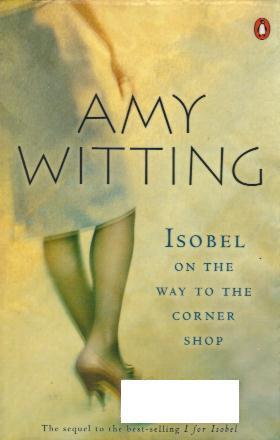
I have just read I for Isobel, Sue, and it was fascinating for me to read about her mother who sounds very similar to mine unfortunately, but that meant I could relate so much to her anxiety and fraught home life! I’ve ordered Isobel on the Way to the Corner Store from Ebay (along with I for Isobel) – I actually love the old covers instead of the text classics! I am looking forward to reading this one and will let you know what I think when it arrives. I do remember a friend reading it in Melbourne long long ago, but I evidently had no interest at that time, so I’m catching up now.
I’m so sorry I was too late for Witting and Astley at Cheltenham!
Yes, lucky Ros, eh? Anyhow, I’m so glad you liked it. She’s such a clear and perceptive writer, and Isobel is such a great character. I look forward to hearing your thoughts on the second one.
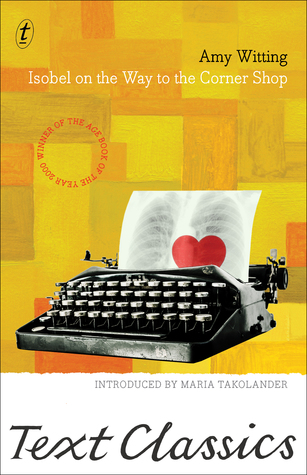
This sounds like my cuppa for sure. Such a cute title. And I just love the cover illustration.
I reckon it would be, Marcie. And it’s not long!
Do you mean Text’s cover, or the original one?
The typewriter! 🙂
Yes, good, because I think it’s a great cover too. WH Chong is an excellent book designer.
This novel sounds wonderful, and the quotes you provided sure did get my thinking, especially that one about other people’s eyes being the most narrow prison. I’d never thought of it that way, but she’s not wrong. If you imagine the way in some cultures we narrow our eyes purposefully to show dissatisfaction, the prison becomes even smaller still.
I did somewhat recently read a tuberculosis memoir by Betty MacDonald (I’m reading quite a lot of her just recently, and it’s all Bill’s fault). The novel was quite sad but educational, from the noises people with lung diseases make to the procedures and therapies they used. Nurse friend/blogger Lou confirmed the treatments for collapsing a patient’s lung and not letting them do ANYTHING truly were the best option at the time.
Thanks Melanie. Glad you liked that quote. I thought it was so spot on and so concise.
I think the lung collapsing was mentioned in the novel. Sounds terrible doesn’t it.
It does, my my nurse friend in the UK, Lou, said it actually helped.
Medicine is so fascinating.
Pingback: Sunday Lowdown #157 – Grab the Lapels
Great review.
Thanks to you I have now read Amy Witting. She is the best reading surprise I’ve had since reading Iris Murdoch fifty or more years ago, and maybe better than that.
I loved all of her novels and this book particularly appealed because it described fairly precisely what I went though when I was unwell. I was ill and for a while I was not me. The illness and the drugs conspired to make me somewhat mad. I then spent four months as a parcel in hospital. The treatment and the level of caring (not just care) were brilliant but the personalities of the nurses and the doctors were a source of constant intrigue and at times amazement. My favourite part was the schism of the Swifties and the non-Swifties. As a person who had seen a number of Taylor Swift videos and enjoyed them, I was embraced by the Swifties. For self preservation, I had to mention to the somewhat thin lipped non-Swifties that I didn’t really like her most recent music.
So I thoroughly enjoyed this book.
She is a very important author and I only wish she had written more novels I highly recommend all of them. I think that she is wry but I also found myself constantly laughing aloud. She is very funny.
She is also very sane and intelligent. There is a controlling intellect behind the books which has me in awe. It’s not flashy but the constant clarity is bracing.
Finally, she is also intensely readable. While I was reading this book, I told myself that I’d read for half an hour then do some chores. Fifty five minutes and 75 pages later I forced myself up. I learnt very quickly not to go to bed with a book part read.
I am thrilled with your “best reading surprise” comment, David. You will be getting a sense perhaps now of one of my favourite types of writers – those who have serious things they want to say but who do so with a witty mind. You made me laugh about learning not to go to bed with a book part read. That’s when short stories can be useful. I used to read short stories when I was a student, for this very reason.
I was moved by your sharing how your own experience of illness made Isobel’s story so meaningful and comprehensible. Sounds like you handled the Swifty vs Non-Swifty challenge with aplomb. (You do want to keep everyone on-side when you are vulnerable!) Our kids introduced me to Shake it (is that the title of the song) years ago, but I don’t really know Swift otherwise.
Anyhow, I agree with all of your assessment of Witting – sane, intelligent, readable and funny.
(PS I’ve read some Murdoch, and enjoyed them – but was initially put off her by the first book I tried, An unofficial rose. I never have finished that one, but maybe I should try it again …)
I reread all of Iris Murdoch two years ago, except for the last three. I think that she and Witting are very similar. Murdoch is less obviously funny but she is sly. Murdoch is still underrated and I think that she’ll eventually be seen as one of the great c20 novelists. This is undercut somewhat by the fact that she wrote too many books and absolutely refused editorial intervention, so over time she develops some bad habits and her later books are far too long; hence I didn’t read the last three. Rereading Under the Net was a wonderful gift. It was the only one I didn’t like much when I originally read her, and it seemed very fresh and clever/wise.
I reread Murdoch because I had read the biography(ies) of Lucien Freud, who was possibly one of the most odious people I have ever read about. (I was trying to get to grips with his paintings). I thought that Murdoch would be a good counterweight to the filth that was Freud and I was right. Her words “Attention is a moral act” are highly debated but I think nonetheless wise, and I believe that she lived by her words. After I had read her various biographies and her novels I felt clean again.
I could have read Witting with the same effect had I known she existed. Thank you again. I start Harrower on Saturday.
I’m intrigued as to the choice of Murdoch as a counterweight to Freud (whom I only know very superficially). Not that I have any reason why not. I can see why “Attention is a moral act” is highly debated but I like your assessment that it is “wise” … and it neatly escapes a debate that, while interesting for those involved, might forget what’s really important which is what that statement means for people. (And I’d better move on or I’ll start debating it with myself!) Overall, while I have read a handful of Murdochs, but not Under the net, I don’t have a good handle on her. Something that would be good to rectify but time left to read and live will probably defeat me.
Harrower is very different to Witting. She was a good friend, I believe, of Patrick White’s. I have been enjoying, recently, coming across, more or less serendipitously, the various writers, many of them women, whom he admired and encouraged.
I am thrilled with your “best reading surprise” comment, David. You will be getting a sense perhaps now of one of my favourite types of writers – those who have serious things they want to say but who do so with a witty mind. You made me laugh about learning not to go to bed with a book part read. That’s when short stories can be useful. I used to read short stories when I was a student, for this very reason.
I was moved by your sharing how your own experience of illness made Isobel’s story so meaningful and comprehensible. Sounds like you handled the Swifty vs Non-Swifty challenge with aplomb. (You do want to keep everyone on-side when you are vulnerable!) Our kids introduced me to Shake it (is that the title of the song) years ago, but I don’t really know Swift otherwise.
Anyhow, I agree with all of your assessment of Witting – sane, intelligent, readable and funny.
(PS I’ve read some Murdoch, and enjoyed them – but was initially put off her by the first book I tried, An unofficial rose. I never have finished that one, but maybe I should try it again …)