Monday musings on Australian literature: Guest post from Michelle on our Brave New (online) World

Book coverToday, I present another Monday Musings guest post coordinated for me by Bill (The Australian Legend), this one from Michelle Scott Tucker, author of the wonderful Elizabeth Macarthur: A life at the edge of the world (my review).
Thanks so much again to Bill and to Michelle for helping me out with my Monday Musings. Read on … and of course we’d love your comments  … Do you think your online activity will change significantly post-COVID-19?

Michelle’s post

Hands up if you’re quite the expert at videoconferencing now. Got your lighting all sorted? Your headphone hair? De rigueur Indigenous artwork behind you?

With the onset of the COVID-19 shutdowns, the Australian literary community has moved its events online with commendable alacrity. A few organisations, like the Wheeler Centre, were ahead of the curve. They’ve regularly livestreamed some of their events for a while now. But for the rest of us, the haste with which the move to online ‘events’ had to happen resulted in a few bumps along the way, but overall, the experiment has been a success, I think.

I’ve no insider data for you, no formal evaluation, but in the last three months I’ve been involved in quite a few literary events via Zoom, or similar – so let’s take a closer look at how the experiment is going.

The Stella Prize usually hosts a glamorous, invitation-only gala event at which the annual winner is announced. Egalitarianism be damned! The NSW Premier’s Literary Awards have an equally glamorous event which, in the past, was at least ticketed. This year, though, the events were cancelled, and the announcements were livestreamed. Well, I say livestreamed but what they really meant was pre-recorded clips of the relevant hosts and authors were livestreamed to the web at an agreed announcement time. That was a little disappointing, to be honest, although understandable logistically. It wasn’t that the winners weren’t fabulous, or the speeches less interesting but what was missing was the buzz. The excitement. The little jokes and patter that are part of a live event. Frankly, though, even big-budget events like the Logies (Australia’s version of the Emmy Awards) or the Academy Awards are pretty tedious. It’s only the fashion that gets them over line and let’s face it, fashion isn’t going to rescue a literary award – everyone wears black, or Gorman. Apparently that’s the law.

The organisers of the Yarra Valley Writers Festival managed to pivot from face-to-face to a live-streamed extravaganza with swan-like grace. I can only imagine how hard the organisers had to paddle beneath the surface. The livestreamed festival was a very professionally run event, and it showed. And it was actually ‘live’, which was nice. The organisers clearly had access to excellent video and tech support. Whispering Gums blog-host Sue wrote about the sessions she watched here, here, here and here. I “attended” the festival too, largely because I found their pricing to be irresistible. For $15 I could watch a whole day of sessions live, and for an additional $20 I could continue to have access to the recordings for the next two months. Bargain. To compare, attendance in-person would have cost me $75 for the day, plus food and petrol.

In the pre-COVID world there’s little chance I’d have attended the Yarra Valley Writers Festival. It was at least two hours’ drive from my place, and family commitments usually fill my weekends. So in terms of accessibility, the revised format was a winner. But I found it difficult to stay watching and engaged for more than a couple of sessions, and eventually spent the afternoon doing something else. I kept meaning to go back and watch those later sessions but somehow never got around to it. I would rather, I belatedly realised, have listened to them in podcast format while I was doing that ‘something else’. And my insider sources tell me I was not alone – the online version of the Yarra Valley Writers Festival could best be described as a qualified success.

Other writers festivals were not so confident about executing the pivot from face-to-face to live-stream and so sensibly aimed for a much less ambitious offering. The volunteer organisers of the excellent Bellingen Readers and Writers Festival, for example, ended up cancelling the festival although they managed to salvage the Poetry Slam, which they ran live via Facebook, as well as some other book launches and workshops. I genuinely feel for the organisers, and for the would-be audiences, the local businesses and the speakers (of which I was going to be one. I was lined up for a couple of sessions at Bellingen, but the one I was looking forward to the most was facilitating a discussion between three Stella Prize winners: Heather Rose, Vicki Laveau-Harvie and Carrie Tiffany. How good would that have been?). On this last point, I should flag that I accept speaking gigs because I enjoy them. The fact that I occasionally also get paid for them is a happy bonus. But many writers rely on their speaking gigs as an important source of income. Some earn more from speaking than they ever will from sales of the book itself, especially those who speak at schools. This is yet another example of the impact of the COVID-19 shutdown on artists’ incomes.
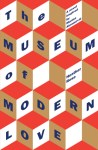
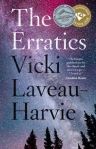
During the shutdown period, I also “attended” an online book launch and, separately, a bookshop event where a panel of three writers were interviewed about their work. Both these events were held via Zoom on weekday evenings. The book launch was a free event, and the bookshop panel discussion was sensibly priced at $5. I thoroughly enjoyed both of them, and would have been unlikely to physically attend either in a pre-COVID world (not least because the bookshop in question was quite literally a thousand miles from my place). But, again, I had some reservations.

These days I usually attend bookish events because I know the author and want to support them. For authors I don’t know personally, but whose work I admire, I simply seek out their interviews in podcast format. ABC Radio is a great source of interviews with Australian writers, via The Book Shelf, The Book Show and Conversations, as are the excellent podcasts The Garret and The First Time. So all this Zooming has made me think about WHY I attend literary events.

I think that it’s less because of the formal proceedings, and more because of the interesting conversations that follow – with the author when I buy their book, and with the other book-loving attendees. At the last book launch I attended in person I ended up having a good chat with Helen Garner! At writer’s festivals, the same applies. I enjoy listening to the sessions, but I REALLY enjoy meeting new people or bumping into acquaintances in the crush of the coffee queue. To continue my blatant name-dropping, at Bellingen Writers Festival last year I had an impromptu pub dinner with Dr Marcia Langton AO and Dr Jane McCredie, CEO of Writers NSW. Halfway through we were joined by actor and director Rachel Ward AM. Yes, I managed to play it cool – sort of!  And, to be clear, while I know that Jane remembers this dinner very fondly, I very much doubt that Marcia or Rachel do!

So the online book launch I attended, and the online literary event were interesting, but they lacked buzz. I missed the face-to-face interactions of real life, and in this I’m not alone. A friend started up a Zoom book club as we moved into the COVID-19 shutdown. She reports that they were very popular early on, but enthusiasm was waning by the three-month-mark. Many reported that after spending much of the day using Zoom for the day job, the thought of logging-in again in the evening was less than appealing. I can vouch for that, too.

But what of the core purpose of literary launches and events – to sell more books? It appears that Zoom and its ilk have only been a qualified success. Writer and bookseller Krissy Kneen had some super interesting things to say on the topic recently, during a podcast interview. She was pleasantly surprised by the number of sales that livestream events generated but didn’t pretend that those sales were as high as they would have been for a face-to-face event.

So, in essence, livestreamed literary events have been a useful stop-gap but may play a decreasing role as physical distancing restrictions are eased. There is, however and of course, an exception to that rule.

Writers Victoria, in a usual year, hosts large numbers of face-to-face workshops, seminars and events. They adroitly managed to move most of these online and my sources tell me that the number of participants has been pretty much the same as usual. This is impressive, given that fees for a full-day online workshop remain at $155 for members (concessions are available, and non-members pay more) but the sweetener is that most online courses include, afterwards, personalised feedback by the presenter on a piece of writing up to 500 words. It’s also worth reminding ourselves that delivering online sessions often costs much the same as delivering face-to-face sessions. Fee-paying participants can also subsequently access a recording of the session, so they can go back and review what they learned.

The delightful part, though, is that the online workshops have provided access to people who otherwise could not have participated. Attendees have included people from overseas, from interstate, or who for various reasons would have been housebound even without the COVID-19 threat. Apparently there’s a mum with a newborn who has happily attended several! I delivered one of these full-day online workshops and was pleasantly surprised by how interactive it was, and how much we were able to engage with one another. The word is that Writers Victoria will return to face-to-face workshops when they can, but – beyond the shutdown – will continue to provide online workshops too.

And there, for me, lies the answer. As we move beyond a strict shutdown, I hope that we’ll be able to enjoy a blended approach to accessing literary events. By all means hold a live, face-to-face event but livestream or podcast it too. Include separate webinars as an integral part of your festival offerings, alongside face-to-face activities. By doing so, the literary community might become a little more open to the wider community and might become a little more accessible to readers – whoever, or wherever they are.

What do you think?

Michelle Scott Tucker is the author of Elizabeth Macarthur: A Life at the Edge of the World (Text Publishing, 2018) – a compelling biography of the woman who established the Australian wool industry, even though her husband received all the credit.

Elizabeth Macarthur was shortlisted for both the 2019 State Library of NSW’s Ashurst Prize for Business Literature, and the 2019 CHASS Australia Prize (from the Council for the Humanities, Arts and Social Sciences).

Michelle is a freelance writer and consultant, with a successful career in government, business and the arts – including a recent stint as Executive Director of the Stella Prize, Australia’s top prize for women writers. She has served as Vice Chair of the Writers Victoria board and is currently one of the organisers behind the inaugural ‘Mountain Writers Festival’. The festival’s focus on the environment, story and place not just as a theme, but as the festival’s entire purpose now and into the future, is unique in Australia. Passionate about Australian literature, history and storytelling, Michelle lives in regional Victoria with her family.

Bill curates: Notes from a Wikipedian

Bill curates is an occasional series where I delve into Sue’s vast archive, stretching back to May 2009, and choose a post for us to revisit.

I first ran into Sue in Wikipedian mode when I wrote something wrong about Eve Langley, and Sue who had spent a great deal of time and effort on the Eve Langley entry in Wikipedia, pulled me up. Rightly, of course, because she was, and kindly, because she is. I have moved on only one day from May 2009, so when Sue writes “two years ago” she is referring to 2007.

_______________________

My original post

Two years ago I made my first edit in Wikipedia … and got hooked. You see, as a young teenager I decided I wanted to write an encyclopedia. I did start one, but didn’t get very far. Life got in the way as I recollect. As with several of my early dreams, however, life has had a way of seeing them realised, almost without my being aware of it, and so to Wikipedia I came.

Like any communities – and Wikipedia is a community – it has its ups and downs. Within a couple of days I had incurred the wrath of the “copyright” patrol. Some young (I could tell from their user page) French Wikipedian slapped a “speedy deletion” notice  for copyright infringement on a page one hour after I had created it and while I was still working on it. You see, I had “copied”, with some minor changes, a couple of sentences from a website into a new article I had created. The article was about a conference and these sentences essentially said the conference was held biennially and rotated around the states.  There are only so many ways you can say that! As someone who had worked closely with copyright all my career, I didn’t think I’d breached anyone’s creativity in almost-but-not-quite copying those sentences and, anyhow, I was still working on the article. My initial reaction was, I have to admit, a high level of distress. Sitting quietly on my comfy sofa with my laptop on my lap I felt attacked – personally and professionally (in terms of my sense of self). But, I calmed down, decided to react sensibly and got through it: I politely left a message on the tagger’s user page explaining what I was doing and set about enhancing the article. Three hours later the tag was suddenly, and as mysteriously, removed. Phew! I relaxed. But I did learn some things from that experience:

  1. the Wikipedia quality police are out and about 24/7;
  2. the best way to react is calmly so that you don’t enflame the situation; and
  3. there is an “under construction” tag you can put on a new article to tell the police (and other eager editors) to lay off for a while.

All this came back to me as I read David Runciman’s review in the London Review of Books of a book by Andrew Lih called The Wikipedia Revolution. Runciman describes in some detail the way the Wikipedia community works suggesting that it reverses Gresham’s Law which states that “bad money drives out good”. He writes:

One of the remarkable achievements of Wikipedia is to show that on the internet Gresham’s Law can work in reverse: Wikipedia has turned into a relatively reliable source of information on the the widest possible range of subjects because, on the whole, the good drives out the bad.

And how do they do it? Via the police of course! Because the truth of the matter is that my French Wikipedian was simply doing his best to ensure that the high principles of Wikipedia were being upheld. He wasn’t to know I was an honest newbie still feeling my way.

Anyhow, read the article … Runciman says some interesting things and, along the way, does manage to talk a little about the book he is reviewing.

Subsequent posts on WIkipedia:

____________________

Ali Cobby Eckermann, Inside my motherWell, I wasn’t expecting Bill to choose this one for Bill curates, but I’m so glad he did because Wikipedia was an inspired idea and has become such a significant force on the Internet. I love that Bill went the extra mile and sussed out my subsequent posts to add to the end of my original post.  As for kindness! Bill has shown his own colours in that direction by producing this series for me.
As I became more involved in blogging, my Wikipedia work fell away, though I still regularly update pages when I can, particularly Australian literary awards pages or pages for contemporary Australian authors. However, I did take part in the Boosting women’s entries project in 2017, and created the page for Ali Cobby Eckermann.

Do any of you dabble in Wikipedia editing or article creation? We’d love to hear your experiences.

Vale my magnificent Mum (1929-2020)

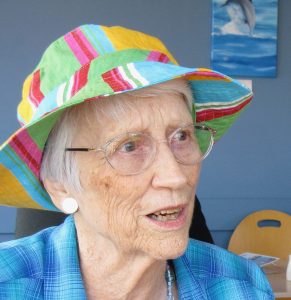
Portrait of JessieSome of you already know, but most of you may be wondering about my recent silence. I am really too heartsore to write much now, but I feel all you lovely followers deserve to know whyfor this silence. On Friday, my dear 90-year-old Mum died peacefully, after a short illness that, coincidentally, aligned with the COVID-19 lock-down here. I have spent much of the last month by her side, and am just too sad right now to compose a proper post about her. She loved and nurtured me with all her heart from the moment I was born right through to the end; she fostered my love of reading, introduced me to Jane Austen and taught me cryptic crosswords; she supported and respected me; she was self-effacing, always putting herself last; she was quietly passionate about social justice and the environment; and she made me laugh. She was the whole package.
Here are some words from her friends:

“I have fondly admired Jessie and feel so privileged to have learned from her wisdom, her gentle elegance, and her intellect.”

“Jessie is one of the most beautiful women I have known, so kind and thoughtful and so clever too. She is a truly lovely lady.”

“I feel very privileged to have known Jessie … so wonderfully supporting, caring and kind.”

 “I have always enjoyed her company and admired her attitude to all things.”

And, finally, from one of her church friends …

“We have lost a soft voice, a strong faith, an enquiring mind and a great friend”.

As for the family, we have lost a dearly treasured and much enjoyed wife, mother and mother-in-law, grandmother, great-grandmother, aunt and cousin. The loss is all ours.

(Finally, I must say a huge thanks to Lisa and Bill for their behind-the-scenes support and offers of help, and to Bill, in particular, for ensuring my blog kept going. There are still a couple of Bill Curates posts to come. I do not have enough words to thank them.)

Bill curates: Christos Tsiolkas’ The slap

Bill curates is an occasional series where I delve into Sue’s vast archive, stretching back to May 2009, and choose a post for us to revisit.

Tsiolkas is an author I admire and enjoy and yet I have not read The Slap. I remember that it caused quite a stir when it came out and if I was the sort of person who went to dinner parties I’m sure I would have joined in the discussions it gave rise to (I smacked my own children, but not other people’s). This is my third and final selection from May 2009. Notice how short it is. I wonder when her reviews began to get longer.
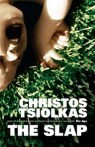
Christos Tsiolkas, The Slap, Allen & Unwin, 2008

_______________________

My original post

You could easily give yourself away when reviewing Christos Tsiolkas’ latest novel, The slap. For example, do you align yourself with the uncompromising, emotional earth mother Rosie or the rational, cool and collected but somewhat more willing to compromise Aisha? Do you rail against the liberal use of expletives, the relaxed attitude to recreational drug use, and the focus on carnal appetites more often in their ugly or elemental than their loving guise? Do you engage in the private versus public school argument? These are the sorts of things that confront Tsiolkas’ readers.

Courtesy: Allen & Unwin

In simple terms, The slap explores the fallout that occurs after a young child is slapped by an unrelated adult at a family-and-friends barbecue. This slap occurs in the first “chapter”, reminding me of Ian McEwan’s books which also tend to start with an event that triggers a set of actions and reactions. However, unlike McEwan, Tsiolkas does not build up a strong sense of suspense about “what will happen next”. In fact, the actual slap storyline is resolved about two-thirds of the way through the novel.

Rather, the book is about its characters and their relationships as spouse, parent, child, sibling, friend. At face level, most are not particularly appealing. They are often intolerant, narrow-minded and/or confrontational. Just as you begin to like, or at least understand, them they do something that changes your mind.  And yet, in all their imperfections, they do engage.

The book has an interesting though not unique structure. Like Elliot Perlman’s Seven types of ambiguity, the story is progressed through a sequence of different, third person, points of view covering three generations. This shifting of perspectives and stories has the effect of moving our focus from the plot to the content.  And the content ranges broadly across the things that confront families and marriages – love and hate, family versus friends, anger, loyalty, compassion and forgiveness. It has moments of real venom, but also of real tenderness.

Not surprisingly, violence features heavily in the book. Tsiolkas shows how pervasive violence is in western middle class society. Through the various characters’ stories we see a wide range of violent behaviour from domestic violence through consensual but aggressive sex to those seemingly casual expressions of violence such as “I wanted to kill her” about a person who annoys. We also see how deeply ingrained prejudice against “other” is, whether that other be racial, religious, cultural, sexual orientation or socioeconomic. In Tsiolkas’ world it feels as though only a thin veneer of civility covers our more primitive selves and the reader is never quite sure when or whether these selves will break through and wreak havoc. It is to the credit of the characters, and by extension us, that they rarely do, but we are left in no illusion that they could.

A critical aspect of the structure is whose perspective starts and ends the novel. Interestingly, again perhaps emphasising the minimal importance of plot, these are neither the slapper nor the “slappee”. In fact, the final voice is given to someone who starts out on the edge of the main action but is gradually drawn in. As an involved outsider, with issues of his own, he is able to resolve (as much as they can be resolved) the secondary plot lines and, as a person on the brink of adulthood, he can offer a sense of hope to what has been a pretty gritty story.

Wallace Stegner, the great American writer, wrote in his book, Angle of repose, that “Civilizations grow by agreements and accommodations and accretions, not by repudiations”.  This, taken at a more personal level, seems to be the point of the novel for as Aisha says in the second last chapter, “This finally was love … Love, at its core, was negotiation, the surrender of two individuals to the messy, banal, domestic realities of sharing a life together. In this way, in love, she could secure a familiar happiness”.

POSTSCRIPT: In 2011 The slap was adapted for television, for the ABC, and closely followed the novel’s narrative style with each episode being viewed through the eyes of a different character. The scriptwriters are, I think, a quality bunch:  Emily Ballou, Alice Bell, Brendan Cowell, Kris Mrksa, Cate Shortland. Interestingly, Tsiolkas is not among them.

_______________________

So, Bill likes Tsiolkas too, but, from his comment on my review of Damascus, it seems that that book’s subject matter doesn’t appeal to him much. Given Bill hasn’t read The slap nor Damascus, I’m guessing he’s read the earlier novels, which I haven’t – and should rectify.

Oh, and re length of reviews. I love that Bill noticed that. I started by wanting to keep my reviews to 800 words, but now my goal (not rigorously adhered to) is 1000-1200.

Anyhow, are any of you Tsiolkas fans and, if so, what is your favourite?

Favel Parrett, There was still love (#BookReview)

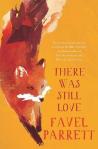
Book coverFavel Parrett’s third novel, There was still love, is one of those novels in which not a lot happens but has a lot going on. Just the sort of novel, really, that I tend to like. (It all started with Jane Austen!)
The novel revolves around the lives of two Czech sisters, one who ends up in Melbourne with the other remaining in Prague, but their story is mainly seen through the eyes of their grandchildren. Melbourne-based Malá Liška or “Little Fox” lives with her grandparents Máňa and Bill, while Prague-based Luděk lives with his Babi (grandmother). The novel is set mostly in 1980, and alternates between these two places, with occasional forays into other places and/or times to fill in some backstories. It’s a carefully constructed book, one that benefits from close reading, which is not to say it’s hard reading, because it’s not. It’s one of the fastest reads I’ve had in some time.

Now, if you know your European history, the above description will have suggested to you the book’s framework, and you’d be right. Separated during World War Two, with young Máňa going to England, the women’s lives are further up-ended by the 1968 Czechoslovakian Revolution. Through it all, although physically separated, they stay in touch, via letters and the occasional visits back to Prague by Máňa and Bill:

My grandparents saved their fifty-cent coins to buy aeroplane tickets. They managed to do this every four years, sometimes every three years if they were careful. If they saved very hard.

They bought the cheapest tickets.

They took the longest route.

Such is the call of home, about which more later.

The stories, as mentioned above, are told through the eyes of Malá Liška (in first person) and Luděk (in third person.) I suspect Malá Liška’s is first person because she is modelled on Parrett herself, thus providing a grounding authenticity. Luděk’s story is, the Author’s Note says, drawn from the experiences of her cousin Martin. The Prague scenes, she writes, “would be nothing” without his help. I haven’t visited Prague, but Parrett, through Luděk via Martin, brings it alive:

Luděk loved the mess, the decay. His city wasn’t clean, it wasn’t pretty. And there were wires everywhere in the sky and they crisscrossed like a million black lines. Everything was covered in stinking soot, in pigeon shit, covered in old rusted scaffolding … Prague was his city, the flat his whole world, and he loved it all.

Prague, and his grandmother’s flat, in other words, are his home.

There was still love is about many things, of which love, which survives upheaval and separation, and home, which you can make and remake throughout life while never forgetting your origins, are the two overriding ones. These are big themes, and yet the novel is just over 200 pages. I’m in awe of Parrett’s concision. There were some in my reading group who wanted the whole family saga – which I get – but I loved Parrett’s ability to convey a wealth of meaning and history in a phrase, a sentence or a short scene. Here, for example, is a scene between Luděk and his uncle Bill, in Prague:

‘I think that man is following us,’ he [Bill] said, and his eyes moved up the path towards another bench.

Luděk remembered how his Mama said they were always watching at the airport, watching, taking photos …

Babi told him never to say anything important on the telephone.

The reality of living under surveillance is conveyed quietly, thus, in a couple of pages, but we readers know exactly the fear and brutality that lie just behind these words.

Another example of this concision is a brief scene in a Melbourne shop during which Máňa is called a “stupid wog”. She walks out of the shop with dignity, but Malá Liška notices that “a tear, just a small one, spills down her soft, powdered cheek and she does not wipe it away.” Again, a brief scene, but we know that this is not the only time Máňa has been treated like this. Life, Parrett shows, can be difficult whether you stay or go.

Parrett also achieves concision through a “suitcase” motif. It is introduced in the gorgeous brief poetic prologue called “The suitcase”. Parrett describes suitcases being everywhere, evoking a powerful image of people on the move, of people escaping and of people not getting away. She writes:

You must close up tight, protect your most needed possessions … your heart, your mind, your soul. You must become a little suitcase and try not to think about home.

From here on, suitcases of all sorts are subtly dropped into the narrative to suggest various ideas – a suitcase in a roof space holding an old gymnastics blazer from a past life; “a suitcase with yellow eyes – a suitcase with a mouth like a big black hole” in a Czech Black Light Theatre performance in Melbourne; people arriving at airports, looking “dazed, pushing trolleys loaded up with suitcases”. The most powerful reference, though, comes from The Black Light Theatre Company’s Magician (based on the still living Jiří Srnec):

I put the broken in my suitcase and take them with me until they are ready to go home again.

There is still love.

There it is, home and love again. Luděk’s much missed mother travels with this company, and is tempted to defect to the free West.

Closely related to the idea of love and home is the story of refugees, of migration. In a little section devoted to him, Bill tells of changing his name from Vilém in 1942 England in order to fit in, while Máňa “works on her accent”. He shares the pain of leaving one’s home:

The only way to live now is to keep moving forward and not look back. It is the only way his heart can keep on beating and not break. He must look forward and not behind.

He must never look behind.

A common – and painful – experience for refugees.

Finally, There was still love is also a story about women, and particularly old women who carry on. It is Luděk, loving his grandmother and coming to care for another old women, who voices this:

The city was full of old women left behind, left to keep everything going – to carry the old goddam world by themselves.

My reading group briefly discussed the title, There was still love. What did “still” mean we pondered? “Still” as in ongoing, or as in continuing despite everything? Both, I think. Whatever the meaning, however, There was still love is a moving read that reminds us yet again that the most important things in life are home and love, wherever you find them.

Lisa (ANZLitLovers) also loved this book.

Challenge logo

Favel Parrett
There was still love
Sydney: Hachette Australia, 2019
214pp.
ISBN: 9780733630682

Monday musings on Australian literature: Guest post from Kate on anxiety, COVID and Aussie lit

Today, I present another Monday Musings guest post coordinated for me by Bill (The Australian Legend), this one from Kate (booksaremyfavouriteand best), she of Six Degrees of Separation fame. Bill suggested a topic to Kate – one applicable to her professional interests and to what we are currently experiencing – and it seems she ran with it!
Thanks so much again to Bill and also to Kate for helping me out and for offering some fresh content for Monday Musings. Read on … and of course we’d love your comments  … How are you coping with COVID-19?

Kate’s post

Had you told me last year that 2020 would bring months of ‘stay at home and bunker down’ time, I would have thought that it sounded like heaven. No more taxiing children around? No more daily commute and peak-hour traffic? Oodles of ‘free’ time to read? Great, sign me up. And true, at the beginning of lockdown, I thought that I would get so much reading done, and therefore so much blogging done…. But that hasn’t happened. Like many bloggers (and people in general), COVID-19 brought with it a level of anxiety that I have not previously experienced.

At the same time as this feeling of anxiety was creeping in, posts on social media popped up about how ‘industrious’ people were being – “I cleaned out my wardrobe!” and “I painted the fence!” and “I’ve finally knitted that jumper I bought wool for three years ago!” and “I’ve learnt Spanish!” and “I’m making my own sourdough #delicious #nomnom!” Huh.

Then came round two of the ‘maximising time’ posts – “My kids are really getting ahead in maths” and “Look at these macarons Master 6 whipped up for afternoon snack”.

Through the noise of painting, craft, calculus and baking, one thing became very clear to me – I can’t possibly write blog posts and worry about a pandemic at the same time. Great for those that can, although I think that’s a very small percentage of people. For most, the industriousness that they’re putting on social media is their anxiety talking. Specifically, when overwhelmed by uncertainty, some people focus on what they can control (such as their sourdough starter, or memorising conjunctions for Spanish verbs), and others (like me), do nothing. Both are defence responses – our reptilian brain relies on fight/ flight/ freeze for survival.

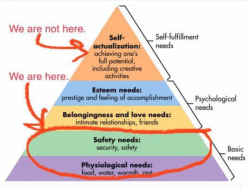
To understand what was happening with blogging, social media, and my lack of reading, I turned to Maslow’s hierarchy. Essentially, we can’t do the ‘self-fulfilment’ stuff when the ‘basics’ are in doubt (and blogging sits in the self-fulfilment category) – with our ‘foundation’ threatened, no wonder we feel anxious.

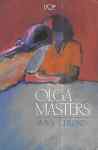
This is a Monday Musings post, and therefore needs an Australian literature reference. There are plenty of memoirs by Australian authors dealing with anxiety – this year alone I’ve read such books by Clare Bowditch, Georgie Dent and Nicola Redhouse. Equally, there are plenty of memoirs and novels that deal with anxiety in relation to a particular trauma. But what of stories that speak to those bottom rungs on Maslow’s hierarchy? Certainly stories about ‘pioneering’ fit (I’ll defer to other bloggers, such as Bill of The Australian Legend, who have a thorough knowledge of these books). But my mind turned to a book I read thirty years ago (so my memory is sketchy, but significantly, small details have stayed with me) – Amy’s Children by Olga Masters.

Book coverIt’s the story of a young woman living in Sydney during WWII. The War is merely a backdrop – instead, the focus is on Amy and her decision to leave her children in the care of her parents in regional New South Wales, while she goes to Sydney to make a life for herself. Amy puts considerable effort into setting up a home. There’s a slow accrual of ‘things’ – a bed, a wardrobe, a kitchen table – and the coveting of the unobtainable (Amy’s fantasies include “…a little glass fronted cabinet containing a bottle of sherry and fine stemmed glasses and a barrel of wafer biscuits. She would put a match to the gas fire ‘to take the chill off the room’, without having to consider the cost…”). She digs a vegetable garden and meets the neighbours. She gets a job, and begins a relationship.

From memory, much was made of Amy’s ‘selfishness’ and lack of maternal feeling, but does the story read differently through a Maslow lens? Are Amy’s attempts to ‘set up house’ representative of her need to feel secure, both personally and in the context of a world at war? I’ll do a re-read and report back.

In my professional life, I spend a lot of time working with people suffering anxiety. Anxiety tends to be a very specific beast – different things trigger different people – however, the starting point for managing it doesn’t change (I call it ‘mental first-aid’). Basically, get some exercise (preferably with fresh air involved); eat well (I don’t mean lavish, I mean nutritious,  so redirect Master 6 from macarons to paella); sort out your sleep; maintain social connections; and talk with someone if you’re not feeling great. Hopefully, with those things in order, the space for becoming engrossed in a book will return.

Six degrees of separation, FROM Normal people TO …

My time is tight right now and my mind distracted, but I did want to continue Six Degrees, which as you know is a meme currently run by Kate, and you can read all the rules on her blog – booksaremyfavouriteandbest.
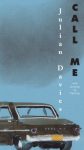
Her June selection is Sally Rooney’s Normal people, which I have not, once again, read. I am going to keep it brief.

So, here goes:

Normal people

Call me

to take

Two steps forward.

But,

Everywhere I look,

I see

Signs preceding the end of the world.

Maybe tomorrow?

Regardless,

Yours truly,

The still deceived.

(Links on titles are to my posts.)

How nice it would be if our recent experience of cooperation (here in Australia, anyhow) did encourage us to take two steps forward into a new way of being and doing and relating.

And now my usual questions. Have you read Normal people? And, regardless, what would you link to? 

Bill curates: Jane Austen’s letters, 1814-1816

Bill curates is an occasional series where I delve into Sue’s vast archive, stretching back to May 2009, and choose a post for us to revisit.

Book coverI said, when I introduced this series, that Sue began writing Whispering Gums in May 2009. It seems that once begun she could not stop. There are WG posts for May 2,4,5,6,10,14,15,16,19,21,22,27,28,30,31. The May 31 post is titled, prophetically, “When too much Jane Austen is barely enough”, and is in fact the third Jane Austen post for the month. Today I reprise the second. But there will be more.
Diedre Le Faye ed., Jane Austen’s Letters, Oxford University Press, Oxford, 2014

More Jane Austen from Whispering Gums (here)

_______________________

My original post

By 1814, Jane Austen had published Sense and sensibility (1811) and Pride and prejudice (1813).  Mansfield Park (1814) was about to be published, and Northanger Abbey had been written many years previously but was not yet published. She was over half way through her major published oeuvre of 6 books and had less than 4 years to live. Tragedy!

Jane Austen's desk with quill

Austen’s desk, Chawton. (Courtesy: Monster @ flickr.com)

There have been several editions of her letters, the most recent being Jane Austen’s letters, published in 1995 and edited by Jane Austen scholar, Deirdre Le Faye. Of the estimated 3000 letters she wrote, only about 160 survive so it is well to savour them slowly. I have just (re)read the letters from 1814 to 1816, and found much to delight a Janeite. They contain some of her most famous quotes regarding her subject-matter and style, advice to her nieces on novel-writing, criticisms of other writing which provide insight into her own writing, as well as a lot of detail about her daily life.

One of her most famous comments was made to her niece Anna (nèe Austen) Lefroy in September 1814:

You are now collecting your People delightfully, getting them exactly into such a spot as is the delight of my life – 3 or 4 families in a Country Village is the very thing to work on.

Somewhat less well known is her response to James Stanier Clarke, the Prince Regent’s chaplain and librarian, who suggested she write a novel about an English Clergyman. She writes:

The comic part of the character I might be equal to, but not the Good, the Enthusiastic, the Literary. Such a Man’s conversation must at times be on subjects of Science & Philosophy of which I know nothing  […] A Classical Education, or at any rate, a very extensive acquaintance with English Literature, Ancient and Modern, appears to me quite Indispensable for the person who would do any justice to your Clergyman. And I think I may boast myself to be, with all possible Vanity, the most unlearned, & uninformed Female who ever dared to be an Authoress. (December 1815)

False modesty perhaps, but she she knew what she was comfortable writing and this was not it. She makes clear in her letters exactly what she thinks makes good writing and one of those things is to write what you know. She tells Anna that it is fine to let some characters go to Ireland but not to describe their time there “as you know nothing of the Manners there” (August 1814). Interestingly, it would have been around this time that she was writing Emma – some of whose characters go to Ireland but no details are given of their life there. She also tells Anna that fiction must appear to be realistic as well as be realistic when she says:

I have scratched out Sir Tho: from walking with the other Men to the Stables &c the very day after his breaking his arm – for though I find your Papa did walk out immediately after his arm was set, I think it can be so little usual as to appear unnatural in a book. (August 1814)

In other words, truth is allowed to be stranger than fiction!

In the September 1814 letter referred to earlier, she advises Anna to keep her characters consistent, and to be careful about providing too “minute” descriptions.  And in another letter written that same September she warns Anna off “common Novel style” such as creating a character who is “a handsome, amiable, unexceptionable Young Man (such as do not much abound in real Life)” and to not have a character “plunge into a ‘vortex of Dissipation’ … it is such thorough novel slang – and so old, that I dare say Adam met with it in the first novel he opened”!

There is a lot in these letters – about writing and getting published, the weather, fashion, health, and the like. However, in the interests of brevity I will close with something completely different but which, given the current popularity of Christos Tsiolkas’ The slap, seems very apposite. She writes this in 1815 about a young boy of her acquaintance: “we thought him a very fine boy, but in terrible want of Discipline – I hope he gets a wholesome thump, or two, whenever it is necessary”. If Jane thinks it’s a good idea, who are we to argue?

_______________________

When Bill offered this series to help me out, he said he’d start with Eve Langley’s The pea pickers, which he did. I wondered what he would choose next, but I should have guessed that he would have turned to another favourite that we share, Jane Austen.

We’d love all you other Austenites to show yourselves and tell us what you most love about her.

Monday musings on Australian literature: Guest post from Lisa on national library book culls

As I noted in last week’s Monday Musings, Bill (The Australian Legend) has organised a few Monday Musings guests posts for me. Of course, given we comment closely on each other’s posts, he turned to Lisa (ANZLitLovers) for the second one. Bill did suggest an idea to Lisa, in case she needed it, but she found another topic to inspire her. It is a highly relevant one to me as a retired national institution librarian/archivist, so I was more than happy with her suggestion.
Thanks so much again to Bill and Lisa for helping me out and for offering some wonderful new content for Monday Musings.  Read on … and do let us know what you think …

Lisa’s post

Last year, when in New Zealand for the Auckland Writers’ Festival, I visited the Auckland Art Gallery, and was disappointed to find its ’Historic European’ Gallery closed.  From the postcards on sale in the shop we could see that they had some very interesting pieces, so we were a bit disappointed. But at the time we just thought this meant they had stopped collecting European art.  However, from a recent visit to their website, it’s clear that European art has been sidelined.  If you want to see New Zealand and Pacific art, this gallery is the place to go.  But if on the other hand you are a Kiwi student of art history, or merely curious about New Zealand’s international collection as we were…

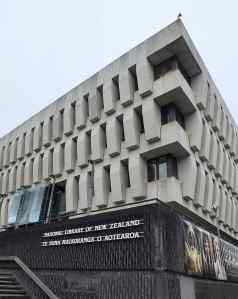
I thought of this when I came across a more radical policy underway in the New Zealand National Library. In October last year the library announced that they are going to ‘rehome’ 600,000 books to make room for New Zealand and Pacific material, in line with their 2015 Collections Policy.

Yes, that’s right, 600,000 books!

Behind the scenes, libraries have all kinds of policies that affect their acquisitions and deaccessions procedures.  These rarely attract much interest from the public, except for the issue of censorship, or ‘self-censorship’ of certain types of books. (As, for example, when a school library unofficially responds to complaints from religious minorities by not lending books featuring magic such as the Harry Potter series).

Acquisitions and deaccession policies reflect a variety of complex issues which change over time.  No collection is static, and space for underutilised materials is always a problem.

The New Zealand library’s Rachel Esson (Director of Content Services) explains their decision like this:

The overseas published collection is not one single collection but is made up of an assortment of books acquired from a range of sources, some were purchased and some donated to us having been weeded from other libraries. These books were collected to support the library system, to provide access to information that other libraries might not hold. However, around 80% of them have not been issued for 20-30 years which means most of these books are not being used and that means that the library system is telling us that it doesn’t need these books anymore.

To be clear, they are keeping some overseas published books and will continue to purchase more for their collections in focussed areas, which include: library and information science; music; reference works; children’s literature; family history, and print disabilities.

But the removal of 600,000 books is needed to make room for New Zealand and Pacific Materials:

The National Library acquires between 80,000 – 90,000 electronic and print publications a year that consist of New Zealand, Pacific and overseas material.

That makes sense to me, because New Zealand is a wealthy nation and is in a position to be a centre of excellence for the literature of Pacific Island nations which may not have the resources to do it themselves.

But as I know from my own experience as a teacher-librarian, undertaking a cull of underutilised books can be a fraught exercise, because there is always someone who, for sentimental or research reasons, needs that battered copy of a text that seems past its use-by date.  At the same time there will always be people who want to cut a swathe through the entire collection to rid it of books that offend them for one reason or another.  In the feminist Seventies, for instance, there was alarm about the preponderance of male central characters in library collections of children’s literature, and that’s still a problem today.  So is the paucity of characters reflecting Australia’s multiculturalism, its Indigenous past and present, and its LGBTIQ and disabled communities…

The philosophy of inclusion is comparatively new and it keeps changing.  Difficult decisions have to be made around those innocuous words ‘as well as’, ‘instead of’ and ‘proportion’ because these decisions have implication for space, storage, display and especially funding.

For most libraries, the decision to acquire or get rid of a book to make space for others is a decision for the local community and the users.  However, in the case of a national or state library, the rules are different.  They have a statutory obligation, i.e. enshrined in law as ‘deposit legislation’, to acquire and retain the books they have for the benefit of the nation.  According to New Zealand writer and reviewer David Larson, in a lively critique for The Spinoff the relevant Minister has to sign off on the disposal of these 600,000 books.  Amongst other concerns he is alarmed about the process for retention and selection.  There’s more to it than whether the books have been issued within a certain time frame…

The consultation process, Larson says, appears not to have adequate expertise to identify which books are needed for research purposes, and offering them to other New Zealand libraries which have no obligation to keep them is a concern.  Then there are books that are published overseas, but written by New Zealanders:

New Zealanders are, famously, a nation of part-time expats: any number of Kiwis have contributed to this field or that by publishing books while living overseas. So if the goal is to keep “anything that is New Zealand and Pacific related”, that will require identifying a huge corpus of often obscure books published offshore.

Likewise, there are many overseas-published books by non-New Zealanders which touch on New Zealand or Pacific interests, often in ways obvious only to specialists.

Larsen stresses that many of these books are destined not for rehoming, but for destruction, but his article met with a droll riposte from librarian Rebecca Hastie, in a piece also for The Spinoff, ‘Weed in the Dead of Night, a Librarian shares the secrets of book culling’.

To see why it might matter that New Zealand could lose its only copy of a text that’s being offered for ‘rehoming’, I took a look just in the ‘A’ section of the Fiction List (downloaded from here).  For a start, the library is also offloading everything that Jessica Anderson and Thea Astley wrote, so Australian Literature isn’t a priority area for retention.  Too bad if a Kiwi wants to do a PhD in the comparative literature of our two countries.  There were titles I’d love to read by Kingsley Amis, Joan Aiken, Louisa May Alcott, Isaac Asimov, and Margaret Atwood.  Even Jane Austen has to go.  Top of the Bs was a stack of titles by Isaac Babel, which, along with three by Leonid Andreyev, mean that someone in a previous era understood the important of dissident Soviet literature (which is surely still a subject for scholarly attention.)

Lest you think that this is only an issue for this particular library in New Zealand, this week Inside Story is carrying an article called ‘Asia Illiteracy’ about a new collection development policy at the National Library of Australia, which is about to sideline its collections of Southeast and Northeast Asian material:

For almost seven decades, the National Library of Australia has been building one of the world’s most extensive collections of Southeast and Northeast Asian material. The legacy of accumulated investment and collecting by specialist curators, its store of Asian newspapers and periodicals, books, government documents and other rare materials is among the great treasure troves of Asian studies, and the most extensive Asia collection in the Southern Hemisphere. Researchers visit from around the world, and the collection is a foundation stone of decades of effort to build sustained and deep knowledge of Asia at Australian universities.

Now, much of this is to be abandoned. In a new “collection development policy” — the document which lays out what and how the library will collect — the library has dramatically downgraded its emphasis on overseas collecting. It has removed key Asian countries from its list of priorities; it has closed its Asian Collections Room; it has cancelled subscriptions to hundreds of Asian periodicals.

[…]

The new collection development policy makes it clear that the library is turning inward, sharpening the focus on Australian materials. Thankfully, the Asia-Pacific will remain the priority in overseas collecting, but the scope of the reduction leaves only part of the previous Asia strategy intact. Countries that have been a major focus for decades — notably Japan and Korea, and also all the countries of mainland Southeast Asia — have been dropped altogether from the list of priority countries for collecting. 

The catalyst for the New Zealand decision seems to have been the need to deal with a collection in a flood-prone storage facility which is too expensive to replace, while the NLA’s decision, according to Inside Story is forced on them by relentless funding cuts.

It’s always a matter of money…

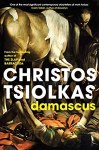
Christos Tsiolkas, Damascus (#BookReview)

Book coverI have reviewed (and enjoyed) two of Christos Tsiolkas’ books since blogging – The slap and Barracuda – so I was of course interested when Allen & Unwin sent me his most recent release, until, that is, I saw its subject matter. Biblical history, or historical fiction set in biblical times, are not really big go-to areas of interest for me. However, it was Tsiolkas so, finally, when its turn came, I dived in.

What did I find? I hadn’t read reviews, but I had heard that it was pretty violent, and it certainly is in places. Indeed, it starts with the stoning of a woman – but it wasn’t gratuitous or dwelt on. The actual stoning was over in a couple of sentences, and, given Tsiolkas is a serious writer, I decided to trust that he was going somewhere interesting.

Damascus – the title referencing Saul’s (Paul’s) epiphany regarding Christ on the road to you know where – uses the story of Saul, his acolytes, and people he knew, to explore the first few generations of Christians and, through them, the foundations of Christianity. The media release which accompanied my copy says that the novel “explores the themes that have obsessed Tsiolkas as a writer: class, religion, masculinity, patriarchy, colonisation, exile.” Class is the first one to raise its head in the book, and is the one that encouraged me to keep going, because the book reminds us of Christ’s teachings about equality. A few refrains run through the novel, but the first one that captured my attention was “The first will be last, and the last will be first”. It is this teaching, this original Christian belief, that most infuriated Christianity’s opponents. That slaves, for example, should be treated as equal, should sit down at the table with others, was an affront. Given Christianity’s problematic history, I loved being reminded of this fundamental point.

The book, for me, explores two main issues. One is this Christian value of equality – accepting all people as worthy of love and attention. It dominates the first part of the book. However, another issue also raises its head fairly early – through another refrain that ends with “Truly, he is returning” – the Christian belief in the Resurrection. This theological concern occupies much of Saul’s thinking and dominates the book’s ending. In Angela Savage’s YVWF conversation with Tsiolkas, he said that he doesn’t believe Christ was resurrected. He doesn’t believe in an eternal kingdom, but that finding how to live a good life has to be worked out here and now. He therefore chose to include the character of Thomas, the doubter from the Gospel of John, to suggest another direction in which the church could have gone. His Thomas appears in the novel as the apocryphal twin of Jesus, thus giving flesh to the dichotomy between these two world views. This dichotomy is also neatly embodied in the love another of the book’s main characters, Timothy, has for both Saul and Thomas.

So, these were the two themes that kept me interested in the book, but what about the actual experience of reading it? Like many Tsiolkas’ novels, it is a multiple (or “roving”) point-of-view novel. It has a complex structure, comprising two chronologies, as you can see in the following list of the book’s parts:

  • Saul I 35 Anno Domini
  • Hope Lydia, Antioch 57 A.D.
  • Saul II 37 Anno Domini
  • Faith Vrasas, Rome 63 A.D.
  • Saul III 45 Anno Domini
  • Love Timothy, Ephesus 87 A.D.
  • Saul IV 57 Anno Domini

One chronology tells the life, thoughts and inner conflict of Saul, while the other explores the impact of Saul on others. Lydia appears in the biblical book of Acts as the first woman Saul brings to the new religion; Vrasas is his jailer in Rome and has a hatred of those he describes as “death-worshippers”; and Timothy, his companion in the Bible, had a pagan Greek father and a Jewish mother and so embodies, Tsiolkas said, “between world-ness”.

All this is rather complex, and if you don’t know your biblical history you need to concentrate hard on who is who, and where they are going, on the various belief systems and their suspicion if not hatred of each other. You also need to go with Tsiolkas’ view of Saul as a flawed man struggling with his own temptations, his lusts, pride and envy. Tsiolkas’ Saul is a man not a paragon, one who struggles even as he tries to bring the new religion to people on his travels. Here he expresses guilt over his love for Timothy:

Saul falls to his knees on the stony ground. He is sin, he is evil. The storm inside him rages and scorns. He will never conquer the serpent that coils around his loins–its poison floods his heart and mind. What arrogance to believe he is loved by the Lord! How vain to think that he has been chosen by the Saviour. (p. 264)

Inner conflicts like this are well-known, I believe, to Christians.

One of the major joys in reading this book is the characterisation. Lydia, whose first baby is abandoned on the mountains because she is an unwanted girl, is a powerful, but moving character who shares her life as a wife in a seemingly typical merchant family before she takes to the mountains herself. Vrasas, on the other hand, is a brutal character. His section is called, ironically, “Faith”. His faith is a brutal one, and his section contains some of the most brutal scenes in the book, starting with a sacrifice. The aforementioned Timothy, who loves both Saul and Thomas, is a particularly engaging character. His section, “Love”, contains another brutal scene, the punishment of a Jesus-follower by a pagan cult. Timothy, in a way, helps resolve the theological conflict between Saul and Thomas. He sees, I think, the essence of what they both believe. He comes to realise that the point is not the second coming, the cataclysm – though he believes it will come – but the love and hope that are conveyed in the Christian message.

Now, as you have probably realised, Tsiolkas, being Tsiolkas, does not hold back in his graphic descriptions of the brutality of the times. This is not a namby-pamby story but a gritty, mucky, one. It will offend some people in its physicality and viscerality, and it will offend others for its perspective on some much-loved biblical characters, but it is also suffused with one of the main metaphors of Christianity, light. When Saul is grappling with his conversion, “he marvels at the solace of light, the joy it brings him”. It’s a hard-won conversion. At one stage, conflicted by what Ananias’ group is saying, he prepares “to condemn the wicked circle” only to feel “that the light has gone.” Gradually, Ananias teaches Saul to see that Yeshua’s “words were a light” and that this light helps his followers shed darkness, hate, bitterness, cruelty. Light metaphors recur throughout the novel, sustaining characters whenever they feel its presence.

Damascus is not a novel for everyone. Its confronting exploration of the early Christians, alongside the complex history of times that many of us are no longer familiar with, make it a challenging read. However, I related to Tsiolkas’ heart, which aligns with Saul’s “misery at what the world is. At what the world can do”. If only we could recover those original Christian values of loving our neighbour, of treating every person we meet with equal respect, so much of that misery would be gone.

Christos Tsiolkas
Damascus
Crows Nest: Allen  & Unwin, 2019
423pp.
ISBN: 9781760875091

Review copy courtesy Allen & Unwin