Gay Lynch, Unsettled (#BookReview)

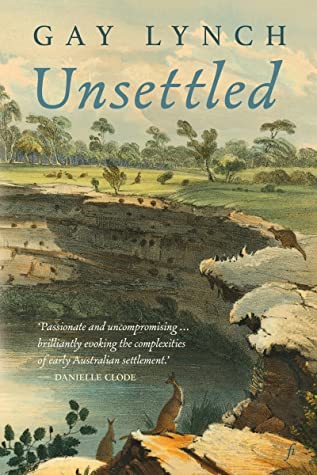
Coincidentally, my first review after this week’s Monday Musings on historical fiction happens to be a work of historical fiction, Gay Lynch’s cleverly titled Unsettled. Consequently, I’m going to start there, that is, talking about the form.

Well, more or less, because I should at least give you a sense of its subject. It is set primarily in South Australia’s Gambierton (later Mt Gambier) from the 1859 to 1880, with most of the action taking place in the 1860s. It’s the story of an Irish family, the Lynches, who migrated to Australia in 1848. The Lynches, as you might have guessed from the author’s name, are based on her husband’s family. Unsettled explores their story primarily through two fictional characters, Rosanna and her younger brother Skelly.

… in the spirit of the story

Which brings me to the genre. In her Acknowledgements, Lynch provides some useful insights into the book. Firstly, regarding intention, she says that she specifically wanted “to materialise Lynch girls, absent from every family anecdote and official documents, church, state and school, apart from their birth documents … the girls’ lack of documentation and therefore their invisibility reflect their early settlement status on the frontier.” The challenge, of course, in “materialising” invisible characters from the past is to make them real, and avoid anachronism. This is difficult when records are few, but I think there are enough records of frontier women in general to validate Lynch’s conception here.

Lynch also addresses where she has changed Lynch family “facts”, such as their and their employers’ names. She also says that her two main characters, Rosanna and Skelly, “exist only in [her] imagination”, but “her lived experience as Lynch wife and mother, verifiable historical events, and historical Lynch antecedents” offered her “the connective tissue” needed for their fictional lives.

She goes on to say that “in the spirit of historical fiction” she has kept close to official records so that the characters drawn from life are as “true” as she can make them, but that “in the spirit of story, some events may not be verifiable”. That, of course, is historical fiction; it’s about fleshing out lives and times with story, where the facts are not known or are minimal.

Finally, she addresses her inclusion of the local Boandik people, an issue we often discuss here. She writes that they “tell their own South-East story – they still live on that once dangerous frontier, on land they never ceded – of their attempted eviction and genocide”. She says she “benefitted from knowledge shared by Boandik custodian Ken Jones”, conversed “with Boandik linguist linguist David Moon”, and was supported in addressing “important questions about voice and Indigenous historicity”. As I’ve said before, it’s really up to the Boandik people to say whether they agree with their representation, but Lynch has, it seems, done the right thing: she has included them in her narrative (in an appropriate way) and has conferred with the people she ought about doing so.

I’ve spent a bit of time on this I know, but it’s important with historical fiction to be very clear about what it is we are reading. I’m not an expert in South Australian settler history, but I feel Lynch has provided me with enough here, in addition to the knowledge I do have, to reassure me that her story is a valid one, so let’s get to that …

“now that the country is settled”

Nearly halfway through the novel, Rosanna converses with her employer, the hard, English station-owner, Mr Ashby. He is searching for some local Indigenous people who, he believes, have been “filching” from him. Rosanna, who has befriended the young local woman, Moorecke, tells him that Moorecke “belongs on this land”. She adds, hoping to throw him “off the scent”, that she rarely sees “Blacks, now that the the country is settled.”

Here, and throughout the novel, Lynch layers meanings in brief exchanges. Implied in this little scene, for example, are multiple power imbalances – between settlers and the original inhabitants, between the landowning English and the oppressed Irish, and between man and woman. And of course, overlaying this is the fraught idea of being “settled” and all its connotations, political and personal, physical and emotional. “Now that the country is settled” implies of course that it was “unsettled” before. This novel, with its title, “Unsettled”, keeps this foundational wound front and centre in our minds, which, dare I say, “unsettles” us.

This layering of meaning is one of the reasons I found the book an enjoyable read, because I enjoy such thoughtful, provocative writing, but the enjoyment here is compounded by the characters, particularly Rosanna and Skelly. Both are well individualised, with the novel’s third person perspective shifting mainly between them.

Over the course of the novel, Rosanna is our guide to what happens on the frontier. She works for the landowning Ashbys; she spends time with and learns from Moorecke of the Boandik people; she rides with the poet Adam Lindsay Gordon and confesses to Father Tenison Woods. She falls in love naively, makes many mistakes big and small, can be mean and tender, but she is a warm, courageous young woman who is determined to make her way authentically through a world which pays little attention to the dreams, let alone rights, of women. A world, in fact, in which “men are dangerous creatures if thwarted”.

Skelly, her sensitive and somewhat frail younger brother, is both foil and support to Rosanna. Their relationship contains the typical sibling tensions, but love and loyalty underpin it. It is what happens to Skelly at a school in Melbourne that propels Rosanna’s actions which provide the novel’s opening drama.

As is common in historical fiction, Lynch uses a family drama to drive the narrative forward and engage our emotions and interest. Lynch also imbues her story with references to both Australian and English literature of the times. For keen-reader Rosanna, Anthony Trollope’s Irish heroine Feemy Macdermot, from his first novel The Macdermots of Ballycloran, offers lessons to heed.

The main work that threads through the novel, however, is Edward Geoghegan’s play The Hibernian father, which was a popularly performed tragedy in mid- to late-nineteenth century Australia. It tells a tragic story of the Lynches of Galway, whence our own Lynches had come. The tragedy distresses our young Lynches, and threatens to destabilise them as they struggle to forge their lives without failing in the same catastrophic way. Rosanna’s father Garrick Lynch reassures his family that “it’s an ancient story … from bloody times”, but the irony is that “bloody times” are still with them.

In the end, all of this has one goal, to serve the real point of Lynch’s story, the complicated politics of settlement, oppression and dispossession, the injustices of colonialism. As Rosanna becomes aware, during an interaction with her employer Mrs Ashby, “living on the edge of civilisation unsettles everyone”. Gay Lynch’s book does the same – and that, I’m sure, was her intent.
Challenge logo

Gay Lynch
Unsettled
Balmain: ligatu.re, 2019
421pp.
ISBN: 9781925883237

(Review copy courtesy the author.)

Monday musings on Australian literature: Supporting genres, 1: Historical fiction

While my prime focus here is literary and classic fiction, I do also delve into other forms (like biography, autobiography/memoirs, poetry, history), and other genres (like crime, dystopian fiction, and historical fiction). So, I’ve decided to start a little MM subseries on other genres and forms, starting with historical fiction. My aim is less to analyse the genre itself, than to share some of the ways in which it is supported in Australia.

I’m starting with historical fiction because of the recently announced longlist for the inaugural ARA Historical Novel Prize, which Lisa (ANZLitLovers) posted on recently. Let’s start with the prize’s home, the …

Historical Novel Society of Australasia (HNSA)

HNRA describes itself as

the third arm of the international Historical Novel Society, and is recognised as the home of the historical fiction genre in Australasia. The Society promotes the writing, reading and publication of historical fiction … Our events showcase the best literary talent and enable readers, writers and publishing professionals to celebrate the genre.

They consider historical fiction

to be important to both the entertainment and education of readers as it contributes to the knowledge of the reader and provides a valid perspective beyond the viewpoint of the historian. Both the imagination and dedication of historical novelists present an authentic world which can enrich a reader’s understanding of real historical personages, eras and events.

The secret River cover

While I agree that there is an educative aspect, we readers need to appreciate what sort of education we’re getting. We can’t expect certifiable facts but can expect insight into how things were or might have been. My favourite historical fiction, though, does more; it explores the past in a way that throws light on the present. I find the statement that historical fiction provides “a valid perspective beyond the viewpoint of the historian” interesting in light of The secret river controversy. Beyond? I think alongside might be better?

Anyhow, on the ARA Historical Fiction Prize page, they define historical fiction. It:

  • means novels written at least 50 years after the events described, or written by someone who was not alive at the time of the events and who therefore approaches them only by research.
  • can include historical mystery, historical romance, historical fantasy, and historical fiction written for children and young adults; and also alternate history, pseudo histories, time-slip novels, multiple-time novels, and parallel narrative novels with flexibility to crossover between eras stretching from 50 years or more in the past until contemporary times.

HNSA has now held three biennial conferences – in 2015, 2017 and 2019. They also offer a suite of prizes/awards of which the new ARA Historical Novel Prize is “the crown jewel”. The others are the ARA HNSA Short Story Contest and the TCW HNSA First Pages Pitch Contest. They also offered a Colleen McCullough Residency on Norfolk Island in 2019, and this year instituted the Elizabeth Jane Corbett Mentorship for Young Adult historical novelists (that is, for previously unpublished writers of young adult fiction, not for writers who are young adults1)

ARA Historical Novel Prize

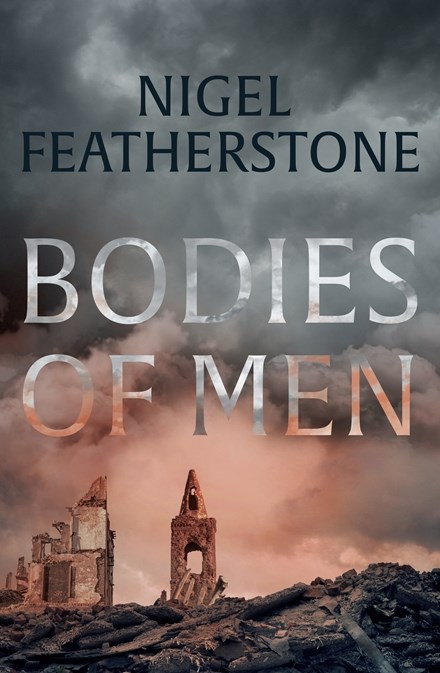
Nigel Featherstone, Bodies of men

This prize, which is supported (fascinatingly) by a building and facilities company, the ARA Group, is worth $60,000, with $50,000 going to the winner, and $5,000 each to two short-listed writers. It is open to Australian and New Zealand writers. The longlist was announced on 6 October, with the shortlist of 3 books to be announced 28 October, and the winner on 10 November.

The inaugural 2020 longlist is:

  • Sienna Brown’s Master of my fate 
  • Nigel Featherstone’s Bodies of men (my review)
  • Catherine Jinks’ Shepherd
  • Mirandi Riwoe’s Stone Sky Gold Mountain (want to read, Theresa’s review)
  • Dominic Smith’s The Electric Hotel (my review)
  • Christos Tsiolkas’ Damascus (my review)
  • Pip Williams’ The Dictionary of lost words (on my TBR, Lisa’s review)
  • Tara June Winch’s The yield (my review)

Surprisingly for me, I have read half of them!

HNSA Conferences

In 2019, the conference included a full-day academic stream, focusing on the overall conference theme of History repeats. There were three panels through the day: Genre and gender; Genre and the discourse of history; and War and conflict. Abstracts of the papers can be found at the link above.

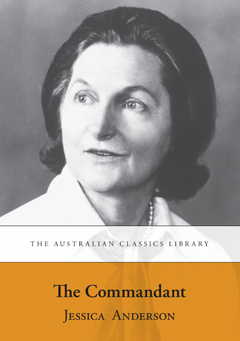
Jessica Anderson, The commandant Book cover

One of the papers was “‘the truth of the book’: Jessica Anderson’s The Commandant as a work of biofiction, Merran Williams“. I have reviewed this book, which is Anderson’s only historical fiction work. In her abstract, Williams says that “Historical novels have the ability to provide unique insights into untold histories” and that

Anderson subverted the traditional biofiction of a man of importance by feminising the masculine history of Patrick Logan and the Moreton Bay convict settlement and telling much of his story from the point-of-view of the soldiers’ female family members. I focus on her fiercely forensic approach to historical research and how she applied this to her writing practice to produce a work of historical biofiction that shines a light on a foundational period of Australian history.

This is a stream of the conference I’d love to attend if it ever came my way.

AWW Challenge

Challenge logo

Many of you know that I have been involved in the Australian Women Writers Challenge pretty much from its inception. It collects on-line reviews by contributors of any books – all forms and genres – written by Australian women. At regular intervals, mostly monthly or bimonthly, volunteers post round-ups of reviews contributed in the previous period for specific genres/forms. Our current Historical Fiction volunteer is Theresa Smith (Theresa Smith Writes.)

You can find her Historical Fiction round-ups at the AWW site. The Books Reviewed search page will find all contributors’ reviews posted to the challenge. The site comprises an excellent resource for reviews on books published recently and in the past, because our reviewers read widely.

Other

The Nib Literary Award could be seen to support this genre in a broad way, because, although its winners tend to be non-fiction, its aims are to celebrate excellence in research, including in fiction.

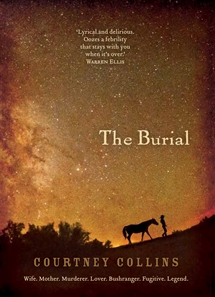
Courtney Collins, The burial

There is also an interesting international site called historicalnovels.info which devotes a page to Australasia. It’s uncomfortably simplistic in its understanding, offering this about Indigenous Australians regarding historical fiction: “Native Australians, dubbed Aborigines by European settlers, did not fare well as colonization spread, but modern novelists recognize the positive aspects of their culture”. However, for readers looking for a list of Aussie historical fiction books, there’s something here. The list includes classic and contemporary novels – including writers like Eleanor Dark and Brian Castro! I learnt a few things, including that Courtney Collins’ The burial (my review) was published in the USA as The untold.

I’d love to hear what you think about historical fiction – even you Bill! – particularly regarding whether you like and why or why not?

Bill curates: Monday musings on Indigenous Australian writers

Bill curates is an occasional series where I delve into Sue’s vast archive, stretching back to May 2009, and choose a post for us to revisit.

The feature of Whispering Gums that we all most look forward to is Monday Musings. But when did they start? It took me a while to locate – WordPress really needs the ability to scroll through post Titles by Date – but it turns out Sue put up the first one on 9 Aug. 2010 (here). Check it out, it’s only short, not much more than a statement of intent. No. 2 (here) covers 5 Australian novels, of which two would have to be my all time least favourite. So I’ve chosen for today, No. 3, from 23 Aug. 2009.
_______________________

My original post titled: “Monday musings on Australian literature: Indigenous writers”

Tara June Winch

Tara June Winch (Courtesy: Friend of subject, via Wikipedia, using CC-BY-SA 3.0)

It’s important I think that my third post be on our indigenous writers. Again it’s going to be pretty idiosyncratic as my reading in this area has been scattered, not for lack of interest so much as the old “so many books” issue that we all know only too well. I was first introduced to indigenous writing at high school where I had two inspirational teachers who encouraged us to think seriously about human rights. It was then that I bought Oodgeroo Noonuccal’s (or Kath Walker as she was then) book of poetry, My people.

In my first Monday Musings post, I mentioned David Unaipon who is generally recognised as the first published indigenous Australian author. However, it was Oodgeroo Noonuccal, with her book of poetry, We are going (1964), who heralded contemporary indigenous Australian writing. So let’s start with her.

Oodgeroo Noonuccal My people (1970, poetry)

Noonuccal’s poetry is largely political. She wrote to right the wrongs which indigenous Australians confronted every day: the racism, the white-colonial-slanted history, the lack of land rights, and so on. Much of her poetry is therefore strong but accessible “protest” poetry. My people collects poems from her first two books and includes new works as well. Here are just a few lines to give you a sense of what she was about:

… Do not ask of us
To be deserters, to disown our mother,
To change the unchangeable.
The gum cannot be trained into an oak.
(from “Assimilaton – No!”)

Gumtree in the city street,
Hard bitumen around your feet,
Rather you should be
In the cool world of leafy forest walls
And wild bird calls.
(from “Municipal gum”)

I love the way she uses gums to represent her people – who they are, where they should be. Some of the poems are angry, some are conciliatory, and others celebrate her culture. I loved the book then, and I still value it now.

Sally Morgan My place (1987, memoir)

The next book in my collection, chronologically speaking, is Sally Morgan’s memoir My place. Sally Morgan is primarily an artist but her memoir became a best seller when it was first published. In it she chronicles how she discovered at the age of 15 years old that her colour did not come from an Indian but  an Aboriginal background, and her subsequent investigations into her family’s rather controversial story. I don’t want to go into the controversy here. Rather, the point I’d like to make is her story-telling: it is warm, funny, and thoroughly engaging.

Women of the centre (1990, short life-stories); Black chicks talking (2002, short life-stories produced in film, book, theatre and art)

Telling stories is an intrinsic part of Indigenous Australian culture. It’s how traditions have been passed on for 40,000 years or more. It’s probably simplistic to draw parallels between traditional story-telling and the telling of stories in general. After all, we all love stories. Nonetheless it is certainly clear from the little experience I’ve had and the reading I’ve done, that story-telling is an intrinsic part of Indigenous Australian culture and is becoming an important way of sharing their experience with the rest of us. This was powerfully done in Bringing them home: The stolen generation report of 1997 which contained not only the history of the separation of children from their parents and recommendations for the future, but many many first person stories which drove the drier points home.

Two books that I’ve read which contain personal stories by indigenous women are Women of the centre and Black chicks talking. The introduction to the former states that its aim is to help we non-Aboriginal Australian readers to understand lives that are so different from our own and “to provide personal written histories for the descendants of the women involved”. This latter is becoming an urgent issue in indigenous communities today – the capturing of story before more is lost. In Black chicks talking Leah Purcell interviews nine Aboriginal woman – some urban, some rural, some well-known, some not – about their lives. Another wonderful read.

Life stories/memoirs represent, in fact, a significant component of indigenous literature. Another work worth mentioning, though I’ve only seen the film and not read the book (shame on me!), is Doris Pilkington’s “stolen generation” story of her mother’s capture and subsequent escape involving an astonishing trek home, Follow the Rabbit-Proof Fence.

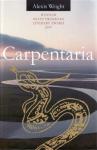
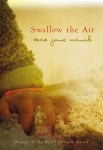
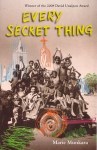
Alexis Wright Carpentaria (2006); Tara June Winch Swallow the air (2006); Marie Munkara Every secret thing (2009)

Finally, a brief mention of three recent fictional works, two of which I’m ashamed to say are still in my TBR pile. These are the two David Unaipon Award winners by Tara June Winch (reviewed since then) and Marie Munkara (reviewed since then). If you are interested in the latter, please check Musings of a Literary Dilettante’s review.

I have though read Alexis Wright’s Miles Franklin Award-winning Carpentaria (my post). It’s set in a fictitious place, tellingly called Desperance, in northern Australia. Its focus is colonialism (ie European invasion of the land), and conflict within black communities about how to respond. To explore these, Wright touches on lot of ground, including land rights, deaths in custody, mining rights, boat people, and petrol sniffing to name just a few. She flips between the real and the magical, she uses language that is image-rich and often playful, and she tells some very funny stories. It’s a big, wild and rather complex read that manages in the end to be hopeful despite itself.

This is just a small introduction to the wealth of Australia’s indigenous literature. It won’t be the last time I write about it. I will also in the future post on white Australians who have written about Aboriginal Australians, writers like Thomas Keneally who wrote The chant of Jimmie Blacksmith but who now says he wouldn’t presume to write in the voice of an Indigenous Australian. A vexed question really. I believe there should be no “rules” for writers of fiction and yet, sometimes perhaps, it is best not to appropriate voices not your own. But that is a question for another day…

Meanwhile, back to Alexis Wright – and stories:

Old stories circulating around the Pricklebush were full of the utmost intrigues concerning the world. Legends of the sea were told in instalments every time you walked in the door of some old person’s house. Stories lasted months on end, and if you did not visit often, you would never know how the story ended. (Carpentaria, p. 479)

____________________

I’m not surprised – and am glad – that Bill chose this one from my early Monday Musings, because this is an area of Australian literature that is dear to his and my hearts (and to Lisa’s who runs her Indigenous Literature Week each year.) And phew, I’m glad I’ve since read those two novels that were on my TBR back there in 2010.

[You can find all my Monday Musings by clicking on the Monday Musings category, or this link]

Would you, wherever you are, like to recommend any indigenous writers?

Fannie Barrier Williams, Women in politics (#Review)

It’s been months since I posted on a Library of America (LOA) Story of the Week offering, but this week’s piece by African American activist, Fannie Barrier Williams, captured my attention. Several LOA offerings this year have been relevant to the times – including stories about infectious diseases – but this one is so spot on for so many reasons that I could not pass it up.

Fannie Barrier c1880, photographer, public domain via Wikipedia

Fannie Barrier Williams (1855-1944) was, according to Wikipedia (linked above), an American political and women’s rights activist, and the first black woman to gain membership to the Chicago Woman’s Club. According to LOA, she was also the first African-American to graduate from Brockport Normal School and “quickly became part of Chicago’s black elite when she moved there with her lawyer husband in 1887”. She was a distinguished artist and scholar.

However, it’s her activism that is my focus here. Wikipedia says that “although many white women’s organizations did not embrace their black counterparts as equals, Barrier Williams made a place for herself in the Illinois Woman’s Alliance (IWA).” She represented the viewpoint of black Americans in the IWA and “lectured frequently on the need for all women, but especially black women, to have the vote”.

And so we come to her little (in size not import) piece, “Women in politics”, which was published 1894. It concerns women voting. Universal suffrage was still some way off in the USA, but Barrier Williams commences by arguing that the “fragmentary suffrage, now possessed by women in nearly all states of the union”, will certainly and logically lead to “complete and national suffrage”. So, with this in mind, she, says LOA’s notes, “challenged women to use their newfound political power wisely”. She asks:

Are women ready to assume the responsibilities of this new recognition of their worth? This question is of immense importance to colored women.

She then poses, provocatively,

Must we begin our political duties with no better or higher conceptions of our citizenship than that shown by our men when they were first enfranchised? Are we to bring any refinement of individuality to the ballot box?

Her concern is that women – but we could read anyone really, giving it broader relevance – should not vote on partisan lines. Her concern is that voting along party lines will achieve nothing, and that

there will be much disappointment among those who believed that the cause of temperance, municipal reform and better education would be more surely advanced when the finer virtues of women became a part of the political forces of the country.

Hmmm … this seems to trot out the belief that women will bring “womanly” virtues, those more humanitarian-oriented values, to politics, which history has not necessarily borne out. However, this doesn’t belie the main point about voting thoughtfully.

She then discusses the opportunity for women to vote in Chicago for the trustees of the state university, but notes that the two women candidates have aligned themselves, respectively, to the republican and democratic tickets. She says that “so far the campaign speeches and methods have not been elevated in the least degree above the dead level of partisanship”. She doesn’t want to discredit these women’s good motives but argues that

this new opportunity for self-help and advancement ought not to be lost sight of in our thirst for public favors, or in our eagerness to help any grand old “party.” We ought not to put ourselves in the humiliating position of being loved only for the votes we have.

It seems that these two women candidates were white women. What she says next reminds me of Aileen Moreton-Robinson’s Talkin’ Up to the White Woman: Indigenous women and feminism (2000)which Angharad of Tinted Edges recently reviewed. Angharad writes that “Moreton-Robinson argues that because of feminism’s inherent but insufficiently examined white perspective, Indigenous women are excluded, minimised or merely tolerated conditionally. She argues that because race is considered to be something that is “other”, white feminists are unable to acknowledge their own race and associated privilege, their own role in perpetuating racial discrimination and are therefore unwilling to relinquish some of that power.”

A similar point was made over 100 years earlier by Barrier Williams:

The sincerity of white women, who have heretofore so scorned our ambitions and held themselves aloof from us in all our struggles for advancement, should be, to a degree, questioned. It would be much more to our credit if we would seek, by all possible uses of our franchise, to force these ambitious women candidates and women party managers to relent their cruel opposition to our girls and women in the matter of employment and the enjoyment of civil privileges.

She continues that “we should never forget that the exclusion of colored women and girls from nearly all places of respectable employment is due mostly to the meanness of American women” and that voters should use the franchise to “check this unkindness”. She urges voters not to focus on “the success of a party ticket for party reasons”. This would make them “guilty of the same folly and neglect of self-interest that have made colored men for the past twenty years vote persistently more for the special interests of white men than for the peculiar interests of the colored race”.

Strong words, but history surely tells us true ones. So, she asks voters “to array themselves, when possible, on the side of the best, whether that best be inside or outside of party lines”.

For Barrier Williams, as for many who fought for women’s suffrage, the vote was not just about equality but about what you could do with the vote. It was about having the opportunity to exert “a wholesome influence in the politics of the future”. The words may be strange to our 21st century ears, but the meaning still holds true – and is a timely one to consider now!

Fannie Barrier Williams
“Women in politics”
First published: The women’s era, 1894
Available: Online at the Library of America

Monday musings on Australian literature: Alison Lester

Saturday, as I noted in my Six Degrees of Separation post, was National Bookshop or Love Your Bookshop Day in Australia (and in Great Britain too, it seems). For last year’s day, I wrote a post on author-owned/managed bookshops, most of which were located in places other than Australia. The exception was Australian children’s author and illustrator, Alison Lester, so I thought she deserved a little feature post today.

Alison Lester has appeared in my blog a few times, but the first was the most significant, because it was when she and Boori (Monty) Prior were named our first two Children’s Laureates. She was also mentioned briefly in my post referencing the 2018 National Bookshop Day, when Daughter Gums bought a Lester book for a baby shower she was attending! It’s time, then, to give her a little bit of a profile here, even though children’s literature is a sideline focus here.

As I wrote in my Children’s Laureate post, I first became aware of Lester through my own children. As I wrote then, she’s an author/illustrator best known for her picture books, though she has also illustrated chapter books for other writers and written a couple of young adult novels. The first book that she both wrote and illustrated herself was 1985’s Clive eats alligators.

Book cover

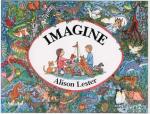
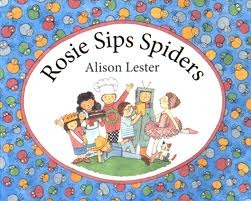
This means that Lester was just starting out when my children were young, so most of her children’s books have been published after my children left that stage of their reading lives. But, we did have some favourites, including Rosie sips spiders (1988), Imagine (1989) and Magic beach (1990). As our children grew we also enjoyed Robin Klein’s chapter book, Thingnapped, which was illustrated by Lester.

Lester, like all the best children’s book authors and illustrators has a lovely sense of fun while also conveying important values to children, such as respecting difference, a critical value at a time when rejecting other seems to be on the rise again. Indeed, as her website says, “her picture books mix imaginary worlds with everyday life, encouraging children to believe in themselves and celebrate the differences that make them special”.

Jonathan Shaw of Me fail? I fly has discussed Alison Lester’s books several times on his blog in his Ruby Reads series where he discusses the books he reads to his granddaughter. Lester’s books featured by Jonathan to date are:

  • Clive eats alligators (1985), which features seven children going about their daily lives, except that “Clive eats alligators”. You’ll have to read it to discover that that means! Jonathan says that the fun in this book lies in tracing any one of these children through the book to see “how their interests play out in the different contexts: the girl who loves horses, the bookish boy” and so on. Rosie sips spiders, which Daughter Gums loved, follows the same children in more adventures through life. Lester fans will get a giggle when, in this Rosie book, they read that “Clive jumps in Alligator Creek.”
  • Are we there yet? (2005), a picture book about – yes, you’ve guessed it – family car travel. Jonathan says that her images are “completely beguiling”. Maybe this is why it was the first book given to a child from Dolly Parton’s Imagination Reading Library.
  • Kissed by the moon (2013), about a baby, the night, and nature. Jonathan writes that “pragmatically speaking, I guess it’s a bedtime read, but Alison Lester knows how to put words together, and how to make images, that reach in and touch your heart”.
  • My dog Bigsy (2015), which is one of those books in which the feature character wanders around a farm, meeting other animals, like, for example, Pat Hutchins’ fabulous Rosie’s walk. I haven’t read this Lester yet, but Jonathan says that Lester does it well. I think I’ll be getting it for Grandson Gums.

Thanks Jonathan for posting on these books – for the Australian Women Writers’ Challenge where we have appreciated these posts, and so I could use them here! Very thoughtful of you!

Lester has been shortlisted for, or won, Children’s Book or Picture Book of the Year awards several times over the years. She has also won the Dromkeen Medal for services to Australian literature, and was the first children’s writer to be awarded the valuable Melbourne Prize for Literature. She has been shortlisted for the international Astrid Lindgren Memorial Prize. And, of course, she is an active promotor of Aussie children’s literature, including being that Children’s Laureate role and being an Ambassador for the Indigenous Literacy Foundation.

Lester, born 1952, was a farm girl, and still rides a horse when she can. Adventure, that features in her stories, is in her DNA it seems (something I think I missed!) So, I wasn’t surprised to read that in 2005 she went to Antarctica as an Australian Antarctic Arts Fellow. You can read her Antarctic Diary on her website.

Alison Lester Gallery

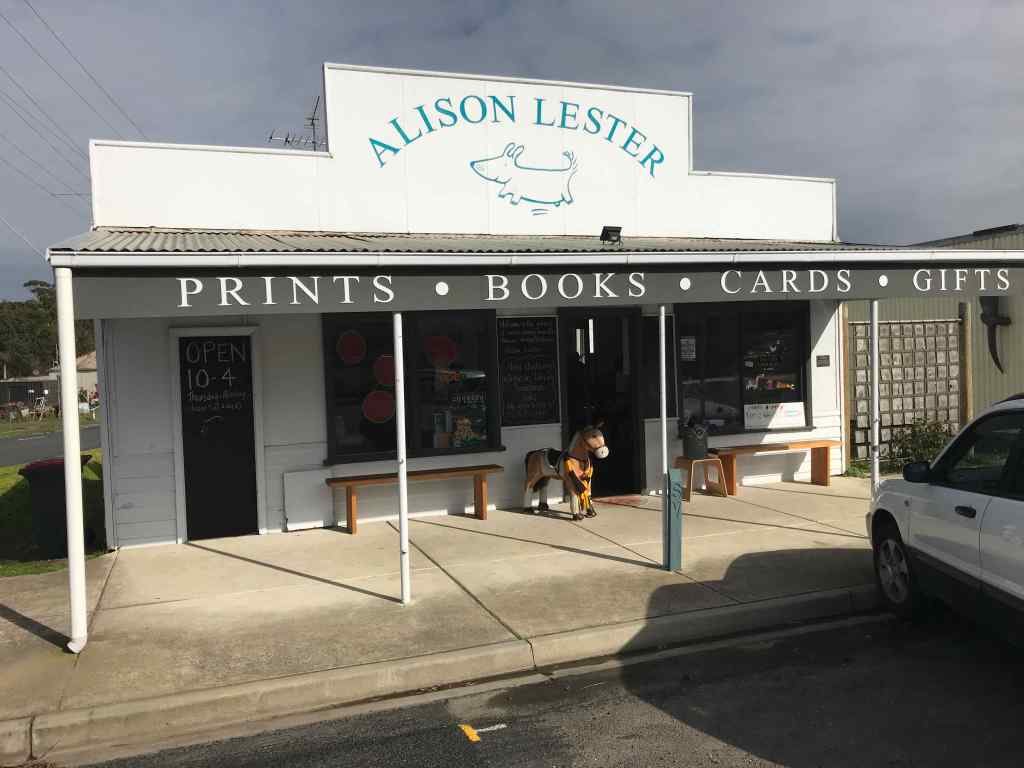
Now to Lester’s bookshop. It is, I have to admit, not like the others. Located in the gorgeous Victorian town of Fish Creek, near where Lester was born, it is more a “gallery” than a bookshop, and is devoted solely to her work. We have been there, and it is a light, airy, welcoming place that sells her books, cards and other merchandise, and also prints of many of her illustrations. It also has lounges where you can sit and read her books.

So, a rare post for me, given its focus is children’s literature, but most of us here started our reading lives when we were very young, and if we’ve had children or grandchildren we’ve done our best to share that love down the generations.

I’d love to hear about your favourite children’s authors. Who did you love as a child and/or who have you loved reading to children in your life?

Six degrees of separation, FROM Turn of the screw TO …

One month into spring here down under, and it is so lovely, particularly with daylight savings starting tomorrow. That will hopefully mean not being woken at 5am by sun and birdsong, much as I enjoy the latter! Now though, onto today’s business, this month’s Six Degrees of Separation meme.  As always, if you don’t know this meme and how it works, please check out meme host Kate’s blog – booksaremyfavouriteandbest.

Once again, the starting book is one I haven’t read, though I have read and enjoyed several books by Henry James. The book is his Turn of the screw. Published in 1898, it’s a classic Gothic mystery featuring a young governess, in a country house.

Louise Mack, Girls together

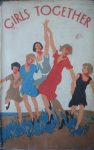
I was tempted to go with governesses for my first link, but decided to do something different and go with year of publication. Louise Mack’s Girls together (my review) is a little known Australian coming-of-age novel that was also published in 1898. Commencing as a school story, it’s about protagonist Lennie’s transition from self-focused girlhood to adulthood and its associated more mature world-view. Her life and choices are paralleled to those of her friend, Mabel.

Book cover

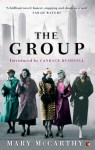
Another book which starts with young girls who meet at school – at Vassar College in fact – is Mary McCarthy’s The group (my review). In this case, however, we are talking eight girls, and we follow them through many years of their post-school life.

Book cover

My next link will be obvious to Australians as it is a book which talks about a group of women friends at the other end of their lives – that is, women in their 70s. The book is Charlotte Wood’s The weekend (my review).

Book cover

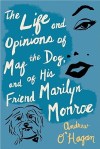
While the main focus of Wood’s book is the women, there is another important character, Finn, the aging dog. He doesn’t have a voice in the novel, but a dog who does is Maf the dog in Scottish writer Andrew O’Hagan’s The life and opinions of Man the dog and of his friend Marilyn Monroe (my review). Phew that’s a title, but it was, as I recollect, an enjoyable book!

Book cover

And here is where I get to the point I really wanted to get to because today, Saturday 3 October, is National Bookshop Day in Australia (or, it seems, now called Love Your Bookshop Day). You may be wondering how I am going to link to this? Well, Marilyn Monroe, as you probably know, was a big reader, so I’m linking to author Ann Patchett’s essay, The bookshop strikes back (my review). I reckon Marilyn Monroe would have loved this little book had she still been with us.

Book cover

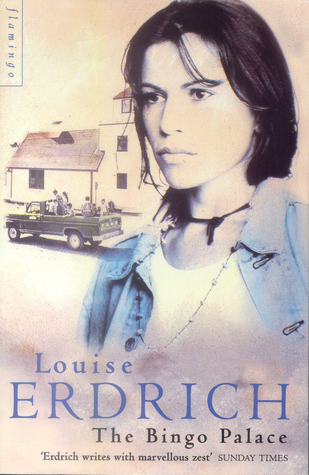
To strengthen this post’s tribute to bookshops, I’m sticking with them for my final link. Ann Patchett, as you also know I’m sure, is an independent bookshop owner as well as an award-winning novelist. I included her in my post on author-run bookshops last National Bookshop Day. Another bookshop-owning author I listed in that post was Louise Erdrich, so it’s her The bingo palace (my review) that I’m using for my final link.

Although I didn’t intend it, I’ve stuck very much to anglo-speaking countries this month – Australia, Great Britain and the USA. Moreover, all my authors but one, this month, were women. Not wonderfully diverse then! However, on the plus side, I did manage to work in a tribute to reading and bookshops, because initially I’d headed off in a different direction.

And just so you know, my favourite fabulous bookshops here are:

Now, the usual: Have you read Turn of the screw?And, regardless, what would you link to? And, this month, a bonus question: Would you, wherever you are, like to give a little shout-out to your favourite independent bookshop?

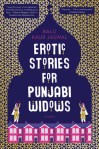
Balli Kaur Jaswal, Erotic stories for Punjabi widows (#BookReview)

Book cover

Broadly speaking, Singaporean author Balli Kaur Jaswal’s third novel, Erotic stories for Punjabi widows, reminds me of Anita Heiss’ choclit books like Paris dreaming (my review). By this I mean it presents as an escapist romcom genre novel but within it is some serious intent. In this case it relates to the oppression of women, particularly widows, and, more specifically, the problem of honour killings, in Britain’s Punjabi Sikh community.

The story concerns the “still searching for her calling” Nikki, who, twenty-two-and-a-half years old with half a law degree behind her, obtains a job teaching writing to immigrant Punjabi widows in Southall, the heart of London’s Punjabi community. Except, what she finds is that these widows do not want to learn to write:

I’ve survived all this time without reading and writing; what do I need it for now?’

What they want is to tell stories – erotic ones – to each other. What they want, really, is companionship and a safe place to be themselves, away from the oppressive eyes of a traditional community dominated by the self-appointed “morality police”, the Brothers.

And here is where some darkness comes in, because within this community, several young women have died. Officially, these deaths are recorded as accidental or suicide, but it gradually becomes apparent that all may not be as it seems and that murder and honour-killing may be involved. Widow Sheena chillingly says later in the book that “in this community I’m suspicious of accidents.” The novel, therefore, is a romcom-cum-crime mystery.

Paralleling this story of the widows and their writing class is that of Nikki and her nearly 25-year-old sister, Mindi. Born in England to Punjabi immigrant parents, they represent the other side of the cultural coin – to a degree, anyhow, because Mindi, a nurse and (still) unmarried, is considering “embracing our culture” and going the traditional arranged marriage route. This shocks the freer wheeling, English-to-a-core-she-thinks, Nikki, who tells Mindi:

This is what young women do in Britain! We move out. We become independent. This is our culture.

Even so, our modern Nikki does sometimes feel “split in two parts. British, Indian.” Fortunately, Nikki meets a man the more usual way – by serendipity – and love starts to bloom. But, this is a rom-com so, as you’d expect, the course of true love doesn’t run smooth and soon enough Nikki finds herself wondering why this man is behaving a little strangely.

As with Anita Heiss’s choclit books, what lifts Erotic stories for Punjabi women out of the straight chick lit genre, is its interrogation of social issues. Besides the above-mentioned mystery concerning a young woman’s death, two other issues are reflected in the lives of these characters, one being the challenges faced by young first generation women, and how they navigate the two cultures they find themselves straddling. By having Nikki and Mindi handle this quite differently, Jaswal reveals the complexity of what this generation faces. Then we add in Nikki’s new love, Jason. I don’t want to spoil anything, but let’s just say that his experience of being a first generation Sikh man from the USA, and the expectations placed on him, adds commentary to Nikki and Mindi’s thoughts about life, love and marriage.

The other main issue is the oppression of Punjabi Sikh women, particularly but not only widows, within their own culture and in the culture of their adopted home. Our widows are invisible in their own community. Without their husbands they are seen as and feel “irrelevant”. However, these Punjabi women overall haven’t made any inroads into the English community either, feeling the English “haven’t made their country or their customs friendly” to them. “Britain”, Nikki realises, “equalled a better life and they would have clung to this knowledge even as this life confounded and remained foreign.”

There is, then, a lot going on here, but Jaswal, whose first novel, Inheritance, earned her a Sydney Morning Herald Best Young Australian Novelist Award, knows how to construct and move along a plot. She also knows how to entertain. The erotic stories are a bit of a hoot. With our widows finding creative synonyms for certain body parts, you may never look at a cucumber the same way again. It’s laugh-out-loud funny at times, which my reading group enjoyed, and there are some lovely touches of irony. For example, the earnest Kulwinder, interviewing Nikki for the writing class, starts to sense that Nikki’s idea and her own may not be aligned:

It dawned on Kulwinder that she had advertised for something she did not understand.

The joke, though, is on Nikki too, because for all her “passion to help the women”, little did she expect just how that “passion” might play out!

My favourite books are those which touch the heart and challenge the mind. Erotic stories for Punjabi widows, for all its serious intent, primarily meets the former. It ticks all the boxes: it’s fun to read, has likeable characters, and its message is valid and relevant. For me, though, it’s a little too obvious and predictable, and the resolution is too neat to give the book the sort of gritty, punchy power I love. However, I enjoyed the read and recommend it to anyone wanting an enjoyable romp of a read with a little meat on its bones.

Lisa (ANZLitLovers) also enjoyed this book.

Balli Kaur Jaswal
Erotic stories for Punjabi widows
London: HarperCollins Publishers, 2017
ISBN: 9780008209902 (eBook)
299pp.

Monday musings on Australian literature: Nib Literary Award

The Mark & Evette Moran Nib Literary Award is a somewhat unusual award that I’ve been receiving notifications about for years, but have never posted specifically on (though Lisa of ANZLitLovers has.) It’s unusual for a couple of reasons. One is that its focus is on celebrating “excellence in research and writing in Australia”, and the other is, as the website also says, that it is “the only major [national] literary award of its kind presented by a local council”.

The award was established in 2002 as the Nib Waverley Library Award for Literature, but was renamed The Mark & Evette Moran Nib Literary Award in 2017 to recognise the Morans’ significant sponsorship of the award. Exactly who initiated it is a little unclear, but it seems that the Australian author and playwright Alex Buzo (1944-2006), who lived near and prolifically used Waverley Library, and Chris Haywood, Patron of the Friends of Waverley Library*, were instrumental. (I love seeing a Friends’ group involved in something like this.)

The award is open to all Australian writers regardless of their experience, chosen subject matter or genre. The judging criteria are: excellence in research, high level of literary merit, readability and value to the community. These are interesting criteria and reflect, I understand, the ethos, passions and goals of both Alex Buzo and the Waverley Council. Announcing the 2019 award, City Hub Sydney suggested that these are the only awards given out for research and the writing process itself rather than just for the finished product. The shortlist and winner are chosen by an independent panel of three judges, of which Alex Buzo was one in its first few years.

There are additional prizes, but again their history is a little uncertain:

  • Alex Buzo Shortlist Prize of $1000 to each shortlisted author (added in 2006?)
  • The Military History Prize of $3000, supported by the Bondi Junction, North Bondi, and Rose Bay RSL Sub-Branches to commemorate the ANZAC centenary, “for a work that illustrates the service and sacrifice of Australian service men and women, families or the broader home front, during or in relation to any threat(s) of war” (added 2015?)
  • People’s Choice Prize of $1000 (added in 2017?)

Book cover, The forgotten rebels of EurekaI haven’t been able to find anything about the 2020 Military History Prize, so am not sure about its continuation or, at least, its being awarded this year.
Winners

  • 2002 Tim Low, The new nature (nature/science writing)
  • 2003 Barry Hill, Broken song: TGH Strehlow and Aboriginal possession (biography)
  • 2004 Geoffrey Blainey, Black kettle and full moon: Daily life in a vanished Australia (social history)
  • 2005 Helen Garner, Joe Cinque’s consolation (true crime)
  • 2006 Gideon Haigh, Asbestos house (business writing/company history)
  • 2007 John Bailey, Mr Stuart’s track: The forgotten life of Australia’s greatest explorer (biography)
  • 2008 Christopher Koch, The memory room (novel) (Lisa’s review)
  • 2009 Robert Gray, The land I came through last (autobiography)
  • 2010 Andrew Tink, William Charles Wentworth (biography)
  • 2011 Delia Falconer, Sydney (history/travel)
  • 2012 Jane Gleeson‐White, Double entry: How the merchants of Venice created modern finance (business writing/history)
  • 2013 Gideon Haigh, On Warne (biography)
  • 2014 Clare Wright, The forgotten rebels of Eureka (Text) (history) (my review)
  • 2015 Erik Jensen, Acute misfortune: The life and death of Adam Cullen (biography) (Lisa’s review)
  • 2016 Rachel Landers, Who bombed the Hilton (investigative writing/political history)
  • 2017 Kate Cole‐Adams, Anaesthesia: The gift of oblivion and the mystery of consciousness (science writing/memoir)
  • 2018 Helen Lewis, The dead still cry: The story of a combat cameraman (biography) (Lisa’s review)
  • 2019 Nadia Wheatley, Her mother’s daughter: A memoir (hybrid biography/memoir) (my review)Nadia Wheatley, Her mother's daughter

I have read just three, but only two since blogging. It’s interesting, but not surprising, that although the criteria encompass all “genres”, only one of the winning books, to date, has been fiction. We have talked about the role of research in fiction here many times. I would love to see this award grapple with that a little more. There were a couple of novels in the 2020 longlist, including Heather Rose’s Bruny (my review) and Julie Janson’s Benevolence (on my TBR).

In the various announcements I’ve read online, I’ve seen little in the way of judge’s comments, so I don’t know how they’ve assessed the winning books in terms of the criteria, that is, their “excellence in research, high level of literary merit, readability and value to the community”. It would be really interesting to know, for example, what they mean by “readability” and “value to the community”.

Overall, though, I love that this award exists. It’s quite a testament to Waverley Council and its supporters that it has survived, now, for 19 years.

Are you aware of this award, and, regardless, what do you think about its criteria?

* See Nib Waverley’s Alex Buzo page and Wikipedia.

Bill curates: Favourite writers, no. 2

Bill curates is an occasional series where I delve into Sue’s vast archive, stretching back to May 2009, and choose a post for us to revisit.

We discovered in August that Thea Astley is Sue’s #3 favourite writer. We’ve always known that Jane Austen (here) is #1. So I thought we should check out # 2. And, if you’re wondering, I’ve looked and there is no #4. Sue of course – she’s a librarian – is astonishingly well organised, so to go to her Jolley reviews, click on Authors above. There you will find authors listed alphabetically, and beneath each author the books Sue has reviewed.

My original post titled: “Favourite writers 2: Elizabeth Jolley”

Not, unfortunately, being a time-traveller, I haven’t managed to see or hear Jane Austen in person. I am, however, far more fortunate in this regard when it comes to the subject of my next favourite writers post – Elizabeth Jolley. I did get to see and hear her at a literary lunch at the height of her career. My reaction was the same as many others – her “little old lady” appearance and voice belied her sharp wit and earthy worldliness.

Elizabeth Jolley (Photo: Courtesy Fremantle Arts Centre Press)
Elizabeth Jolley (Photo: Courtesy Fremantle Press)

It’s not surprising that she is one of my favourite writers: I call her my antipodean Jane Austen. She is witty and ironic, she is wicked (though blacker than Austen), and she tends to write about a small number of people in a confined, often domestic, situation. But here the similarity ends. While the “character” of Austen’s characters play a role in what happens to them – there’s a reason why Elizabeth not someone like Lydia “gets” Mr Darcy – Austen’s main interest is in the social and economic constraints on her characters. Jolley on the other hand focuses more on the interior. She explores loneliness and alienation. She looks at the disturbing or unsettling sides of relationships, the ‘feelings’ people have but often don’t admit to such as those for a person of the same sex or for a person for whom they should not have feelings for (due, for example, to age differences, power differences, or infidelity). She shows how difficult it is to maintain a long-term intimate or deep relationship that is equal on all levels (physical, intellectual, social, material, etc).

In the Australian and New Zealand Journal of Psychiatry (Vol. 25, No. 1, 1991), Jolley writes:

In my own writing I have been interested in the exploration of survival (perhaps emotional survival), resilience and responsibility. (I only know this now after several books are written).

How very Jolleyesque that aside is – humble but a bit sly at the same time. She continues a little later to say:

…for the most part my characters are perplexed, anxious, often frightened with perhaps one redeeming aspect in their personalities – that of optimism which might for a time, until it gets out of hand, keep them from the specialist’s doorstep.

Photo: Courtesy Fremantle Press

The first Jolley I read was the short story, “Night runner”, in an anthology titled Room to move. It introduced me to her concept of alienation and rather black notion of survival, her particular brand of irony, her portrayal of characters who more often than not suffer from some level of self-delusion, and her dark humour. I went on to read Miss Peabody’s inheritance, The newspaper of Claremont Street, The well, The sugar mother, and An innocent gentleman, among others, and have never really been disappointed. I enjoy her use of repetition and self-referencing, the motifs and the characters, even, that reappear in different works. She gets me in the pit of my stomach with her vulnerable but often unkind or downright cruel characters, but makes me laugh at the same time with her depictions of their attempts at survival. You just have to see Ruth Cracknell playing The woman in a lampshade to know what I mean!

I have not yet read all of Jolley’s works. Just as for a long time I kept back one Jane Austen novel because once I’d read it I’d have read them all, I am now doing the same with Jolley. Her books are so delicious they need to be savoured. I’m sure this is not the last post I’ll be writing about her.

Postscript: Since this post I have read more Jolley, but I still have some up my sleeve!

____________________

Bill is right. There is no #4, though I have frequently thought about who would be my number 4. I’ve also wondered about how many favourite writers it would be reasonable to have? I love so many writers, still living and those who are no longer with us … but I think that if I do name a 4th I will stick to ones who have died. And, I think I know who that would be.

You now know my top three writers, as I considered them 10 years ago? Would you care to name your top 3?

Carol Lefevre, Murmurations (#BookReview)

Book coverMurmurations is a beautiful, evocative word, and Carol Lefevre’s latest book, titled Murmurations, does beautiful, thoughtful justice to it. It is though an unusual book. Styled by its author as a novella, it reads on the surface like a collection of short stories, except that the stories are not only connected by the various characters who pop in and out, but by an overarching mystery concerning one of them, Erris Cleary, whose funeral occurs in the first of the eight stories.
Murumuration is, you may know, the collective noun for a flock of starlings, something I discussed in my 2016 post on Helen Macdonald’s essay “The human flock”. She says starlings flock for protection (out of fear), to signpost where they are to other starlings, and for warmth. Lefevre provides, as an epigraph for her book, an image of a murmuration and the following quote from a paper on starling flocks:

The change in the behavioural state of one animal affects and is affected by that of all other animals in the group, no matter how large the group is.

These ideas are all reflected, in some way, in Lefevre’s book. But, the book also has another idea as Lefevre explains in her acknowledgements, and that is that each story was inspired by a different Edward Hopper painting. If you know his paintings – like “Automat” which inspires the first story – you will know that although they are set in real places, they have a certain paradoxical other-worldliness, which entwines bleakness with a sort of dreamy expectation. This tone also pervades Lefevre’s book.

Murmurations starts with “After the island”. Here, young doctor’s secretary Emily considers the funeral of her employer’s wife, the 53-year-old Erris Cleary. She remembers some mysterious messages that had occasionally broken through the doctor’s patient note recordings, messages that implied Erris was in danger. The book ends with “Paper Boats”, in which two neighbours, Amanda and Magda, discuss Erris’ death, with Amanda going on to write a short story about it. Erris Cleary, then, is the link that joins the stories.

The six stories that come between these opening and closing ones are all, like the two just mentioned, told third person from different characters’ perspectives. All are women except for the titular (and penultimate) story, “Murmurations”, which features a young man. His, Arthur’s, story is the only one in which we finally “meet” Erris as a living woman. Four of the remaining five stories feature women who moved in Erris’ circle – Claire, Fiona, Jeanie and Delia – with the fifth one featuring Lizbie who had a complicated and ultimately tragic relationship with two sons from this circle. She is also the daughter of the final story’s Amanda.

Each story focuses on the dark little accommodations or disturbances in its protagonist’s life. Marriage breakdown, looming dementia, suicide and other events threaten to – and usually do – destabilise the characters. There is a sense of quiet desperation in the stories, even in those that look to be alright on the surface. Claire (“Little Buddhas everywhere”) clings to the husband who has remarried. She relies on his sense of responsibility, not to mention her faith in her inherent lovability, to keep him looking after her as well as his new family, while Jeanie (“The lives we lost”) is thrown by the fact that the man she married admits years later that he hadn’t loved her then, though he did now. Delia (“This moment is your life”) is starting to lose her mind. She appreciates her second husband but seems to have married the same sort of controlling man she had the first time. And so on.

These are, mostly, the quiet little tragedies of life, the ones that never make the newspapers but that are all around us – if we only knew what questions to ask. As one character or another appears in the story of another, we see the possibilities for impacting each other – as in a murmuration. The overarching tragedy is that for all their apparent connections, no one seems to really see what is happening to the others or to have the time, or even the desire, perhaps, to genuinely care. This is beautifully illustrated in Jeanie’s story. She moves in with her cousin but they can’t connect:

Neither cousin understands what the other is saying. Though they speak the same language, words, sentences, turn opaque when they attempt to describe their lives.

The implication seems to be that this little murmuration of women is a surface one only, with little protection or warmth afforded to the individual members.

The exception is the mysterious Erris who, in the titular story, speaks to the young Arthur, working in her garden. She offers him the chance to fly:

… and a note, addressed to him, scribbled on a page torn from a blind notebook: Fly away, Arthur. Fly far, be free. Erris.

Around the edges of the paper, cloud shapes were filled with dozens of small, dark, pencilled birds.

The book is beautifully structured to suggest complex layers of links between the stories and characters, layers that would only multiply, I suspect on multiple readings.  The first story’s Emily, for example, is a young girl from the Star of Bethlehem children’s home. Then, after five stories about women linked through neighbourhood lives to Erris, we come to the aforementioned young Arthur. He also comes from the Star of Bethlehem children’s home and was a friend of Emily’s. Will these two, despite lacking the opportunities the others have presumably had, make a better fist of their lives?

The final story adds another dimension. In converting Erris’ death and the mystery surrounding it into a short story that she submits to The New Yorker, Amanda hopes to achieve her writing goal:

to hit one true note. A note that will make sense of something, perhaps of everything, a note that will crack the obliterating silence once and for all.

Can fiction, Lefevre seems to be asking, make the difference? Can we, through fiction, see the connections that we don’t always see in the real lives around us? If it’s fiction like this, written with such clarity and heart, I believe it can.

Challenge logoCarol Lefevre
Murmurations
North Geelong: Spinifex, 2020
108pp.
ISBN: 9781925950083

(Review copy courtesy Spinifex Press)