Monday musings on Australian literature: A message from the remote west

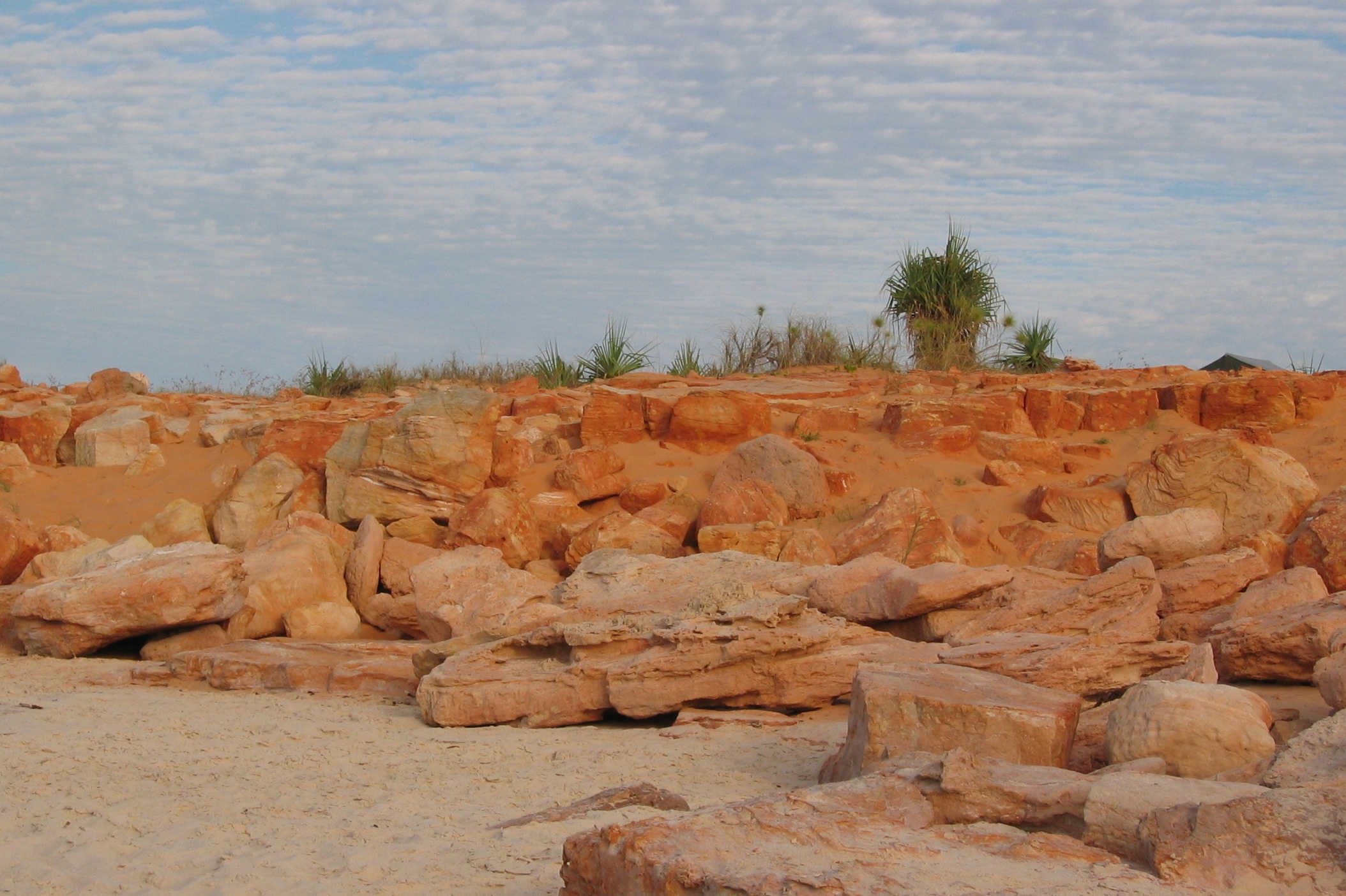
Cape Leveque

Section of beach at Cape Leveque (rather north of Shark Bay)

Do you look at those airline magazines you find in planes? I usually do … and often find something of interest in Qantas: The Australian Way. Yesterday I left Mr Gums behind and flew west for a week’s work in a remote town in north-west-ish Western Australia. It was a long flight (three actually) so I managed to watch a movie or two, read most of my novel, do a crossword and dip into the magazine. And, I’m glad I did because …

… in it was an excerpt from a new edition of Tim Winton‘s Land’s edge. The article described is as memoir, but the back of an earlier edition called it “an autobiographical meditation about his obsession with the coast”. Whatever you call it, it is clearly about his experience of one aspect of his life. I like writers’ memoirs but have yet to read this one. Its language is, needless to say (well, for me, because I like Winton), delicious:

The land around it [Shark Bay] looks blotchy and beaten. Desert right up to the water, it stains the white beaches vaguely pink. The water is variegated with sandbar whorls, veins of channels, meadows of seagrasses like bruises. It’s here that Europeans first met the Great South Land – Hartog, Vlamigh, Dampier – and they didn’t linger because the landscape seemed to shut its eyes and fold its arm against them: it was inscrutable.

I love that description of the landscape. It’s actually a wide open landscape but it “looks” empty and mysterious, rather beautiful but also somewhat unwelcoming. These days though, people flock to Shark Bay because this is where Monkey Mia is, the place where you can swim with dolphins. I haven’t been there yet, but I’m planning to:

This is the only place in the world you can do this naturally, expect to stand in the water, before breakfast, in the middle of the morning, just before sunset, and touch a free dolphin, feel its powerful bulk, look it directly in the eye and feel it slide back out of reach, unafraid. This is what all these people have caught planes and buses or spent 10 hours in a hot car for. Because none of this is normal, and the ritual has gone on since 1964, before Flipper, before environmentalism, before the New Age came slinking upon us. Generations of humans and dolphins meeting on land’s verandah.

And I think I’ll leave it at that …

Nine, just 9, books by female authors at the top of a 20th century list?

Portrait of Virginia Woolf, 1902

Woolf, 1902, by George Charles Beresford (Presumed Public Domain, via Wikipedia)

The Reading Ape, in his February Literary Fact of the Day compilation, included the following tidbit:

There are only 6 female authors on The Modern Library‘s list of the 100 best novels of the 20th Century.

In fact, in the Modern Library’s Board’s list (over 10 years old now), a woman doesn’t appear until slot 15, and it’s Virginia Woolf‘s To the lighthouse. By contrast, a woman – Ayn Rand no less – occupies the first two slots of the Modern Library’s Readers’ List. Granted, this list is old news now as it was published at the end of the 20th century and was well raked over at the time. But, the Reading Ape reminded me of it and it seemed to me to be worth another look, 10 or so years down the track.  Here are the women:

  • 15. Virginia Woolf’s To the lighthouse
  • 17. Carson McCullers’ The heart is a lonely hunter
  • 58. Edith Wharton’s The age of innocence
  • 61. Willa Cather’s Death comes for the archbishop
  • 69. Edith Wharton’s The house of mirth
  • 76. Muriel Spark’s The prime of Miss Jean Brodie
  • 84. Elizabeth Bowen’s The death of the heart
  • 94. Jean Rhys’ The wide Sargasso Sea
  • 95. Iris Murdoch’s Under the net

Oh, that’s actually 9. The Reading Ape can’t count! Still 9% is pretty poor isn’t it? There are only 2 in the first 50, and did you notice that only one of these authors is represented by more than one book? That’s not the case with the male authors. I’m not going to be thorough about this but Joseph Conrad, William Faulkner, Ford Madox Ford, EM Forster, James Joyce, DH Lawrence, and Evelyn Waugh are just some of the male authors represented by two or more novels.

Anyhow, back to the women. I’ve read all those authors, and 7 of the books. I would agree with the inclusion of most of them, but let’s think about who’s missing. Well, for a start, there are quite a few Nobel Prize winners, including the following who write in English (which seems to be what this list is – Top 100 English language novels):

  • Pearl S. Buck
  • Nadine Gordimer
  • Toni Morrison
  • Doris Lessing (Nobel granted in 21st century, but her main body of work was written in the 20th century)

Surely each of these has at least one novel worthy of inclusion and could, say, replace one of DH Lawrence’s 3 (THREE!) inclusions? And what about Christina Stead, Margaret Atwood, Margaret Drabble, Anita Brookner, AS Byatt to name a few other significant female authors of the 20th century? What about Keri Hulme’s The bone people? Or a novel by Thea Astley? (Because, another feature of the list is that it’s very America-England centric)

Given that we are now over a decade into the 21st century, it might be interesting to reflect on a list compiled at the end of the 20th century. What do you think of the balance, and do you think there are novels by female writers which should have been included in the top 100 of the 20th century? (Let’s not get too bogged down in what we’d eliminate – that’s much less fun!)

Leah Swann, Bearings

Bearings bookcover, by Leah Swan

Bookcover (Courtesy: Affirm Press)

When I read a collection of short stories, I look to see whether there is an overriding theme. It’s not essential that there be one, of course, but it can add to the satisfaction, if only because looking for a theme forces me to think a little more about what I’ve been reading. Well, I didn’t have to look too far with this most recent collection, as the title pretty well gives it away. Bearings, by Leah Swann, is a collection of seven short stories and a novella and, as the back cover blurb says, is about “challenging the course of our lives and keeping a foothold during unpredictable times”. That’s a pretty good description and, I must say, it’s appealing, for a change, to have a short story collection whose title is not that of one of the stories within.

Bearings is the fifth book in Affirm Press’s series, Long Story Shorts. (I reviewed the fourth one, Having cried wolf, a few months ago.) It’s a gorgeously produced series. The books are a little more squat than the usual paperback, and each has a cover designed by Dean Gorissen. They are books you want to hold (fondle even) and look at.

Anyhow, on with the show. This is a varied bunch of stories. Some are told in first person, some third, and the first story is told in the less common second person. The subject matter includes broken families, suicide, grief, foster children, and motherhood. That is, all those things that happen in people’s lives to challenge them. However, as the title suggests, the stories are not totally depressing. Sad at times, yes, but not hopeless. They are more about finding ways to survive the challenges.

The stories grew on me. It’s not that I didn’t like them from the start because I did, but I think the writing got surer and more interesting, less predictable, by the end. Whether, of course, they are presented in the order written I have no idea. Probably not, but that’s how it feels. Of the first few stories, I especially liked “All the mothers”, a first person story about a foster child. He starts off as a naive narrator, not quite understanding what is happening as he moves from “mother” to “mother”. Take, for example, Mr Gordon who sometimes gives him an Eskimo Pie “especially if I have a cuddle”. When Mrs Gordon catches him on Mr Gordon’s knee one day, she pulls him off but he’s mystified: “I keep saying I’m okay, but she doesn’t believe me. Or maybe she’s not listening”. Gradually, of course, he becomes less naive and, more angry. It’s a well realised, psychologically real, slice-of-life story.

The central novella, “Silver hands”, is a little predictable. You can see most of it coming before you get there, but it’s nonetheless a good read because the characters are engaging and the language is fresh. I enjoyed descriptions like this:

His laugh goes up and down the scale like a hammer on chimes.

And this one on a woman starting to see signs of aging:

My skin is drying like the pages of a manuscript lettered with childbirth, lovemaking, nicotine and alcohol, and under it all the bones are losing density. But the letters of my true being are not written here. I am not only my body. I’ve never believed that yet here I am mourning it, sucked into that great big lie, measuring myself by flesh more than ever.

This is (obviously) a first person story. The set up is a marriage in the process of breaking down, but it’s more about how experiences in our past can come back to bite us if we don’t properly address them at the time. There are some “mysteries” for the reader to uncover and Swann plots them nicely. An enjoyable read.

My very favourite stories though are the last two, “The Easter Hare” and “The Ringwood Madonna”. Many of Swann’s protagonists are artists – potters, musicians, painters, writers – and this is so in these two stories. “The Ringwood Madonna” is about an artist who is struggling with motherhood, about how she meets a homeless tagger and engages in her own little act of rebellion. She creates a Madonna poster which she pastes like graffiti on a railway cutting wall. It attracts a lot of attention but an art expert says that holy images should not be sprayed around town. However,

Her graffiti Mary was  – to her – a beautiful lamp in suburban ugliness. A gift. Subconsciously she’d hoped that by creating Mary she would create beauty inside herself, she could see that now. And she had felt warmth when she was creating. Yes. Even joy.

The story’s conclusion nicely resolves some of the conflicts in her life while also making a comment on art as being not only about expression but communication too.

“The Easter Hare” takes place over Easter (of course) and beautifully reflects on the Easter story of death and redemption through a loose parallel describing a suicide and the response of strangers to it. It’s a finely told tale, and its conclusion brought tears to my eyes.

Swann describes the mother in “The Easter Hare” as wanting to write an Easter story for her children that is not “bloody and harsh” like the Crucifixion story, as wanting, rather, to “create something gentler for them”. This seems also to be what Swann wanted to create for us. She chronicles the challenges, sufferings and miseries of life but, as her title suggests, her worldview is a positive one, one that believes we can all find our “bearings” if we just take the time to look for them. This collection would be a good place to start.

Leah Swann
Bearings
(Series: Long Story Shorts, 5)
Mulgrave: Affirm Press, 2011
198pp.
ISBN: 9780980790429

(Review copy supplied by Affirm Press)

Monday musings on Australian literature: Writers from our Deep South

Yes, Australia has a “deep south”, though we may not necessarily call it that. It’s Tasmania, an island hanging off the southeast of mainland Australia. Like Western Australia, it can sometimes feel like another country. You have to go over the sea to it – and when you get there, you sometimes find yourself saying, “In Australia …”. Very embarrassing when you catch yourself doing it, but it does reflect how “different” Tasmania can seem. It can feel a bit English – it’s cooler, greener and more compact. And, because of its relative insularity, there are, I have to say, jokes about the mental acuity of its inhabitants (like those you also hear of about places like Appalachia). Totally unfair of course! Not only does my brother live there, but Tasmania is home to some significant Australian writers, not to mention creators of all persuasions. Peter Sculthorpe, who is arguably our most famous composer, is a Taswegian.

Saltwater River penal settlement ruins

Ruins of penal settlement at Saltwater River

Tasmania has a rather dramatic history, from the early days of white settlement when it was home to some of our worst convict prisons to more recent times when it has been at the centre of some of our most dramatic conflicts over the environment. It is also where one of the worst shooting rampages in the 20th century occurred (in 1996). Add to this the fact that it contains some of Australia’s most beautiful and inaccessible wilderness, and you can see why gothic is part of its literary tradition.

Probably the state’s two most famous writers are Marcus Clarke and Richard Flanagan, and Gothic influences can be found in the writings of both. Marcus Clarke wrote what is probably regarded as the Australian convict novel, (For the term of) His natural life (published in 1874). It tells the story of a young man wrongly transported for murder, and it documents the worst of the convict system. It is an Australian classic – and has been adapted to film and television.

Richard Flanagan is a contemporary writer and environmental activist. Most of his books are set in Tasmania. Gould’s book of fish (2001) is another convict novel and is inspired by convict artist, William Buelow Gould. It’s some years since I read it but I’d recommend it for its evocation of the horrors of colonial Tasmania in a voice you don’t quickly forget. Here he is on George Augustus Robinson (Chief Protector of Aborigines in Tasmania, 1839 to 1849):

Robinson treated the savages as though they were his entourage, & the savages treated him like he was one of the many stray dogs they picked up on their travels. Neither seemed to notice the earth falling away beneath them as a breaking wave.

No indeed… Gould’s main subject, though, is not the plight of “the savages” but his own survival in a world not kind to the poor and powerless:

For as Capois Death said, if shit ever becomes valuable, the poor will be born without arseholes. That was our fate, & I didn’t pretend I could alter it. I only wished to survive as best I could …

It is hard to find excerpts from this wild novel that make sense out of context, but I hope these two will give you a sense of the language and black comic tone. Flanagan’s latest novel Wanting (2008) also deals with Tasmania’s early colonial days and is similarly worth reading.

As with my post on Western Australian writers, I’m not going to give you a long list, so I’ll just mention a few other writers. High on my TBR is Jessie Couvreur (or Tasma). She migrated to Tasmania with her family as a young child in the early 1850s and lived there until her marriage. The book I have is her A Sydney sovereign and other tales (1890), but she also wrote novels. Anyhow, the first story in my book is titled “What an artist discovered in Tasmania” and concerns one Richard (“who is an artist, perhaps, more in sentiment than in execution”) and his trip to Tasmania (from England) to find “the most hardened criminal on earth” to sit for a portrait. When he announces his plan, his sister Polly asks where Tasmania is, and here is the narrator’s response:

Kind Tasmanians – whose blossom garlanded isle is the original Eden of the Anthropoghagi; whose aromatous breezes greet the pallid stranger, and efface from his recollection the haunting odours of Yarra* bank noisomeness – do not stigmatise Polly for her ignorance. She had been through a course in  school geography, and had mastered, you may be sure, the latitude and longitude of Hobart Town, just as she had mastered the latitude and longitude of Acapulca; but somehow the whereabouts of Tasmania had escaped her.

There is a delightful tongue-in-cheek tone to the story of an artist who doesn’t quite find what he went looking for … I must read the rest of the book.

Other writers from Tasmania worth checking out (but they aren’t the only ones) include novelist-essayist Amanda Lohrey, poet Gwen Harwood, and novelist Helen Hodgman (who emigrated from Scotland with her family, when she was a teenager, and some of whose novels are now being re-released by Text Publishing).

How I dreamed of Paradise,
this southern land at the world’s edge,
weeks of blue water separating old from new.
I tasted air in my dreams,
faint hills, mounds of whales;
the beginning of things.
(from Jane, Lady Franklin, by Adrienne Eberhard)

For all its ferocious past, Tasmania is a place many Australians dream of as our little Paradise down south. If you never have a chance to get there, you could do worse than check out some of its writers.

* With apologies to Melburnians. This is Tasma writing, not me!

The illicit passions of Griffyns

Musical instruments at the Belconnen Arts Centre
The instruments await their players

Ha! That got you in didn’t it? Or, didn’t it? It’s been a while since I wrote about a music event. That’s not because I haven’t been to any but because I’m no expert and prefer not to put that on show too often. However, the Griffyn Ensemble is a young, talented ensemble and deserve, I think, to be recognised, encouraged and promoted – and so here I am again, talking about a musical evening.

I have written about the ensemble before but, just to recap, it is a small chamber ensemble which likes to push chamber music into unexpected directions. That includes composing and/or arranging music themselves, premiering the works of other contemporary composers, playing non-chamber music in a more-or-less chamber setting and, sometimes, even, playing chamber music. The concert we attended this weekend was titled Illicit Passions:

From Baroque to Rock ‘n Roll, The Griffyn Ensemble returns with inflamed desires and rapture, performing music exploring the sordid side of love with songs inspired by carnal lust, women of the night and tortured romance, and featuring stories from Ancient Greece to a surreal future. (from the programme)

Sounds a bit like the kitchen-sink, doesn’t it? And, in some senses it was, but this is a group that likes to take its audience “on a journey” rather than, as their musical director Michael Sollis said at the concert, “just playing pieces”.

The ensemble currently comprises:

  • Michael Sollis, Musical director and composer
  • Kiri Sollis, Flute (etc)
  • Matthew O’Keeffe, Clarinet (etc)
  • Wyana Etherington, Percussionist
  • Carly Brown, French Horn
  • Meriel Owen, Harp
  • Susan Ellis, Soprano

Because it is such an eclectic group of musicians, their concerts tend to provide opportunities to showcase individuals though solo and small group performances. And so at this concert we had, for example, Meriel Owen premiering, on the celesta, an intriguing piece composed by Sollis, titled “Letter to a Greek Nymph”; Kiri Sollis and Meriel Owen playing Debussy’s sublime “Prelude à l’après d’un faune”; Matthew O’Keeffe and Kiri Sollis playing a gorgeous rendition of “Send in the clowns“; and Susan Ellis singing, from the back of the room, a heart-rending a capella interpretation of Tori Amos‘ “Me and a gun“. There were also some very entertaining rounds of 18th century drinking songs sung by Michael Sollis, Wyana Etherington and Meriel Owen, and a whole lot more music, ranging from Beethoven to The Police! The concert concluded with a mesmerising (and unfamiliar to me) arrangement of Bob Dylan’s “Forever Young” sung by Ellis, accompanied by Etherington.

The programming was a little odd – but entertaining for all that. I’m not sure how “Forever Young” fits into the theme of “illicit passions” but it could I suppose suggest the “surreal future” referred to in the programme notes. The programme sequencing took us on a bit of a wild ride in which the connections were not always completely clear. But – and this is a big but – the performers played (and sang) beautifully and I do like music programming that’s innovative, that challenges we audiences to think about what we’re hearing and why. There’s joy in this ensemble – even when the music is sombre.

Silver moon upon the deep dark sky,
Through the vast night pierce your rays.
(From “Song to the moon”, by Antonin Dvorak)

… sang Ellis, early in the second half. Some 30 minutes or so later, we went out into the dark sky, gladdened that we have such an ensemble in our town.


Lloyd Jones, Hand me down world

I used to find myself saying, I can’t imagine. But, I’ve since found out, you can – it’s just a case of wanting to.

Hand me down world, bookcover

Book cover (Courtesy: Text Publishing)

What this character is talking about is empathy – and empathy, the having or not having it, is for me a major theme of New Zealand writer Lloyd Jones’ latest novel, Hand me down world. The novel is chock-full of characters who vary in their ability to empathise or not with other humans, to behave altruistically or selfishly towards others, to treat others with the dignity that all humans deserve or as nobodies to be ignored (or worse). These are not, in the real world, absolute alternatives but continuums along which we all position ourselves when relating to others. I think this positioning is one of the fundamental challenges of being human, and Lloyd Jones explores it in a novel which got me in from the get-go. In other words, I loved it.

This is a novel with a simple plot but a complex narrative. The plot concerns a young, poor African woman, a hotel worker, who leaves Africa using human-traffickers to find her son in Berlin. Why she does this is a shocking story revealed in the first chapter. The book follows her journey until its inevitable but not totally predictable conclusion.

What is particularly interesting about the book is how Jones has chosen to tell the story. It is divided into five parts:

1. What they said
2. Berlin
3. Defoe
4. Ines
5. Abebi

The first two parts comprise 13 chapters, each named for the narrator telling that part of the story. All but one of the narrators are first person and they chronicle their experience with the woman (whom we come to know as Ines) as she journeys to and finally arrives in Berlin. The third person narrator is “The inspector”. Why he is third person initially mystified me, but it all becomes clear when he reappears in Ines’ part. As I was reading these early chapters, I was reminded of Gabriel Garcia Marquez‘s Chronicle of a death foretold because they sounded like witness statements (and that, in fact, is what we later discover they are). This is not, though, a whodunnit, any more than Marquez’s book is, although a death does occur. Intrigued? You should be.

Anyhow, it is in these early chapters that the “empathy” theme starts to play out as it is in them that we hear how Ines gets from Africa, via Italy, to Berlin. She is “helped” by a number of people including a truck driver, snail collector, an alpine hunter, a chess player and a film researcher. Some of these people help her expecting nothing, some help her only if she gives something in return (and I’m sure you can guess what that might be), some help her but would like something in return, some are unsure whether to help her or not, and so on. It certainly makes you wonder what you would do, how far out of your way you would go.

Suffice it to say, she makes it to Berlin, manages to find a job, and starts searching for her son. But, I won’t talk more on that, so you can discover for yourself how her story plays out. What I will talk about instead are some of the other features of the book that make it such an interesting read.

Several metaphors run through the novel, but they never feel overworked. One that I particularly liked concerns phantoms/ghosts. Lloyd uses them to describe the marginalised or dispossessed. The pastor (who better to talk about ghosts?) speaks of ghosts in a number of contexts, including:

The ghost remains a spectre, no more than a possibility. Something to be afraid of. A manifestation of fear, such as the opposition parties in each and every undemocratic regime in Africa.

The other ghosts – the real ghosts if I may call them that – are simply those whom we choose not to see.

Ines, of course, is one of these – and later, when she considers stealing her son, she talks of teaching him “to turn himself into a ghost”. Another motif that runs through the book is that of versions and lies. Most of the early narrators are not exactly reliable, several people do not go by their own name and there are references to things being transformed (such as snails which can change gender and lungfish which can live in and out of water). When Defoe describes the lungfish (below) we see its reference to the way people change, to how we can transform (for good) or dissemble (for ill, such as the father of Ines’ baby):

Now he arrived at the question that interested him. At which point does it become the one thing and cease to be the other? In becoming that new thing how much does it retain of the other?

One of the little side stories in this multilayered novel concerns the old blind man Ralf in whose household Ines finds work. We learn from Ralf’s ex-wife, Hannah, that after her gentle, kind father-in-law had died they found a photograph that revealed his secret past as a photographer of atrocities during the Nazi regime. Ralf’s inability to come to terms with his father’s contradictory, secret past brings about the breakdown of his marriage. Meanwhile, Ines lies, steals and pretends in order to achieve her goal of developing a relationship with her son:

I had to see him. And that need turned me into someone with no heart or conscience. I didn’t care how the money was earnt.

It is difficult in fact to know who the real Ines is … but she is a wounded soul. Who are we to judge? Throughout the novel, in fact, Jones confronts us with imperfect people and challenges us to consider both them and their circumstances. How far can, should, our empathy extend? Uncomfortable questions but ones we must face.

During Ines’ story she says “I was shown more kindness than abuse” which reminded me of Rieux’s statement at the end of The plague that “there are more things to admire in men to despise”. I like to think they’re right but, with Camus and Jones, I also know that we need books like this to remind us that we still have a way to go …

Lisa at ANZLitlovers also enjoyed this book.

Lloyd Jones
Hand me down world
Melbourne, Text Publishing, 2010
352pp
ISBN: 9781921656682

André Gide, The immoralist (or, L’immoraliste)

André Gide: pencil drawing

Gide, c. 1901, Pencil drawing by Henry Bataille (Presumed Public Domain, via Wikipedia

Reading synchronicities strike again – though on the surface it wouldn’t seem to be so. That is, could there really be synchronicities between Geoff Dyer‘s Jeff in Venice, death in Varanasi and Andre Gide‘s The immoralist? I think there are. Besides some comments on art – its value and meaning – in The immoralist, there is the grappling with what seems to me to be the paradoxes inherent in explorations of how to live our lives. In Dyer, as I wrote in my recent post, the paradoxes are front and centre. You can’t miss them. In Gide, they are there too, but tend to be more subtle.

The immoralist was published in 1902 and was at the time, I believe, seen as a rather shocking tale of dereliction. Over a century later, we are not so easily shocked by the behaviour he describes, but the book still has things to say. Gide writes in his preface:

If certain distinguished persons have refused to see this drama as anything other than the folding of a particular, unusual case, and its hero as anything other than an individual with an illness, they have failed to see that there are important ideas of interest to many to be found in it.

In other words, he claims some level of universality for his tale.

The first thing to note about the novel is that it has three parts – at least, from the second edition on when Gide included his preface. There’s:

  • the preface in which Gide, as I’ve explained above, argues that Michel’s “problem” exists regardless of whether or not he resolves it;
  • the letter in which one of Michel’s friends seeks a job for Michel to, in effect, save him from himself; and
  • Michel’s story, as told to his three friends.

And so what is Michel’s story? Well, it’s about an unworldly young scholar who marries a young woman, Marceline, whom he barely knows, at the request of his dying father. After their marriage, which they do not consummate for some time, he becomes ill with tuberculosis and nearly dies. As he starts to recover in beautiful Biskra to which they have travelled, he starts to see life in a new way – inspired partly by a young Arab boy, Bachir, introduced to him by his wife:

I thought of Bachir’s beautiful, glistening blood … And, suddenly I felt a wish, a desire, more pressing and imperious than anything I have ever felt before, to live. I want to live!

So, gradually, begins his life as an “immoralist”. This does not exactly mean that he lived an “immoral” life, though that he did to some degree, but that he rejected being bound by morality, by society’s rules and restrictions. Gide was influenced by the philosophies of Nietzsche, which in the novel are promulgated, somewhat extremely, by an older friend, Ménalque. For Michel, they mean, for example, learning to “feel” – and to eventually putting sensation (body) totally ahead of thinking (the mind):

The only way I could pay attention to anything was through my five senses …

From this time on, he tries out his new ideas and starts leading a self-centred life, ignoring his friends and his wife more and more to follow a life of freedom to do what he will. He wants to live a life that is individual, not imitative of others. He loses interest in the lessons of the past (which had once been his passion) because, as Ménalque says, the past (particularly through memory) “encroaches” on and thereby spoils the present:

Now I could only derive pleasure from history by imagining it in the present. I was much less inspired by great political events than by the new emotions stirred by the poets or certain men of action…

What he discovers, though, is that freedom does not, in fact, free him (or, make him happy). Paradox, n’est-ce pas?

I’m not going to detail the full story of his “decline”, his forays into low-living, his “repudiation of all culture, decency and morality”, the tragedies he experiences in his personal life, but he eventually arrives at the point where he calls his friends to hear his story, and help him. He says to them at the end of his story:

The thing that scares me, I have to admit, is that I am still quite young. I sometimes feel as if my real life has yet to begin. Take me away from here and give me a reason to live. I no longer have one. Maybe I have liberated myself. But so what? I find this empty liberty painful to bear.

This is a complex little book, and I’m not sure I’ve fully grasped its import. Does it, for example, reject Nietzschean ideas or simply the misapplication of them? Does the Michel at the end still believe in himself as the “perfectible being” he did earlier in the novel? Are we meant to see his as a cautionary tale, and if so, what particular lessons should we draw from it? Anyone?

Andre Gide
The immoralist
(trans. by David Watson)
London: Penguin Books, 2000
124pp
ISBN: 9780141182995

Monday musings on Australian literature: The Australian bildungsroman

Miles Franklin

Miles Franklin, c. 1940s (Presumed Public Domain, via Wikipedia)

I know the sad truth. About everything.
(Craig Silvey, Jasper Jones)

In past posts, I’ve talked of enjoying coming-of-age novels (aka bildungsroman) and so today I thought I’d share 5 (cos 5 seems like a manageable number for a list like this – and gives you an opportunity to contribute your own!) Australian novels in the genre.

In the introduction to a course on “The European bildungsroman” at Columbia University in the USA, there is a brief discussion on the definition of the term. The unnamed writer (so let’s call him/her Columbia) of the introduction says:

My particular approach to defining the genre … returns to Dilthey‘s original definition. According to Dilthey, the prototypical Bildungsroman is Goethe’s Wilhelm Meister’s Apprenticeship in which the hero engages in a double task of self-integration and integration into society.

Columbia then expounds a little on this definition arguing that, while Dilthey see this as an affirmative, conservative genre which aims to find the “hero” a productive place in a valid society, s/he sees it as involving a tension – that between “the priorities of self-integration and social integration”, between personal desire and social obligation. For Columbia this tension is a major criterion for the Bildungsroman genre. This makes sense to me … perhaps this tension isn’t an issue for every young person who is coming of age, but a coming-of-age story without that tension, without some conflict to resolve, is probably not going to be interesting to read!

(By the way, I’m not sure that this necessarily negates Dilthey’s definition. The difference between Dilthey and Columbia seems to me to be that Dilthey focuses on the end result, while Columbia focuses on the process which may or may not culminate in Dilthey’s goal.)

And so, five Australian coming-of-age novels (choosing from those I’ve read):

  • Miles Franklin‘s My brilliant career (1901) is probably Australia’s best known book of the genre. It’s a semi-autobiographical novel about Sybylla, a young girl on an outback property who must choose between her passion for a man and her passion to be a writer. It was made into a film by Australian director Gillian Armstrong.
  • Henry Handel Richardson‘s The getting of wisdom (1910) is another novel about a blue-stocking girl. Laura’s innocence and idealism are sorely tested by the city sophistication of her well-to-do peers. In this story, the awakening is more intellectual and philosophical than sexual. According to the Henry Handel Richardson Society, this novel was admired by HG Wells. It was also made into a film.
  • Melina Marchetta‘s Looking for Alibrandi (1992) is a young adult novel (and, later, a film) which adds an immigrant background to the heroine’s challenge. Not only is she a young intelligent girl who confronts her awakening sexuality but she must do so within the strictures of a conservative Italian family.
  • Tim Winton‘s Breath (2008) explores the youthful drive to prove oneself, to take risks, and the complications that arise from choosing an imperfect male role model and from becoming embroiled in a rather unhealthy sexual relationship with an older woman. Eva is no Mrs Robinson. The question left for the reader at the end goes to the heart of Columbia’s disagreement with Dilthey.
  • Craig Silvey‘s Jasper Jones (2009) is set in rural 1960s Western Australia and, with a nod to To kill a mockingbird, combines a somewhat Gothic mystery with a more traditional coming-of-age story. Racism (against immigrants and indigenous people), sexuality and learning who you can trust are some of the adult issues that Charlie confronts in his growth to maturity.

I’m intrigued by how many of these books have a rural or small town setting. (Even Laura, in The getting of wisdom, is a country child, though the book is set in a city boarding school. Looking for Alibrandi is the only truly urban novel here.) Is this because we equate country with innocence? Because rural life tends to be more conservative and therefore presents a greater challenge to a burgeoning self? Is it simply that the books I’ve chosen are not representative? Or? What do you think?

Hate trees! Love bumpy roads!

I was a contrary child. When my family went on long car trips, a few decades ago now, I would, in my sunny way, announce to my parents, “I hate trees, love bumpy roads”. Guess what my parents were talking about prior to this pronouncement from their co-operative first-born? This refrain, as you can imagine, has become one of those enduring family jokes, and particularly so now with my gums-inspired blog.

Anyhow, the thing is, while reading my current book, Andre Gide‘s The immoralist, I came across a description of trees:

Huge olive and carob trees, with cyclamen growing in their shadow; above, woods of chestnut trees, cool air, northern plants; below, lemon trees by the sea. The last are arranged in small terraces because of the slope, like a staircase of gardens, almost all the same, with a narrow path running through the middle from end to end. One enters them silently, like a thief. There one can dream, in the green shadows. The foliage is dense and heavy, no direct light can penetrate. The fragrant lemons hang like thick drops of wax; in the shade they look greenish-white; they are within reach, and taste sweet, sharp and refreshing.

And I realised that I have always loved trees. I did say I was a contrary child, didn’t I?

Pialligo gardenTrees are the stuff of childhood – they evoke adventure, magic, imagination. They are places to climb, to hide or rest in, to swing from or, of course, to read in. I had a climbing tree when I was young – a lovely old spreading custard apple tree. It’s an important part of my childhood memories. Naturally, this got me to thinking about my childhood reading and I realised that trees were always there too. I didn’t “know” many of them in my Australian environment but I loved the sound of them – large spreading oak trees, fragrant magnolias, lush weeping willows, elms, lindens, firs and so on. Trees, in fact, abound in children’s books, so I’m choosing just three that are particularly memorable to me. I’d love to know whether trees conjure up any special feelings from your childhood.

Like many young girls, I fancied myself Jo March (of Louisa May Alcott‘s Little women fame). What better role model could we find but this lively, adventurous young woman who also loved to read:

“No,” said Jo, “that dozy way wouldn’t suit me. I’ve laid in a heap of books, and I’m going to improve my shining hours reading on my perch in the old apple tree…”

Another favourite childhood novel was Johanna Spyri‘s Heidi (of which I was recently reminded by Iris). When Heidi is sent to Frankfurt to keep the sickly Clara company, she misses her home in the Alps:

It was still early, for Heidi was accustomed to get up early and run out at once to see how everything was looking, if the sky was blue and if the sun was already above the mountains, or if the fir trees were waving and the flowers had opened their eyes.

Heidi was one of those books which introduced me – an urban child – to the love of the countryside. (It also made me crave white bread rolls. Those rolls seemed so much better than anything I’d ever seen, and they introduced me to the vicarious enjoyment of food through literature, but that’s another story).

In Australian books, there were of course the gums, the most memorable being the one in Seven little Australians:

There was a tree falling, one of the great, gaunt, naked things that had been ringbarked long ago. All day it had swayed to and fro, rotten through and through; now there came up across the plain a puff of wind, and down it went before it. One wild ringing cry Judy gave, then she leaped across the ground, her arms outstretched to the little lad running with laughing eyes and lips straight to death.

I’ve always been fascinated by the fact that while Louisa May Alcott had the sweet, gentle Beth die, Ethel Turner did the reverse and chose that fate for the “cleverest” of the siblings, the one whose “brilliant inventive powers plunged them all into ceaseless scrapes”.  Interesting eh?


Geoff Dyer, Jeff in Venice, death in Varanasi

Geoff Dyer, Jeff in Venice, death in Varanasi

Bookcover (Courtesy: Text Publishing)

What, a few moments earlier, had seemed such a persuasive notion – that ridiculousness might be the animating principle of life –  seemed, in the face of this more pedestrian idea of progress, abruptly … ridiculous. No sooner had I thought this, than I’d suddenly had enough of walking. (“Death in Varanasi”)

Hmm … what has the “idea of progress” got to do with “the animating principle of life”? Geoff Dyer‘s Jeff in Venice, death in Varanasi, which comprises two loosely connected novellas, is full of non-sequiturs, paradoxes and other confusions – so much so that I’m not quite sure what to make of it, but perhaps by the end of this review, I will!

I wanted to read it because I’d been hearing about it around the traps, and had seen it recommended several times on people’s reading lists. There is, it seems, a vague autobiographical element to this book: Dyer has been to the Venice Biennale and to Varanasi, and he has written journalistic pieces as have the two (or is it one?) narrators the book. But, he went to both with his wife, not as a single man, and he is Geoff not Jeff. Methinks there is some teasing/playing with us going on here!

The first tease relates to the form. Are the two novellas connected by character? Is the third person Jeff in “Geoff in Venice” the same as the first person narrator in “Death in Varanasi”? And there are teases in the subject matter, but let’s talk plot first, such as there is. “Jeff in Venice” describes Jeff’s few days at the Venice Biennale, and particularly his falling in love (or is it lust) with the lovely Laura. There is quite a bit of explicit sex in the story: in other words, the so-called “little death” is well covered. This first story is about art, life and love – and yet encompasses, paradoxically, the idea of “death”. In “Death in Varanasi”, the main character, a freelance journalist who could very well be Jeff, goes to Varanasi for a few days to write a commissioned piece, but decides to stay. One of the first things he does in Varanasi is go to see the cremations by the Ganges. Death is all around, and yet, paradoxically, this is where many westerners turn up to find “enlightenment”, that is, to find the meaning of life. The narrator, himself, gradually drops all vestiges of his former self until, near the end, he has shaven his head and wears a dhoti.

So what is the background premise to these stories? As far as I can tell it is something to do with being in one’s mid-forties and starting to wonder what it’s all about. Jeff Atman, “stuffed with pastry, tense with coffee”, decides to dye his hair because:

For a long time he’d thought of grey hair as a symptom, a synonym of inner dreariness, and had accepted it as inevitable – but that was about to change.

There are a lot of sly little jokes and word-games in the book. When Jeff’s newly dyed hair is about to be revealed, he calls it “the moment of untruth” which, in a sense it is, though it is also his new truth. It’s all a matter of perspective isn’t it? (After all, the hairdresser had quoted Plath – a hairdresser quoting Plath impresses Jeff –  at him by saying “We do [dye] it so it looks real”.) And so the new real Jeff goes to the Venice Biennale, a place characterised as much by “party-anxiety and invite-envy” as it is by exciting new art to discover. This first story is about hedonism, about booze, drugs and sex. It’s a common story in literature – a certain dissipation that follows disillusion, and leads to … well, it seems to me, back to disillusion. See, it’s a tricky  book!

I enjoyed the satirical descriptions of the Biennale, of the art world and, particularly, of the more sycophantic adherents. But, I couldn’t quite believe the relationship with Laura – it felt more like male fantasy than real. Perhaps that’s how it was supposed to come across.

In the second story of the book, the tone becomes a little more meditative, lower key. I expected to meet the beautiful Laura again. After all, she told Jeff in the first story that she planned to go to Varanasi to be a hedge fund manager (of all things!). But, we don’t meet her and, if there’s a reference to her (and I think there is), it’s very obscure and does suggest we are dealing with Jeff again. “Death in Varanasi” starts with:

The thing about destiny is that it can so nearly not happen and, even when it does, rarely looks like what it is.

What happens is that the narrator’s brief stay turns into something longer term. It’s not so much that he makes a definite decision to stay as that he doesn’t decide to leave: “there was nothing to go home for”.

As I said at the beginning, this is a book full of teases and paradoxes. The narrator in Varanasi “invents” the God Ganoona who “is all that which is not anything else. But it’s also that which is everything else”. In a similar vein he talks of being desire-free:

… for the idea of desirelessness to take root, to set off in that direction, to try to free yourself of desire, surely that must manifest itself as a desire, a yearning, an urge. How then does desire transcend itself?

This book demands some mental gymnastics – not hard ones, necessarily, but ones asking you to keep on going without pondering too long or thinking each one is the answer. In a discussion about the book on The First Tuesday Book Club, English author Philip Hensher says that in all his books Geoff Dyer “seems to reinvent the genre, to make the reader think twice about what it is he’s reading … the book is constantly retreating from you” so you have to make up your own mind. And that, in my best Dyeresque way, is where I’ll leave you … it’s worth a look, even if at the end you are not quite sure what you saw!

Geoff Dyer
Jeff in Venice, death in Varanasi
Melbourne: Text Publishing, 2009
296pp.
ISBN: 9781921656897

(Review copy courtesy Text Publishing)