Henry James, Paste

Photograph of Henry James.

Henry James (Presumed Public Domain, via Wikipedia)

It’s been a while since I’ve read any Henry James though, like many readers, I did a few years ago read Colm Toibin‘s The master and David Lodge‘s Author Author. I was pleased, therefore, to see James pop up as Library of America‘s author last week. The story is “Paste” and it is a bit of a riff on Guy de Maupassant‘s story “The necklace”, which I first read way back in my teens.

According to LOA’s introductory notes James met Maupassant several times, “and read his work avidly, but with mixed feelings”. James apparently described Maupassant’s Bel-Ami “as brilliant … [it] shows that the gifted and lascivious Guy can write a novel … [it] strikes me as a history of a Cad, by a Cad – of genius!” This brings us to “Paste” which James acknowledged was inspired by “The necklace” and which contains a character Mrs Guy who is lively but of somewhat worldly ethics. A back-handed tribute, perhaps, LOA suggests.

The plot revolves around a young woman, the governess Charlotte, whose aunt, the wife of a vicar, has recently died. Charlotte’s cousin Arthur, the stepson, offers her the aunt’s jewellery, which he readily admits is rather gaudy and cheap, belonging as they apparently did to the aunt’s previous life as an actress. Offhandedly, he says to her that if they’re worth anything, “why, you’re only the more welcome to them”. His sensibilities are clearly perturbed by the idea that his stepmother kept these “trappings of a ruder age” and become moreso when Charlotte questions whether the pearls may, in fact, be real. For Arthur that would be a double whammy – first that his stepmum might have been the sort of woman who had been given something of such value, and secondly that she’d then kept them, hidden away, after her marriage. No, they are definitely not real, says Arthur, with his apparently “nice” sensibility (though in the first paragraph we are told that his face contains “the intention …. rather than the expression, of feeling something or other”).

And so Charlotte takes home the “gewgaws”, and feels better after she has put them away “much enshrouded” beneath clothes, where they would have entered “a new phase of interment” if it hadn’t been for the suggestion of some tableaux vivants at a party in the house where she works. Such tableaux of course need decoration and Mrs Guy (with “the face of a baby and the authority of a commodore”), whose idea the tableaux is, lights upon Charlotte’s “things” … and the pearls appear again. Now, our Mrs Guy is a woman of the world, and knows a bit about pearls. She puts them on and Charlotte is surprised by how “the ambiguous objects might have passed for frank originals”. Well, Mrs Guy clearly thinks they are original, telling Charlotte that

” … That’s what pearls want; they want to be worn – it wakes them up. They’re alive don’t you see? How have these been treated? They must have been buried, ignored, despised. They were half-dead. Don’t you know about pearls?”

And thus commences Charlotte’s moral conundrum. Mrs Guy thinks that since they were a gift, Charlotte should remain silent and keep them, arguing also that Arthur was a fool not to recognise their value and that Charlotte should have no compunction about keeping them. Her reaction to Charlotte’s explanation of Arthur’s misgivings confirms her worldliness. At the supposition of their coming from an admirer, Mrs Guy responds, “Let’s hope she was just a little kind!”

I won’t tell you what Charlotte decides, and how the story pans out, because you can read it via the link below. But, I do like the way James has taken, and made more morally and psychologically complex, Maupassant’s original story. Like Maupassant’s story, there are issues of class – Charlotte is a governess, and therefore not rich, just like Maupassant’s heroine – and there is the question of “doing the right thing” versus keeping quiet. James though has added a few twists so that, by the end, while we know what Charlotte’s decision was, some questions are left hanging regarding what the ambiguous Arthur and worldly Mrs Guy did, and how this might impact Charlotte’s own future moral development. The result is something more layered than Maupassant’s somewhat melodramatic story … though both are still, I would say, the real thing!

Henry James
“Paste”
First published: Frank Leslie’s Popular Monthly, December 1899
Available: Online at the Library of America

Monday musings on Australian literature: the AWGIES (for film)

Last week I finally saw the (excellent) film adaptation of Patrick White‘s The eye of the storm (which I may – or may not – separately blog about). I was intrigued to notice that the scriptwriter was one-time actor, Judy Morris, and this reminded me of the AWGIE awards.

The AWGIES are annual awards organised by the Australian Writers’ Guild. They recognise excellence in screen, television, stage and radio writing. I want to post about them because so often the scriptwriter is forgotten when films are spoken of – we talk most of the directors and the stars, and sometimes of the producers and cinematographers, but far less frequently of the scriptwriter. And yet filmmaking is truly a team activity and the script is a critical component. Scriptwriters are recognised, I know, in other awards – the Oscars, BAFTA, AFI etc – but the AWGIES are devoted to them.

The AWGIES have multiple categories, grouped under Film, Television, Stage, to name some – and they now have one for Interactive Media too. For Feature Film there are two main categories, though they aren’t always both awarded: Original and Adaptation. The awards have been going since 1967 – too long for me to list all the winners – so, yes, as usual, I will pick out some that particularly interest me!

Currency Press

In the 2011 awards, Currency Press won the Dorothy Crawford Award for Outstanding Contribution to the Profession. Established in 1971, Currency Press is a specialist performing arts publisher and, apparently, Australia’s oldest still active independent publisher. They are the first place you look (in Australia) if you want a published screenplay, but they also publish more widely in the performing arts arena. And they are, of course, a member of SPUNC, about which I wrote some months ago. Go small publishers!

Christos Tsiolkas

Like many writers, Tsiolkas (of The slap fame) doesn’t only write novels, though they are his main claim to fame. He has, in fact, won two AWGIES. The first was in 1999, for being co-writer of a stage play, Who’s afraid of the middle class? His second was in 2009, again as a co-writer, for the multi-story feature film, Blessed. It’s not hard to see Tsiolkas’ hand in this film which confronts us with the challenges of mothering from multiple angles. It’s gritty, but sympathetic rather than judgemental.

Luke Davies

Davies is another contemporary Australian novelist who tends to confront the seamier side of life. He’s also an award-winning poet and a screenwriter, and he won an AWGIE in 2006 for his feature film adaptation of his own (somewhat autobiographical) novel, Candy. Candy was one of Heath Ledger‘s last films and explores the world of a couple caught up in heroin addiction. I have seen the film, but have yet to read any of Davies’ work, something I must do.

David Williamson

It would be impossible to write about the AWGIEs without mentioning the prolific David Williamson. Primarily a playwright, he has also adapted many of his plays for film, and has won multiple AWGIEs for both his plays and his screen adaptations. His film AWGIEs include adaptations of his own plays, The removalists (1972), Travelling north (1988) and Emerald City (1989). He also won an AWGIE for an original screenplay, for the (now classic Australian) film Gallipoli (1981) on which he collaborated with the director Peter Weir. Williamson’s work tends to be satirical, and he has targeted most things that make up contemporary Australia, including football, party politics, the Melbourne-Sydney rivalry, university ethics and the police force.

Helen Garner

And now, just because I can, I’m going to include Helen Garner, who not only writes novels, short stories, literary non-fiction, and essays/articles, but also screenplays. She hasn’t won an AWGIE but she’s sure to have been considered because the films based on her scripts have all been well-reviewed (and won or been nominated for other awards). She adapted her own novel, Monkey Grip, for film, and she has written two original screenplays, Two Friends and The Last Days of Chez Nous (for which she was nominated for an AFI award). Two Friends is particularly interesting. It’s a teleplay directed by Jane Campion, and was shown in the Un certain regard section at Cannes in 1986. I like its narrative structure, which starts in the present, when the two friends had drifted apart, and moves backwards to the beginning of their friendship. If you know Campion and Garner, you have an idea of what a perceptive little treasure this feature film is.

At the bottom (currently anyhow) of the Australian Writers’ Guild website is a quote from Tom Stoppard. I like it and think you might too:

Words are sacred… If you get the right ones in the right order you can nudge the world a little. (Tom Stoppard)

How often do you think of the scriptwriters of the movies you like – or don’t like?

Nigel Featherstone, Fall on me

Featherstone, Fall on me
Fall on me bookcover (Courtesy: Blemish Books)

Nigel Featherstone is nearly a local writer for me – he lives in the country town an hour down the road – but I haven’t read him before, even though he has published a goodly number of short stories and short fiction. How does this happen? Anyhow, Fall on me is his second novel, or novella, to be exact. It is, in a way, an age-old story. The protagonist has experienced something in his past that has stalled his life, made him lose his way. From pretty early on, you know that this is what the story is about, but Featherstone tells it in such a way that it doesn’t feel old, that makes you want to keep on reading to find out exactly what did happen, and how (because you assume he will) our protagonist is “unstalled”.

How does Featherstone achieve this? I’ll explain soon, but first I’ll flesh out the plot just a little more. There are three main characters – Lou, our protagonist, who’s 38 and owns a small cafe in Lonnie (Launceston, for the non-locals); Luke, his son, who is 17 (and, significant to the plot, therefore not quite an adult yet); and Anna Denman, their boarder, who’s in her late 20s and works in a bookshop. As the back cover blurb says, the plot revolves around a decision by Luke “to risk all by making his body the focus of an art installation” which forces Lou “to revisit the dark secrets of his past, question what it means to be a father, and discover …”. Well, you’ll have to read the book – or at least find the back cover – to discover what Lou discovers!

The title of the book comes from the R.E.M. song, “Fall on me”, which is, says songwriter Stipe, a song about oppression, about the things that “smash us”. For Lou, a big R.E.M fan, what’s smashing him is his inability to move on from what happened in the past, when Luke was one month old. It is Luke’s art installation, of course, which finally precipitates Lou’s “unstalling”. Featherstone’s plotting is sure; he drops clues to what had happened, without telling us too soon but not dragging it out too long either. We realise fairly quickly that it involves a loss (after all he’s a single father) but how this occurred and who might be involved is not immediately made clear. The past is gradually filled in, through flashbacks, and the picture is slowly built up – though only sometimes in the expected direction. Where, we wonder, for example, does his old schoolfriend, Fergal, fit in?  Meanwhile, in real-time, the art installation plot runs its course.

A number of themes run through the novel, besides the “unstalling” one. One relates to art. I like the way the plot, without specifically mentioning it, reminds us of the Bill Henson “is it art or pornography” controversy which caused a furore in Australia in 2008. What happens when art pushes the edges, particularly when children are involved? Lou is shocked by Luke’s “My Exposure for You” installation and fears for his son. He wonders about “laws” that might come into play, and whether some sort of “‘artistic licence'” might apply. Luke, though, gets to the point: “But my body – ultimately – means nothing. It’s my heart that counts”. Another theme relates to parenting. Lou worries about the “installation”:

He can’t allow the exhibition to happen. He won’t – he could never – allow his son to put himself in the sort of danger that might now be coming his way, their way […]

Hang on. Is that really his responsibility, stopping his son from getting in the way of danger? Isn’t a greater responsibility encouraging his son to be all that he can be?

The writing is direct, straightforward. It’s not wildly innovative, but that doesn’t mean it’s uninteresting. There’s the occasional word-play and irony, some effective description, and apposite allusions including a sly reference to Lou reading Patrick White‘s The Twyborn affair. The characterisation is good. This is a novella, so only the main characters are developed and, even then, Anna is a little shadowy. We know what we need to know – but perhaps not as much as we’d like to know!

I enjoyed this book. It’s warm and generous, and it feels real. Around the middle of the book, when Lou expresses his desire to protect his son, Luke responds that “safety doesn’t always equal life”. Some risks need to be taken … as each of the characters realise, some later rather sooner. The end result is a story with heart … and that is a lovely thing.

Nigel Featherstone
Fall on me
Canberra: Blemish Books, 2011
130pp
ISBN: 9780980755633

(Review copy courtesy Blemish Books)

Kyung-Sook Shin, Please look after mother (Shadow Man Asian Literary Prize 2011)

location of South Korea

Locator Map of South Korea (Courtesy: Seb az86556, using CC-BY-3.0, via Wikipedia)

Two of the Man Asian Literary Prize team have cheated! They read and reviewed Please Look After Mother by Kyung-Sook Shin before our team was formed, and are showing me up big-time. I bear no grudge though and happily point you to their reviews. We are, as they say, on our way!

Shin Kyung-sook was born in South Korea in 1963. She has written several novels though few have been translated into English – and has won major literary awards in her country.

It’s exciting, in fact, that our first reviews represent a country – South Korea – that many of us (speaking for myself at least) are not well read in. This diversity – with books from such places as Iran, South Korea, and Bangladesh as well as from the bigger countries like China, India and Japan – has to be one of the best things about the Man Asian Literary Prize.

PS Apologies for the unusual rapid fire of posts this week. I promise I won’t keep filling up your inboxes/readers/feeds like this – I couldn’t keep it up anyhow!

Shadow Man Asian Literary Prize, 2011

Shadow Man Asian Literary Prize 2011 Badge

Image created by Matt of A Novel Approach

This week, to whet your appetite (unbeknownst to you!), I focused my Monday Musings on Asian Australian writers … What, do you say, was I whetting your appetite for? Well, for a plan to review the longlist for this year’s Man Asian Literary Prize, which is an annual literary award given to the best novel* by an Asian writer published in the previous calendar year. The plan involves a team – conceived by Lisa and Matt (see below) – of bloggers who will review, between them, all the longlisted titles.

The longlisted books are:

Our Shadow Man Asian Literary Prize 2011 blogging team consists of

Each blogger will post her/his own review/s and will also post links to reviews on team members’ blogs.

After the announcement of the shortlist next January and before the winner is announced in March, we will, if possible, select a shadow winner. Watch this space (well, not THIS ACTUAL SPOT) for updates.

Thanks to Kevin from Canada whose Shadow Giller Prize Jury inspired our plan. And again, thanks to Lisa for getting our ball rolling and to Matt for creating our logo. We hope our readers enjoy this coordinated approach to providing reviews …

* The novel can be either written in English or translated to English.

Howard Jacobson, The Finkler question

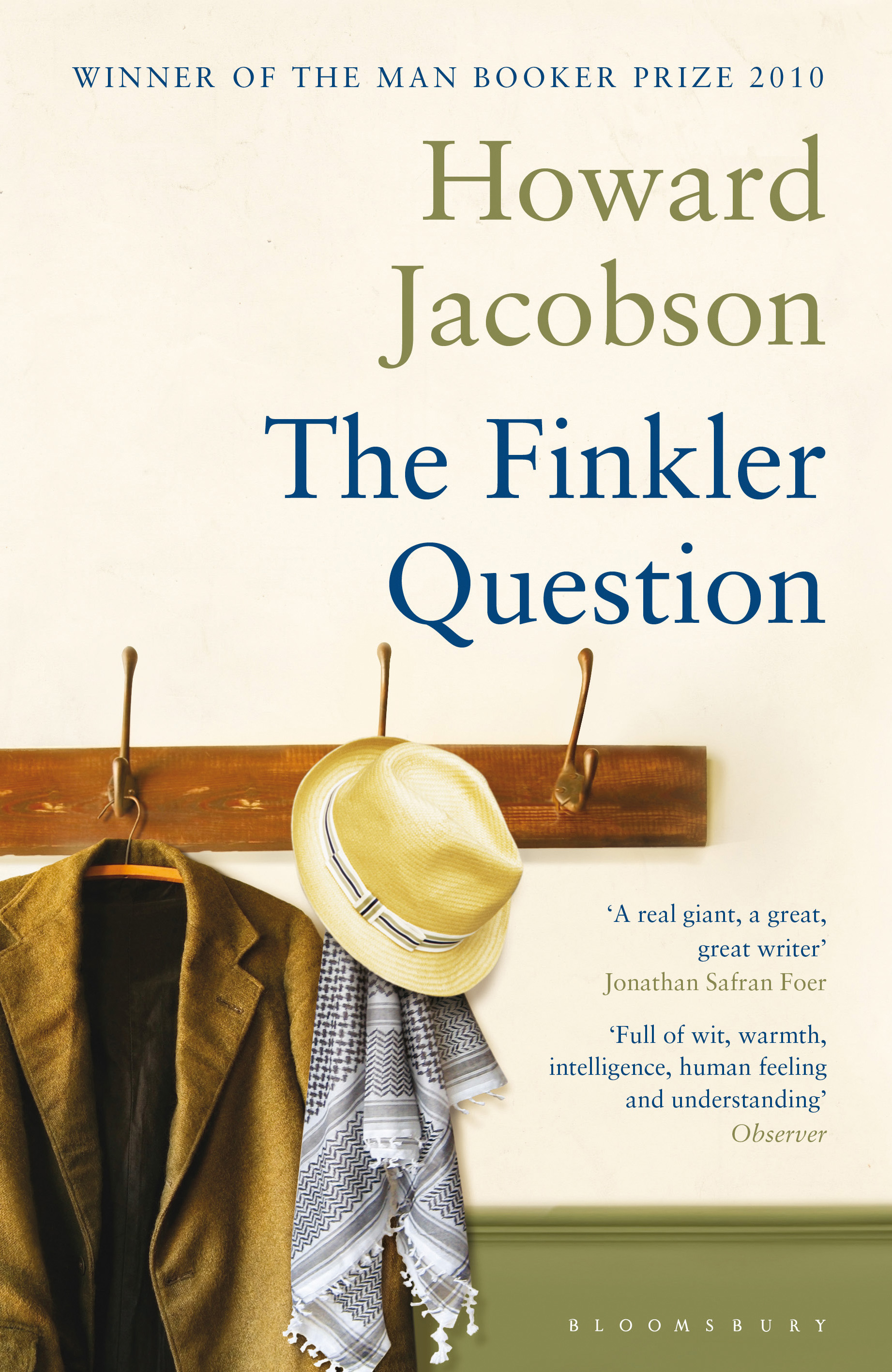
Howard Jacobson's The Finkler question

Howard Jacobson’s The Finkler question (Courtesy: Bloomsbury Publishing)

Whispering Gums, as you would expect, writes erudite marginalia and so you’d be in for a treat if you ever obtained my copy of Howard Jacobson‘s 2010 Booker award winning novel, The Finkler question. The margins are peppered with my reactions, like, you know, “Ha!” and “Oh dear”. Riveting stuff … and yet, what comments would you make in this book? Ah yes, “stereotyping” is another one, because that, really, is the springboard from which this rather funny book is written.

Do I need to summarise the plot? I feel that I’m about the last blogger to read this book, but just in case I’m not, here goes …  It concerns three longstanding friends: Julian Treslove and Sam Finkler who have been friends since schooldays, and Libor Sevcik who was their teacher at school. At the beginning of the book, Finkler and Libor, both Jews, have been recently widowed. Treslove, the non-Jew, is the “honorary third” widower because he is single (yet again). The novel’s premise is that Treslove would like to be a Jew …

Why, you might ask, would Treslove want to be a Jew (or, a Finkler, as he privately calls them – and hence the title)? It is not an accident that Treslove’s occupation when the novel opens is to be a paid double (or “lookalike”) of famous people at parties, conferences, corporate events:

Treslove didn’t look like anybody famous in particular, but looked like many famous people in general, and so was in demand if not by virtue of verisimilitude, at least by virtue of versatility.

And that’s pretty much how his Jewishness goes too. He might look and play the part but, deep down, can a non-Jew ever really be Jewish? Treslove is about to find out.

Jacobson has a way with words. It was this, together with the endless discussion, using every Jewish stereotype going, of what makes a Finkler (a Jew, remember!) a Finkler, that kept me going through a book that I wasn’t really sure was going anywhere. I laughed at Treslove’s incomprehension of Finkler (the character, this time):

“Do you know anyone called Juno?” Treslove asked.
“J’you know Juno?” Finkler replied, making inexplicable J noises between his teeth.
Treslove didn’t get it.
“J’you know Juno? Is that what you’re asking me?”
Treslove still didn’t get it. So Finkler wrote it down. D’Jew know Jewno?
Treslove shrugged. “Is that supposed to be funny?”

Oh dear! “Julian Treslove knew he’d never be clever in a Finklerish way” but, despite this, he continues with his goal to be Jewish. Meanwhile, Finkler, grieving for his wife and a marriage he still doesn’t understand, tries to dissociate himself from Jews (particularly Zionists) through membership of the ASHamed Jews. And Libor, grieving heavily for his true love, tries to dissuade Treslove from his ambition.

The book chronicles a year or so in the life of these three as each confronts his particular challenge. Treslove falls in love with Libor’s (Jewish) great-niece, Hephzibah, furthering, he hopes, his path to Jewishness; Finkler starts to fall out with the ASHamed Jews though not with their anti-Zionist principles; and Libor starts to fall out of life itself. All of this is told with both warmth and humour. The humour is always there, and yet is never pushed so far that the humanity of the characters is lost. You feel for them, despite their flaws and foibles. You want Julian, the hopeless father and failed lover, to make a go of it this time. You want Finkler to make peace with his Jewishness. And you want old Libor to get over his grief and join the world again. But through all this, you wonder, why? Why is Jacobson writing this story?

I have a few ideas. One may simply be to capture the diversity of Jewishness. Through all the stereotypes that made me laugh (Jews are musical, brokenhearted, rich, clever, comic, and so on), Jacobson shows that Jews, like any other group, are not all the same, cannot all be put in the one basket. Another  reason, though it’s depressing to think it’s needed, may be to defend Jews in an anti-Semitic world, to show their humanity. You care for these characters whose troubles with identity, love and loss are universal. And another may be to explore Zionism, safely. Can Zionism be defended? Has it changed into something more ugly, something that undermines its original conception?

In the end I did like this book because, while I was contemplating the “why”, I was engaged by the characters and their stories. The novel commences with Treslove, the would-be Jew, but it concludes with Finkler, the troubled Jew. Here he is, towards the end:

He was a thinker who didn’t know what he thought, except that he had loved and failed and now missed his wife, and that he hadn’t escaped what was oppressive about Judaism by joining a Jewish group that gathered to talk feverishly about the oppressiveness of being Jewish. Talking feverishly about being Jewish was being Jewish.

Ha! You said it, Mr Jacobson, I’m tempted to say. But that would be too smart-alecky of me because the book is, in fact, as much about humanity as it is about being Jewish.

Howard Jacobson
The Finkler question
London: Bloomsbury, 2011
370pp.
ISBN: 9781408818466

Monday musings on Australian literature: Asian Australian writers

Brian Castro

Brian Castro (Public Domain, via Wikipedia)

Australia is an immigrant country, with the first immigrants, the original Aboriginal Australians, believed to have arrived 40-60,000 (there are arguments about this!) years ago via the Indonesian archipelago. They established what is now regarded as one of the longest surviving cultures on earth. Today, though, I’m going to write on some of our more recent immigrants – those from Asia. The first big wave of Asian immigrants came from China, during the Gold Rush in the mid 19th century. Since then people from all parts of Asia have, for various reasons, decided to call Australia home – and have enriched our culture immeasurably.

I’m not going to focus on the political issues regarding acceptance, promotion and encouragement of Asian Australian writers because, like any stories to do with immigration, it’s too complex for a quick post here. I hope that things are improving, but only the writers and communities themselves can really tell us that.

As has been my practice in these sorts of posts, I’m going to introduce 5 Asian Australian writers to get the discussion going. After that, I’d love you readers to share “immigrant” writers you know and love …

But first, a definition. My focus here will be on writers who emigrated from Asia, rather than those from subsequent generations. I will not therefore be discussing writers like Shaun Tan and Alice Pung.

Brian Castro (Hong Kong born in 1950, emigrated 1961)

Castro is one of the most prolific and most awarded writers among those I’m listing today. He came here as a child, and started writing short stories in 1970. He has, to date, published 9 novels, many of them winning major Australian literary awards. Lisa at ANZLitLovers suggests he is a contender for Australia’s next (should we ever have another one) Nobel Prize for Literature. In 1996, in the Australian Humanities Review, Castro said this about Australia and Asia:

The situation currently is that Australia needs Asia more than Asia needs it. While the West seems to have run out of ideas in the creative and cultural fields, relying on images of sex and violence, reviving old canons and dwindling to parody and satire in what can already be seen as one of the dead ends of postmodernism, the Asian region is alive with opportunities for a new hybridisation, a collective intermix and juxtaposition of styles and rituals which could change the focus and dynamics of Australian art, music and language.

Strong words – but they make you think! My sense is that Australia is now seeing (accepting?) some of this hybridisation that he speaks of – not only from Asia but also from our indigenous authors like Kim Scott and Alexis Wright. I wonder if Castro agrees?

Yasmine Gooneratne (Sri Lankan born, emigrated 1972)

Gooneratne is one of the first Asian Australian writers I read. I have chosen her for that reason and for some sentimental reasons: she holds a Personal Chair in English at my alma mater, Macquarie University, and she is the patron of the Jane Austen Society of Australia! Long ago I read her first, appropriately named, novel, Change of skies (1991). Like many first novels, it has an autobiographical element and explores the challenges of changing skies, of migrating to another place. It was shortlisted for the Commonwealth Writers Prize. She has, in the last decade, received a number of awards here and in the South Asia region for her contribution to literature.

Michelle de Kretser (Sri Lankan born, emigrated 1972)

Like Castro, de Kretser emigrated to Australia in her youth (when she was 14) and made quite a splash with her debut novel set during the French Revolution, The rose grower. Her second novel, The Hamilton case is set in Sri Lanka and represents she says her “considered” farewell to her country of birth. Her third novel, The lost dog, is set in her home-city (now) of Melbourne, but its main character migrated to Australia from Asia when he was 14 and struggles to find his identity. Her books are not self-consciously migrant but tend, nonetheless, to be informed by the experience of dislocation.

Nam Le (Vietnamese-born, emigrated 1979)

Nam Le is our youngest migrant in this list, arriving here when he was less than 1! His debut book, the short story collection, The boat (2008), won multiple awards and is remarkable for its diversity of content (setting and subject matter) and voice. I, like many others, am waiting to see what he produces next.

Ouyang Yu (Chinese born, emigrated 1991)

To my shame I hadn’t heard of Ouyang Yu until relatively recently, but I do have an excuse. He has only written three novels in English and two of them very recently: The eastern slope chronicle (2002), The English class (2010), and Loose: A Wild History (2011). He is, however, a prolific writer, of, apparently, 55 (yes, 55!) books of poetry, fiction, non-fiction, and translated works in English and Chinese. He’s translated Christina Stead, no less, and even Germaine Greer’s The female eunuch. If this is not contributing to cross-cultural understanding I don’t know what is.

I’ll close with some words from an interview with Michelle de Kretser in which she articulates rather nicely I think the experience of being a migrant (using the character Tom from The lost dog):

But I think that like a lot of people who come to Australia, Tom is trying to escape something. You know, people come here often because they’re trying to get away from war, or poverty or persecution — or merely from perhaps difficult family situations. And I think Tom coming here as a child simply delights in the kind of freedom and anonymity that Australia offers him, which is a classic experience of people moving countries, or indeed if you go back to the 18th century people moving from the city to the country; the city at once offers this kind of blissful possibility of inventing yourself anew, a kind of wonderful freedom from inherited ways of thinking and being identified and categorised. On the other hand that is also simultaneously — can be — a very lonely and disconcerting experience, again.

Vale Sarah Watt

Non-Australians may not be aware of Sarah Watt, unless they are interested in Australian film. Sarah Watt is an animator-writer-photographer-film director who made a small number of well-reviewed films, one of which, My year without sex, I reviewed on this blog.

Sarah (aged 53) died on Friday from secondary bone cancer (diagnosed in 2009), having been originally diagnosed with breast cancer in 2005. Just before her first diagnosis, she made the award-winning film Look both ways (2005) which gorgeously incorporated animation into live action to tell a story about a man (played by her husband William McInnes) coping with a cancer diagnosis. It’s a clever, whimsical, sad (but prescient) film about ordinary lives in an ordinary suburb. Ten years earlier, she had made the film which brought her to public attention: a short animated film called Small treasures (1995) about the loss of a baby during birth, something Sarah and William experienced. It won a short film award at the Venice Film Festival in 1995 – and gave us a sense of what she was about.

In an interview some years ago Sarah wrote of her work, that

I probably make films that are autobiographical more because I think they make better stories because they’re real and therefore more likely to, sort of, touch other people and pull other people into the story and into the drama  … When I go and see films or look at paintings or whatever, I want to be moved and touched and, and usually it’s coming from something personal in the, in the artist, so, that’s why I probably raid my own life a bit to, to make films.

If you haven’t seen a Sarah Watt film, do yourself a favour and go hire one. I can’t imagine you’d be disappointed.

In a recent interview about their jointly written (amazingly titled) book Worse things happen at sea (2011), William paid tribute to Sarah and all those who struggle with cancer. They are, he said, the bravest people I know. I think he’s right.

Vale Sarah … we’ll miss your humour, humanity and beautiful work.

Meanjin’s Tournament of Books 2011, Round 2

For those interested in the continuing story of Meanjin‘s Tournament of Books, which I introduced in late October, Round 2 has now been played. Here are the results … with a little additional commentary by me.

Match 1, Joan London’s Gilgamesh defeated Helen Garner’s The children’s Bach

Oh, such a hard one. I feel for judge Michaela McGuire, a self-0uted Helen Garner fan who gave the match to Joan London. That takes bravery. I’m sure she had her heart in her mouth when she put those fingers to her keyboard. Anyhow, in the end, she gave it to London for the lovely single sentences (she’s right there) and, as I understand her, the expansiveness of the conception. She admires Garner’s “characteristic elegance and wryness” but “was left wanting”. She decides not to give it to Garner based on her love for the body of Garner’s work but to London based on this work. Fair enough. It would have been a hard call for me, too, and I would like to see London’s beautiful, mesmerising book receive wider exposure.

Match 2, Kate Grenville’s The secret river defeated Christina Stead’s The man who loved children

This may be the shock of the round, methinks. Admittedly the judge, Michael Williams, like McGuire above, bemoaned his lot. He calls them both masterpieces. He argues that both writers have a significant body of quality work. He says literary comparisons are b******t. And so, in a sense, he cops out. He tells us that in 1967 The man who lived childrenwas declared ineligible for the Britannica Australia Award because Stead had “ceased to be Australian”, though he also admits that it took only 70 years for it to assume a strong place in the Australian canon. But, he concludes, “Canonisation is for the dead. Tournaments are for the living. I’m giving this to Grenville“, and then declares his conflict of interest as having been involved in promoting The secret river at Text Publishing on its publication. Not having read Man yet and being a big defender of The secret river as excellent and valid historical fiction, I must, in fairness, stand on the sidelines, but I find this outcome an interesting one.

Match 3, Miles Franklin’s My brilliant career defeated Melina Marchetta’s Looking for Alibrandi

Sorry, Melina, I did love your book but I feel this is the right and proper decision. Judge Sarah L’estrange discusses the similarities in subject matter between these two books – “strong willed and independent” teenage girls fighting to find their own life against a background of familial and societal expectations. However, she gives the match to Franklin because Looking for Alibrandi is “just too straight-forward in the telling, there isn’t the dazzling dance of words across the page that My Brilliant Career has in spades”. I think she’s right. Alibrandi is locked pretty firmly into the Young Adult genre while Career has a more universal appeal, largely because of its writing and conception.

Match 4, Henry Handel Richardson’s The fortunes of Richard Mahoney defeated Cate Kennedy’s The world beneath

Another judge complaining about comparing literature! Makes me wonder why they signed up for the job! Anson Cameron makes me laugh though. Of Richardson‘s big book he says “Fat books, like fat people, die young unless they have huge hearts” and concludes that “only very good books age this well. Only very good books have the architecture to withstand great changes in the world. Of Kennedy‘s book he writes that it is “a Garnerish, (Garneresque? Garnery? Garnerly?) type novel in that it is imbued with a the kind of everyday insufferable domestic pressure Helen Garner excels in and it’s rendered in a spare, accurate prose reminiscent of her”. Not that he says it, but perhaps that’s a good enough reason for it to lose, perhaps it is too “Garner” rather than something original. I’m afraid I wouldn’t know as this one’s still in my TBR pile. Richardson would, I think, have the body of opinion behind her so Cameron has probably chosen well … and anyhow, if Garner was going to win, I’d rather it be Garner (if you know what I mean).

Now onto the Semi-finals …

In three of the four matches in this round, a classic was pitted against a contemporary, and the classic won two of them. I’m surprised the third one didn’t win too. Does this mean I’m a reactionary, old fuddy-duddy of a reader? Or does it simply mean that the classics have proven themselves as stayers over time? I prefer to think the latter … which suggests that if a contemporary novel wins the tournament, it will surely move one step higher on its climb to classic status.

I will be reporting again …

PS: I planned to list the semi-final matches here, but the numbering of the matches above does not accord with the numbering on the initial tournament plan, so I’m not sure which book will be pitted against which. Has some match-fixing been going on? Surely not!

On the titling of books

Forget about judging books by their covers, what about titles? How important are they to you? Do you ever decide to read a book based on the title alone? Do you always (never, sometimes) consider the title when thinking about the meaning of a book?

Title Puzzle Clker M

Titles: They're a puzzlement (Courtesy: M, via clker.com)

It seems to be a fraught issue, this book titling business – and it makes me wonder just what import to ascribe to titles. Who decides on the title? Do authors always have the final say in the titling of their books? Well, no, they don’t … so, how much can/should we readers think about the title when discussing or thinking about the books we read. Is it worth wasting our time bothering about it as, for example, readers did with Wolf Hall. Why, many of us wondered, was Hilary Mantel‘s book called Wolf Hall? I had an answer, and so did others, but is it worth even bothering about if we don’t know whether the author created the title? This may be a bad example though. Hilary Mantel was an established author when Wolf Hall was published, so it’s likely she had more clout in the titling of her book than a first time author has. Hmm, then, how am I to know when an author has chosen the title and when he/she hasn’t – and therefore when it might be worth my while considering the title and when not?

And what about books which are published under different titles in different countries? Think Miss Smilla’s feeling for snow versus Smilla’s sense of snow. This is a tricky one though because, like The outsider versus The stranger, it is a translated book, so there’s a double whammy here. Not only has the title been translated, but it’s then been translated differently. Are these difference due to translation decisions or marketing ones? A better example might be Harry Potter and the philosopher’s stone versus Harry Potter and the sorcerer’s stone. What’s that about*? Marketing, of course. (And, I can’t help wondering whether the book might have met with less opposition in the USA if the title had not been changed to “sorcerer”?) Again, where does this title confusion, oops variation, leave we readers, particularly regarding our wish to understand and analyse what we are reading?

For an interesting discussion of book titling, read Caroline Baum’s article “What it takes to title a book” in the Sydney Morning Herald back in 2003. It answers some of the questions I raise above and gives some great examples, but it doesn’t really consider where the reader sits in all this (except as the target for marketing).

What say you on the book title issue?

* Rhetorical question. Reasons abound, some from Rowling herself, on the internet. My concern is the general issue, not this specific case.