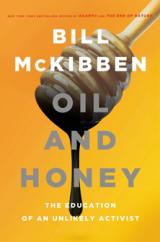
Bill McKibben, Oil and honey (Review)

Bill McKibben, Oil and Honey

Courtesy: Black Inc

It’s coincidental, but nicely appropriate, that the World Meteorological Organisation (WMO) published its Provisional Statement on the Status of the Climate in 2013 last week, just as I was finishing US environmental activist Bill McKibben‘s latest book, Oil and honey: The education of an unlikely activist. It’s likewise coincidental that, three days before WMO’s announcement, Stefanie (of So Many Books) published a post titled Gardening for Climate Change* containing her thoughts on her garden and how climate change might affect it.

WMO’s statement says, among other things, that “During the first nine months of 2013, most of the world’s land areas had above-average temperatures, most notably in Australia, northern North America …”. As you know, I live in Australia; Bill McKibben and Stefanie live in the northern part of the USA. We are seeing (feeling) the changes, and are concerned. What I’m going to say next is pretty obvious, but I’m going to say it anyhow because I always like to start with the basics in discussions like this. There are two critical issues in the climate change debate: Is the climate changing and, if it is, Is it human-caused? It’s hard to imagine, given all the data available, that there’s anyone out there who really believes the climate is not changing, though I believe there are still some who think it’s simply a case of “climate variability”. These people think that the climate will get back to normal (some year soon, they hope). The trickier issue, however, is the causal one. Most of the deniers are not so much denying that the climate is changing, but that we are causing it. This brings me to Bill McKibben.

McKibben does not, in Oil and honey, spend time trying to prove that humans are causing climate change. For him it’s a given. Rather, he shares how he changed from being an environmentalist, who researched and wrote books, to an environmental activist who campaigns (and writes books). It’s an interesting, clearly written book about one man and his path, but can also be read as a how-to for those who want to get active.

You may now, though, be wondering about the title. Oil and honey? I’m sure there’s an ironic allusion here to the biblical “land of milk and honey” (which we are not heading towards), but there is also a literal meaning to the title. The narrative shifts pretty seamlessly between his two main passions. One is to do with bees, honey and good farming practice. The other is oil, or the fossil fuel industry, and how to stop its impact on the climate. Oil and honey, climate and farming. It’s all related.

You may also be wondering, particularly if you’re not American, who Bill McKibben is. As the blurb on the back of my edition says, he has written over a dozen books including the New York Times bestselling Eaarth and The end of nature. He also founded the environmental organisation 350.org and “was among the first to warn of the dangers of global warming”. Despite all this, he did not until recently see himself as an activist. After graduating, he worked as a journalist for The New Yorker for five years, but quit in 1987 when its long-term editor was forced out of his job. Since then he has been a freelance writer.

Oil and honey is his latest book. I’d call it part-memoir part-manifesto, because it is both the personal story of his transition to full-blown activism and the story of his passion for saving the planet. The personal aspect of the book helps make it a good read. We get to understand his thinking, we feel his anxiety about becoming not only an activist but a leader of activists, and we learn that his activist philosophy is inspired by the non-violent resistance ideas of Gandhi and Martin Luther King Jr. We see his love for nature and for working close to the land on the bee-farm he bought for his friend Kirk Webster to run. This farm functions both as respite and as a place for him to see land stewardship working.

That’s the memoir aspect. In the manifesto aspect, he shares with us the development of his ideas and strategies. We learn of various campaigns he has been involved in since 2009, including Step It Up, Keystone XL,  Do the Math. And he explains how he and his co-activists have shifted from focusing on politics and politicians – through such activities as sit-ins at the White House and lobbying politicians – to directly tackling the fossil fuel industry. He came to realise, he says, that the situation was/is becoming so dire there’s no time “for slow graceful cultural evolution”. Consequently, the last part of the book deals with the goal of encouraging educational institutions to divest their investment portfolios of fossil fuel industries. They’ve targeted educational institutions because students represent a significant percentage of climate change activists. For these students the question is simple:

are you paying for our education by investments in an industry that guarantees we won’t have a planet to make use of that learning?

I’ve only touched the surface of what this book covers. Like many books of its type, chances are that it will only be read by the converted. That’s a bit of a shame, but it’s not useless says McKibben:

You might think it’s a waste to preach to the choir, but the truth is, you need to get the choir fired up, singing loudly, all out of the same hymnal. The choir is there, but most of the time it’s just humming in the background, or singing so many tunes that no distinct harmony emerges.

So, if you’re part of the choir, this book is still for you. And if you’re not, think about joining. It could be the most important thing you do.

Bill McKibben
Oil and honey: The education of an unlikely activist
Collingwood: Black Inc, 2013
255 pp.
ISBN: 9781863956178

(Review copy supplied by Black Inc)

* Stefanie has since posted a link to a British blog called Climate Change Garden.
Monday musings on Australian literature: MUBA 2013

Last year I reported on the inaugural MUBA – Most Under-rated Book Award. I hoped that it would continue, because it brings to our attention good books that somehow slide under the radar, mostly because their authors are less known and/or their publishers are small.

In 2012, I had read one of the four short-listed books, Irma Gold’s Two steps forward (my review), but it didn’t, unfortunately, win. This year again, I had read one of the four short-listed books, Merlinda BobisFish-hair woman (my review). But, before I announce the winner, here is the shortlist:

  • Merlinda Bobis’ Fish-hair woman (Spinifex Press)
  • Ginger Briggs’ Staunch  (Affirm Press, which published Irma Gold’s book)
  • Annabel Smith’s Whiskey Charlie Foxtrot (Fremantle Press)
  • Anna Solding’s The hum of concrete  (MidnightSun Publishing)

The judges for this year, according to its sponsor SPUNC, included book reviewer/writer Stephanie Campisi, bookseller/poet Ben Walter, and writer/bibliotherapist, Estelle Tang. SPUNC says of the shortlist that:

The shortlisted writers represent four of the original and worthy voices to be published by independent Australian publishers in the 2012 calendar year. These books show excellence in their genre and demonstrate quality of writing, editorial integrity, and production. They have been overlooked for other prizes and have not generated the sales they deserve for any number of reasons other than the great quality of the products.

And the winner is – ta da – Merlinda Bobis’ Fish-hair woman. As I said, I haven’t read the others though I do have Annabel Smith in my reading sights. However, I was highly impressed by Fish-hair woman, which is a challenging but rewarding read, and so am thrilled for her. It’s a timely win too as Merlinda Bobis is a Filippine-Australian. As Spinifex Press director Dr Renate Klein said in their Press Release on the award:

At this time when the Philippines is experiencing a humanitarian disaster on an epic scale, I’m pleased that a kernel of something positive has happened this week. Merlinda is a Philippine Australian writer who has shown how much she cares for the Philippines and its people, and I know this award means so much to her.

It is fantastic, but not surprising, that Fish-Hair woman captured the judges’ attention; it deserves a much wider audience, and this award will definitely assist in attracting more readers to the book.

So, huge congratulations to Bobis and Spinifex – and let’s hope it results in more sales.

Have you read any books in the last year or so that you believe are under-rated? Do let us know in the comments and give them a plug!

Griffyn Ensemble’s 2013 Elements of Canberra season

The Griffyns ended their 2013 season on a high … literally (in a performance of “Southern Sky”) and figuratively (with beautiful playing under somewhat challenging circumstances … but more on that anon).

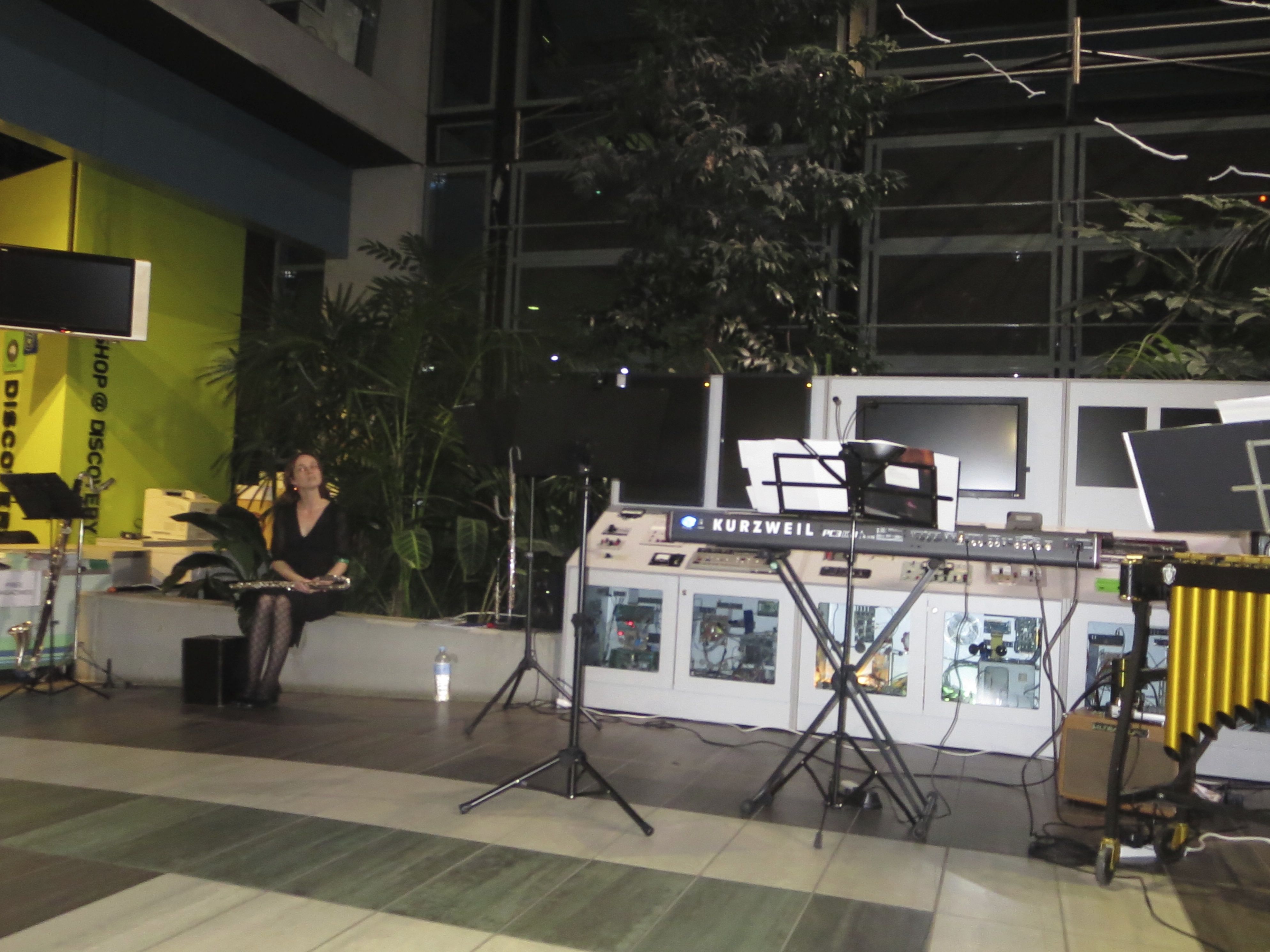
Griffyn Ensemble, CSIRO Discovery Centre

Downstairs, CSIRO Discovery Centre (A bit dark for my digital compact!)

You have to be hardy to be a Griffyn Ensemble follower. You never know where you will have to go to hear their next concert. In this Canberra Centenary year for their “Elements of Canberra” season, we went to the Belconnen Arts Centre ( “Water”) where the lovely Lake Gininderra forms a backdrop, the CSIRO Discovery Centre ( “Earth”), the TAMS Depot industrial hangar (“Air”) and the roofless shell of the ruined telescope on Mt Stromlo (“Stars”). These are not your usual concert venues with plush seats. In fact, a couple required some serious rugging up, but if the musicians are prepared to perform in these atmospheric venues, their loyal followers are clearly prepared to join them.

I haven’t written about the Griffyns this year since the first concert, mainly because we headed off overseas the day after the second concert and had only just returned, with all the concomitant catching up to do, before the third. (Indeed we sandwiched our trip to fit between these two concerts). I don’t plan to review them now. As I’ve said before, I’m not a musician. What I know, technically, about music you could fit on a clarinet reed. But, I do like music that moves, entertains, wows and challenges me – and this is what the Griffyns do for me. So, instead of writing a review, I’m just going to do a little recap of the other three concerts of the season.

It is not necessary to understand music; it is only necessary that one enjoy it (Leopold Stokowski)

The second concert was themed Earth, focusing on Trees and celebrating National Science Week. It took place in the CSIRO Discovery Centre’s atrium, where we were surrounded by trees, and displays and models from nature. It was mid-August and therefore winter in Canberra. Just as well we brought our winter woollies as the Griffyns took us on a musical and physical journey, upstairs and downstairs in this atmospheric, open-plan-glass-walled building. The concert was accompanied by a stylish booklet designed by local artist Annika Romeyn (whose illustrations were on display at the concert). That concert was some time ago now – or at least, I have done much since then including a 2-month overseas trip – so the memory has dimmed. It was, however, a typically eclectic Griffyn concert, as Annika Romeyn describes on her blog. It started with Finnish composer Kaija Saariaho‘s lovely, wistful piece “Fall” which, to me, had at times a rather Japanese sound. It featured the harp (Meriel Owen). And it ended with Michael Sollis’ composition, “City of Trees”, which was commissioned by Robyn Archer for our Centenary. In between were pieces like Martin Wesley-Smith‘s now well-known and fun “Caterpillar”; German-American composer Ursula Mamlock’s “Der Andreasgarten” featuring critters like dragonflies and hummingbirds; an arrangement of Cold Chisel’s “Flame Trees”; and, dear to my heart, Michael Sollis’ “Song of Trees”. It was composed for the opening of the National Arboretum and comprises an extensive list of tree names starting, of course, with gums. It was sung with aplomb by the Ensemble. You can read Clinton White’s review of this concert at CityNews.

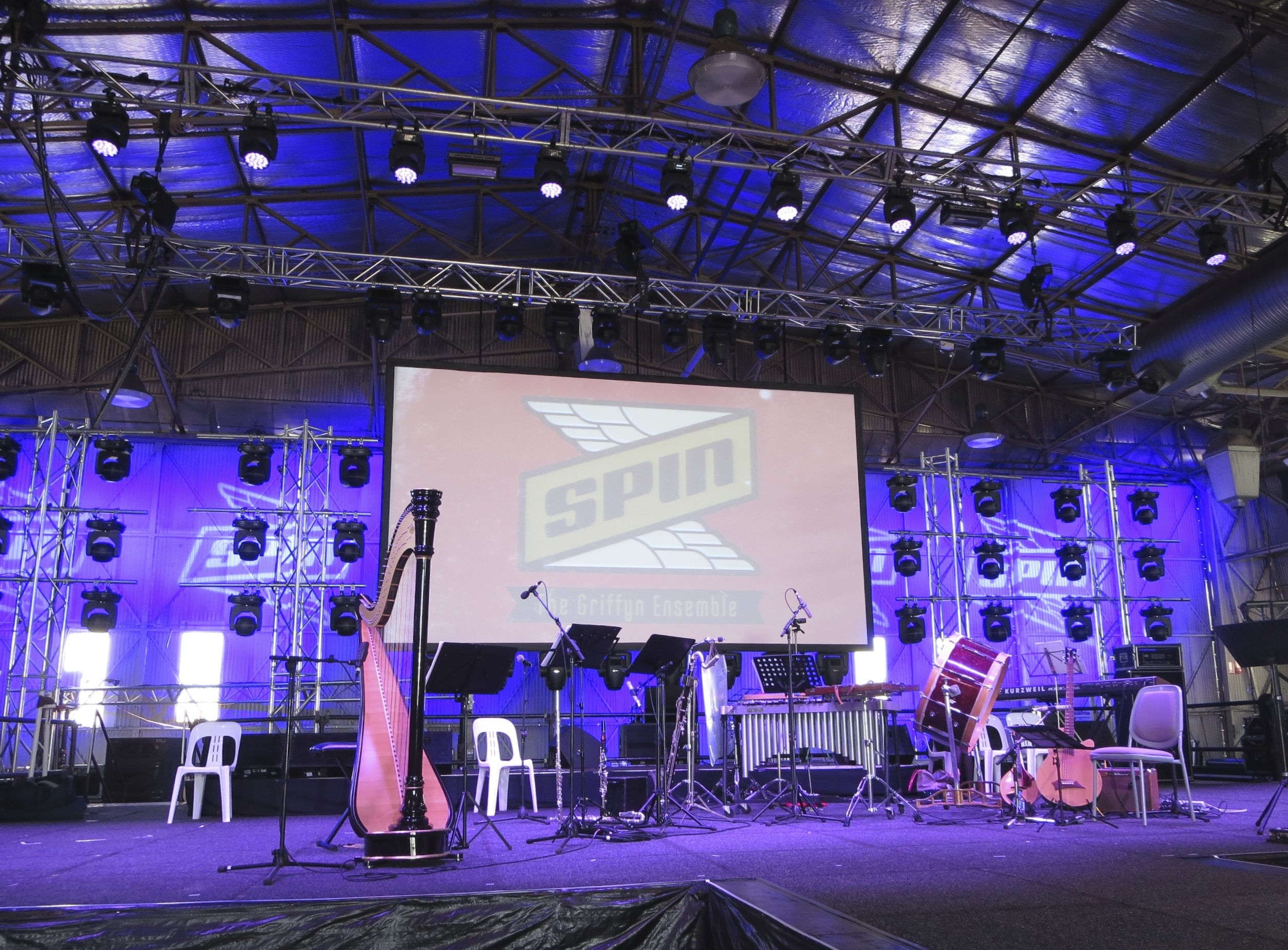
Griffyn Ensemble, TAMS Depot, Kingston

Griffyns in the Tams Depot, Kingston

The next concert, Air, saw us sitting around cable drums in an old hangar on, fortunately, a very pleasant Spring day. We were neither too cold nor too hot. This concert, which coincided with the SPIN Festival, took us travelling by train, bike, plane and even into space. It started on a light note with Luigi Denza’s “Funiculi Funicula”, led by the always-expressive soprano Susan Ellis, and included another ensemble vocal piece led by Ellis, Freddie Mercury’s “Bicycle Race”. As with all their concerts, this one featured some seriously virtuosic playing, particularly from Kiri Sollis (flute) whose “The Great Train Race” (by Ian Clarke) was breathtaking and Matthew O’Keeffe who pushed his clarinet to surely its highest registers in “Someone is learning how to fly” (by Marie Samuelson). The final piece was Brian Eno’s mesmerising, eerie “Music for Airports” (first movement). It’s some 15 minutes or so long and rather repetitive but I could have listened forever. Dare I say I could imagine doing yoga to this, lifting my spirit while contorting my body!

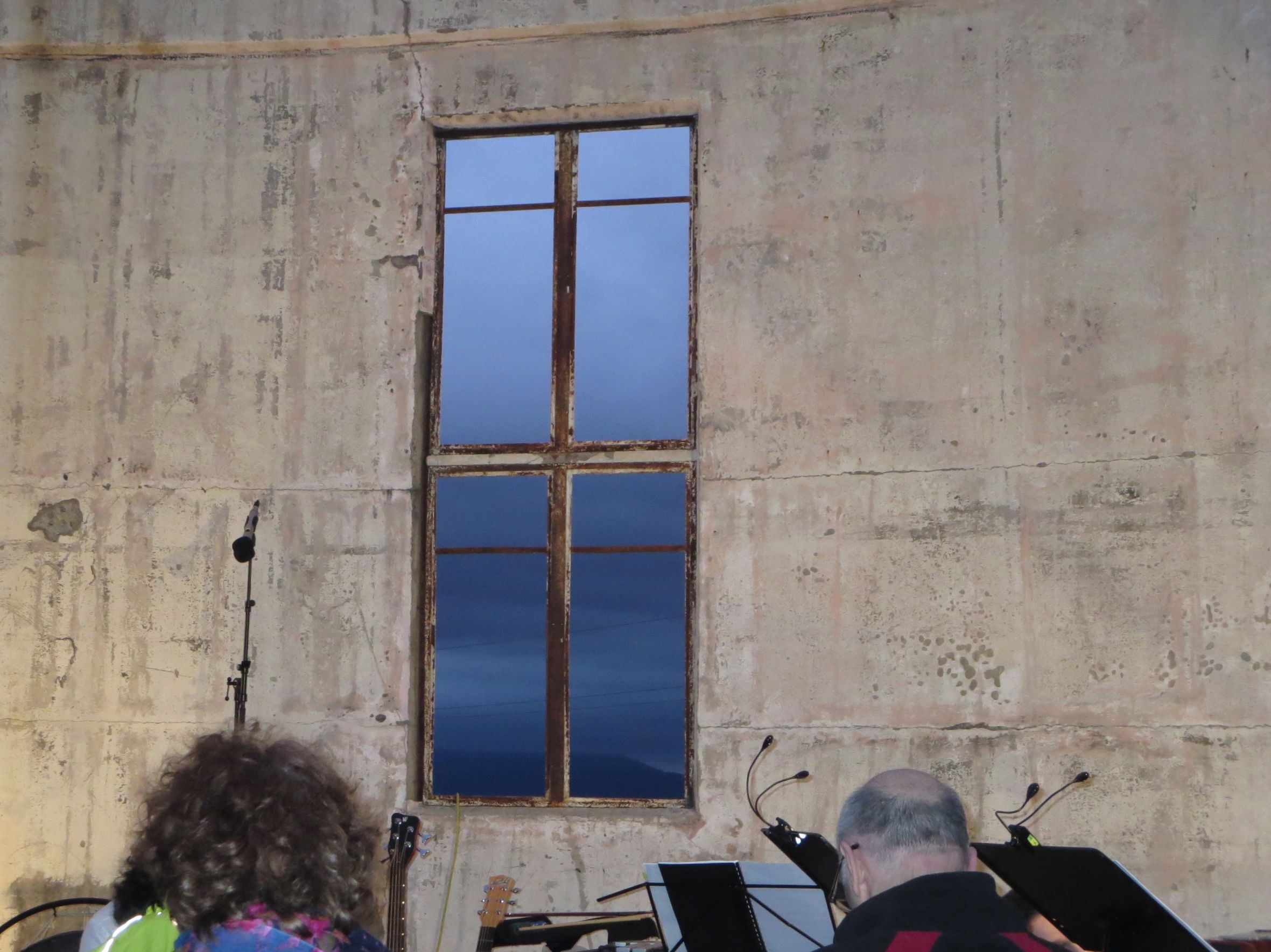
Mt Stromlo burnt out telescope

In the roofless, burnt out telescope on Mt Stromlo

The year ended on something a little different, because, unusually, the whole concert comprised one multi-movement piece called “Southern Sky” by Estonian Urmas Sisask who was inspired by his visit to Australia in the 1990s. You can read an excellent review of the concert on the Canberra Critics Circle blog. I really can’t add anything to what they’ve said. It was cold but, luckily for us (and the musicians), the rain that fell a few kilometres away on my house missed us. The piece, arranged by Michael Sollis, shows off all members of the Ensemble (as the above-mentioned review describes). It was magical, spoilt only by the fact that the cloudy sky meant that astronomer Fred Watson could not actually point out any of the constellations represented in the pieces. I did love seeing Wyana O’Keeffe back in her percussion spot. We’ve missed her this year while she’s been away on baby duties.

And so 2013 ended, a credit to Michael Sollis and his impressive all-round musicianship. What a team they are.

The Griffyns have announced their 2014 season, which is themed “Fairy Tales” and will see them again collaborating, as they like to do, with other creators around town. I can hardly wait.

If you are interested, you can hear examples of some of the music we’ve heard on the links below – but note that many of the pieces will be somewhat different to the versions we’ve heard, as ours were arranged by Michael Sollis for the Ensemble’s particular mix of instruments:

With apologies for this self-indulgent post but, you know, it’s my blog and I’ll write what I want to!

Delicious descriptions from Down under: Lebkowicz and Moorhouse on 1950s Canberra

At the beginning of this year I reviewed Frank Moorhouse‘s Cold light (my review) which commences with the arrival of his protagonist, Edith Campbell Berry, in Canberra in 1950. The Petrovs, the subject of Lesley Lebkowicz’s The Petrov poems (my review), arrived in Canberra in 1951.

Lebkowicz’s description of Canberra accords very much with Moorhouse’s. The second poem in her verse novel is “Canberra”. It is one of the unrhyming couplet poems in the book – and is also one of the poems that concludes on a single (and significant) line. I’d love to quote it all but I’m not sure about the copyright rules regarding individual poems in a verse novel – so I’ll assume I can quote a goodly percentage of the poem but not all of it*. The poem begins with a lovely description of  the quiet, the space, the birds, and uses that colour most associated with Patrick White, “dun-coloured”, to describe the grass. It then continues

… Their house is between

Kingston and Manuka where shops
for clothing and food squat close to the ground.

There’s a news agency, a shop for sewing materials,
a furniture store – but no cafés, no restaurants.

Civic has two-storey buildings with cloisters
where in winter the wind from Cooma sharpens the cold

into blades. She shivers. All around sheep huddle
and graze, but in Griffith they have a whole house

to themselves: a whole house and plenty of food.

Compare this with Moorehouse’s Cold light. Edith has been offered the honorary (!) job of town planner. She does a lot of reading, and appreciates Walter Burley Griffin‘s** passion and is awed Marion Mahony Griffin‘s gorgeous drawings:

She even had a small vision of her own – about the lucerne. Why not have a working farm in the heart of the city? With cows and and sheep and haystacks. Didn’t Marie Antoinette have her farm – the petit hameau?

She doesn’t voice this to her “boss”, Gibson – “she might not mention this idea at this moment” – which is just as well:

He said, “What we need are more verticals, more variation of skyline, blocks of flats, spires.”

She thought not. Gibson did not have the awe of the plans there in his office; maybe he was past that.

Gibson said, “Griffin didn’t want skyscrapers because he wanted low, large buildings so that light and air could play their parts. Now we have too bloody much of both. Pardon my French. We have too much light and too much air and too many trees and too little else.”

She smiled to put him at ease.

Sixty years later, we are still planning Canberra. We are still arguing about the verticals. How high or how low should we go? And about the green (or dun-coloured as the case may be) spaces. Should we fill some in? But perhaps all cities are like this? In Meanjin‘s The Canberra issue (my review), journalist-author Chris Hammer says, “The city is evolving as the nation it serves is evolving …”. And that, I think, is as it should be.

* The full version is, however, on line at Verity La, albeit not formatted the way it is in the book.
** To read more about the Griffins and Marion’s drawings in particular, see here and here (click on the illustration to see it in better detail.)

Lesley Lebkowicz, The Petrov poems (Review)

Canberra poet Lesley Lebkowicz has made a couple of brief appearances in my blog: first in my post on The invisible thread anthology, and then when she won this year’s ACT Poetry Award. I was consequently more than happy to accept for review her latest book, The Petrov poems.

English: Evdokia Petrova at Mascot Airport, Sy...

Evdokia being escorted by two Russian diplomatic couriers to a plane at Mascot Airport, Sydney (Presumed Public Domain, from NAA, via Wikipedia)

It’s intriguing that nearly 60 years after the events, we are still interested in the Petrovs. In fact, I have written about them before, in my review of Andrew Croome’s historical novel, Document Z. Most Australians will know who they are, but for those global readers here who don’t, the Petrovs were a Russian couple who worked at the Soviet Embassy in Canberra in the early 1950s. Vladimir (Volodya), Third Secretary, and his wife Evdokia (Dusya) were both Soviet intelligence officers (or, to put it baldly, spies). They defected in 1954. The defection was particularly interesting because Vladimir defected first, and Evdokia two weeks later at the airport in Darwin after some dramatic scenes at Sydney’s Mascot airport.

At first glance, The Petrov poems looks like a collection of poems but in fact it is a verse novel, albeit one comprising many short individually-titled poems. These poems are organised into four “chapters”: Part 1, Volodya defects; Part 2, Dusya defects; Part 3, The Petrovs at Palm Beach; and Part 4, The Petrovs in Melbourne.

I must admit that I wondered, initially, why Lebkowicz had decided to write about the Petrovs, given that they have already been picked over in novels, non-fiction, theatre, and television. But, as soon as I started reading it, I could see why. Lebkowicz gets into the heart of these two characters, bringing them back to ordinary human beings who were caught up in something that was both of and not of their own making. It is a rather pathetic story. There are no heroes here – and yet, as happens with these sorts of things, it captured the world’s attention for a short time.

Now, before I comment specifically on this book, I’d like to quote another Canberra poet Paul Hetherington from an interview with Nigel Featherstone in the online literary journal Verity La:

One of the ways I recognise the poetic is when I find works in which language is condensed, ramifying, polysemous and unparaphraseable. Part of what I wish to do when writing poems is to make works that speak in such ways – but to do so without resorting to any kind of trickery or artificial obscurity.

While I wouldn’t use words like “ramifying” and “polysemous”, and while we can paraphrase the ideas to a degree, this is pretty much what Lebkowicz achieves in The Petrov poems. In just 80 pages or so she manages to not only tell the story of their lives but get to the nub of their hearts and psyches – as much, anyhow, as anyone can do for another person. We learn that Volodya is not succeeding at spying:

He wants to succeed but stumbles. Failure
follows him like iron torn from a roof and
rattled along the wind.
(from “Glass I”)

We learn that he loves Dusya (“Dusya is his place in the world”), but that he loves booze, his dog and prostitutes more. He seems weak, but he’s a man struggling. With Stalin’s death and the arrest of his boss, he fears reprisals when he returns to Moscow. Here he is at the moment of defecting (which he does, after disagreements on the subject, without telling Dusya):

Once again he’s going to be wrenched from the soil.
He remembers his father – struck by lightning, buried up to his neck
by foolish men, and dying in the freezing night.
Then chaos and not enough food. Uprooting a full-grown plant
is no easy thing: so many roots
are wound through the earth. He mutters the Russian words
for sadness and home and ruffles his Alsatian’s fur.
(from “Loss”)

Dusya, on the other hand, is a stronger character, but she has suffered severe losses in her life, including her first love and her daughter:

This is something Dusya does not allow herself to think: how her
life might have been if Romàn had not been arrested. […]
If she had gone on taking happiness for granted. Living with
Romàn had been like walking along a winter street and arriving
in a field of warm poppies. If Romàn had not been broken in a
labour camp. If Irina had not died –
(from Romàn I)

While she understands Volodya’s fear, she fears even more what might happen to her family if she defects. At Darwin airport she doesn’t want to make a decision: “If only/this government man would abduct her”. But of course he can’t.

We then watch them as their relationship falters, first during ASIO’s interrogation, and then the years of living together in Melbourne, officially in disguise but known nonetheless. (“The whole street knows they are Petrovs -/too many photos, too much publicity”).

While I’m not a Petrov expert, I’ve read enough to feel that Lebokowicz’s interpretation is authentic. She explores what happens when the political interferes with the personal; she recognises the pull of culture and the despair that losing one’s home can engender; and she sees that corruption is not confined to communism:

so when ASIO falsifies (No! Not falsifies
amends, adjusts, even corrects) the documents
he brought from the Embassy – of course he assents
(from “Bones”)

Australian Women Writers ChallengeThese are wonderful, readable poems. They are poetic but, to quote Paul Hetherington’s goal, without “trickery” and “artificial obscurity”. The imagery is strong but clear. I particularly liked the way Lebkowicz varies and plays with form. None of it is rhymed, but there are sonnets, couplets, poems with multi-line stanzas but closing on a single dramatic line, and others. There are poems with short lines or terse rhythms, indicating action or stress, and poems with long lines conveying thoughts and reflections. There is also a shape-poem, “Torment”, in which the zigzag shape mirrors Dusya’s distress (“Her life is a staircase that switches directions”).

Like any good historical fiction – if a verse novel can be called that – you don’t need to know the history to understand the story told here. And like any good historical fiction writer, Lebkowicz has produced something that enables us to reconsider an historical event from another perspective and to understand the humanity below the surface of the facts. An excellent and moving read.

Lesley Lebkowicz
The Petrov poems
Sydney: Pitt Street Poetry, 2013
95pp.
ISBN: 9781922080141

(Review copy supplied by Zeitgeist Media Group)

Monday musings on Australian literature: Writers’ archives

Australian author and feminist Germaine Greer ...

Germaine Greer, 2006 Humber Mouth Festival (Photo: Walnut Whippet, CC-BY-2.0, via Wikipedia)

Having heard recently about the University of Melbourne‘s acquisition of Germaine Greer‘s archives and having written in last week’s Monday Musings about the biographer Hazel Rowley who spent hours researching such archives, I thought it would be worth writing a little about writers’ archives – their importance and challenges.

First off, I am, as many of you know, a (retired) librarian/archivist, so this topic is particularly dear to my heart. The personal papers or archives or manuscripts (terminology varies a bit) of significant creators are of course the lifeblood of researchers. Without them, writing biographies of people long gone is very difficult. Consequently, libraries often start negotiating for writers’ papers long before they die – to save that embarrassing, difficult vulture-like situation of contacting families after they’ve gone! Some donate outright, some sell (though money is tight so purchase is rare except for very significant papers), some are bequeathed, and some are donated through tax incentive schemes.

So, the first challenge is negotiating acquisition. I won’t detail the challenges regarding what is acquired, but this is another minefield. What does the library want? What is the creator prepared to offer? What indeed has the creator retained? Australians will know the story of the irascible Patrick White who wrote to the National Library in 1977 that:

I can’t let you have my papers because I don’t keep any. My manuscripts are destroyed as soon as the books are printed. I put very little into notebooks and I don’t keep friends’ letters as I urge them not to keep mine, and anything unfinished when I die is to be burnt.

However, wily that he was, this was not quite true, and some 16 years after his death, Barbara Mobbs, his literary agent and executor, pulled off what White biographer David Marr has called “perhaps the greatest surprise in this country’s literary history” by offering 33 boxes of White’s papers (including some manuscripts and correspondence) to the National Library of Australia. Very exciting for Australia’s literary culture – but somewhat of an ethical quandary, because White did direct in his will that his papers be burnt. Mobbs couldn’t do it, and argued that if White had really wanted this to happen he would have done it himself. She knew him very well so we have to assume she was right. Anyhow, she waited 16 years, three years after the death of Manoly Lascaris, White’s partner of 49 years, before she made the collection known.

Another challenge is that of embargoes. Many people, when donating their papers, put embargoes on some or all of the papers, usually to protect those named within, effectively preventing the use of those papers (or sections) for years, often decades. This is pretty frustrating for the librarians who want to make their collections available and for the researchers wanting to use them, but at least the collections are secure for the future.

And then there’s the challenge of organising the papers and making them available. This is an immense task, with some ethical challenges of their own. I don’t know of any major cultural collecting institution that doesn’t have large backlogs of papers needing to be sorted, arranged, indexed/catalogued and now, these days, digitised. The first reports I saw of the acquisition of Germaine Greer’s papers implied that they were bought for A$3million which made Greer sound a little money-grubbing but it turns out, as Greer clarified on ABC’s Q&A last week, that $3million is the cost of the archives. Katrina Dean, from the University of Melbourne, writes that this amount includes “transport, cataloguing, indexing and digitisation”. She says:

Despite the efforts of archivists and digital scholars, much of the archival legacy of the 20th century [and presumably preceding centuries] remains untranslated into computer-readable language and accessible only to those with traditional archival research skills and specialised reference services.

And of course, only accessible to people who can travel to the place where the papers are stored.

Some specific writers’ papers

David Marr wrote his Patrick White biography while White was alive. He did not see the papers that the library acquired until, well, they were acquired at which time he went through them in some detail. He says they contain no great revelations that would make him want to redo the biography, but:

Jumbled and haphazard though they are, the notebooks are filled with biographical gold: scraps of diary, poems, reflections, lists of characters (121 for The Vivisector), the first pages of at least six novels in early draft, reams of detailed research for Voss (“Sydney hospital was known as Sydney Infirmary till 1881”), timelines, fashion notes and fragments of conversations overheard in the street.

Just by way of example, I thought I’d mention a few writers’ archives, and the works they’ve supported:

  • Christina Stead’s papers at the National Library of Australia were used by Hazel Rowley in her biography of Stead. Interestingly, and as often happens, Rowley’s papers relating to her research for the Stead biography are also held by the Library.
  • Elizabeth Jolley’s papers at the Mitchell Library in the State Library of New South Wales were used by Susan Swingler in her memoir-of-sorts, House of fiction. Brian Dibble, who wrote a biography of Jolley, Doing life, did the same. There are apparently embargoes on these papers, but permission can be sought to access them.
  • Mary Durack’s papers (in the Durack Family Papers) at the State Library of Western Australia were used by Brenda Niall in her book, True north: The story of Mary and Elizabeth Durack. (See my review)
  • Miles Franklin’s papers at the Mitchell Library in the State Library of New South Wales were used by Jill Roe in her book,  Stella MIles Franklin: A biography.

A small sample but, as you can see, these papers are spread around Australia, which is a good thing, really, in terms of preserving literary heritage. Now all we need is for them to be digitised and readily available to all, eh?

Villainesses thriving in Canberra

Now I know many Australians see Canberra, their national capital, as a soulless, boring, sliced-white-bread sort of place but not so. There is life here. Art is happening – and it’s fresh, vibrant and young. Not all our young people have left (yet!).

Last night Mr Gums and I went to the opening of a collaborative exhibition organised by a group of twenty-somethings. The theme was Villainess. It was chosen, as one of the collaborators Georgia Kartas wrote in the foreword of the accompanying booklet,

for its surface-level but nonetheless undeniable badassery. Heroes have quests, villains have motives.

This is not a politically-focussed feminist exhibition as its name could suggest – though by its very existence it makes a statement about young women and their sense of self, their confidence, their willingness to get out there and do something for themselves. No, in fact it’s a fashion photo shoot exhibition. It is fun, clever, wicked – and it is stylish, as you’d expect from a fashion shoot. You can read something about its origin and the creation process at hercanberra and at Georgia Kartas’ redmagpie blog.

The collaborators were Elly Freer (photographer), Laura McCleane (make-up artist), and Georgia Kartas (fashion editor). The clothing, the hairpieces, the props were all sourced locally.

The photographic subjects are – of course – villainesses and they were chosen by the models – Elly, Laura, Georgia and their friends. There are ten villainesses, and they come from literature, popular culture and mythology, ranging from the very modern, such as Elle Driver from Quentin Tarantino’s Kill Bill, to the very classic, like Medusa.

We loved the exhibition. The photographs are beautiful, and exude a delightful, but intelligent, irreverence which characterises the ethos of the exhibition. A lot of thought has clearly gone into the event, including the production of an accompanying booklet which contains written responses to the villainesses by local writers. These responses give the exhibition an extra dimension – reflective, and often satirical, or tongue-in-cheek. I particularly enjoyed Eleanor Malbon’s response to Elle Driver who was modelled by Elly Freer (what a coincidence in names here!) in which she manages to spoof both Quentin Tarantino and James Cameron (Avatar):

… All together, the problems of the world make a charge at Driver.

Flesh meets steel as she wields her swords. Elle Driver dunks soil erosion in a bucket full of gypsum. She rips the mask off charity programs to reveal their reinforcement of material inequality. Her bullets fly through the heart of the underlying causes of biodiversity loss.

You get the picture I’m sure. The booklet itself, designed by Sheila Papp, is a lovely piece of art and a fabulous memento of the exhibition.

Yep, a good night in which we saw the next generation of artists-creators strutting their stuff. What fun!

Villainess
Kaori Gallery, Cnr London Circuit and Hobart Place, Civic
7-9 November, 2013

Disclosure: I have known the photographer since she was a baby. Go Elly!

Bianca Nogrady, The end: The human experience of death (Review)

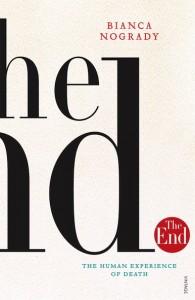
Bianca Nogrady, The end book coverHave you thought about your death? About how and where you want to die? These are the questions Australian science journalist Bianca Nogrady asks us to consider in her recent book, The end: the human experience of death. I’m not a morbid person, but when Nogrady contacted me to ask whether I’d consider reviewing her book, The end, it didn’t take me long to say yes. Like Nogrady I did witness, a couple of years ago, something I would call “a (pretty) good death”. That I felt it was so, intrigued me. I was therefore interested to read what Nogrady had to say.

And what she had to say was fascinating from beginning to end. In her introduction, she says:

This book could just as easily have been Everything you wanted to know about death but were afraid to ask. Death is fascinating, compelling, and it consists of much more than simply the end of a biological life-form. In seeking to understand death, we are seeking to understand life.

The rest of the book is structured logically according to the sorts of topics we are likely to ask about, starting with why we die, and then moving on to issues like defining death, where, when and how we die, spiritual and out-of-body experiences, and religion. Nogrady looks at these issues from all the likely points of view –  medical, sociological, psychological, philosophical, legal and ethical. She organises her information well, and the chapters (and subchapters) flow very naturally from each other.

So far, I have probably made it sound like a well-organised rather dry read – but that’s not how it is. Not only did Nogrady do a lot of secondary research (as the Notes at the end attest) but she also interviewed a lot of people. As a result, the formal information garnered from her research is supported by people’s stories, which also add colour and life to the facts. Many are of course sad – we are talking death after all – but this is not a sad book.

The most complicated section of the book is the second chapter on “Defining Death”. Nogrady takes us carefully through the different “definitions” – specifically, cardiac death and brain death (which, I learnt, can be further subdivided into “whole brain death” and “brain stem death”). She shows how the definition issue has been complicated by medical advances enabling us to keep the body alive and, of course, by the organ transplant process. Royal North Shore Hospital’s Intensive Care Specialist Dr Ray Raper suggests that death is:

a continuum; a graded box with one end as ‘being alive’ and the other end as ‘being dead’ … If you look at the domains of the transition between life and death, they’re spiritual, functional and structural and they’re biological, and the most important ones are the functional ones.

Death, in other words, is a process. If your fingernails are still growing when you are in the coffin, then, says Arizona State University Professor of Philosophy Joan McGregor, the questions needing answers relate to what are we preserving and why do we value it. I’ll leave this discussion here because there is no single solution – or not at present anyhow. This is murky ground indeed, but Nogrady manages to traverse it with clarity. I will probably have to read the book a few times though for the concepts to stick!

She also discusses euthanasia, teasing out misconceptions. She explains the differences between physician-assisted suicide, voluntary euthanasia and terminal sedation. She also explores the rise in palliative care as a profession, covering related issues like death doulas and volunteer workers in palliative care hospitals (or hospices). And of course she talks about near-death experiences, and those death-time phenomena that science can’t explain such as clocks stopping, machines behaving erratically, and deathbed visions.  The final chapter discusses faith and belief. Death is cultural, but, as she discovered, there is as much similarity as there are differences in end-of-life rituals.

It’s a funny thing to say, I suppose, but this is an enjoyable book. It’s neither superficial nor so detailed that you get bogged down. There is a lovely balance between expert opinions and anecdotes. I can imagine reading it again – or parts of it. It’s a shame, though, that there isn’t an index, which seems to be common in non-fiction books aimed at a general market. I guess it’s all about cost.

Australian Women Writers ChallengeIn her epilogue, Nogrady returns to her own experience, to how the death of her grandmother had caused her to want to better understand death. Writing the book, she says, made her think about “the value of planning, or at least thinking about how we want to die”. Death is, after all, a “one-way journey”. We do it alone, and it may well be, she argues, our best chance “find out who we are at the core”. One man who spent a long time thinking about his death, because he had a degenerative, terminal disease, was Australian public intellectual Donald Horne whose last book, written with his wife Myfanwy, was Dying: A memoir. He wrote:

My final drifting away, via a morphine dose, I would want to be among my memories, with Myfanwy whom I love holding my hand.

Think about your death, plan for it, is Nogrady’s final message to us. If you’re ready to take up her challenge, The end would be a good place to start.

Bianca Nogrady
The end: The human experience of death
North Sydney: Vintage Books, 2013
260pp
ISBN: 9781742752051

(Review copy supplied by the author)

Monday musings on Australian literature: Hazel Rowley Literary Fund

It seemed appropriate to talk about the Hazel Rowley Literary Fund this week given that several commenters on my review of Christina Stead‘s For love alone mentioned Rowley’s well-regarded biography of Christina Stead. Quite coincidentally – amazing how often such coincidences occur isn’t it – AustLit posted on their blog last week a piece titled The names behind our literary awards #1: Hazel Rowley. Today’s post was clearly meant to be.

For those of you who don’t know, Hazel Rowley was one of Australia’s most respected biographers. Christina Stead: A biography, published in 1993, was her first biography. It won the National Book Council’s “Banjo” Award for non-fiction. Her next biography published in 2001 was on the African-American writer, Richard Wright, whose book Native son is on my TBR, courtesy of my daughter. This was followed by Tête-à-tête: the lives and loves of Simone de Beauvoir & Jean-Paul Sartre in 2005, and the biography I have read and reviewedFranklin & Eleanor: an extraordinary marriage, in 2011. Unfortunately, this is where her work ends because Rowley, born in 1951, died in New York of a cerebral haemorrhage in 2011 as that last biography was coming out. What a tragedy – for her, her family, and us. I love the fact that she wasn’t afraid to tackle already well-covered subjects, like Sartre and de Beauvoir, and the Roosevelts. I’m not an expert on the Roosevelts but from my reading I think she did contribute an interesting perspective to the body of work about them.

Anyhow, soon after her death, her friends and family established the Hazel Rowley Literary Fund. It “aims to commemorate Hazel’s life and her writing legacy through activities that support biography and writing in general”. The main vehicle for this is the Hazel Rowley Literary Fellowship. It  is offered annually and provides up to $10,000  to a writer researching a biography, or “an aspect of cultural or social history compatible with Hazel’s interest areas”. The Fund states that “Preference will be given to projects that are about ‘risk-taking’ and expanding horizons, promote discussion of ideas, and make a significant contribution to public intellectual life”. That’s a big call – but an encouraging one too – particularly given the discussion in last week’s Monday Musings about “commercial imperatives” blocking “artistic ones”. More encouragement of “risk-taking” is what we want. Is it good enough though to rely on private funding to achieve this?

(With thanks to AustLit for the inspiration for this post)

Thoughts on Christina Stead’s writing in For love alone

I can’t resist writing another post on Christina Stead‘s For love alone, which I reviewed recently. Usually in my reviews I make some comments about the writing, but that review was getting so long that I decided to leave that discussion for another day.

I’m embarrassed to admit that For love alone is my first Stead. I’ve been wanting to get to her for the longest time, but somehow other books kept getting in the way. I’ll admit too that I was a bit nervous – as I’d heard over the years that she was difficult to read, or that her books were too miserable. Fortunately, I found neither of these to be the case with this novel. From the first chapter I was hooked. The book does have a little prologue which I enjoyed, but it was the first chapter that really got me in – and it got me in primarily because of its writing.

I love writing that plays with words and this is what I found in chapter one. Take for example this use of the word “bending” in an exchange between the heroine Teresa and her father (pp. 11-12):

“… I am in love again, with a young woman, a woman of thirty, a – ” His voice dropped. He came towards her, seized her arms and looked into her face without bending. “A wonderful, proud looking woman, pure in soul. “My whole life is wrapping itself around her, so I’m glad you brought it up for you will understand later on -”

She angrily shook her arms free. “Don’t touch me, I don’t like it.”

He sighed and turned his shoulder to her. “That is no way to treat men, men don’t like an unbending woman.”

“I am unbending.”

“You will be sorry for it.”

Then a few sentences down, her father says to her about flirtatious, coaxing behaviour in women:

“If, I say, you should ever be tempted to tricks like that, thinking to please some man, remember that they detest those tricks and see through them. They know they are traps, mean little chicane to bend them to women’s purpose.”

This is such a clever and telling exchange. It immediately tells us something about the father, the daughter and their relationship, about the likely themes of the novel (particularly given the title) and, though we don’t know it, it sets up future exchanges with Jonathan Crow who often talks of women trapping men.

A couple pages on is a another exchange in the family in which the idea of “honour” is played with and twisted. Stead, I sensed, was a writer I was going to like.

This, however, is not all that captured me in the first chapter. There were also several oxymorons (oxymora?) that added to the sense of slipperiness. Teresa’s room is described as “an inviting cell” and her brother, Lance, as “chaste and impure”. In the next chapter, a womanising dockhand is “agreeably sinister”.

It is language like this – ironic, satirical, biting – that keeps me reading, particularly in early stages of books where I’m not sure what is happening. I enjoy this sort of language because it challenges our preconceptions and can set a strong tone. (I do like a strong tone.) Mostly, though, such language tells me that the novel in question is likely to be multi-layered and that I’d better be ready to look beneath the surface.

Stead also writes beautiful, evocative descriptions. Christina Houen, commenting on my review of the book, referred to Stead’s description of Sydney. Stead herself grew up on Sydney Harbour. Here is the description Christina referred to. It occurs as Teresa is returning home after the wedding that opens the book:

It was high tide at nine-thirty that night in February and even after ten o’clock the black tide was glassy, too full for lapping in the gullies. Up on the cliffs, Teresa could see the ocean flooding the reefs outside, choking the headlands and swimming to the landing platforms of jetties in the bays. It was long after ten when Teresa got to the highest point of the seaward cliffs and turning there, dropped down to the pine-grown bay by narrow paths and tree-grown boulders, trailing her long skirt, holding her hat by a ribbon. From every moon-red shadow came the voices of men and women; and in every bush and in the clumps of pine, upon unseen wooden seats and behind rocks, in the grass and even on open ledges, men and women groaned and gave shuddering cries as if they were being beaten. She passed slowly, timidly, but fascinated by the strange battlefield, the bodies stretched out, contorted, with sounds of the dying under the fierce high moon. She did not know what the sounds were, but she knew children would be conceived this night, and some time later women would marry hurriedly, if they could, like one of her cousins who had slept the night with a man in one of these very grottoes; and perhaps one or two would jump into the sea. There were often bodies fished up around here, that had leapt when the heart still beat, from these high ledges into waters washed around these rocks by the moon. (Beginning of Ch. 5)

I won’t even try to unpack all this, but I’m sure you can see how intense and dense it is. It’s ambiguous about love and sex – and this ambiguity underlies the whole book, right through to – and beyond – its resolution.

Oh, and then there’s her facility with dialogue, her imagery, her literary and classical allusions – but again this post is starting to get long. Maybe another day!