Jessica White, Entitlement (Review)

WhiteEntitlementVikingEntitlement is a powerful title for Australian author Jessica White’s second novel, but then White wanted to explore some powerful themes – though they are, unfortunately, somewhat belied by the rural romance/saga looking cover. The author bio at the front of the book tells us that White grew up on a property in northwest New South Wales and it becomes clear very early in the book that she knows whereof she speaks!

Of what does she speak, then, you are probably asking? Entitlement is set in contemporary times on a cattle property near a fictional place called Tumbin. The story starts with 29-year-old Cate McConville, now a practising GP, returning home because her parents wish to sell the property. She, with other family members, is a partner in the business, and all need to agree to the sale. But, Cate’s holding out – not because she loves farming and wants to return, but because her only sibling, her much-loved brother Eliot, had disappeared several years earlier and she wants him to have a home to return to. The farm – the land – also contains her memories of, and therefore her link to, him.

While the plot-line is established gradually, the first chapter sets the book’s tone and style. It tells us there’s tension between Cate and her parents; that memory is going to feature strongly in the telling; and that indigenous issues are likely to be part of the story. The book then progresses, introducing more and more characters over the next few chapters. Each chapter tends to be dedicated to one character, or a small group of characters, and usually involves flashbacks, as the character remembers something from, or reflects on, the past. White handles this well. There are many characters, but the present-flashback narrative style keeps them clear and in their place (if that makes sense). This style does risk becoming a little rigid, but White breaks it up every now and then with a chapter purely set in the present, or one that commences in the past.

Very early, as the characters are introduced, the themes start to become clear. The story is told within two main contexts – farming succession and indigenous connection to land. Over-riding all this is the notion of stolen and lost children. Local indigenous man, Mellor, has worked for a couple of decades for the McConvilles, as had his wife until she’d died of cancer. His extended family, particularly his two aunts, live with him on the edge of the property, and have experienced the stealing of their children. Cate’s father, Blake, is racist and dismissive of indigenous people and their rights, while her mother Leonora, by contrast, is on friendly relations with Mellor and his family.

Now, if you’ve been reading my blog for a while, you’ll have read some of my discussions of non-indigenous people writing about indigenous issues. It’s uneasy ground to walk on, but for White, with her farming background, the issues of stolen children and indigenous land rights are things she’s likely to have lived. I’m not surprised she wanted to explore it. Indeed, she wrote a comment on this blog nearly two years ago, saying that this novel:

raises the question of who, in contemporary Australia, is entitled to the land? I also tried to show, through the break up of a white family that was fighting over land, how Indigenous people have been affected by their dispossession. I don’t think it’s a question that can ever be answered, though I did aim for a (probably utopian) resolution at the end of the book.

She couldn’t do this, really, without creating indigenous characters and that means of course that she had to present (her understanding of) their attitudes. I think she’s handled this sensitively, but of course I’m non-indigenous. I did wonder if she’d stepped onto shakier ground when she drew comparisons between Cate’s mother’s loss with that of the stolen generation mothers. However, in her acknowledgements White thanks “Michael Aird and Sarah Martin for their conversations and resources on Indigenous culture and history”. She has not, it seems, walked this ground lightly. And she doesn’t leave it at country and stolen generation issues, but touches on other injustices, such as indigenous health and housing, and racist violence.

White is on safe ground when she discusses the land and farm from Cate’s point of view. I thoroughly enjoyed her descriptions of the landscape and farm life – little scenes of her father and uncle undertaking farm tasks, of Mellor tending to fences, or of Cate running through the land, for example. Here’s a description of an Australia Day picnic:

Flies and mosquitoes plucked at their skin. The scents of the bush were drawn out by the heat and bundled together like a sweet, loosely woven shawl. Kangaroos bounded away in alarm as they made their way up the hill. Crickets whirred, rising from the long grass, and cockatoos screeched.

Her characters, too, are real; they are imperfect, believable human beings. Cate’s inflexibility, her selfish unwillingness to understand the health issues forcing the need to sell, made me cross but the pain, the loss, driving her behaviour is believable. Her parents are presented as having a loving relationship, but not without its tensions and conflicts. And so on.

Entitlement is an engrossing and serious, though not a grim read. As White admits, she does try for a positive resolution, which could almost do the seriousness of the issues a disservice. However, the story is not completely neatly tidied up, presumably because she realised that her question – how do we handle conflicting relationships to this land so many of us call home – does not have a simple answer. It’s therefore important that both indigenous and non-indigenous writers put stories and ideas out there for us to think about. It can only help the discussion, don’t you think?

awwchallenge2015Jessica White
Entitlement
Melbourne: Viking, 2012
289pp.
ISBN: 9780670075935

(Signed copy won in a blog giveaway)
Stella Prize 2015 Shortlist

I rarely write longlist, shortlist and winner posts, but for the Stella Prize I don’t mind making an exception. Last month, I posted on the longlist, and yesterday, the shortlist was announced.

  • Maxine Beneba Clarke’s Foreign Soil (Hachette): short story collection that I really must read, a debut book
  • Emily Bitto’s The Strays (Affirm Press): another debut book, this a novel that’s been garnering excellent reviews, and I’m keen to read this.
  • Christine Kenneally’s The Invisible History of the Human Race (Black Inc): the only non-fiction in the list, about her research into DNA and humanity’s origins.
  • Sofie Laguna’s The Eye of the Sheep (Allen & Unwin): second adult novel by an award-winning playwright and writer for children, about an individual young boy who may be, though it’s apparently not stated, on the autism spectrum.
  • Joan London’s The Golden Age (Random House): the only shortlisted book by a well-established novelist. I love her writing so need to read this. All these “must reads” make me wonder what I have been reading!
  • Ellen van Neerven’s Heat and Light (UQP): another debut book, and an intriguing collection of short, long and interrelated stories. I reviewed it last month.

It’s great seeing so many smaller publishers in the mix. Reminds us again that we should not overlook them when we are seeking quality books! This Stella Prize link will give you all the gen on the shortlist, including excerpts.

I was disappointed not to see Helen Garner’s The house of grief shortlisted, but not having read all the books, I’m in no position to pass judgement.

PS Apologies to those who saw it for the early incomplete posting of this post. I’m on the road and, against my better judgement, stupidly tried to use WordPress’s app. I like most things about WordPress, but detest the iPad app, so I tediously finished this in the browser on the iPad. Not a fun thing to do.

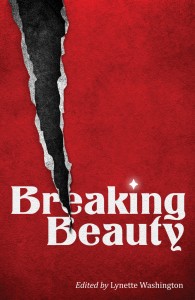
Lynette Washington (ed), Breaking beauty (Review)

Lynette Washington, Breaking Beauty

Courtesy: MidnightSun

As I’ve said before, I usually don’t read book introductions until the end. In the case of Breaking beauty, an anthology of short stories edited by Lynette Washington, it wouldn’t have mattered if I had read it first because Brian Castro’s intro gave nothing away while at the same time saying a lot. He starts by noting that the short story is making a come-back, “and wondering why it ever went away, perhaps because we were too imbued with the great whatever novel in the Borealis of canons or by the glossy fits of fashionable shades of grey”. Love the bite in that!

It’s a great introduction. It’s erudite, pithy, and often tongue-in-cheek. Castro says, reading my mind, “what good is an intro-duction if you haven’t been in-ducted, or even read the stories”. What indeed? And yet, his “intro-duction” manages to craftily incorporate the stories and their contexts, the ideas that drive them, without over-explaining or giving anything away. It is one of the most delicious introductions I’ve read in a very long time – unlike my introduction, so let’s move on!

Breaking beauty is a collection of stories by graduates of the University of Adelaide’s Creative Writing course. As Castro hints through a reference to Rousseau and as Washington states more directly, the stories explore the “complementary forces” and “dualities” encompassed by the idea of beauty, the notion that “there is no beauty without ugliness”. There are 28 stories, of which 22 are by women. They range in length from three or four pages to ten or so. Five of the stories have been published elsewhere, including Melanie Kinsman’s heart-rending “A paper woman” which was published in the Margaret River Press’s The trouble with flying (my review).

As you would expect, the stories look at beauty from all sorts of angles, physical, emotional, spiritual, even intellectual, but they rarely tell it straight. In Matthew Gabriel’s “To my son”, for example, an ugly father presents, to his apparently similarly ugly son, his solution for “neutralising physical appearance” which, he believes, will “not only rid the world of ugly’s plague but also its inextricable and toxic inverse”. Jo Lennan’s “A real looker” explores an extra-marital passion that resulted in a daughter who struggles to understand the adult world of passion, and a father transfers this passion to a boat called Marilyn. Sean Williams’ “The beholders” is a speculative fiction piece which cleverly twists the idea that beauty is in the eye of the beholder.

In other stories, beauty is more abstract . The second story, Corrie Hosking’s “A well strained fence”, is told first person by a young man for whom beauty is neatness and order. It’s a nicely sustained story that epitomises what a complicated notion or concept beauty is. It also neatly provides me with an opportunity to talk about voice. Just over half the stories are told first person, and two are told second person. One of these, Mary Lynn Mather’s mother-and-child story, “Whatever happened to the fairy-tale ending”, uses second person effectively to convey an emotion that is almost beyond bearing.

But of course voice is about more than which “person” is used; it’s about the persona used to tell the story, that is, about how the narrator of that story sounds to us. In short story collections – particularly anthologies – we usually find a great variety in voice (and, related to this, tone). Lynette Washington, in “Lia and Amos”, uses a matter-of-fact, reporter-like third person voice to tell a story with an unusual twist. The voice keeps us on our toes, divulging only what is going on in the moment, with no backstory or additional information, so that the end, when it comes, surprises and yet seems natural at the same time, because nothing has been sensationalised. By contrast, Rosemary Jackson’s narrator, Athina in “Athina and the sixty-nine calorie burn”, exudes the distressing (in this case), naive confidence of the young while the reader knows exactly what’s going on.

Several stories, including some already mentioned, tackle contemporary society’s (over-)emphasis on beauty. Others look at a broader notion of aesthetics from some interesting angles. Rebekah Clarkson uses an argument about aesthetics – a finial, in fact – in “A simple matter of aesthetics” to expose male arrogance, while in Katherine Arguile’s “Wabi-Sabi” a man’s commitment to aesthetics puts his family’s health, indeed survival, at risk. Meanwhile, Stefan Laszczuk’s narrator in “The window winder” finds beauty in a very gruesome place.

There’s no way, of course, that I can mention all twenty-eight stories. The ones I’ve mentioned here aren’t the only ones I enjoyed. There are moving – and often painful – stories about love, about sons and mothers, nieces and aunts, husbands and wives, mothers and children. There are stories about ageing, and the losses that usually attend, in one form or another. And there’s Lilian Rose’s cheeky story about a very unusual “Ladies Tea Party”.

Castro writes in his introduction of “the fleeting and the fleeing before one’s eyes, as a good short story is wont to do, not allowing its meaning to fully emerge because that would kill it, but letting it flit mothlike into memory”. This definition of good short stories could also define “true” beauty – as I’m sure the writers in this diverse and enjoyable collection would agree.

awwchallenge2015Lynette Washington (ed)
Breaking Beauty
Rundle Mall: MidnightSun Publishing, 2014
228pp
ISBN: 978192522700

(Review copy supplied by Midnight Sun)

Monday musings on Australian literature: Novels set in Canberra

The time will come, I’m sure, when I start repeating myself in my Monday Musings posts. This week’s post comes perilously close. I’ve written before about Canberra’s centenary publications (The invisible thread and the Meanjin Canberra issue), and I’ve written about Capital women and men poets, and women and men novelists*, but I haven’t specifically written about books set in Canberra. So today, Canberra Day, that’s what I’m going to do. Canberra Day, for those of you who don’t know, celebrates the official naming of Canberra on 12 March, 1913.

Canberra, as you’ll know if you’ve been reading my blog, boasts many writers (past and present). However, those writers have often not written about or set their novels in Canberra – and, sometimes, writers who don’t come from here, have. Consequently, this post’s focus is the works, not their creators’ origin. As always, I’m presenting a small selection – and the books will be presented in chronological order of their setting (as best as I can determine that).

  • M Barnard Eldershaw’s Plaque with laurel (1937) is believed to be the first novel set in Canberra. Unfortunately, I’ve not read this book but historian Patricia Clarke wrote about it in the Sydney Morning Herald in 2012, the 75th anniversary of its publication. A satirical novel about Australia’s literary scene, it is about a writers’ conference held in “inscrutable” Canberra and is apparently not at all complimentary about what was then barely a city. One character apparently describes living there (here) as “just awful”. Clarke sees it as an “invaluable historical record of Canberra in the 1930s”. I really must read it, and try not to let my patriotic blood boil!
  • Frank Moorhouse’s Cold light (2012, my review) spans around two and half decades, from 1950 to 1973. The last book in the Edith trilogy, it completes the story of Edith’s career which started in Europe in the League of Nations and ended in Canberra during some of the city’s most formative decades. These were the years when, for example, Lake Burley Griffin was created after much dispute. One of Edith’s first jobs when she arrives in Canberra is to work as a town planner, and Moorhouse gorgeously chronicles the discussions and controversies that raged at the time about Canberra as a place to live and work. I loved Edith’s desire to see Canberra as a “social laboratory”, which would “try out all sorts of ideas for good living”, and as a “place for citizens to ask questions”. I think Edith would love to see today’s Canberra!
  • Andrew Croome’s Document Z (2008, my review) is set in the mid-1950s and tells the story of Canberra’s most famous spies, the Petrovs. Croome describes the Canberra of those days, the suburbs and shops of the inner South, with an authenticity that suggests thorough research. Like Moorhouse’s novel it’s a good example of historical fiction, which I see as a work that combines an interesting story with well-researched depiction of the times in which it is set.
  • Sara Dowse’s West block: the hidden world of Canberra’s mandarins (1983) is set in the 1970s in West Block which is one of Canberra’s early buildings housing public service functions, and was, for some time, the home of the Prime Minister’s Department. This book is about the machinations of the bureaucracy, about the public servants who work behind the ministers to create and manage the policies the ministers want. My reading group loved it when we read it in the 1980s, because it rang true to the world we knew.
  • Fog sculture, National Gallery of Australia

    Fujiko Nakaya’s Fog sculpture rising over Dadang Christanto’s Heads from the North

    Dorothy Johnston’s The house at no. 10 (2005, my review) is set in the early 1990s, on the cusp of the legalisation of the sex industry in Canberra. This Canberra is the Canberra of suburbs and neighbours, of love and betrayal. It could almost be set in any city, except that Johnston knows Canberra and uses its particular history and features – such as the lake to divide the two aspects of the main character’s life as a mother and sex-worker – to ground the work in a particular place and time while also exploring universal themes.

  • Marion Halligan’s The fog garden (2001) is set around the time it was written. It is her novel about coming to terms with the loss of a much-loved partner. It’s also a clever book about the art of fiction – about finding the truth in the nexus between fact and fiction. It has an autobiographical element, but “Clare is not me” she says. The title is metaphorical, describing the “fog” that comes with grief, but also drawing from the wonderful fog garden at Canberra’s National Gallery. This is just one of several books that Halligan has set in Canberra.
  • Kel Robertson’s Smoke and mirrors (2010) became, by popular vote, the ACT’s book in the 2012 National Year of Reading collection of eight books designed to “articulate the Australian experience – remote, regional, suburban and metropolitan”. I haven’t read this, though Mr Gums has, but I was intrigued that a crime novel was chosen by Canberrans to represent us. Then again, perhaps it’s alright, as the murders being investigated take place at a writers’ retreat! (Maybe Robertson had read Plaque with laurel!) Also, the murders are political, relating to an about-to-be-published memoir of a government minister that is suspected to reveal CIA involvement in Gough Whitlam’s dismissal in 1975.

Have you noticed how many of the novels have politics at their core? That’s not surprising, given the sort of city we are, but I also noticed that most of the novels are fully or mainly set south of the lake (or where the lake ended up being). This is interesting, particularly given the CBD is north of the lake, but maybe it reflects my first point – parliament house, the centre of politics, is located in the south!

For a more extensive list of novels set in Canberra, check out the blog Dinner at Caphs, which documents blogger Dani’s year of reading and reviewing Canberra-set novels.

* I should probably use the adjectives “female” and “male” here, and I did in the title of one of those posts, but for some reason it just doesn’t sound right to me.

Jane Austen, Emma Vol 1 (Review, or perhaps just thoughts)

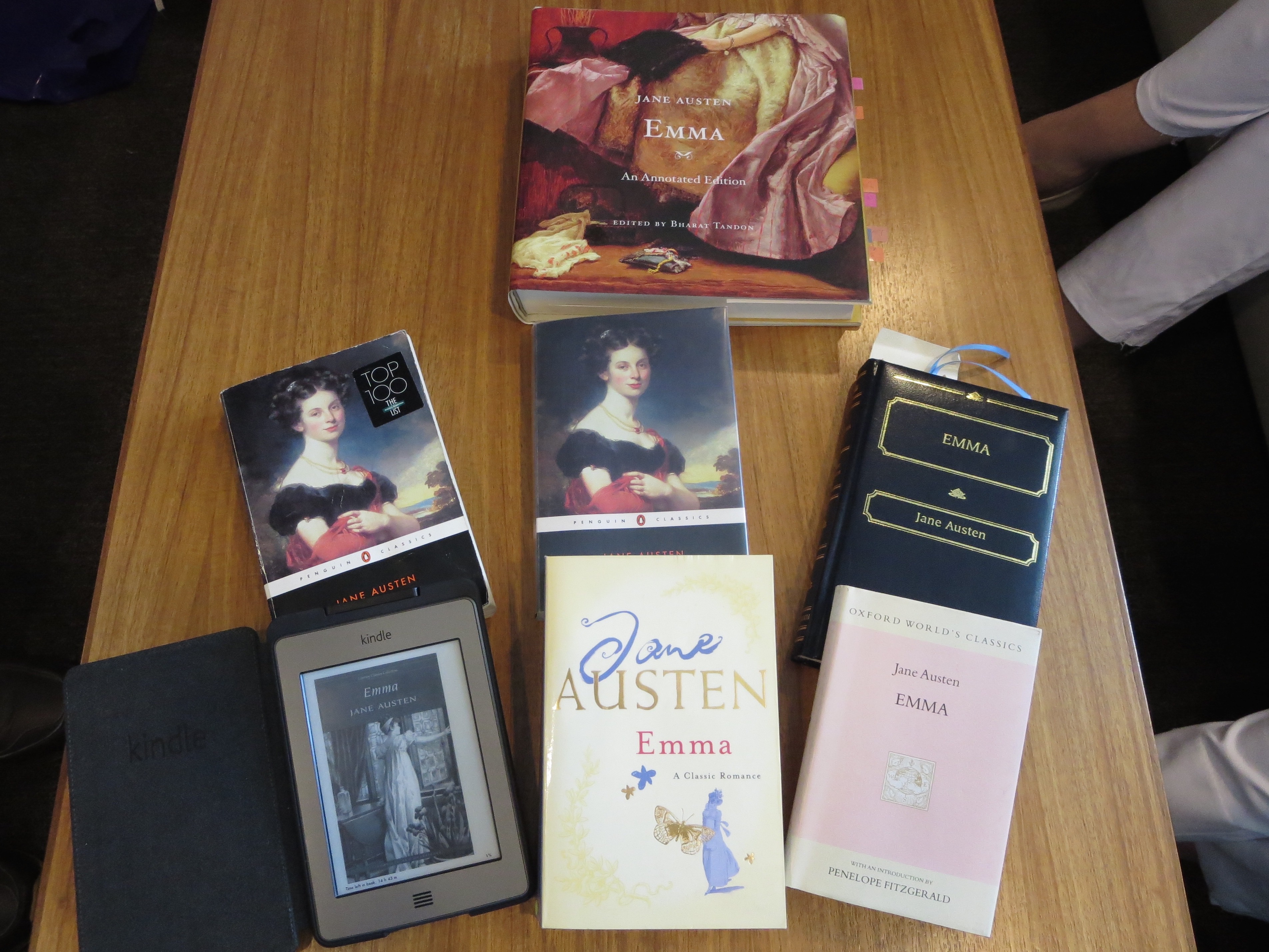
EmmaCovers

Every now and then my local Jane Austen group does a slow read of one of Austen’s novels. With 2015 being the 200th anniversary of the publication of Emma, we decided it was the logical choice for our next slow read. I love this activity because what happens when I re-read an Austen novel – particularly when I take part in a slow read – is that I “see” something new in the novel, something new to me that is, because it’s hard to think that anyone could come up with something totally new about Austen.

So, last time I re-read Emma, the thing that stood out for me was how beautifully plotted it is. There isn’t a word or action that doesn’t imply or lead to something telling, even if we don’t know it at the time. This read, with the plotting firmly in my brain, I’m finding that the aspect is flying a little under the radar. Instead, I’m noticing how often the word “friend” or notion of “friendship” is appearing. The novel, in fact, starts with Emma losing her ex-governess-then-companion Miss Taylor to marriage. They’ll remain friends but … so Emma, alone in a big house with her fussy, demanding, albeit gentle father, develops a friendship with Harriet, “the natural daughter of Somebody … [who] had no visible friends but what had been acquired at Highbury”.

This, though, is not the only friendship involving Emma to appear in Volume 1. Mr John Knightley, Emma’s brother-in-law, advises Emma “as a friend” that Mr Elton’s attentions are more than friendly, but Emma believes that she and Mr Elton “are very good friends, and nothing more”. Emma and her long-standing friend and neighbour, Mr Knightley, decide to “be friends again” after one of their quarrels. Meanwhile, we, like Mr Knightley, wonder whether Emma’s friendship is helpful to Harriet or not.

In the third paragraph of the novel, Austen suggests what she sees friendship to entail:

Sixteen years had Miss Taylor been in Mr. Woodhouse’s family, less as a governess than as a friend, very fond of both daughters, but particularly of Emma.  Between them it was more the intimacy of sisters.  Even before Miss Taylor had ceased to hold the nominal office of governess, the mildness of her temper had hardly allowed her to impose any restraint; and the shadow of authority being now long passed away, they had been living together as friend and friend, very mutually attached, and Emma doing just what she liked; esteeming Miss Taylor’s judgment, but directed chiefly by her own.

I’m talking about the words “and Emma doing just what she liked”. Miss Taylor/Mrs Weston, as Mr Knightley says to her later, had been a good companion to Emma but had also been better at submitting her will to Emma than in giving Emma the “complete education” he thinks she needed. Mr Knightley’s view of friendship encompasses providing honest, wise advice. He’s therefore severely angry with Emma when she encourages Harriet not to accept Robert Martin’s proposal:

 You have been no friend to Harriet Smith, Emma.

There are other friendships in the novel that don’t directly involve Emma, some with and between neighbours, and some within families. Her father, Mr Woodhouse, may be “no companion” for Emma, but we learn in Chapter 3 that he “liked very much to have his friends come and see him”. One of those visiting friends is Miss Bates who feels fortunate to be “surrounded with blessings in such an excellent mother and so many good neighbours and friends”. And one of these “good neighbours and friends” is Mr Knightley who supplies the low-income Bates’ women with apples and other produce from his estate. Emma’s friend Harriet, herself, has friends who invite her to visit, the Martin family who manage a farm on Mr Knightley’s estate. See what’s happening? An intricate set-up of all sorts of friendships. Austen must be on about something.

Emma more than any of Austen’s six novels paints a fairly in-depth picture of a diverse community. There are the Westons, Mrs and Miss Bates, and their niece Jane Fairfax, Mr Knightley and his estate, Mr Elton the minister and his wife, Mrs Goddard and other members of her school, the new-money Coles, and various other members of the community who appear briefly, including the poor and gypsies. This is a more complete “Country Village” than we find in the other novels, even though her focus here is still her favourite, that is, “3 or 4 families” (Letter to her niece, Anna, 9 September 1814). It’s not surprising, then, that with such a wide and diverse group that friendship would feature more significantly. I look forward to watching and thinking about how she develops this concept over the next two volumes. Watch this space …

Monday musings on Australian literature: Pitch days

When I was researching last Monday’s post on development programs for writers, I came across several references to publisher “pitch” days. As someone who isn’t writing a book, and who has no plans to, the concept of a “pitch” day was something that hadn’t made a big impact on me, though of course I knew what it meant.

If you are a writer who’s tried to get a book published, you know there are various ways of going about it. One is to find an agent who will tout/pitch your book to publishers. Another is to win a prize that involves publication – not that there are many of those! Yet another is to send your manuscript, unsolicited, to a publisher and hope they will read it. We’ve all heard stories about what happens then. They end up in a pile, and more often than not don’t get read. What authors want, of course, is some sort of guarantee their work will be read. This is where “pitch” days come in.

So what, exactly, is a pitch day? Most publishers have always accepted unsolicited donations, albeit with varying degrees of enthusiasm, but their pitch days offer two specific things: the publisher clearly identifies what they are looking for, what the writer needs to submit, and how; and they (mostly) offer some sort of guarantee that the work will be read and the time-frame within which this will happen. These pitch days are a fairly new thing, I believe, and stem partly from the possibilities offered by digital publishing.

Here are some of the programs I’ve come across, and that I believe are currently operating:

  • Allen & Unwin’s The Friday Pitch has been running for 6 years or more, and is open to writers for adults, young adults and children. They ask writers to “email a short synopsis or outline of your chapters and contents, and the first chapter of your work and related illustrations if relevant” on any Friday. They say that “if we like what we read … we will get back to you within a fortnight”. They don’t say, but I think imply, that they will read everything. They also say that Friday Pitch has discovered some bestselling authors, including Fleur McDonald, Helen Brown, and Mary Groves, though I must say that I don’t know these authors myself.
  • HarperCollins’ The Wednesday Post started in 2013. Writers can send fiction and nonfiction submissions each Wednesday, for print and digital publication, and digital-only publication. They say they will respond to authors within three weeks if they are interested. According to Writing WA, HarperCollins wants to find “new adult and YA titles and is particularly interested in ‘exceptional contemporary women’s fiction'” from new and established writers.
  • Pan Macmillan’s Manuscript Monday is a “new” initiative (though I don’t know when they wrote that statement). This process only occurs monthly on the first Monday of the month. They “accept submissions between 10am and 4pm that are sent electronically” and comply with the guidelines available via the link above. They say they will read every submission within three months of receipt, but won’t provide reasons for their decision nor give any feedback. And you can’t ring or contact them to chase up your submission. I think this includes pitches for Momentum, which is PanMacmillan’s “digital first imprint”.
  • Penguin’s Monthly Catch was created because Penguin “is keen and excited to read new work from Australian authors”! This program operates over the first 7 days (that is from the 1st to the 7th, regardless of days of the week) of every month. Only electronic submissions are accepted, and only works for adults. They say they’ll read every manuscript, and will get back to successful authors within three months. They do not provide feedback.

These are just a few of the programs out there. There are, for example, some genre-specific ones, such as for Romance writers. And some conferences run pitch-to-the-publisher programs, such as GenreCon and the Perth Writers Festival.

What these publishers won’t accept is fairly consistent. Poetry, plays, and educational works are frequently identified as not wanted. Some exclude works for children and young adults, while others will accept these. Authors need to check each publisher’s guidelines to make sure.

If you are interested in reading more about pitching, you might like to read the experience of two authors: Patrick Lenton who was published by Pan Macmillan’s digital arm, Momentum, and the above-mentioned Fleur McDonald who was published by Allen & Unwin. I also enjoyed reading this blog post on the “art of pitching to publishers”.

As always, I’d love to hear if any readers here have used “pitch days” … or have any stories about being published.


Delicious descriptions: Fiona McFarlane thinks a house can be a character

In another life, well, not quite another life, but in my pre-blog life when I discussed books online via listserv reading groups, I became involved in various literary discussions. One of these was whether a house or place can be a character. Some of us argued they could because they could be seen to act or react, to reflect mood, and so on. Others argued they couldn’t because they couldn’t develop the way characters can. The argument was never resolved. In other words, I suspect we all remained in our original positions. As you might have guessed, I was in the former camp. Of course, a house or place is not a person, but if an author personifies them in some way, imbues them with “spirit” or “emotion”, then I’m happy to “see” this in terms of character, albeit a different sort of character. I’d argue that Fiona McFarlane, whose The night guest I reviewed earlier this week, would agree.

Here is a description of the protagonist Ruth’s house after Frida comes to be her “carer”:

The house took to Frida; it opened up. Ruth sat in her chair and watched it happen. She saw the bookcases breathe easier as Frida dusted and rearranged them; she saw the study expect its years’ worth of Harry-hoarded paperwork. She had never seen such perfect oranges as the ones Frida brought in her little string bag. The house and the oranges and Ruth waited every weekday morning for Frida to come in her golden taxi, and when they left they fell into silences of relief and regret. Ruth found herself looking forward to the disruption of her days; she was a little disgusted at herself for succumbing so quickly.

Of course, McFarlane is using the house to represent Ruth’s state of mind, to represent Ruth “seeing” herself adopt and adapt, but still, I can describe that as the house having, or even being, character.

A little later in the novel, when Ruth has two guests in the house causing tensions, she worries:

Now she would lose him because of Frida, and Frida because of him; and with that, her last before sleep, the whole house emptied out.

Of course, the whole house didn’t empty out. All three were still there, but the sense (or fear) of psychic emptiness is palpable. Perhaps this is not the house having/being character exactly, but I’m not averse to seeing it that way.

What do you think? Do you ever see a house or place (a setting, in other words) as being or having character?


Fiona McFarlane, The night guest (Review)

McFarlaneNightGuestPenguinThose of you who followed the literary award season in Australia last year will have seen Fiona McFarlane’s debut novel The night guest pop up several times. The more it popped up, the more I wanted to read it – but also the more I thought it would be good to read with my reading group. So, I bought it, and held onto it until this year, as we did, in fact, schedule it for our end of February meeting.

The first thing to say about this book is that it’s an easy, quick read, a page-turner in fact. But, it is not a simple read. It’s a read that keeps you guessing right to the end, even though you are pretty sure you know what is going on. It’s about Ruth. She’s in her mid-seventies, and recently widowed. She lives in the family’s old holiday house to which she and her husband had retired a few years previously. And, she’s “reached the stage where her sons worried about her”.

Then, along comes Frida, from the government she says, to be Ruth’s carer, because Ruth, as we’d suspected, has dementia, albeit in early stages. She is, she feels, “still self-governing”. Apparently, both of McFarlane’s grandmothers had dementia which helps explain why McFarlane has been able to present Ruth’s state of mind so convincingly. I say “helps explain” because there’s clearly a perceptive and skilled writer at work here too. It’s one thing to experience family members with dementia, but it’s quite another to be able to present it with such authority and authenticity.

How does McFarlane do this? The most important decision a writer has to make I think – and I’ve certainly heard many say this – is the voice. For this book, McFarlane chose third person subjective, that is, it is told third person but almost completely from Ruth’s perspective. A good decision, because we can feel Ruth’s uncertainty as she slides between confidence and uncertainty, between independence and neediness, between reality and a strange world that doesn’t always make sense. Because it’s from her point of view – and not an omniscient author’s – we are kept on our toes, not always sure, as Ruth is not, of where she is on any of those spectrums at any given time. Sometimes it’s patently obvious, but other times it’s not so clear.

Ruth has a few guests during the course of the book – including Frida (of course) and a man called Richard Porter. But there is another one, a tiger! The tiger appears in the opening sentence of the novel:

Ruth woke at four in the morning and her blurry brain said, ‘Tiger’.

She was of course dreaming, except that now she’s awake, she starts to hear noises, “something large … rubbing” against her furniture, and “the panting of a large animal”. These noises are too big to be coming from her cats. The tiger is ongoing “character” in the novel. More on this anon.

The second guest to arrive is the aforementioned Frida. She appears out of the blue one day – “You don’t know me from Adam” she says – to start caring for Frida. The question though is, is she “out of the blue” or is it that Ruth didn’t remember that someone was coming. Questions like this recur throughout the novel, keeping us in a sort of readerly vertigo. One minute we believe we know, and the next we are uncertain again. By the half-way point, though, I suspect most readers are pretty confident of what’s really going on, but even then there are uncertainties about how it will actually play out. All this makes the book an engrossing challenge.

Then there’s the third guest, Richard Porter, who was her first, and unrequited love, when she was a young woman living in Fiji with her missionary parents. Ruth invites him for a visit, hoping that “things could still happen to her”.

It’s hard to know how to write more about the book though because this is one of those stories in which the plot and the meaning are intertwined. However, I can say that it’s broadly about ageing, grief, love and loss. It’s also about trust, honesty and the responsibilities we have for each other.

The tiger

The tiger, as I’ve already indicated, appears on the first page. He’s a complex figure, alluding partly, I’m sure, to Blake’s “The Tyger”. But, and here perhaps I’m drawing a longer bow, he also reminded me of the tiger (aka Richard Parker, which is very close to Richard Porter, but that might be a bridge too far!) in Yann Martel’s Life of Pi. Both tigers reflect a duality: they are both fearsome (and perhaps representative of evil, though I like to avoid that word), but both can also be seen positively. Blake’s tiger was made by the God who also made the lamb, and so by extension can be seen to encompass both forces. Martel’s tiger needs to be kept at bay, but his very presence also gives Pi the strength and focus he needs to survive.

So, too, in The night guest does the tiger play a complex role. He appears when Ruth is at her most uncertain, most fearful, most disoriented, disappearing when she’s calm. In that sense he represents the negative. But, there’s something grand, and perhaps even reassuring about him. In his first appearance, Ruth thinks:

A tiger! Ruth, thrilled by this possibility, forget to be frightened and had to counsel herself back into fear.

A little later, when she is feeling comfortable, the tiger is “safely herbivorous”. But, he comes back, and Ruth is irritated “because there was no point to him now that she had Frida and Richard; the tiger had prepared the way for them and was no longer needed”. I’m tempted to suggest that Frida and Richard could represent the tiger’s duality, but the book isn’t simplistically conceived, so I don’t want to take that line of thinking too far.

Towards the end, when the tiger is fighting for his existence,

Ruth felt for a moment on the verge of understanding exactly what the tiger was saying when he roared. He wasn’t concerned for his safety, but for his dignity …

I’ll leave the tiger there, but I think you can see how McFarlane uses him in the novel.

There are other images and symbols which run through the book, some of them biblical, like lilies (“she was safe behind her lilies”), which makes sense given Ruth’s missionary upbringing. And, of course, Ruth’s name itself is biblical. None of this is heavy-handed though, or suggests a slavish adherence to symbolism. It just adds to the depth with which we can contemplate this book – at least, I think so.

In the end, this is a book about people – and how we treat each other. Several people, besides those I’ve mentioned here, are involved in Ruth’s life, such as her sons and a young mother who’d found her husband as he was dying. The book asks us to consider how far do we – should we – take our duty of care? How do we decide when we should intervene in another’s life and when we should not. I did enjoy this book.

Lisa at ANZLitLovers didn’t enjoy it as much as I did. I agree that it doesn’t really work as a psychological thriller, which is how some of the blurbs on my edition describe it. But, as I was reading it, I wondered whether that’s what McFarlane intended … or just how it’s been promoted?

awwchallenge2015Fiona McFarlane
The night guest
Melbourne: Penguin Books, 2014 (orig. ed 2013)
275pp.
ISBN: 9780143571339

Monday musings on Australian literature: Writer development programs

I’m not a writer – as regular readers here would know – so I only have an outsider’s understanding of how writers develop their skills. Here is what I know. First, of course, writers have to write – and write – and write. This is a pretty lonely business – and I suspect, often a frustrating one. They may need help developing their manuscript to completion, or they may not know how to navigate the publishing process,

But, they can receive help. There are creative writing courses in schools and universities. There are writers’ retreats (as I’ve written about before) where writers get to work on a project and sometimes receive advice while doing it. And there are targeted development programs. These are the ones I’m writing about today. They vary in length, format, funding arrangements, and who they target, but they all have one goal – to help writers succeed.

As usual, I’m just going to share a few to demonstrate the variety of offerings out there:

  • Gertrude Contemporary and ARTAND Australia Emerging Writers Program is a very specific program targeting “emerging visual arts writers” who want to “contribute to the critical discussion of Australian contemporary art”. It teams four writers with mentors to help them “develop their writing practice, publish their work and gain further insight into the field of contemporary art writing”. It was established in 2005 and they say it’s the longest-running program of its kind. (That’s a great achievement though I’m not sure what they define as their “kind”). (Melbourne, Victoria)HARDCOPY 2015 - Nonfiction Edition - open for applications
  • Hard Copy, run by the ACT Writers Centre, with funding from the Australia Council for the Arts, targets “committed emerging writers”. It has several aims, writerly ones like helping them develop their manuscripts to completion, and practical ones like increasing their knowledge of the industry and their ability, if I read the aims correctly, to network. In 2015, Hard Copy is focusing on writers of non-fiction, and applications close on 13 March. (Canberra, ACT)
  • QWC/Hachette Australia Manuscript Development Program is a program jointly run by the Queensland Writers Centre and the publisher Hachette. It has been running now for 7 years, and has resulted in the publication of books like Favel Parrett’s Past the Shallows and Inga Simpson’s Mr Wigg. It’s a four-day program for 10 emerging fiction and non-fiction writers, and provides individual consultation with Hachette editors and the opportunity to meet “publishing industry professionals such as literary agents, booksellers and established authors”. (Brisbane, Qld)
  • SA Writers Inc Professional Development Program is, I think, typical of the programs run Australia’s state-based writer’s centres. The describe their professional development program as comprising “a wide variety of events, workshops and masterclasses”. If you click the link I’ve provided, you will see the calendar for the current month, showing that at the end of February there is a Masterclass in Creative Writing and a Spoken Word Workshop for Young People run by Omar Musa. (Adelaide, SA)
  • Varuna, The Writers House, like many writers retreat venues, offers a wide range of development opportunities to writers besides its residential program. They divide their non-residential or outreach program into two groups, Workshop and Events, and Writer Development Program. The former can include short-term courses like the Introduction to Life Writing Workshop presented by Patti Miller in 2014, while the latter provides writers with one-on-one consultations on their manuscripts. (Katoomba, NSW)

If you’re a writer, have you attended any professional development programs? Were they useful (and what made them so, if they were!)?

Ellen van Neerven, Heat and light (Review)

Ellen van Neerven, Heat and light, book cover

It’s silly I know, but I had a little thrill at the end of Ellen van Neerven’s Heat and light, because not only was the last story set in a place where I spent six of the formative years of my childhood – Sandgate on the northern edge of Brisbane – but one of the characters learnt to swim in the same pool there that I did, and her brother has a beagle, just as we did. Ah, childhood. Enough, though, of readerly nostalgia. Time to properly discuss the book.

Heat and light won the David Unaipon Award for Unpublished Indigenous Writer in 2013, and has been on my TBR for several months. I hadn’t prioritised it for reading, but its longlisting for the Stella Prize last week convinced me to squeeze it in before two works I had to complete by 21 and 24 February. I hope I won’t regret it. No, let me rephrase that: I know I won’t regret having read it, but I hope I don’t regret my decision to read it right now!

The first thing to say is that Heat and light isn’t a novel. It has, in fact, an intriguing form, something that’s not unusual with writers from an Indigenous background. Simplistically speaking, it comprises short stories organised into three sections titled Heat, Water and Light. However, each of these sections is quite different. Heat comprises interconnected short stories (5) about three generations of the Kresinger family, while Water is longform short fiction (54 pages in my edition) in the speculative fiction genre. Light, on the other hand, is more like a “traditional” collection of short stories (10). Together, the three sections, including the future-set Water, create a rich picture of contemporary indigenous life and concerns.

And here I confront again the challenge of being a non-Indigenous Australian reviewing a work by an Indigenous Australian featuring Indigenous people. It always makes me a little anxious: I fear sounding earnest or, worse, patronising; I fear making what’s different sound exotic; and, I fear missing the point. And yet I love reading Indigenous writers, because their perspective is different and because they (see, I’m generalising, aren’t I?) tend to be adventurous in their story-telling, often taking risks with voice, form, chronology, genre, and more. Van Neerven, as I’ve already implied, is such a writer.

The titles of the three sections – Heat, Water, Light – make me think of the elements. They are not quite the classical elements (fire, air, water, earth) but they convey, it seems to me, the essence of what’s needed for life. The focal character in Heat, though we don’t see a lot of her, is Pearl, the grandmother of the narrator of the first story which is titled, in fact, “Pearl”. Pearl is a bit of a free spirit – earthy, hot (in its sexual meaning, with “her siren eyes”), and likely to appear or disappear with the wind. Over the five stories in this section we learn about Pearl, her sister Marie, and the two succeeding generations. Van Neerven’s writing is confident, moving comfortably between first and third person narrators, all of whom are members of a complex extended family. Loyalties – to their indigenous background and to their blood relationships – are tested. As the narrator of “Pearl” says:

So much is in what we make of things. The stories we construct about our place in our families are essential to our lives.

And this is true, whether or not the stories so constructed are “true”. The implication is you need to know what you are doing. Colin, for example, finding himself, through his own actions, disconnected from his Indigenous heritage, wants to return, but

she told me if I was going to make my way home I’d better do it soon before the dust had covered my tracks.

The third section, Light, explores similar issues to those in Heat, but through ten separate stories, ranging from 2 pages to 30. The characters in both sections both move between city and country, but, while Heat is set in southeastern Queensland, the stories in Light are set in Sydney, Western Australia and Queensland. The protagonists tend to be young, and female. They also tend to be in formative stages of their lives, or at crossroads; they are sorting out their relationships, their sexuality, their identity. They confront racism and face conflict, but they also experience and give love. There’s humour, some of it wry, such as the young girl noticing that the tag on her pants states that “this colour will continue to fade”.

Water, the longform story that occupies the middle of the book, is very different. For a start, it’s set in the near future, the 2020s, when Australia is a republic with a female president. There’s a new flag and Jessica Mauboy’s song “Gotcha” is the national anthem. There’s also a social media ban! I reckon Van Neerven enjoyed imagining this. However, life isn’t perfect. Our narrator Kaden has a new job as a Cultural Liaison Officer and was initially pleased because she thought she’d be working with “other Aboriginal people” which would provide a “way of finding out about my culture and what I missed out on growing up”. But, she discovers she’ll be working with “plantpeople” who are sort of mutant plants with human features created during “islandising” experiments. Kaden’s job is to evacuate them in preparation for the Australia2 project.

I don’t want to give any more of it away, but you’ve probably guessed that it’s a story about how we treat other, about segregation, discrimination and dirty politics. It’s also about connection to country and about the importance of controlling one’s own art. Artist Hugh Ngo says:

I don’t make art for galleries. Or for money. I make art that speaks the truth.

This is a clever (and true!) book. The bookending sections Heat and Light present stories of Australian people going about their lives, and most of them happen to be indigenous. Their indigeneity is evident, and it affects the issues they confront, but there’s no specific advocacy. The middle section, on the other hand, is more overtly political. It picks up issues that appear in the shorter stories and provides a coherent, ideological context for the whole.

Heat and light is one of those really satisfying reads: it combines engaging writing with stories that make you feel you’ve got to the things that matter. So no, regardless of whether I meet my other deadlines, I’m not sorry I bumped this book up in my reading priorities.

awwchallenge2015

Ellen van Neerven
Heat and light
St Lucia: UQP, 2014
226pp.
ISBN: 9780702253218

Note: One of the stories in Light, “The Falls”, is available on-line at Kill Your Darlings