Dymphna Cusack, Jungfrau (Review)

Dymphna Cusack, Jungfrau

Courtesy: Allen & Unwin

Are there some historical periods that particularly fascinate you? There are for me, and one of those is that between the two world wars. It was a complex time encompassing both economic hardship and great social change. A time when many of those Victorian era constraints were being lifted and women, in particular, were starting to enjoy an independence and freedom they hadn’t had before the First World War. Dymphna Cusack’s first novel, Jungfrau, is set in this period and deals with this very subject.

I have written about Cusack before, when I reviewed A window in the dark, her memoir about her time as a teacher. Because of its relevance to this novel, I’ll reiterate a couple of the points I made in that review. Cusack, I wrote, had a finely honed moral and social conscience, and was acutely aware of injustice. She was convinced of the “wickedness of our economic system”, and abhorred the power those with money had over others. She was consequently outspoken on social and economic justice issues, and was particularly critical of the treatment of “that much-maligned creature, the woman teacher”. A window in the dark was written forty years after Jungfrau, and is a memoir, but you can see the genesis of her values and ideas in this, her first novel.

Jungfrau is set in Sydney over a few months in the 1930s. It concerns three young women in their mid to late twenties: the rational, realistic and religious Eve, the emotional, dreamy and vulnerable Thea, and the modern, pragmatic, confident Marc. Eve and Thea have been good friends for several years. Marc is Thea’s friend, but Eve and the free-thinking Marc do not like or understand each other. At the novel’s opening, Eve and Thea are talking about Thea’s interest in a man twice her age, a married university professor. Eve cautions Thea about the risks, but Thea is ready “to take life—use it—now, instead of letting it use me”. Eve gently retorts that “If you leave yourself open to the world, it will rush in on you”.

Indeed, Eve, who has seen first hand in her maternity ward the results of poor, single women taking life, suggests that experiencing life “is much safer in books”. She says to Thea:

When you talk about getting in touch with reality and finding out what life is, all you really mean is following your instincts in spite of the consequence … Only, if you take your friend Marc’s prattling literally, I’d advise you to learn more about physiology than you know at this moment. You can’t safely combine what your modern friends rather euphemistically call ‘experience’ with a degree of ignorance that’s almost mid-Victorian. You’ll need to be practical if you’re going to be a realist. Marc’s evidently both.

The novel, as you’ve probably guessed by now if the title hadn’t given it away, explores what happens when Thea does not heed Eve’s advice and lets this relationship develop. I’d call this a coming-of-age novel but, having been written by Cusack, its themes are as much social as psychological. What did it mean for a woman at that time to have an affair with a married man, and what were her options with the – hmm – consequences?

The trouble is that while obstetrician Eve and social worker Marc are daily faced with the grim realities of life, teacher Thea evades them. Here’s Eve on her ward rounds,

All this rot about reality, this frenzied escape into abstractions, had curiously little to do with life as she knew it. … Here was reality. Tortured bodies, tired minds, birth and death. Nothing vague about this; no escaping from facts; no sheltering behind fancies.

Acerbic Marc has her own view on woman’s lot:

Women are cursed, all right. If you wither on the virgin stem you go all pathological; if you go off the deep end you get some foul disease; and if you marry and have dozens of young you die of exhaustion.

By contrast, here is Thea discussing the real Jungfrau with her professor:

“Yes,” he said almost inaudibly, “white, proud and untouched. But they’ve built a funicular almost to the top of it now, and the tourists swarm all over it like flies.”

“Poor thing! I don’t mind climbers and mountaineers; but it must hate the tourists soiling it—”

“That is usually the fate of the proud and the untouched,” he said, digging his stick in the turf, and she recoiled as though struck, her hands flung out in a gesture of defence.

Oh dear, we readers think – and so would Eve and Marc if they’d heard this conversation. Their lot, though, is to love Thea and to watch in dismay as she takes life to an edge that she is not fit to handle.

The critical thing about this book is that Cusack doesn’t judge these three women for their choices. We might find Marc a more sympathetic, more appealing personality, of the three, but Cusack is even-handed. She understands human psychology and empathises with women. Her ire is focused more on society’s expectations and rules than on any one woman’s decision or behaviour. I described this novel earlier in my review as a coming-of-age novel, but it could equally be called a novel of ideas. In it Cusack exposes “the reckless squandering of human possibilities”, of lives “anaesthetised by half-baked education, political platitudes and doles”. Economic inequities, abortion, women’s independence, and the meaning of freedom are her targets.

I read this book as part of my long-term plan to read classic Australian literature – and I enjoyed it immensely. While the social milieu is very different from now – thank heavens – the emotional truths transcend the particulars of time and place. The language did feel a little overblown at times. It has that DH Lawrence sort of emotional intensity that can sometimes be a little too melodramatic, or declamatory, for my 21st century ears. And yet, paradoxically, one of the novel’s real pleasures came from its descriptions of Sydney. Cusack catches the landscape – the plants, the light, the water – beautifully (but I’ll save sharing a couple of those for a Delicious Descriptions post).

I imagine this was a confronting novel at the time of publication, but I hope it got people thinking, as Cusack surely intended. Cusack, Katharine Susannah Prichard, Miles Franklin, Marjorie Barnard and Flora Eldershaw, to name the best known from that era, were fierce and intelligent writers. We are lucky to have them.

awwchallenge2015Dymphna Cusack
Jungfrau
Sydney: Allen & Unwin, 2012 (Orig. ed. 1936)
ISBN: 9781743431450 (ebook)

Note: I do need to have a little whinge. There were several errors/typos in my kindle edition, which is disappointing and did spoil the read a little.
Monday musings on Australian literature: On labelling writers

Today’s post was inspired by a tweet from Aminatta Forna which led me to an article she’d written titled “Don’t judge a book by its author”. The Guardian led the article with the following pull quote:

I have never met a writer who wishes to be described as a female writer, gay writer, black writer, Asian writer or African writer …

It’s a fascinating article that raises some meaty issues. It is, I recognise, about writers and writing in general, not just Australian, but I’ve decided to  write about it in my Monday Musings series because it touches on some issues I’ve talked about here before.

But first, Forna’s main thesis … it’s that labelling (or classifying) is “the very antithesis of literature”. She starts with the practice of labelling writers. Now, I admit, I am guilty of this. I have categories and/or tags on my blog for “women writers”, “Australian writers”, and so on. I’m a librarian/archivist by training and I find classification useful to support searches for specific information. Forna would possibly ask why we might want to search by such labels or categories, but I’ll come to that later.

As a librarian/archivist, I also know the limitations of categorising. How, for example, do you categorise Forna herself? She was born in Scotland to a Sierre Leonian father and a Scottish mother. She has lived in several countries but now lives in London, I believe. I decided, somewhat uncomfortably, to opt for British writer. We librarians also know about the implications of categorising, and Forna explores some of this too. The white male writer, she says, is “the only one called simply ‘writer'”. This is all very interesting, but is just the entrée to her main point, and to the main reason I wanted to talk about her article here … so let’s move on.

She argues that labels are the antithesis of literature because “the way of literature is to seek universality”, while labels are limiting. She uses the example of China Achebe who is “often called the grandfather of African literature”. As labels go, she argues, it isn’t the worst that could have been “pinned” on him, but the problem is that he “often found his universal themes overlooked in favour of an ethnographic reading” of his novel Things fall apart. Forna’s point is that

Writers do not write about places, they write about people who happen to live in those places.

This certainly rings true for her own The hired man, which I reviewed last week. She provides very little detail about the particular war it concerns, but focuses instead on its impact on people.

This sense of limitation extends further, however, as Forna explains. She posted, she said, a question on Facebook:

Where did the new orthodoxy arise that writers must only set stories within their own country of origin or nationality?

If you’re a regular reader here, the penny might now have dropped regarding why I am writing about this article here. It relates to my discussion last year concerning white Australians writing about indigenous Australians. I quoted Margaret Merrilees expressing concern about non-Aboriginal writers fearing “‘appropriating’ Aboriginal experience”. Forna reports that one respondent to her Facebook post, British (ha, she labels this writer!) writer Linda Grant, suggested

it’s about authenticity … And probably came in with post-colonial studies. If white people can’t appropriate the experiences of the oppressed for fiction then it no longer becomes possible for anyone to write outside their own experience.

Forna then quotes another writer, the Pakistani-British writer Kamila Shamsie, continuing this point:

What started as a thoughtful post-colonial critique of certain types of imperial texts somehow became a peculiar orthodoxy that essentially denies the possibility of imaginative engagement with anyone outside your little circle.

I think you get the drift without my going on. The political issue, as we’ve discussed before, has a lot to do with power. It requires sensitivity and awareness, if you’re the majority, but it should not deter writers from exercising their imagination. Forna talks about “authenticity” – and some writers’ fear that they can’t authentically write about a “culture” not their own. But what is authenticity, she asks, and who’s the judge.

I’m not going to continue with Forna’s argument here, because you can read it yourself, except to say that Forna concludes that “a novel is a work of imagination” in which the writer offers to take the reader on a journey. It’s a journey, she says, in which the novelist uses imagination to show readers something they have not seen before, and in which, readers, in return, bring their own experiences and imagination. I like it …

We have though moved quite a long way from the initial point regarding labelling and classification. Forna does return briefly to it suggesting that “sometimes we need labels just to describe the thing we are talking about”. I’d agree. I’d also say that sometimes we need labels for practical reasons, such as to identify issues or problems and right them. We Australians, for example, need to hear indigenous stories, but if disadvantage, prejudice and/or the commercial imperative mean these stories don’t get out, then we need to find those writers and support them. To do that we need to label them – don’t we?

Aminatta Forna, The hired man (Review)

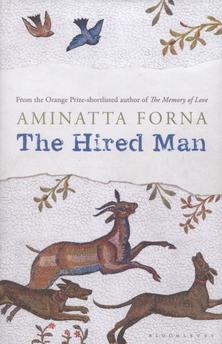
Aminatta Forna, The hired manEarly in Aminatta Forna’s The hired man, the narrator Duro is told by his old, ex-best friend Krešimir, “People have moved on, Duro. Maybe you should too”. At this point we are not sure exactly what they have moved on from but we guess it might have something to do with war – and as the story progresses we discover we are right.

The hired man is Forna’s third novel, but my first to read. All of them, together with her memoir The devil that danced on water, deal with the prelude and aftermath of war. In The hired man it’s the Croatian War of Independence which occurred in the early 1990s. Forna, though, never names the war, and while there is some description of war-time action, she doesn’t provide any real historic details about who, what or where.

The novel is set in the fictional town of Gost, and commences in 2007 with Duro, our first person narrator, telling us that “at the time of writing I am forty-six years old”. Later we realise he is writing for a future reader, after he dies. He writes

… I have to tell this story and I must tell it to somebody, so it may as well be you, come to sort through my belongings.

The trapdoor is opened …

So, what is the story he has to tell – and why is he suddenly compelled to tell it now? Well, towards the end of the novel he says this:

Laura arrived in Gost and opened a trapdoor. Beneath the trapdoor was an infinite tunnel and that tunnel led to the past.

You don’t know who Laura is, though, do you, so it’s time I introduced the plot. The novel spans Duro’s life from his childhood to his mid-forties. He tells of his family, and his boyhood friends, particularly the aforementioned Krešimir and his younger sister Anka, with whom Duro fell in love. He tells how his relationship with Krešimir crumbled as Krešimir’s true, cruel, nature became apparent, and why he left Gost for a few years, returning just before the war started. And he tells us about the “chaos” that ensued during the war, “when men turned to hunting each other”. I don’t want to give too much away here, but let’s just say that by the time the war starts his relationship with Anka had moved, necessarily, from that of lover to good friend.

We jump then sixteen years to 2007 – when Duro is living alone and friendless – though the novel is not told in this linear way. It’s told more organically as the changes resulting from the opening of the “trapdoor” stimulate memories and bring the past back to Duro. This trapdoor is opened because Krešimir sells the “blue” house, the home he’d shared with Anka and their parents, to Laura and her husband who plan to renovate it, sell it, and move on. Duro, we discover, is a handyman, and he becomes Laura’s “hired man” for this renovation, and in the process becomes the family’s friend.

There is an underlying theme here of the British moving into Europe, oblivious of history and inherent dangers:

The way the English saw it, the past was always better. But in this country our love of the past is a great deal less, unless it is a very distant past indeed, the kind nobody alive can remember, a past transformed into a song or a poem. We tolerate the present, but what we love is the future, which is about as far away from the past as it is possible to be.

These English do not understand, for example, that the “fields that used to be ploughed … are now full of wild flowers because nobody dares to walk in them in case they put their foot on a mine and are blown to pieces.”

“I imagine myself with the body of a bird, a raven. Outstretched wings and neck, rigid beak and shining eye, I swoop over the ravine and hover over the town.”

So, here is Duro, standing “guard over the past” like a predatory bird. And here is Laura, reminding him of Anka who, though we don’t know why, is no longer in Gost. And here is “the chill of unfinished business”. The stage is set … but here I’ll leave the plot.

What is beautiful about this novel is that, despite its depiction of brutality and betrayal, and despite a sense of menace, it is restrained – and it’s restrained because Forna’s focus is not violence and revenge, though there are elements of these in the novel. Her interest is how people live with each other after war, and particularly after Civil War when traitors, collaborators, opportunists and victims, depending  on your point of view of course, must all live together. The novel made me think of Olivera Simić’s Surviving peace which I reviewed last year. It’s a memoir, and Simić does not still live in her Serbian home, but she makes very clear that surviving a war, particularly ethnically-driven civil war, is just the beginning.

What is also beautiful about this novel is Forna’s writing – her use of imagery, symbolism, irony and parallels to convey her meaning. Birds and colours have multiple connotations, some positive, natural, others menacing. The “ravine” on the edge of town bears witness to beauty and horror. Hunting suggests violence and predation, but is also a source of sustenance and defence. The title, itself, “the hired man”, has both benign and malignant meaning …

As does the idea of masculinity, “with its undercurrent of aggression”. For Duro, it encompasses loyalty, protectiveness, and reliability alongside strength and control, while for men like Krešimir and Fabjan, the town bully, it means power and competitiveness, and is attended by a sense of menace.

Nothing, in other words, is simple in Forna’s world, and the language conveys this subtly but emphatically.

‘Well this is one of the most beautiful places I’ve ever been. You don’t notice it any more, but you don’t know how lucky you are.’

Laura, new to the town, is oblivious to the irony of her utterance, and so are we as the novel starts – but, we soon learn differently. It is not a pretty town but by the end some rapprochement, uneasy though it still may be, has been achieved. This is a moving but realistic book about just how difficult it is to survive peace.

Aminatta Forna
The hired man
London: Bloomsbury Publishing, 2013
ISBN (Kindle ed): 9781408818770

Monday musings on Australian literature: Reading Australian literature

Reading Australian Literature is a lecture series inaugurated at the University of Sydney last year by its School of Letters, Arts and Media. The idea is for writers to talk about a literary text that means something to them. Here is how the website describes it:

Writers’ festivals and other popular forums invite writers to talk about their own work and creative practices. But what might they have to say about the books that excite their imaginations? There are few opportunities for writers to substantially engage with literature in the public sphere.

Reading Australian Literature is a series in which acclaimed Australian writers reflect on the Australian books they value. In a thoughtful and engaging public lecture, each writer will discuss a favourite Australian literary text. What has led them to these books? What do they find remarkable about them? Have these encounters with Australian books left an imprint on the speakers’ own writing?

As far as I can gather there were three lectures last year, and they plan four this year. Because I love hearing authors talk about writing and writers, I thought I’d share with you the writers and their chosen texts to date in the series:

  • Michelle de Kretser: Jessica Anderson’s Tirra Lirra by the river. De Kretser, whose Questions of travel I reviewed a couple of years ago, likes this novel, which I read and loved many years ago, because it’s “one of the great novels of place”.
  • Drusilla Modjeska: Randolph Stow’s Visitants. Modjeska chose this “underrated” novel set in the Trobriand Islands because it “remains unsurpassed in outside fiction of our complex near-neighbour”.
  • Fiona McFarlane: Patrick White’s The aunt’s story. McFarlane, whose The night guest I reviewed recently, said that White’s novel “produces a bodily reaction” in her. She reacts to it, she said, “with a kind of horrified, delighted rapture.”
  • Charlotte Wood: Shirley Hazzard’s The transit of Venus. Wood describes Hazzard’s novel, which I have also read, but a long time ago, “as a novel I could return to for the rest my life, each time finding a new experience within its pages.” An edited version of Wood’s lecture can be found online at the Sydney Review of Books. Wood writes here that the novel is “concerned with much deeper moral courage than that required simply to love”. She also sees it as being about self-sovereignty. In my reading notes, I wrote that it’s about the discrepancy between who we might be and who we are, about the failure of many of us to be the best we can because we let ourselves be distracted by superficial concerns.
  • Delia Falconer: Christina Stead’s Seven poor men of Sydney (lecture scheduled for 21 April). Falconer, whose The service of clouds I’ve read, again long before blogging, says she’s come to this book late. She loves its evocation of Sydney in the 1920s’s, but also says she’s impressed by “the intensity of Stead’s artistic vision”. She plans to argue “against the accepted view that this is an uneven book marred by the excesses of a first-time author” because she sees “the astonishing maturity and political sophistication of her use of form”.

How difficult it must be for these authors to choose just one literary work to talk about, but these particular choices are fascinating – not just for the books they’ve chosen but for the reasons they’ve chosen them. Those reasons tell as a lot about their interests as readers and writers. Drusilla Modjeska’s focus on “outside” fiction and Michelle de Kretser’s on place, for example, make sense if you know the sorts of things they write.

Intriguing all the authors so far have been women. It would be good to see male writers in the last two planned for this year.

Just a little post this week, but I thought this lecture series was worth sharing. Unfortunately, it doesn’t seem that the lectures are published online by the organisers, in either oral or written form. What a missed opportunity!

I spent Anzac with the Griffyns

While other Aussies were attending dawn services, or watching almost 24/7 ANZAC broadcasts on the box, this ANZAC Day, Mr Gums and I chose to remember it by going to the Griffyn Ensemble’s The Dirty Red Digger concert, which was devised by their musical director Michael Sollis. Even more audacious than usual, Sollis managed to create a thoughtful show that married the story of the Glebe Rugby League football team (the Dirty Reds) with that of the ANZACS in World War 1, framed by interviews with young rugby league footballers today. He – and his “team” of engaged and talented performers – had the audience glued to its seats.

In a program that ran for a little over 2 hours, with a short break for half-time (!), Sollis spun a story about men and war and sport, about loss and class war and conscription. The performance integrated music and song, much of it composed (and all of it arranged) by Sollis himself, with archival and documentary film footage. The amount of work involved in putting all this together, the research, the writing, the interviewing, not to mention the composing and arranging – well, let’s just say we are in awe. It certainly conveyed Sollis’ passion for the subject matter – music, history, politics and football.

The show comprised nineteen pieces of music (or eighteen if we count the reprise as one) that varied in style from “classical” to folk and rock, from music hall/vaudeville to ragtime. Between and during the musical numbers, this versatile ensemble recited letters and poetry, and enacted stories with barely a hitch, while on the screen we saw a diverse selection of mostly war-related historical footage interspersed with contemporary interviews with young footballers from the Gungahlin Bulls.

“Man’s blind indifference to his fellow man” (Eric Bogle)

Sollis teased out two main themes through the show: the relationship of football to the Australian labor movement and, by extension, class struggle; and the challenge of manhood and the value of brotherhood for soldiers and footballers, past and present. We shared in the grief for soldiers (including footballers) lost, the humour and pathos of vaudevillian propaganda, and the recognition that many young working class men today continue to find purpose, meaning and mateship in football.

“I cannot engage in the work of recruiting and urge others to enlist unless I do so myself” (Ted Larkin)

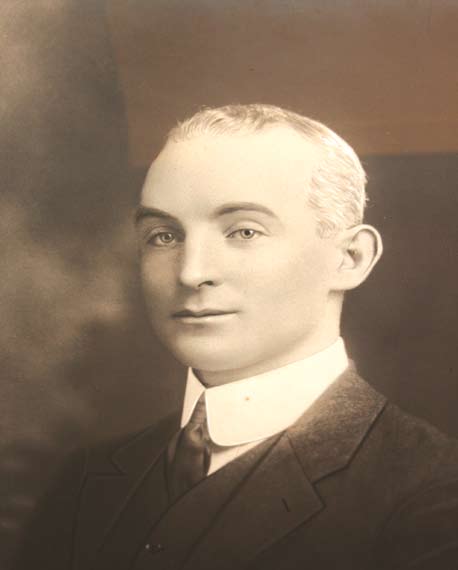
Ted Larkin

“ER Larkin” (Unknown) (Presumed Public Domain via Wikimedia Commons)

Rugby League football we learnt had its origins in northern England when working class clubs, unable to survive under the more affluent south’s “amateur” rule, broke away in 1895 to create the Northern Rugby Football Union. This form of football was established in Australia 1908. It represented, the Griffyns told us, a social movement which united young Australian working class men. It was also, from its start, closely aligned with the Labor party. Prime Minister Billy Hughes, who later earned the labor movement’s ire by attempting to introduce conscription in the Great War, was Glebe Rugby League Club’s patron in 1908. He was just one of several Labor politicians who aligned with the Rugby League movement because of its labor movement origins.

Another of these politicians was Ted Larkin. He was Australian Labor Party member for the NSW State Parliament, from 1913, and the paid secretary of the NSW Rugby League. He died at Anzac Cove on 25 April 1915, and, with his brother who died in the same battle, has no known grave.

You are probably starting to see now the story the Ensemble wove for us as they joined the history of Rugby League football to the progress of the War. It was told through music composed in various styles by Sollis (such as “Heartbeat”, “The Digger’s London Leave”, “Greater Game Rag” and “Conscription”) alongside propaganda songs of the era (such as “What do you think of the Kaiser?” and “Daddy’s in the firing line”) and more recent works like Eric Bogle’s heart-breaking “Green fields of France” and “Working Class Man” (made famous in Australia by Jimmy Barnes). The connections were palpable.

We also heard unfamiliar composers, such as Edouard (or Ede) Poldini, a turn of the century Hungarian composer best known for his miniature piano pieces, like “The Clock”, which featured Kiri Sollis on flute supported by the ensemble. It had a lovely, distinctive tick-tock motif.

“Footy’s my fix” (contemporary footballer)

Interspersed with footage from the Great War, including the Conscription Referendums and the Great Strike of 1917, were interviews with young Gungahlin Bulls footballers and one of their coaches. They talked of mateship, what football means to them, and how they’d feel about going to war should the call happen again. They spoke from their hearts about depression and alcohol, and with humour about the distance between them and those IT guys, the “keyboard warriors”, who are too smart to get themselves beaten up on a football field! Through their comments, and the accompanying footage, Sollis brought working class culture to an arts environment, and as the ensemble belted out “Working Class Man” we saw on the screen those (not really so) simple souls with hearts of gold in our complicated land. It was pretty spine-tingling.

I believe this program will tour nationally. Don’t miss it, if it comes near you. If you’re not moved by the story and impressed by the musicianship of the performers, not to mention challenged to keep up, well, your tastes are very different to mine!

Other (very different) YouTube versions of some of the music:

And you can see sheet music for “The Clock” online, though I couldn’t find a performance.

Team Griffyn: Michael Sollis (Musical Director and Mandolin), Susan Ellis (Soprano), Kiri Sollis (Flute), Chris Stone (Violin), Laura Tanata (Harp) and Holly Downes (Double Bass).

Jane Rawson, A wrong turn at the Office of Unmade Lists (Review)

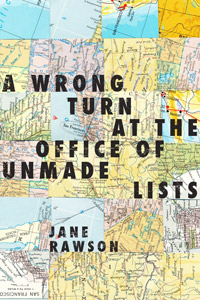
RawsonWrongTurnTransitThe weirdest thing happened when I put down Jane Rawson’s debut novel, A wrong turn at the Office of Unmade Lists: I started imagining things! This is weird because I’m not a particularly imagin­ative or fanciful person, so it must have been this book that did it. Let me explain …

First though, I need to say that I’ve been keen to read this book for some time. It started with the cover. I tend not to focus a lot on covers but some do grab me. This one, with its chequerboard of maps, is both eye-catching and intriguing. Then there’s the title. As a librarian/archivist, I’m drawn to organisation and lists but don’t mind a little anarchy every now and then. Is that what’s going on here, I wondered? And finally, there’s its MUBA award win last year. So it came down to a case of three strikes and you’re out – or, more accurately, in – and I bought the book. Well, what a read, because …

A wrong turn at the Office of Unmade Lists is a very unusual book. It traverses two places and times: Melbourne in 2030 and a sort-of imaginary San Francisco in 1997. It is, partly at least, a cli-fi* book. 2030 Melbourne is a bleak place – it’s very hot, clean water is harder to come by and more expensive than beer, soap is a luxury, and UN peacekeepers are in town. The rich survive as they do, but poverty is common, and many people live on the streets or in humpies. Bodies are regularly found in the streets. It’s a world you expect in dystopian novels, except that despite appearances, this novel is not completely dystopian.

Indeed, the novel has been described as a “genre-buster”. It is, for example, also a time-travel story, which brings me to the plot. Our protagonist is 33-year-old Caddy, who is living rough, having lost her husband and home in a heatwave-induced fire a couple of years before the novel opens. Like many in this devastated city, she survives on odd jobs – working in a bar, doing courier work, and selling her body. She has friends – an indigenous man and wheeler-dealer Ray, and bar-owner Peira. She also likes to write, and this is where San Francisco comes in because the story she is writing is set in 1997 San Francisco. It’s about two orphans-cum-childhood friends, 17-year-old Simon and 14-year old Sarah. They spend their time following a quest started by their parents in which they have to stand at least once in every 25-foot square of the USA, in order to see the whole country. With me?

At first this story of Caddy’s is told in italics within the main story, but in Part Two the narrative shifts and whole chapters are told in Sarah’s voice. Meanwhile, Caddy, with Ray who has bought some used and apparently magical maps, time-travels from Melbourne to San Francisco where they meet her creations.  Still with me? Hope so, because it gets tricksier. This “travel” involves passing through a sort of netherworld called The GAP, where we find the Office of Unmade Lists, and other sections including Tupperware Lids, Partially Used Pens, and Suspended Imaginums. Suspended Ims, as we in the know call it, is where the things that people imagine but “don’t come true” end up. I think that’s where my brief imaginings have gone!

This sounds more complex than it is – or, should I say, it’s conceptually complex but not hard to follow. Indeed it’s a hoot to read, because for all the grim, grittiness of this climate-damaged world, there’s warmth, love and humour – and a delightful sense of the absurd. I loved Rawson’s exploration of the two universes, the “real” and the “imagined”, and the way she has them meet. She messes with our minds! It made me think of Marion Halligan’s comment about her main character in Fog garden. Halligan writes: ‘She isn’t me. She’s a character in fiction. And like all such characters she makes her way through the real world which her author invents for her. She tells the truth as she sees it, but may not always be right.’ Halligan’s purpose is different, but the concerns, those to do with where imagination ends and reality begins, are similar.

That said, I’m not 100% sure of what Rawson’s purpose is, but I think she’s playing with her readers, with the idea of writing fiction, and with the meaning of fiction itself. Take, for example, her character Simon responding to Caddy telling him he’s her creation:

‘You come in here and tell us we’re imaginary, and now you’re saying you’re not even a very good writer! What do you mean? Like we’re all two-dimensional and shit, not fleshed out at all? Unrealistic? Is that what you’re saying? I don’t feel unrealistic. I feel pretty pissed off actually, which is kind of a realistic response to someone telling you you’re a shithouse imaginary character.’

Caddy looked at Ray like he might somehow get her out of this. He still had his head in his hands.

‘Sorry’, she said. ‘You’re heaps more complicated than what I imagined, if that helps.’

I love the sly, tongue-in-cheek allusion here to literary theory, to EM Forster’s notion of flat and round characters. This is just one of several references in the book to the things readers and critics talk about.

A wrong turn at the Office of Unmade Lists is a fun, absurd, clever book in which Rawson somehow marries her very real concerns about the future of our earth with a belief that human compassion and ingenuity will survive, and wraps it up in an exploration of the complex relationship of imagination to reality. Imagination, Rawson seems to be saying, is the real stuff of life.

So, my recommendation is: Don’t worry about the book making complete sense. Suspend your disbelief, enjoy the ride, and realise that here is a lively intelligence you don’t want to miss.

Lisa at ANZLitLovers also enjoyed the book.

awwchallenge2015

Jane Rawson
A wrong turn at the Office of Unmade Lists
Melbourne: Transit Lounge, 2013
318pp
ISBN: 9781921924439

* Jane Rawson was, and maybe still is, Editor of Energy & Environment at The Conversation

Monday musings on Australian literature: Social media reviewing

I’ve been a bit distracted lately by life and so missed an article which appeared a few days ago in the online journal, The Conversation. Luckily, there’s Twitter, so I didn’t miss it entirely! Isn’t social media grand? Except, of course, when you botch it. And this is where this article I nearly missed comes in …

Written by Jane Messer of Macquarie University, it asks, perhaps a little too cutely, “Should authors Rushdie to judgment as book reviewers?” The article springboards from a recent brouhaha involving Salman Rushdie giving “public 1-, 2- and 3-star ratings to books by well-known and esteemed writers such as Kingsley Amis, the late father of his friend Martin Amis, and Hermione [I think she may have meant Harper] Lee” on GoodReads. He was not a popular man, but claims that he didn’t realise his ratings were public.

However, my focus today is not Mr Rushdie, but social media reviewing. Messer quotes Charlotte Durack, Marketing Executive at Pan MacMillan Australia, who told her that GoodReads “is the most important site at which authors should have a presence, ‘as this is where the majority of reviewers live'”. Social media, Messer says, offers authors the opportunity “to engage with readers and the industry” in all sorts of discussions.

Messer’s focus in her article is authors reviewing authors. She continues:

The negative reaction by other authors to Rushdie’s book ratings demonstrates how sensitive writers can be to the public discussion of the literature of their peers or literary antecedents. But why shouldn’t an author as reader, or expert reader, give however many stars they like to a book?

Stars without reviews can be “glib” she says, and GoodReads, unlike Amazon, does not provide “ethics guidelines or even tips or warnings”. I must say that I tend to be bemused by these sorts of guidelines. Should we have to be told that it’s not ethical, if you’re an author, to post anonymous negative reviews of other authors (or anonymous positive reviews of yourself)? (What is wrong with us that we need to be told this?)

Anyhow, Messer’s point is that writers are readers too – and the literary world, she says, encourages critics and reviewers to be courageous when speaking publicly. She quotes a number of sites as supporting this philosophy: Sydney Review of Books, the Australian Women’s Writers Challenge (woo hoo!), and the Pascall Prize for Australian Critic of the Year. She continues:

These relatively new initiatives are having influence and impact, by expanding the depth and range of reviews of books and writing, and a diversity of reviewers, among whom are authors (my emphasis).

She’s certainly right about the Australian Women Writers’ Challenge where several authors – such as Annabel Smith, Amanda Curtin, Jessica White and Jane Rawson, to name a few – are among our reviewers. The challenge team greatly appreciates their contribution to and engagement in the process. The more perspectives we have, surely the better for Australian literature – and authors, I find, can often have quite a different perspective. I love hearing their thoughts about how a book is put together – they know intimately the challenges of getting a plot to work, of making characters engaging, of not upsetting readers with incorrect facts!

Social media reviewing is, of course, a mixed bag – and users need to recognise that many (most, even) of the reviews they read are by amateurs who vary greatly in interest and skill, and can, in fact, have different ideas about what reviewing is. It’s not all great, but it’s not all bad either. Indeed, George Orwell suggested in his essay “Confessions of a book reviewer” (my review) that amateurs could be fine reviewers of novels.

Anyhow, I’m rather glad that this article came to my attention now, because it has given me the opportunity to announce that the Australian Women Writers Challenge has just made available the ability to search all reviews (some in blogs, some on GoodReads) posted by challenge participants since the beginning of 2013. Reviews posted in 2012, the first year of the Challenge, will be added soon. The search page is still being tweaked, and sometimes a bug or two appears, but we’d love readers to start using it and give us feedback. You can access the page here.

Now back to Messer who concludes her article by saying that:

Authors need to be very digitally literate to make the best use of their voices.

But that, I’d say, is true for all social media users. The consequences of digital illiteracy may not be as dramatic for us “ordinary” readers, but they are there. Best to be wise before the fact!

Carmel Bird launches Marion Halligan’s latest at Paperchain

Sometimes blogging brings you little thrills, and I had one a few days ago when Carmel Bird, one of Australia’s literary luminaries, emailed me with the offer to post her launch speech for Marion Halligan’s latest book. Was this out of order she asked? As if! So, I attended the delightful launch, and received the text from Carmel Bird’s hands. Here it is …

Carmel Bird launches Goodbye Sweetheart

I acknowledge the traditional custodians of the land on which we are gathered.

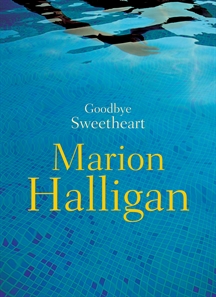
Marion Halligan, Goodbye Sweetheart

Courtesy: Allen & Unwin

For a writer, the so-called literary world is made up, as are many worlds, of friends and enemies. Marion and me, we are friends. You don’t invite your enemies to launch your books. Goodbye Sweetheart is Marion’s twenty-second book, and it’s the first one I have had the honour of launching. I can tell you this is a great pleasure.

Margaret Atwood says she thinks that all narrative writing is motivated by a fear and fascination with mortality. I agree with her. This doesn’t mean the details of the plots are necessarily going to focus on death. But sometimes they do. The publisher’s advertising for Goodbye Sweetheart begins by telling you the main character has just drowned, that the novel is going to explore the mourning of his family. And clearly there is going to be plenty of that other important topic, sex. In fact the two key subjects of fiction – sex and death – are entwined in the title Goodbye Sweetheart.

The blue, blue cover of the book is soothing, until you connect the shadow at the top with the information about the drowning. The story begins and ends with water – William drowns in the luxury pool of a fancy hotel, and ultimately his ashes are scattered in the sea, becoming ‘part of the shredding of the water on the rocks below’. When I talk fancy here, I’m quoting the book. His son and one of his wives then watch the moon on the water – a benign and hope-filled image that lulls the reader as the book is closed.

Novels often pose a question for the reader. Goodnight Sweetheart asks not only how you would behave if you were part of William’s family, but how, in your heart, you would mourn.

The narrator suggests that there are enough births, deaths and marriages, enough anguish here for half a dozen nineteenth century novels. This is a bit of a challenge for the writer. But Marion is up to it of course. The rhythms of her sentences, the precision of her words. One of the wives is advised to seek the joy of grief, the gift of sorrow, but she thinks these are just the threads of words all plaited together making a pattern but having no meaning. Later on she realizes that the true thing is that William loved her, and this will always be true. So there is the ‘true thing’, the good thing, the meaning. And fiction may be motivated by death, but its aim is usually to seek out meaning. To unravel the tangles of lives and to present the reader with a pattern that makes some sense of it all. Another character says ‘Meaning is what we make for ourselves.’ Marion takes a pretty big cast of characters and weaves them – I am inclined to say she stitches them up – into a pattern, and the meaning – the true thing – emerges and stays in the reader’s mind.

Now this is getting to sound rather philosophical and serious – have I forgotten about the sex and death thing? No. I have not. The story unfolds in present-day Australia, in the domestic lives of an extended and muddled family. Early on, a character points out that some of the great traditions of literature had a domestic beginning. This story is going to be domestic, not epic or anything like that. But it will frequently spin the focus round to someone such as Milton or Browning or, in particular George Eliot. For one of William’s sons is a great admirer of Middlemarch. The narrative refers back to the dense narratives of myth and poetry and fiction.

Now a lovely thing, speaking of the domestic again, is the way the titles of the chapters keep bringing you back to the very ordinary everyday. Like no chapter headings you have ever seen. There’s a list of them in the front – ‘The gym is busy’ – ‘Lynette plans a sale’ – ‘Jack goes fishing’. They play so sweetly against the grand themes of death and love and betrayal. Love might be the true thing, but the fabric of everyday life is made up of things such as ‘Helen comes home late’ – and ‘Aurora drinks vodka’. Watch out for ‘Barbara drinks the last of the wine’, though. Of course, people are often drinking things – and eating nice stuff too. Marion never lets a good story get in the way of a fine meal.

Now I want to talk about coincidence. It is such a joyful thing that happens really quite frequently in everyday life. It also happens quite a bit in literature – think of the works of Dickens, for one. It isn’t always easy to make coincidence smooth and acceptable in fiction. But at the end of Goodbye Sweetheart there is a delightful one, and it is part of the melody of the novel, is a graceful gift offered to one of the nicest characters. It will put a smile on your face. Not only is there love, there is hope. Even the title of the chapter in which it happens is a joy – suggesting as it does that the young man is at last on the right path – it’s called ‘Ferdie takes the bus’.

There are also a few ghosts involved along the way, and a rich vein of fascinating short narratives, one in particular that appealed to me – the tale, legend, of a boat that came, once upon a time, into the bay at Eden. It had picked up smallpox in India when it took on a cargo of silk. The infected silk was buried with the bodies of the dead. Then guess what – people dug up the infected silk and sold it, and the ladies of the town made it into dresses. The complex everyday lives of the main characters are threaded with mysterious narratives such as that one. And these narratives form a subtle, dark undertow to the everyday problems of the characters. So while the surfaces of lives are followed in meticulous detail, from the clothes people wear to the food they eat, the wines they drink, the glasses they drink from, the landscapes they contemplate – a darker undertow works away in the depths.

So, William dies. His wife, his two ex-wives, his children, his mistress – I think I’ve got it covered – gradually gather, revealing their own stories, discovering parts of the story of William, until William is ashes in the sea, and the moon moves across the water.

You are going to love reading this novel. You are going to love having it alongside all the rest of Marion’s books. It is my honour and joy to launch it on its way to the open arms of your lucky bookshelves.

– Paperchain Bookshop, Canberra, April 14, 2015

PS Carmel has what she calls a “sleepy blog”, Blue Lotus. She plans to post this speech there also. Do go check her out because there you will find her short story, “When honey meets the air”, which I featured in my review last year of Australian love stories. It’s one of those pieces that has you chuckling, marvelling and puzzling all at once. Carmel’s next book, a collection of short stories titled My hearts are your hearts, will be published by Spineless Wonders later this year.

Marion Halligan’s reponse

No, I don’t have her speech too, but I did make some brief notes! Mostly, of course, she thanked various people – publisher and editors, family, and Carmel. However, she did say a few other things. Responding to Carmel’s comment on chapter titles, she said she has to name, not number, her chapters, because she doesn’t write them in order and needs to recognise them when she comes to shuffling them around! Don’t you love it? I can see why Halligan and Bird are such friends, they such have a wonderfully confident cheekiness about them. (I’m sure you detected some cheekiness in Bird’s speech).

Marion also commented that reading about death isn’t necessarily miserable. Death is something we all have to face up to, some sooner than later, she said (!), so we may as well get used to it. Must say I agree with her. I’m not one to shy away from books that deal with grief and death. I know many people love Joan Didion’s beautiful memoir, The year of magical thinking, but Halligan’s novel, The fog garden, is an equally beautiful book, a novel, about the loss of a loved partner.

Finally, Marion praised the book’s designer, Sandy Cull, who also designed Valley of grace and Shooting the fox. She’s right – I have all three now – and they are all, simply, luminous. It was a delightful launch involving two special Australian writers – and I now have a signed copy of Halligan’s book in my hands, and Bird’s thoughtful speech about this book and fiction in general preserved on my blog for posterity. Thanks Carmel. Thanks Marion.

Monday musings on Australian literature: Short Stories, 1920s style

“A good short story is a work of art, and a joy of forever!” So wrote the author of The Sydney Stock and Station Journal’s “Our Book Column”, back in March 1920. I hadn’t planned to write about this topic today, but the various discussions of short stories I found while researching Trove distracted me. You all know how much I enjoy short stories. I couldn’t resist delving a little deeper – and by a little, I do mean a little, but still, I found some interesting ideas and perspectives.

Back to my opening quote. I love the fact that it comes from a stock and station journal. It suggests that short stories were widely popular then – in those days before television, and even radio (which started around 1923-1924 but of course was not immediately available to everyone everywhere). The writer (or writers) in The Queenslander’s Literature pages wrote frequently about short stories in the early 1920s, usually in reference to published collections or anthologies, most of which were not Australian. I’m mentioning them here though, not so much for the books being reviewed or promoted but for the commentary they provide on short stories. Here’s a fairly random selection of comments from The Queenslander.

  • On the value of short stories: “A book of short stories is usually a boon, and when the short stories are good it is a distinctly pleasant possession”. Well, duh – though I do like the idea that short stories are “a boon” by their very existence. Do readers still feel this way?
  • On the first of a planned annual, clearly international, anthology, The Best Stories of 1922: “In their first collection, “The Best Short Stories” of 1922″ (Jonathan Cape) they include some that certainly ought never to have got beyond the page of the magazines in which they were originally printed, and merely mention in a second-class a great number of others that must be considered with the year’s best. It may be, of course, that they were handicapped by the copyright. A few of the stories, however, are really first-class, including “Seaton’s Aunt,” by Walter de la Mare”. I like the fact that the writer doesn’t pull punches about the mixed quality of the selection.
  • On a growing interest in English language short stories: “For a great many years the short story was supposed to be the special property of the French writer, and for a generation the short story had only two notable exponents in English—Kipling and “O. Henry,” masters for all time. Recently, however, there is hardly a British or American writer of note who has not sought to excel in this special field, and one concludes that the English-speaking world is at last waking up to the value of the short story.”
  • Another par on the growing interest in short stories: “That the short story has gained a hold on the imagination of the English speaking peoples is very evident, for scarcely an English or American mail comes in without a book or two of short stories from the publishers. One of the latest is “Thirty-one Stories” (Thornton Butterworth), collected by Ernest Rhys and C. A. Dawson Scott, and containing stories by such writers as H. G. Wells, Arnold Bennett, John Russell, Aumonier, Galsworthy, May Sinclair, and others.” One of the things I enjoy about these articles is seeing the writers they include – some I know, some I don’t know, and some I’d forgotten about.
  • And another one in the same year on, yes, the popularity of short stories: “The world evidently cannot have too many short stories. Almost every author of note has published, or is publishing, a volume of short stories, and occasionally some discerning publisher collects a number of short stories of various authors and the result makes a very readable book.” The article mentions a recently received American collection called Marriage, which includes stories by Hergesheimer and Booth Tarkington among others. I wonder how these stories would read today?

Other articles I found talk about fostering and encouraging local writers. Evening News wrote in 1921 that it would continue to publish short stories by Australian authors in its Sunday News edition, as part of its “policy of endeavoring to give a stimulus to native literature”.

The writer of The Western Mail, probably the Fairfax I mentioned in a post earlier this year, praises the stories of Dowel O’Reilly whose humour, he says, “never degenerates—as is the case with some Australian writers—into the unedifying antics of sheer larrikinism”! The Western Mail was not so pleased with the stories of Elizabeth Fairfax. I’ll quote this par in full:

We have received from the publishers, (Melville and Mullen Pty. Ltd., Melbourne) a copy of “Garden o’ Memories and Other Stories,” by Elizabeth Fairfax. Reprinted from the pages of various Australian periodicals, the stories contained in this little volume are no better and no worse than the majority of their kind. Whether they were worth reissuing is another matter altogether. Perhaps “Time and Tide” is the pick of the bunch, but they are all of them afflicted with an incurable tendency to sentimentalism in its most advanced stage.

The book has a frontispiece in colour – and a pictorial cover design.

Hmmm … sounds like the cover might be the best part.

Finally, something practical. Here is the writer in The Argus responding to a query regarding how to get short stories published. S/he writes: “It is only possible to find publication for the stories if they are equal to the standard required by the editor to whom they are submitted. The stories should be typewritten on one side of the paper only, and a stamped and addressed envelope should be forwarded with the manuscript for its return in the event of its proving unsuitable. The manuscript should be addressed to the editor of the magazine or newspaper to whom it is to be submitted, and on no account should a copy be sent to two papers at the same time.”

I’ve filled this post, I know, with excerpts from newspaper articles but I do enjoy these insights into the thinking of a different time. I hope you get something out of them too.

Meeting Biff Ward

WardMotherAllenUnwinIn her comment on my review of Biff Ward’s beautiful memoir, In my mother’s hands, in which I mentioned that Biff had been present at my reading group, Stefanie (So Many Books) asked if I planned to post specifically about Biff’s presence. While I don’t always do this when authors visit my group – Biff was our sixth author in our 27 years – I did do so for Marion Halligan and Alan Gould. Since our discussion covered a lot of ground that I didn’t include in my review, I figured that this was one of those visits to write up …

The writing process

The most common questions readers ask authors tend to relate to why and how they wrote the book in question. We were no different. And really, I think such questions can be good ice-breakers because “how did you come to write your book” is surely a question most authors can answer without too much angst? For Biff, the answer was quite complex. She said that her father, and others, always assumed that she would write his biography, but she wasn’t interested in biography … and so … WardFatherDaughterGrove

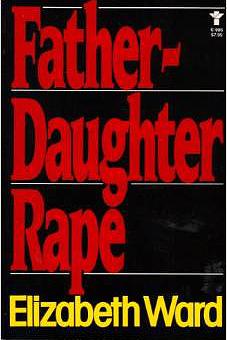
Biff had, she said, been writing for 40 years or more. Her first book was the ground-breaking Father-daughter rape*, published by The Women’s Press in London in 1985. One of our reading group members, a psychotherapist, knows the book and said it is still referred to for its discussion of child sexual abuse. Biff, quite rightly, seemed rather chuffed at this news!

The memoir, though, was written over 15-20 years – in bits and pieces. The first “bit” she wrote was a reminiscence of her mother’s in which she remembered hearing of the assassination of the Romanovs. Uncertain about where Russia was, she asked her father who vaguely said, gesturing, “over there”. For her mother “over there” meant “out of sight beyond the horse paddock”. It’s a lovely anecdote shared between mother and daughter, but it has deeper resonances in terms of her mother’s life, and Biff included it pretty much untouched in the final memoir.

Biff said that she started writing more on the memoir as she transitioned to retirement, but work on it intensified after she attended a writing retreat in Byron Bay in 2009. By the time she presented it to her publisher, Richard Walsh, it was 105,000 words, but it was gradually whittled down to the final 70,000 words. We wondered whether she could publish some good short stories from the bits edited out.

We aren’t, I guess, a very original group because another question we asked is a common one: how did you choose the title? Biff responded that she brainstormed it with her writing group. Her original title had been  Alison, for her parents’ first child who had died at 4 months, but then, through brainstorming, it was decided that the title should refer to her mother. The final challenge was whether to go with At her mother’s hands or In her mother’s hands. We agreed that “In” is better. It feels more inclusive, and less aggressive.

We also talked a little about the sources of her information, but I mentioned some of those in my review. I was intrigued by a reference in the book to how a lover washing her hair brought back childhood memories of her mother washing her hair. It made me wonder what memories don’t come back and the implication of almost serendipitous memory-joggers like this on the final story. I loved Biff’s answer that the “memoir” form is more forgiving than “autobiography”. It is, after all, about memories, so what you do and don’t remember, for whatever reason, is essentially what it’s about.

Writing (and reading) as therapy

If you’ve read the book, or my review, you’ll know that the underlying story concerns mental illness. You won’t be surprised then to hear that the book brought out some painful (but valuable) sharing. It was truly special that we all, including the “stranger” in our midst, felt safe enough to do this – and for that reason, obviously, what was shared in the room will stay there. I can say though that it also brought up the idea of writing as therapy. Biff believes that writing for therapy is valuable – but in journals and diaries, not in published books.

Related to this theme, we asked whether writing the memoir was a painful or traumatic experience but, as Biff mentions in the book, she had undergone extensive psychotherapy so had, she said, worked her emotions through before she came to write the book. We also asked her whether she was angry about her childhood, but she said she was more sad than angry. She said, thinking of her father, that partners can suffer more than children. That’s a generous response I think – but then this is a generous book.

We also talked a little about the way the family had hidden its problems, but we could all relate to the fact that people are generally anxious to say “I’m fine”. People don’t, as Biff discusses in her book, have the words, the language, to express difficult things. Biff did refer, though, to the moment in the book when she and her father had finally been able to talk about “the terribleness” they had experienced. An “odd word” she wrote in the book but it was lovely, she told us, to have been able to be honest about their experiences. Biff’s father had his failings, about which she’s clear in the book, but he was she said “a deeply moral man” and late in his life regretted his less admirable behaviours.

Our reactions

As you will have gathered we all enjoyed the book and deeply appreciated having Biff present for our discussion. We shared our various reactions – profoundly moving, harrowing, kind, a stimulus to remembering our own childhoods, and the like. One member used the word “endearing” for Biff’s portrait of her father, for the way she showed her love for her father while writing “all sides” of him. Biff said she enjoyed finding the words to describe him.

A point that intrigued us was the fact that a country university, the University of New England (UNE), had employed a “communist” academic who had been rejected by the major city universities. Biff told us that UNE had quite a reputation for employing “all the Reds that no-one wanted”! We all loved this.

Near the end of the evening, Biff unveiled the “show-and-tell” she’d brought. It was a beautiful, sensitive portrait of her mother painted when she was in her late 20s. A cropped black-and-white version is in the book (p. 62) but to see the original full version in colour was, well, special. But then again, it was just one more special thing in an evening that was very special.

* Lest you be concerned, this book is not about Biff and her father – there’s no such sexual abuse in the memoir – but about her later research into child sexual abuse after meeting two young abused girls in a women’s refuge.