Francis Keany, Follow the leaders: How to survive a modern-day election campaign (Review)

Francis Keany, Follow the leadersI had a little laugh when I picked up Francis Keany’s book, Follow the leaders, about his experience as a journalist on the 2013 election campaign, because that very day our current leader Malcolm Turnbull formally announced the 2016 election. It’s all a game of course because we already knew when it was to be – the budget had been brought forward a week to accommodate the chosen date, after all – but the formalities had been held off until after said budget had been delivered. The fact that elections and electioneering are largely a game is one of the themes of Keany’s book.

Now, before I tell you more about this book, a little disclosure. Francis (or Frank) Keany is known to me. He has been my son’s friend since they met in high school in the mid-late 1990s. I’ve taken a particular interest, therefore, in following his journalistic career which has included stints in country New South Wales, Sydney and back in Canberra where we now hear his reports on ABC Radio. He’s a radio journalist, and during the 2013 election he was working for the Macquarie Radio Network.

Mr Gums and I went to the launch of the book and were interested to hear in the introductory comments by journalist James Massola that for all the books out there about politics, there are not very many about a journalist’s experience of an election campaign. He did mention one Australian book, Margo Kingston’s Off the rails about Pauline Hanson’s 1998 campaign, but this is not he said about the main campaign, the leaders. Keany’s book is particularly interesting, he continued, because it’s about modern campaigning in which social media is a significant component. As Keany writes:

the so-called 24-hour media cycle has added to the pace and tone of modern election campaigns. The mistakes that are made are amplified and exaggerated in a bid to meet the appetites of media consumers …

In this world, gaffes like Tony Abbott’s “suppository of all wisdom”, he writes, start trending immediately on Twitter. And then there are the interminable attempts by people to get selfies with the leaders, a “ridiculous aspect” of the campaign the journalists agree.

Keany’s book is not an analysis of or treatise about the process, he doesn’t have a theory to push, he simply shares the dogged day-to-day experience of being part of the press pack that accompanies the two leaders over the last 30-odd days of the campaign. Keany spent the first two weeks of the campaign following the Abbott (Leader of the Opposition) camp, and the last two weeks or so with the then Prime Minister Rudd’s camp.

I found it rather eye-opening. Of course, I’ve seen and read and heard the journalists reporting on campaign trails and I’ve comprehended that they travel in a bunch, but just how intense, not to mention exhausting, it all is, I hadn’t fully realised. Keany describes the experience of being herded onto military planes with their crude toilet facilities, of travelling on coaches, of visiting three states in a day, and of plans being changed suddenly. He describes donning hi-vis vests to traipse after a politician in a factory, sharing late night drinks with colleagues, and missing his partner Tess.

He is painfully honest about his personal experience of being a rookie campaign journalist, of the emotional toll of being separated from a partner when a little bit of support is just what you need, and of the physical toll wrought by the sheer exhaustion of the hours, not to mention by the poor nutrition as you eat on the run.  Here he is at Day 16:

The tiredness has set in like a staph infection – it has become incurable. No number of power naps or snoozes can shake off the dull feeling that’s filling my head.

I can’t think clearly – I’m starting to make too many mistakes.

While his prime focus is his experience, he does provide some insights into the campaign itself. He explains – though perhaps we all know this one – that “campaigns have never been just about policy. They are about public relations”. He watches the politicians interact with the public, hears them discuss strategies, and concludes that “I don’t think politicians give the average punter enough credit for their knowledge of the outside world.” He talks of the journalists’ awareness of panic in the Rudd camp with last minute schedule changes, press conference delays, and sudden policy announcements. We glimpse the machinery behind the leaders – how political minders try to control the message by, for example, withholding press releases until the last minute. How tricky it is, we see, for journalists to keep it all together. They have to physically keep up with the leaders, tease out the key issues from the spin and try to get their questions answered, and then find time to prepare and file their stories according to the needs of their bosses.

Next time I start to rail at a journalist’s gaffe, I’ll think first about the difficulties that can be involved in “filing” one’s reports while you are on the run, and risking missing the bus to the next venue!

Keany’s writing is clear and, appropriate to his aim, is informal and chatty in style. He has a sense of humour too, which is conveyed in frequent asides, such as his description of a hotel room which “looks like it was nice back when the Raiders last won a premiership”. Even if you don’t know when that last one was, which I don’t, you get his point. But, I can’t help commenting, pedant that I am, on a recurring and irritating grammar peccadillo. It’s to do with “who” versus “whom”, as in, for example, “a mysterious pilot who we hardly ever see”. Or, is this just another grammar nicety that’s going to bite the dust?

For all the stresses and challenges, Keany is clearly passionate about his career. He writes in his Introduction that he’s aware of debates about the value of the press gallery, but says:

I firmly believe that our political system is grounded in the participation of all Australians, and that the media has a significant role to play in ensuring as much transparency as possible in that system.

I think he’s right – and I also think he has done journalism a service by providing some behind-the-scenes insight into why the media may not always be perfect, while also demonstrating that in this age of spin and control journalists are needed more than ever.

Francis Keany
Follow the leaders: How to survive a modern-day election campaign
Braddon: Editia, 2016
153pp.
ISBN: 9781942189404

Monday musings on Australian literature: Let’s get physical – Kati Thanda-Lake Eyre

Last week I wrote my fifth “Let’s get physical” post, and chose Adelaide because visiting there was bookending our trip last week to Kati Thanda-Lake Eyre. You’ll understand, therefore, why I’ve chosen the subject I have for this week!

Lake Eyre was named for explorer Edward John Eyre, the first European to see it in 1840, but in 2012 its official name was changed to combine its English name with its indigenous one, Kati Thanda. This recognition of indigenous place names is happening around Australia and is so important – not only to help reconciliation, but because these names mean something to the land we live in. 

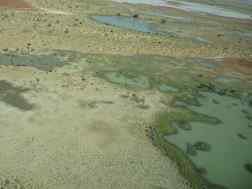
Lake Eyre aerial view

Lake Eyre Basin aerial view, 2016

Lake Eyre, for my non-Australian readers, is a large shallow lake in remote and very dry South Australia, approximately 700 km north of Adelaide. It contains Australia’s lowest natural point, around 15 m (49 ft) below sea level. When it fills, albeit this is a rare event, it is also Australia’s largest lake.

There are many stories associated with the lake – indigenous ones, of course, and settler ones. It was the subject of intense exploration in Australia’s early colonial days – by those looking for an inland sea – and was where major land speed record attempts were made in the mid 1960s. Importantly, native title over it was granted to the local Arabana people in 2012. There are some tensions, particularly regarding water activities, between the indigenous desire to respect its sacredness and its role as a tourist destination.

Early reports

The first person to write about the lake was Eyre. His writings, Journals of expeditions of discovery into Central Australia and overland from Adelaide to King George’s Sound in the years 1840-1, were published in England in 1845. They can now be read at Project Gutenberg Australia. Here he is writing about the region – very dry one day and then rain the next:

Lake Eyre, aerial viewyre Ba

Lake Eyre Basin aerial view, after 2016 rains

In passing through the plains, which were yesterday so arid and dry, I found immense pools, nay almost large reaches of water lodged in the hollows, and in which boats might have floated. Such was the result of only an hour or two’s rain, whilst the ground itself, formerly so hard, was soft and boggy in the extreme, rendering progress much slower and more fatiguing to the horses than it otherwise would have been. (August 31, 1840)

Crossing many little stony ridges, and passing the channel of several watercourses, I discovered a new and still more disheartening feature in the country, the existence of brine springs. Hitherto we had found brackish and occasionally salt water in some of the watercourses, but by tracing them up among the hills, we had usually found the quality to improve as we advanced, but now the springs were out in the open plains, and the water poisoned at its very source.

Occasionally round the springs were a few coarse rushes, but the soil in other respects was quite bare, destitute of vegetation, and thickly coated over with salt, presenting the most miserable and melancholy aspect imaginable. (September 2, 1840)

Warburton River aerial view

Warburton River aerial view

This is desert, an area, that is, of very low and very erratic rainfall. The problem was that in the early days of settlement, explorers sometimes happened to visit areas like Lake Eyre at a rare wet time and drew conclusions that later, of course, proved false. In 1858 explorer Peter Egerton Warburton thought that “the abundant and sure supply of water” would make the region easy to occupy. The fact that the biggest towns here – Birdsville and Marree, for example – have permanent populations of 100 people or less rather puts paid to that forecast.

In 1887, a bore was sunk at the Coward Springs railway siding. A contemporary magazine, Pictorial Australian, reported that:

Acres of nearly level table-land were turned in a few hours to a swamp … it is only a matter of weeks before miles of country will be covered with water. (from an interpretive panel at Coward Springs)

Wetlands were created – and breeding grounds for birds and other wildlife ensued. Indeed Lake Eyre is  famous for its birdlife and its breeding grounds. Ornithologist Captain SA White undertook “an ornithological trip” to the area in 1914 to collect bird specimens. He wrote about the artesian bore at Coward Springs where the pipes had corroded, so that the water

now flows out at the surface and finds its way across the the plain, where for many acres it forms a swamp, mostly covered in green rushes trimmed down by the stock. Amidst this short vegetation many water-loving birds find a home and feeding ground. (from an interpretive panel at Coward Springs)

I don’t pretend to understand how water works here. We saw some water courses/ponds/springs that are permanent, and others that are caused by recent rains and will evaporate or otherwise dissipate very quickly. The critical point is that there is not enough – in quantity and quality – to support regular, intensive farming, though there are cattle stations in the area.

More recent writing

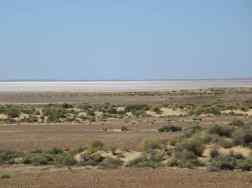
Lake Eyre South

Lake Eyre South (viewed from the ground)

Not surprisingly for such a fascinating place, many non-fiction books have been published over the years about it – by scientists, journalists, and travellers – but not much fiction. Given its remoteness you’d think it would provide excellent inspiration for novelists, but not so it seems. Arthur Upfield who, in the mid twentieth century, wrote crime fiction set in Central Australia did set one in the Lake Eyre region, Bony buys a woman, and another of his, Death of a lake, is about a fictitious lake that could be based on Lake Eyre.

As for non-fiction, I found a useful list of recommendations, including a trilogy by Roma Dalhunty who travelled in the region with her geologist husband. The books are The spell of Lake Eyre (1975), When the dead heart beats Lake Eyre lives (date?), and The rumbling silence of Lake Eyre (1986).

My own favourite work about the area is, however, a movie, the 1954 Shell-sponsored docudrama The back of beyond. It chronicles the trip made between Marree and Birdsville every fortnight, from 1936 to the late 1950s, by mailman Tom Kruse. Scripted mainly by its director John Heyer, the final narration was co-written by Australian poet Douglas Stewart. Marree is described as a “corrugated iron town shimmering in the corrugated air” and Birdsville as “seven iron houses burning in the sun between two deserts”. The drama of life in the region is described through lines like “Who passes or perishes, only the dingo knows”.

I’m sorry I don’t have anything more exciting for you, but at least you now know where I was last week!

Meanwhile if you know of any fiction set in Lake Eyre, please to tell.

Edition de luxe: A collection of short stories

Edition de luxe: A collection of short stories inspired by our hotelsLast October, I wrote a Monday Musings post on writers-in-residence programs. The first one I listed, because I listed them alphabetically, was Accor Hotels MGallery Literary Collection. This is (or was?) a collaborative program with Melbourne’s The Wheeler Centre. Quoting what I wrote then, ‘it involved providing eight award-winning Australian writers with a short residence in one of Accor’s boutique MGallery hotels and commissioning those authors to write a short story which will be published in a book which will be “presented exclusively to guests at MGallery Hotels”.’ Well, it just so happens that this weekend we are staying in one of these hotels, and what did I find but the book of short stories titled Edition de luxe: A collection of short stories inspired by our hotels. Woo hoo!

It’s a nicely presented little book, with, for each writer, a brief bio, their short story, a brief history of the hotel plus that hotel’s special appeal, photographs, and a “memorable moment” describing something you might be able to enjoy if you stayed at the hotel. This is marketing after all, in addition to offering the treat of a bit of support to writers. The marketing bit comes to the fore when you look at the table of contents. It lists the title of the story, and the name of the hotel at (or about) which it was written, but NOT the name of the writer! Harumph. I’m always irritated when names of authors are not given due recognition in listings.

So, without further ado, I’m going to name the writers, 6 women and 2 men, who appear in the book. They are:

  • Favel Parrett (“Gold”)
  • Graeme Simsion (“Slideshow”)
  • Chris Flynn (“The prophecy, 1931”)
  • Robyn Annear (“Batman’s Hill lives”)
  • Toni Jordan (“Like a kindness”)
  • Debra Oswald (“Dog grooming”)
  • Alison Croggon (“Hello”)
  • Hannie Rayson (“Pip”)

I’ve read the stories – of course, otherwise I wouldn’t be writing this! They are all 2-3 pages, some fiction, some not. They probably, the fiction ones anyhow, qualify as flash fiction, depending on your definition.

The first story, Favel Parrett’s “Gold”, is a little mood piece about what she sees from the balcony of her room at Mount Lofty House, “her” hotel, naturally. It’s non-fiction, and I enjoyed her description of the end of the day:

Time is measured in light. Evening shadows begin to stretch over the valley. The gold moves further and further away towards the horizon, chased by the sun going down.

Nice, peaceful.

The fiction pieces vary in tone from the poignant or sad, like Graeme Simsion’s “Slideshow”, with its little surprise ending, and Alison Croggon’s more worrying “Hello”, to the more lightly humorous, like Chris Flynn’s “The prophecy, 1931” about Walter Lindrum (set in Melbourne’s Hotel Lindrum) and Hannie Rayson’s sperm-donor-inspired final story in the collection, “Pip”. Historian Robyn Annear explores Melbourne’s Batman’s Hill, razed in the 1860s to make way for the railway, in her story “Batman’s Hill lives”, and Toni Jordan, in the Blue Mountains, recounts a chance encounter, which may or may not be real but which makes a sweet story, in “Like a kindness”. But, perhaps, though it’s hard to choose, I most liked Debra Oswald’s “Dog grooming” with its tale of subversion and catharsis.

I won’t say more. These are little pieces, perfect for reading in a hotel at the end of a busy working or travelling day. Quality writers, thoughtful stories. I wonder what, if any, feedback Sofitel/Accor and the Wheeler Centre have had, how the writers found the experience, and whether the project will be repeated.

Delicious descriptions: Chinua Achebe’s people and places

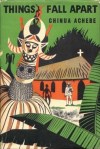
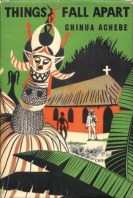
Chinua Achebe, Things fall apart

First edition, from Heinemann (via Wikipedia)

In my recent post on Chinua Achebe’s classic, Things fall apart, I focused mostly on its themes and ideas, which drove the quotes I chose to share. Here I want to show more of his writing, including his wit and use of imagery.

I’ll start with this early description of the protagonist, Okonkwo, who is determined not to be like his failure of a father:

When he walked, his heels hardly touched the ground and he seemed to walk on springs, as if he was going to pounce on somebody. And he did pounce on people quite often. He had a slight stammer and whenever he was angry and could not get his words out quickly enough, he would use his fists. He had no patience with unsuccessful men. He had had no patience with his father.

At first the phrases “heels hardly touched the ground” and “walk on springs” conjured for me (anyhow) Jesus Christ walking on water, but they’re immediately followed by the very un-Christlike idea of pouncing on people, confirming that the reference is instead to powerful, predatory cats. The “slight stammer” could garner some sympathy from us. We can understand the frustration of not being able to speak fluently, but resolving it with his fists again undercuts the possibility of our sympathy. And the last two sentences! Love them. The economy – and wit – with which he makes the point. And to not respect his father? Unfortunately, for all his determination to not be like his father, to be an admirable man respected by all, he ends up with a son who doesn’t respect him. This is the sort of writing I love, writing that gives with one hand and takes away with another, that requires me to fully engage my brain as I read.

Oh, and the rhythm of this paragraph is lovely too – long sentence, short sentence, then long, followed by short, short. It just reads well.

There’s a lot of lovely imagery – mostly earth and nature related which you’d expect given the book’s setting – but I’ll just share one. It describes Okonkwo’s son Nwoye being tempted by the new (that is, Christian) religion:

But there was a young lad who had been captivated. His name was Nwoye, Okonkwo’s first son. It was not the mad logic of the Trinity that captivated him. He did not understand it. It was the poetry of the new religion, something felt in the marrow. The hymn about brothers who sat in darkness and in fear seemed to answer a vague and persistent question that haunted his young soul – the question of the twins crying in the bush and the question of Ikemefuna who was killed. He felt a relief within as the hymn poured into his parched soul. The words of the hymn were like the drops of frozen rain melting on the dry plate of the panting earth. Nwoye’s callow mind was greatly puzzled.

For an agricultural society, the image of rain on a “panting earth” provides a perfect description of Nwoye’s desperation for comfort.

Other imagery relates to aggression, violence, strength – wrestling, fire, knives – which is reflects the novel’s themes and the character of its protagonist. Again, I’ll just choose one example. It’s short and comes from Part 3 after Okonkwo has returned to his village to find the white man’s arrival has caused a breakdown in village relationships. Obierika says of the white man that:

He has put a knife on the things that held us together and we have fallen apart.

And with that, Achebe unites the novel’s title, its narrative arc, and the epigraph:

Turning and turning in the widening gyre
The falcon cannot hear the falconer;
Things fall apart; the centre cannot hold;
Mere anarchy is loosed upon the world.
(from “The second coming”, WB Yeats)

Such a beautifully conceived novel.

Monday musings on Australian literature: Let’s get physical – Adelaide

This will be the fifth in my occasional “Let’s get physical” series, and I’ve chosen Adelaide because this week I’m spending a few days in this city, the state capital of South Australia, bookending a trip to Kati Thanda-Lake Eyre.

Adelaide, which was proclaimed as a British colony in 1836, is located in the country of the Kaurna Aboriginal nation. Unlike Sydney, Melbourne, Brisbane and Hobart, it was established as a place of free settlers. That didn’t mean, unfortunately, that indigenous people fared any better. Their culture and language was, apparently, destroyed within years of white settlement there, but it’s a particular story that I don’t know enough about to go into here.

St Peters Anglican Church, 1880s

St Peters Anglican Church, 1880s

Adelaide has many reputations, including being the city of churches, the home of one of Australia’s best-loved arts festivals, one of the world’s most liveable cities and, oh dear, the city of corpses. Stephen Orr, whose rural novel The hands I reviewed recently, has written a non-fiction book called The cruel city. He apparently reports that author Salman Rushdie once suggested Adelaide was “the perfect setting for a Stephen King novel or horror film”. Poor Adelaide. This is not based on the number of murders, but on the fact that for two or three decades in the mid to late twentieth century it had more than its share of “gruesome or distressing murders”, starting with the still unsolved disappearance of the Beaumont children in 1966. They have never been found and their story was used as a cautionary tale for all Australian children growing up in the 1960s and 1970s. Stephen Orr’s Time’s Long Ruin, which was longlisted for the Miles Franklin Award in 2011, was inspired by the case.

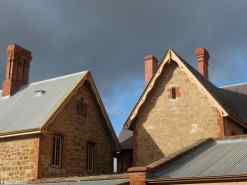
South Australian Museum roofs

Roofs, 1850s, in the old Police Barracks and Armoury courtyard

But, my main point of this series of posts is meant to be “the physical” – and I’ll start by saying that I like Adelaide, and the reasons are partly physical. It’s a small city, and I like small cities, and it has my favourite style of climate, a Mediterranean style featuring warm to hot dry summers and mild damp winters. It can get hot there, very hot occasionally, but that would be a small price to pay to my mind.

Jane Jose writes about Adelaide in her book, Places women make, which I recently reviewed. She describes the city as follows:

Adelaide, in settled south Australia, has its circle of green hills around the city, its expansive pale-blue desert skies and an inheritance of parklands and colonial architecture.

That was then

But now, let’s flash back to those early colonial days, to 1859, and the first novel by a woman to be published in South Australia, Marian by Maud Jeanne Franc (pen-name of Matilda Jane Evans). Early in the book, Marian’s future employer comes to Adelaide to interview her. Here he is arriving at the house:

He reached it, and a moment after was shown into a little parlour, half-dark it appeared to him, for the blinds were let down to exclude the sun, and everything appeared bleak as he entered.

It was typical of those days that people would draw curtains or blinds against the sun. Wise of course in high heat, but my understanding is that it was done against most sun. And the result? Bleakness!

Jumping to the mid-late twentieth century, we have Adelaide-born authors Barbara Hanrahan (b. 1939) and Murray Bail (b. 1941). Hanrahan, who wrote the gorgeous autobiographical novel The scent of eucalyptus (1973) (my review)worked hard to find her Australia. As a child, she writes in her novel, she struggled to find “the sunburned land” of her reading and history in the town where she lived, and only really found her “place” after she left:

l feel it’s of value to divide my life between England and Australia . . . Two places, so different that one illuminates the other. London so large that I may lose myself, which means find myself because I can be anonymous. Adelaide – smaller, strange, this place where I began from, the place of childhood, of legend. (personal papers, n.d. 1978?)

Murray Bail found it a provincial place – “overwhelmingly reactionary, Protestant, and fiercely defensive of time-honoured standards” – and he, too, escaped, first to India in 1968, and then to London in 1970. This, presumably primarily inspired by Adelaide, comes from his Notebooks 1970-2003:

When I think of ‘Australia’ I first see its shape. It is quickly followed by scenes of slow-moving dryness, muted colours, and some of the great white trees. Of people in general, it is often the young, flushed mothers in sleeveless cotton dresses yanking or carrying children on the hot city asphalt.

Homesickness: habits of a landscape acquired over time. (London June 1970 – November 1974)

His first novel, Homesickness, was published in 1980. It is on my TBR.

This is now

Born ten years after Bail, and in the tiny South Australian town of Minlaton, novelist-poet-librettist Peter Goldsworthy set his  2003 novel Three dog night partly in Adelaide and partly in central Australia. In it, Martin brings his English wife back to Adelaide. Here they are driving into the Adelaide hills:

The day has taken its name to heart: a Sunday from the glory box of Sundays, a luminous morning saturated with sun-light and parrots. Happiness rises in my throat, thick as cud; the world outside the car, wholly blue and gold seems almost too much for my senses, too tight a squeeze.

‘Paradise’, Lucy murmurs, smitten.

At last, the “real” Adelaide – blue sky, gold sun and birds! Of course, this is a novel, and “paradise” is not that easily attained. Indeed, the novel (which I read long before blogging) is really rather dark.

I will end here, but I must first defend Adelaide against those charges of provincialism, because in 1970, after Hanrahan and Bail had left, reformist politician Don Dunstan became Premier of South Australia, and things changed. Pretty soon Adelaide (and the state) became one of Australia’s most socially progressive places. Just goes to show what a visionary leader can do!

PS I haven’t read it, but JM Coetzee’s Slow man is set in Adelaide.

Jane Jose, Places women make (Review)

Jane Jose, Places women make“Places”, Jane Jose writes in her book Places women make, “can lift our spirits and be inclusive, and add surprise, excitement, wonder or some beauty to day-to-day life in the city.” These sorts of places, which are essential to making our cities liveable, rarely just happen. They take planning, and who does this planning? Men. At least, it’s men, says Jose, who have been the “hero architects of most of Australia’s city buildings, leading the design, even if women were invisibly designing the detail behind the scenes.” So, in Places women make, she aims to right this imbalance, to bring to the fore the work women have done in making cities better. This is not, however, a feminist rant. She does not undermine the work done by men. She simply wants women to receive their share of recognition, not just because they deserve it but because it is important for other women – particularly young women – to know.

I had not heard of Jane Jose before reading this book, which proves her point rather because, in fact, she, a self-described urbanist, has been involved in urban planning for well over two decades. She has done this through many roles, including, at one point, Deputy Lord Mayor of Adelaide, her home town. Indeed, one of the fascinating aspects of the book is just how many ways people can contribute to urban planning and improvement. She tells of the obvious people – the architects and town planners – but there are others too, such as the civic leaders and politicians, the landscape designers and gardeners,  the heritage and environmental activists, and the philanthropists. Women – many of them – have performed all these roles, and she shares some of their stories. It’s inspiring reading.

The book is structured thematically, starting with her overall thesis about what women can offer to urban design. This is probably a good place to mention two – hmmm – mantras, I’ll call them, which pervade the book. One is straightforward, and that is, to (mis)use EF Schumacher’s phrase, “small is beautiful”. Although women have been, and are, involved in big projects, it is often in the “small” projects that they make their biggest impacts. Early on, she repeats a leading architect’s criticism of Sydney’s Lord Mayor of Sydney, Clover Moore. Jose writes that he

once criticised her to me for having paid too much attention to the small public places and parks in the city rather than driving major projects. He described the small projects she is promoting in the city as being “like tatting”. To my mind this shows a lack of understanding of how women see the small things adding up to a greater whole.

Jose goes on to discuss the projects and ideas Clover Moore has driven, arguing that Moore “understands that community places and activities are the glue in the community” and further, that beautiful, liveable cities “bear the fruit of a strong economy”. I’m not an economist, but there must be some truth to this argument I think. Anyhow, throughout the book, Jose describes many, many small community-focused projects initiated by women, from Wendy Whiteley’s magical Lavender Bay garden to Stephanie Alexander’s Kitchen Garden Foundation, from Jane Lomax-Smith’s work on protecting Adelaide’s parklands to Tess Brady’s involvement in the creation of Australia’s first booktown at Clunes. Some of these, as you can tell, started small but ended much bigger, which is what happens to good ideas. From little things, big things grow (as Australia’s Paul Kelly sings).

The other mantra or thread is perhaps a little more problematic. It relates to what Jose calls a “feminine sensibility”. She defines this in terms of “creativity … intuition … lateral approach”, as having “a special relationship with community and village life”, and as taking the “long view”. She writes that “we know a female perspective is different from that of a man”. Intuitively – ha! – I understand what she is saying, but from a gender studies or feminist point of view this feels like dangerous ground. However, I’m going with her because her stories are powerful enough to argue her case. Women’s contributions have in general been overlooked or underplayed. Take for example Marion Mahony Griffin, wife of Walter Burley Griffin, credited as Canberra’s designer. It took decades for her part in what was clearly a partnership to be recognised.

What I enjoyed most about the book are the stories about projects, big and small, that women have initiated, some known to me, but many not. I enjoyed reading about Australia’s cities and what local women have fought for in them. This coming week I’ll be in Adelaide, the city where Jose cut her urban planning teeth. She writes about her involvement in the re-visioning of North Terrace and more specifically in activism to save Adelaide’s heritage architecture. I have visited Adelaide several times over the years, but on my visit last year, I was thrilled by how beautiful – and welcoming – it is, particularly North Terrace. We have Jane Jose, forensic pathologist Jane Lomax-Smith, architect Jackie Shannon Gillen, among others, to thank for that.

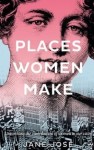
While her main focus is contemporary Australia, Jose also tells stories from the past. She describes how wives of Australia’s early administrators strongly affected the design of the cities they were in, women like Mrs Macquarie, wife of governor Lachlan Macquarie, and the energetic Lady Jane Franklin, wife of explorer and lieutenant governor of Van Dieman’s land, John Franklin. It is this Jane, in fact, who graces the book’s cover. (I have written about her before on this blog). These women are just two examples of women who, married to influential men, used their influence to affect city planning and design.

In addition to casting her net historically, Jose also crosses the seas. She ends her book with a special tribute to the influential American urbanist Jane Jacobs (1916-2006), who inspired her belief that cities can be villages or communities. But she also refers to other international women, such as American landscape architect Kathryn Gustafson, Chilean landscape architect Teresa Moller, and London-based Iraqi architect Zaha Hadid.

What more can I say? Places women make is a fascinating book written by a woman passionate and clearly knowledgeable about her subject. If I have any complaints they are minor, and yet I do need to say them. One is that while she provides a wonderful list, at the end, of the women whose stories she tells, there is no index. I’d love an index. The other is that there are no foot-notes or end-notes documenting her sources, just a brief reading list. These don’t affect the book’s worth as a popular introduction to her subject, but they’d be much appreciated by those of us interested in a little more!

And now, since you can’t really “spoil” a book like this, I’ll end with Jose’s conclusion because it says it all:

Cities matter. They are alive and they change, they are the places we live our lives and make our memories. It takes commitment, imagination and passion to make even the smallest idea for change blossom from an idea into a park, a playground, a library or a shaded street. With the influence of women, cities can be better places. Tomorrow’s children need the places women make.

Lisa at ANZLitLovers also enjoyed the book.

awwchallenge2016Jane Jose
Places women make: Unearthing the contribution of women to our cities
Mile End: Wakefield Press, 2016
213pp
ISBN: 9781743053942

(Review copy courtesy Wakefield Press)

The Griffyns are mummified

Those Griffyns, if you haven’t realised it from my previous posts, are a brave and versatile bunch. Their latest outing, the Ear of the Cat, was inspired by musical director Michael Sollis’ residency in Egypt last year. Performed last weekend, it was the ensemble’s first real concert of the year and was included – a first for them I think – in this year’s Canberra International Music Festival.

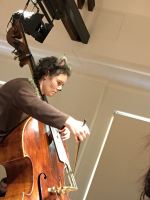
Holly Downes

Brown cat Holly Downes playing her double bass

Another first, sort of, is that it was designed to appeal to children or, as the Ensemble’s promo describes it, it’s “a staged production for the young and young at heart:  a show all about cats, magical keys, video games, and a green soup eaten by ancient kings”. (I say “sort of” because the Griffyns did create and perform a school version of last year’s ANZAC Dirty Red Digger program.)

So, a staged production featuring cats. Here is how the Griffyns explained it:

Come on an adventure of discovery as deep within an underground Egyptian tomb, four mummified cats are woken by a mysterious sound. Join these inquisitive cats and be led by your ears, as you journey through an unfamiliar new world of haunted mazes, video games, and the streets of contemporary Cairo to help the cats find a way to belong in the land of the living.

Chris Stone

Mummified cat, aka violinist Chris Stone

It was a 45-minute (or thereabouts) program that took us from a mummy’s tomb to the streets of Cairo. As we walked into the performance space we were confronted with four colour-coded mummified “cats” (Holly Downes, Susan Ellis, Chris Stone and Michael Sollis) lying on pallets down the length of the hall (in the Ainslie Arts Centre). Gradually, to the call of sophisticated cat Kiri Sollis’ gorgeous piccolo – acting like a Pied Piper, perhaps? – the cats awoke and shed their mummy bindings, and started looking for a way out. A key was found but were they brave enough to venture out? Perhaps not – or not quite yet. This was, though, a multi-media performance, so while the cats crept about, uncertain of what to do, we were entertained by video interviews with young Egyptians about life and cats in Cairo. They were engaging as young people can be and added a dose of reality to the fantasy being enacted in front of us – but finally we discovered that the “ear of the cat” is the shape into which you tear and then fold pita bread to eat green Mulukhiyah soup. You can always be sure to learn something new from the Griffyns!

Now, what else to say? Michael Sollis’ clever music, which supported the narrative, varied from cattish-wailing to foot-stomping, from discordant sounds reflecting anxiety and uncertainty to lyrical jig-like and sometimes jazzy ensemble pieces conveying confidence. Laura Tanata’s harp played a gentle encouraging role throughout. Soprano Susan Ellis, reminding me of a spunky (less tatty) Grizabella from Cats*, prowled the room looking for answers, and at one point carried on an evocative and entertaining squeaky “conversation” with Kiri Sollis’ piccolo (if I’ve remembered correctly). The whole ended with a “miao chorus” inviting audience participation.

While the “story” was about mummified cats, it called up, for me, a broader archetype – sophisticated town cat versus nervous country cousins – and, as in all good stories, they all got together in the end.

I must admit that I’m not sure I fully comprehended all the connections being made as the story progressed, perhaps because coming from an older generation I’m not so good at quickly absorbing multiple inputs, but I always enjoy seeing what these skilled performers come up with. They make music meaningful and fun, and present it with a great deal of warmth towards their audience. I look forward to their next concert.

Griffyn Ensemble: Michael Sollis (Musical Director and Mandolin), Susan Ellis (Soprano), Kiri Sollis (Piccolo), Chris Stone (Violin), Laura Tanata (Harp) and Holly Downes (Double Bass).

* Ian McLean who reviewed the performance for City News was also reminded of Grizabella! I think it was the long fur coat.

Monday musings on Australian literature: Ideal books for newcomers, 1965-style

Another treasure from Trove! Just over 50 years ago, on 1 January, 1965, an article appeared in a journal titled The Good Neighbour, which was published from 1950 to 1969 by the then Department of Immigration.

The article is called “Ideal books for newcomers” and opens with:

Following Mary Durack’s articles on “The Old Australia” which appeared in the October and November issues of The Good Neighbour, the author has compiled a list for some suggested reading.

I assume “the author” is Mary Durack? If so, I must say that I’d have written it as ‘Following her articles on “The Old Australia” which appeared in the October and November issues of The Good Neighbour, Mary Durack has …’. Anyhow, the article continues that:

The books named are not necessarily the best or most profound, the author states, but would seem to provide the readiest introduction to Australian literature and history. Many of these books would make useful presents for newcomers to Australia.

So, what does this “author”, let’s presume Mary Durack, recommend? I’m not sure about copyright* on this, so I won’t reproduce it all but the full list is available at the link I’ve provided above. Durack produces her list under headings, such as Australian History, Australian Aborigines, Early Colonial Novels (before 1900), and so on. As you will see, there’s no playing to the lowest common denominator here. The list assumes a good facility with English, and decent concentration levels.

History and culture

Two books are recommended on “Australian Aborigines”. One is AP Elkin’s The Australian Aborigines: how to understand them (Angus and Robertson). An unfortunate subtitle by today’s standards, but this was first published in 1938. A much later edition was a set text for me when I studied Anthropology, Elkin having been Professor of Anthropology at Sydney University. I might be wrong, but I’d be surprised if many Australian citizens had read this book in 1965. Still, in the first edition’s preface, Elkin does suggest that the book has three audiences: the general public, administrative officials and missionaries, and university students and scientists. He suggests that those with a more general interest could skip the chapters detailing relationship systems.

Another category is “Documentary, Travel and Biography”. There’s a strong focus here on the rural, with books about Cobb and Co, the Overland Telegraph, and the Outback (including her own, now classic, Kings in grass castles) being recommended.

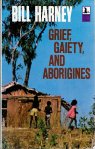
Bill Harney, Grief, gaiety and aboriginesWith her outback experience, Mary Durack was familiar with Aboriginal people, and so in this, and other categories, she makes sure to include books about (though not by, given the time we are talking about) indigenous people. I was intrigued by one, unknown to me, Bill Harney’s Grief, gaiety, and the Aborigines. My link here is his Australian Dictionary of Biography (ADB) entry. He had close connections with indigenous people, and is described by ADB as “gregarious and generous person who regarded everyone as equal”. This ABC News item supports this assessment. It would be interesting to know how he managed the difficult role of government patrol officer and protector of Aborigines, which he did from 1940 to 1947.

The last category I’ll mention in this group is “Critical and Interpretive Studies”. Among the three books listed here is Russell Ward’s classic, ground-breaking history of Australia, The Australian legend. Last year I reviewed his daughter Biff Ward’s memoir, In my mother’s hands. (And, blogger “wadholloway” who regularly comments here has named his blog for this book.)

Novels

The lists of novels are divided into three categories: early colonial (before 1900), early colonial and pioneering days (post 1900), and later Australian life.

Only two are recommended in the first group, Henry Kingsley’s The recollections of Geoffrey Hamlyn (on my TBR) and Rolf Boldrewood’s Robbery under arms. Not, I notice Marcus Clarke’s classic For the term of his natural life which would perhaps be the first of the early novels that people would think of today. Was she wanting to avoid the convict stain?

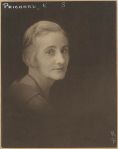
Katharine Susannah Prichard

Katharine Susannah Prichard, by May Moore (Presumed Public Domain, State Library of NSW)

Her next group – her post-1900 date referring, it seems, to the date of publication not of the content of the novels – contains the usual suspects: Joseph Furphy’s Such is life, Miles Franklin’s All that swagger, (not My brilliant career), Henry Handel Richardson’s famous Richard Mahoney trilogy, Eleanor Dark’s The timeless land, Katharine Susannah Prichard’s The Roaring Nineties, Ernestine Hill’s My love must wait, and Patrick White’s Voss. These seem fair enough, though every Australian literature lover would probably tinker with this. She also includes a book unknown to me, Brian Penton’s Landtakers. According to Wikipedia he was a novelist and journalist, and this novel featured pioneering life in Queensland from 1824–64. Given the Durack family’s story (see my review of Brenda Niall’s biography of the Durack sisters, True north) it’s not surprising that she’d recommend a book on this subject. Interestingly, women writers feature well in her list!

The final group focuses on “later Australian life” – in other words, they’re mostly about life in the 1930s to 1960s. It contains many books I know, some authors I know but not the particular book, and some I’ve never heard of:

  • Katharine Susannah Prichard: Coonardoo
  • Louis Stone: Jonah
  • Xavier Herbert: Capricornia
  • Kylie Tennant: The battlers
  • Patrick White: Riders in the chariot
  • A. G. Hungerford: Riverslake
  • Donald Stuart: The driven
  • Tom Ronan: Moleskin Midas
  • Frank Dalby Davison: Man Shy
  • B. Vickers: First place to the stranger
  • Judah Waten: Alien son
  • Gavin Casey: Snowball
  • Randolph Stowe: To the islands
  • Elizabeth Harrower: The long prospect
  • Nene Gare: The fringe dwellers
  • Eve Langley: The pea pickers (my review)

An interesting and probably reasonable list, given the 1965 date. I’m impressed to see Elizabeth Harrower’s second novel, The long prospect, here. It suggests the regard in which she was held at the time she was being published. An obvious omission is George Johnston’s now classic My brother Jack. However, it was only published in 1964, and perhaps Durack didn’t know it.

Again, there are a few authors I don’t know at all: Donald Stuart, Tom Ronan (who appears in other categories too), B. Vickers, and Gavin Casey (who also appears in other categories). That’s 25% of the list! Stuart, Wikipedia says, “attempts to view the world from the aboriginal point of view, making him one of the few Australian writers, along with anthropologists … to even attempt to come close to a personal knowledge of the aborigines”. It would be interesting to read him now – such as his first novel, Yandy – given current thinking on this..

Overall, these books, as in the non-fiction categories, tend to be country rather than urban based. This probably partly reflects what novelists at that time were writing about, but could also reflect Durack’s background and interests. Would this focus have addressed the likely interests of newcomers?

Durack also recommends some verse and short stories, but you can read them at the link.

Meanwhile, I’d love to know what you think about this list (from any point of view you choose!)

* If the government holds copyright on the article, then it is now, just, out of copyright I believe.

Frederick Law Olmsted, Trees in streets and in parks (Review)

I last came across the American landscape architect, Frederick Law Olmsted, a few years ago when I was doing some freelance research for a Canberra 2013 centenary project. This was because Olmsted, who designed New York’s Central Park with Calvert Vaux, inspired Walter Burley Griffin and Marion Mahoney Griffin, the original designers of Canberra. Now, it just so happens, that my current read is a book by Jane Jose, Places women make, about the contributions women make to the development of cities. In it she talks of Marion Mahoney Griffin, and her role in the design and planning of Canberra, a garden city. So, when a piece by Frederick Law Olmsted titled “Trees in streets and in parks” popped up as last week’s Library of America’s Story of the Week, I decided it was for me.

Frederick Law Olmsted

By James Notman, Boston, 1893, engraving of image later published in Century Magazine (Public domain, via Wikimedia Commons)

It’s a fascinating piece for its insight into nineteenth century thinking about trees, parks and cities. The article was published in a journal called The Sanitarian. He commences by disagreeing with an idea promulgated by French art critic, Charles Blanc, that nature is not beautiful, only design can be so described! Olmsted admits that some trees can be poorly or inappropriately planted or maintained but even those can be – well let him say it

But looking up at the continuous green canopy which these maltreated trunks support, swaying in the light summer breeze against the serene blue beyond—swaying not only with the utmost grace of motion, but with the utmost stately majesty—I say that cheaply, inconsiderately as the planting work was done, if the result is not to be called beautiful, it is only because it has more of sublimity than beauty.

Take that Monsieur Blanc! However, sanitation being his apparent main interest, he moves on to talk about parks and their importance to the “sanitary apparatus of a large town”. Parks are important for providing clean air to city residents. Travellers to London, he writes, had until recently described its myriad parks as ‘“airing grounds,” “breathing places,” “the lungs of London”’. Although times are changing, “the atmospheric theory”of the value of parks still holds strong, he says. For people to benefit from this air, the parks have to be attractive, so trees are planted for their decorative value.

However, it is not for their air-purifying value, nor for a decorative motive, that he plants trees in his parks. His reason doesn’t “interfere with or lessen the value of a park as an airing ground”, but not pursuing decoration as a goal results, he suggests, in a more attractive and less costly park. So, what is his purpose? Well, it has to do with defining “sanitation” more holistically: it’s not just about supporting the body but also encompasses the mind. Yet, he realises,

It is plainly not enough to answer that it is to move the mind recreatively, because that is equally the motive of Punch and Judy, of a flower-garden, of a cabinet of curiosities, of jewelry.

Frederick Olmsted

Portrait of Olmsted, at (the beautiful) Biltmore Estate, 1895, by John Singer Sargent (Public domain, via Wikimedia Commons)

Admitting he’s not a scientific expert, he argues that “the recreative and sanative value of large parks” comes from what he describes as an unconscious process. He distinguishes, in other words, between “conscious, or direct recreation, and unconscious, or indirect recreation”. Designing the placement of trees (and other garden objects) to call people “to a halt, and to utter mental exclamations of surprise or admiration” runs counter to this idea of “unconscious recreation”. A park’s highest value lies, rather, in “elements and qualities of scenery” to which the minds of those experiencing them give “little conscious cogitation” at the time. These elements or qualities “are of too complex, subtle and spiritual a nature to be readily checked off, item by item, like a jeweler’s or a florist’s wares”.

He provides an analogy. It’s the difference he says

between the beauty of a common wildflower seen at home, nearby others of its class, peeping through dead leaves or a bank of mossy turf, and that of a hybrid of the same genus, double, of a rare color, just brought from Japan, now first blooming in America, taken from under glass, and shown us in a bunch of twenty, set in an enameled vase against an artfully-managed back-ground.

In other words, coming across a scene, flower, tree unexpectedly and perhaps without even consciously stopping to comment on it, may have “a more soothing and refreshing sanitary influence”. These are the natural, simple pleasures that “cottagers in peasant villagers” have always been able to enjoy. And here he moves to a more political point. With the growth of cities and the development of the rich, with “the prominence given by the press to the latest matters of interest to the rich and the fashion-setting classes”, the problem is that

the population of our country is being rapidly educated to look for the gratification of taste, to find beauty, and to respect art, in forms not of the simple and natural class; in forms not to be used by the mass domestically, but only as a holiday and costly luxury, and with deference to men standing as a class apart from the mass.

This impoverishes us, dissipates tastes that once brought happiness. It’s a very appealing attitude to parks and park-making, though I must say his language is not the most straightforward to read.

The National Association for Olmsted Parks summarises the legacy of Frederick, his sons and their successors as:

The Olmsteds believed in the restorative value of landscape and that parks can bring social improvement by promoting a greater sense of community and providing recreational opportunities, especially in urban environments.

I think this is what you’ll be hearing about again soon, when I review Places women make!

Frederick Law Olmsted
“Trees in streets and in parks”
First published: In The Sanitarian (September 1882).
Available: Online at the Library of America

Chinua Achebe, Things fall apart (Review)

Chinua Achebe, Things fall apart

First edition, from Heinemann (via Wikipedia)

At last I’ve read that classic of African literature, China Achebe’s Things fall apart. It all came about because this year ABC RN’s classics book club is doing Africa. As I’ve been wanting to read this book for a long time, and as my reading group has been making a practice of choosing one ABC RN bookclub book a year, I recommended Things fall apart and – woohoo – they agreed. I am so happy! OK, so I’m easily pleased, but …

The funny thing is that as I started it, I did wonder what all the acclaim was about. Yes, I was finding the writing gorgeous, and yes, I found all the detail about life in the little Igbo village of Umuofia fascinating, but were these enough for its huge reputation? Then, I got to Part 2 – this is a classic three-part book – and the arrival of white man and the missionaries in southeastern Nigeria. The plot started to thicken – but, not just the plot. The whole gorgeous structure of the novel, its complexity and its sophisticated analysis of human society and the colonial imperative started to become clear.

Here, though, is my challenge – a challenge faced by all bloggers writing about much-analysed classics – what can I add? I haven’t actually read any of the analysis, except for my edition’s introduction, so I risk either going over the same old ground, or heading off on a completely irrelevant tangent, but I’m going to try. And how I’m going to try is to talk about a few of the aspects of the book that stood out to me, which, as is my wont, will focus more on how it is written than with the story itself.

However, I will start with a brief synopsis of the story, just in case there are others out there who haven’t read it. The plot is fairly simple: it tells the story of Okonkwo. Born to an “ill-fated”, “lazy and improvident” man, he decided early in life that he would not be like his father. He becomes a powerful and respected “warrior” in his community, one known to be hardworking but who could also be cruel to his family or to anyone who showed weakness. He is determined to be a “man”, to never show a “female” side. Male-female dichotomies are, in fact, an underlying thread in the novel. Whenever things go wrong for him, his response is always aggressive: if you aren’t confronting a situation head on, you are a “woman”. This inflexibility, his unwillingness to waver from his tough-minded course, results in his downfall. He could be seen I think as a classic tragic hero, as the man who could have been great but for a tragic flaw, an inability to be flexible, an unwillingness to marry his two sides.

This idea of two parts is fundamental to how the novel is structured and how the themes are developed – and Achebe conveys it through dichotomies and parallels. There’s the male-female one, which Okonkwo battles within himself. “When did you become a shivering old woman” he asks himself regarding the distress he feels after engaging in a violent act. Later, he is surprised to hear of a husband who consulted his wife before doing anything:

 ‘I thought he was a strong man in his youth.’ ‘He was indeed,’ said Ofoedu. Okonkwo shook his head doubtfully.

But there are other dichotomies, and two, in particular, that I found interesting. One is between  Okonkwo and his friend Obierika. Both are respected men in the village, and both adhere to their traditions and conventions, but Okonkwo, who is “not a man of thought but of action” is so fearful of appearing weak he follows the “laws” rigidly. Obierika on the other hand is more thoughtful:

Obierika was a man who thought about things. When the will of the goddess had been done, he sat down in his obi and mourned his friend’s calamity. Why should a man suffer so grievously for an offence he had committed inadvertently? But although he thought for a long time he found no answer. He was merely led into greater complexities. He remembered his wife’s twin children, whom he had thrown away. What crime had they committed?

A similar dichotomy is set up between two missionaries:

Mr Brown’s successor was the Reverend James Smith, and he was a different kind of man. He condemned openly Mr Brown’s policy of compromise and accommodation. He saw things as black and white. And black was evil. He saw the world as a battlefield in which the children of light were locked in mortal conflict with the sons of darkness.

So, we have dichotomies established within the two cultures he’s describing – the African and colonial/missionary – but these two sets of dichotomies also work as parallels for each other, reflecting the differences, the conflicts in fact, that can occur within both (all) cultures.

Now I get to more uncomfortable ideas. Okonkwo’s tragedy could be seen to mirror Africa’s, but this is a tricky thing to consider. Okonkwo’s flaw we know. Did Africa, likewise, have a flaw or weakness? We criticise colonialism – and surely it is a bad thing, the subjugation of one people by another, the taking of one people’s land by another – and yet … Achebe himself benefited from the education brought by the missionaries, and in Things fall apart he tells us that some Igbo villagers saw positives:

The white man had indeed brought a lunatic religion, but he had also built a trading store and for the first time palm-oil and kernel became things of great price, and much money flowed into Umuofia.

Some even saw positives in the religion.

So, Achebe is not uncritical of either side of the colonial equation – the colonisers and the colonised – but his final point in the novel makes clear his attitude to the colonial project. In the last paragraph we learn that District Commissioner plans to write a book. Its title, “The Pacification of the Primitive Tribes of the Lower Niger”, euphemistically describes the colonisers’ mostly violent/aggressive subjugation of African people as “pacification” and demonstrates an arrogant assumption that a society not like their own is “primitive”. For Achebe, then, the overriding point of Things fall apart is not so much to present the positives and negatives within the two opposing cultures, but to expose the disdain with which the colonisers treated African people, and the way they denigrated African culture.

This is such an honest and provocative book, one that would bear multiple re-readings – like all good classics. Have you read it?

Chinua Achebe
Things fall apart
London: Penguin Classics, 2001 (orig. pub. 1958)
ISBN (e-book): 9780141393964