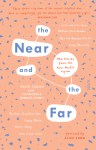
Anthologies, almost by definition, have a unifying theme, something that explains their existence. There are the “best of” type, as in best of a year or of a genre, for example. There are those drawn from a prize, such as The trouble with flying, and other stories (my review) from the Margaret River Short Story competition. And of course there are subject-oriented ones like Rebellious daughters (my review) or Australian love stories (my review). David Carlin and Francesca Rendle-Short’s anthology, The near and the far, is another type. Its origin is a project called WrICE (Writers Immersion and Cultural Exchange) which, the editors tell us, is “a program of reciprocal residences and cultural events focused on writers and writing from Australia and the Asia-Pacific”. The residencies and events occurred in such places as Singapore, Malaysia, Vietnam and Australia. The aim was to enable Asia-Pacific writers to immerse themselves in the face-to-face exchange of ideas and collaborative experiences, in order to build cultural understanding and find, as one participant says, “sustainable ways of speaking amongst ourselves and relating to one another as cultural practitioners”.
The result is that the stories – and even the forms of the pieces – are varied. The book has been thoughtfully presented. There’s a foreword by Alice Pung and an introduction by the editors at the beginning, and some notes on WrICE and a list of contributors with mini-bios at the back. The stories themselves are organised into three groups – The Near, The Far, and The Near and The Far – though I’d probably have to think hard about why certain stories have been allocated their particular group. There are 21 stories, 15 of which, if I’ve counted correctly, are by women. There’s a lovely extra touch, which is that at the end of each story is an author’s reflection – on the writing process, the goals and/or the experience of WrICE. They were often illuminating.
Before we get to the stories – and of course I’m only going to be able to focus on a few – I’d like to share some comments from the foreword and introduction. In her foreword, Pung calls the book a travel anthology, and I suppose it is, in a sense, though I may not have described it that way if I hadn’t read her foreword! She says
The near and the far is one of those rare travel anthologies, combining fiction with poetry and longform essays, each piece revealing a real insider’s experience of inhabiting a different world without exoticising the foreign. Each story has a centre – whether philosophical, moral, or political – and yet none of them are didactic.
The editors talk of how our different colonial experiences had “left long shadows across our imaginations”. They refer particularly to “settler” Australians who live in what was seen as an “outpost” – further than the “Far East” – and yet who still tend to look to Europe and America for our main cultural input. “The far feels near”, they write, “and the near feels far away”. That makes a lot of sense – to me.
You think you know (Omar Musa)
Now the stories. They come from, as you’d expect, a diverse group of writers, from Australia and Vietnam, from the Philippines and America, and from many places in between. Some I knew – like Melissa Lucashenko, Omar Musa, Cate Kennedy, and of course Francesca Rendle-Short – but most were new to me. Many of the pieces explore in some way the idea of what we know and don’t know. They may be about ignoring what we know because it’s too painful, or because we fear the rejection of others. They may be about the disconnect between what we assume and what we find. Or they may simply be about facing something new or unexpected.
I loved that indigenous Australian writer Melissa Lucashenko’s story, “Dreamers”, was chosen to start the anthology. Set in rural Australia in 1969, two years after the famous referendum, it’s a beautifully structured and told story about the relationship that develops between indigenous woman and her non-indigenous employers. It’s a story about love, loyalty and tolerance, but manages to quietly reference, without being polemical, social change issues such as environmental protest and the stolen generations.
Not surprisingly, the theme of accepting – welcoming, hopefully – diversity runs through the book. In “My two mothers”, Singaporean Suchen Christine Lim shares a story about a young adopted girl’s shame at having two mothers, her unwillingness to appreciate their love and tender care, and her eventual recognition of what they had given her.
If you have ever read or heard Australian-Malaysian performance poet Omar Musa, you won’t be surprised to hear that diversity underpins his contribution, “You think you know”. In this first-person story he explores “the deeply troubling issues” regarding sexual identity in Malaysia through his narrator’s (presumably himself) friendship with a young Malaysian man met on a bus. It’s a quiet, reflective, wrenching story – quite different from the higher octane wordplay of his performance poetry.
A story using a completely different tone and pace is Chinese-Indonesian, now American writer Xu Xi’s “BG: The significant years”. In a time when scientists and historians argue about dating nomenclature – BCE/CE anyone? – Xu Xi has come up with her own, BG or Before Google! Google (created 19 August 2004, if you want to know) provides for her a significant life marker. In short chronological sections, starting with “BG 43 (circa 1961 to ’62)”, she chronicles her life – in a lightly satirical tone – from applying to go to university in America, to becoming a US citizen, and getting a job and then losing it in the 1986 stock market crash. Her commentary on life in the US is enlightening. Joining the unemployment queue meant, she writes, that “for once I wasn’t a minority, because the minority was the majority in that government office”! Telling eh?
There are many more stories I’d like to share: Laurel Fantauzzo’s second-person-told story, Some Hints About Travelling to the Country Your Family Departed, about going back to the place (in her case the Philippines) a parent came from; Francesca Rendle-Short’s “1:25,000” on the geologies of time, on memories, regrets and saying “no”; and Maxine Beneba Clark’s short, painful, 9/11-inspired “Aviation” in which accepting “other” is put to the test.
And then there’s David Carlin’s gender-bending, mind-bending “Unmade in Bangkok”. Inspired by Thailand’s ladyboys, he explores ideas about identity and gender. The story is told in ten sections, mostly in third person but slipping between male and female personas. In section four, “she” considers:
Women make themselves up, men do not. This is curious when she thinks about it. To be a woman, in this culture, is to be a creature dipped in fiction, whereas to be a man is to be altogether real or at least natural, unconstructed.
So she dresses up and considers: “What is she becoming? Ever more fictional? A character in drag?” I enjoyed how Carlin explored gender identity, using broader ideas about “fiction”. “Some fictions trap us”, he writes, “but other fictions free us”. For ladyboys the implications are serious. It’s a complex story which covers a lot of ground. I need to read it again.
I titled this section “you think you know” because in all the stories, the writers are seeking to know, not so life can be assured, or complete, but in the spirit of understanding, of growing. Alvin Pang, in the note to his story “The Illoi of Kantimeral”, discusses the invented language he used:
Their precise meanings may or may not be immediately discernible from context, but neither is the experience of engagement, negotiation, resistance, and mystery within the Asia-Pacific itself as straightforward as we might wish the world to be. There is humility and pleasure in earnest encounter, and in listening out for the inherent humanity of what we do not fully recognise.
Perfect! This is a book which confronts us with many ways of seeing and experiencing. Different stories will appeal to different readers, depending on experiences, but I hope I’ve given you a taste. Books like this deserve a bigger audience than they often get.

David Carlin and Francesca Rendle-Short (eds),
The near and the far: New stories from the Asia-Pacific region
Melbourne: Scribe, 2016
288pp.
ISBN: 9781925321562
(Review copy courtesy Scribe)







 Whispering Gums