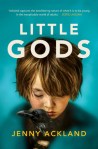
 The universe is telling me something. Jenny Ackland’s Little gods is the second novel I’ve read in a few months that is set in the Mallee region of northwestern Victoria, the other being Charlie Archbold’s Mallee boys (my review). Interestingly, both are coming-of-age novels, both involve farms, and both have a death at the centre. However, this is where the similarity ends, because Ackland’s protagonist, Olive, is female – and younger than Archbold’s – and Ackland’s death is a mystery to Olive, whereas in Archbold’s novel it’s the mother’s death which precipitates the narrative.
There’s another difference too, and it’s that Mallee boys slots into YA fiction*, albeit also a good read for adults, whereas Ackland’s book, while seen primarily through Olive’s point of view, is adult fiction. This is because although it’s about Olive’s journey, the main focus is on the way children see adults and the way adults completely miss what is going on in children’s minds, on the decisions adults make about what to tell children and how children respond to what they sense isn’t being told.
So, the story. Set in the 1980s, it’s about Olive and her extended family in which two of the sisters, Audra and Rue, had married two brothers, Bruce and William, with a third sister and brother on each side left over. Thistle, the oldest (and left-over sister), lives with Rue and William and their three children, Sebastian, Archie and Mandy, on the sisters’ family farm. Audra and Bruce, with Olive, live close by in town. The action is split between the farm, which Olive’s family visits regularly, and Olive’s home in the neighbouring town.
The novel starts with a little un-named “prologue” which tells us that the book is about the year Olive turned 12, when she was “trapped in the savage act of growing up”. It’s about a time when, uncertain about what was going on, she reached back into her memory, only to find that memory can be deceptive. It all could have ended up far worse than it did. (We know it didn’t because here she is at the beginning, alive, apparently well, but contemplative!)
She is fierce
Anyhow, from this point, the novel proper starts with Olive knowing that the local community thinks her family – the whole family, I mean – “odd”, which entrenches her sense of outsiderness but also fires her sense of agency. The novel starts slowly, with the plot not picking up until we are well in. Before that, Olivia’s character and the family’s complicated relationships, particularly between the sisters, are carefully developed. Olive, we soon learn, is independent and, outwardly at least, sure of herself. She’s “fierce”, as the epigraph from Shakespeare warns us, and bosses her best friend, Peter, and her cousins around. But she is needy too. And for this there is Grace, a wild raven who provides her with the affection that she doesn’t get from her stylish but withdrawn mother. For all her faults, we like her.
And so, here’s Olive, on the cusp of adulthood, wanting to understand the world. She knows which adults in her life will nurture her, mainly Rue, and which are likely to answer her questions, and that’s mostly Thistle. However, Thistle has her own issues and sees life through a particular prism which is not always useful to Olive. It all starts to unravel when Olive finds pictures of her parents and Thistle all holding a baby which is not her. Through insistent questioning, she discovers that the baby had been her sister and had drowned. But, with no more details forthcoming, she decides the baby had been murdered and that she knows who is responsible. She determines on revenge, but needs help. Meanwhile, Thistle is working through her own lost baby problem … You could see this novel as a modern take on the Aussie “lost child” motif.
At times, as the narrative plays out, we are called on to suspend disbelief, but never quite beyond the point of no return. Some shocking things happen but others are diverted, so that by the end Olive has found some answers and also learnt some valuable lessons.
There are several joys in reading this book, one of which is the writing. Ackland’s descriptions of the Mallee, though brief, are evocative:
Sunday morning and the sun rose on the bleached Mallee landscape and lit the distressed greens and greys.
Even lovelier are the ways she captures people, their thoughts and relationships, particularly Olive’s of course:
Olive crept back to the bathroom. It was a startling thing to know that Cleg could be tender with Thistle the sister he seemed to like the least. Standing in front of the mirror it was as if there was an opening inside her mind. A plant, a tall one, with a green stem that was thick all the way around. At the top of it, a tightly bunched bloom, an enormous head of closed, wrapped petals. She didn’t know the colour of the flower yet but it was bright as if illuminated by special lights, and inside the heard of the flower was a quavering, shimmering sensation of coming movement and understanding.
Perfect.
Water also features throughout the novel, which is appropriate given the drowning, but it is also presented as a positive thing. For Olive, water provides respite. At the pool, “her body feels real in the water”, and, submerging herself in the dam she stays “under just to be in that cool distant place for a while longer.” The novel, in fact, opens and closes with references to Olive jumping off the high board – an effective image for the gutsy way she approached life, though the suggestion in the prologue is that having grown up she “was no longer a girl bombing off the high board.”
So, the book is about the challenges of growing up. Olive, the child, sees the world simplistically. People are “little gods” who “have power to do things, like make baddies pay”. She is shocked when lawyer Cleg sees it a little differently, is not so categorical about “bad people”. Ackland explores the clash between child and adult world views by teasing out responses to a family tragedy. As the secret comes out, as the truth is told, some family wounds heal and some lessons are learnt – but at what cost? I thoroughly enjoyed this book.
Oh, and as for what the universe is telling me … it’s that I need to make good my plan of some years’ standing to visit the Mallee!
Lisa (ANZLitLovers) also enjoyed this book.
 Jenny Ackland
Little gods
Sydney: Allen & Unwin, 2018
345pp.
ISBN: 9781760297114
(Review copy courtesy Allen & Unwin)
* Mallee boys has just been commended as an Honour Book in the Children’s Book Council of Australia Book of the Year for Older Readers Award





 Whispering Gums