Irma Gold (ed), The invisible thread (Review)

The invisible thread, by Irma Gold

Cover (Courtesy: Irma Gold and Halstead Press)

I even get nervous when I open a book, you know, for the first time. It’s the same thing, isn’t it. You never know what you’ll find, do you? Each person, each book, is like a new world … (from Mark Henshaw’s Out of the line of fire, in The invisible thread)

At last, you may be thinking, she’s going to review the whole book. At least, I hope that’s what you’re thinking, because this book deserves a dedicated review rather than the scattered posts I’ve done to date. The book I’m talking about is, of course, Canberra’s centenary anthology The invisible thread.

The aim of the anthology is a little different to that of Meanjin‘s special Canberra issue, which I recently reviewed. While its editor, Sanders, wanted to offer “a taste of Canberra”, Gold’s aim was to present “literature of excellence” from writers, past and present, who have had a significant relationship with Canberra. For her, Canberra is “not the headline act” but provides “the invisible thread” linking the writers to each other and to the rest of Australia. In her foreword, Robyn Archer, the centenary’s Creative Director, puts it this way:

Many of the pieces are not about Canberra, but they reveal a diversity of interest and style among writers in this region, and thus reflect the unique nature of a city which is located rurally, but positioned nationally.

In other words, The invisible thread is not a parochial apologia for Canberra but an intelligent presentation of the city’s and thence the nation’s cultural, political, social and interpersonal life. The nation’s concerns are Canberra’s concerns – at both the macro (war, indigenous-non indigenous relationships, the environment, and so on) and the micro (birth, marriage, death, and everything in between) levels. You would be hard-pressed as an Australian, or even as an international citizen, not to find something in this book to interest and move you.

Reviewing an anthology is tricky though, and this is particularly so with The invisible thread because it comprises highly diverse pieces – poems, short stories, essays, and excerpts of novels and non-fiction works.  The pieces are not grouped by form, like the Meanjin issue, but in a more organic way intended to take us on a journey in which, editor Irma Gold writes in her Preface, “each work is allowed to converse with those beside it”. And so, in preparation for my reading group’s discussion, I went back to the start and read the book in the order presented. What a pleasure that turned out to be because I did indeed discover added meanings that weren’t necessarily apparent from the dipping-in-and-out approach I had been using.

Let me give an example. The anthology opens with an excerpt from war historian CEW Bean’s Anzac to Amiens, itself a condensation of his Official history of the first world war. I knew of Bean but had not read his history. I was surprised by his use of imagery, such as this:

And out on every beautiful fresh morning of spring come the butterflies of modern warfare – two or three of our own planes, low down …

After another war-related non-fiction piece, the anthology segues to a short story (“The Good Shoppers”) by Lesley Lebkowicz, which is about her refugee parents, now old and shopping in the supermarket but still affected by the Holocaust, and then to two poems about age (Judith Wright‘s “Counting in sevens” and AD Hope‘s “Meditation on a Bone”). The “conversation” encouraged by this sequence is complex and, I expect, different for each reader. For me, the juxtaposition suggests an irony: “war” steals “age” from many of the youths sent to it. This is just one small example of the sorts of “conversations” Gold has set up in the anthology. Considering them as I read the book added another layer to an enjoyable reading experience. I like reading that challenges my brain on multiple levels.

Compiling an anthology involves, obviously, selecting what to include. It must be hard enough to choose poems, short stories and essays, but what about writers who are best (or only) known for novels or non-fiction books? They can only be represented through excerpts, but there is the risk that these cut-down pieces will be less satisfying to read. Alternatively, of course, they might encourage us to locate the full work and read it. The Bean example above is an excerpt. There are many others, including those from Kate Grenville’s Sarah Thornhill, Jack Heath‘s Third transmission, and Roger McDonald‘s When colts ran. I have noted many to follow-up, which tells you how I found the excerpts overall!

A trickier challenge, probably, is that of representing diversity – not just regarding chronology, subject-matter, tone, and form or genre, but in terms of the writers themselves, such as their gender, or whether they are of indigenous, migrant or other minority background. What emphasis should be given to these in the selection process? And, anyhow, should the writer’s background be highlighted? I’m not sure what Gold and her committee decided about this but the anthology, while primarily representative of the majority culture, is not exclusively so and probably reflects the writing community it drew from.

This is not the last you’ll hear from me on the anthology. It is much too delicious, much too rich, much too full of “luminous moments”* for me not to continue to draw from it. I’m possibly – probably? – biased, but I believe this book should be on every Australian bookshelf and, without disrespecting Irma Gold’s hard work, I’d say it doesn’t really matter whether you read it in its original order or just dip into it as the spirit moves you. What would matter would be to not read any of  it at all.

Irma Gold (ed)
The invisible thread: One hundred years of words
Braddon: Halstead Press, 2012
256pp.
ISBN: 9781920831967

* from Marion Halligan’s essay “Luminous moments” which concludes the book.
Anita Heiss, Paris dreaming (Review)

Anita Heiss Paris Dreaming

Paris Dreaming (used by permission of The Random House Group Ltd)

Late last year I wrote a post about the inaugural Canberra Readers’ Festival. One of the speakers was indigenous Australian author, academic and activist, Anita Heiss. I wrote then that I bought one of her books. It was her fourth (I think) chick lit novel, Paris dreaming. This might surprise regular readers here, as chick lit is not really my sort of thing, however …

There are reasons why I was happy to read this book. First was that my reading group chose it as part of our focus on books featuring Canberra for our city’s centenary year. Yes, I know, it’s called Paris dreaming, but the heroine starts in Canberra and Canberra is mentioned (not always positively I must say) throughout the book. The other reason is the more significant one, though, and that is Heiss’s reason for writing the book. I said in the first paragraph that she is an activist and her chick lit books, surprising though it may sound, are part of her activism. In fact, I think pretty much everything Heiss does has an activist element. In her address at the Canberra Readers’ Festival she described herself, an educated indigenous Australian, as in the top 1% of the bottom 2.5% of Australia. She feels, she said, a responsibility to put her people on the “Australian identity radar”.

Does this book do it, and if so how? Well, one of her points is that 30% or more of indigenous Australians are urban and this book, as its genre suggests, is about young urban indigenous women. Anita Heiss manages I think (though I’m not the target demographic so can’t be sure) to present characters that both young indigenous and non-indigenous women can relate to. Our heroine Libby and her friends are upwardly mobile young professionals. They care about their work; they love fashion, drink and food (this is chick lit remember!); and they wonder how to marry (ha!) their career goals and romance.

Indigenous design vase, on hall table, Governm...

Indigenous art vase, Government House, Canberra

So what’s the plot (besides the obvious chick lit formula which this book certainly follows)? At the start of the novel  30-year-old Libby, manager of the education program at the National Aboriginal Gallery, is on a man-fast. She’s been bitten one too many times and has sworn off men, much to the dismay of her tiddas (her “sisters”). She is, though, keen to develop her career and wants a new challenge – all part of the chick lit formula – and so pitches a proposal to her boss that she mount an exhibition of indigenous Australian art at the Musee du Quai Branly in Paris. Of course, her boss approves and off she goes to Paris where, following the formula, she falls for hunky, sexy Mr Wrong while Mr Right watches on, spurned (and spurned and spurned). But, of course, I don’t need to tell you how it comes out in the end do I? This is not subversive chick lit because that would not serve Heiss’s purpose …

Did I enjoy it? Yes, but not so much as a piece of literature because my reading interests lie elsewhere, but as a work written by a savvy writer with a political purpose. This purpose is not simply to show that young, urban, professional indigenous Australians exist but, as she also said in her address, to create the sort of world she’d like to live in, a world where indigenous Australians are an accepted and respected part of Australian society, not problems and not invisible. She is therefore unashamed about promoting indigenous Australian creators. She names many of them – artists, writers, filmmakers – and discusses some of their work, educating her readers as she goes. Most of the people, works and places she mentions are real but there’s an aspirational element too. The National Aboriginal Gallery does not exist but she presents it as a significant player in the Canberra cultural institution scene. Good for her!

I’ll probably not read another of Heiss’s choc lit (as she, tongue in cheek, calls it) books, but I’m glad to have read this one – and I’ll certainly look out for works by her in other genres (including her memoir Am I black enough for you?). Heiss is a woman to watch.

Anita Heiss
Paris dreaming
Sydney: Bantam, 2011
313pp.
ISBN: 9781741668933

Frank Moorhouse, Cold light (Review)

As I reached around the two-thirds point in Frank Moorhouse‘s Cold light, the third tome in his Edith trilogy, I wanted to cry out “Enough already”! It’s not that I wasn’t enjoying (most of) it, and it’s not that it’s a bad book, but it does go on – and on. It’s a book, I think, that could do with a severe prune. But perhaps that’s just li’l ol’ novella loving me talking!

For those not familiar with Frank Moorhouse’s Edith Trilogy, a little summation. The first book, Grand days (1993) sees Edith Campbell Berry join the League of Nations as an enthusiastic, idealistic ingénue. She’s “plucky”, as most reviewers point out, which she needs to be because she wants to change the world. It was, as I recollect, a thoroughly engrossing  a thoughtful insight into Europe at that time. The second book, Dark palace (2000), I haven’t read, though it is in the TBR. Embarrassing eh? It won the Miles Franklin Award after Grand days had been controversially rejected for not being, according to the judges’ interpretation of the award conditions, “Australian enough”. Dark palace chronicles the failure of the League and, with it, of the ideal of internationalism. This ideal, or at least her desire to make the world better, is something that Edith still hankers for at the start of Cold light. Unlike the first two novels, which are set in Europe, Cold light is, until the last few chapters, set in Canberra. That of course gave it added interest for me.

The three novels cover the middle half of the twentieth century – from the early 1920s to the early 1970s – with Cold light “doing” 1950 to 1973. Edith must be in her 40s when the novel opens and is well into her 60s by its close. This can be a challenging time of life for a woman and Frank Moorhouse’s exploration of the issues women face – biologically, socially, and intellectually – is sensitively and authentically done. Edith’s challenges are compounded by the fact that she wants to work – in the public sphere – but in 1950s Australia married women, as she was, were not entitled to work for the government. Edith does manage to get around this in various ways, mostly by being employed under honorariums and the like. Not very satisfactory, but better than nothing.

What I most enjoyed about the novel was its coverage of some of the big issues of its time, particularly in relation to Australia: the planning of Canberra which was still in its infancy, the Cold War and the attempts to ban the Communist Party of Australia, and nuclear energy. One way or another, Edith becomes involved in each of these issues and serves as our guide. I particularly liked the discussions about Canberra and what sort of city it should be. Early in the novel it is described as a “toy city”, a “make-believe city”, an “unfinished city”, “a city that is not a city”. Some of those criticisms still hang over it now, though less so I hope. Certainly, Edith begins to warm to it and enthusiastically works for a few years with the Town Planning section. She initially envisions it as a place of “communal memory”, as “the living memory of the nation”. Fifteen years on, as the will-we-won’t-we-will-we-won’t-we artificial lake is finally “opened”, her thinking has moved on. She would like to see Canberra as a “social laboratory”, which would “try out all sorts of ideas for good living”, and as a “place for citizens to ask questions”. Moorhouse’s thorough research into Canberra’s planning shows through here, as it does in the other topics he covers in the book.

I also enjoyed much of his characterisation. The novel has a large cast of characters, so his list of “Who is who in the book” at the end, with the “real” people asterisked, is very useful. But, beware, because if you read Edith’s entry, you’ll find a potential spoiler. The best drawn characters are the fictional ones: Edith, her cross-dressing “lavender husband” Ambrose, and to a less extent her brother and Communist Party official Frederick, and his girl-friend-partner, Janice, for whom Edith has some confused feelings.

Edith is, of course, the focal character. The novel’s voice is third person subjective, that is, it is told through Edith’s eyes, her perspective. And Moorhouse does it well. Edith’s a living, breathing, believable human being – but there’s just too much of her. We spend too long with her questioning and ruminating on just about everything she confronts. She ponders, and wonders, she asks herself multiple questions – and it is all just too much. And yet, and I know I’m being contradictory, she’s an engaging character. But not “plucky”. Surely that’s a bit twee for a professional woman? I’d use the words resourceful and confident. Even when she doesn’t feel confident, she knows how to put on a show. Despite this, by the book’s end, she wonders if she’s “bungled” her life. She wonders, in fact, for many pages, and asks many questions (have I said that before?) in the process. She tries to recast her life as “a journey” rather than as a failure to achieve goals, which seems fair enough to me. She’s most concerned, at this point, with her personal rather than her professional life, and the fact that she’s had three husbands. Alluding to Othello, she concludes:

She had loved not too wisely, nor too well. But she had tried with all her might.

She sure had.

I also enjoyed the themes of the novel. There are many of them, in fact, but the two that interested me most are the failure of idealism and the challenges of aging. As the book draws to a close she wonders:

Perhaps she was wrong to assume that evolution was moving towards some humanistic paradise.

But she still believes that

Safety lay in candour – the open personality in an open society.

And I love her for it.

Finally, I liked the fact that this novel of uncertainties has a very certain end. Moorhouse was clearly determined to end with a bang, not a whimper. Overall though, I would have like some zing, some wit, or alternatively, something to wrench my guts. Instead, it was just a little too laboured for me to feel the “wow” that I’d hoped for. A good read? Yes. An interesting read? Definitely. But a great read? Not quite.

For a thorough and totally positive review, check out Lisa’s at ANZLitLovers.

Frank Moorhouse
Cold light
North Sydney: Vintage Books, 2011
719pp.
ISBN: 9781741661262

Happy 200th birthday to Pride and prejudice

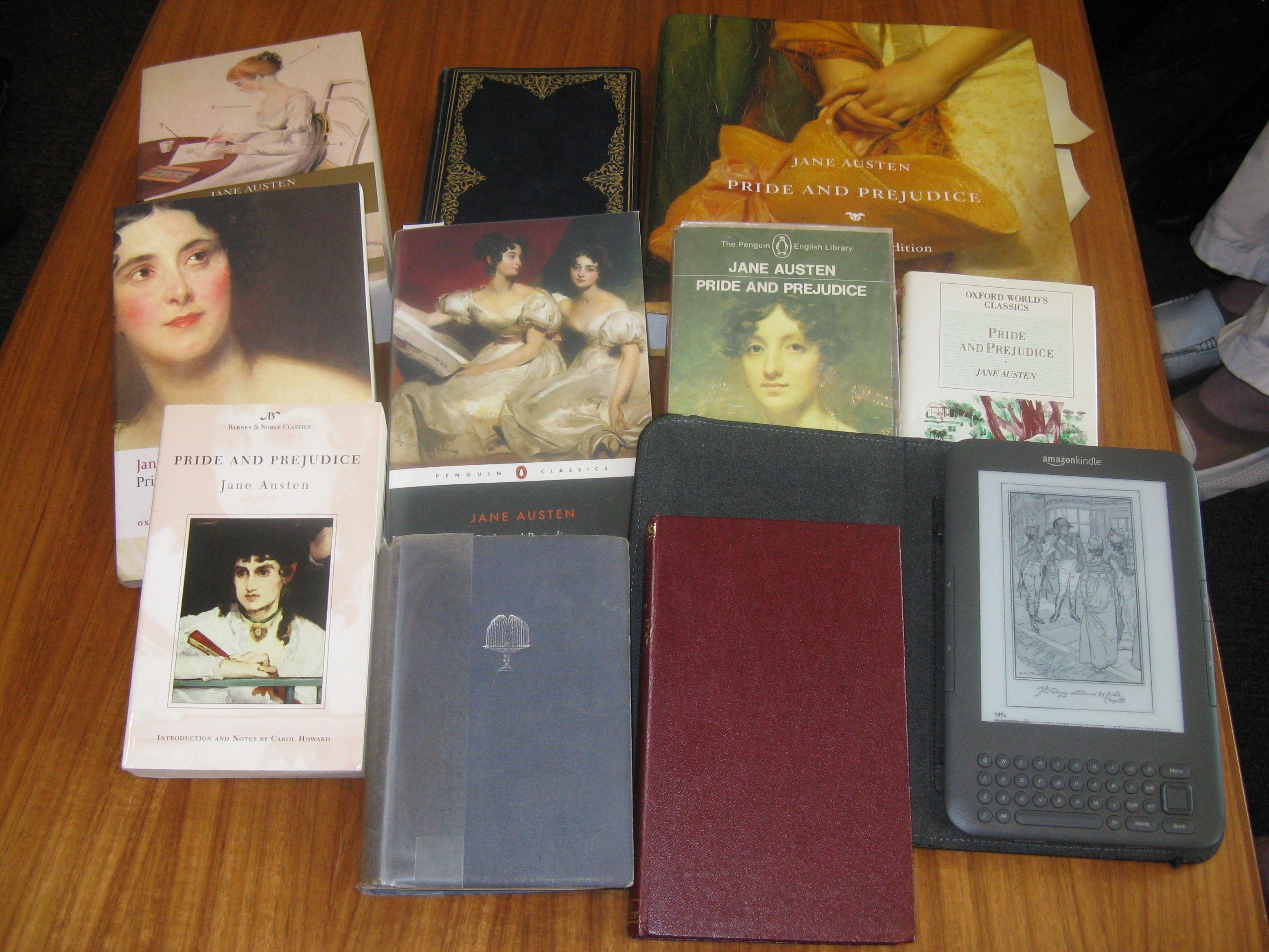
Pride and prejudice book covers

Just a few editions of Pride and Prejudice

It is a truth … no, I can’t go there but, just in case you haven’t caught up with the news, I’m here to tell you that today, January 28, is the 200th anniversary of Jane Austen’s most popular novel, Pride and prejudice.  And so I’ve decided to give Monday Musings a break this week and talk a little about this book. But where to start? What can I say that hasn’t already been said?

How about what the book means to me. It is the book that turned me from being a book reader to a literature lover. I hope that doesn’t sound snooty but what I mean is that Pride and prejudice is the first book to teach me that there can be more to reading books than quick page-turning to find out what happens in the story. There’s nothing wrong with page-turners – they serve a very important purpose in helping us to escape the daily grind – but books can offer a lot more if we want something else from the time we spend reading. They help us better understand the human condition, they can challenge our intellect, and they can appeal aesthetically.

Pride and prejudice, like all of Jane Austen’s novels, satisfies the first of these in spades. Through her characters, Austen demonstrates an in-depth knowledge of human nature. She shows us kindness, compassion, envy, selfishness, stupidity, thoughtlessness, integrity, anger, pride, prejudice and more, including, though Charlotte Bronte (who once wrote that “she ruffles her reader by nothing vehement”) would not agree, passion. Mr Darcy’s ghastly “in vain have I struggled” proposal is nothing if not passionate. I for one don’t need ripped bodices to feel the passion!

Regarding challenging our intellect, one of the delights of reading Austen is the mind games she plays with us – the irony, the wit, keep us on our toes, encouraging us to see the meanings beneath the surface. And, if you read for plot, try reading an Austen novel a second time and you will see how perfectly she plots. Rereading books like Pride and prejudice brings so many pleasures. It’s like meeting an old friend and learning new things about her that enrich your relationship and remind you why she became your friend in the first place.

The aesthetic pleasures are something else – and I fear I’m on thin ground here because I’m probably using the term quite differently to the way philosophers and literary theorists might use it, but it’s the best I can come up with. What I mean is appreciating the novel as a work of art, regardless of its content. Readers from the 20th and 21st centuries can, I think, find Austen’s “art” a little quaint, if not downright dated, but in fact she was innovative. Susannah Fullerton in her latest book, Happily ever after: Celebrating Jane Austen’s ‘Pride and prejudice’, spends a few pages on this. Austen’s main innovation lies in her use of “free indirect discourse” (FID) or “free indirect speech”. She was not the first writer to use it, but was, says Fullerton, “the first English novelist to use FID consistently and extensively”. It is used in third person narratives and involves “hearing” what a character feels or thinks without the use of dialog and not via authorial interaction or the omnipotent narrator. We feel, in other words, that we are in the character’s head rather than being “told” what s/he feels. Austen slips between third-person and this interior mode regularly in her novels. It allows us, in Pride and prejudice, for example, to feel right along with Elizabeth – but the advantage of this technique is that it can shift from character to character in between omnipotent third-person narration. These and the rest of Jane Austen’s grab bag of literary techniques are another reason why she’s such a pleasure to read – and why her books are just plain beautiful.

In other words, Pride and prejudice is the real deal – great story and characters, along with food for the mind, the intellect and the heart. No wonder it has never been out of print.

Highlights of 2012: Blogging and the Reading Life

It’s been a busy year chez Gums and so I’ve decided to write two highlight posts – one listing some favourite reads, and this one for other blogging and reading highlights. Here, in no particular order, they are …

The challenge to do when you don’t do challenges

I decided when I started blogging that I wouldn’t take part in challenges, much as some intrigued me. I wanted to be mistress of my own reading choices and not get drawn into “having” to read something to comply with a challenge. But then, along came the Australian Women Writers Challenge, and I couldn’t say no. It’s a bit of a cheat, really, to say I’ve engaged in a challenge because reading Australian women writers is not a challenge for me. It’s what I do anyhow, it’s my reading preference. And so, readers, I completed the challenge – and will take part again next year. Look for tomorrow’s Monday Musings for my challenge wrap-up …

Other blogging activities

This year I took part in two other blogger-initiated literary activities. One was the Shadow Man Asian Literary Prize team (which actually started in late 2011 but ran through the first quarter of 2012). With a team of 6 (Lisa, Fay , Matt, Stu and Mark), we reviewed the full longlist and chose our winning book, Kyung-Sook Shin’s Please look after mother, which was also chosen by the official judges. It was a great experience, and some of the books I read will be among this year’s reading highlights. However, I have not joined the team this year because I knew I wouldn’t be able to keep up. I’m missing reading some great books though, I know.

The other activity was the Bah-Humbook virtual gift exchange instigated by Guy Savage and Emma. My exchange partner was Stu (see Shadow Man Asian team above!). Stu chose two fascinating sounding books for me, so you can expect reviews of these in the coming months!

Blogging highlights

It has been a pretty exciting year for Whispering Gums blog. Firstly, I finally decided in October to buy my own domain name so that I’m now the proud owner of “whisperinggums.com”. It doesn’t mean much really – except that Google “lost” me for a few months – but it somehow feels more authentic. I’m still hosted by WordPress, giving me, for my needs, the best of both worlds.

Around the same time, an excerpt of my review of Gillian Mears‘ wonderful novel Foals’ bread was included, along with those from another blog (Reading Matters) and several newspaper/magazine reviewers, in the front pages of the “C” paperback edition of the novel.

And then, in December, my blog was added to the Pandora web archive by the National Library of Australia, meaning that, if I ever disappear, my blog will be available online in perpetuity (or until a librarian decides to deselect it!).

Literary events

I attended a number of literary events this year … though never as many as I’d like to! The highlight was probably the inaugural Canberra Readers’ Festival. With writers like Kate Grenville, Anita Heiss and Frank Moorhouse speaking, it had to be a winner, and it was. We Canberrans hope it continues next year.

I also attended the Prime Ministers’ Literary Prize post-announcement panel, and the launches of The invisible thread anthology, Nigel Featherstone’s novella I’m ready now and Suzanne Edgar’s poetry collection Love procession.

Reading goals

This heading is a bit of a misnomer, as I don’t set formal reading goals. However, I do have in my mind works and authors I’d like to read, and this year I achieved an important one, Gerald Murnane. He’s been on the Australian literary scene for a few decades but I had never managed to read him until now. And why now? Because of Text Publishing’s new Text Classics series – the publication of which is another highlight of my reading year. Text has made available, at a good price, a wonderful and diverse collection of Australian classics. I’m glad I finally met this goal, and look forward to more Murnane in my reading future.

Red Dog

I wrote a post in September about the number of ways people were reaching my blog by asking about the film Red Dog, particularly by asking whether Red Dog dies in the movie. Three months later – and some sixteen months after my review – my Red Dog post is still in my top five posts for the year. That movie seems to have really hit a chord. This doesn’t mean I am now going to tell you the answer, but I’m sorry to tell you that Koko, who played Red Dog in the movie, died this month. He was only 7 and had, apparently, won awards for his role. I didn’t even know there were awards for animal stars but apparently there are. All I can say is, Vale Red Dog, oops, I mean Vale Koko!

And that’s about it from me for my blogging/reading life highlights of the year. I’d love to hear if you have any highlights of the literary or blogging kind that you’d like to share …

Gerald Murnane, The plains (Review)

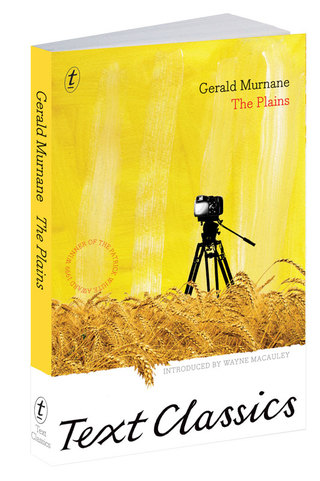
Gerald Murnane, The Plains, bookcover

Bookcover (Courtesy: Text Publishing)

Wayne Macauley, he of the Most Underrated Book Award fame, wrote in his introduction to my edition of Gerald Murnane‘s The plains that “you might not know where Murnane is taking you but you can’t help being taken”. That’s a perfect description of my experience of reading this now classic novella. It was like confronting a chimera – the lower case one, not the upper case – or, perhaps, a mirage. The more I read and felt I was getting close, the more it seemed to slip from my grasp, but it was worth the ride.

The plains was first published in 1982, which is, really, a generation ago. Australia had a conservative government. We still suffered from cultural cringe and also still felt that the outback defined us. All this may help explain the novel, but then again, it may not. However, as paradoxes and contradictions are part of the novel’s style, I make no apologies for that statement.

I’m not going to try to describe the plot, because it barely has one. It also has no named characters. However, it does have a loose sort of story, which revolves around the narrator who, at the start of the novel, is a young man who journeys to “the plains” in order to make a film. It doesn’t really spoil the non-existent plot to say he never does make the film. He does, however, acquire a patron – one of the wealthy landowners – who supports him in his endeavour over the next couple of decades. It is probably one of Murnane’s little ironies that our filmmaker spends more time writing. He says near the end:

For these men were confident that the more I strove to depict even one distinctive landscape – one arrangement of light and surfaces to suggest a moment on some plain I was sure of – the more I would lose myself in the manifold ways of words with no known plains behind them.

Hang onto that idea of sureness or certainty.

The book has a mythic feel to it, partly because of the lack of character names and the vagueness regarding place – we are somewhere in “Inner Australia” – and partly because of the philosophical, though by no means dry, tone. In fact, rather than being dry, the novel is rather humorous, if you are open to it. Some of this humour comes from a sense of the absurd that accompanies the novel, some from actual scenes, and some from the often paradoxical mind-bending ideas explored.

So, what is the novel about? Well, there’s the challenge, but I’ll start with the epigraph which comes from Australian explorer Thomas Mitchell‘s Three expeditions into the interior of eastern Australia, “We had at length discovered a country ready for the immediate reception of civilised man …”. Bound up in this epigraph are three notions – “interior”, “country” and “civilised”. These, in their multiple meanings, underpin the novel.

Take “interior”. Our narrator’s film is to be called The Interior. It is about “the interior” of the country, the plains, but it is also about the interior, the self, and how we define ourselves. While there are no named characters, there are people on the plains and there’s a sense of sophisticated thinking going on. Some plainspeople want to define the plains – their country, the interior – while others prefer to see them almost as undefinable, or “boundless”, as extending beyond what they can see or know. The plainspeople are “civilised” in the sense that they have their own artists, writers, philosophers, but it is hard for we readers to grasp just what this “civilisation” does for them. Is it a positive force? Does it make life better? “Civilised”, of course, has multiple meanings and as we read the novel we wonder just what sort of civilisation has ensconced itself on the plains.

These concepts frame the big picture but, as I was reading, I was confronted by idea after idea. My notes are peppered with jottings such as “tyranny of distance” and boundless landscapes; cultural cringe; exploration and yearning; portrait of the artist; time; history and its arbitrariness; illusion versus reality. These, and the myriad other ideas thrown up at us, are all worthy of discussion but if I engaged with them all my post would end up being longer than the novella, so I’ll just look at the issue of history, illusion and reality.

Towards the end of the novel we learn that our narrator’s patron likes to create “scenes”, something like living tableaux in which he assembles “men and women from the throng of guests in poses and attitudes of his own choosing and then taking photographs”. What is fascinating about this is the narrator’s ruminations on the later use of these “tedious tableaux” which have been created by a man who, in fact, admits he does not like “the art of photography”, doesn’t believe that photographs can represent the “visible world”. The landowner contrives the photos, placing people in groupings, asking them to look in certain directions. Our narrator says

There was no gross falsification of the events of the day. But all the collections of prints seemed meant to confuse, if not the few people who asked to ‘look at themselves’ afterwards, then perhaps the people who might come across the photographs years later, in their search for the earliest evidence that certain lives would proceed as they had in fact proceeded.

In other words, while the photos might document things that happened they don’t really represent the reality of the day, who spent time with whom, who was interested in whom and what. They might in fact give rise to a sense of certainty about life on the plains that is tenuous at best.

Much of the novel explores the idea of certainty and the sense that it is, perhaps, founded upon something very unstable. Murnane’s plainspeople tend to be more interested in possibilities rather than certainties. For them possibilities, once made concrete, are no longer of interest. It is in this vein that our narrator’s landowner suggests that darkness – which, when you think about it, represents infinite possibility – is the only reality.

The plains could be seen as the perfect novel for readers, because you can, within reason, pretty much make of it what you will. If this appeals to you, I recommend you read it. If it doesn’t, Murnane may not be the writer for you.

Lisa at ANZLitLovers, a Murnane fan, has reviewed The plains

Gerald Murnane
The plains
Melbourne: Text Publishing, 2012 (orig. published 1982)
174pp.
ISBN: 9781921922275

Elliot Perlman, The street sweeper (Review)

Elliot Perlman‘s latest novel, The street sweeper, is a complex book with a pretty simple message. It’s complex because of its multiple interconnecting storylines that move back and forth between World War II, the American Civil Rights era, and contemporary times. It has multiple themes, about which I’ll write further, but the underlying message is simply this: history is important. Related to this is the idea that all things are connected. Let me explain …

The original characters in the novel, those from whom the connections flow, are two lawyers, the Jewish Jake Zignelik and African-American William McCay. Both were active in civil rights in the 1960s. However, as the novel starts, Jake has been dead for some time, and William is in his 80s. The baton, in a way, has been passed to their sons, Charlie and Adam who are historians at Columbia University. It is around 2008, and both men have lost their way somewhat. Charlie is a successful academic, so successful that his administrative duties are not only tearing him away from his main love, research, but also from the important relationships in his life, those with his father, wife and teenage daughter. Adam’s problem is different. His career has stalled. He hasn’t published anything for so long that he will not get tenure – and Charlie, who has been his mentor, but who has let that relationship slide too, can’t help. Adam, believing it’s the honourable thing to do, breaks up with his long-standing girlfriend, Diana, on the basis that he’s unable to be the husband and father that he believes she wants.

None of these characters, though, is the street sweeper of the title, because there is another significant character, the one who opens the novel. This is Lamont Williams, an African-American who has just started work as a janitor at a cancer hospital in a pilot program for ex-convicts. He, like Adam, is close to 40 years old. Lamont, we soon learn, is a good man to whom bad things happen, just like the hero in Perlman’s first novel, Three dollars. He is, in fact, innocent of the crime that put him in jail but his colour and poverty meant he didn’t have a chance – just like the Jews in war-time Europe.

The novel focus primarily on these two men – Adam and Lamont – as they struggle to get their lives on track. Lamont’s story sees him getting to know hospital patient and Holocaust survivor Henryk Mandelbrot who tells Lamont over a period of nearly 6 months of his experience under Nazism, particularly in Auschwitz. Mandelbrot wants his story known, and insists that Lamont learns and remembers it. Meanwhile, Adam, initially reluctantly, looks into a research project suggested by Charlie’s father William, one that sees him also learning about the horrors of the Holocaust. As the novel progresses, and more characters – from the past and present – are introduced, the connections and links between people multiply, rather like a Dickensian novel. There is, though, a point to these connections. Early in the novel, Perlman writes that

you never know the connections between things, people, places, ideas. But there are connections.

And these connections, whether we know it or not, can direct the trajectory of our lives – as they do for the characters in The street sweeper. There is also a central ideological connection in the book, and this is that there are “parallels between the situation of blacks in the United States and the Jews in Germany”.

A major theme of the novel – one of Perlman’s pet themes in fact – is that of moral responsibility, of what makes a “good” person. As so often happens, those who have the least but, paradoxically, the most to lose, are quickest to take the moral path. Early in the novel, and four days into his 6 months probation, Lamont is accosted by Mandelbrot who asks a favour. This favour is something Lamont is not supposed to do – it’s not his job – but, seeing the old man’s distress, he risks losing his job to do the right, the moral, thing. Late in the novel, a professional woman who has nothing to lose but a bit of her time is asked to do a moral thing. She experiences a jolt when, after a passage of time, she realises that she’d been prevaricating about an issue of justice. Not all characters though come to this realisation regarding their moral duty.

I said in my opening paragraph that the underlying message of the novel is that history matters. This is conveyed throughout the book by discussions about history and the role of historians, by showing historians going about their business, by reference to the “long causal chain” and to the importance of remembering, and most of all, by the refrain, “tell everyone what happened here”. You won’t be surprised to know that I loved the fact that Perlman explicitly and implicitly explores the theory and practice of history here, but it deserves a post of its own so watch this space … I’ll simply say now that Perlman explains in his author’s note which characters are based on “real” historical figures, and he provides an extensive list of the sources he used.

The question I always ask when reading historical fiction is why has the author decided to tell this story from the past? In Perlman’s case the answers are obvious. First it’s the one made explicitly in the novel, and that is to “tell everyone what happened here”. Then there’s the more implicit one to do with why we need to know what happened, and that is to ensure that the horrors visited upon the Jews in the Holocaust and the African-Americans in the US don’t happen again. And finally it’s to remind us of our basic moral responsibility which is, as William says to his son, to “Do what’s right here, Charlie”.

I could pick some holes in the novel. It’s big and a little baggy around the edges. It can verge on didacticism at times. And, to make the necessary connections, Perlman relies a lot on coincidence, which could seem contrived if you haven’t bought into the story. But, here’s the thing. I have read many good, even excellent, books this year. However, The street sweeper, like Rohinton Mistry‘s A fine balance and Margaret Atwood‘s The handmaid’s tale, is one that will stay with me long after I’ve forgotten the name of the characters, long, even, after I’ve forgotten how the plot falls out. And that, for me, is the best sort of read.

Lisa of ANZLitLovers also liked this novel.

Elliot Perlman
The street sweeper
Kindle edition
Random House, 2011
ASIN: B005LV7O4S

Anna Funder, Stasiland (Review)

Anna Funder's Stasiland bookcover

Funder’s Stasiland (Courtesy: Text Publishing)

Anna Funder‘s Stasiland, which won the Samuel Johnson Prize for Non-Fiction, is one of those books that can be reviewed from multiple angles, and I know that when I get to the end of this review I’m going to be sorry about the angles I didn’t get to discuss. But, I can only do what I can do, eh?

I found it interesting to read this book immediately after another non-fiction book, Brenda Niall‘s biography True north, because the contrast clarified for me why I liked True north but loved Stasiland. To put it simply, True north is a well-written but pretty traditional biography, while Stasiland is what I’d call “literary non-fiction”. In other words, in Stasiland, Funder uses some of the literary techniques – relating to structure, voice and language – more commonly found in fiction to tell her story. It’s not surprising really that this is the case, because when I heard her speak last month, she said that she had initially planned to write Stasiland as a novel but, having done the research and interviews, it “didn’t feel right” to turn those people’s stories to another purpose. She was also aware that there were things in these stories that might not be accepted, that might seem too far-fetched in fiction! Such is the fine line we tread between fact and fiction.

At this point, I should describe the book, though its broad subject is obvious from the title. Funder (b. 1966) has a long-standing interest in things German, from her school days when she chose to learn German, and has visited and/or lived in Germany several times. She writes of travelling through the former German Democratic Republic, a country that no longer exists, that comprises “tumble-down houses and bewildered people”, and she describes feeling a sense of “horror-romance”:

The romance comes from the dream of a better world the German communists wanted to build out of the ashes of their Nazi past; from each according to his abilities to each according to his needs. The horror comes from what they did in its name.

And so she decides to try to understand this dichotomy and places an ad in the paper:

Seeking: former Stasi officers and unofficial collaborators for interview. Publication in English, anonymity* and discretion guaranteed.

This is, depending on how you look at it, either a very brave or naively silly thing to do. Funder, who sees writing as an act of empathy or compassion, interviews several Stasi men who answer her ad, as well as other East Germans who suffered at Stasi hands. It might be coincidental, but essentially all her subjects who suffered were women, while the perpetrators were men. In fact, when she visits the Stasi HQ in Berlin, she’s told it only had toilets for men! All this is not to say, however, that men didn’t suffer (or, even, that there weren’t women perpetrators). Indeed, some of the Stasi men she interviewed were themselves bullied, blackmailed and otherwise stood over to keep them in line.

What makes this book compelling are the stories she gathers, partly because the stories themselves are powerful and partly because of Funder’s own voice. Funder places herself in the book. This is not a third person “objective” recounting of the interviews she conducted but a journey we take together to find some answers. When she interviews Herr von Schnitzler, who hosted the Black Channel, a television program in which he presented a Communist commentary on excerpted programs from the West, we are in the room with her, hearing not only what he says, but getting a sense of his personality alongside her. We see her being fearless in sticking to her questions in the face of a man who frequently shouts. “I recognise”, she writes, “this pattern of unpredictable shouting followed by bouts of quiet reason from other bullies I have known”.

It is particularly in the von Schnitzler section that the GDR paradox becomes most clear. Von Schnitzler was, Funder tells us, molded by the injustices of the Weimar Republic. We see how the drive to create a new society not bedevilled by the iniquities – that is, the inequalities – of capitalism (or imperialism as many of the Stasi men call it) resulted in the creation of an authoritarian society where freedom was minimal (or non-existent) and dissent not allowed. In stark contrast to von Schnitzler and his refusal to see any error in, or critique, the GDR, is Julia, one of the “victims”, who had believed in the GDR but, through having an Italian boyfriend, had become caught in the Stasi net. She discovered that the “state can be so dangerous, so very dangerous, without me having done anything at all” and was completely traumatised by the extent of surveillance and loss of privacy she experienced. And yet, having experienced the East and the West, she can still say

you see the mistakes of one system – the surveillance – and the mistakes of the other – the inequality – but there’s nothing you could have done in the one, and nothing you can do now about the other … and the clearer you see that the worse you feel.

The GDR story is, as Funder tells it, one of grand humanitarian aims but one also riddled by paradox and irony. She asks Herr Bock, a recruiter of informers, what qualities he looked for in an informer:

‘… and above all else,’ he says, looking at me, his eyes distorted and magnified through the glasses, ‘he needed to be honest, faithful and trustworthy.’

I look back at him. I feel my eyes too, getting wider.

How can you resist a writer who tells a story like this, who shows without telling exactly what is going on, who can inject sly touches of wit and humour into the tough stuff?

I can’t possibly relate all the stories – many quite horrendous – in this book. All I can say is that it is a book that manages to show how history writing can be intimate while at the same time conveying facts and hard truths. It is a memorable book, and worth reading if you have any interest at all in politics and human behaviour.

Anna Funder
Stasiland
Melbourne: Text Publishing, 2002
ISBN: 9781877008917
282pp.

* I’m intrigued by the promise of anonymity because it seems that in some, if not in all, cases, real names are used. I presume the people involved agreed to this.

Susan Johnson, Life in seven mistakes (Review)

By coincidence, really, my local reading group finally got around to reading Susan Johnson’s Life in seven mistakes just as her next novel, My hundred lovers, is to be published. Johnson has written several novels now, though I’d only read one, The broken book based on the life of Charmian Clift, before this. I loved that book and I liked this one.

Life in seven mistakes is a book targeted squarely at middle-class, middle-aged Australian baby boomers – a bit like, perhaps, Jonathan Franzen‘s The corrections was for Americans. It’s about a family – parents Nance and Bob who have retired to Australia’s answer to Miami, Surfers Paradise, and their three middle-aged children, Elizabeth, Robbo and Nick. They are not a particularly well-functioning family (says she, in an understatement). Johnson sets out to analyse how such families come to be … and how, or if, they can be rectified.

There’s not, as is common in books like this, a strong plot.  The main story is set over a few days encompassing Christmas. Robbo and Elizabeth, with their families, have come up to Surfers Paradise from their respective big southern cities to celebrate Christmas and their parents’ 50th wedding anniversary. Nick is absent, being in prison for a minor drug related offence, but his life has been off the rails for some time. The atmosphere is charged with long-unspoken tensions – and a crisis, of course, occurs – but I won’t spoil that main plot point.

Like The corrections, this book chronicles the family’s past while also telling a story about the present gathering. Johnson does this by using alternating the chapters to tell two chronological stories. The present one starts a couple of days before Christmas with the family already gathered, while the past story starts at the time Nancy meets Bobby, and progresses until it pretty much meets the present. This structure works well. It is easy to follow and enhances our understanding of the characters without interrupting the flow of what’s happening now. The chapters have pointed titles like “On top of the mountain” in which Elizabeth sees Australia’s Great Dividing Range in symbolic terms:

As she drives, Elizabeth fancifully pictures the mountain range as forming the backdrop to their lives, and for one fantastical moment she imagines time strung end-to-end along it, her father in his working boots, aged twenty-five, at one end of the mountains, and his son Nick, aged forty-five, at the other. She sees her father at the very top of the mountain, moving trees with his bare hands, and her brother at its very base. Did her father want to remain forever elevated, was that it?

Johnson has a keen eye for family dynamics and most readers (at least from the target group I described) would have moments of recognition here even if, hopefully, the whole is not their experience. It is this, together with Johnson’s sharply observed language, that makes this book somewhat of a page turner. You can’t help wanting to know how this motley crew came to be and what they are going to do next. Will Elizabeth, the successful ceramicist about to have her first one-woman show in New York, grow up and finally stop feeling “infantilised” around her family? Will Nancy relax her drive for perfection and let her family in? Will Bob engage with his family rather than stick to his position as “star of the story”?

I must say I loved the language. Almost every page contains something that makes you stop and think, yes, she’s got it. But – there is a but – somehow the book didn’t work for me quite as well as The broken book did. I’m not quite sure why because, really, it’s the sort of book that is normally right up my alley – and by this I mean the subject matter, the setting (much of which was very familiar to me) and the language.  And yet, it didn’t totally sing for me. One reason may be that the novel is billed as “funny” and “ironic”. Whilst there is humour here, I didn’t find it a funny novel, and I didn’t really see it as ironic. It read more like a serious, straight drama to me. This can’t be my main concern though, because a novel shouldn’t be judged by how it is described by others.

My bigger issue is probably more to do with the “voice”. The novel is told third person – mainly third person, limited.  And this limited point of view is predominantly Elizabeth’s. It’s her pain, her inner conflict, that we are mostly privy to. But the point of view does shift at times. It has to, for example, in the chapters about Bob and Nancy’s marriage because Elizabeth can’t know their story. And so, there are subtle shifts between Elizabeth’s, Bob’s, Nancy’s and sometimes an omniscient viewpoint. This, I think, spreads our engagement a little thin. The book feels like it’s meant to be Elizabeth’s, but it isn’t totally, and so when the resolution comes it feels a little, well, limited.

It was nonetheless a good read … and I would certainly read more Johnson. Can’t say  better than that!

Lisa at ANZLitLovers loved it. Resident Judge enjoyed it too, and like me, saw some similarity to The corrections.

Susan Johnson
Life in seven mistakes
Sydney: Bantam, 2008
346pp
ISBN: 9781741669190

Deborah Robertson, Sweet old world (Review)

Sweet Old World by Deborah Robertson cover image

Cover (Courtesy: Random House Australia)

I may not have read Sweet old world by Deborah Robertson if Random House Australia had not suggested it to me – but I’m rather glad I did. Why do I say this? Because it isn’t the sort of book I usually like to get my teeth into. It doesn’t play with form, or voice, or style. It is, instead (“hallelujah” some might say), a single voice, third person, chronological novel. In other words, it’s a traditionally told tale – but is well done.

Before I continue, though, I must mention a surprising synchronicity. I read today, in Random House’s publicity sheet, that in 2006 Robertson had won the Colin Roderick award (for her first novel Careless, 2006). Now, if I’d read that before writing this week’s Monday Musings, that name (and therefore award) would have passed me by. Some things are clearly meant to be! I should add that, with the same book, she also won the Nita Kibble Award, and was longlisted for the Orange Prize and shortlisted for the Miles Franklin Award. She is a writer to watch.

So, onto the book. Sweet old world is about journalist and part-guesthouse owner, David Quinn. He’s 43 years old, single, childless, and lives on Inishmore Island, one of those beautiful but harsh Aran islands off Galway. David is your quintessential SNAG (Sensitive New Age Guy), but I say that without any sense of satire. He is a genuinely nice guy who desperately wants to be a father, something he, as a man, feels unable to talk about “although he’s not exactly the silent type”.

At the start of the novel, the closest he is to achieving this goal is to be the involved uncle of his sister Orla’s three sons. They are not central to the plot though. A woman is. Early in the novel, after dining at his house, 17-year-old Ettie has an accident on her bicycle and ends up in hospital in a coma. Her mother, 38-year-old Tania, flies out from Western Australia (whence David had also originally come) to watch over her daughter … and you can guess the rest. Or can you? I’ll say no more on the plot, to avoid spoilers.

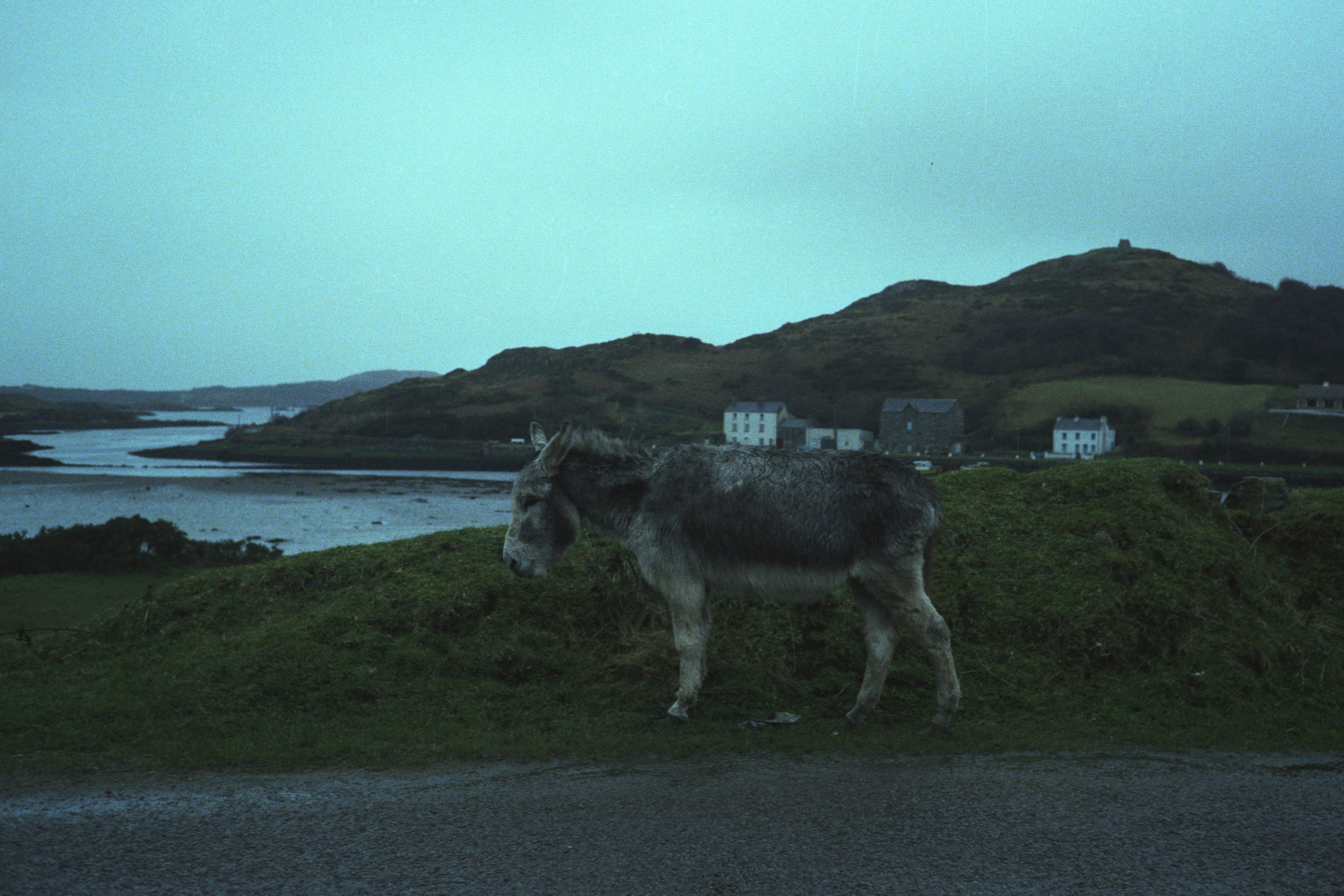
Connemara Donkey, Galway, 1980

Connemara donkey, Galway, 1980

What is lovely about this book is Robertson’s ability to describe place and get to the heart of a character. I loved her description of Inishmore and Galway (which I have visited). There’s rain, and more rain, there’s the wild terrain, but there are also blue skies and mild, warming weather. David’s relationship with nature charts his emotions, but not in a heavy-handed way. The first section of the novel (there are no numbered chapters) ends with:

He pushes the door wide open … and steps out into the day of salt-scented sunshine.

Later in the novel, “he gives into the sun and the excitement inside him” but, in a down period, “rain blackens the island’s limestone”. Another time, the island makes him feel “subtly undermined”. Out of context, these seem too obvious, but within the text they effectively support the tone.

What also charts David’s emotions is his bad back. When things aren’t going well, he is laid (seriously) low. This bad back also plays a role in the plot. It brings Tania to him – and it reminds us, and him, that he is on the wrong side of 40 (particularly in terms of his fatherhood goals), and “that, one day, time would suddenly contract; tighten around him”. It’s an effective and believable motif.

Like most chronologically told stories there are flashbacks to fill out the picture. We hear about David’s past failed relationships and about his previous job as a journalist for Agricultural Times which saw him writing about the Animal Liberation Front. We discover that Orla may be right about David being “a truth-seeking missile for hurt”.

If there’s a weakness in the novel, it’s in the plot. I found it a little contrived, particularly regarding the crises in the relationship. While the story is told in third person, it’s limited to David’s point of view. If we are to believe him, and I think we are meant to, then his actions make sense.  And yet Tania keeps falling over one issue – her uncertainty regarding his very brief and, from what the reader saw, innocent time with her daughter. I found Tania’s uncertainty understandable, somewhat, the first time, but less so thereafter. It all hinges on David’s credibility …

Technically, though, the plot is well-constructed, and teases us to second-guess where it’s going. Take, for example, this description of David’s nephews’ comic project which, sometimes

turns out to be the genuine item, that rare thing – a romantic comedy with injuries, tears and forgiveness, as well as real jokes.

Whether Sweet old world meets this description is something for you to discover. I will simply say that despite my initial statement, there is something fresh in this novel. I loved her descriptions, and the occasional flashes of whimsical humour. Robertson has created in David an interesting and psychologically-comprehensible character, and she has given real voice to men who long for children. There’s much to enjoy here.

Lisa at ANZLitLovers enjoyed it too, but also has some questions.

Deborah Robertson
Sweet old world
North Sydney: Vintage Books, 2012
291pp.
ISBN: 9781741668254

(Review copy supplied by Random House Australia)