Jessica Anderson, One of the wattle birds (Review)

I have finally read Jessica Anderson’s final novel, One of the wattle birds, which has been sitting in my beside cabinet since my parents gave it to me in 1998! Never let it be said that I don’t read books given to me – though, on reflection, I’d prefer you didn’t hold me to that! I have many many books in my TBR pile and most of them are not in the bedside cabinet. For a start, they wouldn’t fit. Anderson, though, has stayed there because she really was high priority, as I do like her. What finally prompted me to read this novel was Lisa Hill (ANZLitLovers) who recently reviewed Anderson’s penultimate novel, Taking shelter. She suggested that we swap books, when I’d read mine. When I suggested that it might take me some time, she sneakily said, “I’ll send mine up to you and then you will feel guilty if you don’t do it.” That was mean, don’t you think?

And so, being the responsible person that I am, I read One of the wattle birds and am glad of that little nudge (but don’t tell Lisa!). It is a deceptively simple book. When I started reading it, I wondered whether I was really interested in the first-person story of a 19-year-old female university student and her boyfriend. I thought I knew what it would be about, but how wrong I was. Set in Sydney, it describes three days in the life of the narrator, Cecily Ambruss, the only child of a single-parent family. Cecily’s mother, we discover, had died of breast cancer the previous year while Cecily was overseas with her boyfriend, Wil, and two other couples. Not surprisingly, Cecily is grieving deeply. Her grief is not helped by her inability to understand two things: why did her mother let her go overseas without telling her about the terminal illness and, what’s more, refuse to let her be called back, even for the funeral; and why did her (unmarried) mother stipulate that Cec must marry before she can inherit. Interesting, n’est-ce pas?
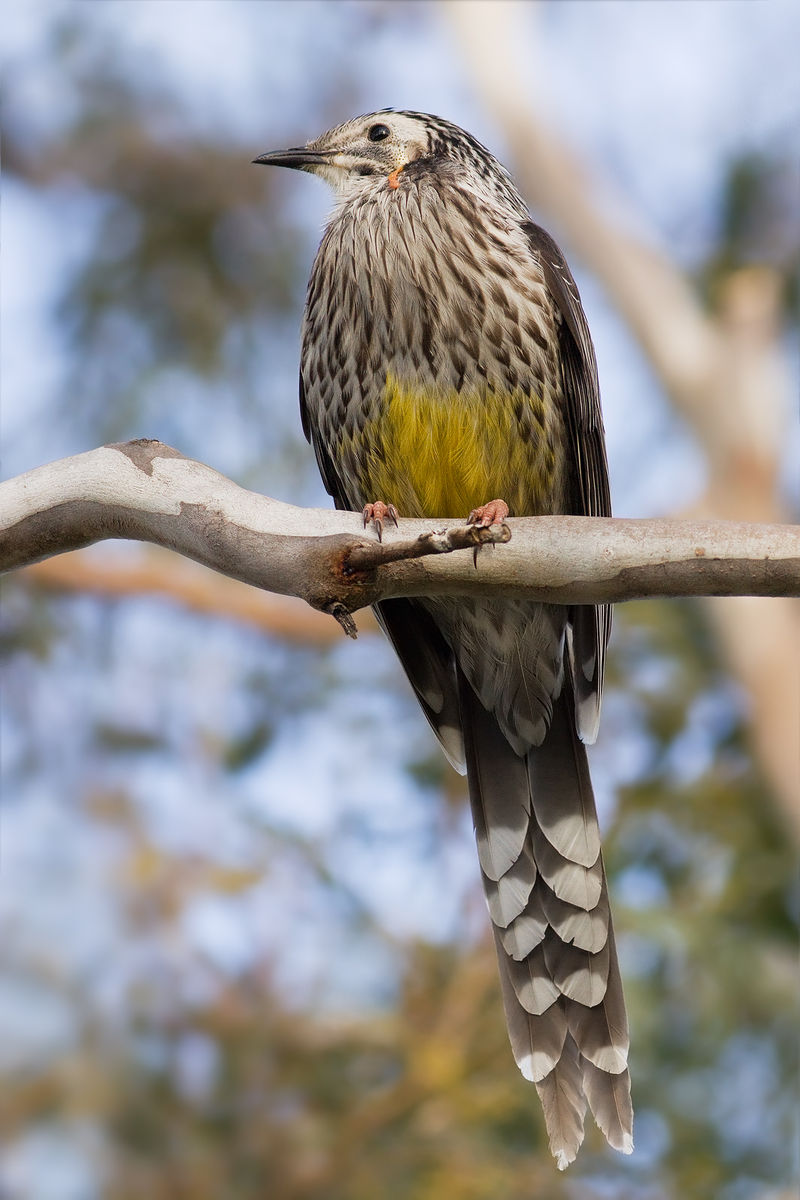
Red Wattlebird (Photo: JJ Harrison, using CC-BY-SA 3.0, via Wikipedia)

Red Wattlebird (Photo: JJ Harrison, using CC-BY-SA 3.0, via Wikipedia)

The three days over which the story takes place happen to be part of stu-vac, but while Wil – good, decent, conscientious law-student Wil – is taking his study seriously, arts student Cec is distracted. She cannot get her questions out of her mind. She has given up bothering Wil about them as he’s tired of her talking about her mother. And yet, grief is like that, particularly grief after unexpected deaths. You talk and mull, and mull and talk, over and over and over.

This brings me to the birds. There is, of course, the wattle bird. Cec calls it the DOIK*, for its sound, or “no-comment bird”, because it seems to be drowned out by other birds, reflecting, presumably, Cec’s feeling of inconsequence.  In another reference to birds, Cec says :

I feel like one of those raggedy birds you see trying to feed their remorseless young. And among the gaping beaks, that one gapes widest. And among the chorus of cheeps, that one cheeps loudest.

The beaks and cheeps are the insistent questions that the bird tries to quieten with answers she’s gathered from others, such as her mother’s friends, her uncle and aunt, and even her counsellor. But they don’t satisfy, so she keeps searching – and eventually comes to her father, a man who had professed to have no interest in her and whom, therefore, she had long ago decided she didn’t want to meet.

Alongside this search for answers, Cec does do the occasional study – and what she’s studying is Malory’s story of King Arthur which is, appropriately enough, a quest story. But, it raises other issues for Cec too, such as how much magic versus Arthur’s “own hands” played in his achievements. I suspect this has something to do with Cec learning that not everything has a clear, logical answer.

While all this is interesting, much of the delight in reading the novel comes from the interactions between characters. They are, generally, exquisite. The often prickly Cec has wonderful exchanges, for example, with her Aunt-by-marriage Gail, her Gran, and her father who tries his best to help her see where her mother may have been coming from. These characters aren’t paragons, but neither are they malign. They are, simply, human. My only quibble with Anderson’s characterisation is that Cec and her friends – all around 19 years old I assume – seem at times a little improbable. How many 19-year-olds – particularly university students – talk about mortgages and the like?

Anyhow, by now you must be wondering about Cec’s mother. Without spoiling anything, there’s nothing to suggest they had a difficult relationship – and the answers to Cec’s questions are probably pretty mundane. The point of the novel is, in other words, not so much Cec’s relationship with her mother but her coming to terms with her grief, her identity, and her relationship with Wil.

This novel is not easily categorised. Part quest, part comedy-of-manners, part family drama, it has some laugh out-loud moments as well as reflective ones. It explores many of the themes common to Anderson’s work. One is money and power. Cec’s family has money – “fruit and veg have been good for us” – and money is used both subtly and not so, as a means of control. Another is deceit and concealment. As the novel progresses, Cec starts to tell Will less and less. At first she justifies it because it’s all too complicated to explain – and he does tend to brush her emotional concerns off –  but, by the third day, there are many things she doesn’t tell him. “I foresee no end to the things I won’t tell Wil”, she says. And another, as the surprising last paragraph makes clear, has to do with the act of creation or, perhaps more correctly, with living life creatively.

One of the wattle birds is a tight, cleverly conceived “concoction” that makes, I’d say, a fitting conclusion to Anderson’s literary life. Has anyone else read it?

Jessica Anderson
One of the wattle birds
Ringwood: Penguin Books, 1994
Cover design: Joanna Hunt
192pp.
ISBN: 9780140240320

*A not very tuneful bird. We have a resident Red Wattlebird in the tree outside our bedroom. It squawks us awake every morning.
Hannah Kent, Burial rites (Review)

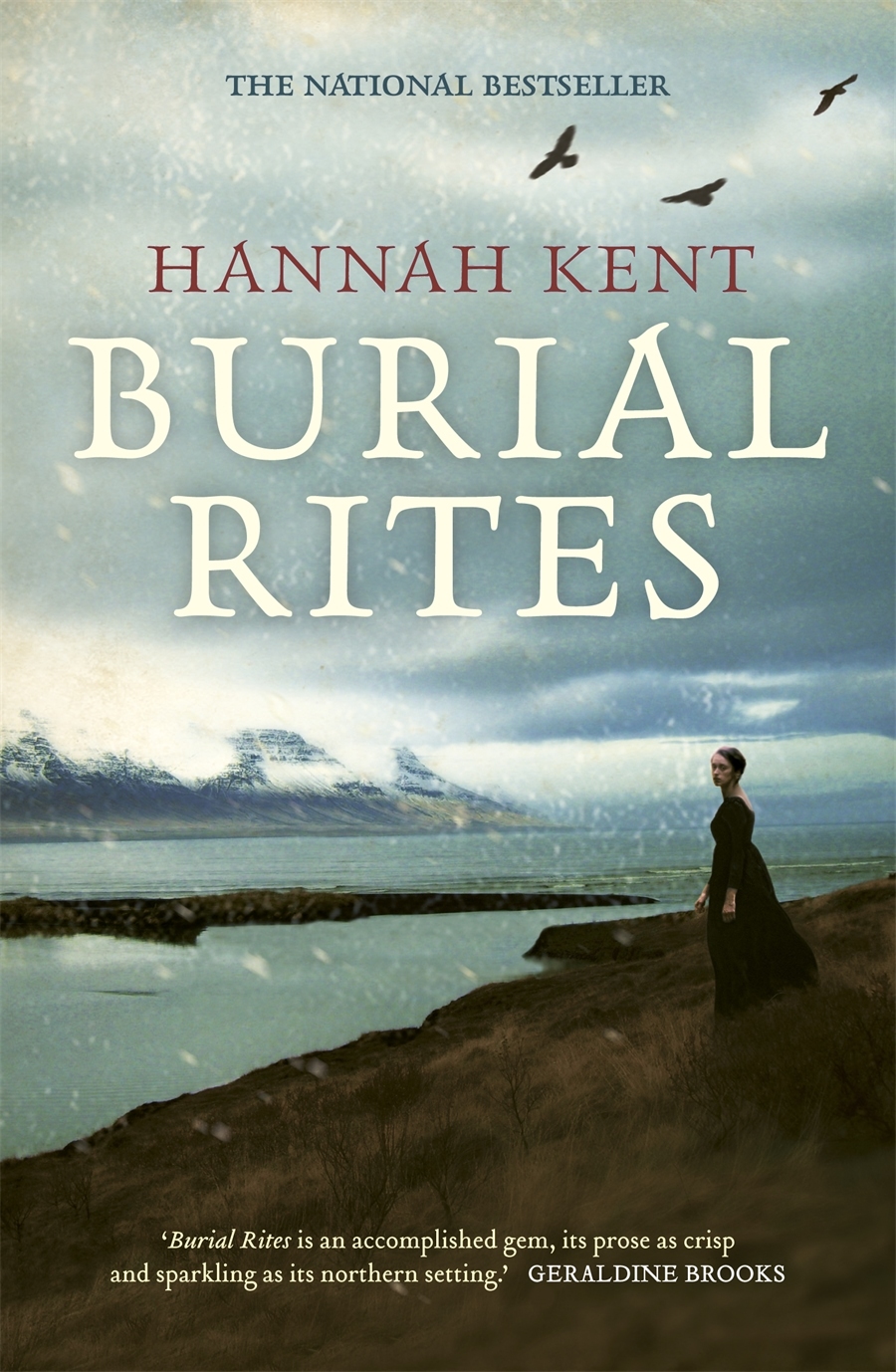
Hannah Kent, Burial Rites bookcover

Courtesy: Picador

“We’ll remember you” says Margrét to Agnes on the day of her execution. We sure will, if Hannah Kent’s debut novel Burial rites has anything to say about it. Kent’s book is the second novel set in Iceland I’ve read, the first being Icelandic writer Halldor Laxness’s unforgettable Independent people. Although Laxness’s novel is set a century after Burial rites, it prepared me for Kent’s novel – for the difficult landscape, the hard lives, and the unforgiving natures that such an environment can engender. Yes, that’s a generalisation I know. You can find unforgiving natures anywhere, but oh, they work so well in harsh environments. Just think, for example, of My Antonia (my review).

But now, what to say about a book that hit the book stands running? I wanted to read it last year, but I also wanted to read it with my reading group, which is why I have only now read it. Reading a book so late can make it difficult to add anything meaningful to the conversation. Fortunately though, while I couldn’t avoid the early buzz, I haven’t read the myriad reviews out there, enabling me to come to it reasonably freshly. So, here goes …

Remember your place, Agnes

It’s a compelling read. Icelanders may know the basic story, but we don’t. It concerns Agnes Magnúsdóttir – great sounding name, eh? – who, in 1830, was the last person to be executed in Iceland. She and two others, Fridrik Sigurdsson and Sigrídur Gudmundsdóttir, were convicted of murdering Natan Ketilsson, a complicated and probably cruel man, and his friend Pétur. Fridrik was also executed, while Sigrídur’s sentence was commuted to life imprisonment. Apparently, executions were normally carried out in Denmark but District Commissioner Björn Blöndal wanted to make an example of Agnes. As it would take some time to organise the executions and as Iceland had no real prison facilities, Agnes and Fridrik, were, literally, farmed out to live with public officials who were also farmers. Most of the novel takes place on the farm, Kornsà, to which Agnes was sent. The main characters, there, are the farmer’s dying wife Margrèt, her two daughters Steina and Lauga, and her husband Jón. Making regular visits is Assistant Reverend Tóti, chosen by Agnes to be her religious adviser. As the novel progresses, we also meet the victim and Agnes’s co-murderers.

Kent creates a believable world in which the people at Kornsà are initially resentful and fearful, but gradually, more gradual for some than others, come to recognise Agnes’ humanity and to believe that her sentence “isn’t right”. Similarly, the anxious but conscientious Tóti grows through his relationship as Agnes’ mentor. We learn about Agnes’ childhood, in which she is early deserted by her mother and then loses a loving foster-mother through death in childbirth. And we learn about her struggles to support herself as a woman. She thought she’d found her place with Natan, who seemed to offer her love while also offering her a job, but he soon reminds her of “her place”! Kent’s Agnes lives most of her life alone, lonely, and unsupported, which was probably not uncommon for women of her class at that time. This is, I’m sure, one of the themes Kent wants to explore in her novel.

You could argue that, overall, Kent’s women are fleshed out more than her men, but this is Agnes’ story and we know, I think, what we need to know about the men. There is a feminist reading to the book, but it is also more broadly sociological, to do with poverty and disempowerment. That women are more likely than men to find themselves in these positions is part of the problem.

This is what I told the reverend

Kent doesn’t use a simple, direct narrative to tell her story. (What novelist does in this post-postmodern world of ours!) For a start, she opens each chapter with one or more translated archival documents. This regular interruption of the main narrative could irritate readers by breaking emotional engagement with the story, but I found it enhanced the novel, particularly considering Kent’s intentions. One of these intentions, as she explained in an interview at last year’s World Book Expo, relates to the fact that she sees the novel as “speculative biography” not “historical fiction”. She describes, in this and other interviews, her methodology which was to use facts wherever they were available. Where the facts weren’t available, she says, she did broader contextual research about Iceland to imagine what was most likely to have occurred. She felt “free to invent” only in the outright gaps. She describes this approach as “research-driven creative-practice”. It’s logical, given all this, that she would use archival documents to support her “story”.

The other main narrative technique Kent uses is to switch voices from first person for Agnes, to third person for everyone else. This also makes sense given that Kent’s prime motivation was to give Agnes a voice, to “find her ambiguity, her humanity” and lift her out of the prevailing, more caricatured image. Again, I think it works, mostly. Agnes’ voice is distinctive, strong, and wavers, as you would expect, from confidence and hope to anxiety and fear. However, there were times when the switch back to third person seemed unnecessary. Mostly the third person sections focus on other characters, even when they are interacting with Agnes, but on a couple of occasions the shift occurs in the middle of Agnes’ story. One minute she is telling her story – “This is what I told the reverend” – and next minute the reverend asks “What happened then” and her story continues in the third person with her words in quotation marks. This was a little disconcerting, though it didn’t spoil the story significantly.

A magic stone

While the main point of the novel is Agnes’ story, Kent, in the process, paints a rich picture of Icelandic society, of the farmers, healers, neighbours, poets, gossips, maids and so on. Religion is clearly important, but for some characters, omens and superstition are equally if not more powerful. Natan is depicted as highly susceptible to bad omens, and for Agnes the ever-present ravens – “their black feathers poisonous against the snow” – reflect her sense of aloneness, and bode ill. By contrast, stones suggest good luck:

The stone Mamma gave me before she left. It will bring you good luck, Agnes. It is a magic stone.

It is, therefore, telling when she spits out a stone from her mouth on the day of her execution.

This brings me to Kent’s writing. It’s strong, evocative and often visceral. She uses motifs, like the ravens and stones, to reinforce her ideas. (It’s probably not coincidental, either, that the novel has thirteen chapters!). She is though, a first-time novelist, and at times the writing becomes a little heavy-handed, like this, for example:

Sometimes, after talking to the Reverend, my mouth aches. My tongue feels so tired; it slumps in my mouth like a dead bird, all damp feathers, in between the stones of my teeth.

But who’s complaining? Burial rites is a magical read that gets you in from the first page and doesn’t let you go until you get out your hanky at the end. Consider yourself warned.

awwchallenge2014Hannah Kent
Burial rites
Sydney: Picador, 2013
Design: Sandy Cull
338pp
ISBN: 9781742612829

Christos Tsiolkas, Barracuda (Review)

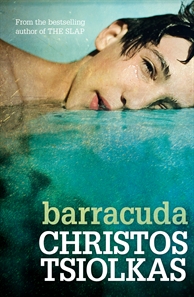
Christos Tsiolkas, Barracuda

Courtesy: Allen & Unwin

The best way I can describe Christos Tsiolkas’ latest novel Barracuda is to liken it to what Tsiolkas would define as a “good man”, tough on the outside, but tender within. I don’t know how Tsiolkas does it, but he manages to reach into your heart while at the same time confronting you to your core.

On the surface, Barracuda is about success and failure, specifically in sport. The plot concerns Danny Kelly aka Psycho Kelly aka Barracuda who is a talented swimmer. He receives a scholarship to attend one of Melbourne’s elite private schools and be coached on the swim team. Danny, with his Scottish truck-driving father and Greek hair-dresser mother, is not the normal demographic for the school and feels an outsider from the start, but he knows – or believes, at least – that he can be “the strongest, the fastest, the best”. However, things don’t go according to plan and Danny, who had poured his all into a single vision for his future, is devastated. The novel explores how a young man copes with such a major blow to his self-image, what happens when his expectations for his future are destroyed. Tsiolkas examines the social, political and economic environment in which Danny lives and the role they play in what happens to him, but he also delves deeply into the psyche, because what happens to Danny can only be partly explained by external forces. In the end we are, as Danny comes to realise, responsible for ourselves and our actions.

Contemporary writers annoyed him

Barracuda is quite a page-turner, but it bears slow reading, because it is a carefully constructed novel and some of its joys come from considering what Tsiolkas is doing. There is an amusing moment in the book when Danny, now in jail, becomes an enthusiastic book reader – primarily of 19th century novels. When the librarian asks:

‘Why are you always buried in those old farts?’ Danny would accept the teasing good-naturedly for he knew it was apt. Contemporary writers annoyed him, he found their worlds insular, their style too self-conscious and ironic.

I say amusing because there’s a self-consciousness in Tsiolkas’ style and I can only assume that he is having a little dig at himself. The novel’s structure reminded me somewhat of Evie Wyld’s All the birds, singing (my review) because both start at a point in time and then, in alternating chapters (sections), radiate forwards and backwards from that point. Tsiolkas, though, follows this structure a little less rigorously than Wyld, and he combines it with a change in person. In the first half of the novel, the sections moving backward are told in third person (limited) through the eyes of Danny, while the sections moving forward are told in first person through the eyes of Dan. This effectively enables the growing, maturing Dan to disassociate himself somewhat from his old self, although the dissociation – or perhaps the reintegration – of the two selves have a long way to go when the book opens. In the second part of the novel the point-of-view is reversed with the third person used for the older Dan, and first person for the younger, perhaps suggesting some progress towards the realignment of the selves? I need to think about this a bit more! Not only does this book warrant slow-reading, but rereading wouldn’t hurt either.

He couldn’t bridge the in-between

A significant issue for Dan is managing the two worlds he finds himself in:

It’s like two worlds were part of different jigsaw puzzles. At first, he’d tried to fit the pieces together but he just couldn’t do it, it was impossible. So he kept them separate: some pieces belonged to this side of the river, to the wide tree-lined boulevards and avenues of Toorak and Armadale, and some belonged to the flat uniform suburbs in which he lived.

When the two worlds conflict, Danny feels split open, cracked apart. “No one could ever put him back together”. And so, he starts to occupy what he calls “the in-between” but that leaves him silent, and alone. This dissection of worlds, of  “class”, and of anglo-Australia versus immigrant Australia, is an ongoing concern for Tsiolkas. We came across it in his previous novel, The slap (my review) and we see it again here. Tsiolkas is not the only writer exploring this territory, but he’s one of the gutsiest because he’s not afraid to present the ugliness nor does he ignore the greys, the murky areas where “truth” is sometimes hard to find (though he doesn’t use the word “truth”).

While Danny is the main conduit for teasing out the tensions in society between two worlds, other characters also reflect it. There’s Danny’s childhood friend, Demet, whose working class migrant background is challenged when she goes to university, and his school friend Luke, a nerdy ostracised boy at the elite school who, with his Vietnamese mother and Greek father, is also “half and half”. These characters manage to traverse their worlds more easily than Danny, but Tsiolkas shows that it isn’t easy.

His father was a good man

Barracuda is about a lot of things. It’s not an exaggeration to say that Tsiolkas taps into the zeitgeist of contemporary suburban Australia. But I might explore that in another post, because this post is getting long and I do want to end on the theme that struck me the most, that of defining “a good man”.

Throughout the novel, Danny meets many men – his father, grandfather and coach, in particular, when he’s a boy, and his lover Clyde, old schoolmate Luke and brain-damaged cousin Dennis when he’s an adult. As an adolescent, and somewhat typically, Danny loves his grandfather, rejects his father, and dotes (until he “fails”) on his Coach. Adult Dan is more circumspect about men, but sees good qualities in Clyde and Luke, while still rejecting his father. None of these men, though, seem able to break through his destructive self-absorption. However, late in the novel, living a self-imposed lonely life, albeit one now committed to helping others, Dan has an epiphany. In a confrontation with his father, he suddenly realises:

His father was a good man. It struck him with a force of revelation, exultation, light flooding through him. His father was a good man. His father was the hero of his own life.

At this moment, he realises he wants to be a good man. He also starts to get a glimmer of what a good man is, and it has nothing to do with being the strongest, fastest and best.

I have more to say about this book, and so will do a follow-up post rather than write a longer essay here. Meanwhile, I know there are readers of this blog who do not like Tsiolkas. He is, I agree, a confronting writer. His characters are not aways easy to like, and he doesn’t shy away from their grubbiest (that is, unkind, violent, sexual) thoughts, but for me he has some valid concerns to share and I want to hear them.

Christos Tsiolkas
Barracuda
Sydney: Allen & Unwin, 2013
515pp.
ISBN: 9781743317310

Eleanor Catton, The luminaries (Review)

Courtesy: Allen & Unwin

Courtesy: Allen & Unwin

Now here’s the thing … I don’t make a practice of reading mysteries. I really don’t care about who dunnit. When Mr Gums and I watch television crime shows, I rarely concentrate enough to work out the plot intricacies, but I do watch the characters. I’m always interested in the detectives and their relationships. I want to know who they are and what makes them tick. And so, I must say that I got a little tired of the plot machinations in Eleanor Catton’s Booker prize-winning novel, The luminaries. I didn’t really want to expend effort to keep track of the complexities of whose gold went where, who told whom what, and so on. But, I did find the book an interesting read, nonetheless.

Why? Well, first and foremost because of the characters. In the first half of the novel, as the characters were being introduced, I was impressed by Catton’s understanding of human nature.  Her characters, most of them anyhow, are nuanced – if that’s not too clichéd a term. Here for example is Thomas Balfour:

When a restless spirit is commissioned, under influence, to solve a riddle for another man, his energies are, at first, readily and faithfully applied. But Thomas Balfour’s energies tended to span a very short duration, if the project to which he was assigned was not a project of his own devising. His imagination gave way to impatience, and his optimism to an extravagant breed of neglect. He seized an idea only to discard it immediately, if only for the reason that it was no longer novel to him; he started in all directions at once. This was not at all the mark of a fickle temper, but rather, of a temper that is accustomed to enthusiasm of the most genuine and curious sort, and so will accept no form of counterfeit – but it was nevertheless, something of an impediment to progress.

This made me laugh. Not all descriptions did of course, but most are insightful of humanity.

There is also humour in the book – some funny scenes, and wry asides. Since we’re on Thomas Balfour, let’s stay with him. Here he is meeting the chaplain Cowell Devlin:

‘Good morning’, returned the reverend man, and from his accent Balfour knew at once that he was Irish; he relaxed, and allowed himself to be rude.

Thomas, as you might have guessed, is English – and this of course tells us more about him than about Devlin.

Perhaps at this point I should mention the plot, though as a Booker Prize Winner, its basic premise is probably known to most of you. The novel is set in the New Zealand goldfields, Hokitika mainly, over 1865 to 1866. The plot concerns the death of one man, the disappearance of another, an apparent suicide attempt, and the provenance of a gold fortune. There are 20 main characters – 12 described as stellar, representing the 12 astrological star signs; 7 described as planetary, representing, of course, the planets; and one, the dead man, described as terra firma. It’s a lot to keep in your head but Catton does provide a character chart at the front to help.

There is a lot to enjoy while reading this book, in addition to the characterisation and humour. The plot is intricate and fun to unravel if you enjoy mysteries. The goldfields setting is realistic, with its businessmen, publicans, politicians, prospectors, whores, opium dealers and tricksters, not to mention the salting and the duffers. The writing is sure. I enjoyed her use of imagery. Grey and yellow feature throughout as do references to spirits (ethereal, emotional, and alcoholic), ghosts, apparitions, phantoms, fog and mist. These all helped convey a sense of murkiness, and of things shifting before our eyes.

The main themes are to do with truth, lies and fraud, with love, loyalty and betrayal. It’s quite a cynical world that our characters find themselves in. As the not-yet dead man, Crosbie Wells, says to the whore, Anna Wetherell:

There’s no charity in a gold town. If it looks like charity, look again.

There is, of course, but it’s rare – and, as Wells advises, you have to be darned careful about who you trust, because, human nature being what it is, where there’s gold, there’s always greed.

The big challenge of this novel is its structure. I’ve already mentioned the structure of the characters. The astrological theme is carried through into the structure of the narrative. The book is divided into 12 parts which, I learnt at my reading group, are meant to align with the lunar cycle, each part being exactly half the length of the previous part. This didn’t feel artificial, because the increasingly shorter parts provided a rhythm to the unravelling of the plot. The other point to make about the structure is that the novel commences on 27 January 1866, 13 days after 14 January when the critical plot events take place. The novel then moves forward, through the trial and its aftermath, to 27 April 1866 (Part 4). In this part, we also jump back, in alternating chapters, to 27 April 1865, when the major players in the plot start, shall we say, “orbiting” each other, if not downright colliding. The novel then progresses forward again, ending on 14 January 1866, not quite back at the beginning, but on the day that precipitates the narrative.

There is, then, a certain circularity to it all, but what does it mean? Does this structure do anything for we readers? I’m not sure. There are intricate astrological charts at the beginning of each part showing where the 12 characters are positioned, astronomically speaking, on that date. I don’t have the astrological knowledge to know whether these charts added meaning or not. The circularity does, however, suggest another potential theme – which is, as chaplain Devlin says, that:

Some things are never done.

Devlin says something else too, which is reinforced by the way the narrative progresses via the stories of the various players:

never underestimate how extraordinarily difficult it is to understand a situation from another person’s point of view.

So, in the end, where did it all leave me? Wondering, in fact, whether it was just a little too clever for itself or, maybe, too clever for me. Either way, I did enjoy the read, and was impressed by the skill with which Catton executed her tale and the insight she has into human nature. Beyond that, I think it’s best if you decide for yourselves.

Lisa (ANZLitLovers) wasn’t enamoured, nor was the Resident Judge, but John (Musings of a Literary Dilettante) liked it very much.

Eleanor Catton
The luminaries
London: Granta, 2013
832pp.
ISBN: 9781847088765

Jane Austen on reading novels

Jane Austen’s defence of the novel in Northanger Abbey is famous. Not only does the hero, Henry Tilney, tell the heroine Catherine, that:

The person, be it gentleman or lady, who has not pleasure in a good novel, must be intolerably stupid …

but Austen, in an authorial comment early in the book, says

… there seems almost a general wish of decrying the capacity and undervaluing the labour of the novelist, and of slighting the performances which have only genius, wit, and taste to recommend them. “I am no novel–reader — I seldom look into novels — Do not imagine that I often read novels — It is really very well for a novel.” Such is the common cant. “And what are you reading, Miss — ?” “Oh! It is only a novel!” replies the young lady, while she lays down her book with affected indifference, or momentary shame. “It is only Cecilia, or Camilla, or Belinda”; or, in short, only some work in which the greatest powers of the mind are displayed, in which the most thorough knowledge of human nature, the happiest delineation of its varieties, the liveliest effusions of wit and humour, are conveyed to the world in the best–chosen language.

This is Austen, though, and while she was passionate about the value of reading fiction, she also saw the other side. Not all novels, perhaps, are equal! And so, Catherine, a fan of the Gothic novel, is shown to be a rather silly novel reader, letting her imagination run too far and getting herself into trouble as a result. She does learn, though …

Northanger Abbey was published posthumously in 1817*. However, Austen wrote it in 1798/99, and revised it in 1803, when it was the first of hers to be sold to a publisher – Crosby & Co. They decided not to publish it, and it was bought back in 1816. Austen did further work on it before her death in 1817. My point though relates to the fact that the bulk of it was written in 1798/99. This is interesting, when you compare the excerpt above to this from her letter (no. 14) to her sister written on 18 December 1798:

I have received a very civil note from Mrs. Martin requesting my name as a Subscriber to her Library which opens the 14th of January, & my name, or rather Yours is accordingly given. My Mother finds the Money. …  As an inducement to subscribe Mrs. Martin tells us that her Collection is not to consist only of novels, but of every kind of Literature, & c. & c-She might have spared this pretension to our family; who are great Novel-readers & not ashamed of being so; – but it was necessary I suppose to the self-consequence of half her Subscribers.

Those comments “great Novel-readers & not ashamed of being so” and “The self-consequence of half her Subscribers” tell us very clearly that novel-reading in the late 1700s to early 1800s was seen by many as a frivolous activity. No wonder she, a beginning novelist, felt the need to defend her craft!

* Published in December 1817, but the imprint date is 1818.

Reading difficult literature

I seem to have been reading a lot in recent weeks about reading, the end of reviewing, the future (or not) of the book, and so on. All interesting, though many revisiting familiar territory. One, though, particularly caught my eye. It was a post in Book Riot, by magazine editor/blogger/reviewer Greg Zimmerman, and was titled Our reading lives: Why I like difficult novels.

It’s not a long post. Zimmerman starts with David Foster Wallace’s notoriously difficult Infinite jest. He loved reading it, and says:

Readers read for dozens of different reasons. One of my favourite is to be challenged. Certainly, I don’t want most (or even 2 percent) of the novels I read to be as tough as Infinite jest. But I think spending a good amount of time with a book, really putting in some effort to piece it together, and coming out on the other side feeling like you’ve accomplished something is just so gratifying.

I’m sure you, like me, know exactly what he means. He next mentions Thomas Pynchon’s Gravity’s rainbow – which he found “really, really tough” – and then Eleanor Catton’s The luminaries. My eyes popped out at this point, as that’s the book I was about to start (and have, indeed, now started). While I knew it was long, I didn’t know it had a reputation for being difficult, but Zimmerman quotes others as saying it’s “long and demanding”, baffling”, even “an ingenious ourobouros“. Had I, I thought, left myself enough time to read it in time for reading group? Time will tell. Zimmerman took two weeks, he said, and that’s about how much time I’ve given myself.

The point I want to make though is that Zimmerman says that its difficulty is different. It’s “not like Pynchon because it’s really readable. And it’s not like DFW because it’s not digressive or purposefully superfluous”. Its difficulty comes from “the number of characters, how they’re all involved in the plot but from different perspectives and with different motivations, and the way the plot folds back upon itself several times”.

This got me thinking – not about The luminaries, as I’ll deal with that as I read it – but about my definitions of difficulty in novels. Dificulty is, I think, in the eye of the beholder, so I’ve come up with a few, not mutually exclusive definitions, which I thought I’d share (or, at least document for my own benefit!):

  • language and/or ideas are obscure and/or complex. A recent example for me is Gerald Murnane’s The plains (my review). It’s a short book but it demanded my complete attention. Miss a sentence and I was lost. I’m not sure I fully understood it, but I loved the challenge of trying to work out what Murnane was on about. Most of the world’s difficult books – those by Joyce, Pynchon, Faulkner, Woolf et al – probably fall into this category. These books may have little or no plot. They are the books in which you wonder “what the hell is going on?”
  • structure is complex or disconnected or full of digressions, making it tricky to pin down things like where, when and/or who at different points in the book. Some readers found this with Kim Scott’s That deadman dance (my review). They found all the shifting around, particularly in the beginning, disorienting. Laurence Sterne’s Tristram Shandy fits here, though it’s a long time since I read it. This point is closely related to the first one, and most of the authors I listed there spill over here too, I think.
  • large cast of characters (often combined with complex or convoluted plot). This is apparently the case with The luminaries. David Mitchell’s The thousand autumns of Jacob de Zoet (my review) is not overly convoluted but it has a large cast of characters, and keeping track of them is a challenge. Mitchell’s Cloud Atlas would fit here too, and in several of my categories I reckon.
  • unflagged transitions between “reality” and “magic” or “dream” or “spiritual” worlds. Gabriel Garcia Marquez, Haruki Murakami and our own Alexis Wright (my review of Carpentaria), to name a few, can trip us up with the way they slide between worlds. Alexis Wright, however, would argue that this only a problem if you have a western mindset. My solution is to go with the flow – and usually all will be revealed.
  • emotionally confronting, that is, the story is distressing or grim. This is not something that usually bothers me. While I do become emotional about characters and what happens to them, I like that literature lets me explore things I hope I never have to experience in life. Rohinton Mistry’s A fine balance is a novel that wears some readers down. For some it’s too depressing, and they give up. I found it ultimately uplifting, despite it all. JM Coetzee’s Disgrace fits here, as do Cormac McCarthy’s The road and Blood meridian, not to mention many Holocaust novels.
  • boring. It’s really hard to read a book that bores you. This is what put me off Great expectations when I first tried to read it in my early teens. I just couldn’t get interested. When I finally faced it again years later, I loved it. I think this might be the reason many readers give up on Louis de Berniere’s Captain Corelli’s mandolin. I loved the opening chapters, but he does take a while to get into the story proper.

Do you read “difficult” literature? If so, what do you find difficult and do you have any hints about how to approach such reading. Oh, and for a list of really tough books, check this list out.

Notable reads and highlights from 2013

Last year I wrote two highlights posts – a general one on blogging and reading, and a specific one targeting books. This year, I think I’ll revert to one post and combine the two. (I’ll provide links to my posts where relevant – not to promote myself, but to make it easy for those of you who’d like to check out anything I refer to that you missed first time around).

Literary event highlights

Sara Dowse text

Sara Dowse (Courtesy: NewActon.Com)

I managed to get to a few literary events this year – including some great book launches – but the three that most stood out for me were:

  • Woven Words: an inspired and inspiring night, associated with The invisible thread anthology, that blended words with music chosen by the guest authors.
  • Writing the Australian Landscape Seminar: a wonderful weekend of speakers organised by and held at the National Library of Australia. Not only was it wonderful to hear some favourite writers in person but the content gave me much to think about. Two ideas that have remained with me are Murray Bail’s suggestion that Australians rely too much on the strangeness of our landscape to construct our identity, and the wider issue regarding reconciling settler Australians’ experience of landscape with indigenous Australians’ relationship to country.
  • Childers Group’s forum on The role of the public arts critic. I particularly loved the idea that the critic is “a trader in ideas”, It takes away the notion of assessment and judgement and focuses us on what the arts are really about – which for me is to provide us with an opportunity to reflect on who we are, what we think, where we’ve come from and/or where we are going.

Aussie reading highlights

I don’t like to list my “top [name your number] books of the year” because it is such a subjective and moveable thing. I prefer instead to name some highlights:
  • The classics: I read a few Aussie classics this year and all were well worthwhile reading, but the two highlights were being able to read Patrick White’s first (buried) novel Happy Valley, which was published by Text Australian Classics, and finally reading a Christina Stead, For love alone.
  • A debut: I haven’t yet read this year’s most touted debut, Hannah Kent’s Burial rites. That pleasure, as I’m assured it will be, is coming this year. But I did read a few debut novels. Courtney Collins’ The burial was a standout for me. I loved the unusual and confronting narrative voice, the strong descriptions, and the fact that it was inspired by the story of a little-known Australian woman bushranger.
  • Awards: While I couldn’t tell you who won all the major literary awards in Australia this year – and have been slack about maintaining my sidebar awards list – two winners were standout novels for me this year: Carrie Tiffany’s Mateship with birds which won the inaugural Stella Prize and Michelle de Kretser’s Questions of travel which won the Miles Franklin award (among others).
  • Canberra Centenary anthologies: Canberra’s centenary year has ended but we have two wonderful books – The invisible thread edited by Irma Gold and Meanjin’s The Canberra issue – to dip into again and again when we want to think about what Canberra means to us, its residents, and the wider us, Australians.
  • Small presses: I’ve read so many excellent books from small presses, books that just don’t get the exposure they deserve. Dorothy Johnston’s e-book Eight pieces on prostitution published via the Australian Society of Authors website, Lesley Lebkowicz’s The Petrov poems (Pitt Street Poetry), Rachel Hennessy’s The heaven I swallowed (Wakefield Press), Gabrielle Gouch’s Once, only the swallows were free (Hybrid) and Susan Hawthorne’s Limen (Spinifex Press) are just a few of this year’s small press treasures.
I feel badly about limiting my list to just these few – I read so many good books this year. Just because they are not listed here doesn’t mean I’ve forgotten them!

Other reading highlights

This year really was a year of Australian reading. However, I did read some excellent books from foreign lands. The highlights were – and I swear I didn’t choose them for the initial of the author’s last name:
  • Hilary Mantel’s Bring up the bodies. What can I say? I loved how Mantel continued Cromwell’s story but with a different theme to the first novel in the trilogy. Can’t wait for the third book. What will she explore in it?
  • Diego Marani’s The last of the Vostyachs which was not only a great read but synchronised well with what turned out to be a major theme of my reading this year – the relationship between language and culture.
  • Bill McKibben’s Oil and honey: the education of an unlikely activist. McKibben does a great job of chronicling his transition from writer on activist issues to an activist who also writes, and he beautifully articulates the development of his activist strategies, making this book work both as memoir and how-to.

Blogging highlights

  • Australian Women Writers’ Challenge: this is such a positive project to be part of, and I am proud of what we as a team are achieving in terms of promoting Australian women writers. I’d love to know whether those writers who are living are seeing any increase in sales or, even, wider recognition, since the challenge started in 2011.
  • Commenters: I’d love to name you all because you have made blogging this year such a positive experience for me. I’ve enjoyed all the thoughtful and honest comments you’ve posted – asking questions, posing different ways of looking at issues, adding your experiences to the conversation. Thank you so much.

Short stories rule: Top posts for 2013

WordPress consistently tells me that the most popular topics I write about – according to my tags and categories – are Australian literature, Australian writers, Women writers, 21st century literature and Review-Novels. However, my most “hit” post last year was a short story by an English woman: Virginia Woolf’s “The mark on the wall (reviewed in March 2012). I presume, partly because of the sorts of searches that find it, that this is because it’s a set text for schools/universities, but still, it’s great seeing short stories being read.

Interestingly, my top “hit” Australian post (and third on my Top Posts for 2013) is also for a short story: Barbara Baynton’s The chosen vessel (reviewed in November 2012). This one I find more intriguing. Is this a set text too? If you can throw light on this, I’d love to know.

Searches that reached my blog in 2013

Every now and then I take a look at what people who come to my blog have searched on. As Google is now offering encrypted  searching, less information about search terms can now be captured by WordPress, but some still are. Here are some of my favourites from this year:
  • non living elements that help a echidna (I have no idea what post this one found as I can’t replicate the search to find me)
  • what significance does “whitaker’s table of precedency” have in “the mark on the wall”? (From the very specific wording of this one, I’m guessing this was a test/essay question?)
  • my sporty.com in sex gum girl (I can’t help thinking he/she was disappointed to find me!)
  • what page of midnight empire does drone attacks start (From someone else reviewing Croome’s book?)

And finally …

Thanks to everyone who has read, commented on and/or “liked” my blog over the last year. I may not know you all, in person, but I really do appreciate your visiting me here. I wish you all happy reading in 2014 … and, meanwhile, would love to hear of your blog or literary or reading highlights of the year.

Diego Marani, The last of the Vostyachs (Review)

Italian writer Diego Marani‘s The last of the Vostyachs was originally published in 2002, but the English translation was not published until 10 years later in 2012. How lucky we are that it was, because this book is unlikely to have been written by an English-language writer. Its focus on the relationship between language, culture and place and on darker issues like ethnic nationalism comes from a different – and particularly European – sensibility. We speakers of the world’s dominant language can, I think, be a bit oblivious to the linguistic issues faced by speakers of other languages, particularly in Europe where multiple languages live cheek by jowl. The challenge of communication is an important issue for Marani who works in Brussels for the European Union. His roles have included interpreter, translator, and policy adviser on multilingualism. Marani knows as well as anyone that language is both a cultural and political issue – and this is what he explores in this, his second novel.

However, The last of the Vostyachs is no dry tome explicating the role and value of language. Instead it is a surprising and often funny novel that weaves myth and saga, melodrama and irony through the warp of a crime thriller. It incorporates a number of literary traditions and archetypes: the wild (innocent) man set loose in the city, the spurned wife, the spirit guide, the corrupt obsessive, and the remote cottage in the woods where dastardly things happen. On the night the crimes (murders, in fact) take place, nature runs amok. Zoo animals roam the city and the temperature drops to its coldest in fifty years.

The plot centres on Ivan, who is the last of the Vostyachs, an ancient Siberian shamanic tribe. He is the only one who can speak the language, though at the novel’s opening he had not spoken it (or anything else) for twenty years, not since, as a young boy in the gulag, he’d seen his father killed. When the gulag is suddenly freed, he returns to the Byrranga Mountains but all he finds are wolves. He believes them to be his people who, to flee the soldiers, had hidden deep in caves and turned into wolves. He cannot bring them back to human form but they shadow and protect him.

Every single language is necessary to keep the universe alive

Into this mix appears the plain, ethical, Russian linguist Olga who is excited to find a speaker of a language thought to have been extinct and who sees in this language an exciting connection between Europeans and the native Americans. Her old colleague, the womanising, unethical, Finnish linguist Jarmo Aurtova is not so pleased with this threat to his theory of Finnish as the “Latin of the Baltic”, as, in effect, the master language of Europe. Jarmo sounds scarily like Hitler in his desire to prove the supremacy of a pure Finnish language:

In ancient times we were the civilised ones and they were the barbarians. We were the masters, they were the slaves. Not for nothing is the word aryan so similar to the Finnic orja, which means slave.

and

But now ‘someone’ was trying to throw Finland into the dustbin of history, together with the other conquered peoples who have no future. Aurtova was not having that …

Jarmo cares not if a language or two disappears and dies in the service of his theory. He believes that the fewer the languages the more “we’re moving towards the truth, towards the pure language”, while for Olga “with each one that dies, a little truth dies with it”. Marani, the creator of the flexible inclusive language Europanto, is on Olga’s side, on the side of plurality. She says

The true meaning of things is hidden from us; it lies beyond the bounds of any one language, and everyone tries to arrive at it with their own imperfect words. But no language can do this on its own. Every single language is necessary to keep the universe alive.

Cherish ignorance

The last of the Vostyachs is a ripping yarn that takes us from the tundra to Helsinki, through city streets, down country roads, across ice and onto the sea, as the various characters pursue their passions. But it’s the irony that conveys its main messages – and much of this irony revolves around our arch-villain and misogynst, Jarmo. His guilt as a murderer is revealed through a clue that is gorgeously ironic. In his final speech to the linguistic congress he, an academic for heaven’s sake, exhorts people to “cherish ignorance”, to not learn other people’s languages but “force” them to learn yours. And, most ironic of all, not only is the Vostyach language not destroyed, but by the end of the book, without giving too much away, “it could truly be said to be alive and flourishing” – albeit in a rather odd place.

Partway through the novel, Olga says to Jarmo of Finns that “to communicate with the rest of the world you have to learn another one, you have to venture out among words which are not your own, which you have borrowed from others”. In The last of the Vostyachs, Marani has ventured out and written something wild and rather risky. In doing so, he has produced a novel that’s not only fun to read but also gives the mind much to think about.

Lisa at ANZLitLovers read and enjoyed this book earlier this year.

Diego Marani
The last of the Vostyachs
(Trans. by Judith Landry)
Melbourne: Text Publishing, 2012
176pp.
ISBN: 978192196885 (Kindle ed.)

Christina Stead, For love alone (Review)

In a recent communication with local author Nigel Featherstone about reviewing, he reminded me of Peter Rose’s advice for new reviewers for the ABR. One of the points Rose makes is:

with major books, ones that have been reviewed extensively in the newspapers, submit reviews that add to our understanding of the book, not just repetitious codas to or echoes of earlier reviews.

This stands also, I think, for classics, for books that have become part of the “canon”. Stead’s For love alone is such a book. My problem then is how to say something about this book that isn’t same-old, same-old. I could be lucky here though, because while Christina Stead is part of the Australian literary canon she’s probably not as well read or as well-known as she should be.

To gain some idea of her reputation amongst the literati, just look at these comments … Patrick White described this book as ‘A remarkable book. I feel elated to know it is there’. Now that is really something isn’t it? Helen Garner has said ‘I could die of envy of her hard eye’, David Malouf wrote that ‘Christina Stead has the scope, the imagination, the objectivity of the greatest novelists’, while American critic Clifton Fadiman called her ‘the most extraordinary woman novelist produced by the English-speaking race since Virginia Woolf‘. He has qualified his praise with ‘woman’, but nonetheless, you see what I mean. What can I add to a discussion of a writer of this ilk?

Enough introduction. Those of you who don’t know the novel are probably wondering by now what it’s about. The title sounds a bit melodramatic, and the basic plot-line could suggest it, but in fact the book is low on drama. You don’t read Stead for page-turning excitement. The novel is set in Sydney and London, from 1933 to 1937. It concerns Teresa Hawkins, the 19-year-old daughter of an unloving, self-involved father. Neither she nor her three siblings are happy at home but seem tied to it, mostly for economic reasons. The novel opens with Teresa and her sister Kitty attending the wedding of their cousin Malfi, setting the scene for Teresa’s quest for love – for a real love, though, not for “some schoolfellow gone into long trousers”. Unfortunately, while she is an intelligent and resourceful young girl, she is also naive. She sets her sights on her Latin teacher, the 23-year-old Jonathan Crow*. Consider the name, and you might gain some insight into his nature!

“She believed firmly in the power of the will to alter things and force things to an end”

It’s hard when reading the novel not to think of Thomas Hardy’s Tess of the d’Urbervilles (surely it’s relevant that Teresa is also called Tessa?) and, even more, of Edith Wharton‘s heroines. However, while society’s rules and conventions underpin the plot, Stead is more interested in her characters’, particularly Teresa’s, psychology. What does Teresa mean by love, what is its impact on her, and how far will she go for it? Very far, we soon discover. She denies herself sustenance almost to the point of death, not once but twice, in the novel. Why?

Well, let’s look at Teresa/Tessa. Early in the novel, she’s idealistic. She will not, she says, compromise her life. “I’ll never give in” (p. 33) she says to her aunts, and a little later says to her cousin, “I’d work my fingers to the bone to keep my lover” (p. 127). As she becomes immersed in her love for Jonathan Crow, she enacts these vows: “I am killing myself for a man” (p. 314), she realises. “Love is hard” (p. 357). And yet, she continues for many more chapters, to believe in her idea of love (in which women can’t expect happiness) and in Jonathan. This, to her, is how love is. It’s an intriguing portrait of a woman who is strong and intelligent, and yet unable to let go of something that is patently going nowhere. When the inimical Crow describes her as “a true example of masochism and also a perfect example of mythomania”, it’s hard not to agree.

Teresa, then, is not a simple character. Her commitment to Jonathan is complicated: when opportunities arise for greater intimacy, she in fact pulls back. It’s significant that several times through the novel she mentions Ulysses:

she could sail the seas like any free soul, from Ulysses to the latest skipper of a sixteen-footer rounding the world.

Eventually, though, she discovers “true love … the love without crime and sorrow” but, as ABR editor Peter Rose also says “never give away the denouement”, I will leave it here. I’ll simply say that the ending is satisfyingly open and true to Teresa’s character.

“The world was hers and she had no doubt of the future”

The novel is, essentially, a bildungsroman. It’s Teresa’s coming of age, intellectually, psychologically and physically. Her youthful confidence takes quite a battering as she confronts the realities – presented by society and by Jonathan. She realises that society’s rules are counter-human:

Why the false lore of society? To prevent happiness. If human beings really expected happiness, they would put up with no tyrannies and no baseness; each would fight for his right for happiness. (p. 532)

This is not a social history. Despite the descriptions of poverty, the analysis of societal marriage conventions, the discussions about money and power, Stead is not writing a Dickensian novel. Rather, it’s about Teresa’s struggle to know herself as a mature loving women, something that is stunted for some time by her relationship with the slippery Jonathan: “In one speech he would be sardonic and naive, cruel and gay, tender and cold” (p. 380) And yet, Teresa cares for this man, and forgives, and forgives, and forgives again his erratic, careless, misogynistic treatment of her. In fact, she appears to be so in his thrall that her employer James Quick begins to wonder whether she is as intelligent as he’d believed:

What can she be, to tolerate such a contemptible, calculating worm […] this intellectual scarecrow (p. 477, 480).

However, she is, of course, intelligent and in true bildungsroman-style does experience “true” love. But this is Stead and it’s not simple. At one point her new love tells her:

he will send her to university – make a woman of her, make a brilliant woman of her … He would take her to Paris, and elsewhere, no-one who knew her now, would know her then; he would make her over entirely.

Oh dear …

Australian Women Writers Challenge

This is a delicious book – rich in ideas, gorgeous in writing, passionate in conception, and complex in psychology. The more I delve into it, the more I want to say. Perhaps, I will another day.

Postscript: By coincidence, I finished For love alone just as the ABC’s Australian Story broadcast the strange story of revered Australian writer Elizabeth Jolley, her librarian husband and his daughter by his first marriage, Susan Swingler, whom he left in England without telling her the truth. The first thing that crossed my mind as the story – I have Swingler’s book, unread, on my shelves – unfolded was “the things people do for love”. Jolley’s novels, like this one of Stead’s, are emotionally intense and explore some of the darker sides of familial and romantic relationships.

Christina Stead
For love alone
Carlton, The Miegunyah Press, 2011 (orig. pub 1945)
575pp.
ISBN: 9780522853704

* The novel is autobiographical, but by no means autobiography. Here is an article on Keith Duncan who inspired Jonathan Crow.

Ella Berthoud and Susan Elderkin, The novel cure: An A-Z of literary remedies (Review)

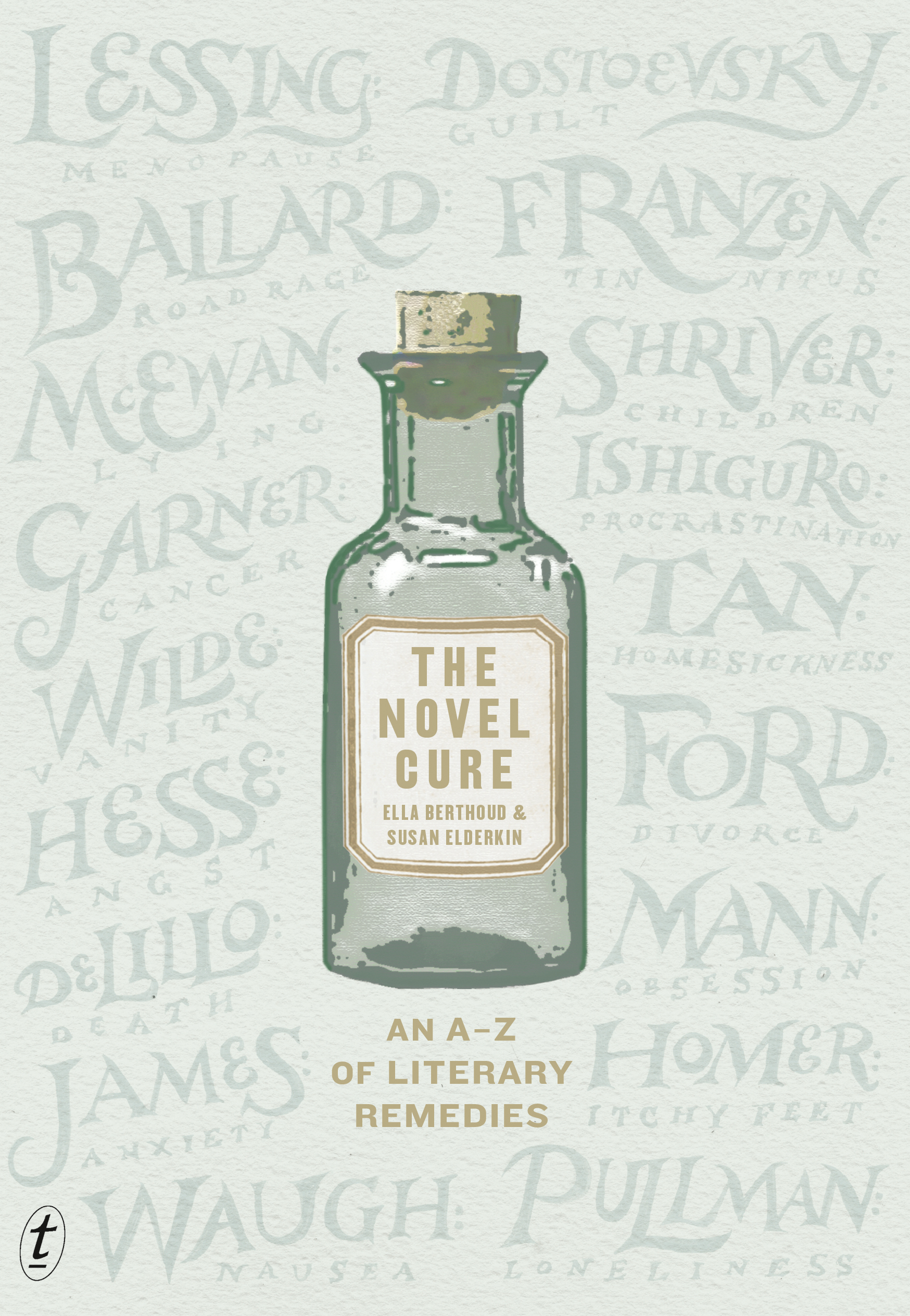
Novel Cure bookcover

Novel Cure (Courtesy: Text Publishing)

I don’t usually blog about books before I’ve read them cover to cover, but I’m making an exception for Ella Berthoud and Susan Elderkin‘s The novel cure because it’s one of those books that’s best read in small doses (no pun intended). You see, it is a book of bibliotherapy, a book that recommends novels to read to cure almost any ailment you can think of.

Bibliotherapy is described in Wikipedia, but I’ll give you Berthoud and Elderkin’s definition:

the prescribing of fiction for life’s ailments.

I don’t want to give away too many treatments. After all, the authors need to eat. But, to give you a taste, here is a sample of ailments and their prescribed treatments:

  • Daddy’s girl, being a: Can you guess the treatment? It’s Jane Austen’s Emma! You didn’t expect me not to start with Jane Austen did you? Emma, Berthoud and Elderkin say, “has been sent out into the world with an overly high opinion of herself and a self-centredness that can only bring her grief”. They suggest Emma should be seen as a cautionary tale and that girls at risk need to “stop playing the game and show him [their father] what a bad girl you can be”. “See: rails, going off the, for inspiration.” Are you getting the idea?
  • Control freak, being a: The authors suggest two Australian books. Is there something these two Englishwomen are trying to tell we colonials? Both are books I’ve reviewed here, Elizabeth Harrower’s dark The watch tower (my review) and Graeme Simsion‘s comic The Rosie project (my review).
  • Nose, hating your: What else could they suggest for this but Patrick Süskind‘s chilling Perfume. That’s a novel that’s not easy to forget. For all the horror of this novel, the authors manage to turn it to a positive purpose, one determined to help the self-esteem of those self-conscious about their noses!

As lighthearted as all this might sound, the authors do believe in the efficacy of literature to help ease (if not cure) both emotional and physical pain. They apparently hold highly successful bibliotherapy sessions and retreats in the UK. Among the ailments in the book is “Eating Disorder” and the two recommended books, Deborah Hautzig‘s Second star to the right and Jenefer Shute’s Life-size, are serious offerings for sufferers and their carers.

Like the good reference book it is, The novel cure includes see references (such as “Control, out of: See adolescence, alcoholism …”) and see also references (such as “Old age, horror of: See also amnesia, reading associated ….”). These helpful pointers warmed the cockles of my little librarian heart.

Scattered through the book are “Ten Best” lists, for which there is an index at the back so you can find them easily. One that made me laugh is “The Ten Best Novels For When You’ve Got A Cold”. As all Australians know, the best remedy for a cold is eucalyptus. It’s fitting then that Murray Bail‘s gorgeous novel Eucalyptus is top of the list.

There are two other indexes at the back of the book. One is the Index of Reading Ailments (for such life-threatening conditions as “Holiday, not knowing what novels to take on” and “Household chores, distracted by”). And the other is, of course, the Index of Novels and Authors. This makes the book useful for those of you who don’t have any ailments needing cure. You can  see if your favourite novels are cures for others.

You will also see, if you look at this index, the breadth and depth of authors and their works covered in this book. I was thrilled to see many Australian authors represented, covering more than a century of Australian literature. As far as I can tell, every continent is covered. The authors include, for example, South African Lauren Beukes, Indian Rahul Bhattacharya, French Albert Camus, Mexican Laura Esquivel, Japanese Haruki Murakami, Russian Leo Tolstoy, and so on. This index comprises eight two-column pages.

To conclude, I’ll offer my own ailment and cure: Reading slump, being in a: Read The novel cure. You’re sure to find a book or two to cure you and, if you don’t, well, you’ll be reading anyhow!

Ella Berthoud and Susan Elderkin
The novel cure: An A-Z of literary remedies
Melbourne: Text Publishing, 2013
Cover design: WH Chong
456pp.
ISBN: 9781922079350

(Review copy courtesy Text Publishing)