Helen Macdonald, H is for hawk (Review)

Helen Macdonald, H is for hawkMy reading really has been rather odd lately. I’ve read a memoir about horse-racing (Gerald Murnane’s Something for the pain), a novel about hedge-funds and investment banking (Kate Jenning’s Moral hazard), and now a grief memoir focused on falconry (Helen Macdonald’s H is for hawk). None of these are topics I would naturally pick up, but in each case I’ve enjoyed being presented these very different worlds. H is for hawk, this post’s subject, is additionally interesting because it combines three different forms of writing – memoir, biography and nature writing.

T. H. White lecturing on his Arthurian fiction (Courtesy John J. Burns Library, Boston College, via Wikipedia CC BY 2.0).

TH White (Courtesy John J. Burns Library, Boston College, via Wikipedia CC BY 2.0).

As I don’t read reviews before I read books, I really didn’t know what I was getting in for, except that I understood it was about a woman managing her grief through raising a hawk. It is about this, but it is about so much more too, including being a sort of mini-biography of novelist TH White. You probably know White through his most famous works, The once and future king and The sword in the stone, but you may not know that he also wrote a book called Goshawk about the training of his goshawk called Gos. Imaginative name that! Macdonald was far more creative. She named hers Mabel! (She does explain this surprising tame-sounding name).

Many people have written about falconry over the years so why does Macdonald light on TH White? Well, it’s complicated. She had read Goshawk when she was a young girl, and hadn’t much liked it. However, she read it again and

saw more in it than bad falconry … White made it a metaphysical battle. Like Moby-Dick or The old man and the sea, The goshawk was a literary encounter between animal and man that reached back to Puritan traditions of spiritual contest …

White, you see, wrote it after he’d left his teaching post in 1936 to live in a workman’s cottage. He was fleeing a world in which he, a homosexual, didn’t fit, a world in which he had to live “in perpetual disguise”. Macdonald suddenly recognises a fellow-feeling, writing that

I felt, for the first time, that my urge to train a hawk was for reasons that weren’t entirely my own. Partly they were his.

Because MacDonald was training her hawk to escape her grief following the sudden death of her beloved father. She was, she writes, “running” like White. Both, we gradually learn, experience a sort of madness that they need to resolve and recover from.

And so the book progresses in fits and starts, but chronologically so, as Macdonald parallels the awful and sad story of White and Gos with hers and Mabel’s. It makes fascinating reading.

Now, this book has been out for well over a year. It won the Samuel Johnson Prize for Non-fiction (which our very own Anna Funder won for Stasiland) among other awards and shortlistings. It’s been comprehensively reviewed, I believe, so I fear reiterating what others have said before. Consequently, I’m just going to give a broad brush overview of my response to it (and follow up with a Delicious Descriptions post of some of its truly gorgeous nature writing).

To start with, I enjoyed it immensely. It fits into what we call literary or creative non-fiction. That is, it uses some novelistic techniques such as dialogue, poetic imagery and a narrative arc, but it is very definitely non-fiction. It contains a lot of fact about her life, and much research about falconry and TH White. And there are several pages of end-notes identifying sources of quotes, though these notes are not flagged in the text.

I was fascinated by her stories of falconry – her own and from the past – and I am always interested in the lives of writers. Macdonald is an historian by profession, and weaves history through the telling of her own experiences. Although as a child she had agreed with the general censure of White’s training of Gos, as an adult she is more sympathetic, empathising with White’s loneliness and understanding his lack of knowledge and experience. I must say that while I was intellectually interested in the falconry, I would be among those of her friends who find the idea “morally suspect”. It seems a cruel activity to me – and, in fact, cruelty is one of the many threads running through the book. White, who had been physically and emotionally abused as a child, was, apparently, a “sadomasochist”, though Macdonald argues that he consciously worked to keep that part of himself at bay.

This brings me to another aspect of the book I enjoyed – the way she weaves multiple ideas or themes through it. Freedom is one. Macdonald seeks it through her hawk:

The hawk was everything I wanted to be: solitary, self-possessed, free from grief, and numb to the hurts of human life.

Hawks seek it too, sometimes. Macdonald describes “bating”, in which a bird tries to fly from a fist or perch while still attached, as a “wild bid for freedom”. And White definitely seeks freedom. Macdonald frequently refers to his desire for it. She quotes his own writing:

A longing came to my mind, then, that I should be able to do this also. The word ‘feral’ had a kind of magical potency which allied itself with two other words, ‘ferocious’ and ‘free’ … To revert to a feral state I took a farm-labourer’s cottage …

Feral. This word conjures another theme, that of wildness. Both White and Macdonald revert to wildness in their own way – by training wild birds, and by withdrawing from society. Macdonald describes how she becomes, essentially, one with her hawk. She starts to think and see like a hawk, and is taken, she writes, “to the very edge of being human”. Eventually though, sense returns. She comes to understand that falconry is “a balancing act between wild and tame” – and not just for the hawk! She rejects American naturalist John Muir’s “earth hath no sorrows that earth cannot heal”, arguing instead that “the wild is not a panacea for the human soul.” All this makes me think that there’s a fourth form of writing that this book could fit into – the quest story – because it is, fundamentally, a quest for sanity and peace, for both Macdonald and White.

There are other ideas and themes, but I fear that my broad brush is starting to become a fine pen. I will write a little about nature and the environment in my Delicious Descriptions post, so will end my main analysis here.

I read this with my reading group. Some found Macdonald a little too self-obsessed for their liking. Why did the death of her father create such a schism in her soul? Why was she not able to see that her mother’s need, as the bereaved spouse, was surely greater? I wondered a little about this too, though it didn’t affect my appreciation of the book. The answer is, I suppose, that we are all different. For whatever reason – timing, perhaps, the quality of the father-daughter relationship, definitely – Macdonald’s father’s death knocked her for a six. Having accepted that as a given, I found H is for hawk a thoughtful, complex book that engaged me from the start.

This is a long post, I know, but I want to share one more thing. It occurs two-thirds of the way through the book, and, to me at least, shares one of life’s important lessons:

There is a time in life when you expect the world to be always full of new things. And then comes a day when you realise that is not how it will be at all. You see that life will become a thing made of holes. Absences. Losses. Things that were there and are no longer. And you realise, too, that you have to grow around and between the gaps, though you can put your hand out to where things were and feel that tense, shining dullness of the space where the memories are.

Helen Macdonald
H is for hawk
London: Vintage Books, 2014
300 pp.
ISBN: 9780099575450
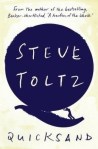
Steve Toltz, Quicksand (Review)

Steve Toltz, Quicksand, soverAldo Benjamin, the anti-hero of Quicksand, accuses wannabe-writer-friend Liam of having “such little imagination”. You could not, however, accuse the novel’s author, Steve Toltz, of this. Quicksand reads a bit like a 19th century satirical novel transplanted into the 21st century. It is big in size (though not as big as his first, A fraction of the whole), broad in subject matter, and full of colourful characters. It’s wild, imaginative, and darkly funny. It’s the sort of novel that you can tackle from different angles depending on what interests you most. Religion, god and fate? Tick. Life and death? Tick. Love and friendship? Tick. Social commentary? Tick. Art (broadly), artists and the making of art? Tick.

“Bad luck is my pathology” (Aldo)

Before I tell you what interested me, though, a little about the plot. Quicksand is the story of Aldo Benjamin, told partly by his friend, Liam Wilder, and partly by himself. Meeting at high school, Aldo and Liam remain friends until the book closes when they are in their early to mid 40s. Together they reveal the ups and downs – mostly downs – of Aldo’s life as he tries to make his way against what he sees as the tide of fate or bad luck. The novel opens when they are in their early 40s and Aldo, a wheelchair-bound paraplegic, has just been released from prison. We don’t know how long he’s been in the wheelchair or how that came to be, and we don’t know why he’d been in prison. These come out in the course of the novel, which flashes back in chapter 2 to their schooldays and then moves between the past and present to tell the story. We also discover in the opening chapter that Liam is trying to restart his writing career by writing Aldo’s story, much to Aldo’s resigned disgust: “I’m nobody’s muse”, he says. Ironically, though, not only is he Liam’s muse but he’d also been one for his musician wife, Stella, and photographer lover, Mimi.

Aldo, “The King of Unforced Errors” as Liam calls him or a sufferer of “clinical frustration” as Aldo sees it, gets into all sorts of strife. He is regularly bailed out by friends (who cover “the full suite of professional services” such as policeman Liam, Doc Castles, his old school teacher Mr Morrell) and lovers. Nothing much works for him, particularly not his various get-rich-quick business ideas, like the device that was supposed to detect the presence of peanuts in food, or clothing for obese toddlers, or tanning salon taxis, or maternity clothes for goths (“a demographic with an 85% abortion rate”). Moreover, his marriage fails, his child dies, his multiple suicide attempts are unsuccessful, and, to rub salt into his wounds, he ends up in the two places he most fears, prison and hospital. As Liam says in response to Aldo’s question about why write his story:

Because you’ll inspire people. To count their blessings.

I love this sort of writing, this dark humour. It’s full-on to read because lines like this frequently fall over each other, sentence after sentence, leaving you wanting to stop and smell the roses for a minute. Still, I was hooked by page 5 when Aldo presents to Liam a long list of our 21st century insecurities, pretensions and self-deceptions, including

‘You know how people are worried their kid’s going to turn to them and say, What did you do to the biosphere, Daddy?

AND

‘And you know how there’s no replacement cycle too short for today’s consumer?’

AND

‘You know how while we’re enjoying reading dystopian fiction, for half our population this society is dystopia?’

These go on for three pages. Wonderful satire. No matter how superior we might feel about most of the pronouncements, there’s bound to be one or two that get us where it hurts! Toltz looks unblinkingly at our lives and shines them right back at us in the most direct, no-punches-pulled way. It made me laugh – but ruefully, if not guiltily at times – almost every page.

“To troubleshoot the human spirit” (Liam)

The other aspect I enjoyed was the thread about art, artists and art-making. The major focus of this is Liam’s novel about Aldo’s life. After years of failure and giving up, Liam finally decides that Aldo is his “natural subject”. Writing about him, Liam tells Aldo, would be “to troubleshoot the human spirit”. It would, he thinks, throw him “into a head-on collision with the meaning of fate, humanity’s sure, but Aldo’s strange specific one too”. Aldo and Liam discuss Liam’s progress frequently, with Aldo always ready with an astute comment or criticism. “Does my character in your book”, Aldo asks, “need to be more consistent than my character in real life?” “No,” says Liam, though in fact many readers do, I find, prefer it to be so!

Liam is not the only creator in the novel. Aldo’s musician wife Stella plunders Aldo’s life for her songs, and then there’s the art teacher from Liam and Aldo’s school, and the artists in the artists’ residence where Aldo lives for a time. Through all these the novel interrogates why we make art, what art is about. Early on, before he starts his Aldo novel and after years of failure, Liam decides to give up writing. He says

I had settled into a life I had always feared but secretly desired, a life uninterrupted and unencumbered by art.

Chapter 2, though, begins with art teacher Morrell’s statement that:

We make art because being alive is a hostage situation in which our abductors are silent and we cannot even intuit their demands.

Art is not, however, presented as something that is easy or even always right. Toltz’s artists struggle to achieve, are frequently self-obsessed, and unapologetically mine their friends and family for material, all the while, thinks Aldo at least, having a good time. “Their brains are all pleasure centres and no circumference”, he tells the court. They are not, in other words, unilaterally lauded, but this is, of course, ironic, if not subversive, since what we are reading is a novel, a work of art itself. The wheels within wheels in this novel – the ironies, the paradoxes, the self-reflexivity – sometimes make your head spin, but in the end, there is an end, and it’s a surprisingly positive one.

And here, I’ll end! This novel is so full of funny lines, so full of ideas, so full of biting commentary, that it’s hard to know when to stop so, as EM Forster* wishes novelists could do, I think I’ll just end, not because I’m bored which is the reason he gives, but because I might as well.

Lisa at ANZLitLovers also enjoyed it.

Steve Toltz
Quicksand
Hamish Hamilton, 2015
435pp.
ISBN: 9781926428680

* Aspects of the novel, by EM Forster

Reading highlights for 2015

Well, dear readers, we have turned the calendar to 2016 so I can now reveal my highlights for 2015. As usual, I won’t be naming top picks. I find that too hard to do. Instead, I’ll discuss highlights which combines best reads with those that were interesting for other reasons. I’d love to mention every book I read, as every one had something to commend it. I have too little time for reading to read books that have no value!  (Seriously. I know I’m retired, but …)

First, though, this year’s …

Literary highlights

By literary highlights I tend to mean literary events, and I went to a few this year (though no writer’s festivals. One day!) What I did attend, though, gave me such pleasure, not to mention new things to think about:

  • Carmel Bird’s launch of Marion Halligan’s latest novel, Goodbye sweetheart, at one of Canberra’s best independent bookshops, Paperchain. This was particularly a thrill because, out of the blue, Carmel Bird emailed me asking me if I’d like to post her launch speech on my blog. I would and I did. I’m embarrassed to say though that the book is still on my TBR. This has been a bad reading year. Bird and Halligan are two of Australia’s literary treasures. Unfortunately, I was travelling in Tasmania when Bird returned to Canberra later in the year for an In Conversation event with Halligan. (And here, I’ll sneak a reference to Carmel Bird’s clever, delightful essay Fair Game which I did read and review!)
  • Jane Austen Society of Australia’s biennial weekend conference titled this year, Emma: 200 years of perfection. I wrote three posts on this wonderful weekend, here, here, and here. No matter how often I read Austen, or how many academics write about her, there’s always to something new to learn.
  • Robert Drewe’s talk titled Who, me? for the National Library of Australia’s Seymour Biography Lecture. Halligan* needn’t feel too badly about her book still being on my TBR pile, because Drewe’s second memoir, Montebello, that I bought at this event, is there too.
  • Author talk with Kate Llewellyn, Barbara Hill and Ruth Bacchus, focusing on Hill and Bacchus’ edition of selected letters written by Llewellyn (my review).
  • Griffyn Ensemble’s Utopia Experiment concert was a musical event, but its focus on poet Dame Mary Gilmore made it, for me, a literary musical event – and a most enjoyable one at that.

Reading highlights

As I’ve done in previous years, I’m going to discuss this year’s reading under categories which reflect this year’s experience.

Literary trends … in my reading, anyhow

  • ScarfeHungerWakefieldHistorical fiction: I don’t see myself as a reader of historical fiction, and yet it seems to feature significantly in my reading fare. I guess it’s a case of interesting stories will out, no matter when they are set. Not surprisingly, most of these stories deal with the poor, or disadvantaged, such as Eleanor Limprecht’s Long Bay about a young woman gaoled for manslaughter in early 1900s Sydney, Wendy Scarfe’s Hunger town set on the Port Adelaide docks in the 1920s-30s, and Emma Ashmere’s The floating garden about a woman losing her home through construction of the Sydney Harbour Bridge in early 1930s Sydney. Emily Bitto’s The strays is not about disadvantaged people, but her Bohemian arts community of 1930s Melbourne comprises people on the edge of society in another way. I’d happily recommend all these books for the way they evoke their respective eras – and for the variety of their subject matter.
  • Farm stories: Although Australia is one of the world’s most urbanised nations, we do have farmers! Given climate change, concerns about food security, not to mention, here in Australia, the dispossession of indigenous people from their land, it’s good to see “literary” authors tackling these issues, such as Jessica White in Entitlement and Alice Robinson in Anchor point. Coincidentally, my first review for 2016 will probably be a farm story …
  • Climate change: Speaking of climate change, I’m keen to continue reading novelists who tackle this issue, and have created a cli fi tag to identify them. This year, in addition to the above mentioned Anchor point, I loved Jane Rawson’s inventive A wrong turn at the Office of Unmade Lists.
  • Danielle Wood, Mothers Grimm, book cover

    Courtesy: Allen & Unwin

    Is it a novel?: I love it when writers play with form, and two Australian books I read this year thrilled me with their use of the short story/long short story/novella forms to produce fascinating works: Ellen van Neerven’s Heat and light and Danielle Wood’s Mothers Grimm. And then there was Julian Davies’ Crow Mellow, with its exhortation on the back page that “This book is a novel. It has drawings on every page”. It is a novel – but the drawings add another dimension to the reading experience.

  • Short stories rule: I read some excellent short stories this year, and particularly enjoyed John Clanchy’s Six and Paddy O’Reilly’s Peripheral vision. Angela Meyer’s collection of flash fiction, Captives, also captivated me!
  • From over the seas: Contrary to how it might look, I did read some books that weren’t Australian. The three standout novels were Vincenzo Cerami’s A very normal man, Aminatta Forna’s The hired man, and Neel Mukherjee’s The lives of others.
  • It wasn’t all fiction: While fiction is my main fare, I do enjoy non-fiction too. Standouts this year were Karen Lamb’s biography Thea Astley: Inventing her own weather, Richard Lloyd Parry’s true crime work People who eat darkness, and Biff Ward’s memoir In my mother’s hands.
  • Mark Henshaw, The snow kimonoSpecial mentions: I can’t complete this list without mentioning two books that don’t fit the above categories but must be mentioned: Mark Henshaw’s The snow kimono and Fiona McFarlane’s The night guest. Both take their readers on a merry (or not so merry really, but you know what I mean) dance, and are very satisfying reads.

Serendipitous Reading Stats

Just because I like them (these percentages are for this year of course):

  • 67% of the authors I read were women.
  • 27% of the works I read were not by Australian writers.
  • 73% of my reading was fiction (short, long or in-between!)
  • 20% of the works I read were published before 2000
  • 30% of the works I read were published in 2015
  • I reviewed multiple (2) works by two authors – Jane Austen, and Ellen van Neerven

I did not achieve my one real goal for the year, which was to read more from my TBR, and, for reasons which regular readers here know, I did not manage to read more books. But, I had a great reading year, nonetheless, and I want to thank you all for joining me in my journey – for reading my posts, engaging in discussion, recommending more books to read and, generally, being all-round great people to know (cyberly, anyhow). I wish you all a wonderful 2016, and hope to see you here whenever the spirit moves you.

What were your reading or literary highlights for the year?

* I nearly missed the autocorrect of Halligan to Halogen!

Neel Mukherjee, The lives of others (Review)

MukherjeeLivesOthersChattoBefore I talk about Neel Mukherjee’s Booker Prize short-listed The lives of others, I want to briefly mention the experience of reading it on the Kindle. I probably haven’t told you my little reading rule of thumb before, which is that I aim to buy Australian books in print, and overseas books electronically. It’s my measured foray into downsizing!

However, I don’t greatly enjoy reading on my Kindle. I like the Kindle itself. It handles pretty much like a book, the e-ink technology is easy on the eye, it’s light and portable, and with this particular author whose vocabulary is impressive, I did find the in-built dictionary to be very useful. But, I don’t find reading books in e-formats particularly pleasurable. It’s not easy to get the measure of a book, to flick through it and see what’s what. Consequently, I didn’t discover the family tree until I’d read the first couple of chapters. Now, if you’ve read this book, you will know that the three generations of the Ghosh family who live in a four-storey house are introduced in one chapter. Their names are unfamiliar to a westerner’s ears making it hard to remember who’s who, so that family tree was a godsend. But, I only found it when a a reading group friend mentioned its existence. The diagram’s small print was, though, very hard to read, and could not be enlarged like e-text can, so I hand-drew a family tree, photographed it, and shared it with my group. Then there were the many specifically Indian words that were not in the dictionary. They were in the glossary at the back, but it’s tedious flipping between glossary and text in an e-book environment, so I didn’t. How hard would it have been to hyper-link those words to the glossary?

“the very quicksands of family” (Suranjan)

Rant over, let’s talk about the book! The lives of others is set in West Bengal from 1966 to 1970, with two epilogues set much later, one in 1986 and the other in 2012. It centres on the aforementioned Ghoshes, a well-to-do family whose wealth comes from paper mills. By the time the novel opens, business is starting to fail, so there is tension in the air, exacerbating the rivalries, envies and secrecies which characterise the family’s relationships. That’s the personal, but this book is also political, because one of the characters, a grandson of the old couple, becomes a revolutionary with the Naxalites, a section of the Communist Party of India (Marxist) (or, CPI-M). In 1967, they commenced radical action to redistribute land to landless farmers and labourers. The book’s chronology mirrors the early years of this movement.

Indeed, the book is chronologically structured, with each chapter labelled by date. The first thirteen of its nineteen chapters comprise two sections – a third person story about the family in the Calcutta house, and a first person epistolary story (presented in a different font – unless your e-book was on an iPad, but that’s another story) by Supratik, the revolutionary grandson who is in the countryside “where the real politics lay”. This first person story finishes in chapter 14, when Supratik returns to Calcutta. The effect of this structure is to parallel manipulative behaviour and power plays in the family with the societal/political power imbalances against which Supratik fights. Just before he leaves the family, Supratik says to his mother, Sandhya:

Are you happy with the inequalities of our family? Of the power-on-top-ruling-people-below kind of hierarchy? Do you think it’s right? Has the thought ever crossed your mind that the family is the primary unit of exploitation?

This structure is just one example of how carefully the book is crafted. There are also allusions – and I’m sure there are many that I didn’t get – to literary classics. Chapter 4’s opening line that “not all family bonds are equal” must surely allude to the opening of Anna Karenina, which is also both about family and land/farm reform. And there’s a scene reminiscent of Sense and sensibility. In it the Ghosh patriarch, Prafullanath, is done out of the inheritance his father wanted him to have by a half-brother, who is spurred on by his wife. This reminded me of Fanny Dashwood talking husband John out of properly helping his stepmother and half-sisters, despite his dying father asking him to do. One of the themes of Sense and sensibility is economic power and inequality, and how families can wield power.

“this unvarying calculus about the worth of one’s own kind measured against the lives of others ” (Supratik)

Mukherjee, however, takes these themes to another level. The lives of others is a powerful and often brutal book. The prologue, which tells of a murder-suicide enacted by a poor sharecropper after consistently receiving no help from his landlord for his starving family, establishes the two main themes – economic inequity, and the inhumane treatment of “others”. These themes are played out in the way various members of the family treat each other, their workers and those with whom they come into contact, and are paralleled in the farm politics which engage Supratik’s passion. While the themes can be simply stated, the story-telling is sophisticated. Complex links and parallels, together with concrete and abstract motifs, evocative images and targeted allusions underpin the novel’s layers to expose human capacity for cruelty, self-preservation and self-deception. In a devastating conclusion, Mukherjee shows what happens when idealism loses sight of the humanity it is trying to protect, when calculation over-rides empathy. He offers no answers, makes no judgements, but simply shows.

The result is tough, and sometimes very uncomfortable, reading, but what drove me on was Mukherjee’s language. It is truly delicious. The imagery is accessible, often referencing the very ordinary, but it is so fresh that it takes its mark perfectly, again and again:

… if you fail an exam, it decreases the chances of getting out of the system that will slowly crush you to a flat piece of cardboard

AND

Two things with the power to scrunch Prafullanath’s plans into a shapeless paper bag had not occurred to his myopic mind.

AND

His voice has the serrations of a knife in it.

Cardboard, paperbags and knives. All so mundane but, in Mukherjee’s hands, so on the money. Here’s one more, describing one of the daughters-in-law:

Haranguing the servants at last gave Purnima a point of convergence for all her diffuse days and energies to focus on, and she took to it like a spindly, undernourished sapling to rich loam.

Mukherjee’s ability to capture people and place with such vividness and clarity is impressive. It’s not a perfect book, being weighed down at times by detail that, interesting though it is, doesn’t always seem essential.

However, Mukherjee’s compassionate but unsentimental understanding of human nature, combined with his clear-eyed analysis of how the personal interacts with the political, reveal uncomfortable truths about our dealings with other, and make him, unlike Supratik, a more trustworthy “defence counsel for humanity”.

Neel Mukherjee
The lives of others
London: Chatto & Windus, 2014
ISBN (e-pub): 9781448192182

Emily Bitto, The strays (Review)

Emily BItto, The strays, book coverLet me start by saying I really enjoyed reading Emily Bitto’s The strays. It was scheduled for my reading group the day after my return from Tasmania, and I suddenly found myself in the last day of my Tasmanian holiday without having started the book. Wah! I read it in two days, helped by several hours in a couple of airports. I haven’t done that for a long time, and what a joy it was to have a real length of time to commit to a book. It helped, of course, that having both a strong plot and an intriguing set of characters, The strays is compelling to read. It reminded me, albeit loosely, of Evelyn Waugh’s Brideshead revisited and Ian McEwan’s Atonement.

This is a debut novel, which also won this year’s Stella Prize. Set primarily in the 1930s, with the last of four parts set in the 1960s, The strays is both historical fiction and a coming-of-age novel. It is also a classic outsider story. Lily, who tells the story first person, is befriended when she is 8 years old by schoolmate Eva, the middle daughter of the Trenthams who, early in the novel invite a number of artist “strays” to form a utopian-bohemian artistic community. The Trenthams are inspired by the Reeds and their Heide group, but The strays is not a Heide story*.  This may be the strength of the novel, but also perhaps its weakness – a strength because it frees Bitto to tell her own story, but a weakness because it removes potential ideas on which to hang her story.

Before I get to that, though, a little more about the story. The first three parts follow the Trenthams for 8 years, from when Lily is 8 to 16. During this time Lily becomes increasingly involved with the Trenthams, in preference to her boring, conservative, middle-class parents, eventually living with them full-time. Some members in my reading group found her parents’ relinquishing of their daughter unbelievable, but this was during the Depression, and Lily’s parents did have some problems of their own to manage. I could suspend my disbelief. From Lily’s point of view, she was in thrall to the excitement of the Bohemian life, telling her parents, “I love you both but I want to be different”.

Her parents, however, should have been concerned, because the Trenthams are rather casual, neglectful parents and the four girls more or less run their own lives, sometimes being fed properly, sometimes not, sometimes, in the case of one in particular, going to school, and sometimes not. The story is as much about them, as about the artists, though we do hear about the artists too. There’s exploration of experimental art and its acceptance or otherwise by society, obscenity charges, mentee supplanting mentor, and so on. There are parties, and other occasions, where artists and children come together. Bitto, through Lily, paints all this beautifully. Indeed, I loved her ability to evoke scenes, people and places with effective, yet tight imagery.

Bitto’s use of Lily as her narrator works nicely. Through most of the novel, we see the story through her child’s point-of-view, but occasionally, with a “later I realised” type of comment, we are reminded that this is an adult telling the story of her childhood:

When was it that I became a voyeur in their midst? I was the perfect witness, an unsuspected anthropologist disguised within the body of a young girl, surrounded by other young girls who were part of the family. Yet I was cuckoo in the nest, an imposter who listened and observed, hoarding and collecting information.

This narrative style keeps the story grounded. We see the dysfunctional dynamics and its effects before Lily, wooed by the excitement, does – though she does have moments of clarity. When the youngest daughter goes missing on one occasion, she writes:

I drew in my breath. These adults were no use in a crisis.

The subtext is that her parents would be.

But, here’s the thing. The book tackles a lot of ideas. There’s the exploration of society’s reaction to experimental art; the idea of coming to terms with the past (for Lily); the utopian artist community and whether it can really work; indulgent or neglectful parenting, creating a dysfunctional family life that comes back to bite; the exploration of girlhood friendships and the whole coming-of-age thread; not to mention those big issues like loyalty and betrayal, envy, sexuality and sensuality. It’s not that these were uninteresting, or even that they weren’t well developed. It’s more that I struggled to find Bitto’s main focus, and I guess I like some sort of central idea on which to hang my understanding of a book.

My reading technique is that when I finish a book I go back and reread the beginning. This usually puts the whole into context, pinpointing what the author was about. However, this technique didn’t work wonderfully with The strays. Bitto’s Prologue starts by discussing the mystery of instant attraction between people, and then moves on to the idea of past life connections and that people’s souls can be twinned from one life to the next. These ideas are used to explain Lily’s relationship with Eva, but I’m not sure that this is fundamental to the book’s meaning. The prologue then discusses the past. Three decades after the main events, Lily receives a letter:

and I become aware of an old compulsive pain I have pressed like a bruise again and again throughout the years.

AND

I feel a tenderness in my chest, and the past rushes in as a deluge I can no longer hold back …

AND

I let my mind turn back once more, to recreate again that distant, still wracked past.

Is it this, the idea of coming to terms with or resolving the past, that binds the book together? It is partly. By the end of the novel, Lily has come uneasily to terms with what happened those three decades ago, and its impact on her life. I say uneasily because – and here we come to the epigraph, by William Pater, which expresses a different idea again to those in the prologue: “To burn always with this hard, gem-like flame, to maintain this ecstasy, is success in life”. Lily’s uneasiness is that she has chosen “conventionality”, but recognises that part of her “is still drawn to the romance of the fully lived life”. Then we have the book’s concluding paragraphs, which are more concerned with mothering and family in Lily’s recognition that it was the Trentham children who paid the debt for their parents’ experiments. See my problem regarding central idea? Or, is it just that I’m being boringly 20th century?!

Whatever it is, they are just niggles. As a read, The strays is up there as one of my most enjoyable for the year – for its lucid writing, for the story and a setting that had such appeal, and, yes, even for that whole raft of ideas that she throws so determinedly at us. Even for that.

Lisa at ANZLitLovers enjoyed the book too.

* Interestingly, a couple of “real” people are mentioned, one being politician and later judge, Herbert Evatt – as a supporter of modern, experimental art.

awwchallenge2015Emily Bitto
The strays
South Melbourne: Affirm Press, 2014
290pp.
ISBN: 9781922213211

Hanif Kureishi, The buddha of suburbia (Review)

Hanif Kureishi, The buddha of suburbiaThe first thing to say about Hanif Kureishi’s 1990 Whitbread award-winning novel The buddha of suburbia is that it’s pretty funny. It’s a comic satire – over-the-top at times, confronting at others. It has its dark moments, but it’s also brash, irreverent and ultimately warm-hearted towards its tangled band of not always admirable but mostly very human characters. I’ve come late to this book, and only read it now because my reading group decided to align one of our books with ABC RN’s bookclub, which this year is featuring novels from the subcontinent. Kureishi’s book was one of the few we hadn’t read, so it got the guernsey.

It’s a coming-of-age novel about Karim, who is seventeen years old at the start and the son of a Pakistani/Muslim father from Bombay and an English mother. He lives in the suburbs south of London, a place populated, in his eyes, by “the miserable undead”. He wants to live “intensely: mysticism, alcohol, sexual promise, clever people and drugs”. The dreams of a young man which, of course, run counter to everything his parents would wish for – except that his parents aren’t watching. His father leaves his mother early in the novel to pursue his own mid-life crisis enlightenment as a “buddha” dispensing wisdom to other suburbanites, while his mother sinks into her misery and her bed. And so the scene is set …

This is a rather raunchy, bawdy read in which characters push the sexual envelope with little concern for consequences. They engage in all sorts of sex for all sorts of reasons that represent a broad spectrum of human experience and behaviour, some loving, some brutal, some exploratory, some exploitative. The novel is set in early to mid 1970s England, before AIDS, at the dawn of punk, and just before Thatcher’s England (1979 to 1990). This could date it, but I don’t think it does, because its concerns remain relevant today: racism, multiculturalism, the stereotyping of “other”, materialism versus the search for meaning, the role of the arts in our lives, and of course, given the title, the urban-suburban divide.

So, what happens? Both a lot, and not much, in that this is a character and ideas-driven novel rather than a plot-driven one. Told first person by Karim, the novel has two parts – “In the suburbs” followed by “In the city”. In the first part Karim talks of his life in the suburbs, of his friends and family, and describes the breakdown of his parents’ marriage as his father moves in with the lively go-get-’em Eva. It’s a life characterised by racism:

The thing was, we were supposed to be English, but to the English we were always wogs and nigs and Pakis and the rest of it.

Aspirations are low, and education is not seen as being useful:

This was the English passion, not for self-improvement or culture or wit, but for DIY, Do It Yourself, for bigger and better houses with more mod cons, the painstaking accumulation of comfort and, with it, status – the concrete display of earned cash.

The city, on the other hand, is a place where you can remake yourself. It seemed, to Karim, like “a house with five thousand rooms, all different”, far from the stultifying dullness of the ‘burbs. But the dichotomy is not as simple as it sounds. Having moved to the city, like his father and Eva, Karim continues to return to the suburbs to see friends and family. He experiences warmth and support there, while the city, where “the piss-heads, bums, derelicts and dealers shouted and looked for fights” can intimidate him.

Nonetheless, once in the city, Karim does start to remake himself – as an actor. But, as elsewhere in the novel, there’s a sting in the tail. The first role Karim is offered is Mowgli in The jungle book. He does well, and his white family and friends praise him, but his honest, feisty childhood friend Jamila sees it differently:

‘And it was disgusting, the accent and the shit you had smeared over you. You were just pandering to prejudices …’.

Karim, who has, earlier and somewhat defensively, described himself as “beige”, moves on to another theatre group where he is chosen because he is “black”:

‘We need someone from your own background,’ he said. ‘Someone black.’
‘Yeah?’ I didn’t know anyone black, though I’d been at school with a Nigerian.

I think you’ve got the drift now. The humour is sharp, with stereotypes being subverted, twisted or just plain skewered. The book is full of witty asides, clever but insightful quips, and some downright absurd situations. There’s tenderness too. I loved the “heart-ambulance”, in the form of a sister and brother-in-law arriving to take Karim’s mother home with them when her heart is broken.

There’s a fascinating subplot involving Jamila and the marriage arranged for her by her father, Anwar. She accedes, but when her husband, the physically disabled hapless but kind-hearted Changez arrives, she lays down the rules for their so-called marriage, and then sets about reinventing herself – in the suburbs – as a strong, independent, liberated woman.

I said at the beginning that this is a coming-of-age novel, but it’s more than that. It’s about transformation and shape-shifting for people of all ages. The only character among the central group, who is unable to accept the challenge of change, is Jamila’s father Anwar, and his ending is not a positive one. By contrast, his friend, Karim’s father, seeks enlightenment. He wants to be something more than a Civil Service clerk who will never be promoted above an Englishman. So, he sets himself up as a “buddha”, a “visionary” who will provide wisdom from the east. I loved the multiple satire here – the joke of suburbanites seeking wisdom from a so-called eastern mystic, and the subversive idea of a Pakistani Muslim setting himself up as that mystic, a buddha.

The novel is about other things too, such as the arts and culture, and the possibility they offer for salvation. While Karim develops a career as an actor, working out how he can or should use his “culture” to further his goals, his friend Charlie reinvents himself as punk star, Charlie Hero. Like Karim, though for different reasons, he discovers it’s not all as straightforward as he thought.

It’s also about love – romantic love, sexual love, parental love, and the love between friends. All the characters seek it, though not all find it. And underpinning all this is the “immigrant condition”, and the idea that, perhaps, “the immigrant is the Everyman of the twentieth century”.

But, in the end, what it’s really about is the desire for a meaningful life and, without giving away details, I think it’s fair to say that most of Kureishi’s characters achieve this, albeit somewhat messily. That said, I can’t help thinking that Karim’s conclusion that “I thought of what a mess everything had been, but that it wouldn’t always be that way” has an ironic edge.

Hanif Kureishi
The buddha of suburbia
London: Faber and Faber, 1990
ISBN: 9780571249398 (epub edition, 2008)

Mark Henshaw, The snow kimono (Review)

Mark Henshaw, The snow kimonoI wasn’t far into Mark Henshaw’s The snow kimono before I started to sense some similarities to Kazuo Ishiguro. I was consequently tickled when, about halfway through, up popped a secondary character named Mr Ishiguro. Coincidental? I can’t help thinking it’s not – but I haven’t investigated whether Henshaw has said anything about this. I’m not at all suggesting, however, that The snow kimono is derivative. It’s certainly not. It’s very much its own book, one that manages to somehow marry an Ishiguro-like “floating” and rather melancholic pace with a page-turning one. On the surface it’s a mystery story, but in reality is something far more complex. Interested? Read on …

Before I discuss the novel, though, I do want to say a little about the author who is not well known. The snow kimono is Henshaw’s second novel. His first, Out of the line of fire, was published in 1988, and was well-received critically, garnering a couple of awards. The snow kimono won this year’s New South Wales Premier’s Literary Award for fiction. Henshaw has worked as a translator, but retired in 2012 as a curator at the National Gallery of Australia in Canberra, which is where I attended the launch of this book late last year. (PS I lied a bit about this being Henshaw’s second novel. He has also written two collaborative crime fiction novels, under the name J M Calder, with another local writer, John Clanchy, whose Six I’ve reviewed here)

And now, back to The snow kimono. It is set in Paris and Japan, with a brief foray to Algeria, and spans the late 1950s to the late 1980s. It concerns the lives of a Frenchman, the retired Inspector Jovert, and two Japanese men, a former Professor of Law, Tadashi Omura, and his old schoolfriend, the writer Katsuo Ikeda. The novel has a complex structure, moving backwards and forwards in time, and between the two main storytellers, Jovert and Omura.

The story commences in Paris, 1989, with the recently retired Jovert receiving a letter from a woman claiming to be a daughter he didn’t know he had (from a relationship in Algeria some thirty years previously). Coincidentally – or is it? – he is confronted by Omura, who has his own tortuous daughter-who-is-not-really-my-daughter story. The novel comprises the stories told by these two men: Omura of his life in Osaka and friendship with the narcissistic Katsuo, and Jovert of his experience in Algeria as a French “interrogator” and of his wife and son. Early on we discover that Omura is the guardian of Katsuo’s daughter because Katsuo is in gaol for an undisclosed (until much later) crime. Complex “truths” about parents and children, and about about who is really whom, underpin the plot’s narrative. There are lies galore …

“the future changes everything”

This novel is a captivating read – for its language, story and ideas – but it demands concentration. There are many characters, and relationships can be obscure or seemingly convoluted. However, as the two men talk, we realise that, while on the surface a plot is slowly being unravelled, Henshaw’s real interests are deeper. How do you live with the lies you have kept, or told yourself? What is memory, and how does it relate to truth? How meaningful is truth at any one time when “the future changes everything”. What does this mean?

Two-thirds though the novel, Jovert reflects

that he had spent most of his life listening to people, sifting through what they said, weighing, assessing. Trying to fit things together. But life, unlike crime, was not something you could solve. What people told you was not always the truth; the truth was what you found out, eventually, by putting all the pieces together. And sometimes not even then.

This is a clue to the paradoxical nature of this novel, and to one of the reasons why it reminds me of Ishiguro. Ishiguro’s books, like Henshaw’s novel, tend to be about memory, its reliability and what it does or doesn’t tell us about who we are. Of course, memory is not an unusual theme for novelists, but it’s the tone, the use of foreshadowing, and the ground-shifting, the pulling of the rug from under us one way and then another, that connected these two authors for me.

So, in The snow kimono, it’s not only Omura and Katsuo who have been living on secrets and lies, but also Jovert. Confronted by the letter and by Omura’s challenge to him that he should meet his daughter, he starts the process of forcing “his memory to surrender what he has spent decades trying to forget”. He had seen memory as a “sanctuary” that can bind people together, but he now sees this is “an illusion”. Memories can in fact “change, be destroyed, be rewritten”, they can be “shuffled, reshuffled”. And so, the man who, during the Algerian War of Independence, had coldly and brutally encouraged others “to recall things they might have otherwise forgotten. Or said they had” now has to confront the “truth”.

The problem is that:

Memory is a savage editor. It cuts time’s throat. It concertinas life’s slow unfolding into time-less event, sifting the significant from the insignificant in a heartless, hurried way. It unlinks the chain. But how did you know what counted unless you let time pass?

Memory is not absolute. It’s mutable, shifting with time, with perspective, with maturity.

I found The snow kimono a deeply satisfying book for this very reason. It suggests that nothing is fixed and that, moreover, as Katsuo cynically says to Omura, there is no “completion”. What does all this say, though, about how we are to live, because surely, this is what the book is about.

The novel’s opening paragraph states that “there is no going back”. This idea is repeated in the narrative: Jovert states after a brutal time in Algeria that “truth can’t be undone”, and Katsuo says after other brutality that “you can’t undo what you’ve done”. However, Jovert does come to believe that “perhaps it was not too late to atone”. What do you think?

There is so much more to this book that I might be driven to write another post …

Mark Henshaw
The snow kimono
Melbourne: Text Publishing, 2014
396pp.
ISBN: 9781922182340

Jane Austen, Northanger Abbey (Review)

Although I’ve titled this a review, as I do when I write about a book, this post on my latest read, Jane Austen’s Northanger Abbey, is not really going to be a review. Like all her novels, it’s been intensively written about from multiple angles, and in fact there are many themes and ideas I’d love to write about, but for this post I am going to focus on one aspect that particularly struck me this time. This aspect is not exactly new to me, but it came together this read in a particular way – and it is this …

Northerner Abbey illus br Brock

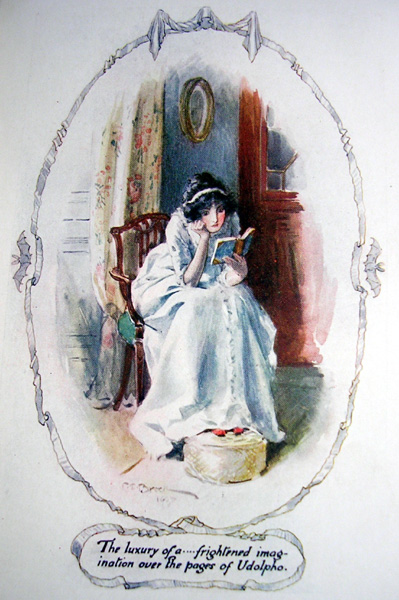
From Chapter 9, illus. by CE Brock (Presumed Public Domain, from solitaryelegance.com)

Northanger Abbey is often seen as a spoof or satire of gothic novels. And it certainly does make fun of these novels, but it does so largely through satirising readers of these novels, particularly (young) suggestible readers. Northanger Abbey is also famous for its defence of the novel, on which I’ve posted before. However, the thing which stood out this read was how much Austen comments on the art or practice of writing novels. The novel opens with:

No one who had ever seen Catherine Morland in her infancy would have supposed her born to be an heroine.

Now this partly sets up the whole Gothic novel thread, the idea that heroines of Gothic novels are certain sorts of people, and that certain sorts of things happen to them, but on this read I was very conscious that there was more going on here between Austen and her reader (in this case, me). Before I explore this a little more, it’s probably worth outlining the novel’s publishing history. Initially called Susan, it was written around 1798–99, when Austen was 23-24 years old. She revised it in 1803, and it was sold to a bookseller, who never published it. In 1816, the year before Austen died, her brother Henry Austen bought it back. Austen revised it a little more, including changing the name of the heroine, and of the novel, to Catherine, but died before putting it out for publication again. In the end Henry organised for it to be published as Northanger Abbey, along with Persuasion, in 1817.

So, it was the first novel she finalised for publication (even though she had previously started on the books that later became Sense and sensibility and Pride and prejudice) but was the last published. The interesting thing about this essentially “first” novel is that the voice, or point-of-view, is a little different from the other five novels which are written more consistently in third-person omniscient voice. In Northanger Abbey however, the author-narrator frequently intrudes into the story to address the reader – sometimes, though not always, using first person – and in so doing tends to draw attention to the making of the fiction.

For example, she introduces the Thorpe family with a brief background, then writes:

This brief account of the family is intended to supersede the necessity of a long and minute detail from Mrs. Thorpe herself, of her past adventures and sufferings, which might otherwise be expected to occupy the three or four following chapters; in which the worthlessness of lords and attornies might be set forth, and conversations, which had passed twenty years before, be minutely repeated.

There is an element here of satirising Gothic novels which tended to be long and detailed and to deal with nobility, but it is also, as I see it, part of Austen’s novelist’s manifesto. She’s telling us that for the purposes of her story we don’t need long digressions into irrelevant, albeit possibly exciting, pasts.

Her frequent references to Catherine and whether or not she is a heroine sets up the reader for a traditional Gothic romance while at the same time teases us to think about what fiction might really be about. We know, from a letter to her niece, that this is, for her, “Three or four families in a country village”. So, on the one hand Austen tells us that Catherine has been “in training for a heroine” and “that if adventures will not befall a young lady in her own village, she must seek them abroad”, and then on the other hand, she returns us to reality with statements like:

she felt more obliged to the two young men for this simple praise [that she was “a pretty girl”] than a true-quality heroine would have been for fifteen sonnets in celebration of her charms.

Austen plays with us like this throughout, comparing the concerns and expectations of a Gothic novel heroine with those of a more “realistic” one.

Towards the end, the two threads – the Gothic and the natural or realistic – come together. Having discovered that all her wild imaginings of murder and mayhem at the Abbey were just that, wild imaginings, Catherine does have to confront a very real crisis when the General suddenly turfs her out of the Abbey, his home, with no explanation:

Yet how different now the source of her inquietude from what it had been then—how mournfully superior in reality and substance! Her anxiety had foundation in fact, her fears in probability; and with a mind so occupied in the contemplation of actual and natural evil, the solitude of her situation, the darkness of her chamber, the antiquity of the building, were felt and considered without the smallest emotion; and though the wind was high, and often produced strange and sudden noises throughout the house, she heard it all as she lay awake, hour after hour, without curiosity or terror.

This is one of the narrator’s third person pronouncements, but Austen, the author, intrudes in first person again at the end, with two statements that refer directly to the making of fiction. One alludes to the final resolution of the romance:

The anxiety, which in this state of their attachment must be the portion of Henry and Catherine, and of all who loved either, as to its final event, can hardly extend, I fear, to the bosom of my readers, who will see in the tell-tale compression of the pages before them, that we are all hastening together to perfect felicity.

The other refers to the introduction of a new character in the last chapter who helps bring about the above “perfect felicity”:

… I have only to add—aware that the rules of composition forbid the introduction of a character not connected with my fable—that this was the very gentleman whose negligent servant left behind him that collection of washing-bills, resulting from a long visit at Northanger, by which my heroine was involved in one of her most alarming adventures.

I love this aspect of Northanger Abbey – that is, I love Austen’s cheeky, inventive voice. She’s not scared to talk to us, to tell us what she’s doing and what she thinks. It’s a fresh, bright novel that beautifully bridges her juvenilia pieces with her more, let’s say, controlled works. We see here the lively intelligence of a young writer who is thinking, perhaps, about imagination and reality, and certainly about what she likes to read and what she wants to write.

This has been pretty brief, and may not have argued my point as coherently as I would have liked, but at least it documents for me the ideas that this reading brought to the fore. I hope it’s given you something to think about too.

Jane Austen
Northanger Abbey
Digireads.com, 2011
ISBN: 9781596251144 (ebook)

Peter Carey, Amnesia (Review)

CareyAmnesiaHamishSomewhere sometime ago I read that serious reviewers should read the book they are reviewing at least twice. I think this is good advice, but I admit that with so many books I want to read I rarely follow it. Peter Carey’s latest novel Amnesia is one that well warrants rereading. It assaults you with ideas and action that aren’t easily assimilated on the first read. However, time marches on, so to write this review I am going (or, to be honest, I’m choosing) to rely on the notes I took, supported by a quick flick through. Please read my review in this light!

Amnesia is a satire, and satires can be pretty tricky to read. They’re slippery. They can be funny, but not necessarily. They tend to be about ideas or issues, so their characters are created to serve that end and may not be fully developed or particularly sympathetic. This can make satires tricky to engage with, particularly if you’re the sort of reader who loves to engage with characters. Amnesia presents the reader with some of these challenges. It’s a romp, a thriller, a drama – but in the end it’s all about activism, cyber security and journalism, about politics and the relationship between Australia and the United States of America. I enjoyed it, though the pace was so cracking at times I found it hard to keep up.

The novel starts with a worm, the Angel Worm, which infects the computer control systems of Australian prisons, releasing their locks. Because Australian prison security was designed by American corporations, the worm also infected nearly 5,000 American prisons. Prisoners of all sorts, including asylum seekers, were freed. The U.S. is not amused. As the story breaks, our protagonist, Australia’s self-described “sole remaining left-wing journalist” Felix Moore, is being tried in court for defamation. He’s “grateful for a story big enough to push me off the front pages”. Unfortunately, in the sort of irony typical of satire, he soon finds himself out of the frying pan and into the fire, because, of course, the parents of one of the Worm’s creators are old university friends, Sando Quinn and his wife Celine.

So here’s the set up. Felix is destitute. His book is to be pulped, and his wife has kicked him out. To his rescue comes another old university friend, Woody Townes, who pays him a lot of money to write a book about worm-creator Gaby. Felix soon learns though that this book is not going to be his book expressing the truth as he discovers it, but a book that says … well, let’s just say that here the adventure, romp, thriller, drama, whatever you want to call it, begins.

What then is being satirised? Let’s start with the four main characters, Felix, Sando, Celine and Woody. They met as students at Monash University and became friends. They were radicals and activists who believed they could change the world. They organised marches and protests, they voted in Whitlam and the Labour Government, and they were affronted and angry by Whitlam’s dismissal in 1975. But, who are they now? One of Carey’s targets is this: what happens when radicals grow up? Woody turns capitalist property developer with hints of something worse; Sando is a politician who tries to keep the faith but discovers the compromises he has (or wants) to make; actor Celine sees herself as Bohemian but becomes seduced by the “finer” things in life and doesn’t want to mix with the working class; and journalist Felix sees himself as the tell-it-all saviour but recognises that in the process he has “become an awful creature”.  It’s not a pretty picture.

Underlying this is a thread exploring Australia’s relationship with the USA. There’s the Battle of Brisbane (a two-day fight and riot between American soldiers and locals during World War 2), discussion of US involvement in Whitlam’s dismissal, and, fictionally, fears of what might happen if the US extradited Gaby. (Julian Assange anyone?) Early in the novel, Felix agrees that Woody has a point regarding the extradition risk:

Everything we knew from life suggested that America would do what it liked and Australia would behave like the client state it always was.

Carey also satirises journalism, particularly the sort that prides itself on exposés in search of the truth. Felix becomes the pawn in a game to produce a story that suits the person who gains control of him – by whatever method they can, by money, say, or by abduction. Woody suggests at one stage that Felix make things up to put Gaby in a positive light, but Felix, who believes there’s “no such thing as objective journalism” argues that this doesn’t equate with making things up! Through the course of the book Felix moves (or, more correctly, is moved through mysterious mechanisms) from a classy high-rise in Melbourne, to a remote primitive shack on the Hawkesbury River, and thence to a motel room in the Blue Mountains. All the while he doggedly listens to tapes of mother, Celine, and daughter, Gaby, talking, talking, talking.

Their story of life in Melbourne, from when Gaby was born, significantly on 11 November 1975, is great reading. Melbourne-born Carey knows the city and captures its life, rhythms, and diversity beautifully. The writing is gorgeously descriptive at times, and often funny, but can also be biting.

I think, too, that there’s an element of Carey sending himself up. I’m not suggesting, despite some obvious similarities between character Felix and creator Carey, that Amnesia is intended in any way to be autobiographical. But, in several of the references to writers and writing, I detect digs at some of the criticisms that have been levelled against him. How about, for example, Felix’s comment at the end that:

For the crime of expressing pleasure that my book would be available to future generations, I was judged not only immoral but vain and preening …

Oh Peter, I thought!

To conclude, though, what is all this satire for? Well, the title says it. There’s a reason Gaby was born on the day of the dismissal, and that she becomes the next generation of activists (or hacktivists) – and the reason is that Carey does not want us to forget. He wants us to “maintain the rage”*, to remain aware and vigilant of what is happening, and of whose fingers are in which pie. It’s not subtle, but then what satire is, and it perhaps tries to pack too much in, but it is both an entertaining and a provocative read. I’d be more than happy to read it again.

Peter Carey
Amnesia
Hamish Hamilton, 2014
367pp.
ISBN: 9781926428604

* I drafted my review and then trawled the net, and what did I find but an interview with Carey in The Australian that says just this. I didn’t steal it, promise!

Dymphna Cusack, Jungfrau (Review)

Dymphna Cusack, Jungfrau

Courtesy: Allen & Unwin

Are there some historical periods that particularly fascinate you? There are for me, and one of those is that between the two world wars. It was a complex time encompassing both economic hardship and great social change. A time when many of those Victorian era constraints were being lifted and women, in particular, were starting to enjoy an independence and freedom they hadn’t had before the First World War. Dymphna Cusack’s first novel, Jungfrau, is set in this period and deals with this very subject.

I have written about Cusack before, when I reviewed A window in the dark, her memoir about her time as a teacher. Because of its relevance to this novel, I’ll reiterate a couple of the points I made in that review. Cusack, I wrote, had a finely honed moral and social conscience, and was acutely aware of injustice. She was convinced of the “wickedness of our economic system”, and abhorred the power those with money had over others. She was consequently outspoken on social and economic justice issues, and was particularly critical of the treatment of “that much-maligned creature, the woman teacher”. A window in the dark was written forty years after Jungfrau, and is a memoir, but you can see the genesis of her values and ideas in this, her first novel.

Jungfrau is set in Sydney over a few months in the 1930s. It concerns three young women in their mid to late twenties: the rational, realistic and religious Eve, the emotional, dreamy and vulnerable Thea, and the modern, pragmatic, confident Marc. Eve and Thea have been good friends for several years. Marc is Thea’s friend, but Eve and the free-thinking Marc do not like or understand each other. At the novel’s opening, Eve and Thea are talking about Thea’s interest in a man twice her age, a married university professor. Eve cautions Thea about the risks, but Thea is ready “to take life—use it—now, instead of letting it use me”. Eve gently retorts that “If you leave yourself open to the world, it will rush in on you”.

Indeed, Eve, who has seen first hand in her maternity ward the results of poor, single women taking life, suggests that experiencing life “is much safer in books”. She says to Thea:

When you talk about getting in touch with reality and finding out what life is, all you really mean is following your instincts in spite of the consequence … Only, if you take your friend Marc’s prattling literally, I’d advise you to learn more about physiology than you know at this moment. You can’t safely combine what your modern friends rather euphemistically call ‘experience’ with a degree of ignorance that’s almost mid-Victorian. You’ll need to be practical if you’re going to be a realist. Marc’s evidently both.

The novel, as you’ve probably guessed by now if the title hadn’t given it away, explores what happens when Thea does not heed Eve’s advice and lets this relationship develop. I’d call this a coming-of-age novel but, having been written by Cusack, its themes are as much social as psychological. What did it mean for a woman at that time to have an affair with a married man, and what were her options with the – hmm – consequences?

The trouble is that while obstetrician Eve and social worker Marc are daily faced with the grim realities of life, teacher Thea evades them. Here’s Eve on her ward rounds,

All this rot about reality, this frenzied escape into abstractions, had curiously little to do with life as she knew it. … Here was reality. Tortured bodies, tired minds, birth and death. Nothing vague about this; no escaping from facts; no sheltering behind fancies.

Acerbic Marc has her own view on woman’s lot:

Women are cursed, all right. If you wither on the virgin stem you go all pathological; if you go off the deep end you get some foul disease; and if you marry and have dozens of young you die of exhaustion.

By contrast, here is Thea discussing the real Jungfrau with her professor:

“Yes,” he said almost inaudibly, “white, proud and untouched. But they’ve built a funicular almost to the top of it now, and the tourists swarm all over it like flies.”

“Poor thing! I don’t mind climbers and mountaineers; but it must hate the tourists soiling it—”

“That is usually the fate of the proud and the untouched,” he said, digging his stick in the turf, and she recoiled as though struck, her hands flung out in a gesture of defence.

Oh dear, we readers think – and so would Eve and Marc if they’d heard this conversation. Their lot, though, is to love Thea and to watch in dismay as she takes life to an edge that she is not fit to handle.

The critical thing about this book is that Cusack doesn’t judge these three women for their choices. We might find Marc a more sympathetic, more appealing personality, of the three, but Cusack is even-handed. She understands human psychology and empathises with women. Her ire is focused more on society’s expectations and rules than on any one woman’s decision or behaviour. I described this novel earlier in my review as a coming-of-age novel, but it could equally be called a novel of ideas. In it Cusack exposes “the reckless squandering of human possibilities”, of lives “anaesthetised by half-baked education, political platitudes and doles”. Economic inequities, abortion, women’s independence, and the meaning of freedom are her targets.

I read this book as part of my long-term plan to read classic Australian literature – and I enjoyed it immensely. While the social milieu is very different from now – thank heavens – the emotional truths transcend the particulars of time and place. The language did feel a little overblown at times. It has that DH Lawrence sort of emotional intensity that can sometimes be a little too melodramatic, or declamatory, for my 21st century ears. And yet, paradoxically, one of the novel’s real pleasures came from its descriptions of Sydney. Cusack catches the landscape – the plants, the light, the water – beautifully (but I’ll save sharing a couple of those for a Delicious Descriptions post).

I imagine this was a confronting novel at the time of publication, but I hope it got people thinking, as Cusack surely intended. Cusack, Katharine Susannah Prichard, Miles Franklin, Marjorie Barnard and Flora Eldershaw, to name the best known from that era, were fierce and intelligent writers. We are lucky to have them.

awwchallenge2015Dymphna Cusack
Jungfrau
Sydney: Allen & Unwin, 2012 (Orig. ed. 1936)
ISBN: 9781743431450 (ebook)

Note: I do need to have a little whinge. There were several errors/typos in my kindle edition, which is disappointing and did spoil the read a little.