Monday musings on Australian literature: University of Canberra Book of the Year 2020

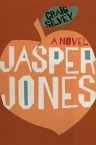
Jasper Jones, by Craig SilveyI wasn’t necessarily planning to announce the University of Canberra’s Book of the Year again this year, having written about it three times already – in 2012 when it was initiated, in 2014, when I checked to see how the program was going, and in 2018 to announce this year’s book. However, next year’s book is such a good choice that I felt it worth reminding you again of this initiative, which is now in its 8th year.

The program involves the University providing a selected book, free, to all commencing students across the five faculties. It is “required reading”. The book is “integrated into the curriculum and provides a common conversational topic on campus”. You can see the main goals in my 2018 post, and there is more about the program at the UC Book page. I had to laugh at one of the FAQs on this page. The question is:  “What does ‘required reading’ mean? Do I have to read the book?” And the answer:”Yes, all commencing undergraduate and postgraduate students in 2020 are required to read the Barbed Wire and Cherry Blossoms…” I would love to see more on the site about how this actually plays out.

It’s an inspired and inspiring initiative, though I’ve had some quibbles. I wrote last year that it was a shame that the books haven’t always been Australian, because it provides an excellent opportunity to introduce students to Australian literature. I also note that while the genres and subject matter have varied somewhat, there’s not been much diversity in terms of writers. No indigenous writer, no writer from a non-white/non-English language background, for example. Well, that has changed this year!

First though, here are the books to date:

2013: Jasper Jones, by Craig Silvey (my review)
2014: Room, by Emma Donoghue
2015: The Rosie Project, by Graeme Simsion (my review)
2016: The strays, by Emily Bitto (my review)
2017: The white earth, by Andrew McGahan
2018: Do Androids dream of electric sheep? by Philip K. Dick
2019: The natural way of things by Charlotte Wood (my review)

UC Book for 2020

In October, the University announced the shortlist, which comprises, this year, all recent Australian books. But, not only are they ALL recent Australian books, they are ALL by indigenous writers! What a wonderful message that sends.

Here’s the shortlist:

  • Tony Birch’s Ghost River (my review): “The highly anticipated new novel from the Miles Franklin-shortlisted author of Blood … The river is a place of history and secrets. For Ren and Sonny, two unlikely friends, it’s a place of freedom and adventure…
  • Claire G Coleman’s Terra nullius (my review): “The Natives of the Colony are restless. The Settlers are eager to have a nation of peace, and to bring the savages into line. Families are torn apart, re-education is enforced…”
  • Anita Heiss’ Barbed wire and cherry blossoms: “In 1944, over 1,000 Japanese soldiers break out of the No.12 Prisoner of War compound on the fringes of Cowra. In the carnage, hundreds are killed, many are recaptured, and some take their own lives rather than suffer the humiliation of ongoing defeat. But one soldier, Hiroshi, manages to escape. At nearby Erambie Station, an Aboriginal mission, Banjo Williams, father of five and proud man of his community, discovers Hiroshi, distraught and on the run…”
  • Melissa Lushenko’s Mullumbimby“When Jo Breen uses her divorce settlement to buy a neglected property in the Byron Bay hinterland, she is hoping for a tree change, and a blossoming connection to the land of her Aboriginal ancestors…”
  • Kim Scott’s Taboo: “From Kim Scott, two-times winner of the Miles Franklin Literary Award, comes a work charged with ambition and poetry, in equal parts brutal, mysterious and idealistic, about a young woman cast into a drama that has been playing for over two hundred years…”

While I’ve only read two of these books, I have read books by all of these authors, and am thrilled to see them represented here because each has something to offer to the program.

Book coverAnd the winner is: Anita Heiss’ Barbed wire and cherry blossoms.

The judges have chosen, probably, one of the less challenging reads from the list, but that’s sensible given the diverse readership they are choosing for in interest, skills and background – and it will serve the purpose of raising some necessary issues regarding indigenous history and lives. Sure, it’s about the past, but it can lead from there to discussions about How much has and hasn’t changed since then, and why …

Responding to the news of her win, Heiss told CityNews:

To have the UC community engaging in the story of the Cowra Breakout, and life of Wiradjuri people living under the Act of Protection during wartime, will add to a greater understanding of a significant moment in Australian history.

What do you think about the book choices, or the program itself?
Jessica White, Hearing Maud (#BookReview)

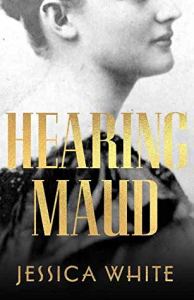
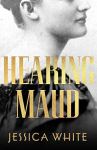
Book coverHybrid memoir-biographies take many forms. For a start, some are weighted more to biography while others more to memoir. As I wrote in my post on Jessica White’s conversation with Inga Simpson, most of those I’ve read “have been mother-daughter stories, the biography being about the mother and the memoir, the daughter. White’s book is different. The biographical subject is Maud, the deaf daughter of the late nineteenth-early twentieth century writer Rosa Praed (1851-1935)”. However, Bill (The Australian Legend) responded in the comments that “I’m pretty sure Hearing Maud is another mother/ daughter memoir. On two levels”. In a sense he’s right.
I say “in a sense” because Maud is not White’s mother. However, two mother-daughter threads do run through the book, Maud and her author mother Rosa, and Jessica and her mother. But, unlike those more direct mother-daughter memoirs in which the daughter focuses on the mother’s story while also throwing some light on her own life, in White’s book the two mother-daughter stories work in some way as foils for each other, but, more significantly, the focus is on the two daughters’ lives. As with most memoirs – hybrid or otherwise – there is a larger intent behind Hearing Maud than simply telling the story of a life or lives. It involves exploring deafness.

As I reported in the conversation post, White talked about “coming out” as a deaf person. I wrote how “living in the country amongst a large extended family, she’d been, essentially, sheltered from fully experiencing her deafness”. This resulted in her growing up as “a hearing person” albeit a “bad” one! It wasn’t until she was in her 30s that she started to think about herself as deaf, and to understand its impact on her life, particularly in her longstanding sense of loneliness and isolation.

Before, however, you start suspecting that this is going to be another misery memoir, let me get to the book. It starts with a Prologue, in which White tells us how she lost most of her hearing around the age of four, due to meningitis (or, more accurately, the treatment for it.) She then says, and it is this idea that underpins her story:

My life came to be defined by what the ancient Greeks termed a pharmakon, that which is a poison and a cure.

She goes on to say that the way the pendulum swings, between these two, depends on the time and culture in which the deaf person lives. For Maud, deafness was “a bane”. It led to her being committed to an asylum at the age of 28 and being left there until she died 39 years later. For White, on the other hand, it led to her becoming a reader and then a writer, because these “assuaged my persistent loneliness and gave me a sense of purpose”. What White goes on to do in her book is provide a mini-history of attitudes to deafness and deaf people over the last century and a half, exploring the ways in which both personal (including family) circumstances and social attitudes and policies can deeply affect the course of a deaf person’s life. Of course, life is a lottery for all of us – we are all affected by time and place, family and culture – but for those with a disability, there are additional layers that further reduce their control over their outcomes. (Interestingly, probably because of when she was born, White doesn’t discuss the whole nomenclature issue. In the early 1980s, for example, it was not acceptable to call people “deaf”, they were “hearing impaired”.)

Now though, I want to talk a bit about the writing. Hearing Maud is White’s third book (I’ve reviewed her second, Entitlement), and it shows. It shows in the novelistic language that brings life to the story. It’s never overdone, but there are scattered images that beautifully convey her feelings, such as this comment after her first real conversation with another deaf person, when she was 32:

Once again I have the sense of something settling into place, like a bird alighting in a tree, its wings relaxing. When I say goodbye and walk back past the sandstone buildings to the bus stop by the lakes, my step is buoyant.

You can feel the emotional release, can’t you.

It also shows in the confident handling of the multiple storylines – hers, and Maud and her mother Rosa’s stories. The stories are told generally chronologically but are interwoven with each other, so we start with White’s childhood ending a little before this book is completed, and similarly we move through Maud’s life. However, there are some backwards movements when something in the life of one raises an issue in the life of another. It does require some concentration from the reader, but the segues are natural and clear. Describing her childhood, for example, White tells of the times she spent in the bush, and how “the solitude was a balm”, enabling her to daydream about the boy on whom she had a crush. This leads her directly to  Rosa Praed – “Whenever I read Rosa’s novels, I reconnect with this heady mix of romance and the bush” – and a discussion of Rosa’s focus on the bush in many of her novels. Similarly, a discussion of the importance of letter-writing to her – being an “unthreatening way … to make connections” – leads to an extended discussion of Maud’s letters, and from that to Maud’s education and the history of deaf education in Europe in the late nineteenth century. There’s a lot of information here, but it’s so well integrated into the narrative that you learn almost despite yourself!

Finally, White’s skill shows in her control of tone. This is not a dry non-fiction work, despite the amount of information it contains, but a story about real people. White’s tone balances the formal (grammatical sentences, endnotes, and so on) with the informal (first person voice, and expressions like “I imagine Maud walking to the museum”). She also conveys her passion for her subject, and sometimes her frustration and anger, but doesn’t let it flow over into diatribe. However, she’s very clear about her intention for the book, as she tells her sister:

‘I’m tired of being taken for granted. I want people to know how hard I’ve worked – and how hard most people with disabilities have to work – to get where I am. I want them to hear Maud’s voice [hearing Maud!] and to know that, although things are much better, deaf people are still expected to act like hearing people. I want them to see how difficult it still is, when it shouldn’t be…’

I hear you Jess, loud and clear!

Lisa (ANZ LitLovers) and Bill (The Australian Legend) have also reviewed this book.

AWW Challenge 2019 BadgeJessica White
Hearing Maud
Crawley: UWAP, 2019
271pp.
ISBN: 9781760800383

Helen Garner in conversation with Sarah Krasnostein

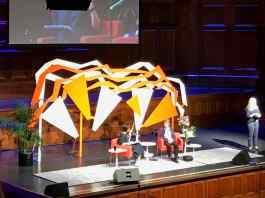
Garner and Krasnostein on stage

Krasnostein (L) and Garner (R), & Auslan interpreter

To say I was thrilled when Son Gums’ partner offered to buy tickets for us to see Helen Garner in conversation (last Saturday) would be an understatement. I have never seen Garner live before so that would be one bucket-list item ticked had I a bucket list! The fact that the conversation was to be conducted by Sarah Krasnostein (author of The trauma cleaner) was the icing on the proverbial cake.

This conversation was, in fact, the opening event of the Wheeler Centre’s inaugural Broadside Festival, promoted as “two days of an unapologetically feminist agenda”.

The Festival was opened by the Governor of Victoria, Linda Dessau, who referenced Barack Obama’s recent statement that “tweeting and hashtagging isn’t activism”. Festival Director Tam Zimet then started proceedings, explaining that the Festival’s purpose was “to bring conversations that are too hard or too much to Melbourne Town Hall”. She quoted Zadie Smith who was also in Melbourne for at the Festival, and who described writing as “taking the temperature of the moment”. This, of course, beautifully describes Helen Garner’s writing.

The Conversation

The conversation centred around the recent release of Garner’s Yellow notebook: Diaries, Volume 1, 1978-1987, so the conversation began by discussing both diary writing and the process of preparing them for publication. Krasnostein, who asked rather long but always thoughtful questions, talked about the role and function of diaries, suggesting they exist for their own sake but are also works in themselves. Garner’s diaries, she said, contain harvested and preserved details from the world, but also show Garner’s “fearless self-scrutiny”, plus “the things one can think but not say”. Garner said that she has always loved notebooks and pens, and how as a child she loved the peace and solitude she got from writing her diaries.
Several times through the conversation, Garner described her diary-writing as being partly about practising writing. She writes everyday, agreeing that you can’t wait “for ideal conditions”. For her, it’s all about “mother discipline”, by which she meant using the time given to you. She also commented on how much work you do when you are asleep, and referred to lessons from Marion Milner’s book, An experiment in leisure which taught her to sit quietly, with a sense of “nothingness”, to let ideas sort themselves out. This is not the same as waiting for inspiration, though. Garner, being her plainspoken self, said that “inspiration is bullshit”. Instead, “you do things little by little”. Writing, said Krasnostein a little later, is not the hard part. It’s getting to the desk.

Later in the conversation, we returned to diary-writing as stacking up the practice hours. Garner said she knows “how to put a sentence together”. (If you love Garner, like I do, you love her sentences.) But, said Garner, writers also need to know grammar. Without it, you can’t criticise your own work. The lack of grammar teaching is a “terrible loss”. Writers also need to read a lot to see how other writers do it. She bemoaned the fact that some books look like no editor has been near them. You see their “life-force leaking out of every joint”.

Krasnostein quoted Joan Didion’s statement that “style is character”, which somehow led to Virginia Woolf’s statement that you tell the truth about yourself first before you can do so about others. Krasnostein wondered whether being clear-eyed about yourself – one of Garner’s strengths, for me – was training for how to write in public. Garner took this to suggest that being honest about yourself gave you permission to write about others, but she didn’t think that would “stand up in court”! Garner suggested that memoirs can sometimes play fast and loose with other people!

Around here, Krasnostein asked whether revisiting earlier diaries – for any of us I think – shows that we are unreliable narrators of ourselves! Garner essentially agreed, saying that “memory is a creative act”. Reading one’s own diary “can be bracing” because it shows how over time you change stories, often showing yourself in a better light. There’s no way out of this, Garner believes, you just do the best you can. “Everything is fleeting, fleeting, fleeting”, she said. Writers write down stuff because they are terrified of forgetting. (I know the feeling!) “Writers are afraid of losing things”. This returned us to an idea that recurred through the conversation, that of writers preserving. Krasnostein quoted Philip Larkin’s statement that “the urge to preserve is the basis of all art”.

Of course, the process of making private diaries public was also discussed. Garner said she cut a lot. Her challenge was to decide what others might find interesting. She established certain criteria, such as she would not rewrite, and would only change (or add) something if it would otherwise be meaningless. A diary, she said, “has no voice over, unlike a memoir”, meaning that you can’t say “I did that then, but no way would I do that now, because now I’m a nicer person”. Accepting herself as she was at the time of her writing brought her to understand that she wasn’t unique, which made her feel more “comradely” with others. “We all hurt and are hurt,” she said. Krasnostein offered the idea that “the more vulnerable you are, the more you connect” to which Garner replied that this is what she hopes!

Another point Garner made was that tone is important, that “tone is character”, to which she then gave a feminist twist by saying that women have felt they’ve had to tone themselves down. She writes short books, she said, because she feels she has only a limited amount of reader’s attention.

I loved Krasnostein’s summation of the diaries as offering a new expansive view of Garner, but retaining her familiar voice, her “forensic eye for detail”, and her “lean lyricism”. I can’t wait to read my copy.

Q&A

There were several questions, but I’ll just share a couple:

  • on her daily writing practice: She rents an office, which stops her getting caught up housework! (In other words, she has “a room of her own”!) I particularly liked her point that she makes her notes about the details, say, of the court cases she attends, but, separately, she also documents her engagement with what she’s seen/heard, what she thought and felt. This material is “brightly alive … a treasure trove of information”. It doesn’t fit into the other boxes but it’s the richest when she comes to write. This is what I think is often missing from my reports of literary events. I need to do more of it.
  • on whether her views on Feminism had changed since the me-too movement: Not really seemed to be the answer. Garner, like many of us I believe, simply knows that when she discovered Feminism it changed her life: “It was like I’d been underwater and I finally put my head up and took a breath.” The me-too movement, like most movements, has been mixed, but “these things keep developing”.

Kate (booksaremyfavoaiteandbest) also wrote this up – including Garner’s comment about age freeing her to talk to random people on trams.

Helen Garner in conversation with Sarah Krasnostein
Broadside Festival 2019
Melbourne Town Hall
9 November 2019

Sue Ingleton, Making trouble: Tongued with fire (#BookReview)

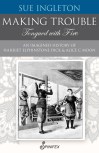
Book coverIn my recent post on Jessica White talking about her hybrid memoir-biography Hearing Maud, I commented that I’m intrigued by the ways in which biography is being rethought in contemporary literature. When I wrote that, I not only had White’s book in mind, but Sue Ingleton’s Making trouble. You can probably guess why from its sub-sub-title: “an imagined history of Harriet Elphinstone Dick and Alice C. Moon”.

“An imagined history”? And yet, it is classified on the accompanying media release as “Non-fiction (biography, history, crime)”. What does all this mean? Making trouble is about two English women, Harriet Elphinstone Dick (1852-1902) and Alice C. Moon (1855-1894), who, in 1875, left England for Australia. As the media release says, they were champion swimmers at a time when women did not swim in the sea; they refused to wear the corsets that women had been told were necessary to hold themselves up; and they were in love at a time when – well, you know the story. The problem, however, is that there is not enough documentary evidence for a traditional, formal biography. Ingleton writes in her Prologue that there were

no letters, no direct descendants both women being childless, no personal communications, only some newspaper stories, advertisements and sections of a thesis written in 1985.

In other words, their achievements are primarily documented in newspapers (“may the gods bless TROVE”, Ingleton writes): through ads for gymnasiums and physical education lessons, articles on talks and lectures, and death notices. Ingleton also had access to a master’s thesis by Lois Young titled Feminism and the physical sex sex education, physical education and dress reform in Victoria, 1880-1930).

To flesh out their lives, to give sense to these determined, influential women, Ingleton fills in the gaps using her imagination and her understanding of the history of the time. Describing herself as a “detective in time”, she had no choice, she writes, but to call this book “an imagined history” or, what is defined elsewhere, “speculative biography.” There is, in fact, a growing awareness, perhaps even acceptance, of this speculative approach to biography, but it’s tricky. At what point does such a work tip over into historical fiction?

Writing on the Australian Women’s History Network about her imaginative book The convict’s daughter, historian Keira Lindsey shares the contradictory responses she received to her requests for endorsement. One historian said she had “fearlessly carved a new path between history and fiction,” while another was “infuriated that she had gone “beyond the historian’s remit”. Clearly then, it partly depends on the reader. Some of us have more tolerance for straying from fact than others. But the writer’s approach and style also affects how readers respond.

Lindsey, for example, did not footnote, but she referenced the sources “with an index and bibliography”. She also provided “chapter notes at the end of the book for those wanting to know which portions of the book were fact and which were not”  and she explained her approach in an Afterword.

Ingleton took a different approach. She writes a Prologue and provides endnotes. I haven’t read The convict’s daughter so can’t comment on how Lindsey’s approach worked, but I did like Ingleton’s Prologue, albeit she argues that there are three components to her work – the Fact line, the Fiction line, and the Spirit world which, she says, can result in the revelation of “hidden facts” or “invisible truths”. This takes us into somewhat strange territory for a biography, speculative or otherwise, but in fact it doesn’t intrude too disconcertingly into the narrative proper.

“a barely documented history”  (Ingleton)

So, to tell the story of her two women, Ingleton interweaves more formal writing, which conveys the facts as she knows them, with a narrative style that is much closer to historical fiction. It generally works well, by which I mean you can usually tell which is fact, or draws on fact, and which is invented or imagined. While I’m happy to accept the use of imagination to fill in gaps, I did feel some of the imagined sections went a little too far into the historical romance fiction vein. I understand why, though. Ingleton is, among other things, an actor, director and stand-up comedian, and so is drawn to dramatic action. She also wanted to convey the love and romance between these two who dared to be different. How to do that in the absence of letters, was her challenge.

Now then, to the women, and why they’re worth reading about. Have you heard of them? Probably not, which is not unusual for women’s stories. Dick and Moon were, says Ingleton,

early pioneers* of physiotherapy, healthy diet, gymnastics and swimming for women and girls, biodynamic farming, journalism, breaking the barriers of women creating their own businesses and most importantly they were lesbians living together – the final bastion against the Patriarchy.

They also fearlessly advocated for sensible women’s attire, that didn’t cripple them physically and mentally. It’s an amazing story really. We follow them from England, to Australia, back to England when Moon’s father falls ill, and back to Australia. We see them build their gymnasium business in Melbourne, develop a teaching practice in schools, and establish a farm at Beaconsfield. Then we see Moon, devastatingly for Dick, cut loose and move to Sydney where she builds a career in journalism, only to die, before she’s 40, in seemingly mysterious circumstances, circumstances for which Ingleton believes she has an answer and builds a fair case.

All this is set against the backdrop of the burgeoning women’s movement in Australia – it was the time of the New Woman and the suffrage movement. Although Dick and Moon “were never deeply connected to the suffrage movement”, they did move in some of the circles mentioned by Clare Wright in her You daughters of freedom (my review), and “certainly were outspoken in the area of women’s rights over their own bodies and minds”.

Making trouble is an unusual book, but Harriet Elphinstone Dick and Alice C. Moon are two women who played a significant role in promoting women’s rights and proving, by their achievements, that women are as capable of living independently as men. They should be better known. Ingleton has done us a service in bringing them to our attention with such passion and flair.

* Not long after, another woman, Marie Bjelke Petersen (1874-1969) also pioneered physical culture for women, and was accused of dressing mannishly.

AWW Challenge 2019 BadgeSue Ingleton
Making trouble: Tongued with fire: An imagined history of Harriet Elphinstone Dick and Alice C. Moon
North Geelong: Spinifex, 2019
276pp.
ISBN: 9781925581713

(Review copy courtesy Spinifex Press)

Jessica White in conversation with Inga Simpson

Book cover

Hearing Maud, author Jessica White told us in her conversation with Inga Simpson two weekends ago, was 15 years in the making. This is something I already knew, because, as the result of our involvement in the Australian Women Writers Challenge, I’ve met Jess and we’ve talked about this book. However, it was excellent to hear the more detailed story – and at its conclusion rather than partway through. Jess is clearly very happy to have it finally off her hands, but it’s also clear that the book was, and is, very important to her – as you shall see.

The participants

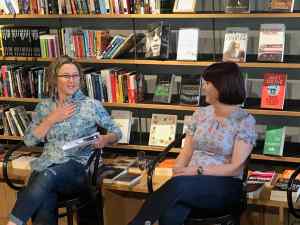
Simpson and White
Simpson (L) and White (R), Muse, 2 Nov 2019

Jessica White has written two novels A curious intimacy, which earned her a Sydney Morning Herald Best Young Novelist gong, and Entitlement (my review). She’s been listed for various prizes, and has had essays and short stories published in Australia’s best-known literary journals, including MeanjinSoutherlyOverlandIsland and Griffith Review. She is a lecturer/researcher at the University of Queensland.

Inga Simpson, whom I’ve still to review here (but I will), has written three novels, Mr Wigg, Nest and Where the trees were, the last two of which have been listed for or won prizes. Her latest book, Understory, is a memoir about her love of Australian nature, and especially trees.

The conversation

As Simpson advised at the beginning, the conversation was not a Michael-Parkinson-like hardball interview but more a conversation between friends which, apparently, they are. As a result, it had a warm, natural feel, while still addressing some important points and issues.

Hearing Maud, which I’ve just started reading, is one of those hybrid memoir-biographies that I’ve talked about recently. However, most of those have been mother-daughter stories, the biography being about the mother and the memoir, the daughter. White’s book is different. The biographical subject is Maud, the deaf daughter of the late nineteenth-early twentieth century writer Rosa Praed (1851-1935) (whom I read before blogging). White did not know or ever meet Maud so her knowledge has come from her research, which, Simpson said, is a strength of White’s.

White began by talking about the book’s genesis. It started with her PhD research into Rosa Praed, with whom White felt a connection, given they shared a rural, bush background and a love of romance! White was drawn to Praed’s “racy romances”, she said!

However, as she researched Praed, she discovered the existence of Maud, and the more she researched the more she realised what a “terrible life” Maud had had. So, she started writing a biography about Rosa and Maud. This was rejected by a publisher, but in rejecting it he suggested that she make the book “more about deafness”. To her credit, White was not put off. Having initially felt that deafness hadn’t challenged her, she started, as she continued to research Maud’s life, to recognise more about her own life as a deaf person – and then to perceive the intersections and divergences in their two lives.

Patricia Clarke, in her biography of Praed, Rosa! Rosa!, wrote that it was fortuitous for Maud to be born at a time when they were teaching deaf to speak, but White, now understanding more about deafness, saw it differently. It was a time of Social Darwinism – when the idea was to breed out disabilities – so the pressure to conform was strong. This was often, as it was in Maud’s case, counterproductive, if not disastrous. I will write more on this when I review the book, but essentially, a number of factors, including the breakup of Maud’s family and Rosa’s non-inclusive attitudes, resulted in her having a mental breakdown at 28 years old, and being committed to an asylum. She spent the next 39 years of her life there, that is, until she died!

The conversation spent some time on White’s own experiences as a deaf person. Simpson, being a writer, was particularly interested in language, so questioned White about words she’d used in different contexts to those Simpson was familiar with, such as, “coming out” (as a deaf person), “assimilation” (of deaf people into hearing culture), “mainstream” (of people with disabilities into abled-culture), and “colonialism” (of deaf culture and language by hearing culture.) Coming out as a deaf person was a slow process for White, not so much because she was resistant to the idea but because she hadn’t realised how much deafness had impacted her. Living in the country amongst a large extended family, she’d been, essentially, sheltered from fully experiencing her deafness. She was, she said, brought up as a hearing person, and just saw herself as “a bad hearing person”. That got a rueful laugh from the audience.

However, White was conscious through her teens and early twenties of a sense of isolation and loneliness. It was not until she was in her 30s that she started think about herself as deaf, and understand its impact on her life. She recognises, though, the paradox (“the poison and the cure” that she discusses in Hearing Maud) of her deafness, because she believes it has had, for her, negatives but also positives. She would not, she says, have become a writer if she hadn’t been deaf, and turned to reading at a young age.

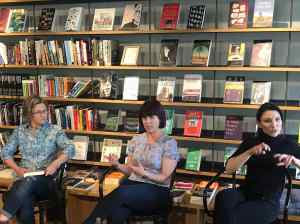
Signing during the conversation
The conversation was signed.

The conversation, at this point, engaged in some of the history and politics of disability (and particularly deafness, of course): on government policy regarding educating deaf children, on the politics of whether to teach signing or not, on the notion (that is embedded in the cochlear implant development) of ”fixing” people. White argued that this medical model of disability opposes the cultural model, which, for example, allows deaf people to sign, to have have deaf friends, to, in fact, be deaf. White observed that signing is strongest in poorer countries where the medical model is not so developed/can’t be afforded! White is now interested in learning to sign, and is pleased that the book has opened pathways for her into deaf communities. She clearly hopes this will result in mutual benefit to them all.

White also explained how her deafness forced her to develop the ability to intensely focus – on faces and body language, for example – to find patterns and thus meaning. This need to attend to detail makes her a good scholar, she believes, albeit also exhausts her!

Returning to more literary topics, White addressed that tricky memoir issue regarding their potential to hurt others. White said that although she says some tough things, this was not an issue in her clearly close family, whom, she described, as over-sharers! Nonetheless, she did pare back some difficult things in her parents’ lives. She also said that the self in the book is her authentic self.

As for what’s next, White has other things planned – as indeed I know she does because, from my meetings with her, I know she has a mile-a-minute mind! One project is an ecobiography about the pioneering Western Australian botanist, Georgiana Molloy, in which she wants to show the importance of biodiversity. She defined ecobiography, as being about how ecology shapes who we are. I’m intrigued by the various ways the biography form is being explored, expanded, teased out in contemporary literature, so I look forward to White’s ecobiography take.

Q & A

There was a short Q&A, which I won’t share in full, but I did ask White why she’d decided to combine memoir and biography. She said that she wanted to tell Maud’s story, but that hers created a foil or mirror for that story, and in doing so, it enriched both stories.

Another questioner, commenting on deaf people having to conform to the speaking world, asked what the speaking world could do to make life easier for deaf people. White said that many people don’t understand the feeling of powerlessness that disability can bring. She hopes the book will help people see that there are different ways of being.

Jessica White in conversation with Inga Simpson
Muse (Food Wine Books)
Saturday 2 November, 4.30-5.30pm

David Brooks, The grass library (#BookReview)

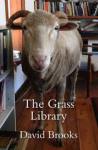
Book coverOK, I’m going to show my hand here. I love animals – and hate animal cruelty – but I am not vegan. More to the point though, I am cautious about animal rights activists because they can sometimes act out the very violence and cruelty on humans that they condemn for non-human animals. I was, therefore, a little wary when I was offered for review David Brooks’ book, The grass library. However, Brooks, a poet/novelist/essayist/academic/one-time co-editor of Southerly, has enough cred that I decided to take a chance. I’m glad I did – just as I was glad to have read, three years ago, Bidda Jones and Julian Davies’ more targeted animal rights book Backlash: Australia’s conflict of values over live exports (my review).
The publisher’s letter accompanying my review copy quoted the Sydney Morning Herald’s description of Brooks as “one of Australia’s most skilled, unusual and versatile writers”. It is the combination of this writing skill, with the thoughts contained within, that makes The grass library such an engaging and provocative read.

Although there is no doubt about the author’s commitment to his cause, The grass library is not an in-your-face polemical book. Instead, it is a thoughtful work in which Brooks, now a committed vegan and animal rights advocate – advocate being, perhaps, a more appropriate word than activist – works through his practical, philosophical and ethical position. And he does so in a way that encourages us to think along, and to wonder about and question our own thoughts, practices and values.

The book is part-memoir, part-reflection. It starts with Brooks’ partner, simply called T in the book, pronouncing that she can’t eat meat anymore. “We’re turning vegetarian”, she says. A week later, that becomes vegan. And so, a big change occurs in their lives, one that takes oyster- and cheese-loving Brooks not too long, in fact, to get used to. Brooks writes, heralding the book’s real subject-matter:

But this book isn’t about veganism, or guilt. If I’d permitted myself a more eighteenth-century subtitle it might have been “An account of three years pf philosophical and un-philosophical transactions with animals in the Blue Mountains of New South Wales”, but ultimately and more simply it’s about discovery and wonder: wonder and wondering.

After a couple of false starts, Brooks and T find themselves, in 2012, living on a small farm in the Blue Mountains, with their recently adopted dog Charlie, and, soon after, two rescue sheep, Henry and Jonathan. Not long after that, a new-born lamb, Orpheus Pumpkin, joins them, and by the end of the book, ram Jason brings the number to four. These sheep and Charlie form the book’s backbone and become (or, should I say in the spirit of the book, are) characters in their own right. Other non-human animals appear too, some briefly, including cicadas, ducklings, a snake, and rats.

What I most enjoyed about this book is the calm, non-histrionic way in which Brooks introduces and ponders on a range of random-sounding but coherent-as-the-book-progresses ideas, such as “dusk anxiety” and “herd music”. “Dusk anxiety” is introduced early on through a twitching that Charlie was exhibiting at that time of day. It’s a sort of mood-change or discombobulation that some humans (and, Brooks believes, some non-human animals like Charlie) feel at that strange twilight, half-and-half time of day. Sounds valid to me. However, it also provides Brooks an opportunity to raise the issue of anthropomorphism. His argument is that anthropomorphism is not a bad thing, that in fact, it is central to empathy. The barbarity we engage in against animals is made possible, he argues, by denying this empathy, by believing “that we are so different from the creatures we live amongst that we cannot know or even hazard how they feel.” To read this book, then, you need to understand (if not accept) this fundamental world-view. Brooks may not know what the non-human animals he writes of feel, but he writes with the assumption that they do feel (and that we may know what they feel).

Another significant idea underpinning the book is that of the binary way we view animals. This idea is one of the most confronting or, at least, challenging in the book:

There are so many old, rusty binaries involved here. […]

We categorise animals, and behave towards them – accord or refuse them protection or sanctuary – depending on whether we see them as wild or tame, feral or domesticated, native or exotic, rare or common, endangered or of least concern, pet or pest, livestock or otherwise …

In most of these cases, he says, one side of the binary will be given a higher “value” (in human terms), with, often, a justification to kill the opposing side. For each animal concerned though it is his/her life!

It’s not for nothing, I think, that the next chapter talks about rats at their farm!

This discussion of binaries is part of a major thread in the book, which is language, and how it “trips” us up, how it “will restrict us, hold us back, if we don’t learn to use it with greater care and respect”. Language is all too often speciesist, he argues. Grammar – the use of “it” for a non-human animal, for example – is violent, for example, or, at least, has the potential for violence.

It’s a book, then, that makes the brain hurt – albeit in a gentle, encouraging way. However, there is beauty in the book too, such as the chapter on “herd music”. This chapter starts in his writing room, his “grass library”, and is inspired by the appearance outside his room of the two sheep when (and only when) he plays music. He ponders this. They are herd animals, but being just two rescue sheep, they have no herd and are thus deprived of, he posits, the music of the herd:

… if music it can be called (but how else to call it?): the sound of hooves shifting in the grass or tapping on stone, the occasional bleat of a lamb, response of its mother, grunt or growl or call of a ewe or a ram, the sound of snipping at grass-blades, coughs, throat-clearings, nudgings, strokings, as one sheep passes another, regurgitations, ruminant chewings, fartings, belches, sounds nearer and further off, all in all a constant, rolling concert, approximated—very distantly resembled, in a bizarre, post-something way— by the muted rhythmical under-music of whatever it is that I might be playing on the stereo system in my cabin, an aural equivalent of warmth, the ghost of companionship.

I share this because I loved this, but also because it provides some insight into the way Brooks thinks (or wonders.)

I can’t say I agree with all that Brooks writes. For example, as vegans, he and T didn’t want to feed their rescue lamb lactose-based lamb powder, so they seek non-animal products like almond milk (which doesn’t, for the record, work). But, but, I say, lambs grow on milk! And then, of course, there are those binaries. Philosophically I take his point, but practically? I need to think about this more.

The grass library, then, can be a confronting read because it challenges us to reconsider some fundamental perspectives and assumptions. However, it is not a difficult read, because not only is it generous, but it is also peppered with engaging stories about life in the mountains and the non-human animals with whom Brooks and T. live. I recommend it.

Lisa (ANZLitLovers) also enjoyed this book.

David Brooks
The grass library
[Blackheath]: Brandl & Schlesinger
221pp.
ISBN: 9780648202646

(Review copy courtesy Brandl & Schlesinger)

Special Book and Event Giveaway for Jessica White’s Hearing Maud

Book cover

Regular readers here will know that I very rarely do give-aways. However, when Jessica White, who is on the Australian Women Writers Challenge team with me and whose novel Entitlement I’ve reviewed, asked whether I’d be happy to do a giveaway for her latest book, Hearing Maud, and her conversation with Inga Simpson at Muse, how could I refuse? Of course, I couldn’t, and didn’t want to.

So, here’s the deal:

On Saturday 2nd November, from 4.30 – 5.30pm at the wonderful Muse Books and Cafe, Jessica will be in conversation with writer Inga Simpson about her hybrid memoir on deafness, Hearing Maud, which details Jessica’s experiences of deafness after losing most of her hearing at age four. It charts how, as she grew up, she was estranged from people and turned to reading and writing for solace, eventually establishing a career as a writer. Central to her narrative is the story of Maud Praed, the deaf daughter of 19th century Queensland expatriate novelist Rosa Praed. In researching Maud’s story, Jessica reached back into the history of the deaf and realised how, although her and Maud’s stories are a century apart, they both still struggled with the expectations that they be like hearing people.

Jessica is offering not one but TWO giveaways:

  • a copy of the book and a free ticket to this event; or,
  • a copy of the book

Please leave your name in the comments, noting which of these two draws you wish to go into, by midnight AEDST Tuesday 29th October.

The draw, using a random number generator, will be made on Wednesday 30th October:

  • The winner of the book and event will just need to turn up at the event as his/her name will be recorded at the door.
  • The winner of the book will need to email his/her address as requested in the announcement email.

Jessica and I look forward to hearing from you!

Ros Collins, Rosa: Memories with licence (#BookReview)

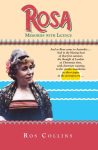
Book coverMemoirs are tricky things. There are readers who love them, readers who hate them, and readers like wishy-washy me who sit in the middle. I sit in the middle because, for a start, I don’t like to say “never” when it comes to reading. I sit in the middle because I couldn’t cope with a steady diet of memoirs, particularly those how-I-got-over-my-[whatever trauma or challenge it was], which is certainly not to say that I don’t admire those memoirists or don’t enjoy some of their fare. And, I sit in the middle because I don’t like formula, because I like books that try to tackle their subject or their form a little differently. So, the memoirs I mostly read are those which play with form or whose subject matter offers something different. Ros Collins’ memoir, Rosa: Memories with licence, does both of these.
First, the subject-matter. Rosa deals with, as the book description says, “Anglo-Australian Jews [who are] often overlooked in fiction and memoir.” Having known many Anglo-Australian Jews through my life, I was interested to read Collins’ discussion of her family’s life, as a contrast to those more directly Holocaust-influenced lives of European Jews we’ve all read about. It’s not easy being Jewish, I believe, regardless of personal or family history, so I was interested to read this story.

Then there’s the form. The subtitle, “memories with licence”, suggests that this is not going to be your usual memoir. For a start, it is told third person about a person called Rosa, which is the name given to the author Ros by “two elderly men from Southern Europe” whom she met on a recent Anzac Day Eve. She goes on to say, in her Introduction, that it is this “Rosa who wanders through the following stories, sometimes fictionally, sometimes autobiographically”, though I hazard to guess it is mostly autobiographical – just told one voice removed! Near the end of the introduction, she says that:

Rosa is much more personal [than her previous family history book, Solly’s girl] – and freely written – and I have taken liberties with the truth. Memoir with a little fiction, or fiction with a little history? It’s hard to say. Memories with licence.

The book has been classified on its back cover as Memoir. And that is how I have read it, as it reads true.

So, why tell it this way? Collins says she wishes “to entertain”. Her aim is not to delve into world history, cataclysmic events, or, even, dystopian futures. She wants, instead to shine a light on lives that may not be well known to many Australians, on Anglo-Australian Jewish lives. Taking a third person voice enables her to tell her story a little more objectively, to comment on what people, in particular Rosa, were, or may have been, thinking and feeling. Third person also enables her to get out of the main subject’s voice and head. It enables her to suggest what others might be thinking, such as Rabbi Szymanowicz:

Rabbi Szymanowicz stopped surreptitiously searching the room for younger people with whom he might more profitably connect, and looked at her. Seldom, if ever, had he met an elderly congregant quite like her; for an eighty-something-year-old Rosa did not come across as a sweetly gentle Miss Marple – more likely to be opinionated and argumentative.

This sort of statement could not be made in the same way in a traditional memoir. A traditional memoirist can not so directly get into the head of another character. A traditional memoirist can only suppose what another character might think (unless they are quoting documented facts from, say, letters). Taking this third person approach gives Collins more licence. She can, for example, “guess” about the relationship between her two grandmothers, two women who were not happy because they lost significant supports, when Rosa’s parents married.

All this could be disconcerting to some readers, but Collins has been honest from the start about what she is doing. Ultimately, the important thing is whether the book rings true and I believe it does. Rosa’s character – her humanity, her sense of her own flaws, her uncertainties, as well as her pride in her achievements – shines through.

Another way in which the book departs from traditional memoir is in its lack of linearity. While there is an overall movement from past to present, Rosa is not told chronologically. Instead, each chapter or “story” takes up a theme through which the story of English-born Rosa (Ros) and Australian-born Al (Ros’s husband Alan) is told. Chapter 4, “Jellied eels”, for example, explores food, Jewish culture, and Rosa’s navigation of it all. Collins explains how, as a child, Rosa had been told what she could and couldn’t eat, but not told why. Her mother expected her to “just accept the traditions” but of course this is not the way to hand down traditions, not, certainly, “to a difficult daughter – full of unnecessary questions”!

Collins also tackles, gently and without polemics, what Israel means (or, might mean) for Anglo-Australian Jews. For those of us who find Israel and the politics of the region highly problematic, it’s useful – though not necessarily convincing – to be reminded that in Israel, as Rosa quotes Golda Meir saying, “nobody has to get up in the morning and worry about what his neighbours think of him. Being a Jew is no problem here.”

Rosa, then, is a warm-hearted, open-minded “memoir” written by an Anglo-Australian Jewish woman for whom being Jewish, as for many I believe, is as much, if not more, about history and heritage as god and religion. In this book, Collins interrogates her family’s past, and her late husband’s story, in order to come to a better understanding of herself, and of what she would like to pass on to the next generation. This book is testament to that soul-searching, and makes good reading for anyone interested in the life-long business of forming identity, Jewish or otherwise.

AWW Challenge 2019 BadgeRos Collins
Rosa: Memories with licence
Ormond: Hybrid Publishers, 2019
ISBN: 9781925736113
186pp.

ABR’s Top Twenty Aussie novels of the 21st Century

Ten years after publishing its first ABR readers fan poll, the Australian Book Review asked its readers again to nominate their best Australian novels, but to keep it to those published this century. In its intro to the resultant list, ABR says that Richard Flanagan’s novel The narrow road to the deep north emerged as the clear winner. It also noted that Tim Winton’s Breath came fourth as it did in the original FAN Poll for the best Australian novel of all time. (That poll was won by Tim Winton’s Cloudstreet). Two other books appeared in the top ten (I think they mean) of the two lists: Alexis Wright’s Carpentaria and Christos Tsiolkas’ The Slap.

In my report of that first poll, I wondered whether Breath’s high ranking was “largely due to its still being fresh in people’s minds”. Clearly it’s more than that, which is fine with me because it’s a book that has remained vivid for me.

You can see the whole list, plus reviews and interviews for the Top Ten, on ABR’s page.

The top twenty

  1. Richard Flanagan’s The narrow road to the deep north (2013) (my review)
  2. Trent Dalton’s Boy swallows universe (2108) (my review)
  3. Alexis Wright’s Carpentaria (2006) (my review)
  4. Tim Winton’s Breath (2008) (my review of sorts)
  5. Markus Zusak’s The book thief (2005) (my review)
  6. Peter Carey’s True history of the Kelly Gang (2000) (read before blogging)
  7. Heather Rose’s The museum of modern love (2016) (my review)
  8. Charlotte Woods’ The natural way of things (my review)
  9. Christos Tsiolkas’ The slap (2008) (my review)
  10. Hannah Kent’s  Burial rites (2013) (my review)
  11. Craig Silvey’s Jasper Jones (2009) (my review)
  12. Michelle de Kretser’s Questions of travel (2012) (my review)
  13. Jane Harper’s The dry (2016)
  14. Kate Grenville’s The secret river (2005) (read before blogging)
  15. David Malouf’s Ransom (2009) (my review)
  16. Peter Temple’s Truth (2008) (my review)
  17. Steve Toltz’s A fraction of the whole (2008) (my review)
  18. Gillian Mears’ Foal’s bread (2011) (my review)
  19. Kim Scott’s That deadman dance (2010) (my review)
  20. Shirley Hazzard’s The great fire (2003) (read before blogging)

Comments? Not many. After all I’m on the road in Japan and my time is short. I am astonished though, to discover that I’ve read nineteen of the top twenty, and most of those I’d regard as worthy of faring well in such a list. Some of course are very recent, and may not appear in ten years time, given the century is so young. Nine of the twenty are by women, which is a fair representation, and two are by indigenous writers. There’s also some immigrant literature here, that is, fiction dealing with issues relating to our multicultural society. There are coming of age stories, some crime, a dystopian novel, and quite a bit of historical fiction. There are books grappling with our uncomfortable history, and there are quieter more contemplative books. In other words, a broad range.

Although there are notable omissions – Murnane springs to mind, for example, but there are many many others – I’m not going to get into what I think should or shouldn’t be here. Sorry!

Thanks to Colin Steele who organises ANU/The Canberra Times Meet the Author events that I try to attend.

And now, over to you. I have a train to catch.

Dominic Smith, The electric hotel (#BookReview)

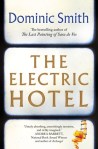
Book coverI admit to a brief feeling of déjà vu when I started Dominic Smith’s latest novel, The electric hotel, because it starts by telling us that its protagonist 85-year-old Claude Ballard has been living in the Knickerbocker Hotel in Los Angeles for over thirty years. Not another man living in a hotel like our gentleman in Moscow? Very quickly, though, I realised that this was a very different book. Towles was inspired by the idea of people living in hotels, while Smith was inspired by something completely different, the idea of lost films. The Library of Congress, he says, believes that over 75% of silent films have been lost forever. A figure familiar to retired film archivist me.

What’s the hotel got to do with all this? Well, apparently, the 1929-built Knickerbocker was, for much of its life, closely connected with the film industry. As Claude remembers in the novel, costume designer Irene Lentz committed suicide by jumping from the 11th floor, and silent film director DW Griffiths collapsed in the lobby. Moreover, at least one person, the character actor William Frawley, did live at the hotel for thirty years. However, Smith’s story, unlike Towles’, spends very little time in the hotel. Instead, it follows the life and career of fictional silent filmmaker Claude Ballard, focusing on his most famous film, The electric hotel, which sent him, and the production team, bankrupt, not because it was a failure but because the film inventor Thomas Edison threatened to sue for illegal use of his patented film stock. While Claude and his film are fictional, Edison was a shrewd businessman who did try to control the film industry. Smith’s research, then, looks good, and while I’m not an expert in the silent era or its technology, I felt pretty comfortable with the history – right down to the concerns about the vinegar smell in Claude’s room, although I don’t think the term “vinegar syndrome” was much used in the early 1960s.

For a (retired) film archivist like me, The electric hotel offers a step down memory lane. Indeed, the framing story is that film historian Martin, who is writing his dissertation on innovation in early American silent film, has become interested in Claude’s career. We are neatly given the shell of Claude’s career in the first chapter via his first meetings with Martin. This segues to Chapter 2 and the largest portion of the novel which takes us from the young Claude’s meeting the pioneering Lumière Brothers in the mid 1890s, through to the heyday of his career when he worked with American producer Hal Bender, French actor Sabine Montrose, and Australian stuntman Chip Spalding, and which peaked with the release of The electric hotel in 1908. They are artists, entrepreneurs, adventurers, and together they make something quite astonishing. Gradually, however, and for various reasons that I won’t spoil now, they go their separate ways. We follow them through to the end of World War 1, with a couple of forays back to the novel’s original time setting, 1962, where we also end up.

It’s an engrossing read. Smith creates vivid characters, and conveys well the excitement and energy of the early film industry pioneers – Claude’s early fin-de-siècle days in Paris, his travelling around the world with the Lumières’ cinématographe, the development of his career in New York with Hal and Chip, and the war years. It’s a complex story, with a fair share of twists and turns, about art and money, success and failure, and, yes, an artist (Claude) and his muse (Sabine).

What, though, is the book really about? Besides being inspired by the idea of lost films, I mean? Smith himself says, as quoted in the press release, that his ongoing interest is “the gaps and silences of history”.  What does he say about these gaps and silences? I’m not sure, really. I think that perhaps he’s not so interested in commenting on the gaps, as dabbling around in them and bringing them to our attention. This is what he does for silent film, anyhow, but in doing so he also explores the increasing realisation of the power of this new movie medium. Early on Claude tells Sabine that “it turns life into moving pictures”, and a little later, Sabine’s coach and devotee of naturalism, Pavel, says that Claude had “managed to trap real life”. It’s in the war, though, that film’s darker potential becomes obvious, as German soldier Bessler forces Claude to produce the perfect propaganda movie, The victor’s crown. Claude, however, manages to subvert it to his own ends, proving to Bessler’s detriment that, indeed, “the camera sees the truth”!

The book is also an ode to the drive, the obsession, to produce art – and to the price paid by those who have this drive. Claude, who never goes anywhere without his camera, keeps his most personal negatives undeveloped because “until that second they hit the chemical bath, every image is perfect in my mind”. I’m sure many creators understand this.

But the book also has a personal dimension. It’s about love and loss, about escaping, hiding, and stalling. Claude’s personal life is peppered with loss, from which he never really recovers. He tells Martin, “I had every intention of starting over. It was like an errand I meant to run for fifty years.” And, late in the novel he says:

… the past never stops banging at the doors of the present. We pack it into watered suitcases, lock it into rusting metal trunks beneath our beds, press it between yellowed pages of newsprint, but it hangs over us at night like a poisonous cloud, seeps into our shirt collars and bedclothes.

It’s good writing – expressive, but controlled, and never overdone.

The smug German Bessler tells Claude that “art is art wherever it blooms”. The electric hotel explores that in all its glorious messiness.

Dominic Smith
The electric hotel
Sydney: Allen & Unwin, 2019
349pp.
ISBN: 9781760528621

(Review copy courtesy Allen & Unwin)