Jorge Amado, Gabriela, clove and cinnamon

Jorge Amado

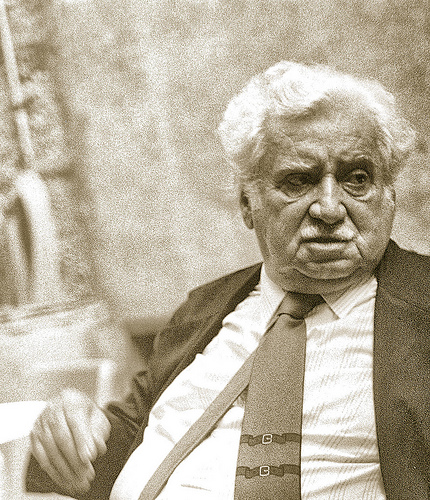
Jorge Amado, 1985 (Courtesy: Xan Carballa, via flickr, using CC-BY-NC-2.0)

How could you resist reading a book with a title like this? I don’t manage to read all the books scheduled for the various bookgroups I belong to, but when this one came up I decided it was a must – because it was by a non-Anglo writer and one I hadn’t read before, and because of its gorgeously evocative title. I wasn’t disappointed. This is fun and rather easy to read, but that doesn’t mean it’s simple.

Jorge Amado is a Brazilian writer, and Gabriela, clove and cinnamon (1958) is set in Ilhéus, a coastal city where he spent his childhood. The novel takes place in 1925 – during a time of great social change:

New streets had been opened, automobiles brought in, mansions built, roads constructed, newspapers published, clubs organised – Ilhéus was transformed. But the ways men think and feel evolve more slowly. Thus it has always been in every society. (p. 2)

The basic plot concerns Nacib (the Arab) and his love for Gabriela (the simple, but sensuous, mulatto girl he hires as his cook). But the book’s subject matter is far wider, dealing with politics and society at a time when “old ways” were being challenged by “new ways”. The “old ways” are typified by macho violence, by the notion, really, that “might is right”. Violence is used by the old leaders (mostly the “colonels”) to attain and maintain political power – and to maintain possession of women. It was accepted practice, for example, for a man to kill an adulterous wife and her lover. In fact, the novel starts with such a murder and then a little later we hear of another man being reviled for not doing so, even though his way of handling it had a delicious come-uppance about it. Ilhéus is, we are told, changing but not yet civilised; it still clings to its old and violent customs; it is

so feudal still despite its much publicised and undeniable progress.

While men hold the power, the novel is structured around women. There are four chapters, each commencing with a poem about a woman:

  • The languor of Ofenísia (who would rather die a virgin if she can’t have the Emperor)
  • The loneliness of Gloria (the mistress of a wealthy man, who has everything but what she wants)
  • The secret of Malvina (the young student who will not be controlled by a man)
  • The moonlight of Gabriela (the free spirit who should not be changed)

The first, Ofenísia, does not really appear as an active character in the book (though we are told that her “importance must not be judged by the brevity of her appearance”). The other three though manage to achieve what they want…and in doing so they epitomise the conflict between the “old ways” and the “new”, between maintaining the “status quo” (with its attendant double standard) and accepting change.

The book is peopled with a wonderful array of characters. I found it hard at the start to keep track of all the characters – particularly the many Colonels – but eventually I did, and realised that they fall into two main camps: those tied to the “old ways” and those supporting change. Colonel Ramiro Bastos is the leader of the former, and new arrival Mundinho Falcâo is a proponent of new ways of doing things, such as through negotiation. This conflict is represented literally and symbolically by the sandbar. It prevents the town being used as a port for the new cacao industry and Falcâo promises to dredge it. The scene is set for a big showdown as the various citizens of the town align themselves with one side or another, but the resolution is not as simple and dramatic as we expect. And this is partly what makes this a novel well worth reading. Change is presented as generally good, but it is not “simply” or even always so. Amado conveys this subtly. The characters are complex and through their very realistic interactions and sometimes contradictory behaviours we see that old versus new is not a simple dichotomy. Gabriela, for example, cannot be changed to fit Nacib’s image of a wealthy man’s wife: she is a free spirit who doesn’t quite represent the old or the new. She just is. And symbolically, the sandbar will not stay dredged and will need regular clearing. It is not a simple answer to continued progress for Ilhéus. Nonethess, by the end, some level of civilisation is achieved. At the trial of the husband who’d murdered his adulterous wife and her lover at the beginning of the book, the lawyer Dr Ezequiel Prado is reported as saying:

Ilhéus was no longer a land of bandits, a paradise of assassins; his theme was civilization and progress.

It is interesting to think that this book was published around the same time as Patrick White’s Tree of man (1955) and Voss (1957). Amado and White are both described as modernists, but how different they are. White is psychologically intense, while Amado here is full of humour, colour and movement, reflecting the messiness of society. Modernism, though, is a forgiving church as Lisa (ANZLitLovers) shows in her post on the subject.

There is so much to write about this book. Its humour and satire, the complex characterisation, the clever way the double murder introduced at the beginning is woven as a motif through the book, and the breadth of its subject-matter are just a few of the the topics that could be explored in depth.

I’ll leave those for others though and come back to a favourite aspect for me which is its thorough analysis of the way the desire for progress clashes with the status quo. I’ll end with statements made by two of the town’s old guard. First, the Colonel who sees that change is coming:

That’s right Colonel. Everything you’ve said is right as far as it goes. But it’s right by the conditions and needs of an earlier time. We spend our lives working hard, and we don’t realise that time is going by and that things are changing…

Then, the Colonel who doesn’t see it:

What does Ilhéus want beyond what we’re giving it? What more is there to do? To tell the truth I don’t see these new needs.

It was ever thus eh?

Jorge Amado
Gabriela, clove and cinnamon
(trans. by James L. Taylor and William L. Grossman)
New York: Vintage International, 1958 (1992)
426pp.
ISBN: 9780307276650

Willa Cather, The sentimentality of William Tavener

Willa Cather

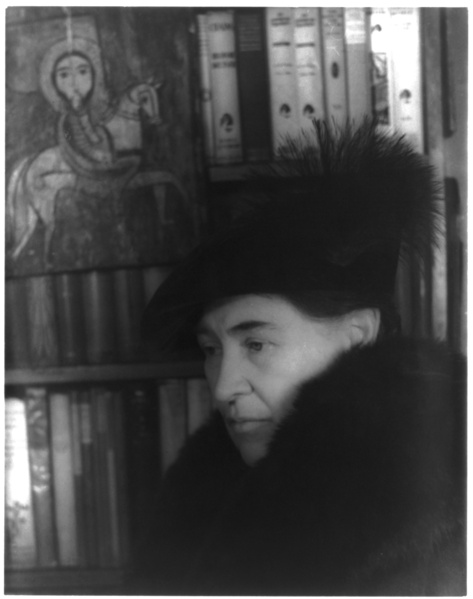
Willa Cather, 1936 (Photo: Carl Van Vechten; Public domain, via Wikipedia)

Last week’s Library of America story was Willa Cather’s “The sentimentality of William Tavener” (1900). I can’t resist blogging about this one because it’s by the wonderful Willa, to whom I was introduced when I first lived in the US in the early 1980s. I have read only three of her novels (My Antonia, The professor’s house, and Death comes for the archbishop) but loved her from the beginning: for her robust, somewhat terse and yet not unsubtle style, and for writing so evocatively about the nation I was living in and keen to learn about.

The Library of America’s introduction says that this story is one of her earliest pieces and that it “combines recollections from her childhood years in Virginia, where she was born, with the atmosphere of her family’s later home in Nebraska”. It also introduces us, the Library continues, to “the strong-willed pioneers who would be so prevalent in her later, more famous fiction”.

“The sentimentality of William Tavener” might be an early piece but it demonstrates well her ability to tightly evoke character and mood. Its plot is flimsy: it takes place in one evening and concerns Hester Tavener’s plan to get her husband to allow their sons go to the circus. He, it appears, is hard and demanding of the boys; she, their ally in obtaining some of the pleasures of life (“No debtor ever haggled with his usurer more doggedly that did Hester with her husband on behalf of her sons”). In less than 6 pages, Cather provides a powerful picture of this couple – of their individual (equally strong in their own ways) personalities and the somewhat distant relationship between them. In the first paragraph is this:

The only reason her husband did not consult her about his business was that she did not wait to be consulted.

And yet, he, the William of the title, is not a pushover – but he does things his way:

Silence, indeed, was William’s gravity and strength.

On the night of the story though, he breaks his silence and the astonishing effect, the ending teases us, is that it just may augur a new balance of power in the family. We see the possibility of this coming as the evening wears on and the barrier between the couple starts to break down through the sharing of memories, but it is heralded by a sudden change in style from concrete, matter-of-fact almost staccato reportage to a descriptive interlude:

The little locust trees that grew by the fence were white with blossoms. Their heavy odor floated in to her on the night wind and recalled a night long ago, when the first whip-poor-Will of the Spring was heard …

There is irony in the title: William is not presented as a sentimental man and yet, we find, a little sentimentality can work wonders.

The story introduces us to the Willa Cather to come – to her direct, matter-of-fact style; to her strong characters who often survive by the force of their own will in a world that is hard (or they perceive as hard); to her exploration of relationships and the challenges of maintaining them (particularly in the long haul); and to her evocative, careful use of landscape and nature. If you enjoy this story, and have not read any other Cather … then do move on to her novels.

POSTSCRIPT: For an excellent analysis of Willa Cather’s writing, see AS Byatt’s article in The Guardian. It takes a writer to know a writer!

Ruth Park, Swords and crowns and rings

Note to self: never again “read” an audiobook over a long period, such as, say, 5 months! This is how I read Ruth Park‘s engrossing 1977 Miles Franklin award-winning novel, Swords and crowns and rings. It was not hard to keep up with the plot as it’s pretty straightforward – and powerful. It is hard, though, over such a time to keep up with and remember all the nuances in her writing and expression and the way they affect character development and thematic strands. For a thoughtful review of the book by someone who read it more sensibly, please see my friend Lisa’s, of ANZLitLovers, here.

I am not an experienced “reader” of audiobooks and I have to say that I found what seemed to me to be the over-dramatisation of the story rather trying in the first few CDs. I gradually got used to it, however, and by the end I was happy with Rubinstein’s reading, but it did take me a while to settle into it.

New-Zealand born Ruth Park is a wonderful chronicler of Australian life. Her novel, The harp in the south, set in working class Sydney in the 1940s is, to my mind at least, an Australian classic – but it is just one of her extensive and well-regarded body of work. Her autobiographies are also well-worth reading, not only for the light they throw on her life and on that of her husband, author D’Arcy Niland, but also on that of the Australian literary establishment of the mid-twentieth century.

Anyhow, back to the novel. Swords and crowns and rings tells the story of two young people born in an Australian country town before World War 1 – pretty Cushie Moy (born to a comfortable family with the stereotypical socially ambitious mother who has married down) and the dwarf, Jackie Hanna (whose background is well and truly working class). Not surprisingly, Cushie’s parents frown on the friendship which develops between the two. This is not an innovative story but, rather, good historical fiction with evocative writing and sensitive character development. Consequently, as you would expect, the two are separated just as they realise their love for each other and the book then chronicles their respective lives – Cushie with various relations in Sydney and Jackie in a number of country locations before he too reaches Sydney. Much of the book takes place during the early 1930s Depression. Park gorgeously evokes the hardships – physical, economic and emotional – experienced by people like Jackie and his step-dad “the Nun” as they struggle to support themselves. All this is underpinned by Park’s thorough knowledge of the social and political history of the time: we learn about labour organisations and the rise of socialism, of that irascible politician “Big Fella” Jack Lang, and of the building of the Sydney Harbour Bridge.

The resolution is predictable – it is, after all, a book of its genre – but it is not over-sentimentalised and is not achieved before the characters, Jackie in particular, have matured to the point that we can trust that he not only deserves what will come but that he will continue to work and mature for the betterment of himself and those he loves. It is truly a powerful book about human nature, as well as about the place and time in which it is set.

Ruth Park
Swords and crowns and rings (Audio CD)
Read by Deidre Rubenstein
Bolinda Audio, 2007
18 hours on 15 compact discs
ISBN: 9781741636628

Edith Maude Eaton, Mrs Spring Fragrance

This week’s Library of America short story offering is “Mrs Spring Fragrance” by Chinese American author Edith Maude Eaton (1865-1914) who wrote under the pen name of Sui Sin Far. She had an American father and a Chinese mother and, according to the notes which accompany the story, was apparently the first person of Chinese descent to write in the US about Chinese-American life.

“Mrs Spring Fragrance” was published in a collection in 1912. Its concerns are not new to us, reading it nearly a century later and familiar with literature about the challenges of living cross-culturally, but at the time it was apparently rather exotic. The subject of the story is marriage, and the conflict between traditional Chinese arranged marriage and westernised marriage in which young people choose their marriage partner. The main characters are a happily married Chinese couple who live in America, the Spring Fragrances. Their marriage was arranged but as we are told early in the story, both are quite “Americanised”. Mrs Spring Fragrance, we learn, is sympathetic to the plight of their young neighbour who has been promised in marriage but who wants to marry her chosen love.

The plot turns on that old conceit of eavesdropping – of things heard out of context which threaten to derail the “real” situation. (Interestingly, there is a book published by Cambridge University Press titled Eavesdropping in the novel from Austen to Proust, which explores the concept of eavesdropping in nineteenth century English and French novels.) Anyhow, back to the Spring Fragrances. In this story, the eavesdropping is complicated by cultural confusion and the result is … Well, I’m not going to give it away as you can read it yourself using the link above.

I will say, though, that what is eavesdropped is Tennyson’s statement:

‘Tis better to have loved and lost,
Than never to have loved at all.

Surely, says Mr Spring Fragrance, expressing a Chinese perspective despite his “Americanisation”:

Is it not better to have what you do not love than to love what you do not have?

It is a straightforward story, but told nicely and with a light touch. She shows how difficult it is to truly “change” cultures: through such comments as those above and Mrs Spring Fragrance’s unconscious error when she refers to the “loved and lost” poem as the “beautiful American poem written by a noble American named Tennyson”! You have to laugh – but not cruelly, as these are appealing characters, earnest in their desire to do the right thing.

This is not a must-read story, unless you are interested in the history of Chinese-American literature, but it is an enjoyable one nonetheless.

Martin Boyd, A difficult young man

Martin Boyd's A difficult young man
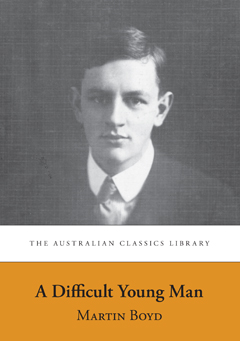
Difficult but handsome (Courtesy: Sydney University Press)

I’m not sure what I was expecting, but I certainly wasn’t expecting the delightful sly wit I found in Martin Boyd’s A difficult young man, which, I understand, is the second book in the “Langton Quartet”. This novel though can clearly stand on its own – otherwise, why would Sydney University Press publish it alone as part of its Australian Classics Library? Is it the best written of the four? The most readable? The one most commonly studied (which goes back to the original question anyhow)? Or was it simple a case of eeny-meeny-miny-moe? (Even “eeny meeny miny moe” has a Wikipedia article – how great is that?) Whatever  the reason, my appetite has been whetted, and the first book, A cardboard crown, will now be promoted in my TBR pile.

Anyhow, back to the serious stuff. I know it was written in a completely different place and oh, nearly a sesquicentenary later, but there’s more than a whisper of Jane Austen about Boyd’s book. Superficially, this book and Austen’s works are very different: this is not a romance – but then neither is that Jane Austen’s focus either; its main characters are male rather than female; it has an autobiographical thread which none of Austen’s novels do; and it uses first person rather than Austen’s omniscient third person narrator. The similarities are, rather, in language (their wit and irony) and form (both write what can be described as social satire). I may be the first person to have put these two authors in the same sentence, but, well, that’s the fun of being a blogger: you can say it as you see it! And what I see is that both writers make me chuckle with their observations on human nature.

So what is the plot? The story is narrated by Guy Langton (a veiled Martin), who is the fourth son of Steven and Laura Langton. He focuses on the late adolescence-early adulthood of the eldest living son, Dominic (inspired by – but not – Merric), the “difficult young man” of the title, who, as the story progresses, manages to fail in, or otherwise mess up, pretty well everything he does. Through the course of the book the family moves from Australia (Melbourne and environs) to the family seat in England and back to Australia again. The book chronicles a number of domestic crises, at the root of which is usually Dominic who somehow undermines “the various attempts to fit him into some place in the world”.  In many ways though, the book is just as much about Guy who, through the process of narration, works to find a balance between “the unaltered impression” of “my childish mind” and “the glaze of adult knowledge”. This is a clever book which reads like, but is not, an autobiography.

It’s an engaging story – not so much for its rather episodic plot as for its array of wonderful and mostly eccentric characters, from the social-climbing arriviste Aunt Baba (who thinks anyone who does “a kindness from which they received no benefit” is silly) to the gentle, wise but somewhat ingenuous father, Steven. My favourite aspect of the book though is its style. I usually enjoy self-conscious narrators, and Guy is definitely that. He regularly addresses the reader directly, reminding us that he can use “the mask of a character in the story” and advising us of which “glaze” he is applying at the time. In this way he lets us know which parts might be more suspect than others in terms of the “facts”, which he recognises as being different from the “truth”:

..but the reader must take certain wild statements as intended for fun, though they contain an element of truth too subtle to be confined within the limits of accurate definition. One can make exact statements of fact, but not of truth, which is why the scientist is forever inferior to the artist.

And this brings us to another concern of the novel – the importance of the imagination. In many ways the book is a hymn to the creative life, a statement of the Boyds’ belief that a life lived without imagination is probably a life not worth living. It also makes a plea for humane values, for peace not war, for gentle not brutal discipline of children, for education that is not conformist. The book is set in the years leading up to World War 1 and the point is made that life before the war – the “secure civilisation” – was to change irrevocably after.

In addition to irony, Boyd uses a wide range of literary techniques rather effectively, such as foreshadowing (which teases us while at the same time directing our understanding), analogies, contradiction, and allusions (particularly to art and literature). All of these imbue the book with a reflectiveness that undermines a focus on plot.

There are so many strands to this novel – its style, diverse subject matter, and characterisation – that would be fun to explore, but that would leave nothing for the rest of you to talk about, so I will finish with a statement made by the narrator towards the end of the novel:

This is really what I am seeking for throughout this novel, the Memlinc in the cellar, the beautiful portrait of the human face, lost in the dissolution of our family and our religion.

I am doubtless romanticising the Bynghams [maternal ancestors], but there is an element of truth in what I write, which is all I ever claim. Also everyone romanticises what interests him.

As he does so often in the novel, he says one thing here and then undermines it immediately after. But it works, and it works because life is messy and contradictory and yet out of this mess and contradiction comes a vision of something that is real and enduring – and that is the transcendence of family, and the importance of imagination.

Martin Boyd
A difficult young man
Sydney: Sydney University Press, 2009 (orig. pub. 1955)
223pp.
ISBN: 9781920898960

(Review copy supplied by Sydney University Press. This is the last of 12 books that my friend Lisa (aka ANZLitLovers) and I received to review. We believe more will be published in this series: if these 12 are anything to go by we are in for a real treat – and the cause of Australian literature can only profit from that.)

Geoff Page, The scarring

Geoff Page (born 1940) is a Canberra-based poet who has been active in the Australian poetry scene for many decades now. He was also, for nearly three decades, an English teacher. Page has published several volumes of poetry and at least three verse novels, of which The scarring is his first.

The scarring, which I read a few years ago but have been wanting to review here, is, I have to say, one of the most gut-wrenching works I have read. Page has set it in the landscape – rural northern New South Wales – of his childhood and says it was inspired by rumours he heard as a child (but it is not a “true” story). The story spans around seven decades from the 1910s to the 1980s, and chronicles the lives of a couple from their youth and courtship through to old age. As the blurb on the back cover says, “their separation through war sows the seeds of their eventual destruction”.

One of the things I love about the book is the way Page weaves so much of the social and political history of twentieth century Australia through the lives of this couple – war, the Great Depression, the boom of the 1950s, city versus country life and values, and of course gender inequity and the old double standard! The scene is set from the first line:

Breed em tough, the old man says.

Little do we know what lies beneath this seemingly innocuous opening – and I’m not about to give it away to you now. Let’s just say that Page deftly weaves the breeding motif through his tale of a young couple running a cattle property.

Here is an example of how history is told alongside life on the farm:

the new white stiffness of the sheets
where Sally will be his forever

‘Forever’ moves on two years more.
The set of skills they share between them
shoves them sideways from the news:
Sudetenland, then through to Munich,
Kristallnacht and into Prague.
It rattles in through bakelite
and once or twice on Cinesound
showing at the flicks in town,
that lifted arm and square moustache
relishing a massed salute.

And so the story moves on to its more or less inevitable – given the events that occur – conclusion. This is not flowery poetry. Page tends more to a spare style that is well suited to his setting and subject.  The poetry’s insistent rhythm draws you on, and Page’s use of repetition slowly but subtly builds up the tension. This is a novel that you’ll want to read in one sitting.

Page is, I think, a little too unsung … but then, isn’t that the case with most poets?

Geoff Page
The scarring
Alexandria: Hale & Iremonger, 1999
111pp.
ISBN: 0868066826

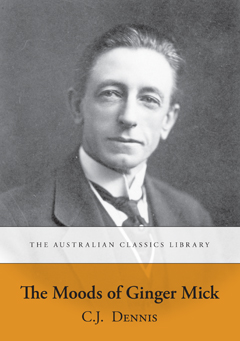
C.J. Dennis, The moods of Ginger Mick

Sometimes a bloke gits glimpses uv the truth
(“In Spadger’s Lane”)

I wasn’t sure, really, that I wanted to read CJ Dennis’ verse novel, The moods of Ginger Mick, which I received as a review copy from the Sydney University Press as part of their Australian Classics Library – but have surprised myself. I rather enjoyed reading it and am glad that I had this little push to do so!

The moods of Ginger Mick
The moods of Ginger Mick cover (Courtesy: Sydney University Press)

The moods of Ginger Mick was published in 1916 just weeks before the big Conscription Referendum, according to Philip Butters who wrote the new introduction to this edition. It does not however buy into that debate. The book comprises 15 poems “written” by Dennis’ other character, The Sentimental Bloke, at whose wedding Mick was best man. The poems introduce us to Mick and his larrikin life before the Great War and then go on to chronicle his life as a soldier.

Dennis writes his poems in broad Australian slang (but there is a glossary at the end). Most are 6-line stanzas with an ababcc rhyme (the same as Wordsworth’s “Daffodils”!) but every now and then there is a different rhyme scheme which mixes it up a little. The sweet poem “The singing soldiers”, for example, has a sing-song aab(with an internal rhyme)acc, while the poignant “Sari Bair” about the eponymous battle has 4-line stanzas with a simple aabb rhyme.

I enjoyed reading the poems, not only for their evocative language but also for their subject matter. While their setting and language make them very much of a particular time and place, their concerns have some universality. They are about egalitarianism vs class difference, and about what it means to be a man (a “bloke” as it were). Mick starts off as a bit of a larrikin – one who cares not for the “toffs” and for whom the “toffs” care not! As he says in an early poem:

But I’m not keen to fight so toffs kin dine
On pickled olives …
(“War”)

What sends him to war in the end is “The call uv stoush” but, when he gets there, he starts to discover that in uniform all men are equal, that

… snobbery is down an’ out fer keeps,
It’s grit an’ reel good fellership that gits yeh friends in ‘eaps.
(“The push”)

This poem, “The push”, provides a wonderfully colourful roll call of the sorts of men who enlisted. Other poems cover the support of women at home, hopes for work when they return home now they’ve proved themselves (after all the “‘earty cheerin’ … per’aps  we might be arstin’ fer a job”) and the sense that Australia has grown up as a nation (“But we ‘av seen it’s up to us to lay our toys aside”). There is ironic humour (as in “Rabbits”) and pathos (as in “To the boys who took the count” and “The game” in which Ginger Mick finally realises that he’s found his metier). There’s also some racism that was, unfortunately, typical of the time. And of course there is patriotism, with some rather lovely descriptions of the Australian landscape. I just have to mention here some references to gums:

An’ they’re singin’, still they’re singin’, to the sound uv guns an’ drums.
As they sung one golden Springtime underneath the wavin’ gums.
(“The singing soldiers”)

An’ we’re ‘opin’ as we ‘ear ’em, that, when the next Springtime comes,
You’ll be wiv us ‘ere to listen to that bird tork in the gums
(“A letter to the front”)

As a group, the poems offer an interesting insight into Australia’s experience of the First World War, particularly given their mix of realism and romanticism that belies perhaps the recent glorification that’s developed around our ANZAC heritage. If you are interested in Australia’s cultural and literary heritage, it is well worth giving this short little book a look.

C.J. Dennis
The moods of Ginger Mick
Sydney: Sydney University Press, 2009 (orig. pub. 1916)
87pp.
ISBN: 9781920898984

(Review copy supplied by the Sydney University Press)

Jessica Anderson, The commandant

Jessica Anderson, The commandant Book cover

Cover image for The commandant (Courtesy: Sydney University Press)

When I first read about Sydney University Press’s Australian Classics Library, the book I really wanted to read waThe commandant by Jessica Anderson. It’s her only historical novel, but its subject matter doesn’t stray much from what she told Jennifer Ellison in an interview many years ago, “I was very much, and always have been, preoccupied with people who are strangers in their society” and “I am interested in families… They are interesting – you know, the tangle” (Rooms of their own). This is a clever and thoughtful novel by yet another much overlooked Australian woman writer.

[WARNING: SPOILERS, if you don’t know the history on which this is based]

The plot is pretty simple. It is set in Queensland’s penal settlement of Moreton Bay in 1830. It draws from the real story of the commandant there, Patrick Logan, who was noted for his harsh methods and who was murdered while out on an expedition. In the novel, Logan’s family is joined by his wife’s young sister (“the stranger”), Frances, who, on her way up to the settlement via Sydney, has been introduced to “radical” ideas critical of Logan’s regime. The scene is therefore set for potential conflict either between Patrick and Frances, or within Frances herself, or both.  In the end, it is a bit of both as Patrick finds his practices questioned and Frances confronts the realities of living in a penal settlement.

Except for Frances’s boat trip up to Moreton Bay with some of the settlement’s residents, the novel is set entirely in Moreton Bay. The characters include Logan’s household (family and servants), his wife Letty’s two women friends, officers of the settlement including two medical officers and the man sent to replace Logan, and of course some prisoners. There are also some characters in Sydney – Frances’ would-be beau and the sisters of a newspaper editor jailed for his criticism of the regime and against whom Logan is bringing libel action. The characters are well-drawn, with the significant ones nicely complex. You get a good feel for life in the settlement.

I would love to write about many of the characters as there are some wonderfully meaty ones, but I’ll just focus on Frances, the only character, really, who changes during the course of the novel. At the beginning, she “was seventeen; she was not stupid, but was often absurd”. She is also sympathetic to the idea of reform, which she says she developed through seeing servant life and poverty first-hand in Ireland and which puts her at odds with many in the settlement. She has a lovely ability to question herself, to see her failings, and it is this which enables her to learn from her several painful experiences. By the end, she is wiser in the ways of the world and has learnt to live with “incurable knowledge”, but has not lost her commitment to the cause of humanity.

Much of the story is told in dialogue – in fact, it wouldn’t be hard to turn it into a play/screenplay. Anderson handles this dialogue well, nicely differentiating the characters, from Letty’s lisp to officer Collison’s uneducated speech patterns. Letty’s lisp is an ironic touch – it lulls us into thinking she is one of those superficial flirtatious women but we soon discover that she is more complex than just a pretty little wife. Characters are nuanced by their reactions to each other  as well as by what they say, rather than by a lot of specific authorial comment, though there is that too.

There is also description, including some particularly beautiful ones of the bush during the search expedition for Logan, such as:

…a few clumps of trees, their rough bark the colour of iron, and their foliage a dun green, stood with the junction of trunk and root shrouded (my emphasis) by tall pale grass; and although at his left the river marked out a fissure of brighter greens, none among them were the sappy (again my emphasis) greens of England and Ireland or the dense fleshy greens of the coast … Among and behind this scrub stood big trees with foliage in similar colours, and with trunks of grey, or silvery grey, or of mauve shading to grey or rust, or of the beautiful colour of pink clay. It was as if everything here inclined not to the sun’s bright spectrum, but to those of the mineral earth and the ghostly daytime moon.

This is not an entirely benign landscape she is decribing – but neither does it hang heavily on her tale: her main focus after all is people. Here is an evocative description of Letty:

She fragmented the worry with her laugh, and waved it away with her hands, but it always seemed to reassemble, out there in the air, and float back to resettle on her.

One of the things that intrigued me most about the novel as I was reading it was the narrative form. It is a pretty straight chronology, but with many small flashbacks that help illuminate the characters. Most interesting though are a couple of slight but meaningful foreshadowings which, before the novel’s end, give us a sense of the sisters’ futures. This makes us realise that the novel is not really about them…it is about humanity, about how we treat each other – and, about that special word, mercy. You will have to read it for yourselves to know what I mean.

Jessica Anderson
The commandant
Sydney: Sydney University Press, 2009
326pp.
ISBN: 9781920898946

(Review copy supplied by the Sydney University Press)

George Orwell, Bookshop memories

I do like to read a bit of Orwell every now and then – and for that reason, though I have other books of his to read in my TBR pile, I recently bought his essay collection, Books v. cigarettes, in Penguin’s delightful Great Ideas series. I blogged about the first essay a couple of months ago. Tonight I decided to read the second essay, “Bookshop memories”, in which he draws on his experience of working in a second-hand bookshop. It was published in 1936.

There’s a nice little Wikipedia article about the essay, giving the background to his writing it and a brief summary of its content, so I won’t repeat all that again here. Rather, I’ll just comment on a couple of observations he makes that tickled my fancy, and these relate to one of the sidelines of the bookshop: its lending library. He says that in a lending library “you see people’s real tastes and not their pretended (my emphasis) ones, and so, he notes that:

  • “classical English novelists have dropped out of favour. It is simply useless to put Dickens, Thackeray, Jane Austen*, Trollope etc into the ordinary lending library; nobody takes them out”. Dickens, he says, “is one of those authors people are ‘always meaning to read'”
  • there is a growing unpopularity of American books (but he doesn’t give any reason for this)
  • people don’t like short stories because, for some, “it is too much fag to get used to a new set of characters with every story”. Orwell says on this one that the blame lies as much with the writers as the readers: “Most modern short stories, English and American”, he says, “are utterly lifeless and worthless”. Those that “are stories”, such as by D.H. Lawrence, are, he says, “popular enough”.

I don’t think the second point is true today (at least in Australia), but I suspect that the first and third still have some credence. Again and again I hear in bookgroups, “let’s not do a classic” and “I don’t like short stories”. Of course, there are exceptions (my bookgroup, for example, likes to do a classic a year!) but I think the rule still applies. Will it be ever thus?

* Have you noticed how Jane Austen is more often than not referred to with both her names while the fellas often aren’t? We comfortably talk about Shakespeare, Dickens, and Wordsworth, but far less so of Austen. Chivalry? Sexism? Odd isn’t it?

Favourite writers: 3, Thea Astley

I love its densely woven grammar, its ingrained humour, its uncompromising politics, and its undimmed outrage at human folly, stupidity and greed (Kerryn Goldsworthy on Thea Astley’s writing)

and

Great story, great characters … Stylistically, however, this book is like a very handsome, strong and fit woman with too much makeup on … This kind of writing drives me berserk” (Helen Garner, on Astley’s “An item from the late news”)

Despite winning four Miles Franklin awards along with several other major Australian literary awards, Thea Astley (1925-2004) has to be one of Australia’s most underappreciated writers. The two quotes above, from two significant Australian literati, give us a clue why. She was uncompromising and gutsy in her subject matter and she took risks with her style. This made her a pretty controversial writer. It also makes her great for discussion by reading groups (if they’re prepared to give her a try!)

Before I continue, though, I need to be honest. Her career spanned over 40 years and some 15 or so novels, as well as countless short stories, essays and articles, but I have only read about half of the novels and a few short stories. I’ve read enough though, from her mid career A kindness cup (1974) to her last novel Drylands (1999) to know that I like her and want to read more.

Take Drylands, for example. It covers a lot of the things important to Astley. Two major ones are words and their importance/their power, and people’s cruelty to each other. Subsumed in this latter one are some recurrent issues for her – gender, race, and other power imbalances. She has several targets in this book: she’s not too fussed on computers, television, or our sports-mad society; she’s also critical about how women are treated, not to mention indigenous people and ‘oddballs’. She’s a writer with a strong social conscience – and, for example, tackled race issues head on in books like the ironically titled A kindness cup (1974) and the gorgeously titled The multiple effects of rainshadow (1996).

But it’s not her subject matter that loses her fans so much as her writing. It can be dense…though it can have a sly humour too. She once said in an interview with Candida Baker that “I can’t resist using imagistic language. I like it. I really don’t do it to annoy reviewers”! It’s how she thinks. Here, for example, are some lines describing a town and its “barbaric” Christmas from the first page of the novel, An item from the late news (1982), referred to by Helen Garner in my opening quotes:

…the beer-gut belchings and the rattle of schooner glasses that always discover the Christmas crib and soothe the infant with whack yoicks seem to me to have a muckworm style. All towns. Not just this one. Because this one is smaller, a mere speck on the world’s glassy eye, the grossness is horribly apparent.

Time usually diminishes the memory; but for me it has done nothing but magnify that swollen moment of history when Wafer had the wax on his wings melted from flying too close, not to the sun, but to the local grandees.

Astley, as you can see, is rather critical of small town Australia…and small towns are the common settings for her books. I’m not sure why I, an optimist, like her jaded view of the world. Perhaps being an optimist enables me to take on board her concerns – concerns that are hard to argue against – without being ground down by them?  Anyhow, in 2002 she won a much-deserved, I think, special award at the NSW Premier’s Literary Awards for being ‘a trailblazer’.

I hope, if you haven’t read her before, that this has whetted your appetite. I’ll say no more but end with a favourite line, with which I identify, from Drylands :

… she had never been harried by the glamour of any possessions but books.

(Note: You may notice that some of the content of this blog is also on Wikipedia. Please don’t accuse me of plagiarism: what I’ve used here is material I put there!)