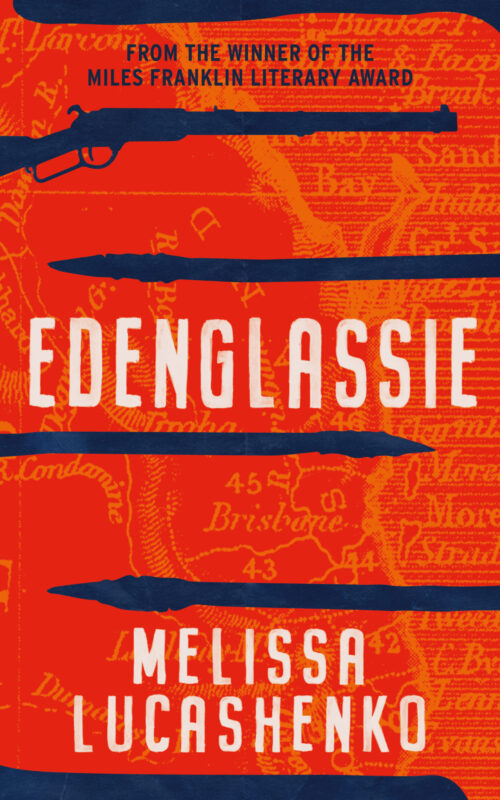
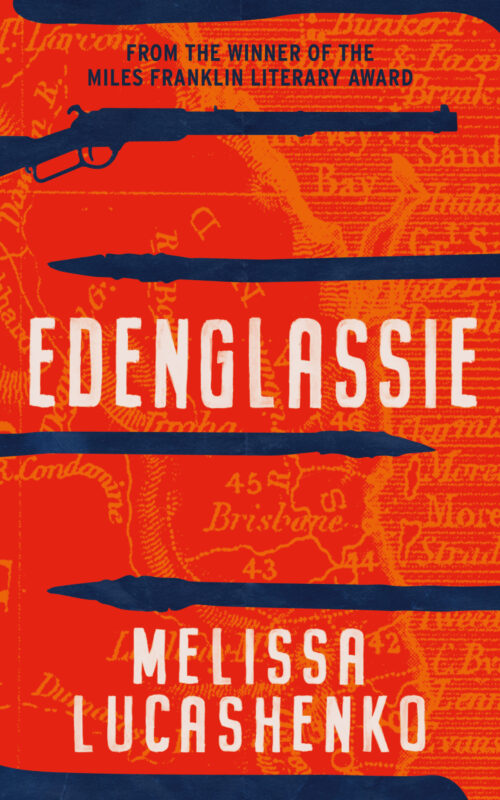
Broadly speaking, Melissa Lucashenko’s latest novel, Edenglassie, does for southeast Queensland what Kim Scott’s That deadman dance does for Noongar country in southwest Western Australia. Both tell of the early days of their respective colonies from a First Nations perspective; both are written in a generous spirit but with absolute clarity about the dispossession that took place; and both suggest things could have been different.
Unlike That deadman dance, however, Edenglassie, is a dual narrative story. The main storyline, featuring two young people, Mulanyin and Nita, is set around the Magandjin or Meanjin (Brisbane) region during the mid-1850s, making it just a little later than Scott’s first contact narrative. Dispossession, massacres and other brutalities from the colonisers were met with armed resistance, but there were also attempts to work together. Paralleling this historical story is a modern one, featuring Granny Eddie, Winona, and Dr Johnny, set in the same area at the time of its 2024 bicentenary. These stories, one using historical realism and the other modern humour, riff off each other to provide a complex picture of the colonial project – then and now.
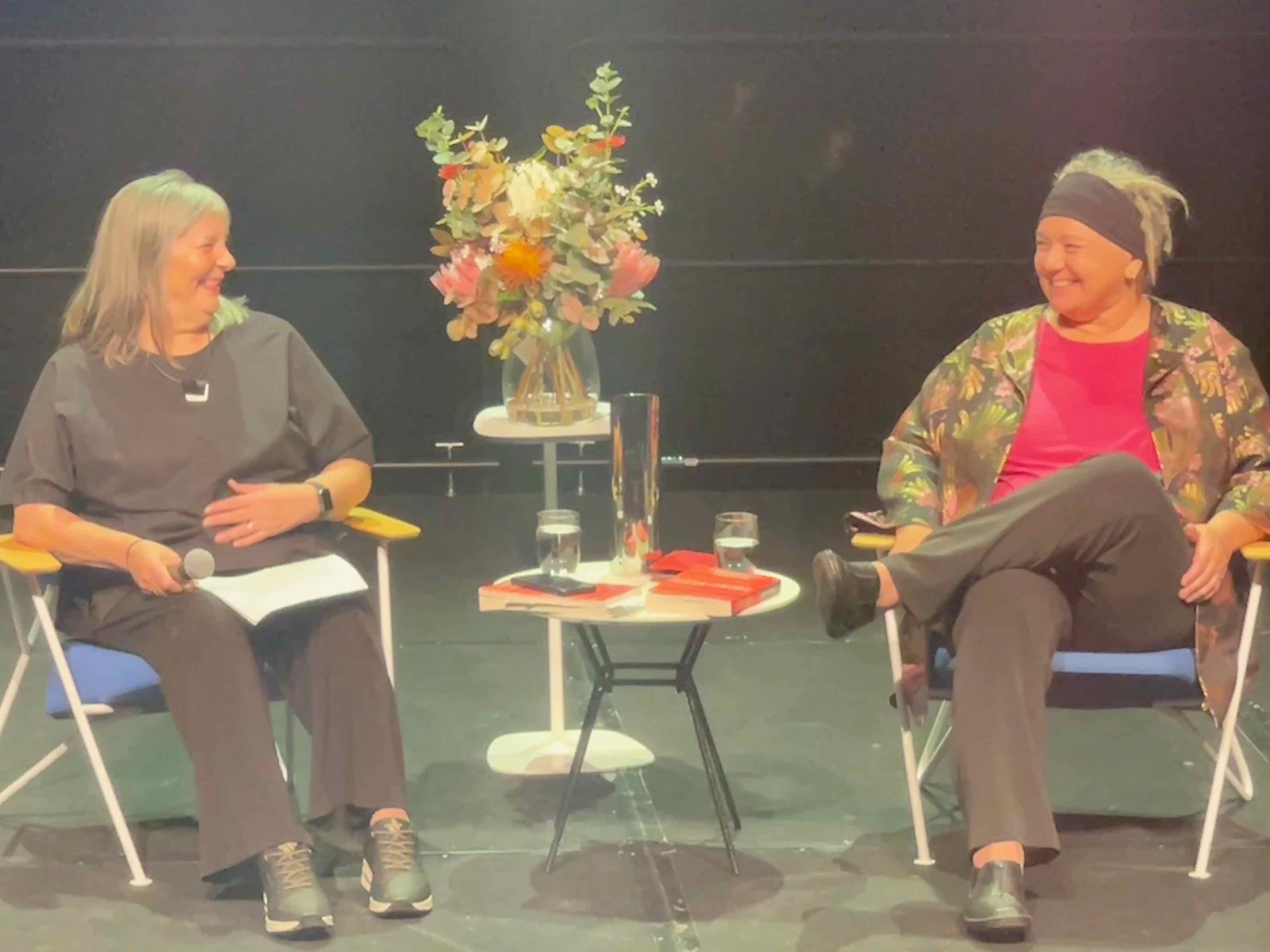
Melissa Lucashenko said much that interested me in the conversation I attended for this book, but here I’ll focus on two points she made. One is that the book’s central question is “what was going through these people’s [the colonisers’] minds?” Things could have been different then, she said, and could still be now. The other point is that she wanted to counteract the trope of the dying race. This idea has been slowly changing since Mabo, she said, but is still evident. The modern storyline, with its confident and politically involved Goorie characters, ensures that we see a vibrant, living culture in action.
Realising these two ideas is a big ask, and in my reading group there were some equivocations, but I think Lucashenko pulls it off, through creating engaging characters who come alive on the page and narratives that ring true to their times. Mulanyin, the kippa (young initiated man) from the historical period, and Winona, the fiery young woman in modern times, represent the passion of youth. They are impatient and want things to happen – or change – now. Both, however, also have elders guiding them – in the Goorie way, which is to encourage people to work it out for themselves and to remedy their mistakes.
“needing to endure the unendurable” (Mulanyin)
So, what is it that these young characters must contend with? The novel starts with two pointed events. In the modern storyline, Granny Eddie trips over a jutting tree root and is ignored by passersby until two young brown faces – Malaysian students as it turns out – help her up and get her to hospital. The modern scene is set, and all is not well.
We then flash back to 1840 where members of the Goorie Federation are looking forward to the imminent departure of the dagai, only to be told that this is now unlikely. A Goorie mother wonders what
If life never returned to normal. If the rule of law was never restored. What would her son see as a man? … Would her daughters be subject to the terrors the dagai brought?
What indeed?
Having asked the question, Lucashenko then moves her historical story to 1854-1855. Mulanyin is living with his law-brother Murree north of his own saltwater Nerang/Yugambeh home. Here, he is in close contact with the colonisers, and particularly with the Petries. At this time, the Petries, particularly the young Tom Petrie, were sympathetic to, and tried in their own way to work with, the Goories on whose land they resided. Lucashenko seems to be saying that, given colonisation was happening and wasn’t going to be undone, there were ways in which it might have been made to work (or, at least, work better). Conversations between Tom, Mulanyin, and other characters, explore their differences, particularly regarding attitudes to country. Mulanyin wants to know
what goes on in the brain of an Englishman? When he arrives in another man’s country to steal his land, and water, and game, and then with a straight face, calls those he steals from thieves? Is this how it is in Scotland? Is this why your people have fled that terrible place?’
The ensuing discussion has Tom struggling to explain the English, but admitting that “in their ignorance, they don’t understand that the land here has its own Law. They think that only their British law exists”. However, he says, they “respect some boundaries still … Those that are well defended”.
What did ‘well defended’ look like, Mulanyin wondered, if not like a thousand Goories assembled at the Woolloongabba pullen pullen? If not like Dundalli, leading the warriors who had willingly assembled under him, from Dugulumba to K’gari?
Fair point, Mulanyin.
Meanwhile, the modern-day characters are living with the fall-out from the failure of the colonisers to make it work and of the colonised to succeed in their resistance. Goories are still here, yes, but life is a struggle, and Winona wants to fight back, wants “to bite em hard onetime, while we got the chance”. She can’t understand why Granny Eddie, who grew up “with a dirt floor and empty belly” doesn’t think she deserves more. Granny, though, is two things. A pragmatist who sees that “Dagai not going away! We gotta get on with them”. And she’s an elder well-versed in her culture, so when Winona takes a hardline with Dr Johnny, who claims Aboriginal heritage, Granny says
“You’re thinking like a whitefella when ya close him out. That’s not our way. We bring people in, we bring our Mob home, and we care about them. We teach them how to behave proper way…”
Further, she argues,
“We can’t be sunk in bitterness … Or stuck in the past. We need to focus on the good dagais, like Cathy and Zainab, and them Petries, and –.”
Winona, Granny Eddie and Mulanyin all make sense, but they speak from different angles. What makes Edenglassie so interesting is the way Lucashenko gives space and respect to these angles. She certainly shows what was lost – and the utter unfairness of it. But, with the generosity of spirit we keep seeing, she also shares through her characters what living with deep connection to country means. And, she encourages everyone to think about alternative ways we can do this.
Towards the end of the novel, Gaja (Aunty) Iris shares an important story with our modern protagonists, introducing it with
we all know how important our stories are … People all over the world keep their stories close. Middle Eastern people believe … that by telling a story you can change the world, and nothing is as powerful as the right story at the right time.
With ideas about truth-telling and decolonisation becoming part of modern Australian culture, now feels like the right time for stories like Edenglassie. It might be an uncomfortable time to be a settler Australian, but that’s nothing compared with what First Nations people have endured and continue to endure. The least we can do is try to understand. Books like Lucashenko’s not only help us along this path but give us a lively read at the same time.
Melissa Lucashenko
Edenglassie
St Lucia: UQP, 2023
306pp.
ISBN: 9780702266126









 Whispering Gums