Humbook Christmas Gift to Stu of Winston’s Dad

I squeezed in at the last moment! What, you ask, did I squeeze into? Well, the Humbook Christmas Gift exchange. This is a virtual gift exchange that Guy Savage (of His Futile Preoccupations) and Emma (of Book Around The Corner) did last year. They enjoyed it so much they decided to invite their blogging friends join in this year. And so, I did – with thanks to Lisa of ANZLitLovers who tweeted the suggestion that I pair with Stu of Winston’s Dad. I jumped at the chance – with the secret hope that Stu might “gift” me a couple of translated books.  Fortunately for me, Stu was happy to be my copinaute …

… and so here I am, on Christmas Day, sending Stu my gift. But, shh … he’s probably still asleep over there on the other side of the world. Please don’t tell him what I’ve got him. I want it to be a surprise.

Is this making sense? No? Well, the idea is that I choose two books that I think Stu will like and post it here on my blog. Stu will do the same for me (when he gets up!*). My job then is to find copies of the books Stu has chosen for me, read them, and review them. But, as Emma and Guy reassure us, there’s no Humbook Police out there making us read the chosen books. It’s up to us … just like it is with any Christmas book we receive.

So, what did I choose for Stu? I didn’t of course want to select something he’d read so I checked his blog and it seems he’s read two Australian novels, since he started blogging anyhow, Christos TsiolkasThe slap and Tim Winton‘s Breath. I thought it might be interesting to choose an older book and a recent one, and I wanted to choose one written by a woman and one by a man.  Now, because I don’t want to keep poor Stu waiting any longer, here are my two “gifts” for him:

  • Joan London‘s Gilgamesh: This book, published in 2001, won The Age Book of the Year Award and was shortlisted for the Miles Franklin Award. I’ve recommended it to a few non-Aussies and they’ve liked it. I love this book for its language and mesmerising tone. It starts – in England, in fact (hello Stu!) – near the end of the first world war, and then moves to Western Australia, and then to Europe. It’s about place, dislocation, and the old meeting the new. It’s a reflective sort of novel. I think Stu will like it. Of course, the challenge with books of a certain age is availability, but I’ve checked The Book Depository and they have it. Phew!
  • Nam Le‘s The boat: I struggled about my second choice. I considered David Malouf, Murray Bail, Patrick White, Gerald Murnane, or the crime writer Peter Temple. I nearly chose Elliot Perlman’s The street sweeper, but I decided to go with something contemporary and have chosen the young Vietnamese-Australian author, Nam Le, and his book of short stories, The boat. Interestingly, like the novel I selected, it is not all set in Australia. In fact most of it is set elsewhere but I think Stu will be tickled by the fact that it’s been translated into many languages. The first story has autobiographical elements, and the last story draws on his father’s experience as a “boat person”.

Somehow I’ve chosen books I read before I started blogging, which is a shame in a way as I can’t share my reviews, but I think they make good introductions for Stu to the breadth of Australian writing. I hope he enjoys them.

Merry Christmas Stu from Down Under! Thanks for being happy to be my copinaute in this exchange. I look forward to seeing what you come up with for me … and will do my best to read them.

* Actually, when Stu gets up he’ll probably open his “real” presents and take Winston for a walk. Like me, he’s sure to have scheduled his post containing my “gifts” a while ago.

Monday musings on Australian literature: Guest post from Nigel of Under the counter or a flutter in the dovecot

This is embarrassing but I really can’t remember how and when I first met Nigel. Actually let me rephrase that: I do remember when I met him in person because I’ve only met him once (at a literary event earlier this year), but who stumbled across whose blog first I have no idea. I’m glad we did though, because in Nigel I’ve discovered not only a lovely writer (see my review of his novella Fall on me) but an active supporter of Australian literature through such activities as the online creative arts journal VerityLa and the arts forum, the Childers Group. I also enjoy his reflective blog, Under the counter or a flutter in the dovecot. And so I was thrilled when he said yes without apparent demur to my request for a guest post. Thanks Nigel …

Real or imagined, raising children makes a great story

The game now finished and the speeches in full swing, the camera panned left to take in the players who were standing off to one side and looked worn-out and knocked around, a few with mud on their faces, a bit of blood too, but smile they did because they’d won and were elated. After a moment, the camera went back to whoever it was that hadn’t yet finished his speech (why is it that a man with a microphone will always go on too long?). For the first time in my life I was grateful when the TV channel cut to an ad break.

When the NRL grand final coverage resumed – I’d not watched the actual game, and had only stumbled on the closing minutes of the concluding celebrations by lazy accident – the victorious players were wandering around the field, or ‘paddock’ as it’s apparently called, many with their young children in hand. It’s this that struck me: rugby league boofheads wanting to be with their kids in these lingering moments of sports elation.

It looked – it felt – amazingly non-sensical.

I’m not one for children; never have been, never will be. I am, in fact, the least paternal person on Earth. At no point in my life have I ever wanted children. Which is, now I examine my life with precision (the process of writing does that), a bit of a lie. I remember that as a teenager I did have day-dreams of raising children, except in those day-dreams my wife was always absent, to be accurate she was dead, which left me to be a hip young single father, and I was very good at fathering, and my kids adored me and I adored them back. Once I was old enough to understand why my wife was always cactus, my mind – my conscious mind – turned to things closer at hand, and much more real. Which is why, aged forty-four, I’m blissfully childless. When on the rare occasions something good happens to me (though for some reason these events are never televised), I reach for a bottle of nicely chilled verdelho and a slice of blue cheese on a cracker.

Not having children, not wanting children – now that I have a fine appreciation of the opportunities and constraints of my life, I desire children as much as I desire the idea of a car-alarm going off in the middle of the night, and if ever I find myself day-dreaming, which is, I should say, a lot, it’s about having a crumbling hut in some far-flung place that you can only access by barging a rusty old four-wheel-drive across seven creek-crossings – is problematic for someone like me, a writer of all things, that ridiculous trade that’s getting more and more ridiculous as each day goes by. For family is the guts of the contemporary Australian story – it is, to throw into the mix some suitably highfalutin French, its raison d’etre.

I’ve just finished having a private Australian literature festival, reading some blisteringly powerful novels by our nation’s finest (who too don’t get to parade their children in front of TV cameras). Kate Grenville’s Sarah Thornhill, Craig Silvey’s Jasper Jones and Gillian Mears’ highly distressing but remarkable Foal’s Bread. All three novels explore family and the impacts on children, but also the desire for children, that procreating is the usual path, the standard, the predictable, how it is just what you do. How the desire to continue your bloodline is simultaneously overwhelming and underwhelming. It is refreshing that both Foal’s Bread, which is largely set between the world wars, and Sarah Thornhill, which has as its backdrop our morally bankrupt colonial times, explore women who aren’t just mothers, whose dreams are bigger and wider and deeper.

*

In my own writing, my own attempts at making words come to life on the page – it always seemed so easy as a boy: you wrote what happened and that was that – I too explore family. My main characters are usually men and women (always a good start!) who have children, who want to be parents, who struggle to cope, who feel the pressure of internal and external expectation, who fail and fall into a heap but pat themselves down and have another crack at it.

Featherstone, Fall on me

Fall on me bookcover (Courtesy: Blemish Books)

My novella Fall on Me (Blemish Books, 2011) is about a single father who has to cope with his precocious seventeen-year-old son who insists on turning his naked body into an art exhibition. Lou and Luke: how through writing their story I’ve gotten to know them well, so well, despite everything how they created a family for themselves, and the addition to that family, Anna Denman, their housemate who became much more. To the point that I still think about them. And it’s always gratifying – and humbling – when readers say they think about them too.

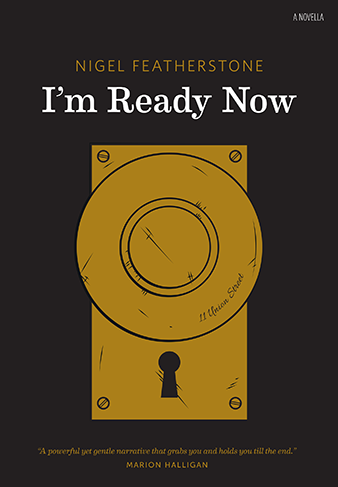
In my forthcoming novella, I’m Ready Now, to be launched in Canberra on 22 November by Blemish Books, I write about a very different family. The story is a simple one, but it’s told from two points of view: a mother’s and a son’s. Lynne Gleeson is a fifty-year-old ‘corporate wife’ (that’s how she describes herself) whose husband Eddie, a man who inherited his family’s property-development business, has died of a heart-attack. Theirs was a perfectly functional if not loving relationship, one of considerable wealth and privilege – the family home is a daunting historic mansion called Gleeson House in Battery Point, Hobart. Now that Lynne is alone, she has decided to sell this property, and the family’s other houses, including an architect-designed getaway on Magnetic Island, Queensland. Effectively homeless, she leaves Tasmania to spend a fortnight in Sydney, staying with her son Gordon. But Lynne has plans. Big plans.

Nigel Featherstone, I'm ready now

Cover (Courtesy: Blemish Books)

Meanwhile Gordon, a professional freelance photographer, is thirty now, and despite being in a relationship of five years’ standing, is having what is described as a ‘Year of Living Ridiculously’ – it involves spending his weekends out in Sydney’s bars and clubs, taking drugs, and having promiscuous sex. For his thirtieth birthday, which his step-father’s death prevented the family from celebrating, Gordon has secretly arranged ‘The Ultimate’, which threatens to tear everything and everyone apart. It sounds heavy, it sounds grim, but it’s just about family. So it’s the truth. And, yes, I really think I can say that: the truth.

Family: there are plenty of other things to write about. Fighting wars amongst far-flung stars. Cornering yellow-teethed bad-guys. Hacking up zombies. Sex, which as I know better than anyone, doesn’t always have to result in something altogether gruesome nine months later. But still it’s family that I write about, the desire to raise someone in your own likeness, to have your best go at doing a decent job of it, to leave something worthwhile behind. All I’m going to leave behind is a handful of stories in the flickering fluorescent-light basement of the National Library of Australia.

*

Last month my older brother and his fourteen-year-old son dropped in on their way to the snow-fields. We went down to a café in the mainstreet for lunch and caught up on all that was happening in our various worlds. An hour later it was time for them to continue on their way south. The day was cold and blustery, the sort that makes my hands turn blue and my mood turn a similar colour. Dust was being flung around and as my brother and his son got into their brand-new four-wheel-drive I began to cough and splutter wildly.

My nephew, who’s not big on conversation and his favourite thing ever is his skateboard, wound down the window and stared at me fair-square in the face and said, ‘Are you sick?’ He looked genuinely concerned. ‘No,’ I said, ‘there’s a typhoon going on out here and it’s hit the back of my throat.’ His eyes brightened right up and he laughed. As my brother drove the two of them away, I sent my nephew a text message: ‘Have a great time on the slopes.’ He wrote back: ‘Have a good week.’ When was the last time someone had wished me a good week? I couldn’t remember. But I loved those words. They moved me. And they still do.

If I have a motivation to write, it’s to move people.

So, despite everything I know about myself, after forty-four years of determined self-direction, to the point that I’m now, to put a twist on something Quentin Crisp once said, one of the stately homos of Goulburn, I watch the dying moments of a rugby league season and can’t take my eyes off the men – proud, probably even gentle men (when they need to be) – who lead their children around a football field; it’s not the men who fascinate me, but the big hands holding the little hands. And I read great Australian novels about family and generations and personal history amongst the maelstrom that is the bigger political and social context. And I write stories about people who do their utmost to raise the best of kids. And I keep in my mind a simple text-message from my nephew.

But I also recall something the US poet and civil rights activist June Jordan once wrote: ‘In the name of motherhood and fatherhood…we threaten and suffocate and bind and ensnare and bribe and trick children into wholesale emulation of our ways.’ My unborn children should be grateful that they had me as a father. Hopefully the ones that live on the page are much more optimistic about their chances in the world.

Monday musings on Australian literature: Guest post from Marilyn of Me, You and Books

I first “met” Marilyn earlier this year when she decided to take part in the Australian Women Writers Challenge 2012. There aren’t many non-Australians who have signed up for this challenge so Texas-resident Marilyn stood out. She is a retired professor of a small liberal arts school in the USA, where she taught women’s history, black history, US social history, and women’s studies. We started “talking” about the similarities and differences in our respective settler nations, and discovered that we share some interests in the intersection between literature and history. She seemed a perfect person to ask to do a Guest Post for Monday Musings. Luckily for me she said yes … thanks Marilyn! Here is her post:

Writing about Indigenous Peoples: Grenville and Clendinnen

I never set out to become a critic of Australian writers. When I started blogging last January, I joined the Australian Women Writers challenge because I wanted to read more globally. Then I read Anita Heiss’s guest post on Australian Indigenous Women Writers and started reading books by and about Indigenous women. I was hooked.

In the past, as a white scholar, I have researched and taught about African American, Native American, and Hispanic peoples in US history. In Women’s Studies, I also have explored the differences between the stories that women and men typically tell about women. With an African American colleague I researched and wrote about Black Women’s Clubs in Kansas. In my own mind, I have played with questions of how those from the dominant culture can write with authenticity about those our culture has defined as Other. Reading books by and about Australian Aboriginals put me back into those issues.

Kate Grenville and Inga Clendinnen have both written about the original encounter between British settlers and Australian Aboriginals. Both have strong views about how to approach the subject. In 2006, after the publication of Grenville’s The Secret River and in the context of the Australian “History Wars,” the two publicly debated their different viewpoints. Having recently read several books by each, I see their debate as crystallizing the issues for all of us who seek to read and write those who are different from us in essential ways.

Grenville writes as a novelist and Clendinnen as an historian, making some of the differences between their writing predictable. As an historian, I may be biased in favor of Clendinnen. But their initial perspectives on Indigenous people are even more divergent and more critical. Clendinnen speculates equally about the British and the people they found in Australia. Grenville explicitly immerses herself in the characters based on her ancestors and views the Indigenous people as “too different” to attempt to understand.

As many of you know, Grenville is a superb writer, in part because she literally puts herself into the landscapes and characters of her stories. For her Thornhill books, she sailed along the rough Australian coast and stepped into the wilderness just off the path to try and discover how her ancestors would have experienced those places. And she is able to convey what she has experienced to her readers. In part, her method works because people, past and present, share basic human thoughts and feelings. Clendinnen points out, however, that the British whose experiences Grenville seeks to know and describe are really not like those of us who read her novels today. Grenville is able to make people from the past seem real, but she can not know them more accurately than historians, as she may have claimed to do. She later retracted comments which implied that fiction was superior in telling what really happened. It may indeed be better at conveying the feelings, but it cannot prove their reality.

Clendinnen is very aware of the rules that historians agree to follow in their writing. She sometimes chaffs at those rules, describing herself as Gulliver held down by all the little ropes of the Lilliputians. Historians are limited by the “evidence.” They don’t write oral dialogue into their books, and they state the sources of their information, for example. In the end, Clendinnen accepts her identity as an historian. But her discipline is changing as historians, like others, face the implications of shifting understandings of “memory” and “truth.” With some assistance from anthropology, Clendinnen seeks to squeeze out clues to the larger cultural significance of human actions, and she is more willing to speculate than historians have traditionally been willing to do. Looking very carefully at the accounts written by British officials about their first contact with the Australian Aboriginals, she analyzes both groups and the values held by each, revealing both the cultural misunderstandings and the confusion on both sides. She points out how initially both groups were hopeful, even willing to “dance with the strangers.” Gradually, however, each side misread the other and tension between them grew. The British could not conceive of the rituals the Australians were enacting, and the Australians could not grasp why the British lashed and hung members of their own community.

What is unusual here, and in sharp contrast to Grenville’s first and third Thornhill novels, is that Clendinnen explicitly gives the Australian Aboriginals and the British equal treatment. Deeply aware that societies define “truth” differently, she sees both groups as equally human. She explicitly rejects any assumptions that the British accounts are objective rather than filled with their own value judgments. In contrast, Grenville stops at the surface of the Indigenous people, portraying them as if they were objects, not as she treats her fully developed Anglo characters. In doing so, she does recreate her own ancestors’ probable perception of them. However, this approach encourages her readers to go on thinking of Aboriginals as silent and thus less than human.

In The Lieutenant, the second of the Thornhill books, Grenville is able to write with an authenticity and feeling about the Indigenous people not present in the other books. Grenville does a fine job of using history as a starting point for this novel. She uses some of the same source material that Clendinnen used in her historical work, Dancing with Strangers, but she goes in a difference direction. First, she creates the character, Daniel Rooke, the fictional version of William Dawes, who kept the notebooks which Grenville used in researching the novel. She envisions him as a boy and young man with a prodigious mathematical ability but no social skills. When Rooke comes to Australia as the astronomer for the First Fleet, one of task he sets himself is that of learning the language of the people already living there. He realizes that learning individual words, as others are doing, is not enough. He wants to grasp the structure and feel of the language. A bright, young Indigenous girl agrees to help him learn in exchange for his teaching her English. Grenville says she is ten or twelve years old, the age that Rooke remembers his dearly loved sister as being. A delightful exchange develops between the two, not romance but the shared excitement of discovery and learning which Grenville describes wonderfully. In the process, Rooke becomes sharply aware of the native peoples’ humanity and, with joy and pain, of his own. As events unfold, he is forced to realize that these human bonds conflict with his duties as a military officer.

Despite their previous disagreements, Grenville follows Clendinnen’s approach to conceptualizing Indigenous people in The Lieutenant. Her major character is British and his changing thoughts and feelings are the focus of the book. When he gets to Australia and begins to work with the people there to learn their language, however, he is increasingly aware of them as real people, not as the silent shadow figures that appear in her other books. Native and British are equals; in fact he realizes that at times the girl is quicker than he is to figure things out. Perhaps Grenville is capable of doing this in this particular book because she stayed so closely to the actual words written in Lawson’s notebooks. She notes, in something approaching a footnote, that the conversations between Rooke and he young girl were not imagined but taken directly from the notebook. She only creates the feelings and thoughts that might have accompanied those words. Clendinnen and any other historians would be impressed. As I read, I didn’t care whether or not Grenville’s descriptions had actually happened because she stayed so close to what we can know in her imagining.

Grenville shows us in The Lieutenant that an author need not be Indigenous to write authentically about them. Using the notebooks left by William Dawes seems to have helped her achieve this. Sadly, she was not able to do the same thing in her next novel where the documents she used were written by those who did not honor and listen to those unlike themselves. Perhaps listening is the key; listening to documents, listening to voices that are unfamiliar. It is hard work, however, for an author to understand and write from the perspective of the Other. But it can be done, as Grenville shows us in The Lieutenant.

I agree that is easy to expect too much of novelists who write historical fiction. But I believe that the most basic requirement of the genre is that authors not treat any group of characters in their books as empty stereotypes. For years male authors treated women in this way until, finally, women began to introduce women characters that were as fully human as their male ones. Now we seeing fuller and more authentic women in men’s writings as well as women’s. We need to make the same change in how we write about other groups which have been subordinated in the past. That is what it means to move beyond colonization and assumptions of white superiority.

Relevant writings. Links to my reviews and online articles.

Grenville, Kate. The Secret River (2006), The Lieutenant (2008), Sarah Thornhill (2012) and “Unsettling the Settlers.” I tried to obtain her Searching for the Secret River, but no libraries in the US have a copy to loan.

Clendinnen, Inga. Tiger’s Eye (2001), Dancing with Strangers (2005), and her online essay, “The History Question: Who Owns the Past” (2006).

And now Marilyn and I would love to hear your thoughts on the books and/or issues she raises here.

Whispering Gums has a new URL – and some news

It’s time I did it and so I did. I have, through WordPress, bought my own domain name.

This means that the URL for Whispering Gums is now http://whisperinggums.com

My old address – https://whisperinggums.wordpress.com – will be automatically redirected by the wonderful WordPress to this new one . However, you may find it more efficient to update your bookmarks. Also, if you have generously linked to my blog from yours, you may like to update that link to the new address (that is, http://whisperinggums.com).

I think this means I’ve come of age … well, more or less, as I’m still hosted by WordPress. Can you, do you think, come of age in baby steps?

The news

The time seemed right to make this change, because last week I discovered (thanks to Nigel Featherstone of Under the counter or a flutter in the dovecot) that Reading Matters and Whispering Gums have been included in the reviews excerpted on the first two pages of the September-released small format edition of Gillian MearsFoal’s bread. Two litblog reviews and several newspaper and journal reviews! That’s exciting (to Kim and me anyhow).

With Lisa’s ANZLitLovers now being harvested by Pandora, and Allen and Unwin including litblog reviews in the print edition of a multi-award-winning novel, it seems that litblogs, amateur as well as professional, are starting to be  recognised as part of Australia’s cultural landscape. This carries responsibilities of course, but I reckon we’re up to it!

How many ways can you ask Google a question?

Just over a year ago I wrote a review of the film (and book) Red Dog. In it I avoided talking about how the film ends, but that hasn’t stopped people asking. My Red Dog post is one of my top five posts and it’s there largely because of the following searches:

  1. does red dog die in the movie : 444 times
  2. red dog movie : 246
  3. does the dog die in red dog : 199
  4. does red dog die : 93
  5. red dog book review : 59
  6. does the dog in red dog die : 56
  7. red dog does the dog die : 54
  8. how did red dog die : 46
  9. does the dog die in red dog movie : 43
  10. red dog book : 32
  11. red dog movie music : 31
  12. how does red dog die : 30
  13. red dog the movie : 29
  14. red dog movie does the dog die : 26
  15. what happens at the end of red dog : 26

… and so on …

It seems that many people, like one of my favourite bloggers Stefanie of So Many Books, like to prepare themselves for sad movies – and so she asked in her comment whether red dog dies. If she hadn’t asked her question, would all of those searches have found me? Does Google look in the comments for search terms as well as the post itself? I’m guessing it must.

Do those of you with blogs have searches that surprise, entertain or even mystify you?

My most unforgettable books, to date!

I was going to title this post “Life-changing reads” but decided that that wasn’t quite right. I’m not sure that any book has quite changed my life though many have opened my eyes to other ways of seeing and being in the world.

May marked my third year of blogging and I started this post then, thinking to mark the moment by reflecting on the books that have most impacted me (in some way or another). Somehow life got in the way, and I am only getting back to it now. I think it’s still worth doing – for my benefit, if not for anyone else’s. It’s going to be hard to keep my list short – as you litbloggers and litblog readers will surely understand. So here goes, in alphabetical order by author – it’s hard enough limiting the number (to a self-imposed arbitrary number of ten) without ranking them too!

Margaret Atwood‘s The handmaid’s tale: Such an astonishing evocation of what might happen should extremist fundamentalist views be taken to their, hmm, logical conclusion. The book functions as both a wake-up call – we can never rest on our laurels while injustice and inequality remain in our world – and a great read.

Jane Austen‘s Pride and prejudice: A great read on multiple levels that introduced me to Austen. I love all Austen’s novels and really can’t pick a favourite, but this is the one that started it all. I can read (and have read) her books multiple times – and every time I find something new. Can’t ask more than that from a writer I reckon.

Albert CamusThe plague: Oh, this one fed my youthful idealism, except I don’t think I’ve ever grown out of the belief that Camus’ Rieux is right when he says “that there are more things to admire in men than to despise”. I have read this three times, and will read it again. (My review)

Gabriel Garcia Marquez‘s Chronicle of a death foretold: It’s all about the tone. I love the way this story is told. I’ve read and enjoyed other books by Garcia Marquez but this is the one that stays in my brain.

Kazuo Ishiguro‘s The remains of the day: This one’s all about the tone too – and the unreliable narrator. There’s a wry humour to the butler’s narrow-minded focus on things that don’t matter while being completely oblivious to the things that do.  I have gone on to read all (but one, so far) of Ishiguro’s oeuvre.

Elizabeth Jolley‘s The newspaper of Claremont Street: I loved the black humour here. It reminded me of a (very) modern Jane Austen. I’m sure Austen would have loved Jolley. After all, I love them both.

Rohinton Mistry‘s A fine balance: This book showed me how a grim book can still offer hope (though not all readers agree with me). What else can I say? If you haven’t read it, I say do!

Toni Morrison‘s Beloved: This post was inspired by the “Getting started with Toni Morrison” post at Book Riot. It’s impossible to forget Sethe and the decision she makes.

Junichiro Tanizaki‘s The Makioka sisters: I didn’t know much about Japan when I read this in the early 1990s, but what I knew was that it was a pretty homogenous society. And, it is, but The Makioka sisters showed me a more diverse society than I had imagined. This is not the main subject of the book, but it was eye-opening for me. I also enjoyed it as a thoughtful analysis of Japan on the cusp of change from a traditional to a modern society , particularly in relation to the lives of women. Oh, and it is an engrossing story.

Patrick White‘s Voss: What can I say? Voss introduced me to Patrick White. It spoke to my teenage sense of the romance of grand ideas and of doomed love in language that was intense but accessible. I went on to read more Patrick White – and am still reading him. I’ve some still to read, and some I’ve read more than once. Such is the life of a reader…

Three of these books – Pride and prejudice, The plague and Voss – I read in my teens. I shall be forever grateful to them for the introduction they provided to the world of literature and what it can mean to one’s life.

I’d love to hear about the books that resonate most with you. (And I’m sure that, for some of your choices at least, I’ll say, “Oh yes, that too!”)

Australian Women Writers 2012 Challenge completed

Australian Women Writers Challenge 2012 Badge

Australian Women Writers Challenge (Design: Book’dout – Shelleyrae)

I am not a blogger who takes part in challenges, until, that is, this year when Elizabeth Lhuede set up her Australian Women Writers 2012 Challenge. It didn’t take me long to break my non-challenge rule, because this challenge focuses on my two main reading passions: Australian Literature and Women Writers. This was the challenge for me!

And so I signed up for the top level: Franklin-fantastic. This required me to read 10 books and review (at some depth) at least 4 Of them. I decided that I would also attempt the criss-crossing Genre Challenge of Dabbler which required me to read “more than one genre”. I can’t pretend that I actively pursued the “top” Genre Challenge of Devoted Eclectic which required reading “as many genres as you can read”.

This week I posted my 10th review and became the 30th person to complete the challenge (at least, my name is the 30th on the Completed section of the challenge page). I will continue – of course – to read Australian women writers and will add those reviews to the Review section of the challenge page, but in the interests of formal closure, here are my 10 books (with links to the individual reviews):

See! More than one genre, but I’d be cheeky to claim Devoted Eclectic. I hope, however, that Elizabeth (a true devoted eclectic) is happy. I certainly thank her for this great initiative. It’s been fun and has certainly attracted a lot of interest. If you haven’t taken part, there’s time yet: Australian Women Writers 2012 Challenge.

Monday musings on Australian literature: Guest post from Christina of Memory and You

As with most of my guest posters here, I met Christina through blogging and thus discovered not only another Australian litblogger (there aren’t many of us) but one who is also a writer. Her special interest is memoir and her blog is titled Memory and You. I enjoy (a good) memoir but don’t get to read as many as I’d like, partly because it is not always easy to determine which are the “good” memoirs. And here is where Christina comes in. She has a PhD and a Masters degree in life writing, and is writing memoir herself. She also mentors and teaches other writers, and reviews books for a couple of newspapers. She has thought a lot about memoir and so I’m thrilled she agreed to write a guest post on it for my blog. Thanks Christina …

Memoir as an act of healing

Memoir is a multi-faceted art, and has become the people’s voice. There is even an Australian publisher’s prize for an unpublished memoir, The Finch Memoir Prize, awarded annually. For me, there are two sorts of memoir: the ‘good story’ that tells us how it is to experience life events that have shaped, perhaps damaged, a life; and the remarkable memoir, that fuses the personal with the universal, and takes us on a journey that we remember and want to revisit. Of the first type, there are many, and more being published each year. Of the second type, there are a few, bright stars that shine out in a crowded galaxy.

It is the bright stars that I want to focus on here, and share with you some that I think are, like a good wine, worth adding to your library (or cellar). The three Australian memoirs I want to talk about are: The Young Widow’s Book of Home Improvement, by Virginia Lloyd (2008); When it Rains, by Maggie Mackellar (2010) and Reaching One Thousand, by Rachel Robertson (2012). These are all memoirs that deal with loss, grief, disability, and with how the subject, the narrator, has been affected  and has survived. There are also some renowned memoirs by overseas writers on this theme, including Joan Didion’s Blue Nights and The Year of Magical Thinking, and Joyce Carole OatesA Widow’s Story.

Some critics say that grief should remain private, unspoken. But memoir can be an act of healing, not only for the writer, but for readers who have suffered and seek stories of others who have survived loss, abuse, betrayal. And even if we have not been so unfortunate, through empathy, we enter another’s pain and are strengthened and illuminated by their sharing. When the personal is fused with the universal, in a memoir that makes us pause, catch our breath, linger and want to return, we share what it means to be human, and finish the book feeling different, more alive.

The Young Widow’s Book of Home Improvement is, as the sub-title tells us, about love and renovation. The author, Virginia Lloyd, lives in an old inner city 19th century house that is attacked by rising damp. The story opens with the diagnosis, by an expert, that it needs extensive repair. The expert is incredulous that Virginia has let the problem get so bad. Her reason, which she does not tell him, is that when the problem surfaced, her husband was dying. She met John when she was 32 and single. He was 47, divorced, and had been diagnosed with a rare tumour at the base of his spine. She knows this, but he is not defined by his illness, and they fall mutually and deeply in love. She moves in with him, and within months, they are married. 11 months after the wedding, she buries him. Throughout the love story and the final, agonising ending, the theme of repair to the rising damp, and of her steps away from the grave, are woven into the narrative. It is impossible to summarise briefly how artfully and seamlessly this is done, and how, as a young widow, she is released from the self that briefly loved and lost into an undefined future, in a house that is both an ending and a beginning; her life as a wife is ended, and her life as a widow and a person who is not defined by her past is beginning, as she prepares to “take flight” for New York, with John’s blessing and desire that she should live “a rich and full life”.

When it Rains, by Maggie Mackellar, narrates how her life is shattered by the sudden descent of her husband into psychosis and suicide, closely followed by her mother’s diagnosis of aggressive cancer, and death within nine months. She and her husband have a five-year-old daughter, and she is six months pregnant with their son when she becomes a widow. After these terrible losses, which she had no time to prepare for, she struggles on for a year in the city, then moves with her children to the family farm in central western New South Wales. Heat and drought are constant themes, but the simple life, the horses and other livestock, the rhythms of the land and the seasons, slowly restore her and her children to a sense of worth and a reason for living. She takes the scary step of resigning from her academic job, and becomes a country woman and a full-time mother and writer. She struggles with two griefs, the grief for her beloved mother, which is “open and raw and honest”, and the intertwined, ambivalent grief for her husband, whom she had loved unreservedly and feels betrayed and abandoned by. He haunts her dreams, and “the question of why one death is so different from another, one grief so perplexing, so hidden, and another so obvious, so instinctively harrowing, keeps niggling me”. At last, she begins to release him, and when her daughter is nine, and agrees that it is time to let go, they go back to the sea, and the children throw his ashes into the air:

He mixes with salt and wind. He falls on rock and heath. He falls into beauty as the children scatter him like chicken feed. They laugh and chase each other on the high headland in the screaming wind. I say goodbye. At last, I say goodbye.

The epilogue: it’s Christmas Eve back at the farm, and a big rain is forecast, breaking the long and severe drought. She lies in bed, quiet and lonely. Then the rain starts to fall. “Tomorrow, I think, because of the rain, tomorrow will be different.”

Finally, a few words about Rachel Robertson’s memoir of her relationship with her autistic son, Reaching One Thousand. The story of Rachel’s awakening to her son’s difference, and her search for ways of relating to him that respect his difference and allow them to develop trust and intimacy is delicately told, with restraint and honesty. Theories about autism and the mind are lightly woven in and filtered through the narrator’s down-to-earth, ethical, questioning intelligence. Understanding and acceptance bring healing for disappointed expectations, and the joy of sharing a different way of being. One of the delights of this story is that Ben, a story-teller in his own right, has a strong voice, and is given the last word. I wrote a longer review of this memoir in my blog.

If you haven’t read these stories, I recommend them. They are shining examples of memoirs of healing.

Litblog reviews – What you said

Help Books Clker.com
Courtesy OCAL, clker.com

Two weeks ago I wrote a post about what readers look for in litblog reviews. There were some wonderful responses with a reasonable consensus, so I thought it would be worth reporting on that. Here goes …

Style and format

Most people prefer a “personal and quirky” (to use Stefanie’s description) style to a more formal academic one. They want to hear the blogger’s “voice”. Some suggested that the style can vary with the type of book reviewed.

Readers want analysis – that is, reasons, literary or otherwise, for the blogger’s opinions – over what Catherine, Laura and others described as unsupported gushiness, cursoriness and venom. DKS at Pykk said she was looking for “discussion” about books rather than reviews per se, and Stu welcomes comparison with other works.

Short reviews are preferred, though a couple of commenters like longer ones.  And everyone wants essay-style rather than dot-points.

Few commented on tags, categories and labels, though one did say “author” and “country” tags were useful. This makes me think that tags (or whatever, depending on the blog platform) may help people find a blog but, once there, readers tend not to use them to navigate around the blog. Then again, perhaps I asked too many questions and this one didn’t really engage the commenters.

In addition to my questions, other ideas were offered, including the need for white space to make reading easier on the eye.

As for the Oxford comma? It was a pretty resounding no – except to avoid ambiguity.

Content

Most of my questions were to do with content and so to keep it short I am going to use dot points. Shock! Horror! But, rules are made to be broken, aren’t they!

  • Plot summary and spoilers. There was an overwhelming “yes” for a plot summary – as long as it’s not too long – and “no” for spoilers (though one or two don’t mind spoilers, particularly with a warning).
  • Background information about the author, etc. Again, most people like the inclusion of some background. But there were qualifications. People only want information that adds context to the work being discussed, otherwise a link to another site (such as Wikipedia or an author site) is the way to go.
  • Quotes. Quotes are generally liked too, but not too many or too long, and accompanied by a reason for their inclusion.
  • Images. Not many seem to care about this but Kim did make a point about including picture credits. Ah, a woman after my own heart.
  • Awards won. Again, this was not a hotly contested issue. Some found awards information useful, some didn’t care, and one didn’t want it.
  • Well-known versus lesser-known or hard-to-get books. There wasn’t a lot of discussion on this topic, either, but those who did, such as Karen Lee and Judith, said they read blogs to discover new-to-them works. They didn’t seem to mind whether those books might turn out hard to get. After all, there are always libraries and on-line second-hand booksellers to help with this, aren’t there?
  • Reading challenges. Only one response to this, and it was a no. This suggests to me that challenges are fine for bloggers to take part in, but they are not important to those who read blogs.
  • Publication details: The few who responded on this were generally in favour but didn’t see it as essential.
  • Links to other reviews: Again, there was minimal response to this question.
  • Information about where to buy the reviewed book: There was minimal response here too, and the two who did respond said “no”.

Some other ideas were offered about content. Justine said she particularly wants to know whether a trusted blogger recommends the book being reviewed. Delia and Tracey like to know why the blogger chose that book to read. And John talked of developing a critical culture, part of which involves, he said, relating the reviewed book to other books and identifying its place in the wider culture.

SO, thanks everyone for responding to my post with such enthusiasm and thoughtfulness. You’ve given me much to think about …

Note: I haven’t named every commenter in my response here, but please know that every comment was read and did contribute to this follow-up post.

What do YOU look for in a book review?

Help Books Clker.com

(Courtesy OCAL, via clker.com)

Way back in January 2011, Peter Rose, editor of the Australian Book Review, described what he looks for in new reviewers. Of course, he’s writing about reviewers for a serious journal, but it got me thinking about what blog readers look for when they visit litblogs. And so, I thought I’d ask. I know what I like, but what do you?

First, do you look for something different in a litblog review from one in a newspaper? And, whether yay or nay, what do you want in a litblog review?

  • A summary of the plot or a longer description of the story? How important is it to avoid spoilers?
  • Information about the author and other background material to the book? In the review, or as a link to another site such as Wikipedia?
  • An objective analysis of the book in terms of its literary merit or a more conversational chat about what the reviewer likes?
  • Lots of quotes/excerpts, few or none?
  • Essay-style or headings and dot-points?
  • Long or short?
  • Images?
  • Awards won?
  • A discussion of well-known easy-to-get books or lesser-known and perhaps harder-to-find ones?
  • Tags/Categories/Labels? If so, what sort of categorising do you find most useful for delving into a blog?
  • Reading challenges?
  • Publication details?
  • Links to other reviews?
  • Information about where to buy the book?
  • And, for fun, the Oxford comma or not!

I know most of these are not necessarily either/or propositions, and you don’t have to answer them all, but I’m sure you have preferences.

Mind you, I’m not guaranteeing I’ll do what you say. This is my blog and I’ll write what I want to … but, who knows, we might find a fit, so I just thought I’d ask …