Monday musings on Australian literature: Novels about objects

This weekend I went to the National Museum of Australia’s current visiting exhibition, A History of the World in 100 Objects from the British Museum. The promo describes it thus: “Explore the history of humanity — how we have shaped the world, and how the world has shaped us — in this major exhibition. Witness compelling stories expressed through a beautiful collection of artefacts from across the globe.” It’s a beautiful, and, to be clichéd, thought-provoking exhibition. I expect I’ll visit it again.

Funerary stela, Egypt

Funerary stela, Egypt, 100BCE-100CE

The texts associated with the objects varied in the sorts of information they conveyed, depending of course, on the sort of object, and its purpose and meaning. I was particularly interested in those where the object has thrown light on our understanding of people’s lives and social structures. For example, the Egyptian funerary stela is inscribed in three scripts enabling it to be read by “multiple levels of Egyptian society”. That says something about the wish to communicate to all, doesn’t it? Another point the exhibition curators make is that objects have their own biography which may depart from their original role or purpose. They exemplify this by the very first object: an Egyptian mummy FOR x but when it was x-rayed was discovered to contain a male. Why the woman was replaced by a man at some time in the object’s history is a matter of conjecture, though they have some ideas.

Anyhow, all this made me think about novels which focus on an object – and I thought it would be a fun topic for a Monday Musings. It turned out not to be easy – though I suspect it would be easier if I decided to include crime fiction! Objects – weapons, serial killer trophies, and so on, aren’t hard to find there! But literary fiction? Hmm… However, here goes … and of course I’ve made it harder for myself because I am going to focus on Australian novels (listed in alphabetical order by author)

Geraldine Brooks’ People of the book: I read this book before I started blogging. It’s not my favourite Brooks’ novel but it does have an intriguing premise which matches the themes of the exhibition because in this novel Brooks tracks the history of the book, the Sarajevo Haggadah, the people who have owned and handled it through history, its impact on their lives and on history. Parallel to this story is a contemporary thread about the conservator whose job is to prepare the book for exhibition and who is anxious to retain (i.e. not restore away) its history. (I must say though that I’m with the readers who found conservator Hanna’s story the problematic part of this otherwise good read.)
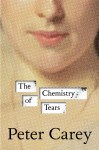
Peter Carey Chemistry of tears bookcover

Peter Carey’s The chemistry of tears (my review):  This was the first book that popped into my head, the one, in fact, that inspired me to write this post. It’s hard to forget the father travelling to Germany to have an automaton made for his ailing son, and the grieving museum conservator given the project of reconstructing it a century later. (I hadn’t thought until now of the loose similarity with Brooks’ book!). The object plays multiple roles: it represents what a father will do for love of a child; it plays a role in the resolution of grief; and, it contains a clever little mystery/irony/message within itself.

Gary Crew’s Strange objects: I haven’t read this novel, a young adult crime novel which won a few awards including the Victorian Premier’s Literary Award in 1991, I but decided to include it because its title, for a start, is a perfect fit. Here is the Wikipedia article‘s description of the book: “Using the framing device of a collection of papers made by a missing boy, Steven Messenger, it is a mystery story that explores the construction of history. When Steven discovers relics from the wreck of the Batavia while on a school camp, (a diary and a mummified hand with a gold ring on it, the two inside an iron pot), he investigates the media frenzy surrounding them …” Wikipedia states that this book was a response to Australia’s bicentenary which, as we Aussies know, brought about quite a revival of interest in exploring Australian history.
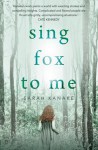
Sarah Kanake, Sing Fox to meSome other books in which objects feature, but not as strongly as those above, are Sarah Kanake’s Sing fox to me (my review) in which a Tasmanian Tiger pelt plays a major role in the way various characters manage grief, take agency, accommodate wildness, and Marcus Zusak’s The book thief (my review) in which books in general, starting with The gravedigger’s handbook, and words, in particular, become the focus of our young protagonist’s attempt to understand the Nazi-controlled world she finds herself in. Murray Bail’s The pages (my review) is also framed by an object, by a dead man’s papers (pages) containing his “philosophy”. In fact, when I started thinking about fiction which focuses on objects, the most common object turned out to be books or papers! Not really surprising, eh? But, to conclude my little perfunctory survey, I’ll go for something very different, a bridge. It features in one of my favourite Kate Grenville books, The idea of perfection. It’s at the centre of conflict in a country town, but it also becomes the means of bringing two lonely people together. (And it features on the cover of my edition!)

Have you read any books in which an object is central to the story and the meaning, in which it plays some role in explaining or resolving people’s feelings and lives? I’d love to hear about them – Aussie or non-Aussie of course.

Or, would you like to answer the question our ABC RN asked listeners in a competition related to the exhibition: What object has shaped your history — and why?

Anna Spargo-Ryan, The paper house (Review)

Anna Spargo-Ryan, The paper-houseI hadn’t heard of Anna Spargo-Ryan’s novel, The paper-house, when it was sent to me for review, which is not surprising given it’s a debut novel. However, I loved the cover – designed by one of Australia’s top book designers, Sandy Cull – and so was more than willing to give it a go. It traverses some familiar ground, grief and loss, and  mental illness, but it did so differently enough to keep me well engaged.

The novel starts with a young couple, Heather and Dave, in a strong, happy relationship. They decide to have a child and that this means buying a house to accommodate their new family. They see one south of Melbourne and immediately know that’s it. And already here, by page 4, as she describes the end of their house-hunting, we have garnered a good sense Spargo-Ryan’s clear but evocative writing:

After six weeks of looking and imagining, we ate teacakes on the western side of the peninsula and our hearts stayed behind when we left.

So simply said – no florid adjectives – but so arresting in its clarity. And it also encompasses two motifs which feature strongly in the novel, hearts and imaginings. Indeed the book opens with the line “My heart fell out on a spring morning”. We know, right then, that this is going to be a story about feelings – not to mention, also, that our writer has a wonderful turn of phrase!

Another strong thread in the novel is that of gardens. Their new house, of course, has a garden:

And the garden: a maze of established trees and crouching shrubs and flowers with bees on them and the faint trickle of water. A garden in which to wander, in which to get lost. For picnics and parties. It breathed in time with me and spat me out into the afternoon air, where the sea caught on the updraft and shot through the corridors. I watched it heave and change as it became night.

It’s a big garden, one which disappears from view behind a “row of pittosporums with their straight backs”, one with “good solid pittos … [which] keep the neighbours out of your business”. These pittosporums become a sort of reference point in the novel for her experience of the garden and, in a way, for her mental state, because this is a story about mental states. It’s about suffering a deep, deep loss, and how this new loss brings back a similarly deep past loss that has remained unresolved.

But now, I don’t want to give away this loss, though perhaps if you’ve heard of the book you already know. The story is told chronologically but, interspersed with this main narrative which chronicles around 6 months in the couple’s lives, are flashbacks in which Heather remembers life with her mentally ill mother Shelley, with her father and her older sister Fleur, and with her Gran. It was clearly a loving family but one under immense stress which each member handled in slightly different ways. As the contemporary story exposes Heather’s increasingly unstable state, we are also inexorably led to the tragedy that occurred in Heather’s teenage life. The resolution has a certain predictability to it, but Spargo-Ryan builds it so well that it doesn’t feel clichéd.

One of the pleasures in reading this sad but ultimately hopeful book lies in the characters around Heather. Her sister and father, and elderly neighbours Sylvia and Ashok, in particular, are colourful but human, and they create a warm, engaging but not sickly-sweet community which tries to shore up Heather. There’s husband Dave too, but he is a little more shadowy, off working as a teacher during the day when much of the action takes place.

The story is told first person by Heather, and as her mental state worsens we find ourselves a little destabilised, uncertain about what is real and what isn’t. She’s reliable only in the sense that she’s telling us what she is seeing and believing, but what she sees and believes is not always “real”. This is where the garden becomes significant. Initially the focus of her dreams for her little family, it becomes escape and refuge:

I threw myself from the bed and into the air. Nightlife moved in silhouette and shadow: the broad wings of a fruit bat against the sky, the low call of the boobook owl that always spoke in couplets – mopoke, mopoke. In the garden the pittosporums stood to attention and the moon pooled at their feet.

Shhh, said my body, folding around me.

But gradually it enables her imagination to run amok – and it plays an important role in the resolution.

The book is beautifully produced – creatively presenting text and white space to mirror and convey the disarray of Heather’s mind. However, what I most liked about it is the way it conveys the impact of mental illness on family members, the way it explores how family members, neighbours and friends can work together to nurture an ill person, and, importantly, the way it shows how carers can get lost in the focus on the ill person. It’s all done through language that shines and shows, rather than didactically tells and exhorts. By the end I had real tears in my eyes, and that doesn’t happen often.

AWW Logo 2016Anna Spargo-Ryan
The paper house
Sydney: Picador, 2016
295pp.
ISBN: 9781743535202

(Review copy courtesy Picador Australia)

Monday musings on Australian literature: Patrick White (Literary) Award

I was thrilled to hear on the radio this morning that Carmel Bird had won this year’s Patrick White (Literary) Award. Bird is such a worthy winner for this award, but more on that anon.

The Patrick White Award* is named, obviously, for one of Australia’s most significant writers and only, to date, Nobel Laureate in Literature. But, more than this, it was established by the man himself, using the proceeds of his Nobel prize money. White, for all his famed grumpiness, was a principled and generous person. Having won two Miles Franklin Awards, among others, he stopped entering his work for awards in 1967 to provide more opportunity for other less-supported writers. His award, established a few years later, continues this desire to support his fellow writers. David Carter, writing in the Australian Book Review, says this about it:

White was no friend to literary prizes and, in some ways, no friend to Australian literature, but he proved himself a friend to Australian writers. The ‘Patrick White’ is in many ways a writer’s award, created by a writer for other writers, and highly valued by them even if it hits the headlines less than the Miles Franklin.

The Canberra Times reported on the creation of this award in October 1973, stating:

Professor Geoffrey Blainey, of the University of Melbourne, said in a statement yesterday that the prize would be awarded annually to “a distinguished Australian writer — preferably an older writer whose life’s writings have not received adequate recognition or reward”.

David Foster, who won the award in 2010, said that White had intended it as ”as a kind of literary loser’s compo”! I guess it’s all a matter of perspective, of how you define “loser”, but it is good to have an award which goes to those writers who, though I wouldn’t call them losers, have fallen into the gaps. Carmel Bird is one of these.

Carmel Bird and Marion Halligan

Carmel Bird and Marion Halligan at the NLA

Before I talk about Bird, though, I’d like to share a little anecdote from Patrick White’s memoir/autobiography, Flaws in the glass. It is about a dinner party he was giving for the second winner of his award, the poet David Campbell:

It was again the evening of a dinner party, this time in honour of David Campbell the poet, who had won the award I set up with the money from my Nobel Prize. I was drudging away in the kitchen about five o’clock when I switched on the radio hoping for distraction from the boredom brought on by chopping and stirring. Like a stream of lava, out poured the news of what was happening in Canberra: that the Governor-General [Sir John Kerr] has dismissed the Government elected by the Australian people …

White goes on to say that he then rejected the Order of Australia that Kerr had recently persuaded him to accept, despite his professed antipathy to such awards, by saying his refusing it “would ruin everything”. Awards, then, are tricky beasts, and I know there are readers of this blog who are not keen on them. I understand their reasons, but I also understand that for many writers the money, regardless of any kudos that may or may not accrue, is very important.

(BTW Note the timing. White wanted his annual Award announced in the week following the Melbourne Cup, which occurs on the first Tuesday in November, “to give literature a brief chance of ousting sport from the nation’s mind”. The dismissal occurred on 11 November, suggesting that in 1975 the David Campbell announcement had been made in White’s time-frame. However, given this year’s announcement date of mid-October, White’s wish seems to have fallen by the way-side.

POSTSCRIPT: This point re timing has caused some discussion in comments and behind the scenes. I have now received in writing from the Trustee’s PR that “Perpetual as Trustee of The Patrick White Literary Award confirms that there is no stipulation in the Trust Deed in regards to the timing of the announcement of the winner.” It seems like it may have been something White talked about but never actually enshrined, which is good really. I believe that the fewer restrictions the better. Times change and donors can never be sure that what they stipulate in their times will have the desired result in later times.)

So now, Carmel Bird. Her Wikipedia article provides an excellent list of her literary output – her novels, her short story collections, the anthologies she’s edited, her non-fiction, and so on. It’s an impressive output ranging across a wide variety of forms and styles, over a long period of time. And yet, under the list of awards and nominations, you’ll see that she’s been shortlisted several times but hasn’t won any of Australia’s major literary awards. Now, at last, she has!

I last saw Bird at the Canberra Writers Festival when Marion Halligan launched her latest novel Family skeleton. On the back of my copy is a quote from the Australian literary critic, Peter Craven:

Carmel Bird is a literary artist to her fingertips … She writes prose that has the precision of poetry and that uncanny quality poetry has of making the inner life speak.

I agree, but the thing that I really like about Bird is the way her mind works. At the risk of sounding cliched, which she never is, she is fresh, original, unafraid to follow the connections her mind makes and certainly unafraid to depart from the expected. You just have to attend a live event involving her to realise this. I mean, this is an author who creates characters who then take on lives of their own, like Virginia O’Day who writes letters of advice to authors in Dear writer. And this is the author who creates a writer, Carrillo Mean, whose work she then uses as epigraphs for her novels! Have you got all that? I wasn’t surprised, therefore, to read that another idiosyncratic writer on the recognition-fringe of Australia’s literary firmament, Gerald Murnane, has described one of her books, The woodpecker toy fact, as “my kind of book”.

FL Smalls 7: Carmel Bird's Fair Game

FL Smalls 7: Carmel Bird’s Fair Game

I’ve reviewed here her cheeky fl small Fair game: A Tasmanian memoir, and I’ve read other work of hers before blogging. I also have the revised ebook edition of her book on writing, Dear writer revisited (featuring the aforesaid Virginia O’Day)I’m not a writer – that is, I have no ambitions to write fiction – but I often dip into this book because the advice is applicable to all writers.

For example, Letter Two discusses “the use of adverbs and adjectives”. Although she is referring to a piece of fiction, Bird’s advice works for any sort of writing. This, for example:

Perhaps you thought that you, as the writer, were the one who had to do all the imagining, and that the reader was to get every detail of the picture from your words. The reader of fiction takes pleasure in doing some of the work, and will more readily believe you and trust you if there is work to do. Strangely enough, the strength of fiction seems to lie as much in what is left out as in what is included, as much in the spaces between the words as in the words. This is one of strange powers at the heart of good writing. The writer’s skill likes perhaps as much in creating the spaces as in finding the words to put down.

Now, when I write my posts I regularly bother about adjectives. I seem to feel that I need them but I rarely like the ones I use. Perhaps I don’t need them at all! The other reason I like to check this book out is for the examples and advice she includes from other writers – from the likes of Helen Garner and Fay Weldon, David Foster Wallace and Frank Moorhouse, to name just a few.

She also quotes Ernest Hemingway:

There is nothing to writing. All you do is sit down at the typewriter and bleed.

Oh dear. This is from Letter Fifteen, “Writers are different”. I think they are – but too often we take them for granted and do not give them the recognition they deserve for the ways they enrich our lives. I’m so glad Bird has received this award and I sure hope she is too.

* I am not sure what this award is called. In some places, including Wikipedia, it is the Patrick White Award, while in others it is the Patrick White Literary Award. Take your pick it seems.

Monday musings on Australian literature: 2016 awards season dragging to a close

As the year draws to a close, our final major literary awards are being announced. We’ve seen this month the winners of the Queensland Literary Awards and the Western Australian Premier’s Book Awards. The Barbara Jefferis Award has announced its shortlist, but we are still waiting for the Prime Minister’s Literary Awards shortlist.

All but one of these awards have had somewhat problematic trajectories in recent years. The Queensland Literary Awards were established in 2012 when the then Queensland Premier, Campbell Newman, abolished the Queensland Premier’s Literary Awards. The awards were managed for two years by a volunteer committee, before negotiation with the State Library of Queensland saw the Library take over management in 2014. In 2015, new Premier Anastasia Palaszczuk announced that the government would again support the awards. However, they are now a more collaborative venture than they’d been under the abolished regime, which should ensure a more secure future for them. The Western Australian Premier’s Book Awards, on the other hand, which had been awarded annually from 1996 to 2014, were downgraded to a biennial timetable starting in 2016. Disappointing, really.

Meanwhile, what has happened to the Prime Minister’s Literary Awards (PMLA)? Established in 2008 after Kevin Rudd became Prime Minister, they expanded quickly from comprising just two prizes (fiction and non-fiction) to several, so that by 2102 there were six prizes with young adult fiction, children’s fiction, poetry and Australian history being added to the mix. However, there seems to be no established timetable. In 2008, the winners were announced in September, while in 2009 and 2010, we had to wait until early November. Then, in 2011 and 2012, they were announced in July, and in 2013 it was August. The last two years, 2014 and 2015, the winners were announced in December, with their shortlists announced in October and November, respectively. Given there’s been a call for entries this year, they must be happening, so presumably we’ll see this year’s shortlist soon! The PMLA people play it very close to their chest, despite having a Facebook page on which they share all sorts of literary news, because this year, as in recent ones, I’ve not been able to find a timetable. I guess we just have to have faith.

The Prime Minister’s Literary Awards have other issues, though, besides erratic timetabling, including a lack of transparency regarding the process, poor marketing and promotion, and, most serious of all, political interference in the judges’ decisions. The best known example of this occurred in 2014 when the then Prime Minister Tony Abbott over-ruled the fiction judges’ choice of Stephen Carroll’s A world of other people to award the fiction prize to Richard Flanagan’s The narrow road to the deep north. But, according to Patrick Allington in The Conversation and past non-fiction judge Colin Steele, such interference has occurred a few times in the Awards’ short history. This is not good enough. As Allington writes, the stipulation that a Prime Minister has the final say about winners “compromises the Awards’ credibility, purpose and depth.”

The fun stuff … some winners

But enough of that. Let’s talk about some of the winners. I’m not going to list them all because the Queensland Literary Awards offers prizes in twelve categories and you can see them all at the site. Similarly, the WA Premier’s Book Awards has about eleven categories, and you can see those winners too at their site. I’m just going to share the few winners I’ve read and reviewed!

Elizabeth Harrower, A few days in the country and other stories

First up, the Queensland Literary Awards. The award which pleased me most is Elizabeth Harrower’s A few days in the country and other stories (my review) sharing the Steele Rudd Award for Australian short story collections sponsored by the University of Southern Queensland. This is a wonderful collection of short stories, which has been shortlisted for a couple of awards, so I’m thrilled to see Harrower receive the recognition she deserves. (And I’m pleased for Text Publishing too given the work they’ve done to bring Harrower to our attention through their Text Classics).

Fiona Wright, Small acts of disappearanceAnother a winner at these awards was Fiona Wright’s honest, insightful collection of essays, Small acts of disappearance (my review), about her experience of an eating disorder. Wright was the Non-fiction Book Award, also sponsored by the University of Southern Queensland.

Meanwhile, over in the west, at the newly biennial Western Australian Literary Awards, it all felt a little old because many of the winners have been around for a couple of years now and most of them featured in the 2015 shortlists and awards. This is not their fault of course, but it certainly brought home the impact of the awards only being two-yearly. The fiction award, for example, was won by Joan London’s The golden age, which was shortlisted and/or won several awards in 2015.

Helen Garner, This house of grief book cover

Courtesy: Text Publishing

The big news at these awards, from my point of view, is that Helen Garner’s non-fiction work This house of grief (my review) won not only the Non-fiction prize, but also the overall Premier’s Prize. A fascinating choice, because mostly, though not exclusively I know, these overall awards tend to go to works of fiction.

Western Australia, like Queensland, quarantines an award or two to writers from their states. Queensland has awards for “a work of state significance” and “emerging Queensland writer”, while Western Australia offers awards for “Western Australian history” and “Western Australian emerging writer”. The winner of this last award is a book I’ve reviewed here, Lost and found by Brooke Davis.

And so, by my reckoning, we have three more literary awards to go – the Prime Minister’s (on a yet-to-be announced date), the biennial Barbara Jefferis Award (on 25 October), and the always interesting MUBA (Most Underrated Book Award (on 11 November). Good luck everyone.

Leah A, Ten silly poems by a ten year old (Review)

Leah A, Ten silly poems by a ten year oldPREFACE AND DISCLOSURE: As some of you know Son Gums is a primary school teacher. One of the programs he likes to run with his class is “the Passion Project”. Part of the theory behind this project is that kids don’t always get to do in class the things that really interest them so, over one 10-week term in the school-year, each student chooses a project s/he is passionate about to work on. Some time is allocated in class each week, and the rest is done at home. At the end of term, the students present what they’ve produced or created, which I understand can (and has) included games, computer programs, websites, artworks, live or animated films/videos, novels and cookbooks. This year, one girl wrote, illustrated and then published on Amazon a book of ten poems. I have bought and read the book and been given permission to write about it here.

NOW, THE FUN PART, THE BOOK: I titled my brief Amazon comment/review, “Edward Lear watch out”, because this gorgeous little (in size, not value) book reveals a lively, cheeky mind just like, I imagine, Edward Lear’s was. And like Edward Lear, Leah (hmm, I didn’t notice that homophone until now) is both writer and illustrator. Her ten silly poems are written in a variety of styles, including Lear’s favourite, the limerick.

The first two poems are not limericks, however, but 8-line rhyming couplets about her parents. They reminded me of when our children (one being, of course, Leah’s teacher) were growing up and showing an interest in writing. I decided then that I needed to let go of my ego and be prepared for my less endearing qualities to be revealed to all. Leah’s parents have clearly realised they must do the same, if they are to encourage her talent. Mum gets away with it this time, but Dad doesn’t come out quite so well:

You’re very handsome and oh so cool
Even though you sleep and drool.
(from “Dad”)

Lucky Mum eh?

Several of the poems are about animals and their adventures, usually involving food. “Lightning”, with its nicely controlled a-b-c-b rhyme, tells of the secret behind this horse’s speed (“All his speed and fastness/Was due to eating sauerkraut”)! Isaac the dog, on the other hand, finds that he needs to be a little careful about what he decides to “bite, bite, bite”. Like many of the poems, “Isaac” also uses the a-b-c-b rhyming pattern, but here Leah changes the form a little by ending most of the stanzas with the refrain “bite, bite, bite”. This use of a refrain comprising repeated words enhances the poem’s mood of silliness, but Leah also has the confidence to break the pattern in the middle of the poem, before taking it up again, to provide a needed change of pace. She’s not afraid, in other words, to mix it up a bit.

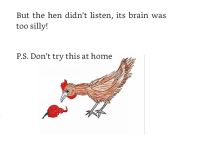
Leah A, Ten Silly Poems, hen imageMost of the poems are narrative, and tell humorous little stories, as you’d expect of the nonsense verse tradition within which Leah is writing. “Carolina Reaper”, for example, tells of a birthday girl who ignores the advice of a Mexican restaurant waiter, to her detriment, while the two delightful “Turbo Turtle” poems play with the commonly held assumption that turtles are slow.

Turbo Turtle, Turbo Turtle
How fast can you go?
Compared to me a cheetah
Is oh so very slow.
(from “Turbo Turtle”)

Occasionally the rhythm falters, but this is offset by the sure sense of story, the cheeky sense of humour, a clever use of language, not to mention the delightful illustrations. And anyhow, what can you expect when you have to write, illustrate and publish a book in ten weeks! Ten silly poems by a ten year old is not only an entertaining read but an impressive achievement. If you have a mind to support young authors, and you have a Kindle (or the Kindle app on your tablet), you might like to buy a copy for yourself at the Amazon link below. At AUD1.31, it’s a steal.

awwchallenge2016A, Leah
(Illus. by Leah A)
Ten silly poems by a ten year old
2016
26pp.
ASIN: B01LY4LZ1J

Available at Amazon (Kindle only) for the amazing price of AUD1.31

Monday musings on Australian literature: Australian Arts, mid-1960s style

Hodge and Whitehurst, Nation and PeopleLast week’s Monday Musings discussed my high school history book, Nation and people, published in 1967. I don’t plan to labour this book, but I would like to share its chapter on the Arts.

The authors, Brian Hodge and Allen Whitehurst, dedicate 8 pages to “The Arts” which is pretty good, I think, for a school history book. The chapter is divided into sections: Slow growth of Australian culture; Poetry; Drama; The novel; Music; and Painting. There are gaps here – nothing on film or sculpture, for example – but what can you do in 8 pages after all!

They start by arguing that “a distinctive Australian cultural tradition has been slow to grow”. Now, before you jump at me and say “But, but, but, what about indigenous culture?”, they do mention this, albeit with the paternalism that was typical of the time:

True culture is probably the product of a deep and intimate relationship with one’s country, something that occurs over centuries. The original owners of the land, the aborigines, certainly evolved an individual culture that was part of the spiritual core of their existence. Although nothing was written they formulated their legends to explain to the young the marvels of the universe, they composed and sang their simple and sometimes haunting melodies, they carved in primitive fashion, they danced superbly.

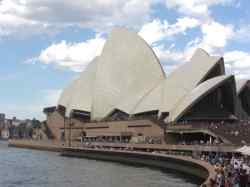
Sydney Opera HouseThere’s a lot that’s wrong with this statement from our 21st century eyes, but at least they recognise the “original owners” and the fact that culture comes from “a deep and intimate relationship with one’s country”. They then go on to describe how the early settlers tended to rely on “the old culture” and that even the balladists telling stories about the new land used “the tunes of their forefathers”. However, they say, “a vigorous development in all the arts” happened after the second world war “coinciding with remarkable economic progress”. Government increased its patronage of the arts, and “in Sydney”, they write, “there is being constructed an Opera House which architectural histories describe as a major achievement of architecture in the twentieth century”. It sure was.

Poetry

I’m just going to briefly share their points on poetry and the novel, given these are the topics most relevant to my blog. Regarding poetry, they point particularly to Judith Wright and AD Hope whose poetry “has been distinguished by a vigour and their imagery noted for its immediacy of impact”. How I wish I could be so succinct! Seriously though, I like their assessment of Wright, that she has “perhaps more poignantly than any other poet”

expressed the nation’s new-found spiritual awareness of its past … Her poetry is the deep expression of the feelings of women: to love, to old age, to decay, to the past, to war, to the future. JB Priestley, prominent English novelist, dramatist and critic, has claimed that Judith Wright is one of the best poets writing in English today.

How fabulous, even though their reference to “the feelings of women” does sound a little reductive?

As for  AD Hope, he too, they say, has “been highly acclaimed by overseas critics”. See that cultural cringe? Clearly, the fact that overseas critics praise Wright and Hope proves their worth! Anyhow, they describe him as “a satirist concerned with Man and his frailties.” (Note the uppercase Man to imply both genders but they can’t avoid the “his”). They quote Hope as describing “Australia as a place ‘where second-hand Europeans pullulate timidly on the edge of alien shores’.” They also say:

In no way does he resemble Wright. Rather he has consciously tried to lead Australian poetry away from a preoccupation with its environment, a savage reaction to the school of Australian poetry that concentrated on gum trees, koalas, kookaburras, kangaroos and boomerangs. His satire has an acidity, a near tragic note and a technical mastery new to Australian poetry.

They name a few other poets, including Douglas Stewart (a favourite from my schooldays), David Campbell, and Gwen Harwood whom they describe as “perhaps one of the most promising contemporaries … whose poetry is deeply personal, with original and compelling imagery”. They were right. She did become important, and one of Australia’s most significant poetry prizes is named for her.

The novel

I’d like to talk about drama, music and painting, but I don’t have the time and energy for that right now, so I’ll move onto “the novel”, which, interestingly, receives far less space than poetry and drama.

They start by saying that “during the 1930s Australian novelists tended to concentrate on the family saga, digging into Australia’s past to reveal the rise of egalitarianism.” They name Miles Franklin’s All that swagger (1933) and the unknown-to-me Landtakers (1934) by Brian Penton. They say that their novels are about pioneers who, as they “gained wealth … seemed to die spiritually.” We can read Landtakers at Project Gutenberg Australia. I’m surprised that they don’t mention works by Katharine Susannah Prichard, M. Barnard Eldershaw, and the other women who made quite a splash in the 1920s-40s. Some of their work was in this “pioneer” mould, but some also turned to the urban landscape, particularly Marjorie Barnard and Flora Eldershaw.

Anyhow, they go on to say that “the writing of historical novels of this pattern continued in the 1940s” but that developments occurred in the 1950s, heralded particularly by Patrick White’s Voss in 1957. They quote an unnamed critic saying:

White has opened up in a startling way the range of Australian fiction, not only by his experiments in form and language (which are sufficiently striking in themselves) but by conceiving and acting out the dramas of his characters in an imaginative world with one more dimension than our novelists have genuinely recognised as existing.

Fascinating, but a little mystifying. “One more dimension”. Is that the telepathic communication experience between Voss and Laura? And “genuinely recognised”? What does that exactly mean? However, I do like their suggestion that the result has been “a turning away from the violence of nature to a deeper study of man himself, with his depths of hidden passion and violence”. They quote Xavier Herbert, Morris West and Hal Porter as writing books reflecting this development.

Points to ponder

At the end of each chapter, Hodge and Whitehurst include some discussion questions. I can’t resist sharing those for this chapter:

Do you consider the Arts important for man? Why?
Do you think the Arts could be an important source for historians? Why?
Which of the Arts are most important in your family?
Do you believe future generations of Australians will regret the enormous expense of the Sydney Opera House?
Do you think Australians yet regard culture as an integral part of their existence

You don’t have to answer them all!

Mike Ladd, Invisible mending (Review)

Mike Ladd, Invisible mendingI think … how all our best art is free; as complex as that, as simple as that. (Gaudi and the light)

I rather liked this statement from Mike Ladd’s collection Invisible mending, even though I’m not totally sure what he means! Does he mean freely available, that is, we don’t have to pay to access it? Or does he mean it frees the spirit, takes us away from ourselves? Either way, he has a point, though perhaps “best” might be arguable in the first sense.

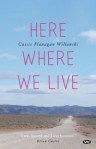
But now, that ongoing conundrum: how to review a collection, particularly a rather strange collection comprising poetry, short stories, memoir, essays and photographs, too. The two common choices are to summarise the range of the stories – like, you know, the stories take us from Adelaide to Japan to Chile and tell us about broken relationships, environmental destruction and living with dementia – or to pick a few stories (as I did with Cassie Flanagan Willanski’s Here where we live) and discuss them. Neither approach is completely satisfactory, but what can you do?

Interior, La Sagrada Familia

In the forest, La Sagrada Familia

Overall, I enjoyed the collection, though I did have a couple of quibbles, which I’ll get out of the way now, before I talk about what interested me. One of these quibbles relates to a pet hate, the use of “utilise” rather than “use”. In “Gaudi and the light”, Ladd writes that Gaudi “utilised spirals, honeycombs, the planoid surfaces of magnolia leaves”. There are some who argue that “utilise” adds another layer to “use”, meaning “put to good purpose”, but unfortunately its over-use spoils any special meaning it “might” have for me. Also in “Gaudi and the light” is this sentence:

There had always been an aestheticism within him: his reverence of nature combined with an early drive towards utopian socialism, ongoing vegetarianism and a sometimes dangerous tendency to fast.

He goes on to talk about Gaudi embracing “a Franciscan concept of holy poverty”. Did he mean “aestheticism” or “asceticism”? Actually, my quibbles are all in this story, because my third one is surely a typo: “in the shadows was an agonising crucifixion figure, the body a taught bow”. Taut, methinks? Maybe this story was rushed, which is a bit of a shame because Gaudi’s life is intriguing and Ladd reminded me of the wonderful time we had seeing his work and learning about him when we visited Barcelona three years ago.

There is a lot in this collection to enjoy, including, for me, learning about pantun poetry. I know about Japanese haiku and tanka, but had never heard of “pantun”. Ladd discusses them in his travel essay, “Pantuns in the orchard” which describes his stay in Malaysia with his wife who was working on an art project. There are different types of pantuns he tells us but his favourite is the “tunggal” which comprises four iambic lines with an abab rhyme. Like haiku, pantun is strict about content as well as form: the first two lines “draw their imagery from the outside world” while the last two lines “turn inward toward human relationships and psychology”. Ladd includes a collection of his, in the piece called “A book of hours at Rimbun Dahan”. I’ll share a couple that tickled me:

I start the great four-bladed ceiling fan.
Seconds later, a gecko drops to the floor,
stunned. Yes, the world’s like that,
We all hang on as long as we can.

AND

Under the mosquito net, settling to sleep
you feel safe from the world’s attacks.
Then you hear the needling, invisible whine
of that one mosquito inside the net: the mind.

These don’t have the traditional rhyme pattern, but they work for me.

Superficially, the book looks like a disparate collection, in form and content, but running underneath are some recurring ideas addressing contemporary concerns (such as human rights at home and abroad, and the environment) and family (including the dementia-related death of his father, and the return of a travelling son).  The story “A neighbour’s photo” tells of the loneliness and uncertainty of a 14-year-old Sudanese who has migrated to Australia with his 18-year-old brother. In the poem “Learn to speak our language”, the narrator turns the statement on its head by suggesting the complainer might learn Kauna or Pitjanjatjarra. Sometimes the politics is more stark, as in the short “Gasoline flowers” in which four self-immolators, starting with Mohamed Bouazizi, are likened to flowers.

Nearly halfway through the book is a little series of pieces about health, the narrator’s own experience in hospital and his father’s with dementia. He captures well that eerie world – a hospital – in “The edge of the lake”. He describes the strange camaraderie that can occur in a hospital ward as four men experience their illness. He writes of his experience of surgery:

Though my legs are cut to blazes, I’m enjoying myself. I feel cradled, it all makes glowing sense to me: the hospital system with its rituals and meals and machines, its steel surface and pecking orders.

I know what he means. It’s a weird, weird world – with its own time and laws – and yet it can feel cocooning, with the outside world far away. Sadder though are the pieces about his father, the man with dementia who is “aghast at the rate the world is leaving him” (“My father at the clothesline”).

One of the longest pieces in the book is “Traffik”. It features the unnamed Student and Middleman, as well as a named Japanese man, Morii, and is about the illegal smuggling of orang-utans. I don’t think I’ve read a fiction piece on this topic before. I liked the complexity of Ladd’s story, the careful way he develops it and the fact that our Student smuggler and orang-utan buying Morii are not simplistic stereotypes of the “parts” they play.

Two other pieces I particularly enjoyed were the story about indigenous pensioner “Ken” and the memoir “Gaps” about parents catching up with their son who has returned from a trip to Columbia. I loved the wordplay on gaps – generation gap, the gaps in knowledge you experience when you return from being away for awhile, and gaps in the hearts of people who may never know that their family members drowned on the Siev X.

There was more that I enjoyed too, including the pointed “Skiing in Dubai” and the satirical “Radio News”, but I’ll finish here.

The back cover describes the collection as “based loosely on the ideas of scarring and healing”. As you can probably tell from the pieces I’ve shared, it is certainly about that. However, it is also about the business of being an artist, and so I’ll close with the last lines of the poem “Back again”:

Our magpie (we call it ours)
tries its run of notes, falters, and repeats;
like our writing and art careers.

Well, perhaps there was the odd falter in this collection but that didn’t stop me being impressed by the versatility and passion of Mike Ladd, and enjoying my time with him. Oh, and it has a beautiful cover, too.

Mike Ladd
(with photographs by Cathy Brooks)
Invisible mending
Mile End: Wakefield Press, 2016
127pp.
ISBN: 9781743054079

(Review copy courtesy Wakefield Press)

Monday musings on Australian literature: on Nation and people

Hodge and Whitehurst, Nation and PeopleDo you keep your old textbooks? I do, though am now starting to move them on. But some I still can’t part with, one being my high school history text. Called Nation and people: An introduction to Australia in a changing world, and first published in 1967, it was written by Brian Hodge and Allen Whitehurst who were teachers at East Sydney Technical High School. I decided for today’s Monday Musings to have a little look at what my teenage self learnt from it …

I was tickled because some of what I saw, looking at it now, had connections with my future – though, of course, I didn’t know it then. First is the fact that I went to high school in Sydney, and the teachers who wrote it were in Sydney, but the front cover is an image of Canberra, the city I moved to for my first professional job after finishing university, and where I live today. The other is that the first book listed in the student’s bibliography at the back is “F. Whyte, William Morris Hughes: His life and times“. F. Whyte (actually William Farmer Whyte), a journalist, was the grandfather of the man I married. This biography was his magnum opus. I have no idea why it is listed first though. The list is not alphabetical by author or title, and Billy Hughes was not our first Prime Minister so there’s not an obvious chronological reason. The order is quite idiosyncratic to my librarian eyes!

What is history?

These, however, aren’t what I really want to share, entertaining though they are to me. I was interested, for example, in the Preface. The authors say that

students should be encouraged to look for themes. It is important … that they understand the nature of a particular topic they are studying and why they are studying it.

In other words, history is not about dates but ideas and trends. Now, my two favourite high school teachers were my history teacher (Mrs Reynolds) and the librarian (Miss Reeve). It was the late 196os, a time of increasing interest in rights for indigenous Australians, of the Civil Rights movement in the US, and when anti-Apartheid activism was becoming stronger. These two teachers – seen as “red” by more conservative parents – encouraged us to think about what we’d now call social justice. I loved them, because for them history was a living thing about themes, ideas and values.

Indigenous Australians

Of course, in looking at this book now, I particularly wanted to see what it told us about indigenous Australians, because this was an issue we felt strongly about. There are a few references to Aborigines, as indigenous Australians were called then, but there is also a 10-page section devoted to them. It starts with some quotes – from the Constitution (1901), “A Crown Lands Commissioner to Governor La Trobe in 1840”, and writer Marjorie Barnard (from her history of 1962) – followed by their introduction:

During the nineteenth century, the white settlers of Australia extended their frontiers and finally won a continent from its former black owners. The pattern was a similar one to other regions in the world where the white civilisation had made contact with coloured races which were less powerful and culturally different. Lands had been conquered, the stability of the conquered society shattered and the coloured peoples exploited.

They talk about early contact – from seventeenth century sealers to the later farmers – and their poor treatment of indigenous people. They note that “few whites made any effort to understand” cultural differences. They describe conflict between white and black people, in which killing occurred on both sides, but in their view:

Too often in Australian history in the nineteenth century good relations were destroyed by the low standard of settler and the low standard of police.

Next, they say

After the white man had won the land, his [this was before 1970s feminism!] attitude changed. The black man became regarded as a useful stockman who could perform important duties in areas of harsh environment where white labour was scarce and expensive. Thus an extensive cheap labour force was set up for the cattle stations …

They go on to discuss other aspects of black-white history in Australia: missionaries and paternalism, and then assimilation. In 1967, a referendum was passed which amended Australia’s Constitution “to allow aborigines to be included in the census”. Hodge and Whitehurst include a photo of some “Young Australians” sitting at desks. The caption reads: “Now these young Queenslanders will be counted. But will they count?” Good question.

This section ends by suggesting that “integration” is starting to be seen as a better policy than “assimilation”, but

This means, of course, that Australians would have to accept the fact that their society is multi-racial and multi-cultured, and that two cultures would live side by side with complete equality.

Those words – “would have to accept” – suggest, don’t you think, an uncertainty that Australians would indeed accept this. Around 50 years have passed since this was written, and progress has been made but “complete equality”? Nope. How very depressing it all is.

Further reading

Finally, the authors provide a list of additional reading at the end – where I found F. Whyte – but they say “the reading list in this text is recommended as a manageable one”.  They don’t think students “should or could read all the books listed, but … are thoroughly capable of looking at quite a number of them.” They tell students not “to become a slave to one or two general texts, even if they are concise and interesting” and not to “attempt to wade though volumes that are recommended as reference books”. Instead, they say:

Perhaps your most profitable course at this stage of your study of History would be to enter into the spirit of the course through biography. This plan of action  you will find very profitable in your study of Australian development. Through reading biographies you will gain a feeling for History and insight into the spirit and problems of each decade.

How sensible is that? Don’t make students read dry recitations of historical events and facts. Better to read books that will bring history alive. Those they recommend at the end include biographies and fiction, such as George Johnston’s My brother Jack, Xavier Herbert’s Capricornia and, interestingly, Alan Paton’s Cry the beloved country.

Looking at this book, I can see the origins of my ideas about what history is and what it means. Thank you Messrs Hodge and Whitehurst, and thank you too Mrs Reynolds and Miss Reeve. You have not been forgotten.

Do you have teachers and classes that have made a lasting impression on you and your way of thinking?

Cassie Flanagan Willanski, Here where we live (Review)

Cassie Flanagan Willanski, Here where we live“Write what you know” is the advice commonly given to new authors – and it’s something Cassie Flanagan Willanski, author of Here where we live, seems to accept. Set in South Australia, where Willanski lives, this debut collection of short stories reflects her two main interests, creative writing and the environment. The book won Wakefield Press’s Unpublished Manuscript Award a couple of years ago, and I can see why.

I wasn’t sure what to expect when I opened the book. Adelaide author and creative writing teacher Brian Castro is quoted on the front cover as saying “I was moved and I was haunted” and on the back “Her stories are as spare and understated as the harsh landscape she describes…” I’d concur. Her stories are not your typical short story. That is, they don’t have tight little plots, nor do they have shock (or even just surprising) endings. They are more like slices-of-life, or like chapters of a novel, in the way they tease out moments in people’s lives that you can imagine continuing into a larger story. And yet, they are complete in themselves and absolutely satisfying.

However, there is more to these stories than “just” slices of life. Willanski writes in her author’s note that they were written as part of her Master of Arts degree, in which she explored “the ways white Australians have written about (and for) Indigenous people in the twentieth and twenty-first centuries”. She introduces the notion of “Indigenous invisibility” which she describes as “ignoring Indigenous Australian people’s current existence, and mourning them as extinct”. She then talks about the issue we’ve discussed here before noting that as white writers became aware of this “Indigenous invisibility” they started to “write about them as characters in their books”. She says she has tried to reflect in her stories the various attitudes she found in her research. I found them authentic and sensitive, but the real judges of whether she’s been successful are indigenous people, aren’t they? There’s a reference to indigenous elder and activist Sue Haseldine in her acknowledgements, which may suggest some acceptance?

There are nine stories in the collection, three told first person, and the rest third person, except for the last and longest story which has two alternating voices, one third, the other second. Her protagonists include a young girl, a young male teacher, a 70-something woman, and a woman grieving for her late female partner. A few stories are connected, but this is not critical to appreciating the collection. Several of the stories, Willanski says in her author’s note, were inspired by real events but in each her imagination has created something new and fictional. Some of these real events are matters of history, such as the Hindmarsh Island Bridge controversy and the Maria shipwreck, while others draw from personal experiences.

Despite the historical inspiration behind some stories, they are all set in contemporary South Australia. The first two are told first person: “This is my daughter’s country” opens the first (“My good thing”) and “The night my husband told me he was going to leave me we were in the middle of a heatwave” starts the second (“Drought core”). Straightaway we are introduced to Willanski’s nicely controlled, pensive tone, and her ongoing themes: family relationships, indigenous issues, the environment and climate change.

The first story is told in the voice of a white woman who has an indigenous husband and a daughter. They are going back to country to clean rockholes. No-one is named – “this is my daughter”, “this is my husband”, “my daughter’s grandmother” – which gives the story a universal, almost mythical sense. There are hints of challenges – subtle references to the Stolen Generations and to environmentally destructive tourism – but it’s a short, warmhearted story about the drive to connect with land and people, and sets up the collection nicely.

I can’t describe every story so I’ll jump to the fourth one, “Stuff white people like”. It is lightly, self-mockingly satirical. It tells the story of a young couple, Oliver and Clay, visiting Ceduna where Oliver is considering a job as a “Nature School Teacher”. They are both earnest, Oliver particularly so, in wanting to understand and relate to indigenous people, so they decide to attend a “healing ceremony” for “‘Maralinga, climate change, feral animals, you name it,’ said the principal vaguely.” It’s an uncomfortable experience, and Oliver doesn’t know how to react to the event which isn’t what he expected. He doesn’t want to be “like the other white people” but how should he be? Clay is able to go with the flow a bit, but not Oliver. Later, on their trip home, she is able to laugh, and take the jokes in the book Stuff white people like, while Oliver is “crippled with self-awareness”. He can’t quite match Clay’s insight. She reads from the book about white people “knowing what’s best” for others:

“Do you think I’m like that?”
“‘Cos you’re excited to get to work with Aboriginal  kids? No!” She stopped for a minute, trying to piece together her thoughts. “Well, I mean–” she said and stopped again.
“What?” said Oliver.
“Well it’s just that Aboriginal people already know about having school outside.”
“I know,” said Oliver. “What’s your point?”
Clay looked at him again, then said, almost irritably, “Well, you’re taking something they’ve been doing for thousands of years and putting the white seal of approval on it.”
“But the missionaries took it away,” said Oliver.
He didn’t say it, but it was implied, and they didn’t know what to do with the implication. Oliver would be giving it back.

I love this on so many grounds – the personal and the political, the desire and the discomfort, the sincerity and uncertainty. These underpin the collection.

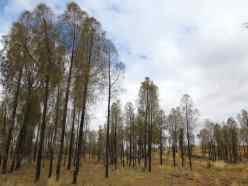
Desert oaks

Desert Oaks, Centralia

There’s only one story in which Willanski speaks “for” or “in the voice of” indigenous people, “Oak trees in the desert”. It’s about the First International Woman Against Radioactive Racism Conference, held in Monument Valley, Utah. This is a fictional conference, but “radioactive racism” is “real” and the aforementioned Sue Haseldine is active in this area.

Willanski opens the story with an indigenous Australian woman introducing herself at the conference. It’s a strong story, with the first-person voices of various First Nation conference attendees interspersed with the third-person story of white Australian woman, 76-year-old Bev, whose late husband had worked at Maralinga and had contracted cancer. There’s also a young white woman activist-organiser providing, again, a light satirical touch. Like many of the stories, it’s very personal but also has a big political message. (I also enjoyed it because I love Australia’s desert oaks, and I’ve driven in the stunning Monument Valley.)

This is getting long so I’ll end with the last story, “Some yellow flowers”, which contrasts a mature love, through the grieving Jean whose partner Nancy has died, with the young love of two teenagers, Loretta and Jackson. This story brings together several of the collection’s themes, including developing and maintaining loving relationships, climate change and caring for the environment, and indigenous-settler relationships. There is a big storm – one of those one-hundred-years storms that are occurring more frequently these days:

The roof shrieks and the sea spray pelts against the front verandah. The separation between land and water, sea and sky, past and present and living and dead becomes more obviously a figment of daytime imagination.

Dreams are had, stories are told, relationships are resolved – not simplistically, but with a sense of continuum.

This is the sort of writing I like: undramatic, understated, reflective stories about ordinary people coping with breakups, death, new relationships, but overlaid with a strong set of values and contemporary concerns, in this case encompassing the intertwined issue of respecting indigenous people and caring for our country. While not always comfortable reading, it’s a hopeful book – and I like that too.

awwchallenge2016Cassie Flanagan Willanski
Here where we live
Mile End: Wakefield Press, 2016
146pp.
ISBN: 9781743054031

(Review copy courtesy Wakefield Press)

Monday musings on Australian Literature: The Vagabond

Quite by accident – no, I tell a lie, it was through a link sent by a good friend (thanks Kate) – I came across “The Vagabond”, a mysterious journalist who wrote for Australian newspapers – primarily in Victoria – in the late 19th century. The link was for an article he wrote on sixpenny restaurants, but that article was published in the online journal Inside Story to coincide with the publication of The Vagabond papers (ed. Michael Cannon, Monash University Publishing, 2016).

So, who was this Vagabond? Well, for a start, he is significant enough to be included in the Australian National Biography (ADB), where he is listed under the name John Stanley James (1843-1896), born in Walsall, Staffordshire, England. If, however, you read contemporary obituaries for him, as I did before I found ADB’s entry, you would think he was Julian Thomas, born in Virginia, USA! If you continued to search Trove, though, you would find articles written the year after his death identifying him as John Stanley James. Apparently, as ADB tells it, he had a few fallings-out with his father, in England, and in 1872 went to the USA where he changed his name to Julian Thomas. He arrived in Sydney in 1875.

According to John Barnes (ADB), his early articles, published in Melbourne’s The Argus, were

on ‘the social life and public institutions of Melbourne from a point of view unattainable to the majority’. The most substantial of the series were based on his first-hand reports of what it was like to be ‘inside’ certain institutions: to gather material, he spent a day in the Immigrants’ Home, was admitted to the Benevolent Asylum and worked as the porter at the Alfred Hospital, an attendant at lunatic asylums and dispenser-cum-dentist at Pentridge gaol. His accounts of these institutions combined intimate knowledge of their day-to-day working with a breadth of perspective gained from his knowledge of other societies. His shrewd observation, practical judgments and suggestions for reform reveal a compassionate spirit behind his cultivated flamboyancy.

One of the obituaries I found in Trove referred to these articles:

His series of articles for the “Argus” descriptive of life in the benevolent asylums, hospitals, and finally the Pentridge prison, created a furore which had never been eclipsed by any work of the kind done here since.

This obituarist described him as having “A clear, crisp, epigrammatic style”.

Another described him as having “a fluent pen, a versatile imagination, and an interesting manner of personal comment” and also mentioned, albeit more measuredly, his institutional pieces:

his earlier series of Vagabond papers wherein from personal experience he revealed some of the abuses in the administration of penal establishments, lunatic asylums and charitable institutions, attracted considerable attention.

John Barnes sums him up this way:

Outwardly egotistical and reckless, he had a generous and sympathetic nature. Probably his early life had helped to develop in him a keen feeling for those in need, a feeling expressed in his best work and commemorated after his death in a memorial erected by public subscription.

The process of raising money for, and the erection of this memorial, is also documented in Trove.

In 1878, he was sent to New Caledonia to report on a native uprising. Barnes writes that “he shocked readers with details of the brutality of the French colonial administration which he condemned strongly”. These reports, plus those on his experiences in the New Hebrides and New Guinea, were published in his book Cannibals and Convicts (1886). Although he travelled again – including to China, Japan, British Columbia and the South Seas – Barnes argues that it’s his early Victorian pieces and those in this book that represent his best work.

I’ll leave the story of his life there … you can read more at the ADB link above or look for his articles in Trove yourself. Instead, I’m going to end by discussing his article on the sixpenny restaurants, which was published in the Argus on 27 May 1876, his early (well-regarded) years in Victoria.

The sixpenny restaurant

Not only did I enjoy the article for itself, but it reminded me of one I discussed earlier this year, George G Foster’s “The eating-houses”. It was published in New York in 1849, and discusses various types of eating-houses, including sixpenny ones. The articles are different overall, but both provide a picture of an active eating-out scene in 19th century western countries. Fascinating.

So, the Vagabond’s article. Interestingly, the version published in Inside Story starts about two paragraphs into the original published in The Argus. These first two paragraphs make a political statement about Australia’s need for labour, and the Vagabond has a proposition:

I would have printed one million handbills, exactly similar to those which any day, from 12 till 2, you will have thrust into your hands in the principal streets of Melbourne, and the wonders of which will strike an English labourer or mechanic dumb. Imagine poor Hodge, who lives on bread and bacon, and whose only idea of spending six-pence is to purchase a quart of ale, reading from the bill of fare that a breakfast with a choice of 10 hot dishes of meat, bread and butter ad libitum, and “two or three cups of tea or coffee;” a dinner with choice of six soups, 12 kinds of meat, including such epicurean luxuries as “beef steak pudding” or “stuffed ox-heart;” and six puddings or pies, with tea, coffee, and bread and butter, as at breakfast, may be had in Melbourne for 6d. a meal. The supper (which he reads may be had “both before and after closing of the theatres,” pleasantly suggesting that it is the custom for his class to patronise those places of amusement) is even more bewildering” stewed rabbit, “haricot mutton,” “curries,” and some 15 other dishes, with salad, beet-root, and tomatoes. A land which can furnish such delights for 6d., must surely be the working man’s paradise (my emph).

This argument leads into the article proper, which starts by stating that “Most men have to suffer a perpetual combat between their tastes and their exchequer”.

Vagabond describes his surprise at the quantity of food he can buy for 6d. at these sixpenny restaurants. It resulted in his doing a tour of cheap restaurants. He found they are pretty much alike – “the dishes tend to be stereotyped, and the cooking is much the same in all”. There can be, particularly in summer, “more flies in the dishes than refined prejudices might fancy”, and sausages, he writes, are such “bags of mystery” that the “enormous consumption” of them is “convincing proof that faith is strong in the colonies”. Love it!

Workers Cafe, Porto

Workers’ cafe, Porto, Portugal

After discussing the food in some detail, he then describes the establishments, making an interesting observation:

Sixpenny restaurants vary a good deal in style; there are some in the principal thoroughfares which shine with plate-glass, white linen, and pretty waiter girls. But all this extra display, and the cost of the handbills which are so freely circulated, cause perceptible diminution in the quantity or quality of the viands. The places where one really feeds best are the smaller restaurants, kept by married couples, who do the cooking themselves … These are chiefly patronised by working men.”

This brought to mind my experience as a traveller: we’ve often had the best meals in little ma-and-pa run restaurants, in worker-patronised restaurants. We tend not to frequent those places at home because they offer the sort of food we might cook ourselves but when we travel, these places can be the best for learning about local food and life.

But, I digress … Vagabond continues to discuss the experience of dining in cheap restaurants. He notes the “tricks” customers employ to obtain more food, and suggests dining after the rush makes it easier for diners to chat together. He then describes the patrons – and it’s a fascinating, multicultural bunch – before moving on to the staff, the waiters who “are refugees from all classes” and the cooks, most of whom began “with making damper”.

He concludes by mentioning that some taverns are setting themselves up as rivals to the sixpenny restaurants. They give “hot lunches with pint of ale, from 12 to 2 daily, for 6d”, but the food mostly comprises “a plate of corned beef and potatoes” and “you get altogether about half the amount of food you would at a sixpenny dinner”. However, these places are frequented by young clerks, who, he says, are too proud to be seen in a sixpenny restaurant. He concludes his article with:

It would be far better for them if they would put their dignity on one side, and take a dinner in a sixpenny restaurant, which up to this time I consider to be the most wonderful example of Victorian progress and prosperity which I have met with.

I can see what Barnes means by “a compassionate spirit behind his cultivated flamboyancy”. I could read more of Vagabond.