Janette Turner Hospital, Orpheus lost (Mini-review)

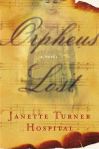
Janette Turner Hospital, Orpheus lostLast year I did a mini-review of Elizabeth Jolley’s An innocent gentleman using some scrappy notes from when I read the book long before blogging. This post on Janette Turner Hospital’s Orpheus lost has similar origins. I’m keen to add it here because I’ve read several of her novels, but none since blogging, and I really want her represented here.

Orpheus lost commences in Boston and is about Leela, a mathematician from the South, and the Australian musician, Mishka the subway-playing violinist, whom she meets.  They become lovers, until suddenly, after a subway explosion in which terrorism is suspected, Leela is taken to an interrogation centre where an old friend Cobb tells her that Mishka isn’t who she thinks he is. Meanwhile, Mishka is looking for his missing father, and heads off to the Middle East. The scene is set for what becomes, in fact, a literary thriller.

In a conversation* with Jason Steger on The Age online book club, Hospital said she had no political agenda but was interested in how people emotionally handle the shock of being randomly caught up in political action, and in what moral decisions they make. In other words, she’s interested in the moral and emotional repercussions of what happens when people get caught up because what they do looks dangerous but actually isn’t. (This is similar, in fact, to what happens in Richard Flanagan’s The unknown terrorist). It’s nightmarish stuff. Hospital talked about the trading of civil liberties for safety in the post-9/11 world, something she sees as a dangerous response. It makes it rather relevant still today doesn’t it?

However, she also talked about Orpheus and Eurydice being one of the great love stories of all time, and suggested that it is as much about loss, grief and yearning, as it is about love. But she was tired, she said, of the women always being the rescued ones. So she decided to give it a feminist twist and invert it. Consequently, in Orpheus lost, the man’s the one snatched away, and she’s the rescuer. Now that’s surely political!

The novel is a multiple-point-of-view novel and opens with Leela’s voice. We learn that she is fascinated by maths (numbers) and on the second page she quotes a seventeenth century mathematician saying ‘Obsession….is its own heaven and hell’. This theory is played out in the novel. The three main protagonists all have obsessions: Leela is obsessed with maths (which she believes always provides an answer to things) and with Mishka; Mishka is obsessed with music and with his identity (which involves his missing ‘father’); and Cobb is obsessed with Leela. There are other obsessions in the novel, though, too – the Islamic fundamentalists, Leela’s father with his religious fundamentalism, and other obsessive musicians and mathematicians.

Into this world of obsessed people, comes terror – and alongside terror, as we all know only too well, is the desperation for safety. Safety is a constant issue throughout the book. For example Cobb describes two types of people – those who take safety for granted and those who know it’s a precious thing. He suggests that the former create risks for the latter.

Unfortunately, I seem not to have the book anymore – which is unusual for me. Perhaps I’d borrowed it! So what I want to focus on is my experience of reading Hospital, rather than on the plot. She’s one of our more structured or tightly-styled writers. This means that I read her with my head as much as with my heart because she always has a lot going on. There is, for example, her strong use of recurring motifs and metaphors, such as, in this novel, photographs. They play several roles: they represent love, connections between people, surveillance, evidence, and the idea of truth vs fiction. I enjoy teasing out these sorts of things. Music and maths are other significant motifs. For some readers, and for me on occasions, Hospital can push her metaphors too hard but I thought they worked here.

And then, alongside multiple points of view and these recurring motifs and metaphors, there are structural devices, such as her use of parallels to set up points of likeness and tension between her characters. The three main protagonists all lost a parent early (Cobb and Leela their mothers, and Mishka never knew his father); Cobb and Leela both have ‘damaged’ fathers; the main characters all have small town upbringings in ‘odd’ places (the Deep South in a town called Promised Land, and the Daintree which is described as ‘the promised land’). The whole idea of “promised lands” is rich for exploration in our modern world of nationhoods!

Anyhow, to conclude this mini-review, lessons are learnt in the novel. Cobb, who initially wants to make Leela fear, comes to regret his actions. And Leela, who has to confront the reality of fear, also learns that random events which you can’t always control do occur. Steger says the book is about redemption – but, despite what Hospital says, I can’t help thinking it is also about politics. Like most of her novels, it’s challenging to read, because she’s a writer who extends, probes and pushes – occasionally, perhaps, a little too much – but that, to me, makes her always worth reading.

Bill (The Australian Legend)‘s review will fill you in nicely on more of the details.
aww2017 badgeJanette Turner Hospital
Orpheus lost
Sydney: Fourth Estate, 2007

* I couldn’t get the actual conversation to load when I checked this old link, but I’m adding it here in case it was just a temporary gremlin.
Monday musings on Australian literature: 5 Australian novels to theatre

Having recently posted on Alana Valentine’s adaptation of Frank Moorehouse’s Cold light, I thought I’d explore other theatrical adaptations of Australian novels, because we tend, when thinking of adaptations, to focus mostly on movies – at least, I think we do.

Now, I haven’t seen many theatrical adaptations of Aussie novels. We get some theatre in my city, but my live performance outings tend to be more dance and music focused, so I’ll be talking here about productions I mostly haven’t seen. There, disclosure done!

Interestingly, I did read an article that bemoaned theatrical directors’ recent focus on adaptations – though the main issue was more about the adaptation of overseas plays (including classics, like Chekhov’s works, et al). The article quotes Andrew Bovell, whom you’ll see mentioned below, on “the rise of adapted plays”:

WRITE your own plays and stop effing around with everybody else’s. It’s lazy. It’s easy. It’s conservative. And it ignores the vibrancy of the contemporary voices that surround you.

Apparently, some of these adapted classics are being called, in some quarters anyhow, “new Australian works”. I’m not going to go there in this post, but do read the article cited above if you’re interested.

Meanwhile, here’s my little set of five original Australian stories adapted to theatre, in chronological order of adaptation…

Cloudstreet

Tim Winton’s 1991 award-winning novel, Cloudstreet, has seen many adaptations – to radio play (1996), theatre (1998), television miniseries (2010, which I’ve seen), and opera (2016). That gives you a sense of the importance (and reputation) of this novel, even if all the other accolades don’t! The stage adaptation was done by Nick Enright and Justin Monjo, who won an AWGIE Award for their adaptation, and the play was directed by one of Australia’s best-known and most successful theatre directors, Neil Armfield. It has not only been staged in Australia but also in London, Dublin, New York and Washington DC. It received the Helpmann Award for Best Play and for Best Direction of a Play in 2002.

The Guardian’s reviewer, writing of the 2001 London production, had some quibbles with the adaptation, but loved Armfield’s production and likened one particular scene to a John Ford film. He continued:

Ford, of course, directed The Grapes of Wrath, and there is more than a hint of Steinbeck’s earthy realism and epic vision in this unfolding saga. But in the end the show is pure Australian, and one hopes it might do something to erode our patronising ignorance of that country’s drama.

I wonder if it has!

The secret river

The secret River cover

Adapted by one of Australia’s current best-known dramatists, Andrew Bovell, and premiered in 2013, the theatrical version of Kate Grenville’s award-winning novel The secret river was hugely successful, and I’m embarrassed that I didn’t organise myself to see it. I did see the later miniseries adaptation, but that doesn’t count in the context of this post. The production was nominated for – and won – several awards in Australia’s main theatre awards, the Helpmann Awards.

Bovell commented on the process of adaptation:

Sometimes the best approach to adapting a novel is simply to get out of the way. This proved to be the case with The Secret River. The novel is much loved, widely read and studied. It has become a classic of Australian literature. My task was simply to allow the story to unfold in a different form. It took me sometime to realise this.

He talks about the contributions to the adaptation made by the play’s director (the aforementioned) Neil Armfield, Bangarra Dance Treatre director Stephen Page, and the Artistic Directors of the Sydney Theatre Company which staged the play, Andrew Upton and Cate Blanchett. These people are the royalty of Australian theatre so it’s not surprising the play was successful, both critically and at the Box Office!

Storm boy

The oldest novel in my selection this post is Colin Thiele’s 1964 children’s novel Storm boy, which was made into a very successful film in 1976. The play adaptation, however, is far more recent, being premiered in 2013. It was adapted by a writer I don’t know – but I’m no theatre expert – Tom Holloway, whom the play’s director John Sheedy called “one of my favourite Australian playwrights.” Sheedy said Holloway was faithful to Thiele’s story and his style.

For those of you who don’t know, the story is about a boy, whose mother had died, and the pelican he befriends (or, who befriends him). The Canberra Times article (linked above) on the play says this about the pelicans:

The pelicans were crucial to the story and Sheedy said, “For three seconds we thought of bringing real ones in.” But then the decision was made to use puppets, carefully crafted to be the size of real pelicans and operated by two Indigenous performers, Tony Mayor and Phil Dean-Walford.

The play was performed in Canberra, Sydney and other eastern state cities in 2015 and 2016.

Jasper Jones

Jasper Jones, by Craig SilveyCraig Silvey’s 2009 novel (my review) has, like Winton’s Cloudstreet and Grenville’s The secret river, became one of Australia’s most popular contemporary novels. It was adapted for theatre in 2014 and for film in 2017. The play adaptation was done by versatile actor and writer, Kate Mulvany. Being a Western Australian-based story, the play was first performed in Perth, with productions following in Sydney and Melbourne in 2016.

The Sydney Morning Herald’s reviewer, Jason Blake, said the following of the Sydney production:

I finished the book off this morning, just before writing this review. I think Mulvany has done a fine job in creating a play that stands on its own feet, though I do feel slightly cheated of the fiery, cleansing climax Silvey has provided his readers.

But whether you know the book or not, this piercing adaptation is very much worth seeing for the way it depicts – and shows ways across – some of the deep and enduring divides in our society.

The women in black/Ladies in black

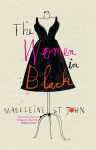
The women in black, Madeleine St John, book coverMusician Tim Finn and writer Carolyn Burns’ 2015 adaptation of Madeleine St John’s 1993 novel, The women in black (my review) is an exception in this list for three reasons: it’s the only one whose title differs from the book’s, it’s a musical comedy rather than a drama, and I’ve seen it! It won Best New Australian Work for Finn and Burns at the 2016 Helpmann Awards.

I’ve been pondering the name change, and my guess is that Finn and Burns felt, probably validly, that the word “Ladies” better conjures the 1950s fashion-section-of-a-department-store setting of the story. Anyhow, I enjoyed the adaptation, and loved that Finn took words from the book for the songs, as in “He’s a bastard, a bastard, a standard issue bastard” (“The Bastard Song”).

The Wikipedia article on the musical quotes the ArtsHub reviewer:

a comedy of mid-20th century manners, Ladies in Black is a paean to an optimistic future – the future of an uncomplicated gender equality and seamless multiculturalism. But Finn’s canny lyricism transports the play from its late 50s context to a subtle but salient comment on social issues of today.

While we have certainly moved on since the setting of this novel, this reviewer has a point – but I’m not sure that message will be the show’s lasting impression. It’s probably a bit too light and fun for that.

An aside: Australian film director Bruce Beresford, and friend of Madeleine St John, has been wanting to adapt the novel to film for a couple of decades now. I’d love to see what he did with it.

Is there any Aussie (if you’re an Aussie) or other (if you’re not) novel that you’d love to see adapted (jn any form)?

Monday musings on Australian literature: Boosting women’s entries on Wikipedia

Have you heard or read about the large discrepancy in Wikipedia between biographical entries (or “individual profiles”) for women and for men? The actual figure is a bit fluid because, of course, Wikipedia is a dynamic site, but most researchers on the topic come up with a figure of around 15-20% as the percentage of biographical articles on women (versus men) in Wikipedia. Why is this? Well, the point Austen so succinctly made in the early nineteenth century seems as true today, 200 years later:

Men have had every advantage of us in telling their own story. Education has been theirs in so much higher a degree; the pen has been in their hands.

In other words, men are also the main contributors to Wikipedia (about which I’ve written before). In fact, the percentage of women editors is less than or similar to the percentage of women’s biographical articles. The Sydney Morning Herald (SMH) reports that Wikipedia had “failed to meet its goal of increasing women’s participation on the website to 25 per cent by 2015”.

Now, it is probably true that men feature more heavily in the public sphere – more politicians, more world leaders, etc etc, are men. Consequently, we might expect some gender imbalance in biographical articles. But, we also know that many women of achievement are under-recognised and under-reported. Feminists have been highlighting this since Feminism’s Second Wave in the 1970s – and yet here, in 2017, we can identify large numbers of women in every field of endeavour who are not in Wikipedia.

Gender symbols

Courtesy: CKSinfo.com

Consequenlty, in recent years women have been taking action, by holding, for example, “edit-a-thons” to support and encourage the creation and upgrading of women’s entries in Wikipedia. On December 8 last year, as reported by SMH (linked above), some 400 new entries were created for women in an international edit-a-thon. Specific events were held, SMH says, in “Istanbul, Cairo, Dhaka, Jerusalem, Delhi, Abuja, London, Cardiff and Washington DC” and individuals also worked “from their own computers across the world”.

But, what about Australia?

Australia has not been missing from this action. In fact, in 2014, as reported by another SMH article, Sydney’s Museum of Contemporary Art hosted an edit-a-thon during which “volunteers gathered to edit and expand the paucity of Wiki pages on Australian female artists”. As well as creating new entries they worked on “improving their academic rigour by providing citations and references”. This is important work, because it enables Wiki’s users to be confident about what they read.

In August 2016, the ABC reports, a group of Australian female scientists took “part in a Wikibomb in an effort to be recognised for their contribution to Antarctic research”. The event took place “at the Scientific Committee on Antarctic Research conference in Malaysia, 93 Wikipedia profiles were created and 20 were improved upon.” There was apparently also a Wikibomb-edit-a-thon event held in Melbourne in November last year.

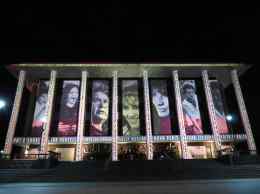
Significant indigenous Australian women (Enlighten 2017)

Some significant indigenous Australian women (Enlighten 2017)

And now, tomorrow, 28 March, Sydney University Press (SUP) and the university’s Fisher Library are holding an edit-a-thon “to improve the representation of Australian women in the world’s favourite reference work.” They’ve chosen March because it’s Women’s History Month. They have a Facebook page and a Twitter account, and they are building an accessible document listing “notable” women in a wide variety of fields who need Wikipedia entries or whose entries need upgrading. It’s a wonderful list, including scientists, artists, activists, historians, botanists and even the odd writer! SUP urges people to come, even if they have no experience or training in Wikipedia editing, as they

will have roving helpers and a cheatsheet with everything you need to know to become a Wiki champion in just a few minutes. It’s going to be a collaborative and fun exercise that will involve EVERYONE.

I’d be there in a flash if I lived in Sydney. You do need to RSVP, so if you are in Sydney and are interested, do check the Facebook Page link I’ve given to see whether it is still possible to join. But, if you can’t, there’s nothing to stop you having a go at home. They give advice on how to do that too on their Facebook page, with links to various useful tutorials.

So, I wish them a very successful day and look forward to hearing the results.

Meanwhile, I would love to know if any of you contribute to Wikipedia – and, if so, what your experience has been? (I have written on this blog about one of my early experiences.)

PS: SUP shares on its Facebook page an Inside Story article reporting that the Australian Dictionary of Biography (ADB) is looking for nominations for women to include in its online database, but that’s a topic, perhaps, for another day because the articles raises some interesting issues about “who” to include.

Monday musings on Australian literature: Whither magazines?

Meanjin Canberra Issue 2013

Courtesy: Meanjin

Are you a magazine reader? I was once a big magazine reader and subscriber – Ms Magazine, the Smithsonian, Choice and Australian Gourmet were my favourites in the 1980s and 1990s. In more recent times, I’ve gravitated to local literary journals like Griffith Review, Meanjin and Kill Your Darlings, but I tend not to subscribe to them. I pick and choose issues, when I feel I have time to read them. Some I buy in print form and some digital.

Australians have long had a reputation for being big magazine readers – but, things are changing, according to The Conversation (“From pig hunting to quilting: why magazines still matter”, by  and and the ABC (“Australian indie magazines thriving as big publications struggle”, by Emily Stewart). We are still big readers of magazines – though, hmmm, apparently the magazines with the biggest readerships are those produced by our two big supermarket chains, Coles and Woolworths. They’re free, which probably helps. But, they don’t represent the main change that’s happening …

Well, actually, it seems that two significant changes are happening. One is the increase in specialised titles, in “niche-interest publications that range from trail bikes to organic gardening”. These magazines still come and go, says The Conversation, but they can survive because of the advertisers:

advertising to a niche rather than a mass audience still makes financial sense and allows these specialised magazines to survive.

Stewart, of the ABC, also reports that “niche titles [with their lower overheads, for a start] have room to thrive”. It’s not easy though. They have, she says, to “think outside the square with their distribution channels to reach their audience, and instead of only using newsagents, Lunch Lady is also available in boutique home wares stores and art galleries”. This seeking out of “niche” distribution outlets is probably something that is easier for a small, and therefore more flexible, publisher to do?

The other change relates to print versus digital. Many magazines, as you probably know, offer print and digital versions, while others offer one or the other, depending on their knowledge of their clientele. Those that offer both versions use them in different ways. Sometimes the print and digital versions replicate each other, sometimes they contain different content. Sometimes, placing some digital content online is used as a teaser to draw readers in. Sometimes you have to subscribe to the whole magazine, while other times you can purchase individual articles. The digital domain offers publishers so many options for reaching their readers.

Griffith Review, for example, offers some of the content of their current issue online – but other articles are only available by subscription or can be purchased individually. The Conversation writes that

It’s tempting to say that we’re in a time of transition from old (print) to new (digital) technology, and that paper will eventually disappear.

The reality is the opposite. Newer magazines like Frankie, an Australian title popular among young women, and Collective, which tackles anything from business to lifestyle and culture, are thriving and selling in print in numbers that rival mainstream women’s magazines.

I love this, I love it because it tells us once again that all those doomsayers who, when a new technology arrives, proclaim the death of the previous technology – remember those claims that television would be the death of cinema? – whereas in fact, new technologies tend to offer more choices, more ways of doing things that suit different needs. It takes time for us all to work out how we want to use new technologies versus old ones, but work it out we usually do. (Of course, some technologies never do come back but in general, I’d argue, doomsaying is not a useful approach to handling change.)

Anyhow, The Conversation goes on to say that

New titles like contemporary women’s magazine Womankind, literary journal The Lifted Brow and Archer, which explores sexuality, gender and identity, are emerging every month – not just in Australia but globally. It is a response to digital overload and distraction – a way to slow down and focus on a beautifully designed, collectible object.

They conclude that the magazine industry “continues to evolve” and that this “evolution is tied to technological change, as it always has been”. But they suggest there’s more to it, proposing that the industry is “also tied to the desire for what political scientist Benedict Anderson famously called the imagined community.” (Nice!) In other words, while social media supports our need to feel part of a group, “magazines offer … an immersion in a carefully curated space made by experts who share your interests … even if that might be babes and boars!”

So, do you read magazines – and if so, what sorts of magazines do you read, and in what form do you read them?

Mena Calthorpe, The dyehouse (Review)

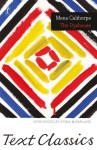
Mena Calthorpe, The dyehouseMena Calthorpe’s novel The dyehouse was, as I wrote in a post last year, Text Publishing’s choice for its 100th Text Classic, which surely says something about its quality or worth, wouldn’t you think? And yet, as Lisa (ANZLitLovers) pointed out in her post, it is not mentioned in recent books discussing the history of Australian literature, such as Geordie Williamson’s The Burning Library and Jane Gleeson-White’s Australian Classics.

However, it is listed in bibliographic and encyclopaedic works like Debra Adelaide’s Australian women writers: A bibliographic guide, Joy Hooton and Harry Heseltine’s Annals of Australian literature, and William Wilde, Joy Hooton and Barry Andrews’ The Oxford companion to Australian literature. It has also captured the attention of others, including Introduction-writer Fiona McFarlane (whose The night guest I’ve reviewed here). She writes of coming across a secondhand copy in a Sydney bookshop and says that she’d never heard of Mena Calthorpe, but as soon as she’d read the opening sentences, she decided to buy it. I can understand that. I would have too.

Now, before I get to the book, I’m going to bore you a little more with what people have or haven’t said about the book. In my above-linked 100th Text Classics post, I noted that while most reviewers were favourable, one from my city’s paper was less so. S/he, RR, called it “badly written and pretentious”, though conceded that if Calthorpe focused on “telling a story simply, economically, and honestly” she could be “a force … on the Australian literary scene”. Marian Eldridge, reviewing a reprint in the same paper, two decades later, had quite the opposite opinion. She praised Calthorpe’s “spare, clear prose and jaunty dialogue”, and called the book …

“a fine example of the social realist genre”

Well, I’m with McFarlane and Eldridge. The book got me in from its first paragraph, and I enjoyed it immensely. It is, what Lisa would call, a book that matters because its subject is, to put it broadly (and baldly!), the impact of capitalism-at-all-costs on workers. That could make for a dry, didactic book, but Calthorpe’s writing and characterisation bring the story to life. Her political message is unavoidable but it’s tempered by a cast of believable people (ranging from the cold chairman-of-the-board to the lowliest labourers), a well-controlled story that contains tragedy and romance without turning into melodrama, and writing that’s fresh and lively.

I’ll start with the writing first. The novel starts in 1956 and takes place over about a year. It’s told third person, in short chapters which move between the many, but not hard to keep track of, characters. It starts with Miss Merton arriving at the Dyehouse and meeting the on-site boss, Mr Renshaw. In chapter 2, we meet the Chairman of the Directors Harvison, the General Manager Larcombe, and Company Secretary Cuthbert. They’re discussing problems in the Dyehouse: it’s not keeping up with production. We quickly get a sense of the characters of these three men. Harrison’s lips tighten as he wonders “Where’s the firing squad?” Larcombe is ineffective – wary, unexciting, and full of excuses – while Cuthbert is “sharp-featured, pleasantly mannered”. We soon learn that he has some humanity, some empathy, but too easily lets his accounting distract him from troubling people issues. Then, in the same chapter, we shift to the General Office, and this (which McFarlane loved too):

Clack! Clack! Up came the carrier and ejected papers onto Mr Dennet’s table. There they lay: the Fanfolds! the Ledger Copies!
The Debits!
Mr Dennet took up his pen and began entering into the Control Book. The Comptometers sprang to life. Two young women with painted nails fell upon the papers.
Tic-tac, tic-tac. Now over to the files.
OK, Miss Brennan, you sort them out. City, Country, Government. Now break them up. A to K, L to Z, and then into the files with them.

There are other short interludes like this – a paragraph on worker Barney running for the morning train, for example – which break up the rhythm and convey the life better than any straight descriptive text could do. I have no idea what RR was thinking. Pretentious? No! Instead, I’d agree with McFarlane’s description of it as “formally experimental … with its episodic structure and its restrained lyricism …  its playful attention to sound.” It all makes for delicious reading.

“The trap’s set for us all” (Miss Merton)

Next, the well-controlled story. Told over a year, Calthorpe explores how the Dyehouse manages with its production crisis. We see Renshaw scapegoating the skilled, experienced but not certificated Hughie, moving him from his beloved dye-room to working on the vats. We also see Renshaw sexually preying on pretty young women in his employ, including the initially gullible Patty. We see the workers, their lack of security – those on “Staff” versus those brought in as needed – and their struggle to sustain their lives. We see the bosses turning a blind eye to the struggles of their people, or, not even noticing these struggles. We see nascent attempts to “organise” for better conditions. Along the way there’s an unplanned mid-life pregnancy, a tragic death, physical assaults and sexual abuse. The novel is nicely structured, beginning and ending with the calm, mature Miss Merton.

All this might suggest that the characters are stereotypical, designed simply to serve the “idea” but, while they do serve the idea, they come across as real, authentic human beings. Larcombe and Cuthbert, for example, are not simple villains. They are, in Larcombe’s case, for example, a bit lazy, a bit self-protective, a bit uncertain, resulting in his being a bit ineffective! Even the biggest villain of the piece, Renshaw, is shown to to have the odd ounce of humanity. Similarly, the workers. Hughie, Barney, Patty, Miss Merton and Oliver Henery, to name a few, are all rounded out with succinctly presented backstories, which establish their authenticity while also adding depth to the plot.

It is, essentially, an ensemble cast, but the stories of two characters primarily carry the plot – Hughie (whose love of his job “had given purpose and dignity to his labour”) and Patty (a naive young women who believes Renshaw will marry her, until she discovers otherwise).

The ending, which I won’t give away, is inspired, striking the right balance between realism and hope.

I really can’t recommend this book enough. It slots well into other books exploring the struggles of the working poor of the early post-war period, like Ruth Park’s Harp in the South series. And it is a thoroughly engaging read which is relevant today, not only because its humans reflect universals of human behaviour as well as the life of the period, but because we are currently seeing new threats to worker security which ensures that this book’s concerns do not feel dated. A worthwhile read on multiple counts, in other words.

Mena Calthorpe
The dyehouse
Melbourne: Text Publishing, 2016 (Orig. pub. 1961)
299pp.
ISBN: 9781925355758

(Review copy courtesy Text Publishing)

Monday musings on Australian literature: Books that matter

In the comments on her post about Alan Paton’s Cry, the beloved country, Lisa (ANZLitLovers) commented that we need “politically aware authors to keep writing books that matter”. Hmm, I thought, most books I read matter, I think, but then a few posts later, when reviewing Jared Thomas’ Songs that sound like blood, she made clear that she meant by this “a yearning for books that tackle the issues of our time”. Ah, I thought, I can work with that idea – and so, here I am, working with it. Thanks Lisa for another Monday Musings inspiration.

The first question is, what are the issues of our time?

Off the top of my head, they would include indigenous rights, climate change and the associated issue of clean energy, asylum-seekers and refugees, women’s rights (including domestic violence), and sexual identity. There are many more, but let’s just work with these.

The second question, of course, is whether contemporary Australian literature – and here I’m meaning fiction, short and long form – is dealing with these?

Before I discuss this, a disclaimer, which is that, for me, books that matter don’t have to deal overtly with issues of the day. Jane Austen has often been criticised for not writing about the big issues of her day, which included the Napoleonic Wars and the impact of the industrial revolution. And yet, I’d argue that she did write about important personal and social issues – particularly concerning the condition of women. She just showed them – rather than explicitly told them.

So, let’s turn now to today’s issues – and I’ll confine myself to books written this century:

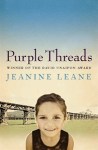
  • Jeanine Leane's Purple threadsIndigenous rights: slowly, very slowly, we are seeing more books written by indigenous people which expose the impact on them of two hundred years of dispossession. There’s historical fiction like Kim Scott’s That deadman dance (my review) and Ali Cobby Eckermann’s Ruby Moonlight (my review), and more contemporary books like Jeanine Leane’s Purple threads (my review). These are just a few, but writers like Tony Birch, Melissa Lucashenko, Ellen van Neerven, Tara June Winch and Alexis Wright are getting their stories out. It’s up to us to seek them and read them so we can inform ourselves better. Lisa’s annual Indigenous Literature Week provides a good opportunity for us to do that.
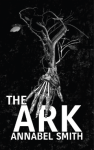
  • Climate and energy: some of the strongest books here are the cli-fi books like Jane Rawson’s A wrong turn at the Office of Unmade Lists (my review), Alice Robinson’s Anchor point (my review) and Annabel Smith’s The ark (my review), but other books like Stephen Orr’s The hands (my review) show the longterm impact on farms of climate change. It’s a topic which lends itself to speculative fiction, but it’s good to see more realistic fiction also exploring the subject.
  • Asylum seekers and refugees: the plight of asylum seekers and refugees has been reasonably well covered in recent years, from all sorts of angles, by non-fiction writers, but what about fiction? Nam Le’s The boat included short stories about refugees – albeit Vietnamese boat people of the late 20th century – and A S Patric’s Miles Franklin award-winning Black rock white city deals with Bosnian refugees in Australian suburbs. Maxine Beneba Clarke’s short story collection Foreign soil explores the lives of migrants, and includes a story set in a detention centre. Irma Gold’s Two step forward (my review) also includes a (memorable to me) detention centre story – from an employee’s point of view. There are also children’s and YA books in this area but I’m not sure the specific issues we are facing right now are being actively covered by our fiction writers. If we believe that fiction can have a positive impact, then …
  • Danielle Wood, Mothers Grimm, book coverWomen’s rights: the most obvious recent book exposing women’s lack of “real” equality, is Charlotte Wood’s dystopian novel, The natural way of things (my review). Interestingly, the Copyright Council, in its Reading Australia program, listed last March (that is, 2016), “8 books to read on International Women’s Day”. It’s a good list, but none of the fictional works were written after 2000. Hmmm … I might have added a book like Danielle Wood’s Mothers Grimm (my review) which exposes at a more domestic, personal level the challenges confronted by contemporary mothers, and the way societal values and attitudes contribute, or even sometimes, create these challenges.
  • Sexual identity: my sense is that this area is being increasingly covered by YA authors, exemplified by the book Lisa praised when she made the statement I’m exploring here. Australia has a growing number of LGBTQI writers. The Australian Women Writers’ (AWW) Challenge maintains a list of Lesbian and Queer Woman Writers, which is useful for anyone wishing to read more diversely. This is not to say, though, that all of their works are political or issues-based – and why should they be? Many write books in which diverse (aka non-heteronormative) sexual identities are a given. That in itself can be read as a political act because we all know the value of seeing ourselves reflected in the arts – in movies, television, books, and so on. Ellen van Neerven’s Heat and light (my review), for example, includes queer characters but their “queerness” is not the issue being explored. This is the point we are aiming for in the real world, but we are not completely there yet. As Yvette Walker wrote in a post for the AWW Challenge, “We appear. We disappear. We are in. We are out.” It’s a slow process.
Annabel Smith. The ark

So, where have we got to in this weird, idiosyncratic (read, minimally researched) ramble I’ve produced? I’d say “the issues” of our day are being covered by our fiction writers, but not always explicitly or politically. The thing is, political novels – or novels of ideas – are problematic. Sometimes the story and the characters become subservient to the politics, which can result in very dull reading. The challenge for fiction writers who do want to explore “issues that matter” is to find “palatable” ways of doing so. Some of those can be (appropriately) in-your-face, like Charlotte Wood’s The natural way of things or Annabel Smith’s The ark or, even, Jeanine Leane’s more realistic Purple threads, while others are more subtle, preferring to let the reader identify the “issues” on the fly. My other conclusion is that short story writers, only a few of whom I included here, are worth checking out when looking for writing about “issues”.

I’d love to know whether you yearn for books that tackle the issues of our time and, if so, whether you’ve found much that meets your needs? 

(And of course I’d love Lisa to add her perspective, because I’ve made assumptions from her comments that may very well have departed from her intention or meaning – and I’d like this to be a conversation.)

Festival Muse: Question time – Robyn Cadwallader with Irma Gold

Robyn Cadwallader, Irma Gold
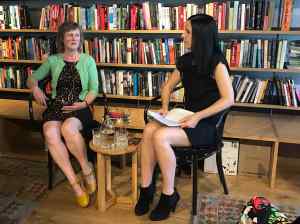
Cadwallader (L) and Gold in the Muse bookshop

Introducing the first event of their Sunday afternoon program, Dan, co-owner of Muse, commented on a peculiarity of Canberra: when they offer sessions on politics or history, they are packed out, but when the focus is fiction, the events are more intimate. Fine by me! I love small, cosy events. But it’s interesting, eh? Anyhow, we then got down to the event, which involved local author and editor, whom you’ve met several times here before, Irma Gold, interviewing local poet, essayist, novelist, Robyn Cadwallader, about her debut novel The anchoress (my review).

It was excellent. Gold structured her questions beautifully, starting with some background questions, moving through well-targeted questions about the book itself – well-targeted for me anyhow because she focused on historical fiction and feminism – and then ending with Cadwallader’s future plans. There was something for everyone – though I suspect most of us were interested in it all.

Gold commenced by providing a quick bio, which included the facts that Cadwallader migrated to Australia with her family when young, and that her background is academic writing. Gold shared Cadwallader’s shock that, when she moved from academic writing to fictional, her struggles with the dreaded term structure followed her! That made me laugh because I love thinking about structure in fiction. Gold also told us that The anchoress had been published in the USA and UK as well as Australia, and has been (or is being) translated into French. She said Marie Claire described The anchoress as “the book the whole literary world can’t stop talking about”. Wow, eh?

The interview commenced then with a brief discussion of Cadwallader’s early interest in books and writing, but let’s get to …

The anchoress

Robyn Cadwallader, The anchoress

The discussion started with Cadwallader doing a reading – and she chose the Prologue. That was great not only because it’s always (hmm, mostly) good to hear authors read from their own work, but also because it refreshed the book and some of its themes for me.

Gold said she’d never heard of anchoresses and asked Cadwallader what sparked Sarah’s particular story. Cadwallader responded that she’d come across anchoresses in her research for her PhD and, like Gold, was both horrified and fascinated by the concept. She said the inspiration for the story came from sitting in an anchorhold, unable to leave it, for an hour or so. It got her thinking about how it would feel to be in such a place forever. What would be the experience? She said her poetry is “about taking a moment and investigating it”. In this book, she took a small space and investigated it. Reinforcing her interest in focusing on the “experience”, she said she’d started writing the novel in 1st person but felt it wasn’t working, so tried 3rd but that didn’t work either. She then realised she had to be there to share the experience. She also made the point that she didn’t want Sarah to speak for all anchoresses.

Gold then honed in on the book’s genre, historical fiction, and asked Cadwallader how she went about separating her research from the writing. Cadwallader said she was lucky because she’d done so much research on the period before she started writing. She had to do a lot of thinking, however, and when she started writing she needed to do extra research on aspects she knew less well, such as village life and monasteries.

Next Gold moved onto how Cadwallader approached incorporating the history into the story. Cadwallader said she knew people would know little or nothing about anchoresses – how right she was! – but didn’t want to do exposition. She used the example of the section where Sarah stands in her cell (anchorhold) for first time. This was hard to write she said without “describing”. She tried to write it from Sarah’s experience in a way that would “show” modern readers, too, what it was like.

Some of the questions at the end concerned the historical fiction issue, so I’m sneaking them in here. Responding to what next, Cadwallader said that some people assumed she’d do a sequel! No, she said, as far as she’s concerned she’d wrapped up Sarah’s life and didn’t have anything more to say. Love it. This points, I think, to a difference between genre and literary-fiction. Genre tends to focus on plot, on the story of characters’ lives. Readers of genre love to get lost in – escape into – the characters’ lives and want to follow them, on and on. Readers of literary fiction – and they can be the same people, so I’m not suggesting a “snooty hierarchy” here – look for different things. They tend to be happy with ambiguous endings, and look forward to moving on to something different. I tend to be one of these readers. You could call me fickle.

Other questions picked up the relationship between fact/history and fiction, about the degree to which historical fiction should focus on the fact versus the fiction. Again, I loved Cadwallader’s considered response. She described historical fiction as an engagement between the present and the past. Writers, she said, need to balance what will communicate effectively with contemporary audiences and what’s accurate. She cited swearing as an example: a medieval oath, like “God’s teeth”, would not convey anger to a modern audience the way a modern swear word would.

Back to Gold now. Her next question concerned feminism. Yes! Was Cadwallader conscious of feminist issues from the start or did they emerge through the writing process. I loved Cadwallader’s answer. She said she was aware of feminist issues and theory from the start because her research had brought her face-to-face with medieval thinking about women, including the belief that women represent the body, and tempt men. However, she is concerned, she said, about historical fiction that wants to be positive about women. Such fiction needs to create strong, feisty women, but she wanted to explore what ordinary women experience.

So, her Sarah pretty soon finds her experience of her body starting “to bump against” the rule that tells her that her body is terrible. Cadwallader wanted to tell about ordinary women doing things that are not “spectacular”. She thinks some readers expected a “spectacular ending” but that would have plucked Sarah out of her context. Her approach to feminism was to describe these women’s experience, to honour them. She didn’t want to exploit them, but explore who Sarah was. She then talked about the village women. (They’re wonderful supporting characters in the book.) She didn’t want them to be “campaigners”, but wanted us to “see” them. It’s too easy for us to miss and not respect the ordinariness of women and what they do.

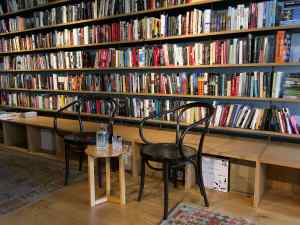
Muse bookshop

Gold ended with questions regarding how Cadwallader has handled her success and what her future writing plans were. Cadwallader talked about ongoing feelings of self-doubt and how easy it is to buy into criticism (rather, it seems, than praise). She described it – and being a writer, she used a metaphor – as being a headwind that you just have to keep walking into! And yes, she is writing another book. And yes, it’s mediaval-focused – to do with illuminators.

There was a brief Q&A, then it was over. We might have been an intimate group, but what a privilege to have been present at a conversation between an intelligent, warm interviewer and a thoughtful, open interviewee. Lucky us.

The natural way of things: Conversation with Charlotte Wood

I have just returned from an inspiring evening in which we got to see Aussie author Charlotte Wood in conversation with Guardian Australia’s Katharine Murphy. It more than made up for our disappointment last year when Wood had to pull out of the Canberra Writers Festival due to illness. Tonight’s event was presented “in association with the Canberra Writers Festival” and had the support of the National Library of Australia where it was held.  

Charlotte Wood, The natural way of thingsAs the post title suggests, the evening was framed around Wood’s latest novel, The natural way of things (my review), which is partly why I was very keen to go because this is a provocative book that doesn’t leave you in a hurry. Wood started by describing the set-up, and explaining that the main plotline is like any prison novel. In other words, the question is: Will they escape or won’t they? I liked the simplicity of this!

Anger and the book’s genesis

Murphy asked her to talk a little about her comment, elsewhere, that anger had inspired the book. Wood explained that she didn’t realise how angry she was when she started writing the book. She talked about hearing a radio documentary about the Hay Institution whose inmates were described by the government as the “ten worst girls in the state”. The anger-inducing thing is that these girls had all been sexually assaulted in some way, and had been locked up for “being in moral danger”. They were locked up because they were in moral danger? You can see why Wood was angry – why any of us would be – on hearing that. Why were the victims locked up?

Wood then explained that her original story was historical, realist, in style, and it wasn’t working. Then, because when you are writing, “everything is about your book”, she started noticing contemporary stories – the army girl raped by a co-cadet, the woman employee sexually harassed by the David Jones CEO, etc – and decided to try a contemporary approach …

… but, while she was writing it, Julia Gillard became Australia’s first PM, and she saw a photo of Gillard, Quentin Bryce, and Anna Bligh together. They presented such a positive picture of female achievement that she thought her book was no longer needed. We all laughed at that! She then spoke of the hatred directed at Julia and her own distressed reaction to this. This is where her writing comes in: art helps you understand incomprehensible things, she said, you can give them shape.

Later, during the Q&A, she spoke more on the anger issue.  She’s uncomfortable with anger, she said – a little self-deprecatingly. She likes it when the book is described as “ferocious” or “fierce” rather than as “angry”. She talked about the importance of humour, of its being the essential companion to anger. (There is humour in the book, as I noted in my review). She quoted American thinker, Patricia Williams (she thought), who talks of the “gift of intelligent rage”. Wood saw this as anger/rage which encompasses positive energy.

That ending!

The discussion then turned to the ending, and its ambiguity. Murphy worried that Wood seemed to be suggesting that the answer is “separatism, opting out”. The ending is certainly the aspect that gave me some pause. It wasn’t that image that bothered many readers of the women pouncing on the designer handbags. No, for me, as for Murphy, it was the ambiguity. I like ambiguity, but here I was a little uncertain about what I was taking away.

Wood’s response was helpful. She said the book has different endings depending on who you are following, and that some readers come away feeling triumphant, while others feel demoralised. She said that for Yolanda, her only liberation was to “separate” herself, to go feral, to become an animal in fact, but that wasn’t Verla’s answer. This gave me a little structure for my thinking.

While she doesn’t like to talk in terms of messages, she agreed that part of it was that in order to be free you have to separate yourself to a degree from a culture that hates women. This can mean not reading women’s magazines that hurt/harm you, not laughing at sexist jokes, and so on.

She talked about another issue that intrigued me, and that’s to do with the men – the prison guards – ending up being trapped too. This is where the balance of power started to shift a little – and is the part of the novel she liked writing!

Nerdy stuff

Charlotte Wood (Courtesy: Wendy McDougall)

Murphy then asked her “nerdy stuff”, that is, about her writing process. I won’t spend a lot of time on this (though nerdy me was interested too). I’ll just share a couple of comments. One was that although she now has five novels to her name, she is still always unsure when she sits down to write, but one thing experience has given her is that she is now “quicker at diagnosing problems”. She has also learnt more about the “craft” of writing, such as how to shape stories.

She described writing as hard – it’s hard making up stuff out of your head, she said. She knows when she’s got the momentum up – it’s when her current book is in her dreams, when she thinks about it as soon as she wakes up. She referred to her PhD on the cognitive aspects of creativity. She found some commonalities between writers, but knowing what these are doesn’t help you do it, she said! Encouraging eh?

Murphy asked whether she kept a notebook to jot down ideas she comes across, things she hears. She said she does this a bit, but wishes she did notebooks as well as Helen Garner. Mentioning the notebook excerpts in Garner’s latest book, Everywhere I look (my review), she said she admires “the precision of her [Garner’s] observations”.

Plausibility in fiction

Early in the conversation, Wood referred to some readers questioning plausibility in the book. I followed this up at question-time, as it was an issue in my reading group. I loved her answer because – as you regular readers here will see – it concurred with my views!

She said it depends, partly, on the sort of novel you’re writing. She wanted this novel to be strange and weird. Her usual benchmark is to ask what she herself would believe. Her question for readers is: “Are you going with it. If you start worrying about factual details, you risk missing out on what’s true.” Yes! So, in this book, in particular, she didn’t “care” much about plausibility. Her next book is more realist so the facts will matter more, but I got the sense that fundamentally she focuses more on what she is trying to do, to say, than on getting all the facts right.

There was more, but I’ll leave it here on my question – and conclude by saying that Wood came across as warm, natural (!), thoughtful, and openly sharing of herself. This made it a most enjoyable event – the hour went way too fast.

Monday musings on Australian literature: Ali Cobby Eckermann’s big prize

Last week’s news that Ali Cobby Eckermann had won a very special prize scuttled my plans for today’s Monday Musings post, which is fine because it can wait, whereas this one can’t. Last year, I wrote about Helen Garner winning the lucrative 2016 Windham-Campbell Prize for Non-Fiction. It was a new prize to me, and is American-based, so imagine my surprise when it popped up again this year through the announcement that indigenous Australian poet, Ali Cobby Eckermann, had won the 2017 Windham-Campbell Prize for Poetry. How wonderful for her, and, by association, for Australian literature, for Australian indigenous writers, and, with Garner and now Eckermann winning, for Australian women writers too.

Eight Wyndham-Campbell Prizes were awarded this year, two each for Fiction, Non-Fiction, Drama and Poetry. This is the first year the awards have included poetry. These prizes, which are open to English-language writers around the world, were “established in 2013 with a gift from the late Donald Windham in memory of his partner of forty years, Sandy M. Campbell”. They’re impressive for a couple of reasons. Firstly, the nominations are made confidentially and judged anonymously, so the recipients have no idea they are in the running until they receive a call from the prize manager. Secondly, the prize is worth USD165,000. That is, each winner receives that amount of money. Now that’s a prize!

Before I get to our winner, just one more thing on the prize. It is awarded at a ceremony during the Windham-Campbell Festival, which happens this year from September 13-15, 2017 at Yale University. The awards ceremony apparently traditionally begins with an invited speaker who gives a talk on “Why I Write.” This year’s speaker will be Karl Ove Knausgård. All the events are apparently free and open to the public. Really, this is philanthropy isn’t it! Now, to …

Ali Cobby Eckermann

The prize announcement page describes her as “Yankunytjatjara Aboriginal Australian”, and the page on her explains her work in these terms:

Through song and story, Ali Cobby Eckermann confronts the violent history of Australia’s Stolen Generations and gives language to unspoken lineages of trauma and loss.

It also says that she founded Australia’s first Aboriginal writers retreat. I didn’t know that.

Southerly 71-2 CoverEckermann has published poetry collections, two verse novels, and a prose memoir. She also edited a special issue of Southerly devoted to indigenous writing. Southerly, congratulating her on win, describes it as their best-selling issue.

On being told of her prize, Eckermann (born 1963) is reported as saying that it will change her life completely. She is currently living in a caravan and looking after her elderly adoptive mother. This money will help her bring her family – including her son and grandsons – together. She is, as you’ll have gathered, a product (I don’t want to say “victim”) of the Stolen Generations. Linda Morris, reporting the win in the Sydney Morning Herald, writes:

In her memoir Too Afraid to Cry, published in 2013, Eckermann related how she had been tricked away from her mother as a baby, repeating the trauma her mother had suffered when she was taken from her grandmother many years before. Eckermann, in turn, had to give her own child up for adoption.

It’s a tough story, and one that reflects, we now know, the lives of many indigenous people. It’s this story, and the wider dispossession of indigenous people, that Eckermann explores in her work. She told Morris that

”I like to think the prize recognises an honest truth around Stolen Generations, for writing around an emotional truth, not academic. I’ve learnt to embrace my emotional baggage and turn it into poetry.”

She sees herself as representing a ”generational voice, not a singular voice”.

Ali Cobby Eckermann, Ruby MoonlightIt might be useful here to list her work:

  • Little bit long time (2009, poetry collection)
  • Kami (2010, poetry collection)
  • His father’s eyes (2011, verse novel)
  • Love dreaming and other poems (2012, poetry collection)
  • Ruby Moonlight (2012, verse novel, my review, winner of the NSW Premier’s Literary Awards Book of the Year and Kenneth Slessor Prize for Poetry)
  • Too afraid to cry (2013, memoir, and winner of the Tangkanungku Pintyanthi Fellowship)
  • Inside my mother (2015, poetry collection, Lisa’s combined reviews post, shortlisted for the NSW and Premier’s Literary Awards, and described by Eckermann as an “emotional timeline” of the Stolen Generations.)

In addition to these she has appeared in many anthologies, including a few editions of Best Australian poems.

The judges praised her ”substantial and formally innovative body of work”. I’ve only read a little of her work – Ruby Moonlight, which I’ve reviewed as you’ll have seen above, some of Inside my mother which I’ve just bought, and an individual poem or two. While I have to admit that my knowledge of poetry is not particularly deep, I can see from even this small sample what they mean by her work being “formally innovative”. As for “substantial”, I’m assuming they don’t just mean quantity but the quality and depth of her work and ideas.

Anyhow, while I didn’t use those words in my review of Ruby Moonlight, I tried to convey a sense of its formal and intellectual cleverness alongside the emotional engagement it generates. I can see these qualities in Inside my mother too. It opens with a gorgeous shape poem, “Birdsong”, and has at least one other, “Severance”. It has longer narrative poems alongside more abstract poems, of various forms, that convey feelings and ideas. There’s a discordant poem, “I tell you true”, that has an almost cheery singsong rhythm while telling a bitter story about alcohol abuse, violence, suicide, loss. And so on …

Interestingly, in his introduction to The best Australian poems 2009, poet Robert Adamson writes:

I attended the APC Regional Poetry Festival at Castlemaine in April 2008. Ali Cobby Eckermann, a poet from Alice Springs was on the program and she read a poem I have included here, “Intervention Pay Back”. Ali recited this poem and the audience was clearly moved. I was certainly moved by both the subject matter and the language of the poem. Somewhere between a ballad and written spoken word, it makes a new shift into what a poem might say and be.

“A new shift into what a poem might say and be” is clearly what the Wyndham-Campbell judges also saw nine years later.

So, big congratulations to Ali Cobby Eckermann on a much-deserved award … and kudos to the person or persons who nominated her.

Monday musings on Australian literature: Three Australian scriptwriters

In a tiny nod to Oscars week, I thought I’d introduce three Australian scriptwriters. I have written one Monday Musings on scriptwriters before in a post on the AWGIEs. There I named a few scriptwriters who also write novels, Luke Davies (who was, in fact, nominated for this year’s Oscars for his script of Lion), Helen Garner and Christos Tsiolkas. In this post, I’m going share three more, none of whom have written novels, but all of whom have written films* that I’ve seen and admired.

Rolf de Heer

Rolf de Heer, 2006 (By Whit (originally posted to Flickr as Rolf de Heer), CC BY-SA 2.0, via Wikimedia Commons)

Rolf de Heer, 2006 (By Whit (originally posted to Flickr as Rolf de Heer), CC BY-SA 2.0, via Wikimedia Commons)

Dutch-born de Heer came to Australia when he was eight years old. He is a significant fixture on the Australian movie scene, with his screen-writing credits including Bad boy Bubby, Dance me to my song (co-written with others including 2017 Stella Prize longlister, Heather Rose), The tracker, Ten canoes, Charlie’s country. Four of these films have been nominated for and/or won national and international awards, and the other, Dance me to my song, about a woman with cerebral palsy, was a critical success.

The tracker, which deals with that complex situation in which indigenous people were used by police to track indigenous people, won an AWGIE award for Best Original Screenplay. It also introduced de Heer to indigenous actor David Gulpilil with whom he went on to make two feature films about indigenous life in Arnhem Land, Ten canoes and Charlie’s country. Ten canoes was the first movie to be filmed entirely in Australian Aboriginal languages. De Heer, as you have probably gathered, doesn’t shy from difficult or challenging subjects.

Andrew Knight

A longstanding, and versatile, player in Australia’s film and television industry, Knight is probably best known for the several highly popular (and well-regarded) TV series which he has created and/or written, such as the comedy-sketch shows, Fast-Forward and Full Frontal, and the dramas, SeaChange (the three series of which Daughter Gums and I have watched several times) and Rake (starring the inimitable Richard Roxburgh).

Knight has adapted several crime novels by Peter Temple for television, including the telemovie of The broken shore (which I read and enjoyed just before blogging). His films include Siam sunset and the more recent films, The water diviner and Hacksaw Ridge. He is clearly an example of someone who has made a living out of screenwriting. Two years ago he received the Longford Lyell Award for Outstanding Lifetime Achievement, at our movie awards, the AACTAs.

Ivan Sen

Born to an indigenous Australian mother and a Croatian father, Sen belongs to that group of filmmakers who writes and directs his own films. He has made five feature films – most of which have been nominated and or won various film awards – starting with Beneath clouds which won the First Movie Award at the Berlin International Film Festival. Made in 2002, it explores some of the challenges facing young indigenous people, through the story of two young people who hit the road, seeking, well, themselves, really. It’s a beautiful, albeit often confronting, film.

“It’s becoming more important for me to make films for Indigenous communities to see themselves on screen” (Sen)

The challenge of indigenous identity, features in many of his films, including in his most recent one, the 2016 Goldstone. It’s a crime thriller set in outback Australia, and features an indigenous detective. It deals with contemporary issues including industrial fraud, political corruption, indigenous land-rights, abuse of women immigrants. It was screened at last year’s Toronto International Film Festival, competing in the Platform section for “artistically stimulating and thought-provoking” films. One of the things I love about Sen’s films is his use of landscape to underpin his themes – and Goldstone is a perfect example.

I could choose more writers, but I’m going to give you all an easy post this week and keep it short. There will be other opportunities to share more writers because, while Aussies always worry about the viability of our film industry, we do seem to have a great pool of exciting writers able to tell meaningful and powerful stories.

How much notice do you take of screenwriters when you watch films? Do you have any favourites?

* Note: I haven’t seen every film I’ve mentioned here, but I’ve seen most of them.