At last year’s festival, I attended a few excellent book launches, and so decided to do so again. Authors need all the support they can get after all.
Book launch: Ian Burnet: Where Australia collides with Asia

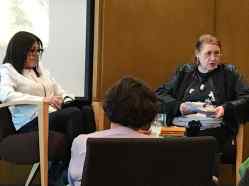
Burnet and Burdon
The first of today’s two launches was for a book with a very long title, by geologist Ian Burnet. It’s Where Australia collides with Asia: The epic voyages of Joseph Banks, Charles Darwin, Alfred Russel Wallace and the origin of the Origin of species. I haven’t heard of Burnet before, though he’s written a few books, and nor have I heard of the publisher, Rosenburg Publishing who produce “a small non-fiction list, concentrating mainly on history and natural history.”
So, that was interesting for a start. The book was launched by Sally Burdon of the Asia Bookroom here in Canberra.
I couldn’t possibly share all the information Burnet imparted to us about the four voyages he covers in the book. A lot of it is well-known, so well-known in fact that Burnet had been wanting to write about Alfred Russel Wallace, his hero, for a long time, but he couldn’t find an angle to make it worthwhile. The thing is that I didn’t know who this Wallace was.
The publisher’s website explains his importance. Wallace
realized that the Lombok Strait in Indonesia represents the biogeographical boundary between the fauna of Asia and those of Australasia. On the Asian side are elephants, tigers, primates and specific birds. On the Australasian side are marsupials such as the possum-like cuscus and the Aru wallaby, as well as birds specific to Australia such as white cockatoos, brush turkeys and the spectacular Birds of Paradise. It was tectonic plate movement that brought these disparate worlds together and it was Alfred Russel Wallace’s ‘Letter from Ternate’ that forced Charles Darwin to finally publish his landmark work On the Origin of Species.
This strait is apparently well-known in certain circles as The Wallace Line.
Burnet explained that the aha moment came when he was sailing in the strait and saw melaleucas, one of the unique species that supports Wallace and Darwin’s theory. He realised that this Australian connection was the story he could tell. (He found some other Australian connections, too, including Darwin’s contemplating his ideas about the origin of the species on the banks of Cox River, and the role of ornithologist John Gould in identifying adaptation in finches.)
An interesting point he made – one relevant to my write-up of the historical fiction session yesterday, even though this is non-fiction – is that it was the easiest book to research. Essentially all the critical documents he needed – letters, diaries etc by the main players – are digitised and available online. Way to go librarians and curators!
It was a lovely launch, and I learnt some things I hadn’t known before, which is always a plus.
Book launch: Stephanie Buckle: Habits of silence
I had identified this launch as one I wanted to attend, partly because the book is by a local author but even more because publisher Finlay Lloyd has sent me a copy of the book to review. Julian Davies, Finlay Lloyd publisher, introduced John Clanchy, whose gorgeous short story collection, Six, I’ve reviewed and who works with Finlay Lloyd as a manuscript assessor and editor.
Clanchy did a grand job of launching Buckle’s debut short story collection, Habits of silence. He explained that he met Buckle 10 years ago in a writers’ group, and talked about her achievements: some of the fourteen stories in this collection have been published before, have won prizes, and/or have been in editions of Best Australian stories. In other words, he said, she’s a writer with some cred (though he didn’t use that word.) She has worked at her craft, he said, even rewriting some prizewinning stories for this publication. (Interestingly, in a throwaway line, he mentioned that she has written a novel about the Canberra fires, From the ashes, but I don’t believe it’s been published as this is her debut book.)
Anyhow, Clanchy then discussed the book itself. He talked about the relevance of the low-light, empty urban streetscape on the cover, and said that it and the recurrence of words like “silence” and “wordless” provide a clue to the content. And this, he suggested, revolves around communication, about how it can break down, about the positive and negative impacts of silence. Silence, he said, can be positive, but with Buckle, things don’t stay the same, and smooth waters can turn turbulent.
Silence can be voluntary or involuntary. Two stories are about a stroke, which forces involuntary silence. He read an excerpt from one of these stroke stories. And then read from the second story in the book, “sex and money”, which is about voluntary silence, about silence being used aggressively by a wife who is not receiving the love and attention she desires. Both readings showed a gorgeous insight into human nature, and an ability to present it economically, as you’d expect in a short story.
Davies then returned to introduce Buckle. He reiterated her willingness to work on stories, suggesting this is partly a salute to being older, to the associated ability and willingness to produce stories of psychological subtlety. He then introduced Buckle to the podium.
Buckle said that the book was a long time coming, and that she never thought her first book would be a short story collection, given their general unpopularity. (Thank goodness for small publishers like Finlay Lloyd who take risks on unusual or less popular forms.) However, she loves short stories she said, particularly those of 2,500 to 3,000 words. You can’t hide in short story, and you can tease out a single idea. But, addressing the comment about her working on her stories, she said the hard thing is to know when to stop! I guess most writers – even bloggers – understand that!
She then read from two of her stories, from “us and them” which is set in a 1970s psychiatric hospital, and “the man on a path” which is about an older woman, widowed and lonely, going on holiday to a place she used to go with her husband. As she walks, all she sees are couples, until she sees a man alone walking towards her. The excerpt she read about what happens next was tantalising.
I so look forward to reading this book – but it will be a little while before it reaches the top of the pile.





 Whispering Gums