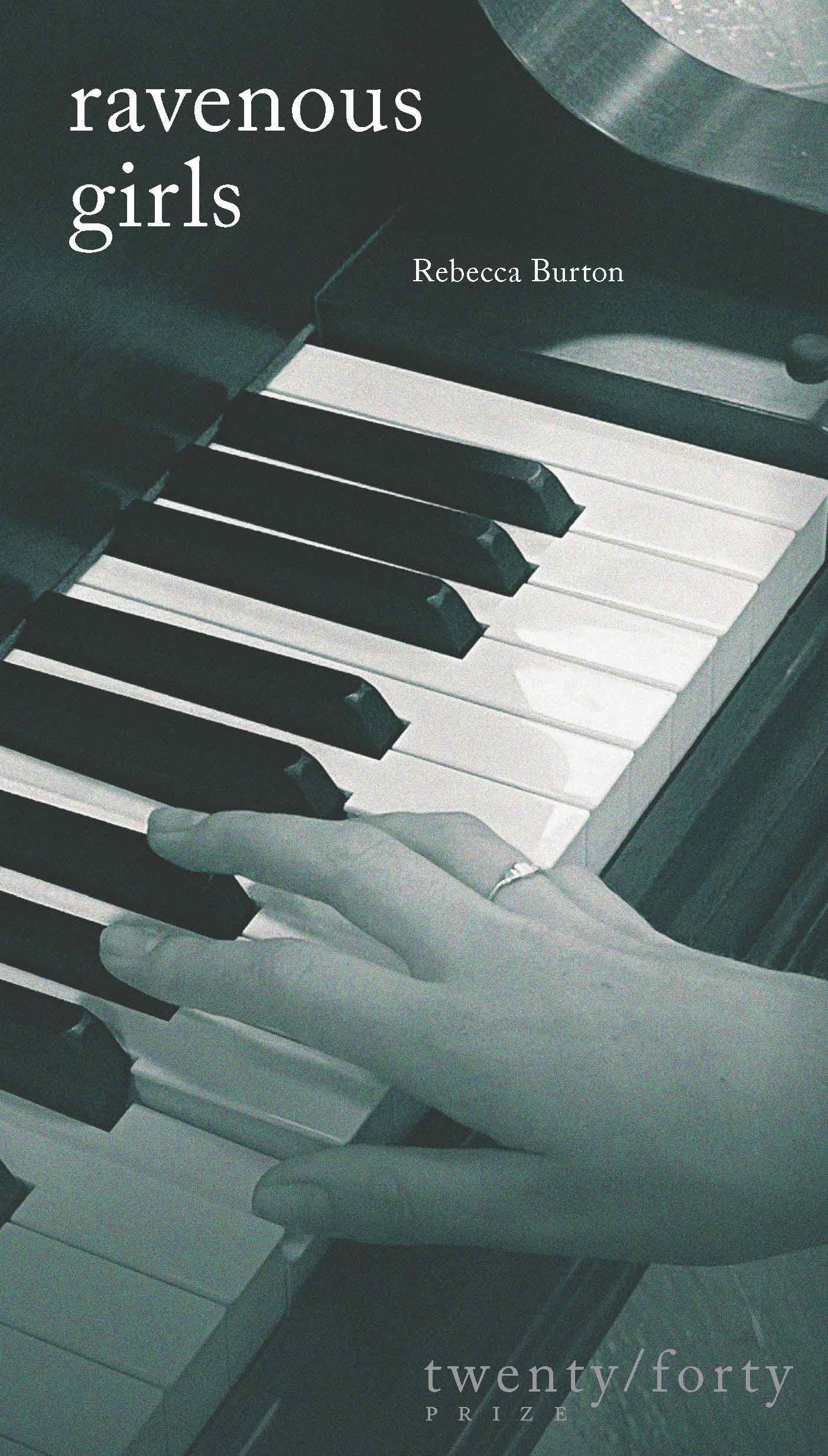
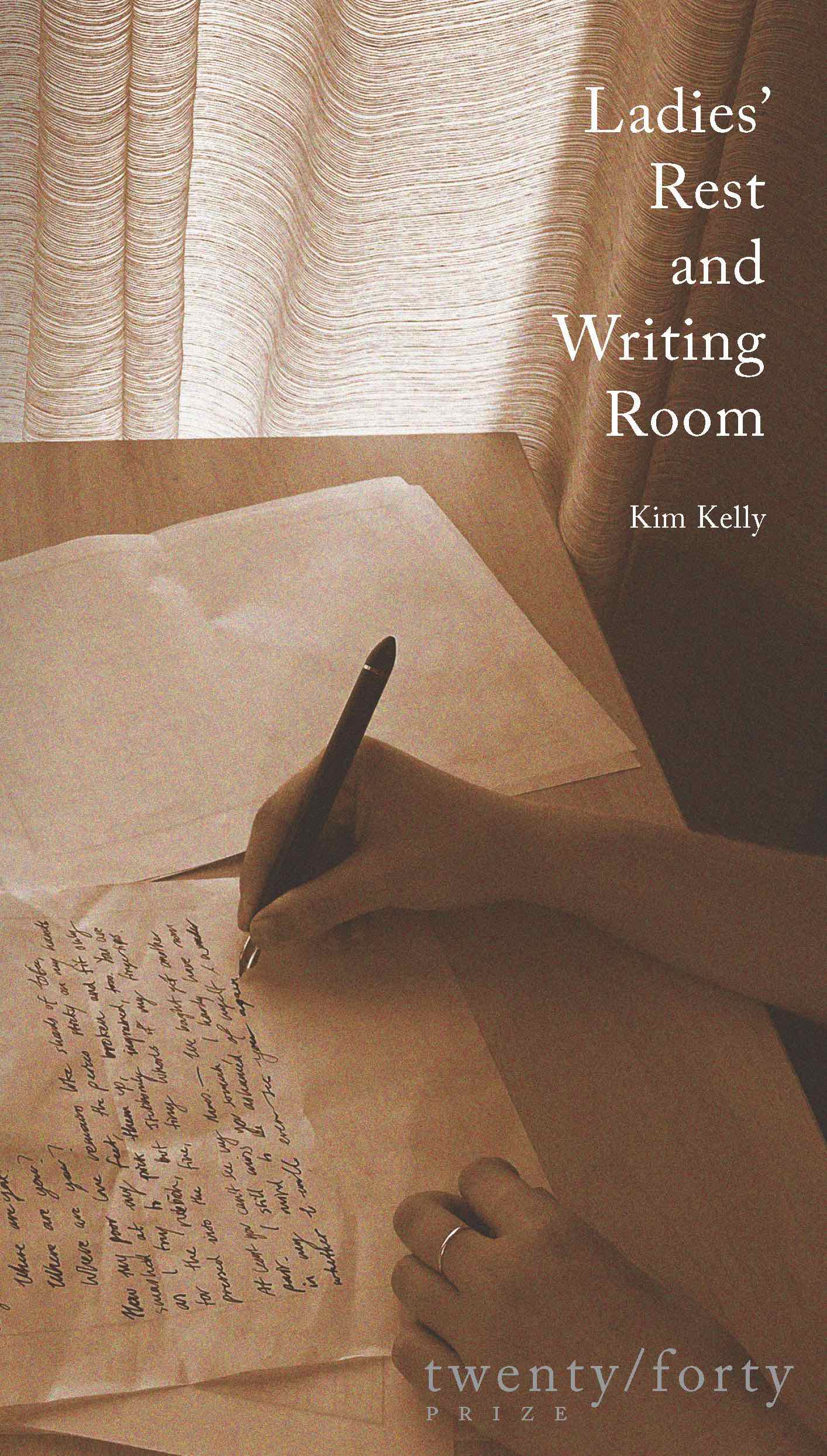
And, the interesting literary awards keep coming. In November 2022, I announced the creation of the new 20/40 Publishing Prize by the local-to-my-region independent, non-profit publisher, Finlay Lloyd. A year later, in October 2023, I announced the inaugural shortlist, and soon after that, the winners, Rebecca Burton’s Ravenous girls (my review) and Kim Kelly’s Ladies’ Rest and Writing Room (my review). I am absolutely thrilled to see that the shortlist for this year’s award has just been announced.
But, before I get to that, a little explanation re my opening sentence. Like the Barbara Jefferis and the Mark and Evette Moran Nib Literary Awards, this award, too, has different and specific criteria, though in this case they are not so much about content as form. The 20/40 prize is a manuscript award with the prize being publication, neither of which criteria is particularly unusual. Further, it is not limited to debut or young or women or any other subgroup of writers, as some manuscript awards are. Submissions can be fiction or non-fiction, but must be prose (albeit “all genres … including hybrid forms” are welcome). What makes this award particularly special – to me anyhow – is that it is for shorter works, that is, for works between 20,000 and 40,000 words (hence the award’s name, the 20/40 Prize). The original aim was to make two awards – one to a work of fiction and one to nonfiction. However, last year the fiction submissions were so strong, said the judges, that both winners were fiction. Let’s see what happens this year …
And now, the 2024 Shortlist
Here is the shortlist, with a description from the announcement, plus further information I have found on the previously published authors.
Alicia Marie Carter’s Minotaur toespulls no punches in taking the reader deep into the searing, visceral reality of the ensnared existence of a young woman, manipulated in prostitution: Carter is a writer, editor, teacher and podcaster who has had short stories, poetry and personal essays published in various literary journals, has won awards for her short fiction, and had a novel, Songs at the end shortlisted for the Penguin Literary Prize 2021.
PS Cottier and NG Hartland’s The thirty-one legs of Vladimir Putinspirits us away on a comedic journey into a world where the reality and absurdity of political power are increasingly indistinguishable: Cottier is a Canberra-based “poet who occasionally writes prose”, among other things, with an impressive body of work to her name; Harland is also a Canberra-based writer about whom I have found little except some references to prose writing.
Susan Saliba’s There is something that waits inside usempathetically explores the search for solace of a girl caught between the example of her high-achieving aunt and her eccentric, dysfunctional mother: Saliba is an English and Creative Writing Teacher, and an award-winning writer of young adult and children’s fiction.
Sonya Voumard’s Tremor shows us that beyond our societal expectations and judgements about normality, individual lives with disability can follow atypical, often difficult, but ultimately inspiring paths: Voumard is a writer and lecturer, primarily in non-fiction, who first came to my attention when she was longlisted for the Stella Prize in 2017 with The media and the massacre (which kimbofo reviewed from her won journalistic perspective).
Last year’s submissions were judged blind. This is not explicitly stated in this year’s shortlist announcement, but Julian Davies did say in an email announcement earlier this year that “Consistent with the ethos behind the prize, and last year’s guidelines, all entries will be read blind by the panel so that the quality of the writing guides the panel’s decisions rather than any extraneous influence”. I am clarifying this as I know it appeals to many readers and writers.
The judging panel for the 2024 prize comprised author Kevin Brophy (whose The lion in loveI’ve reviewed), the publisher and author Julian Davies (whom I’ve reviewed a few times), author and poet Rashida Murphy, and last year’s winners, Rebecca Burton and Kim Kelly (aka Kim Swivel). The ongoing plan is for the previous year’s winners to be on the next year’s panel.
The winners will be announced on 26 October, just in time, again, for Novellas in November. The media release says, “it is intrinsic to a publishing prize that when the shortlisted entries are announced, the winning books are already in the final stages of being prepared for publication”. In other words, we should be able to buy them at the end of this month. Watch this space. I have so many novellas I want to read for Novellas in November …
It is heartening to see Finlay Lloyd’s commitment to their prize. I hope it continues long into the future.
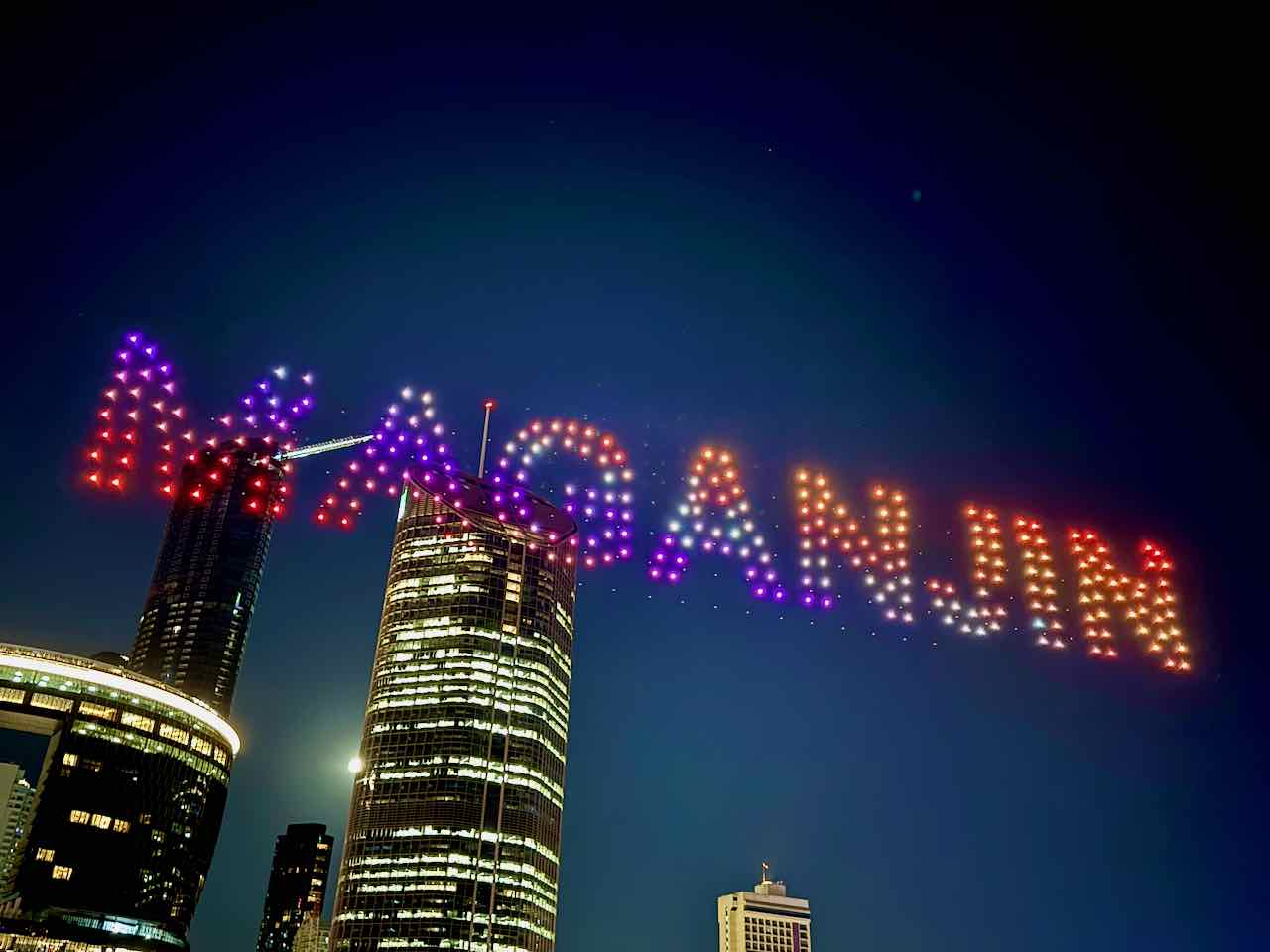
Last week I wrote a post on “literary outback Queensland”, following the route of a trip we had just finished. That trip ended up in Magandjin (or Brisbane), which is very definitely not “outback” so I decided to hold over Brisbane fiction for another post.
Concluding the Skylore drone show, 2024 Brisbane Festival
Brisbane is the capital of the state of Queensland. However, occupation of course long predates this colonial history. The oldest archaeological evidence for Aboriginal occupation dates back 22,000 years but the report used to provide these dates adds that “Brisbane is probably far older than [these dates suggest], with earlier evidence likely destroyed by the changing coastal and sub-coastal environment, coupled with rapid urban expansion”. Several Aboriginal groups claim traditional ownership of this area, including the Yagara, Turrbal and Quandamooka peoples. And these people have their own names for the city. The one best known to settler Australians is Meanjin, a Turrbal word for the land on which parts of the city are built, but another is Magandjin (sometimes spelt Maganjin), a Yagara word referring to the tulipwood tree. I’m not across the finer details here, but this seems to be the name that is the accepted or preferred name.
Colonial occupation commenced with the establishment of the Moreton Bay penal settlement at Redcliffe in 1824, but this settlement was moved to North Quay on the Brisbane River in 1825. From here the city developed in fits and starts as cities often do. You can read about it at the link on Brisbane above if you are interested. I lived in Brisbane through most of my primary school years.
For this post I’ve decided to share a selection of books in chronological groupings – by setting, not by publication. Listing the books chronologically by publication would have its own validity in terms of capturing the interests of the period they were written (regardless of the period in which they were set), but I’ve decided to take the simpler route and focus on the picture they build of Brisbane. Most on my list I’ve read, some before blogging, but there are some TBR wishlist books here too.
Colonial era (19th century)
I have chosen two novels to represent Magandjin’s colonial area:
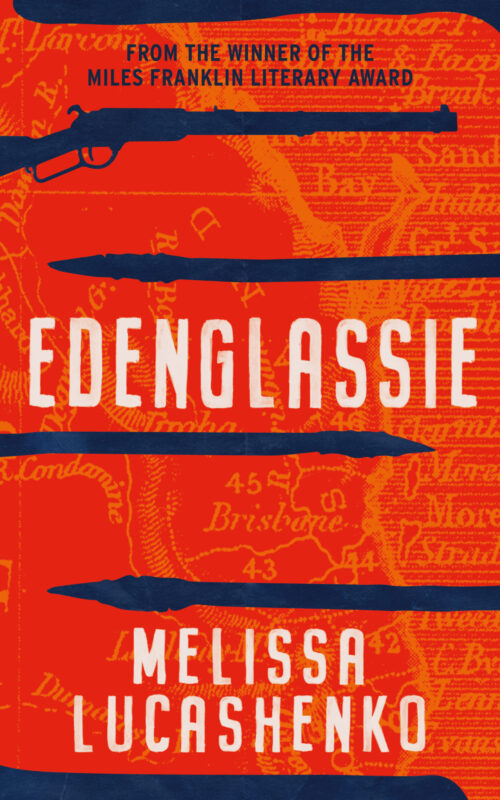
Melissa Lucashenko, Edenglassie (2023, my review): set primarily in colonial Brisbane in the 1850s, with a brief section set in the 1820s as the settlers started to arrive, and a contrasting modern narrative set in 2024, Edenglassie paints a picture of colonial society from a First Nations perspective. Lucashenko said her main aims were to ask “what was going through these people’s [the colonisers’] minds?” (as things could have been different) and to counteract the trope of the dying race. It’s a vivid and engaging book.
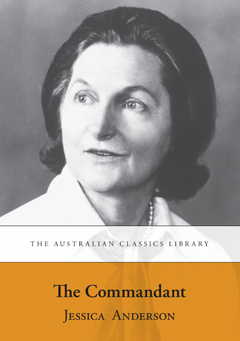
Jessica Anderson, The commandant (1975, my review): also set in colonial Brisbane, but in the abovementioned penal colony of Moreton Island in 1830. It is Anderson’s only historical novel, but was apparently her favourite. It was inspired by the real story of its commandant, Patrick Logan. Known as a harsh leader, he was murdered while out on an expedition. The story is told mostly through the eyes of his (fictional) younger, visiting sister-in-law.
20th Century
Brisbane is Australia’s most northern state capital – Darwin being a territory capital – and was closest to the South West Pacific Area theatre of World War II. Consequently, it played a major role in Australia’s defence, and became a temporary home to thousands of Australian and American servicemen and women. Naturally, this significantly affected the city’s social and political environment. Many novelists have explored this time, but I’m sharing just a few, followed by some novels set later in the century.
Ariella van Luhn, Treading air (2016, my review): set in Townsville 1922, and then Brisbane 1945, this work of historical fiction was inspired by a petty criminal named Lizzie O’Dea. Van Luyn creates vivid pictures of Brisbane, including the story of Lizzie’s theft of “bully beef and US army blankets”, which conveys much about the stresses of the time.
Melanie Myers, Meet me at Lennon’s (2019, my review): set in WW2 Brisbane when American servicemen were in town, sweeping young women off their feet and not always paying attention to their moral compass! My 1929-born Mum was a young woman at the time, and her school was taken over by the American military. Myers’ novel fictionalises the stories and places mum told us about.
David Malouf, Johnno (1975, read before blogging): semi-autobiographical novel about growing up in 1940s-50s Brisbane, with the first person narrator telling of his friendship with his schoolmate, “Johnno”. Malouf captures well-to-do Brisbane life, but also the challenges of growing up and finding one’s place.
Thea Astley, The slow natives (1965, on my TBR): set in the mid-1960s, says Wikipedia, examining “the relationships between suburban Brisbanites, including a priest, nuns and a couple and their teenage son”. Explores the sort of emotional and spiritual aridity that is often at the heart of Astley’s fiction, and that may have stemmed, at least partly, from her youthful experience of life in Brisbane.
Toni Jordan, Fragments(2018): a dual narrative literary mystery which moves backwards and forwards between 1930s New York and balmy 1980s Brisbane.
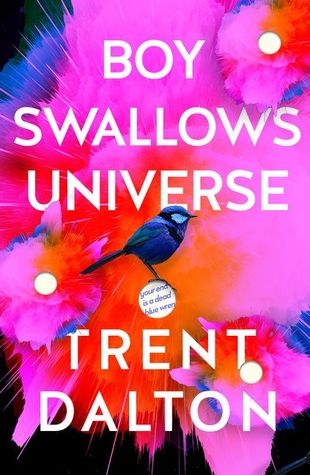
Trent Dalton, Boy swallows universe(2018, my review): semi-autobiographical story of a young boy growing up in the 1980s and 90s, in working class suburban Brisbane; a story about a childhood characterised by drugs and violence, but also love.
Andrew McGahan, Praise(1992, read before blogging): set in 1990s Brisbane, this novel triggered the Australian literary genre, grunge lit, which Wikipedia describes as, “an Australian literary genre usually applied to fiction or semi-autobiographical writing concerned with dissatisfied and disenfranchise young people living in suburban or inner-city surroundings”. Andrew Stafford reviewed Praise in The Guardian, drawing some comparisons with Johnno:
it captured the town’s torpor and the ambivalence of its inhabitants better than any book since David Malouf’s Johnno.
But whereas Malouf luxuriated in detailed poetic descriptions and may have been the first writer to describe Brisbane as a “big country town” (and Johnno moved at about the same pace), Praise was full of pent-up energy. A classic of Australian dirty realism, it’s a novel in which not a lot happens – but like Brisbane itself, all the action is happening beneath the banal facade, fuelled by frustration and repressed rage.
21st Century
Brisbane in this century has experienced some major disasters, including serious flooding, which are increasing in frequency due to climate change. (This report from the Queensland government is instructive.) It has also been a period of high population growth and significant infrastructure development. It feels like a city on the move, but not without tensions over the potential for negative outcomes.
Donna Cameron, The rewilding (2024, my review): set in contemporary Australia, this work of ecofiction takes us on a wild road trip from Sydney to northern Queensland via disaster-struck flooded Brisbane where our eco-warrior protagonist, Nia, takes risks amongst Brisbane’s skyscrapers to promote her planet-saving cause.
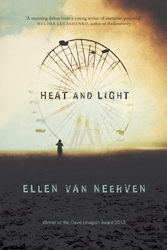
Ellen van Neerven, Heat and light (2014, my review): three-part work, set largely in Brisbane, but with stories set throughout Australia. The middle part, “Water”, is a longform story set in the near future, at least it was from 2014 when it was written, as it’s set in the 2020s. Australia is a republic with a female president, a new flag, and Jessica Mauboy’s song “Gotcha” as the national anthem. However, life isn’t perfect. Narrator Kaden is a Cultural Liaison Officer who thought she’d be working with “other Aboriginal people”. Instead, she she’s to work with “plantpeople” who are sort of mutant plants with human features created during “islandising” experiments. It’s a story about how we treat other, about segregation, discrimination and dirty politics.
Brisbane is home to many wonderful novelists whom I haven’t mentioned here (like Susan Johnson, and Nick Earls), and to the impressive University of Queensland Press which does a sterling job of supporting First Nations and other Australian writing.
Recently, I posted on the shortlist for the Barbara Jefferis Award, which has a very specific goal concerning the depiction of women and girls in a positive way or in a way that empowers the status of women and girls in society. Today, I’m sharing another shortlist for another award with a specific focus. The award is the Mark and Evette Moran Nib Literary Award and its focus is “Australian research-based literature”. It is offered through a municipal council, the Waverley Council in Sydney, which also makes it unusual.
Like the Barbara Jefferis award, and indeed the Stella Prize, this award is not limited by genre or form – that is both fiction and non-fiction are eligible. The judging is based on “on literary merit, research, readability, and value to the community”. I have written about it before, so if you are interested in its origins and intentions please check that link. Previous winners include historians Alison Bashford and Claire Wright, biologist Tim Low, novelists Helen Garner and Delia Falconer, and journalist Gideon Haigh.
Last year, the winner’s prize doubled in value from $20,000 to $40,000, due “to an ongoing multiyear commitment by the award’s principal sponsors, Sydney philanthropists, Mark and Evette Moran, Co-Founders/Co-CEOs of the Mark Moran Group”. This makes it a significant prize. There is also a People’s Choice Prize of $4,000 and the six shortlisted books receive $1,500 each.
The judges for the 2024 award are poet Jamie Grant, publisher Julia Carlomagno, and writer Angela Meyer (whom I’ve reviewed a few times here). They narrowed the shortlist to 6 books, from 175 submissions. The announcement quotes them as saying:
“We were impressed with the breadth and calibre of this year’s entries, which ranged across genres, forms and styles. The six chosen books cast a lens both global and intimate, exploring issues of gender, class, nation and family, and emphasising the importance of community. We congratulate all the shortlisted authors.”
The 2024 shortlist
Shauna Bostock, Reaching through time: Finding my family’s stories (Allen & Unwin, First Nations family history)
Deborah Conway, Book of life (Allen & Unwin, memoir, kimbofo’s review)
Ryan Cropp, Donald Horne: A life in the lucky country (La Trobe University Press, biography, Lisa’s review)
Anna Funder, Wifedom (Hamish Hamiliton, biography, my review)
Melissa Lucashenko, Edenglassie (UQP, historical fiction, my review)
Dave Witty, What the trees see: A wander through millennia of natural history in Australia (Monash University Press, ecoliterature/nature writing)
As commonly happens with this award, life-writing features heavily in the shortlist. Like last year, there is just one work of fiction. But, unlike some years, I’m pleased to have read two of the shortlist!
If you wish to vote for the Nib People’s Choice Awards, you can do so from now until 17th October, so click here to register your choice. For more information on the award overall, check out Waverley Council’s announcement.
The winner of the overall prize and the People’s Choice Award will be announced on 27 November.
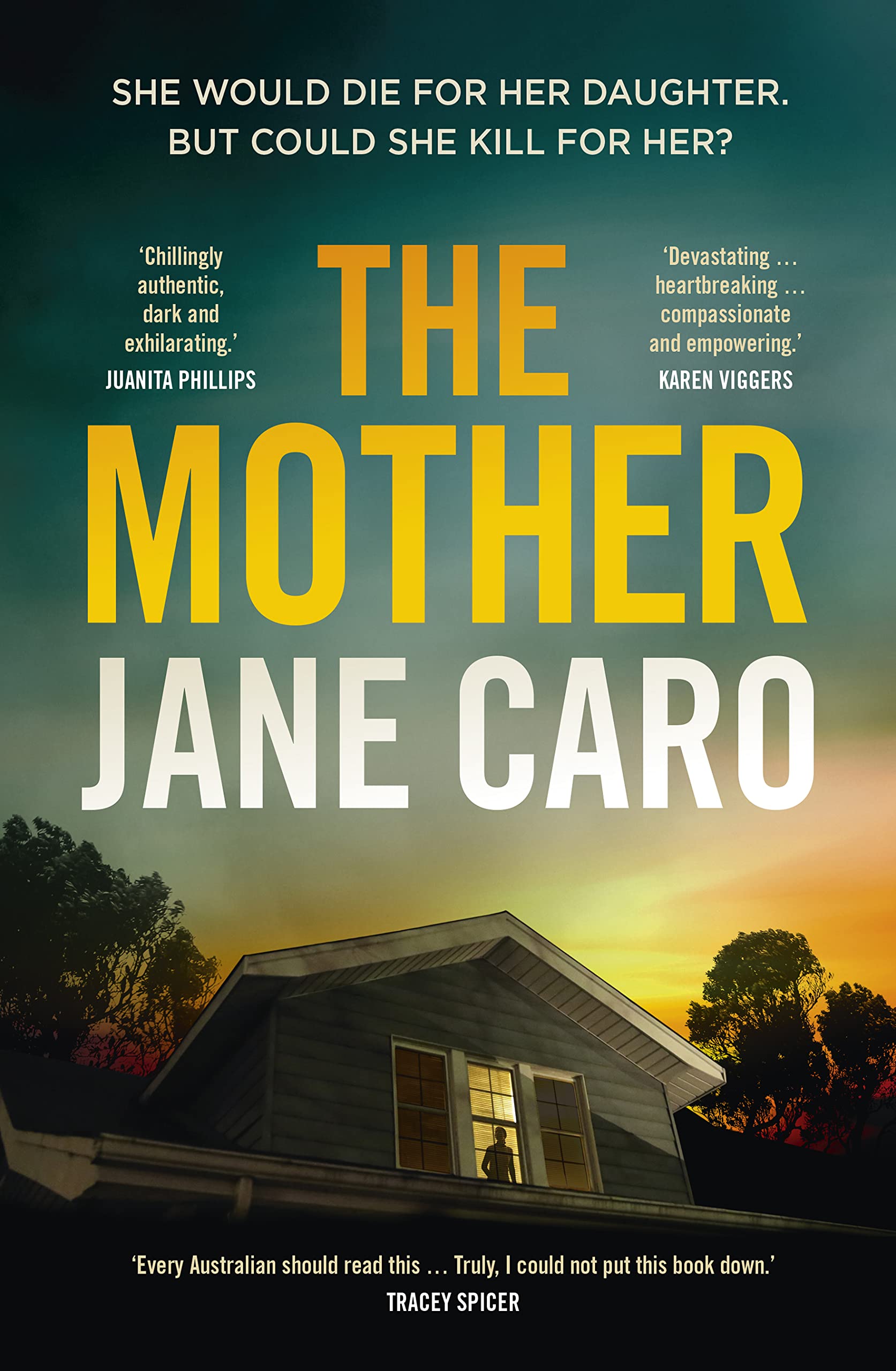
When my reading group scheduled Jane Caro’s debut novel, The mother, I was, I admit, not exactly enthusiastic, because my sense was that it was not going to be the sort of, shall I say, subtle writing I prefer. My sense was right, but I am not sorry I read it – partly because of the engaged discussion we had and partly for Caro’s intention.
The mother, then, is not a literary award-winner – the writing is fine but not exciting or breath-taking in the way I like – but, and it is a big but, it is an accessible, fictional exposé of the main points Jess Hill makes in her Stella Prize-winning See what you made me do: Power, control and domestic violence (my review). Hill explores family and domestic violence from every angle, but the most shocking and enlightening part for me concerned children, particularly the Family Court’s inability or refusal to see the risks to children from its parent access orders, even when the children themselves express fear. This point is powerfully made by Caro in her novel*.
But, let me step back a bit. The mother tells the story of 60-something middle-class Miriam Duffy who, widowed early in the novel, is pleased – and indeed grateful – when her emotional daughter, with whom she has had a tricky relationship, marries a perfect-seeming man. Gradually, however, little niggles about this relationship become bigger until one day they are confirmed when Ally returns home with two little children in tow, having left her husband. From here the situation deteriorates as the husband Nick escalates his bullying, predatory behaviour, and Miriam and Ally realise that the law is unable to protect them. The novel is described as a thriller, so I’ll give you just one more piece of information. It opens with a Prologue in which Miriam buys a handgun.
This brings me to the structure. After this Prologue, the novel is divided into two parts. In Part 1, Ally marries and soon after, Miriam is widowed. There is also a second, older, daughter who is in a stable marriage and has two children. During this part, Caro slowly drips out many of the flags that constitute coercive control, but that on their own don’t initially look like it or can be explained away – things like isolation from family and friends, use of a (demeaning) pet-name, jealousy, charm that is turned on and off at will, and surveillance, moving into sexual violence and gaslighting. This part ends with Ally’s return home. Part 2 commences four years later, and we are reminded of the Prologue, because Miriam is researching where she can buy a gun. Miriam and Ally have been systematically intimidated by Nick, and have reported his transgressions against Ally’s AVO (Apprehended Violence Order) again and again, but
Eventually they had stopped going to the police. It wasn’t that the cops weren’t sympathetic; it was just that they could not do anything.
In this part, Caro ratchets up the sense of helplessness (and hopelessness) the two women feel as Nick finds new ways to harass and terrify them. As I read it, I couldn’t help but think about all the news stories of recent years about murdered women and children. Nor could Miriam and Ally, but they turned the TV off the minute these stories came on. They were too close to home!
Like many issue-driven books, The mother did, as many in my reading group commented, feel didactic at times, and it is somewhat predictable. Some of us also felt that it was a little laboured in places. However, offsetting this is the novel’s characterisation and understanding of human nature. Caro conveys the complex human emotions we all experience under stress. She explores the lines and balance between what is acceptable in relationships and what is not, the fears about when to speak up, the justifications we try to find when things feel awry, and the feelings of guilt (particularly in mothers).
The mother is unapologetically a novel with a cause. With its compelling storyline and believable characters, it has a chance of reaching those who do not understand what coercive control is, and who do not realise that it crosses all demographics. Nick, for example, is a vet and Ally a PhD candidate. Miriam, a successful businesswoman, lives in comfortable North Shore Sydney.
This novel is being promoted primarily as a thriller, but I’m more inclined to see it as belonging to that long tradition of social problem novels. It may not be as sophisticated as the best of them, but its intention is clear, to drive social change. I hope it succeeds. I don’t imagine Jane Caro, or Jess Hill for that matter, will let matters lie until we see real, sustained change happening – and nor should we.
* This month there has been news about changes in family law in Australia, including removing the presumption of equal shared care, putting a focus on prioritising children’s best interests, and revamping the role of independent children’s lawyers. Time will tell what difference this makes in practice.
Jane Caro The mother Allen & Unwin, 2022 368pp. ISBN: 9781761063893 ASIN: B09MQ3PN1W
I started writing this in late August, before we headed off on our outback Queensland trip, revisiting many places from my childhood, as well as seeing some new places. It was while living in Mt Isa, in northwest Queensland that I developed my love of Australian literature and of the Australian landscape. I was 11 when we moved there, and 14 when we left.
Queensland is, area-wise, Australia’s second largest state (though third largest in terms of population). Wikipedia has articles on the different regions of Queensland, but the areas and specific places we are moving through are:
Far North Queensland: encompassing part of the Great Barrier Reef, Cape York Peninsula, the Atherton Tablelands, the Daintree Forest and Queensland’s part of the Gulf of Carpentaria. This is the only part of Australia that is the country of both Aboriginal Australians and Torres Strait Islanders.
These are my focus in this post, though from the Central West we will continue southeast to Brisbane, passing through some other notable areas. We visited nearly all the places I mention below on our recent trip, or we were in their vicinity, waving at their road signs as we whizzed by!
To describe the landscape would take a post in itself, but I’ll just say that this area includes tropical regions that are frequently visited by cyclones, and dry western regions that are frequently visited by drought. Tourism, agriculture (including sugarcane), pastoral (featuring huge cattle stations), and mining are the main industries of the area. First Nations people live throughout the state, but not all communities have survived well. Much has been lost. It was while living in Mount Isa in the 1960s that I first learnt that there were different Aboriginal nations (though we didn’t use the word “nation” then.) The Kalkadoons (more properly now, Kalkatungu) were my introduction to Australian Aboriginal culture and history, not that we learnt much. But it did frame my early understandings of what Australia was.
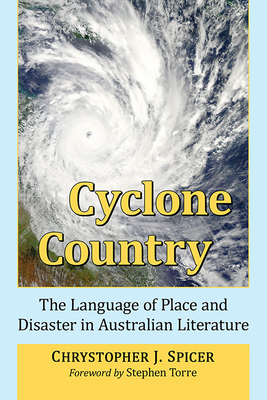
While the big coastal cities – Cairns and Townsville – are well populated, this more western area is far more sparse, but it is nonetheless home to more Australian literature than you might think. A few years ago, I reviewed a book that focused on literature of cyclone country, Chrystopher J. Spicer’s Cyclone country: The language of place and disaster in Australian literature. In this book, he discusses five writers, whom I will include in my list below.
Moving now to literature, specifically, Spicer argues that weather is inseparable from the physical and experiential aspects of the landscape. One of his points concerns how writers capture the idea that people who live in cyclone areas “integrate” the experience in some way into their identity – and into their understanding of how to live in that place. This is probably true in all areas which have “big” weather, not just cyclones but also events like droughts. Regardless, many writers have drawn on the weather as much as the landscape to enhance their stories and ideas. Teresa Smith, reviewing Mirandi Riwoe‘s historical novel Stone sky, gold mountain (2020), which is set during the gold rush in the Palmer River area near Far North Queensland’s Cooktown, writes that “There is no mistaking the location within this novel … anyone who has lived in central and north Queensland will relate to the sense of cloying and oppressive heat that lifts from the pages of this story …”
Over the years, I have read many novels set wholly or partly in outback and remote Queensland. Two authors, though, who stand out are Alexis Wright and Thea Astley. Both have written powerfully and evocatively about the region, pulling no punches about its social, economic and psychic challenges. I’m not, however, going explore this in detail. Instead, I’m sharing a selective list of works, roughly following the trip we took, to give you a flavour! (This means some authors you might expect, won’t appear here!)
A literary trip through Outback Queensland
Our trip started in Cairns, where we did a day trip north before we went west through the Atherton Tablelands, and its sugarcane, gold and timber towns, to the Gulf of Carpentaria. Then we wended south through Mount Isa, Winton, Longreach, Barcaldine and on to Roma and Toowoomba, before heading east to Brisbane.
Carins, Kuranda, the Daintree, Port Douglas, and environs:
Thea Astley, Girl with monkey (1958), A boatload of home folk (1968), Hunting the wild pineapple (1979, my post on the titular story), The multiple effects of rainshadow(1996, my review) are some of the books Brisbane-born Astley, who lived for many years in north Queensland, set in the region. Her focus was outcasts, misfits and injustice.
Xavier Herbert wrote many of his books while living in Redlynch, on the edge of Cairns, but in fact his subject matter tended to be the Northern Territory.
Susan Hawthorne, Earth’s breath (2009) is a verse novel inspired by the 2006 landfall of Cyclone Larry, which affected many coastal towns around Cairns and across the Atherton Tablelands.
Tinaroo: Myfanwy Jones, Cool water(2023, my review) is set on the Atherton Tablelands, with an historical narrative based around the building of the Tinaroo Dam in the mid-1950s and a modern timeline set in the same place. Its theme, however, is not so much environmental, as you might expect, as toxic masculinity.
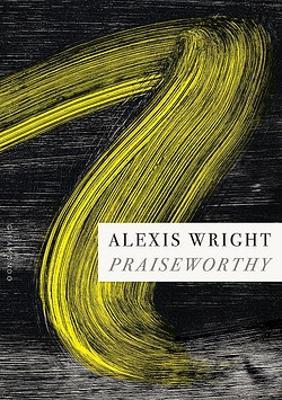
Karumba and the Gulf of Carpentaria: Alexis Wright, Carpentaria (2006, my post), and Praiseworthy (2023): Wright is an activist and writer from the Waanyi nation in the highlands of the southern Gulf of Carpentaria. Her novels capture the region’s political and cultural tensions and challenges, the long tail of invasion and dispossession, with a vibrancy and humour that never forgets the dark side.
Normanton: Nevil Shute’s A town like Alice (1950) is partly set in a fictional outback Australian town which is based on Normanton (and nearby Burketown). It features an entrepreneurial young English woman determined to lift the economy, and make it a “town like Alice”.
Mount Isa and the Barkly Tablelands
Vance Palmer’s Golconda trilogy (Golconda, 1948; Seedtime, 1957, and The big fellow, 1959) is set in Mount Isa, and explores industrial conflict between miners and management.
Debra Dank’s memoir We come with this place (2022, my review) is set in the Northern Territory-northern Queensland region, including the Barkly Tablelands on which Mount Isa sits. Dank truth-tells about her people’s life and culture.
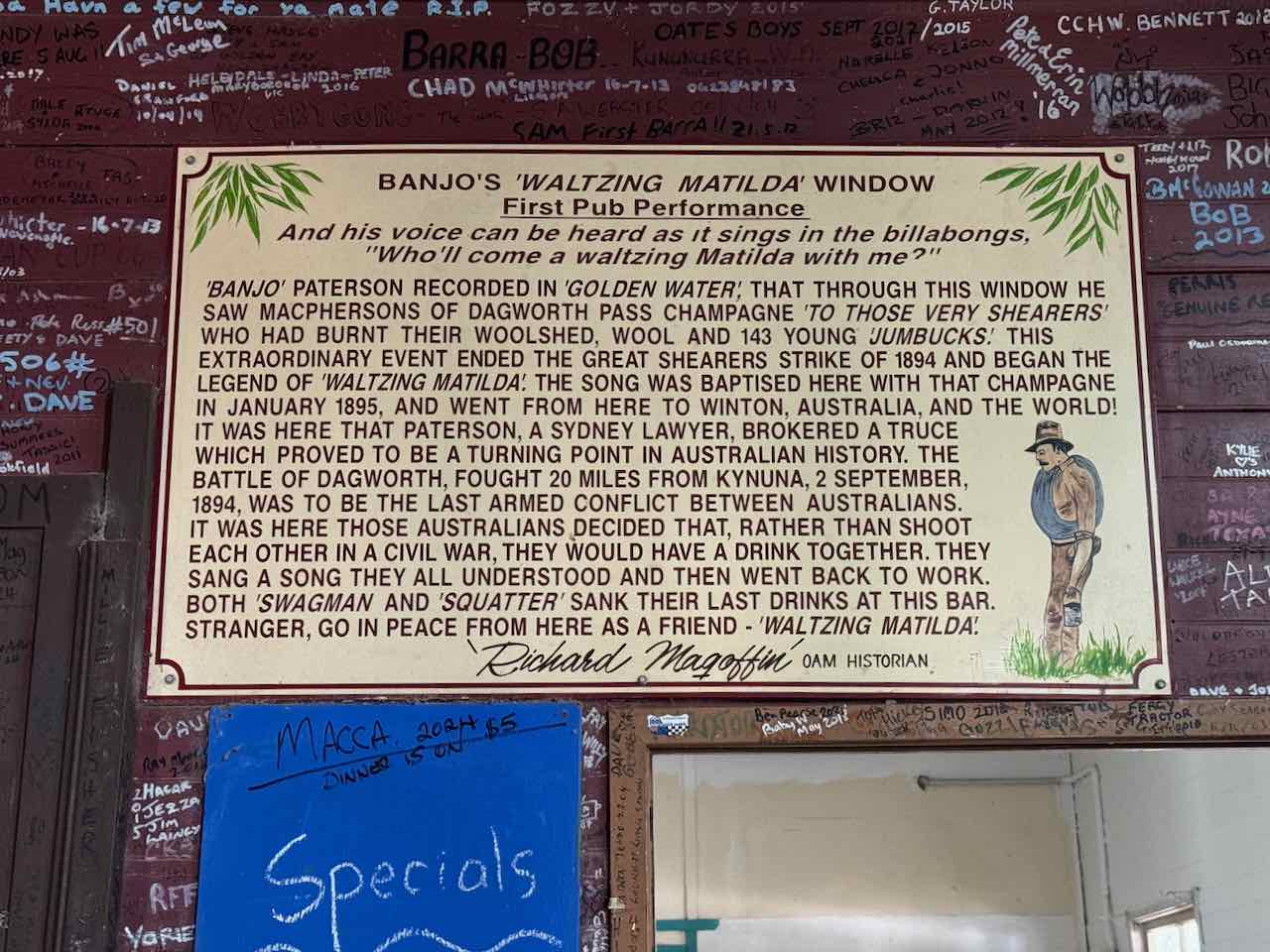
Sign on wall in the Blue Heeler Hotel, Kynuna
Dagworth (sheep station), Kynuna and Winton: AB “Banjo” Paterson’s poem and song “Waltzing Matilda” was written and first performed in this region around 1894 to 1895, though details seem to vary a little about which verses were written where, where it was first performed, its inspiration in characters of the region, and Banjo’s role in the 1894/95 Shearer’s Strike.
Barcoo River: Janette Turner Hospital, Forecast: Turbulence (2011) (partially read) is a bit of a stretch, because its stories are as much set in the USA as in Australia, as far as I can tell, but one of the stories, the “Republic of Outer Barcoo”, refers to the Barcoo River which joins Longreach’s Thomson River to flow into Coopers Creek. Newtown Review of Books says that “Throughout this collection characters’ emotional states are reflected in the weather, or described in terms of floods, hurricanes, tornadoes or the isobars on a weather map” which Chrystopher Spicer would have loved. The Barcoo also features in some Paterson poems. However, I really wanted to include it here because the Barcoo, in the ANU’s words, “has been used since the 1870s as a shorthand reference for the hardships, privations, and living conditions of the outback”. This is a meaning I’ve grown up with. But, the ANU adds that “Barcoo can also denote more positive aspects of outback life: a makeshift resourcefulness” and “a laconic bush wit”.
Barcaldine: William Lane’s A workingman’s paradise is set in Sydney, but includes a character from the Barcaldine-based 1891 Shearers’ strike. He is in Sydney rustling up support for the cause. The striking shearers in Barcaldine, apparently, flew the Eureka flag during and sang Henry Lawson’s “Freedom on the Wallaby”.
Injune: Frank Dalby Davison’s Man-shy (1931, read at high school) about men and cattle, and Dusty (1946) about a drover and his part-dingo dog, were set in this district where Davison had worked on cattle properties.
Roma: Patrick White’s Voss (1957) was inspired by Ludwig Leichhardt’s second fated expedition. It was west of Roma that his party disappeared leaving no trace.
Toowoomba and the Darling Downs: Patrick White’s aforementioned Voss passed through this area.
These books span a century, but Peter Pierce’s The Oxford literary guide to Australia, includes novelists, poets and other writers from the 19th century who lived and wrote the region. The works that I have mentioned vary in their subject matter, but many deal with the challenges of coping with the isolation and the elements (one way or another), and their characters often survive because of their ingenuity and sense of humour. Many of the novels are political, like William Lane’s inclusion of the shearer’s strike in his and Vance Palmer’s dealing industrial unrest in a mining community. First Nations people do not feature strongly in novels by non Indigenous writers, but their own writers are now starting to correct that absence. The landscape – which ranges from bare and brown in the outback to almost too lush and oppressive in the tropics – can be richly metaphorical as well as literal. And, the weather is omnipresent in much of the writing. All these features, I think, mark these books out as essentially different from their urban counterparts.
So, I’ve not included Brisbane, nor the majority of the east coast. Another time perhaps? Meanwhile, now’s your opportunity to tell me what you think and share some of your favourite novels set in remote regions of your country.
I didn’t report on this biennial award in 2022, but with the 2024 shortlist just having been announced, and my having read half of them, I am reminding us all again of this interesting award. Worth $50,000, this award, for those of you who don’t remember it, has very specific criteria:
“the best novel written by an Australian author that depicts women and girls in a positive way or otherwise empowers the status of women and girls in society”.
What this means is that it is not the sex of the writer that’s relevant here (nor, in fact, the genre). This award is for books about women and girls – and so can be written by anyone of any sex – but they must present women and girls in a positive or empowering way. I wrote a Monday Musings post about this “positive or empowering” requirement a few years ago.
This year’s shortlist of six books are all by women, but you’ll see that a male writer, Tony Birch, is among the highly commendeds.
Melissa Lucashenko, Edenglassie (University of Queensland Press) (my review)
Miranda Riwoe, Sunbirds (University of Queensland Press)
Sara M Saleh, Songs for the dead and living (Affirm Press)
Lucy Treloar, Days of innocence and wonder (Pan Macmillan Australia)
Charlotte Wood, Stone Yard devotional (Allen & Unwin) (my review)
This year, the judges also named three Highly Commended titles:
Tony, Birch, Women & children (University of Queensland Press)
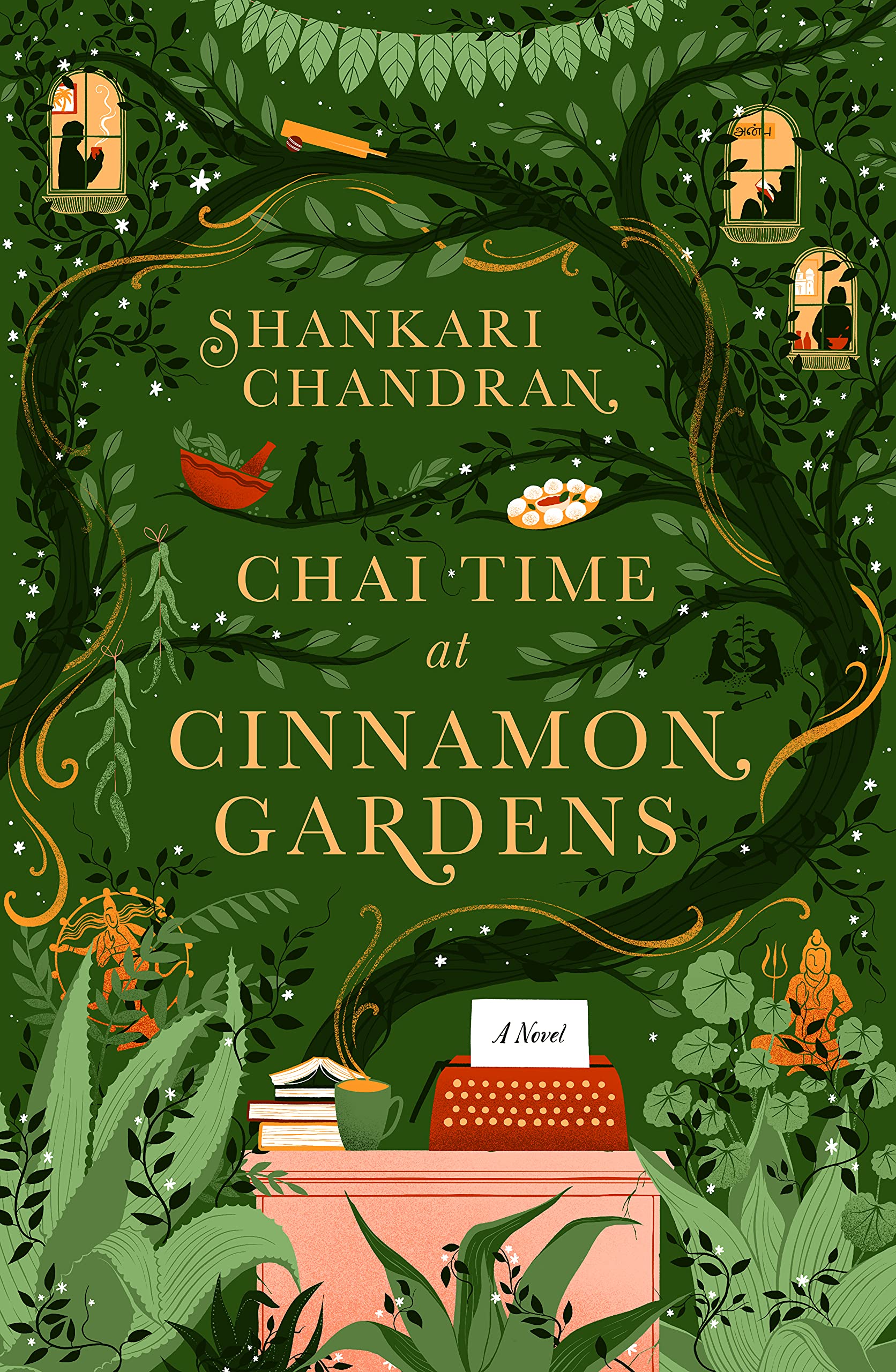
Shankari Chandran, Chai time at Cinnamon Gardens (Ultimo Press) (my review)
Katerina Gibson, Women I know (Scribner)
The judging panel for the 2024 Barbara Jefferis Award comprises Hannah Kent (Chair), Jennifer Mills, and Melanie Saward. You can read the full judges’ comments on their decision and the individual books on the Australian Society of Authors website, but overall they said that:
“The many entries to this year’s prize reflected a healthy diversity of genre, form, settings and narratives. Common to many were themes of migration and exile, resilience and recovery from trauma, social isolation and renewed connection, thwarted ambition, and violence against bodies and minds. The representations of women and girls were varied and often original. We would welcome more expansive representations of gender diversity. […]
We found all six books deeply affecting, and many highly memorable for their unswerving demands for social justice and reclamations of power. We would like to extend our congratulations to their authors.”
They did make an interesting observation that “few writers focused on the future” and “wondered whether this revealed a wider desire for, and interest in, historical reckoning for this country”. Could be so. Having just spent two weeks in outback Australia, I sense some movement in understanding of what our dispossession of land has meant for our First Nations people. But so much has been lost and needs to be recovered, and progress in reconciliation seems very slow. Easy for a city-slicker to say, I do appreciate, but my heart tells me it has to be said.
The winner will be announced on 13 November 2024.
Apologies for the quick post, but I do like this award, and wanted to share it. However, I am on holidays still, and time is short.
I am still tripping through Queensland, and had planned a more in-depth post for today – in fact, I’d started working on it before I left Canberra on 31 August – but my energy levels have been sapped by having had COVID for the last week, not to mention by our busy touring schedule. Rather than publish that post half-baked, I am saving it. Maybe next week!
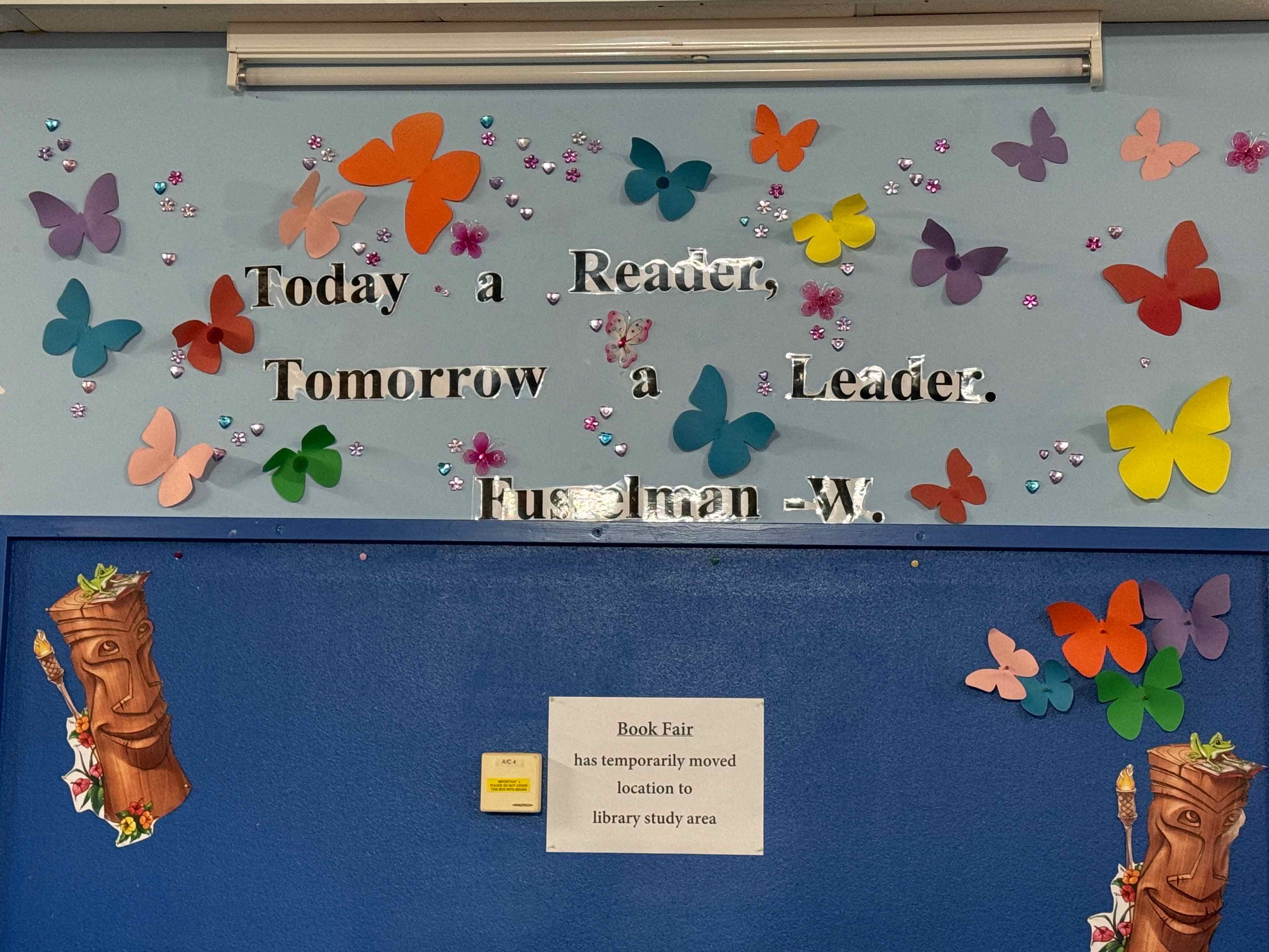
Instead, I’m sharing a little sign on a library board at the Longreach School of Distance Education. This school was formerly called School of the Air, of which there were several around Australia (five in Queensland). These schools, which started operating in 1951, originally delivered education to children on remote properties via radio. Over the years, the delivery technologies changed, but it has only been since 2016 that the school turned to presenting online classes. A big change from their more paper-with-teacher-support based programs. I’m not sure when the name changed, but in Longreach, and presumably elsewhere, it is now called a School of Distance Education.
We did a little tour of the School, and in the library we came across a decorated quote on the library wall. It’s about reading, so this is my little post for today.
This quote is not Australian, and has been around for a century, so it is probably known to many of you. However, if you don’t know its origins, this is apparently it (from Quote Investigator, a site I hadn’t come across before):
“The earliest evidence appeared in 1926 in an intriguing report published in a journal called “The Library” from the Newark Public Library in New Jersey. The head of the library had received a collection of 43 slogans constructed by students, and that set included the statement under investigation. The creator of the slogan was a student named W. Fusselman.”
It’s worth reading the full Quote Investigator article, because it provides verification for its information, and a few other quotes. It also discusses an incorrect attribution to someone called Margaret Fuller. (Of course the School had done the job for me. They have credited Fusselman as the author.)
I do like that this quote came from a student.
Anyhow, this is your lot for this week’s Monday Musings. I hope to resume more usual posts next week.
Tonight I am in Kalkadoon (Kalkatunga) country. The Kalkadoons were the first Indigenous Australian people I became aware of as a young pre-pubescent girl living in Mount Isa in the 1960s. What I remember being told is that they were “fierce warriors”, but nothing much else, because we didn’t learn this history of Australia back then did we? This description, however, never sat easily with me. What did it mean?
During my current tour through outback Queensland, we’ve heard a little more, mainly about how many Kalkadoons were killed at Battle Hill (or Battle Mountain), in retribution for some action of theirs. The word massacre has not been used in the stories we’ve heard, though there has been recognition that spears had little chance against guns.
Of course, the truth is far more complicated, and was part of a long ongoing conflict between the Kalkadoons and settlers. The Kalkadoons certainly see it as a “massacre”. And they have a good website. I am too tired to write a full post tonight, but I wanted to share this site as an example of sites created by First Nations people, in which they tell their story their way, in which they communicate their stories to a wider world while also providing community for their people.
The Kalkadoon site also proudly shares that
On 12th December 2011, Honourable Justice John Alfred Dowsett of the Federal Court said the price the Kalkadoon People had paid for the prosperity of the region would not be forgotten. Native Title was granted to the Kalkadoon People.
We were told about this Native Title on our drive into Mount Isa, but just think about the meaning behind those words, “the price the Kalkadoon People had paid for the prosperity of the region would not be forgotten”. What a significant acknowledgement!
I am leaving it here, because if I write more, it would need to be a lot more, so I’ve decided to go for succinctness.
If you are Australian, do your local First Nation people have a website?
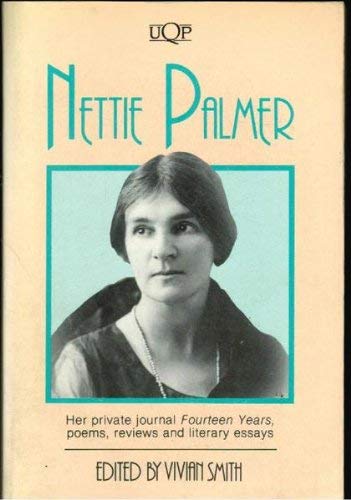
Nettie Palmer has appeared a few times before on this blog, and is likely to appear again, because she was such an active member of Australia’s early to mid-twentieth century literary community, and she was a keen supporter and promoter of Australian writing and writers. Three years ago, I wrote about an article she’d written in 1930 in which she discussed pleasing “advances” in the Australian novel. This post draws on an article she wrote for the Illustrated Tasmanian Mail, a couple of years earlier, on 15 August 1928.
The article seems to have been inspired by the novel competition the Bulletin ran that year. There were, according to Palmer, some 536 entries, which she suggests is “a matter for national astonishment”, given the effort it takes to write a novel.
While only few can win, she says, “the lift in the status of the Australian novel will be considerable”. She goes on to talk about the challenge the judges face, and suggests that, with all that reading to do, their minds are likely to be ‘attracted by what was “striking” rather than what was merely solid’. She says that Australia’s chief literary prize-winner to date had been “that rather esoteric writer, Katharine Susannah Prichard”, and identifies some of the prizes she had won – for The pioneers (1915, my review), a short story, and a play. Will she win again, Palmer wonders. She wouldn’t be surprised if she did, Palmer continues, because Prichard “has always added something fresh and original to our literary store”. As it turns out, Prichard did win this prize, for Coonardoo, but jointly with The house is built by the collaborative novelists known as M. Barnard Eldershaw.
However, I have digressed a little, as my point here is to share Palmer’s thoughts on the Australian novel. Her life’s work seems to have been, at least partly, to define the Australian novel. Anyhow, she comments that she had been “examining a great many Australian stories in magazines, journals, books and manuscripts” and one of the things that has struck her was “the immense variety of geographical angles from which Australia can be regarded”. She takes, as an example, the idea of “the north-west”. For a Victorian, this means “the Mallee country, with its acres cleared for wheat, running up to the irrigated country with Mildura and its fruits and close settlement of semi-urban, rather ‘American’ homes”, while in South Australia it means “the interior, near the transcontinental line, given up to sheep”. In Western Australia, on the other hand, it’s “the country used by H. E. Riemann in his book of short stories, Nor’-West o’ West, set in Broome and its hinterland”. And so on … This, she says, “is just to name one half-point of the compass”. She discusses this a little more, but then says the thing that I really wanted to share:
The point is … that the life and problems of various parts of Australia show immense contrasts, from pearling at Broome to legislating at Canberra. Our writers have the task of gradually revealing it all to us.
This is it, it seems to me, in a nutshell. At some fundamental level, an Australian novel – or any nationality’s novel for that matter – is one which reveals who we are, in all our richness and diversity. It is what, I think, Miles Franklin intended by endowing an award for a novel that conveys “Australian life in any of its phases”. For Palmer, and I suspect Franklin, there was an awareness of the role the arts can play in nation-building, which is understandable given their times. The thing is, we are still nation-building – maybe always will be – and so today, we have First Nations writers and migrant-background writers trying hard to reveal to us their view of Australia. For as long as society keeps changing, there is a role for writers to “reveal it all to us” – even while they also explore the universal – don’t you think?
PS: On Wednesday, Mr Gums and I start a 14-day outback Queensland tour. I may not manage to write Monday Musings on the next two Mondays, but we’ll see. Apologies in advance for this potential hiatus! Monday Musings will not be lost forever.
I do think it’s jumping the gun, rather, to be listing best books of a century when that century is barely a quarter through! However, it seems that critics and reviewers around the world are giving it a go, including the esteemed New York Times, so who am I to quibble? Certainly Readings Bookshop and The Conversation, motivated by the non-inclusion of even one Australian book in NYT’s list, decided they wouldn’t. And, after all, what reader doesn’t love a list?
That said, listmakers rarely agree with each other, neither in their actual lists, nor in their approach to making their list. Some take it deadly seriously, and do their best to produce something authoritative (however you define that) whilst others see, perhaps, that authoritative lists in artistic/creative endeavours are not possible so take a looser approach. So it seems to be here. Readings, for example, asked members of the Australian literary community to nominate their best Australian books of the 21st century, and created a ranked top 30. The Conversation, on the other hand, asked 50 Australian literary experts for their top pick, and they listed all 50, starting with the books that had the most “top pick” nominations. Their experts were allowed to identify two honourable mentions. These “mentions” are not included in the list, but they are in the pickers’ comments. (Check out the lists, including NYT’s, at the end of the post.)
In The Conversation’s list, five of the 50 books were nominated by more than one expert, and they are listed first, but this is not a ranking they say – and perhaps that’s a fair point given their survey was very small. So, their list is indicative rather than thorough in any way, but indicative is still interesting:
Three books by First Nations authors, and four by women writers. Interesting. Some authors appear more than once in the list, including, obviously Alexis Wright, whose The swan book is also in the list, but also Kim Scott and Fiona McFarlane. Theirs is a diverse list reflecting the diverse experts, and that makes it a “good” list to me, because it will speak to different readers.
For me, the most significant book published anywhere this century is Carpentaria (2006). Wright’s larger-than-life, all-too-human characters enact their dreams across a vast tract of earth, water, sky and the “alltimes”. The writing crackles. In this story of Country, ancestral voices offer wisdom and hope. (Nicholas Jose)
Readings’ list on the other hand was drawn from 600 “votes” from members of the Australian literary community – writers, publishers, and Readings’ own booksellers. They were asked “to nominate their favourite Australian books, published since 2000”. I don’t know whether 600 people nominated one book each or whether some nominated one and others more. Whatever method Readings used, they came up with a ranking, presumably based on the number of times each book was nominated. Their top 5 is:
A more popular list, dare I say, than The Conversations’, which is not surprising given its genesis in a bookseller. I have read all of these. Indeed, it’s not until no. 15 on their list – the Garner that also appears in The Conversation’s list – that I hit a book I’ve not read.
Conclusion
Jason Steger wrote about these three lists in his most recent weekly email. He explained that NYT’s aim was to “take a first swing at determining the most important, influential books of the era”. Which of those will still be there in 75 years time? Care to take a guess? You may as well go out on a limb as I’m assuming most people reading this post will not be here on 1 January 2100 to say “I told you so”, or not, as the case may be!



 Whispering Gums