Evie Wyld, All the birds, singing (Review)

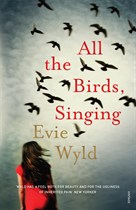
Evie Wyld, All the birds, singing

Courtesy: Random House Australia

Quite by coincidence, I read Evie Wyld’s second novel All the birds, singing straight after Eleanor Catton’s The luminaries. I was intrigued by some similarities – both have a mystery at their core, and both use a complex narrative structure – but enjoyed their differences. Wyld’s book is tightly focused on one main character while Catton’s sprawls (albeit in a very controlled way) across a large cast. Paradoxically, Wyld’s 230-page book spans a couple of decades while Catton’s 830-page one barely more than a year. And yet both convey, through their structures, an idea of circularity, of the close relationship between beginnings and endings. But, enough prologue. On with All the birds singing.

The book opens powerfully:

Another sheep, mangled and bled out, her innards not yet crusting and the vapours rising from her like a steamed pudding. Crows, their beaks shining, strutting and rasping, and when I waved my stick they flew to the trees and watched, flaring our their wings, singing, if you could call it that. I shoved my boot in Dog’s face to stop him from taking a string of her away with him as a souvenir, and he kept close by my side as I wheeled the carcass out of the field and down into the woolshed.

And so we are introduced to Jake and the things that dominate her life – Dog, sheep and birds. Soon, we learn there’s another thing – fear. But fear of what, or whom, we don’t know. From this opening, Wyld tells her story in alternating chapters: the odd ones, set in England, move forward, and the even ones, in Australia, move back to what started it all. It’s an effective structure that explores the ongoing impact on Jake of whatever it was that happened. We see what’s happening now, and we slowly see how she has got to this point.

Jake, at the start of the novel, is in her 30s. She’s a loner, capably running a sheep farm on a remote British island. Her nearest neighbour, Don, keeps a bit of a fatherly eye on her, and tries to encourage her to engage with the local community, to go to the pub for example, but Jake is not interested. As we move back in time we learn snippets about various significant people in her life – a lover while she was a shearer, a controlling man whom she’d initially seen as her rescuer, a female friend and co-worker. We also learn that she’s estranged from her Australian family, and we discover that she has scars on her back, but how they were caused are part of the mystery.

Wyld’s writing is marvellous. The imagery is strong but not heavy-handed because it blends into the story. The rhythm changes to suit the mood. The plot contains parallels that you gradually realise are pointing the way. There’s humour and irony. I love the fact that our Jake, on the run from whatever it is, smokes “Holiday” brand cigarettes.

There’s a bleakness to the novel, but it’s not unremitting. Jake, always the outsider, is tough and resourceful. She sleeps with a hammer under her pillow, but she has a soft side that is revealed mostly through her tenderness towards her animals. She talks to Dog, and losing a sheep always brings “a dull thudding ache”. The imagery is focused. Black, shadows, and fire in various permutations recur throughout the novel. They provide possible clues to what started it all; they contribute to the menace she feels now; and they help create an unsettling tone for the reader. We are never quite sure whether the shadow she sees out there, watching, following her, is real or a figment of her imagination. Jake is not an unreliable narrator, but we see through her eyes, and her eyes are influenced by her very real fears. She is “damaged goods”, though not in the sense meant by the paying customer (if you know what I mean!) offended by her scarred back.

And of course, there are the birds. They’re omnipresent. Sometimes they reflect her mood (“the birds sing and everything feels brand new”); sometimes they break tension; sometimes they suggest death. There are specific birds – butcher birds, night jars, galahs, merlins, currawongs and crows – and there are birds in general. The imagery references the real and metaphorical, from the crows hovering over the dead ewe in the opening paragraph to the birds near the end that attend the defining event:

[…] and the birds scream, they scream at me, Chip, chjjj, cheek, Jaay and jaay-jaay notes, Tool-ool, twiddle-dee, chi-chuwee, what-cheer … Wheet, wheet, wheet, wheet […]

awwchallenge2014It’s deafening. But it’s the silence and the dead birds afterwards that impresses the full horror on us:

The trees don’t want me there … There’s not a single bird to make a sound.

All the birds, singing is about how the past cannot “be left alone”. “We’ve all got pasts”, the shearers’ boss tells Jake early in the novel, but for some people the past must be dealt with before they can move on. The novel is also about redemption. It’s not the first novel about the subject, and neither will it be the last, but it is a finely told version that catches you in its grips and makes you feel you are reading it for the first time.

John at Musings of a Literary Dilettante loved the book too. Thanks to my brother and family for a wonderful Christmas gift!

Evie Wyld
All the birds, singing
North Sydney: Vintage Books, 2013
232pp
ISBN: 9781742757308

Monday musings on Australian literature: The Bread and Cheese Club

I bet that title has you wondering! It was certainly new to me when I came across a book in my late mother-in-law’s collection titled Fellows all: The chronicles of the Bread and Cheese Club. Published in 1943, and written by HW Malloch, this book is a history of  the early years of the club by its first voted-in member.

I was intrigued, of course, so did some research. The Bread and Cheese Club, as it turns out was formed in Melbourne in June 1938. Its motto was “Mateship, Art and Letters”, and it was particularly active in promoting Australian writers. The Club apparently published around “40 volumes of verse and tributes” as well as a journal titled Bohemia. The founder* and Knight Grand Cheese (oh dear!) was John Kinmont Moir (1893-1958), a Melbourne book-collector. He apparently died in 1958, and the club gradually declined, finally ending in 1988. I wonder how many Melburnians know about it now?

Delving further, I learnt a little more about Moir and the club. Moir, in particular, is a rather significant man in Australian letters. According to the State Library of Victoria, Moir, from the 1930s to 1950s, “set himself the daunting task of collecting one copy of every work of fiction, poetry and drama ever published by an Australian author.” This, they said, at a time when Australian literary authors were neither fashionably read nor collected. The result was “one of the finest private libraries of Australian literature ever assembled”, one that he donated to the State Library in the 1950s. It remains one of their most significant collections. You can read more about him – and it’s an interesting story – online in the State Library’s La Trobe Journal.

John Shaw Neilson

John Shaw Neilson (Presumed Public Domain, via Wikipedia)

But, back to the Club. It was male only. The twelve founding members included the poet John Shaw Neilson (1872-1942) and balladist Edward Harrington. According to Malloch, the unusual name was chosen because they wanted something “Bohemian” and “arresting”, and it had the desired effect: it made people curious and provided an opportunity for members to explain their aims. Malloch tells a lovely story, too, about one of its practices – quaint to our point of view but indicative of their era – which was making it “a penal offence” to address each other as “Mister”.  Doing so incurred a fine of one penny which helped, in the early days at least, to swell the club’s coffers!

John Arnold in the La Trobe Journal says that Moir was conservative – right-wing, in fact. But the club was not political – though I suspect from my reading of Malloch that it leaned more right than left. Its goals were:

To promote mateship and fellowship among persons of mutual interests, to foster a knowledge of Australian Literature, Art and Music and to cultivate an Australian sentiment … (Malloch, p. 17)

It did this not only through publishing but by undertaking a wide range of projects and activities such as art exhibitions, song of the year competitions, short story competitions, and lobbying government. Malloch describes some of the earliest activities, including a short story competition which was judged by Nettie Palmer. Searching the National Library of Australia’s digitised newspaper database in Trove provides a fascinating picture of the breadth of the Club’s** activities. One report states that the Bread and Cheese Club was behind the Commonwealth Government’s providing a grant for the writing of a biography about JF Archibald, the founder of The Bulletin.

The club also invited guest speakers, and often opened those meetings to the public. Malloch tells us that these speakers included artist Max Meldrum, indigenous Australian activist, pastor and state governor Doug Nicholls, and journalist-author Frank Clune.

I could go on … it’s a fascinating story of passion and commitment to Australian culture. They even printed 50,000 stickers with such slogans as “Combine Pleasure and Patriotism and Read Australian Books” and “Let Your Christmas Gift be an Australian Book”. Where are these people now!

Finally, before I go, I can’t resist sharing one of those odd little reading synchronicities. I have, as my regular readers know, just read Eleanor Catton’s The luminaries. It starts with 12 men gathered in a hotel room, but they became 13 when a hotel guest wanders in. The Bread and Cheese Club started when 12 men met in a studio with the aim of “fostering Australian Art and Literature”. Having had their meeting, they adjourned to a nearby “city hostelry” where they met Malloch, and promptly asked him to join them. And so, he writes, there were 13. I know, I’m being silly, but I enjoy such, dare I call them, coincidences!

* POSTSCRIPT: While some reports describe Moir as the founder, Malloch’s book doesn’t state this. On page 10, he writes that: “Twelve turned up at the studio of Fellow E. J. Turner, 132 Cubitt Street, Richmond, and set the ball rolling with the definite aim of fostering Australian Art and Literature”. And on page 13, he specifically names these twelve as “the founders”. Moir was elected president (aka Knight Grand Cheese) and Turner secretary (or Worthy Scribe).

** Searching Trove surprisingly retrieves another Bread and Cheese Club in Melbourne! Malloch tells us briefly about that too. It was a very small club of solicitors and in 1859 merged into the Law Institute of Victoria.

Monday musings on Australian literature: Australia’s difficult novels

A week or so ago I wrote a post about reading difficult novels. As I researched that post, I came across many lists of difficult novels, including the one I included at the end of the post. The interesting thing is that none of the lists I saw included any Australian novels, and yet they included novels from most of the other continents. Do we not have any, or, more likely, are we just not on the world literature radar enough? Anyhow, I thought I’d get the ball rolling and suggest a few possibilities:

  • Patrick White’s Voss. It’s logical to start with White, because, currently, he’s Australia’s only Nobel Prize winner for literature. (I’ll do the rest alphabetically!).I’m not sure that Voss is his most difficult novel, but it depends on your definition of difficult. White’s prose is dense, with complex sentence structures and intense, but vivid imagery. Many readers find Voss particularly hard to read, though, because of the spiritual communion between Voss in the desert and Laura in the city. However, it appealed to my teenage sense of romance and resulted in my falling love with White.
  • Thea Astley’s Drylands. I’ve read quite a few Astleys. After all, she’s one of my favourite writers. She has a reputation for being difficult, with her earliest novels being particularly so, but I’ve chosen her last because of its form and its sense of desperation. Writer Mandy Sayer, an admirer like me, agrees that she is not “an easy read”, saying that she is “at once poetic, quirky, and literary”. Her imagery can be over the top, and she doesn’t shy from exploring our brutality, but she has such a heart. Every Australian should read her.
  • Peter Carey’s Illywhacker. Carey is hard to pin down, as his books vary so greatly. It’s one of the reasons I like him. You never know what you are going to get, from the at times surreal, to something like True history of the Kelly gang with its 19th century vernacular, unpolished grammar and largely absent punctuation, to the complexly structured like Parrot and Olivier in America (my review) and The chemistry of tears (my review). I’ve chosen Illywhacker, not because it’s regarded as his hardest but because I haven’t read it (yet).
  • JM Coetzee’s Diary of a bad year (my review). Coetzee, in this book and its predecessor Elizabeth Costello, pushes the envelope in terms of “the novel”. Some argued that Elizabeth Costello was more a series of lectures than a novel. Diary of a bad year presents readers with a very specific challenge. How do you read it, with its three (two to begin with) concurrent strands running across the top, middle and bottom of the page? Do you read one strand and then come back and read the next? Or do you try to read them concurrently? This is one of those books that is a challenge to read for its unusual structure and for the interplay between ideas and story that the reader needs to tease out.
  • Gerald Murnane’s The plains (my review). As blogger M. Sarki has written, “There is nothing but difficulty in reading a book written by Gerald Murnane.  But the reading gives me an enormous amount of pleasure…”. Murnane is one of our most innovative writers. He’s a challenge to read – where am I?, what is he saying? – but there’s exhilaration in that. I need to read more of him.

I think five is probably a good start, particularly given I’ve rambled on about each one. Other writers well worth considering if you are looking for “difficult” Australian literature include Rodney Hall, Thomas Keneally (his early works), David Malouf, Frank Moorhouse, Christos Tsiolkas. Not all works by these writers are “difficult” but many are recognised to be so.

I’ve read works by each of the writers I’ve named, but I’m sure other Aussies could name some favourite writers and “difficult” novels too. Has anyone read, for example, Eleanor Dark’s Prelude to Christopher? I’d love to hear your thoughts on the matter. Let’s get our Aussies out there!

Margaret Rose Stringer, And then like my dreams (Review)

Margaret Rose Stringer, And then like my dreams

Courtesy: Fremantle Press

I was, I have to admit, predisposed to like Margaret Rose Stringer’s memoir, And then like my dreams, before I opened the cover. Fortunately, I wasn’t disappointed, but not, as it turned out, for the reason I expected. Here’s why. Margaret Rose Stringer once worked as a continuity girl in the Australian film industry and she was married to stillsman (film stills photographer), Chic (Charles) Stringer. I spent many years of my career working with film stills, and I loved it. I was therefore looking forward to hearing an insider’s story. However, the book didn’t really spend a lot of time on industry talk, but Stringer is such an engaging writer that I didn’t care because, by the time I realised it, I was fully invested in her story about the love of her life.

“The love of her life”. This could suggest something rather schmaltzy but while Stringer is totally one-eyed about CS, as she calls her late husband, this is not a schmaltzy book, not really, not despite frequent adulatory proclamations of love. Part love-story, part grief-memoir, the book works because of Stringer herself – her honesty and her writing style. I don’t make a practice of reading about grief. However, over the years I have read Isabel Allende’s Paula (1994), Joan Didion’s The year of magical thinking (2005), and Marion Halligan’s autobiographical novel, The fog garden (2001), and haven’t regretted any of them. Of course, Didion, Allende and Halligan were all established writers when they wrote about their grief, whereas Stringer was not.

But, she could have been, because this book has a fresh, lively style despite its subject matter. In fact, I did say it was only part grief-memoir: while we are told in the first chapter – one-page long and simply titled “All of it” – that she met Chic Stringer when she was 31 years old and that he died 31 years later, much of the book is about these 31 years, of which only the last couple encompassed his dying. Theirs was, it seems, the perfect love story. Stringer briefly describes her childhood, particularly her difficult relationship with her mother, then her undirected, rather wild and unsettled early adulthood in which she was dogged by anxiety, panic attacks and clinical depression. She discovered late in her much-loved father’s life that he too suffered but apparently, while he recognised that Stringer, the fourth of five daughters, was similarly afflicted, he did not have the wisdom or knowledge to effectively help her. Chic, though, did – through love, patience and tolerance. Stringer visualises their relationship as a “truth tree” with the trunk comprising the fundamental fact that:

Chic really, really wanted and needed to look after me; and I really, really wanted and needed him to do it.

My feminist self was a little taken aback by this, but it became clear that Stringer is not, as this might suggest, submissive so much as in need of love and nurturing, which Chic provides. In fact she says:

The point is that I didn’t simply go along with  everything Chic wanted, because I loved him. Nono! – I retained my behavioural traits, because they were mine and they comprised me, even if they were less than totally attractive and desirable as traits go. After all, it was me he loved – not some paragon ….

She could, she said, be stroppy and unreasonable, and he could be bossy, but they made it work. I did feel she was a little too self-deprecating, too willing to put herself down at times, but she’s so thoroughly genuine that these niggles subsided.

Most of the book is about their life together: their work, particularly in the film industry and then the video production business they established when long-sightedness forced Chic out of his career; their various homes, including the one Chic built on Dangar Island in the Hawkesbury River; and their European travels, with some lovely stories about their passion for Placido Domingo. She refers us to their site European Travels with a Spouse for further information on their trips because, as she was reminded by her advisers, she was not writing a travel diary! Chic’s dying and her subsequent grief occupies only a small proportion of the whole.

What makes this memoir especially engaging is the style. Firstly, there’s her friendly, open voice. And then there are the quirky features, one of which is the use of script form to convey key scenes. Most of the book is written in first person, as you would expect, but these script scenes are written in third person. They relieve the intensity of the book and are, in fact, a little whimsical even when the point she wants to convey is serious. It’s the reverse what of Francesca Rendle-Short did in her fictional memoir Bite your tongue which she wrote primarily in the third person, using another name for herself, but occasionally inserted some first person commentary. For her, writing in third person enabled a distancing from the emotional intensity of a story she found “hard to tell”, whereas Stringer often uses these third person scenes to make an emotional point. Or, sometimes, just to tell a funny story. Stringer also uses footnotes entertainingly; she openly discusses the advice she received about memoir writing; and she tells her story through mostly short chapters with inspired titles like “Crust (Daily)”,  “Joy”, and  the ironic “Silver Tongue” in which she discusses Chic’s dislike of her “coarse utterance”.

Stringer is, of course, particularly moving when describing her grief, from her initial denial, through the last months of caring for a terminally ill partner, to feelings of “utter confusion” and madness afterwards. Joan Didion also wrote in her memoir of the mad – aka magical – thinking that attends grief. Stringer, in her inimitable style, is more direct and writes of her “mad-soup” brain.

Late in the book, Stringer says that part of her reason for writing was “to travel all the roads and pathways and sidealleys leading to and from grief”. She has achieved that, and more, because what she has written is a sad yet humorous, and ultimately wise book about the most meaningful thing in our lives – love.

awwchallenge2014Margaret Rose Stringer
And then like my dreams: A memoir
Fremantle: Fremantle Press, 2013
323pp.
ISBN: 9781922089021

(Review copy supplied by Fremantle Press)

Monday musings on Australian literature: Here come the men!

Women really have dominated the literary awards season in Australia over the last two years. In 2012, the majority of the awards were won by Anna Funder with All that I am and Gillian Mears with Foal’s bread. Last year it was mostly Michelle de Kretser with Questions of travel and Carrie Tiffany with Mateship with birds. ML Stedman also won an award with her The light between oceans. As well as all this, last year we had, for the first time ever, an all female shortlist for the Miles Franklin Award! Where, you may have been wondering, were the men?

Well, in their writing rooms it seems, beavering away, because by late last year their books started appearing in droves … and nice to see it is. I love reading fiction by women, but I also love reading fiction by men. Let’s face it, I love reading good fiction! Anyhow, I, and others like The Australian’s literary editor Stephen Romei, expect some strong showings by our male writers in this year’s award lists. Books like:

  • Richard Flanagan’s The narrow road to the deep north
  • Tom Keneally’s Shame and captives
  • Roger McDonald’s The following
  • Alex Miller’s Coal Creek
  • Christos Tsiolkas’ Barracuda
  • Tim Winton’s Eyrie

Stephen Romei predicts that Winton and Flanagan will battle it out, though says there are other strong contenders from a bumper year for Australian fiction. I will be reading Tsiolkas and Winton with my reading group over the next few months, and received Flanagan for Christmas. I am greatly looking forward to getting my teeth into these writers, each of whom I’ve reviewed before on this blog, and each of whom I respect and enjoy.

None of these, though, are debut authors. Every one has won and/or been shortlisted for the Miles Franklin at least once, and most, more than once. Of course it takes a little time for a debut to make it into public consciousness. However, you may remember that last year’s Miles Franklin Award shortlist of five titles contained three – yes, three – debut novels (Floundering, by Romy AshThe Beloved by Annah Faulkner, The Mountain by Drusilla Modjeska). That was healthy, and augurs well for the future, but I wonder if we’ll see any debut novels by male authors in the shortlists this year? While I don’t report regularly on awards, I’ll certainly be keeping an eye out for new authors appearing on the scene – or, indeed, for more established authors making their debut on the award lists.

Meanwhile, of course, I’ll continue to read Aussie women for the Australian Women Writers’ Challenge, including Hannah Kent’s debut novel Burial rites which could very well give the men a run for their money this year if the buzz surrounding this book is right.

2014 looks to be another exciting year for Australian fiction. How do you – Aussies and otherwise – see your reading shaping up for the year?

Monday musings on Australian literature: Top Aussie book sales in 2013

This is, I suppose, another end of year round-up post – but one about bookselling in Australia, which is something I don’t usually write much about. However, since many of us love lists, I thought I’d share with you Australia’s top selling books for 2103:

  1. Jeff Kinney: Hard luck: Diary of a wimpy kid (UK, children’s)
  2. Jamie Oliver: Jamie’s 15 minute meals (UK, cookbook)
  3. Dan Brown: Inferno (US, fiction)
  4. Jamie Oliver: Save with Jamie (UK, cookbook)
  5. Andy Griffiths and Terry Denton: The 39-storey treehouse (Aus, children’s)
  6. Matthew Reilly: The tournament (Aus, fiction)
  7. Guinness world records 2014 (UK, reference)
  8. Sarah Wilson: I quit sugar (Aus, nonfiction)
  9. Ricky Ponting: Ponting at close of play (Aus, memoir)
  10. Jodi Picoult: The storyteller (USA, fiction)

It’s good to see some Aussies there, including popular children’s author Andy Griffiths and illustrator Terry Denton. I haven’t read Matthew Reilly but he has a reputation as a good story-teller in, mostly, the action and thriller genres.

Jason Steger, the Literary Editor of The Age and a regular panelist on the First Tuesday Bookclub, says of this year’s top ten:

The pulse rates of Australian readers were probably a bit slower last year, as the boom in erotic and dystopic fiction vanished, and old favourites such as Jamie Oliver, Jeff Kinney, Dan Brown and Matthew Reilly returned to dominate the national bestseller lists.

He is of course referring to the 2012 phenomena of E.L. James’ Fifty Shades of Grey trilogy, and Suzanne Collins’ Hunger Games. Apparently, without these juggernauts, overall sales were down in 2013 over 2012. According to Steger, the overall number of books sold dropped from 56.6 million to 54.1 million, resulting in a drop in value from $978 million to $917 million. Interesting isn’t it? What does this say about reading behaviour? That some people only read when a “huge” book appears on the scene. If everyone’s reading it, they will too, but otherwise reading is not for them? Is that the conclusion to draw from those figures, or am I missing something?

I can’t seem to find the fiction top ten for the year. I’m assuming that you have to pay Nielsen to get this information, but it seems telling that, while newspapers have reported (via journalists Blanche Clark and Jason Steger) on the overall top 10, no-one has listed, at least as far as I can find via Google, the fiction-specific list. The best that I could find was Steger, again, who reported that Tim Winton’s Eyrie (which I’ll be reading this year) was the best-performing literary novel. That says something about the Winton’s pull, as Eyrie wasn’t published until mid-October. Steger also reports that the Australian debut novels, Hannah Kent’s Burial rites (which I’ll also be reading this year) and Graeme Simsion’s The Rosie project (my review), both made the fiction top ten.  This is not surprising as they were probably the two biggest buzz books in the Australian literary firmament this year. However, I’m assuming that Steger’s singling out of these three books means that they are the only Aussies in the top to fiction list – and this means that the Miles Franklin award winning Questions of travel is not there.

None of this is earth shattering. We literary fiction readers know that the books we read rarely make general top 10s. It’s always interesting, however, to see what does. Were there any top 10 surprises in your neck of the woods?

Author interview with “word hustler” Catherine McNamara

Catherine McNamara

Catherine McNamara

I haven’t made a practice of doing author interviews on my blog. In fact, the only other interview I’ve presented was one the now defunct magazine Wet Ink did with Nigel Featherstone. However, when Catherine McNamara asked whether I’d be happy to host her as part of her blog tour, I was more than happy to oblige. Authors published by independent publishers work hard to get their name and books out into the public domain – and Catherine is no exception.

As I wrote in my review of her first book of literary fiction, Pelt and other stories, Catherine is an Australian expat currently living in Italy. She’s led a rather peripatetic life since she went to Paris as a student a couple of decades ago, including working in an embassy in Somalia, and co-running a bar and traditional art gallery in Ghana. Clearly she’s seen much and thought a lot about people and how they relate to each other – and loves to hustle* words in the service of her stories. Catherine has been a regular commenter on this blog for a couple of years now. I’m sure that’s partly about getting her name out there, but it’s also obvious that she loves talking about books and reading. I’ve thoroughly enjoyed getting to “know” her. Promotion may be part of her game – and who could blame her – but she comes across as genuine, thoughtful and a lot of fun.

Anyhow, enough from me. You can decide for yourself when you hear what she has to say …

You clearly love writing short stories. What attracted you to this literary form? Can you tell us your favourite short story writers?

I do love writing stories and fortunately they seem to be appreciated a little more these days, with more and more collections receiving positive coverage, lots of competitions and a rise in small publishers less averse to this “risky” form. I think it’s a wonderful moment to be a short story devotee.

When I was young I fell in love with Katherine Mansfield’s stories – as many do. I also loved Joseph Conrad’s long stories set in the south seas. I published quite a few pieces with Australian Short Stories initially, received encouragement, and found it quite easy. My first published piece was called ‘Elton John’s Mother’ and  was about welfare mums living in a caravan park on the Central Coast who gave their kids pop stars’ names and lived rather desperate lives.

My favourite short story writers include Cate Kennedy, Grace Paley, James Salter, Flannery O’Connor, Simon Van Booy, Nam Le, Kevin Barry, Emma Donoghue, Alison MacLeod, Sarah Hall, Junot Diaz, Amy Hempel, Robin Black, T.C. Boyle, Kevin Barry. I even read a wistful D.H. Lawrence short story recently, and O. Henry for the very first time. One can never read enough!

In your collection, Pelt and other stories, you have written in 1st and 3rd person, and in diverse voices including a gay male. How do you choose the voice to use? Are there any stories in which you changed the voice because it wasn’t working?

Catherine McNamara, PeltI think that when a story or a story springboard presents itself you immediately feel whether it is a 1st or 3rd person piece. You already know if you want the incisive and selective view of an onsite narrator, or a little more distance from the story crux through a third person character, where more description is allowed. For me it’s as clear as the very gist/illumination/transformation you’re heading for, or hope you are.

I’m very attached to first lines and for me they set a tone I rarely veer away from. But if the story feels fumbling, or as though it doesn’t really need to be written, I’ll bin it and wait for something else. I don’t think I’ve ever tried shifting voice. I think if my doubts were that substantial then something in the mix of the story wasn’t going to work anyway.  Perhaps if you were working on a novel where there were larger themes and plot devices to move around, changing person might enhance the work.

You’ve clearly thought about the order of the stories in Pelt and other stories. What factors did you consider when ordering the stories?

I did have great difficulty putting the stories in order. Initially I tried to vary first or third person pieces, then I didn’t want too many African stories in a line, and I wanted an even progression between male and female protagonists, and short and longer pieces. Then there was also the chronology or backwards chronology of the some of the interlinked pieces! Eventually, I worked through all of this and focused on beginnings and endings that seemed to match up. I had first and last sentences and a key chart on bits of paper on the floor, and tried to make them move along. The frightening thing is that I might even change the order again if I went back to revisions.

You have spent most of your adult life as an expat, which is reflected in the diverse settings for your stories. How has expat life has affected your writing?

When I was first living in Somalia I wrote several stories with traditional expat characters reckoning with their place in an exotic, exploited world. I think I saw things as any Westerner would – even though I had studied modern African independence movements at university and thought I knew something – I didn’t know a thing. “Expat life”, so removed from thrumming everyday life and, at its base, an us-and-them construction, was quite shocking. It nearly drove me crazy! Somehow I stepped through a barrier and found a way to live a more valid life. As I went deeper into my own experiences in West Africa I was largely living, earning a living, surviving. Not writing much at all. After nine years in Ghana I wasn’t so much an expat as someone who remained visible, but just lived there. That way when I came to write some of these stories I had a great variety of voices inside.

Pelt and other stories is subtitled “tales of lust and dirt” – and many of the stories deal with the darker side of sexuality, such as incest, sexual violence, sexual jealousy and infidelity. Yet humour is also clearly important to you. How do you reconcile the dark and the light in your writing?

I’m trying to think of incidences of humour in the stories! “Pelt”, the first story: I remember thinking it quite humorous and was floored when an early reader called it a complete tragedy. For me the African mistress was powerful and sassy and knew her game; she made the Westerners look as though their agonies were clumsy and inarticulate, whereas she “would have pulled his hair out by now” and ends up in the kitchen with a pan of hot oil. I think she was great. I wanted to show the contrast between African pragmatism and Western dithering and diplomacy, often so spineless like Rolfe, who can’t even bring some photos back to show his bird the snow in Germany. But I don’t think I consciously set out to meld dark and light, that’s just voice.

Photographers appear in several of your stories, often as a secondary or supporting character, such as Reece in “Stromboli” and Seth in “Nathalie”. They tend to be passive or even negative forces. How does this fit into your world view, at least as you present it in your stories?

When I was much younger I was torn between image and word and took a while to favour writing. I began a graphic arts course and loved photography and film-making – in fact in Ghana it cropped up again when I co-ran a graphic design agency and art gallery. One of the factors that probably made me sway towards the written word was that photography seemed so arbitrary, almost accidental, however I do realise it involves skill, vision and patience!

In the African context I saw that image is often manipulated to show what the West wants to see of the continent – power remains with the photographer. This can seem like the colonial process all over again.  In “Gorgeous Eyes” I wanted to express my irritation at the way the contemporary African condition is often trivialised, glamorised or showed partially to suit the Western palate. There are some brilliant African photographers out there whose work is more real.

You maintain two blogs, one for each of your recently published books. How important is it for you to engage in social media activities such as blogging and what do you see as the pros and cons for authors of engaging in social media?

As you know the blogs are hard work and time-consuming, and yet I feel they can be very rewarding. As a writer, a weekly blog post (that’s all I can manage) can keep you on your toes and remind you that apart from your creative task, you have an audience at hand whose interest you must sustain, perhaps with a topic that has a soft connection to your book. The rub is having to voyage the internet to attract possible new followers, while being sincere and perceptive in your blog comments. I like to engage with my blog readers, and have met quite a few over the past few years (anyone for a drink in Venice?). We have exchanged guest posts, interviews and reviews – something that kills the isolation of the job and makes you feel knitted into a community (even if it’s to share the various difficult aspects of the task). That can renew energy and ideas, and provide useful contacts (festival and reading invites) in a much faster way than letter-writing or serendipity!

The pitfalls are becoming hooked on your platform and social presence at the expense of your development as a writer. I think it’s unwise to dilute your creative energies, and essential to remember that social media time must serve a purpose – contacts, exchange or potential sales, or just light relief. As it can become very draining, it’s important to keep it in its box.

I’m finding it challenging to maintain two blogs but at the moment my two books have quite different audiences – although many readers have bought both books. Eventually I guess I’ll have to merge everything together. The DLC blog veers towards life in modern Italy and speaks of my writing pursuits, racism, politics and also handbags. The Pelt blog stays strictly with short story info, interviews, festivals and musing.

Both your books are also available in electronic format. Are your readers embracing e-books? What impact, if any, do you think electronic publishing will have on the nature of fiction writing in the future?

I’m still very old-school and like to stumble upon a physical book – mostly through recommendation or random browsing or reviews. I don’t think I’m putting enough time into pushing e-book sales, though I noticed when my publisher placed the book on sale just before Christmas that quite a few blog readers made immediate purchases. Also my Facebook friends who are nearly all work-related gave great support.

I’ve had quite a few stories on a smartphone application called Ether, which is at the forefront of the short story download movement in the UK – they have done a lot of groundwork to stir interest in the short story. E-readers have also opened doors for flash fiction writers over the past few years and there has been a surge of competitions. Trends like these do change what is being written – flash fiction seems to make more noise than poetry currently. Also, with many literary magazines failing to survive I think greater respectability has been given to e-zines, some of which are dynamic hives of writing activity and sharing – interesting both for the reader and writer. And downloads mean that the often-neglected novella form has received fresh attention.

Self-published e-books have of course changed the shape of publishing and I worry that this is a sales-driven sphere – there are endless websites devoted to how to improve your Amazon rankings and broaden your fan base. I imagine this is less applicable to literary fiction which has a smaller readership anyway. What seems positive is that there are more books of every type out there, and it seems as though more people are reading – I don’t know if this is true. I’m just glad that short stories are mentioned more often, and with passion.

As this is a blog written primarily for readers, would you tell us some of your top reads over the last year?

Though I love to write I am very much a reader. However I do have to be careful when reading while I am working on a story or novel – I think that subconsciously the tone or cadences of another writer’s language can easily seep in. This year I read several books I’d read about on this blog – Gilgamesh, Everyman’s Rules for Scientific Living, Five Bells and Tall Man, also Tête à Tête – all books I savoured. I am particularly pleased that I picked up an early novel This Side Jordan by Canadian Margaret Laurence set in pre-Independence Ghana, a favourite era of mine. I also discovered Simon Van Booy’s short stories and philosophy books, and even met Simon by chance at my reading in December. (This was one of the most thrilling moments of my year.) I read Iris Murdoch for the first time – The Sea, The Sea – which as soon as I finished I wanted to begin again. I also read James Salter’s Dusk and Other Stories for the first time – I read each story three times over and wished they would not end. I read some contemporary short story writers – Tom Vowler and Alison Lock – and I’m now reading The Devil that Dances on the Water by Aminatta Forna. That’s all I can see on my book shelf from here!

Thanks very much for having me WG!

… and thank you, Catherine, for sharing your thoughts with us. I, and I’m sure Catherine, would love to hear any comments you have on what she has shared with us.

If you would like to read Pelt and other stories, you can order it from the publisher, Indigo Dreams Bookshop or The Book Depository. It is available in e-version from Amazon (Australia, UK or USA). You might also like to chase up her first novel, The divorced lady’s companion to living in Italy, which I reviewed back in 2012.

* Catherine called herself a “word hustler” in a comment on this blog some months ago. A wonderful description, I thought, of someone who is passionate about words and writing.
Catherine McNamara, Pelt and other stories (Review)

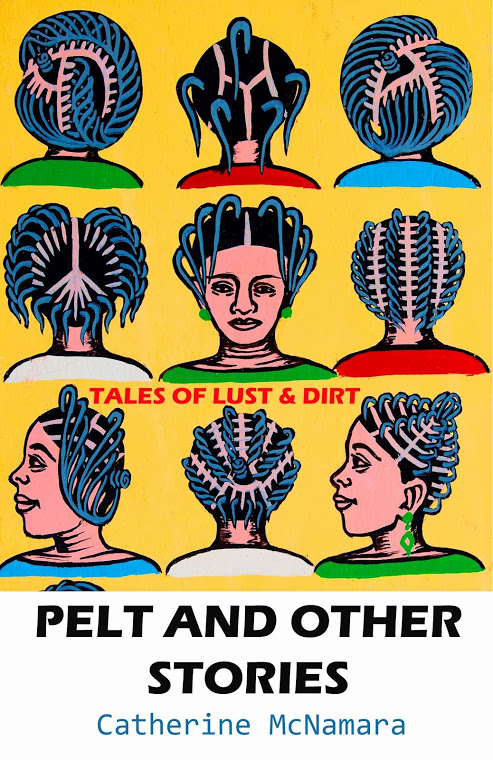
Catherine McNamara, PeltIt seems fitting that my first review of the year be for a book of short stories by one of this blog’s regular commenters, Catherine McNamara. I have reviewed McNamara before, her first published novel, The divorced lady’s companion to living in Italy. McNamara  describes that book as commercial fiction. It is, to describe it differently, chicklit for the mature woman – and is a fun read. However, Pelt and other stories is a different thing altogether. It represents, McNamara has said, where her real writing love is – literary short stories.

You will hear from Catherine herself soon in the form of an author interview on the blog, but by way of introduction now, she is an Aussie expat who left Australia as a student a couple of decades ago. She now lives in Italy but has lived in other parts of Europe and for several years Africa. All this is reflected in her stories which have Australian, European and African settings. As with many short story collections, several of the stories have been published elsewhere, on-line and in print. Her story “Coptic Bride” was published in Giramondo‘s now-defunct, but admired, literary magazine Heat.

The first thing to say about McNamara’s writing is that it is not spare. Her exuberant use of imagery reminds me at times of  the early writings of Thea Astley and another expat, Janette Turner Hospital, both writers who have reveled in colourful, figurative language, albeit to different purposes. Occasionally the imagery can feel a little overdone, but I love their freshness, love the risks McNamara takes. The next thing to say is that her subject matter tends to revolve around sex. The book is, after all, subtitled “tales of lust and dirt”. In McNamara’s work, sexual passion represents the best and worst of what life has to offer. And, given that there’s more drama in the worst or the problematic, it is this – in the form of violence, incest, jealousy and infidelity – that we mostly find in Pelt and other stories. Thirdly, McNamara mixes up her narrative voice. She uses first and third person, and she writes in a variety of voices, including, for example, a white gay male and a black female. This keeps you on your toes. You never know who the next characters will be, and where they’ll be from. I like that.

While Pelt and other stories is a collection, several stories are connected, which makes the order of the stories particularly interesting. I suspect ordering stories in a collection, which I discussed briefly in my review of Knitting and other stories, is one of the trials of preparing a short story collection (or anthology). Do you match or contrast tone or themes? Do you put related stories together? The truth is that it probably matters less to the reader than the writer/editor thinks, as readers will often pick and choose. However, with single-author collections, my practice is to read, from the beginning, in the order presented. And this is where the fun started with Pelt and other stories. There are, for example, sly connections in which a character – Nathalie for example – is an important subject in one story (“Nathalie”), but then appears as a passing reference elsewhere. Other stories have stronger connections. I was particularly intrigued by McNamara’s presentation of three of these – “Opaque”, “Where the wounded go” and “Volta”. They don’t appear consecutively, and when they do appear it is not chronological. I’m not sure what McNamara’s intention was in this, but for me it replicates the way we get to know people. We meet them at a point in time, getting to know their current lives, while gradually learning their back story. In a collection that ranges widely in character and location, the connections can be grounding.

What I particularly like about the stories is their honesty. McNamara doesn’t flinch from letting her characters express their (our) meanest, least generous thoughts. Love, McNamara shows, can make us selfish, desperate, and sometimes cruel. In the first story, “Pelt”, the animality of lust is palpable as a pregnant black mistress stands her ground, fighting for her rather weak, German lover against his barren wife. Many of her stories are about compromised relationships and the accommodations made, by one or both parties, to keep them going. “The Coptic Bride” is one of these, as is “Opaque” in which a woman’s love for her man is tested against her sense of morality, of what is right:

But if she called, it would perforate all that she held close to her. It would cost her her life.

Do you think she made that call?

awwchallenge2014These are unsettling stories about characters struggling to survive in a precarious world. Europe’s colonisation of Africa shadows the book. Many of the relationships are mixed, and in most stories there is power imbalance, and hints of exploitation. It’s there in “Pelt”. In “Janet and the Angry Trees” a sex-worker is taken to her Italian lover’s family home to look after his parents, and seems to accept the pittance of attention she gets from her still-married lover. It’s in the little piece “Innocent” about a taxi driver, his white employer and his pregnant teenage girlfriend, and in “Infection” in which a brother receives a western education while his sister “received no education, cursory love, much admonishment”. There’s a suggestion in some stories of stereotyping – you know, the lusty, sensual black woman and the unfaithful white man looking for “a bit” on the side – but the relationships are more complex than that. Overall, I’d say that the stories are more about humanity than about politics, while recognising that politics has contributed to the uncertainty of the world the characters inhabit.

A recurring motif in the book is the photographer. McNamara seems to view photographers with suspicion. At least they tend not to be the most admirable characters in the stories in which they appear. They represent the disconnect between appearance and reality, and perhaps also the idea of exploitation. In “Gorgeous Eyes”, the narrator views photographs by the visiting famous photographer, Nina Cooke, seeing the truth behind the idealised images of “Dinka men – erotic in beaded body corsets”. He reflects that those in the know see something else, “a crucible of sadness”, in these images and concludes:

If Nina Cooke’s gift ever needed an honest name it would be the invasive branding of humble detail. It appears she is at the vanguard of a vulgar world trait.

These stories are not comfortable reading. Some make more sense to me than others. But McNamara’s voice is strong, her writing lively and her characters real. Pelt and other stories will linger with me for some time.

Catherine McNamara
Pelt and other stories: Tales of lust and dirt
Beaworthy: Indigo Dreams Publishing, 2013
204pp.
ISBN: 9781909357099

(Review copy courtesy the author)

Notable reads and highlights from 2013

Last year I wrote two highlights posts – a general one on blogging and reading, and a specific one targeting books. This year, I think I’ll revert to one post and combine the two. (I’ll provide links to my posts where relevant – not to promote myself, but to make it easy for those of you who’d like to check out anything I refer to that you missed first time around).

Literary event highlights

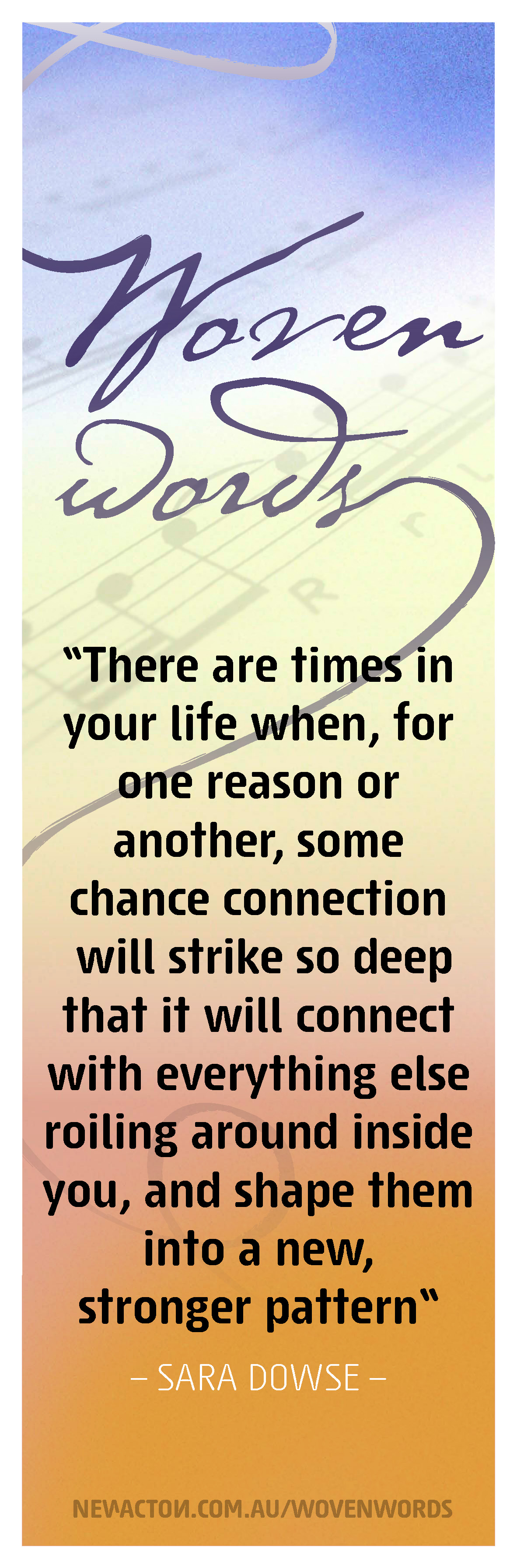
Sara Dowse text

Sara Dowse (Courtesy: NewActon.Com)

I managed to get to a few literary events this year – including some great book launches – but the three that most stood out for me were:

  • Woven Words: an inspired and inspiring night, associated with The invisible thread anthology, that blended words with music chosen by the guest authors.
  • Writing the Australian Landscape Seminar: a wonderful weekend of speakers organised by and held at the National Library of Australia. Not only was it wonderful to hear some favourite writers in person but the content gave me much to think about. Two ideas that have remained with me are Murray Bail’s suggestion that Australians rely too much on the strangeness of our landscape to construct our identity, and the wider issue regarding reconciling settler Australians’ experience of landscape with indigenous Australians’ relationship to country.
  • Childers Group’s forum on The role of the public arts critic. I particularly loved the idea that the critic is “a trader in ideas”, It takes away the notion of assessment and judgement and focuses us on what the arts are really about – which for me is to provide us with an opportunity to reflect on who we are, what we think, where we’ve come from and/or where we are going.

Aussie reading highlights

I don’t like to list my “top [name your number] books of the year” because it is such a subjective and moveable thing. I prefer instead to name some highlights:
  • The classics: I read a few Aussie classics this year and all were well worthwhile reading, but the two highlights were being able to read Patrick White’s first (buried) novel Happy Valley, which was published by Text Australian Classics, and finally reading a Christina Stead, For love alone.
  • A debut: I haven’t yet read this year’s most touted debut, Hannah Kent’s Burial rites. That pleasure, as I’m assured it will be, is coming this year. But I did read a few debut novels. Courtney Collins’ The burial was a standout for me. I loved the unusual and confronting narrative voice, the strong descriptions, and the fact that it was inspired by the story of a little-known Australian woman bushranger.
  • Awards: While I couldn’t tell you who won all the major literary awards in Australia this year – and have been slack about maintaining my sidebar awards list – two winners were standout novels for me this year: Carrie Tiffany’s Mateship with birds which won the inaugural Stella Prize and Michelle de Kretser’s Questions of travel which won the Miles Franklin award (among others).
  • Canberra Centenary anthologies: Canberra’s centenary year has ended but we have two wonderful books – The invisible thread edited by Irma Gold and Meanjin’s The Canberra issue – to dip into again and again when we want to think about what Canberra means to us, its residents, and the wider us, Australians.
  • Small presses: I’ve read so many excellent books from small presses, books that just don’t get the exposure they deserve. Dorothy Johnston’s e-book Eight pieces on prostitution published via the Australian Society of Authors website, Lesley Lebkowicz’s The Petrov poems (Pitt Street Poetry), Rachel Hennessy’s The heaven I swallowed (Wakefield Press), Gabrielle Gouch’s Once, only the swallows were free (Hybrid) and Susan Hawthorne’s Limen (Spinifex Press) are just a few of this year’s small press treasures.
I feel badly about limiting my list to just these few – I read so many good books this year. Just because they are not listed here doesn’t mean I’ve forgotten them!

Other reading highlights

This year really was a year of Australian reading. However, I did read some excellent books from foreign lands. The highlights were – and I swear I didn’t choose them for the initial of the author’s last name:
  • Hilary Mantel’s Bring up the bodies. What can I say? I loved how Mantel continued Cromwell’s story but with a different theme to the first novel in the trilogy. Can’t wait for the third book. What will she explore in it?
  • Diego Marani’s The last of the Vostyachs which was not only a great read but synchronised well with what turned out to be a major theme of my reading this year – the relationship between language and culture.
  • Bill McKibben’s Oil and honey: the education of an unlikely activist. McKibben does a great job of chronicling his transition from writer on activist issues to an activist who also writes, and he beautifully articulates the development of his activist strategies, making this book work both as memoir and how-to.

Blogging highlights

  • Australian Women Writers’ Challenge: this is such a positive project to be part of, and I am proud of what we as a team are achieving in terms of promoting Australian women writers. I’d love to know whether those writers who are living are seeing any increase in sales or, even, wider recognition, since the challenge started in 2011.
  • Commenters: I’d love to name you all because you have made blogging this year such a positive experience for me. I’ve enjoyed all the thoughtful and honest comments you’ve posted – asking questions, posing different ways of looking at issues, adding your experiences to the conversation. Thank you so much.

Short stories rule: Top posts for 2013

WordPress consistently tells me that the most popular topics I write about – according to my tags and categories – are Australian literature, Australian writers, Women writers, 21st century literature and Review-Novels. However, my most “hit” post last year was a short story by an English woman: Virginia Woolf’s “The mark on the wall (reviewed in March 2012). I presume, partly because of the sorts of searches that find it, that this is because it’s a set text for schools/universities, but still, it’s great seeing short stories being read.

Interestingly, my top “hit” Australian post (and third on my Top Posts for 2013) is also for a short story: Barbara Baynton’s The chosen vessel (reviewed in November 2012). This one I find more intriguing. Is this a set text too? If you can throw light on this, I’d love to know.

Searches that reached my blog in 2013

Every now and then I take a look at what people who come to my blog have searched on. As Google is now offering encrypted  searching, less information about search terms can now be captured by WordPress, but some still are. Here are some of my favourites from this year:
  • non living elements that help a echidna (I have no idea what post this one found as I can’t replicate the search to find me)
  • what significance does “whitaker’s table of precedency” have in “the mark on the wall”? (From the very specific wording of this one, I’m guessing this was a test/essay question?)
  • my sporty.com in sex gum girl (I can’t help thinking he/she was disappointed to find me!)
  • what page of midnight empire does drone attacks start (From someone else reviewing Croome’s book?)

And finally …

Thanks to everyone who has read, commented on and/or “liked” my blog over the last year. I may not know you all, in person, but I really do appreciate your visiting me here. I wish you all happy reading in 2014 … and, meanwhile, would love to hear of your blog or literary or reading highlights of the year.

Monday musings on Australian literature: Australian Women Writers’ Challenge 2013


Australian Women Writers Challenge
As last year, I’m devoting my last Monday Musings for 2013 to the Australian Women Writers Challenge. This challenge, instigated by Elizabeth Lhuede in response to growing concern in Australian literary circles about lack of recognition for women writers, was so successful in 2012 that Elizabeth, with the help of a team of volunteers, decided to continue the challenge in 2013. I am one of those volunteers – responsible for the Literary and Classics area – and, of course, am also a challenge participant. It was a quieter year for the challenge as we settled into a routine, but that doesn’t mean nothing memorable happened. So, before I round-up my own challenge I’d like to comment on a few of the highlights for me.

The main excitement was, I think, the announcement of the inaugural Stella Prize. The prize was not created by our Challenge, but it grew out of the same concerns that inspired the Challenge. Marg (Adventures of an Intrepid Reader) attended the award ceremony on behalf of the Challenge and wrote a post on the experience. The winner, Carrie Tiffany (for her novel Mateship with birds), impressed us all by sharing a portion of her prize with the shortlisted authors. A lovely gesture recognising the complex and uncomfortable nature of literary competition.

In October, as a special “event”, the Challenge focused on women writers of diverse heritage, and asked four authors to write guest posts. If you’d like to read these posts, they are:

  • Tseen Khoo: on her frustration about “narrow interpretations of writing by Asian-Australian women writers”
  • Alice Pung: on, interestingly, “Ruth Park, class, and marginalisation”
  • Malla Nunn: on her experience as an African migrant turned Australian writer
  • Merlinda Bobis: on “the necessity of creating and defining ‘home’ both for herself, as a writer, and for her readers”.

Finally, one of the features I particularly enjoy about the challenge is seeing Australian women writers support it (and each other) by reviewing books by other women writers. Annabel Smith, Amanda Curtin and Jessica White are three who have been particularly active this year.

If you are interested in the challenge, you can check it out at the link above, and, if you’d like to join up for 2014, you can fill out the form on this page.  This year, it is possible to join up as a reader or as a reviewer. The challenge can also be found on Facebook, Twitter (@auswomenwriters), GoodReads and Google+.

As I explained in last year’s highlights post, the Australian Women Writers’ Challenge is my only challenge. Once again, I signed up for the Franklin-fantastic Dabbler level, which is that I’d read (and review) at least 10 books by Australian women writers in more than one genre/category. Here is my list (with links to my reviews) for this year.

FICTION

SHORT STORIES

POETRY

NON-FICTION

ESSAYS

ANTHOLOGIES

awwchallenge2014CHILDREN’S LITERATURE

I have enjoyed taking part in the challenge – for being part of a team of committed people keen to spread the word about the breadth of Australian women’s writing, and for being introduced to that breadth. I am learning a lot more about Australian women’s literature than I could possible have learnt by beavering away here on my own. Roll on the 2014 challenge.