Monday musings on Australian literature: Literary fellowships

In past Monday Musings I’ve written about Writers’ retreats and Writers’ development programs. Related to these are fellowships. They involve providing a writer with money and/or resources to enable them to develop a new work. Fellowships usually involve a significant amount of money, and tend to be granted for specific projects.

Australia Council Fellowships are offered across a wide range of arts practice. They are worth $80,000 and support “outstanding, established artists’ creative activity and professional development for a period of up to two years”. Applicants must be Australian practising artists, such as writers, dancers, musicians, and visual artists.

CAUL-ASA Fellowship is offered by the Council of Australian University Librarians and the Australian Society of Authors. As far as I can work out it was first offered in 2014. Its aim is to support creative projects that use one or more of the university libraries’ special collections. Although it’s jointly offered by the ASA, it is in fact open to Australian artists, authors, scholars and researchers. It offers $15,000 which can be used for “travel, accommodation or other project-related expenses”.  From what I can tell, the outcome doesn’t have to be a book.

Copyright Agency Author Fellowship was established in 2014 to mark the Agency’s 40th anniversary “honouring the courage and imagination of the author, publisher and copyright lawyer founders that came together in 1974 to stand up for creators”. The inaugural Author Fellowship was targeted at mid- to late-career authors, because the Agency believed there were many prizes and awards available for new and emerging talent, but fewer opportunities for financial support for authors further along in their careers. The inaugural award, worth $40,000 and announced in September, was given to Mark Henshaw to enable him to work on his third novel, Missing. (I recently reviewed Henshaw’s second novel, The snow kimono, which I understand had its origins in a story Henshaw wrote in 1990 while in Paris on an Arts Council Fellowship.)

Creative Arts Fellowship for Australian Writing is offered by the National Library of Australia, with the support of the Eva Kollsman and Ray Mathew Trust (which I’ve referred to before). It is open to established and emerging writers, working in any literary genre. It enables the writer to undertake an intensive period of creative development at the Library, using the the Library’s collections “as inspiration or to incorporate or transform sources into new creative work”. It includes $10,000 which can be used for travel, accommodation, project costs, as needed. I searched to find the names of past fellows but it looks like this is a new fellowship, one of several replacing the old Harold White and Japan fellowship schemes.

The Kit Denton Fellowship was established in 2007 by the Australian Writers Foundation and Zapruder’s Other Films (the company owned by Kit’s son Andrew Denton). This award offers $30,000 and aims “to promote courage, to champion bold and challenging ideas, and to reward talent and excellence in performance writing”. The winner must be “a writer who has shown courage in their work and demonstrated a willingness to challenge the status quo with their writing”. That sounds like Andrew Denton!  In 2011 it was relaunched as the Kit Denton Disfellowship “because winning it may mean that your nan disowns you, your neighbours shun you and the shock jocks call for you to be locked up”. There is a list of winners on Wikipedia, but only up to 2012. I hope it is still being offered.

Have you heard of any other literary fellowships that sound interesting? Or are you a writer who has benefited from one? What did it mean for you?

Monday musings on Australian literature: Nature writing in Australia

Blogger Michelle (Adventures in Biography) posted last week on a presentation by literary agent, Mary Cunnane, at the HARDCOPY writers’ workshop she attended here in Canberra. Answering a question about narrative non-fiction, Cunnane apparently said “I do wonder, for example, why there isn’t more really good nature writing in Australia”. Quite coincidentally, last week another blogger, Stefanie (So Many Books), asked her readers for recommendations for “good nature books”. Both these posts got me thinking about nature writing in Australia. We have such varied landscapes not to mention interesting flora and fauna, that you would think examples of nature writing would roll off our tongues – but it doesn’t seem to.

What is “nature writing”?

Let’s start with Wikipedia which offers a definition, albeit an unsourced one. Nature writing, it says, “is nonfiction or fiction prose or poetry about the natural environment”. I must admit that when I think of “nature writing” my mind immediately leaps to the strong tradition from Stefanie’s home, the USA, with non-fiction authors like Henry David Thoreau, Edward Abbey, John Muir ( “A wind-storm in the forests”) and Mary Austin (“The scavengers” and “The land”). These writers focus very closely on landscape and the nature within it.

Cunnane, as far as I know, didn’t elaborate her understanding of “nature writing”, but Stefanie did, taking a broad view:

It might be a science-y book on moss or a sociology/psychology/philosophy kind of book on coping with climate change or a travel through the jungle/desert/forest/arctic sort of book or it could be about a cabin on a pond and planting beans and watching ants or about a garden or a farm … Something to take my mind outdoors while my body is stuck indoors.

Looking a little further … Last year, I wrote a Monday Musings about Australia’s relatively new Nature Writing Prize. This essay prize has been described as being about “relationship and interaction with some aspect of the Australian landscape” or for writing that “demonstrates a deep appreciation of Australia’s magnificent landscapes”. The sponsor, the Nature Conservancy, calls it the genre of “writing of place”. “Place” seems to me to be a little broader than nature, but presumably the entrants know what the prize is looking for.

Mark Tredinnick, A place on earth

Published by Bison Books

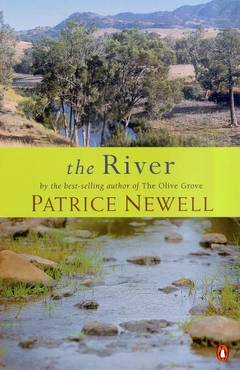
Briefly researching this topic, I came across an article Charlotte Wood wrote in 2004 on an anthology edited by Mark Tredinnick and titled A place on earth: An anthology of nature writing From North America and Australia. Tredinnick, Wood says, wanted to kickstart a new genre, “an Australian ‘literature of place'”! There’s that word “place” again. Wood discusses form and content, starting with the idea that the essay is a natural fit “with this subject matter”. But, not all writers in the anthology agree. Eric Rolls sees no reason why the “essay should be considered the most suitable form for writing about place”, and Patrice Newell, whose farm-memoir The olive grove I read before blogging, says “I’m simply a story-teller. I tell stories about our family, our farm, the flora and fauna, our river, our olive grove”. She refers to the issue of place saying:

There’s a lot of talk about ‘place’ but every place is a place. A tram is a place as crowded with memories as passengers. I’m troubled that ‘place’ is becoming a descriptive term for somewhere in the natural world. It can be too precious.

I’m with Newell. Conceptually, place can include nature, but I don’t think it’s useful as a synonym.

All of this confirms for me that “nature writing” is a rather broad church: it can be fiction or non-fiction, poetry or prose, but its focus must be nature and the environment.

Nature writing in Australia

NewellRiverWood, in her article cited above, quotes essayist Peter Hay as agreeing that an Australian tradition of nature writing has been lacking, though he says that poetry is an exception. He’s right. Many of the early ballads focused closely on the interaction of humans with nature, and then there are those poets he names, like Henry Kendall and Judith Wright. He also says that “Australian fictionalists [a new word for me!] have always unselfconsciously written of the natural world”. In other words, he says, we haven’t “neglected the natural world in our writing”, we just don’t have a “literary genre specifically devoted to these themes as there is in North America”.

And so, while the names of Australian nature writers don’t jump immediately into my head, as they do when I think of the USA, it doesn’t take long for some to float to the surface. How about the two Tims – Flannery and Winton – for example? Tim Flannery’s books on palaeontology and climate – such as The Future Eaters: An Ecological History of the Australasian Lands and People, and The weather makers: The history and future impact of climate change – are obvious. In much of Tim Winton’s fiction, the environment is almost a character itself. Breath, The turning and Dirt Music are three examples, but landscape is critical to most of his books. Winton has written non-fiction about the environment too, including Land’s edge and Down to earth. Murray Bail’s Eucalyptus is an obvious contender with its specific focus on gum trees.

What about those “farm books” which explore human interaction with the landscape? Carrie Tiffany’s Everyman’s rules for scientific living and Mateship with birds (my review), Andrew McGahan’s White earth, Gillian Mears’ Foals’ bread (my review), Jessica White’s Entitlement (my review) and Alice Robinson’s Anchor point (my revieware all good examples.

And then, of course, there’s the relationship of indigenous Australians with the land, or country. Alexis Wright’s Carpentaria (my review) and Kim Scott’s That deadman dance (my review) jump immediately to mind, but much indigenous literature encompasses relationship with and responsibility for country.

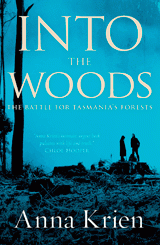
Anna Krien, Into the woods

Cover image (Courtesy: Black Inc)

Wood’s article raises another aspect of nature writing – “eco-activism”. She feared, she said, that this would be the main thrust of the anthology – but it wasn’t so. However, Tredinnick does admit there’s a connection between “creating a literature of place and creating a practical sympathy for the land”. Some writers are conscious of this connection, while others aren’t, but the contributors to the anthology agreed that such writing is not about “preaching”, but about “showing”, about creating the “sympathy” Tredinnick talks about. Anna Krein’s investigative, analytical Into the woods (my review) about the forestry conflict in Tasmania and her quarterly essay about our relationship with animals, Us and them: On the importance of animals (my review), are conscious exemplars of this aspect: they actively grapple with ecological/enviromental issues.

I’ve barely introduced the subject, but it has confirmed for me that while Australia may not have an easily definable tradition of “nature writing”, nature and landscape are integral to our literature, across forms and genres. So, let’s end with the opening of one of Judith Wright’s most famous poems:

South of my days’ circle, part of my blood’s country,
rises that tableland, high delicate outline
of bony slopes wincing under the winter,
low trees, blue-leaved and olive, outcropping granite-
clean, lean, hungry country. The creek’s leaf-silenced,
willow choked, the slope a tangle of medlar and crabapple
branching over and under, blotched with a green lichen;
and the old cottage lurches in for shelter.

(from Judith Wright’s “South of my days” at PoemHunter)

What does nature writing mean to you? And, does it interest you?


Monday musings on Australian literature: Australian literary biographies

Given that a literary biography won the National Biography Award this year, that I’ve recently posted Musings on literary autobiographies/memories, and that my next review will be for a literary biography, it seemed high time that I devoted a Monday Musings to the form, don’t you think?

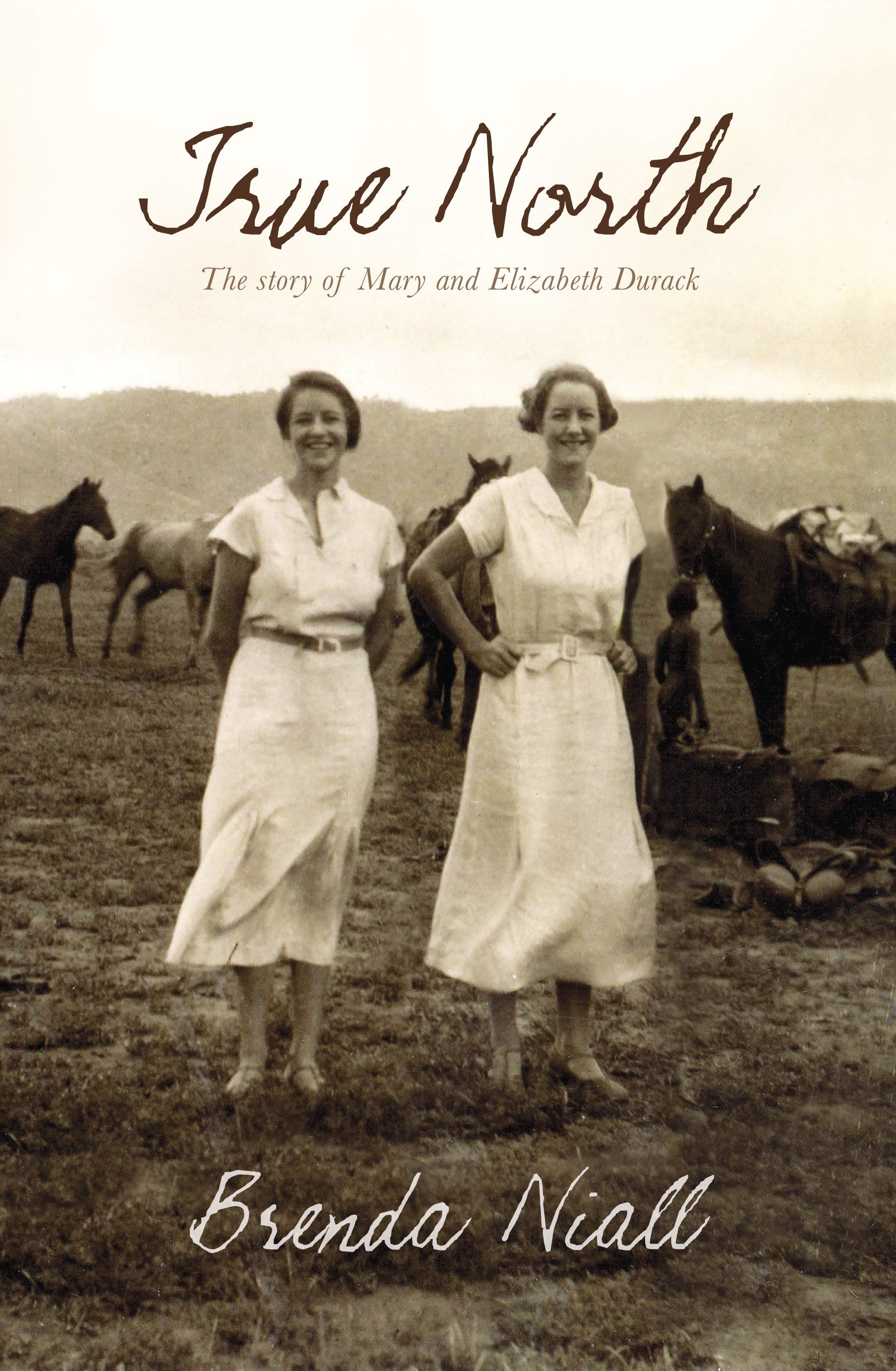
Brenda Niall's True North
Brenda Niall’s True North: The story of Mary and Elizabeth Durack (Courtesy: Text Publishing)

Biographies make up a pretty small proportion of my reading diet, and when I do read them I tend to prefer literary biographies – for obvious reasons. I can, though, be persuaded to read others if the subject is really of interest to me and/or the biographer is one I admire. An example of such a book I’ve reviewed here is Hazel Rowley’s wonderful Franklin and Eleanor.

Do you read biographies? If so, why do you read them? I have, at times, worried that my interest is voyeuristic. I have felt uncertain about whether I’d be better to focus my attention on reading more of authors’ works than biographies about them? And yet, biography is, I think, a serious literary form in its own right. Indeed, at the Australian National University, there is the National Centre of Biography, about which I’ve written before. Its role, to summarise greatly, is to foster and encourage expert and innovative biographical writing in Australia. This, together with the fact that significant institutions like the National Library of Australia with its Seymour Biography Lecture and the State Library of New South Wales with its National Biography Award, suggests that I should worry no more.

What makes a good literary biography? Well, I know what I look for: well-researched (with foot-notes/end-notes), an intelligent but readable style, honest rather than hagiographic (or its opposite!) tone, and an analytical approach to the writer’s work situating it within the writer’s life and times. I also like it when the biographer engages the reader in the form of the biography, in the challenges they may have confronted, in how and why they chose the approach they did.

So, here I’ll list a few Australian literary biographies, that I’ve read or would like to, in alphabetical order, as libraries do it, by the subject. Inclusion here does not mean they are all the best of the form, but simply that they represent a variety in style and subject.

  • Jennifer Walker’s Elizabeth of the German Garden: A literary journey (2013). A recent addition to my TBR, I’m very keen to read this biography of the not-so-well-known Australian-born writer, Elizabeth von Arnim. I’ve read several of her works – fiction and non-fiction – and love her writing. (As an aside, given recent discussions on this blog regarding memoirs, she’s another author who has played with the memoir form in her writing.)
  • Karen Lamb’s Thea Astley: Inventing her own weather (2015). This is the book I am just finishing now and will review in the next few days.
  • Philip Butterss’ An unsentimental bloke: The life and work of CJ Dennis (2014) (my review). This year’s National Biography Award winner. The judges wrote that it’s “meticulously researched”, “fluent in style”, and that it “provides an illuminating analysis of the oeuvre, and its spinoffs, for which Dennis was famous and, briefly, rich”.
  • Brenda Niall’s True north: The story of Mary and Elizabeth Durack (2012) (my review). This is, really, more than a traditional literary biography. Elizabeth was an artist, and the two were daughters of a pioneering cattle family. I enjoyed it, but it suffered, perhaps, from the breadth of its focus.
  • Jill Roe’e Stella Miles Franklin: A biography (2008). This is a biography that I should read, given the importance of its subject to Australian literature and given the reputation of the biography itself. I can, though, suggest you check out Lisa’s (ANZLitLovers) review.
  • Helen Trinca’s Madeleine: A life of Madeleine St John (2013). (my review). St John is not regarded as “high” Australian literature – nor is Mary Durack, for that matter – but she was the first female Australian writer to be nominated for the Booker Prize and, like the Duracks, came from a family which had a public profile.
  • Hazel Rowley’s Christina Stead: A life (1993). Rowley was regarded as one of Australia’s best biographers until she died too young, in her 60th year, in 2011. Her subjects included the French couple Jean-Paul Sartre and Simone de Beauvoir, and American writer, Richard Wright. Her biography of Stead was universally praised, with, for example, critic Michael Upchurch at the New York Review of Books describing it as “everything a literary biography should be”. He wrote: “It’s a model of clarity. Ms. Rowley’s shrewd selectivity and handling of anecdote makes the book compellingly readable”.
  • David Marr’s Patrick White: A life (1991). Another biography I should read, but it’s a big tome, so will need time. Well-reviewed when it came out, it’s still the authoritative biography of Australia’s only Nobel Laureate in literature.

In 2010, journalist Gideon Haigh wrote an article titled “Sleaze-hounds and artist on oath: The state of Australian biography” in Kill Your Darlings. He bemoaned the scarcity of Australian biography “of quality”. I’d certainly agree that we’d like more good biographies. He suggested various reasons for the dearth, including that it “could be as simple as that there are easier ways to earn a living, and that living in the shadow of a subject for the years required to craft something really worthwhile involves a determination and a humility no longer common among those with writing aspirations”. I’m not sure I like the dig about “humility” but it is clear to me that writing a comprehensive, thoughtful biography is a huge task, one that takes not months but years, and that requires extensive research that must be expensive (even in today’s more digitally accessible world). I don’t know how well supported the endeavour is.

Do you have any thoughts or preferences about biographies?

Monday musings on Australian literature: Where is Australia’s George Orwell?

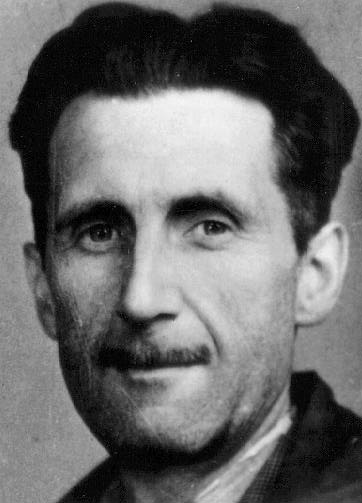
George Orwell, 1933 (Presumed Public Domain, from Wikipedia)

George Orwell, 1933 (Presumed Public Domain, from Wikipedia)

In a comment on my review last week of Kate Grenville’s One life, Lisa (ANZLitLovers) asked “Where’s Australia’s George Orwell?”. This was in reference to the idea that more novelists should write about climate change to help change public opinion. Interesting question, I thought, and one that I could explore in a Monday Musings. You might all be relieved, in fact, to have something different from my recent list-focused musings.

Before I answer the question – and then throw it open to you – it would be sensible to clarify my understanding of the question. (See, I’ve been well-grounded in essay skills: first, define your terms!) To put it simply, I believe Lisa was asking where is the Australian author who is driven to identify injustice, oppose inhumanity, and promote social conscience? That is, an author like Orwell – the man who coined terms like “cold war”, “big brother” and “thought police”, the man who used satire, allegory and other rhetorical devices in his fiction and non-fiction to show us the error of our ways. I hope this is what Lisa meant; this is, anyhow, how I am reading her question.

An Australian Orwell?

Well, a name did pop immediately into my head – Thea Astley. Of course, she’s dead, but so is George Orwell. I suspect Lisa was looking for a living Orwell to speak to us right now on “now” topics”, but, bear with me anyhow.

Astley, like Orwell, wrote in multiple forms – novels, short stories, essays – though Astley didn’t write the sorts of personal experience memoirs that Orwell did in books like Down and Out in Paris and London, The Road to Wigan Pier and Homage to Catalonia. And, unlike Orwell who travelled far and wide, physically and with his pen, Astley’s works were firmly based on Australia. But, like Orwell, she had an acerbic eye and a satiric pen, and she used it to good effect.

Ashley was also a wordsmith, albeit of a different sort to Orwell. She used words that frequently sent (and still send) her readers to the dictionary, and her passion was to “carve a good sentence”.

So far so good. However, having considered Astley, I’m now going to, reluctantly, reject her as our George Orwell. Not because she isn’t a satirist because she is, but because her satire isn’t as explicitly political as his. She was interested in the treatment of outcasts and misfits, regardless of the reason for their “otherness”, which could be race, religion, economic status, age, gender, and so on.  She satirised suburban and small town life, particularly in her first novels. She also tackled more political issues such as white Australia’s treatment of indigenous people in A kindness cup and It’s raining in mango. In Coda she satirised the treatment of ageing. And in her last novel, Drylands, issues like gender, power, modern technology, and sport attracted the attention of her sharp pen.

Astley was surely aware of the political implications of the issues she targeted, but she didn’t explicitly focus on the politics. She was, I think, more interested in the social, cultural and personal ramifications of the behaviours she put before us.

We certainly have political satirists, but they tend to be performers rather than authors.

In 2013, the Sydney Writers’ Festival included a panel discussion titled  The Satirists, which asked the question:

If Australians claim to be anti-authoritarian rabble-rousers, where is the canon of contemporary satirical novels reflecting this stereotype? What are the satirical traditions in Australian literature?

The panel included novelist David Foster, actor/novelist/memoirist William McInnes and poet Alan Wearne. I haven’t read Foster (my bad, I know) or Alan Wearne. And, I don’t think McInnes’ brand of humour, entertaining though it is, is quite what Lisa was asking. Contemporary writers I’ve read included Peter Carey and Richard Flanagan who have written some satirical novels but they are not known primarily as satirists.

So, is there anyone else – writing now – who is making it his or her business to tackle the big questions of our time, questions to do with refugees, indigenous dispossession, climate change? In Australia, or elsewhere?

POSTSCRIPT: I had just scheduled this post for publishing when up popped a blog post from today’s The Guardian. Written by Sam Twyford-Moore and titled “Why so serious: does Australian literature have a funny person problem?”, it starts with the following:

Australian authors show off their satirical chops on social media every day. So why doesn’t more of that wit spill on to the published page?

Of course, not all satire is “funny”, but, regardless, he doesn’t have an answer.

Monday musings on Australian literature: Australian novels adapted for opera

Today’s post is inspired by an article, “Fly away Peter: When Australian literature goes to the opera”, published in May this year in The Conversation. Written by Associate Professor of Vocal Studies and Opera at the University of Sydney, it was inspired by the production of an opera based on David Malouf’s wonderful novel, Fly away Peter.

Now, as some of you may remember, I’ve mentioned Fly away Peter several times in this blog, one being in my second Monday Musings post. Fly away Peter is one of my favourite Australian novels and is also one of a fairly select group of Australian novels dealing with the first world war. I have also mentioned David Malouf in relation to opera before, most recently in a Monday Musings post on Australian novelists and poets who have also written libretti. Malouf has written a few libretti, the most famous being for Patrick White’s Voss, about which I wrote in a post on The Voss Journey. You can probably see, by now, why I was interested in Halliwell’s article.

Halliwell discusses a number of Australian novels/short stories that have been adapted for opera – and I’m going to share them here, in alphabetical order by novelist (with links to my reviews, where I’ve done one):

  • Barbara Baynton’s “The chosen vessel” (my review) was adapted by Australian-British composer and festival director, Jonathan Mills, with libretto by Australian poet Dorothy Porter. It was retitled The ghost wife and premiered in 1996. Halliwell writes that “Baynton’s bleak story, debunking the dominant male myth of the noble bushman, was translated into a confronting music theatre work”. It was performed in Melbourne and Sydney, and had, says Halliwell, a “well-regarded run in London”.
  • Peter Carey’s Bliss was adapted by Australian composer Brett Dean, with libretto by British librettist Amanda Holden. It premiered in Sydney in 2010 to a positive reception, says Halliwell, and was similarly positively received in Melbourne and Edinburgh. It was later presented, in a new production, in Hamburg, under Australian conductor and supporter of the work, Simone Young.
  • Helen Garner’s The children’s Bach (my review) was adapted by Australian composer Andrew Schultz, with libretto by Australian librettist Glenn Perry. It premiered in Melbourne in 2008. Halliwell describes it as “a lightly-scored and evocative chamber opera which took the central metaphor of the fugue from the novel”.
  • Patrick White’s Voss was adapted by Australian composer Richard Meale with libretto, as I’ve already said, by David Malouf. It premiered at the Adelaide Festival in 1986. Halliwell says that it was “hailed at its premiere in 1986 as the ‘Great Australian Opera'”, but it has never been produced again – at least not yet. There have been attempts to adapt Voss for film but some have argued that, while its mystical, visionary aspects translate well to opera, this is not so easy for film.
  • Tim Winton’s The riders was adapted by Australian composer Iain Grandage with libretto by Australian poet, novelist, playwright and librettist, Alison Croggon, It premiered in Melbourne last year (2014). Matthew Westwood wrote in The Australian that “Grandage uses a hunting instrument — the horn — to evoke a man’s odyssey across Europe for the wife who has deserted him. (Frustratingly for that man, Scully, and many of Winton’s readers, the elusive Jennifer never appears.)” Oh dear. I must say that The riders is one of Winton’s least memorable works for me – and I don’t think I’m the only one to feel that way. However, the adaptation was very positively received, says Halliwell.

Alison Croggon is reported in The Guardian as saying that although it’s daunting, it’s logical to write libretti if you write poetry. This makes sense to me: rhythm is critical to poetry, songs and music. Three of the five librettists here – Porter, Malouf and Croggon – are poets.

Halliwell commences his article by quoting Malouf’s statement that “No libretto can reproduce the novel from which it is drawn”. Grandage and Croggon like to call their opera “a reimagining rather than an adaptation”. I’d argue that this is true of all adaptations of a work from one form to another. It’s surely unrealistic to expect a work to be the same. The challenge for the adaptation is to decide what is the essence of the work and to convey that – and for audiences to see if they agree!

Anyhow, if you are interested more widely in the subject of novels adapted for opera, you can check out this Wikipedia category page. It’s by no means complete – indeed not all of the operas I’ve listed here are included.

I’d love to hear whether you have seen any operas adapted from modern novels. Or, do you have a favourite novel you’d love to see adapted for opera?

Monday musings on Australian literature: Australian literary autobiographies

I’ve written Monday Musings on autobiographies and memoirs by indigenous Australians, and I’ve reviewed biographies of Australian writers, like Mary Durack and Madeleine St John. However, I haven’t written about what we might call literary autobiographies, that is, autobiographies by authors. So, today’s the day. I have read several literary autobiographies, but few since I started blogging. Being a reader, I’m interested in writers’ autobiographies or memoirs – because I’m interested in writers, and because, rightly or wrongly, I expect a good writer to be able to write a good autobiography (however we define “good”!)  There are, as I’m sure you know some famous/popular/well-regarded author autobiographies, such as Nabokov’s Speak, memory, but of course here I’m focussing on Australians.

I’m not going to get into the why and wherefores of writing autobiography or analyse how useful or relevant they might be to understanding a particular writer’s works.I’m just going to list – alphabetically by author – a few that I’ve either read, dipped into, or would like to read.

Robert Drewe’s The shark net (2000) and Montebello: A memoir (2012). I haven’t read The shark net, though it’s on my TBR. However, I did see the 2003 television miniseries. For those of you who don’t know, this is quite different to the usual writer’s growing up story. Drewe grew up in Perth in the 1950s and 1960s when the serial killer Eric Edgar Cooke was creating havoc with the locals’ sense of security. “The murders immediately changed the spirit of the place”, he writes. Drewe knew this man, and knew one of his victims. He wrote this memoir “to try to make sense of this time and place”. I haven’t heard much about Montebello, but Drewe is a significant Australian writer.

David Malouf reading Ransom

Malouf reading Ransom, National Library of Australia, August 2009

David Malouf’s 12 Edmondstone St (1985) is a very short book, running to just 134 pages. 12 Edmonstone Street is the address of the Brisbane house he grew up in, but this is not your typical autobiography starting with “I was born in …”. Instead, it discusses selected places in his life, starting with that childhood home. I enjoyed his description of that home, of its weatherboard construction with verandahs. His father, he writes, wanted something more modern, something permanent, like brick.

As for verandahs. Well, their evocation of the raised tent flap gives the game away completely. They are a formal confession that you are just one step up from nomads.

So of course, as soon as he could, he closed it in.

This is a thoughtful, meditative – Malouf-like – book.

Ruth Park’s A fence around the cuckoo (1992) and Fishing in the Styx (1993) are more traditional autobiographies, but they are not ordinary. I read them both when they came out and loved them – as much as I loved Park’s books, like her Harp in the South trilogy. A fence around the cuckoo won the Age Book of the Year Non-fiction Award in 1992.

Together, the two books are great reads about life in New Zealand and Australia in the early to mid twentieth century. They also provide wonderful insight into the writer she was to become, and tell the story of one of Australia’s most famous literary couples, Ruth Park and D’Arcy Niland. Here she is on an early contact with Niland (when she was still in New Zealand and he in Australia). He sent, she writes

a stately and respectful letter, carefully written in the sender’s amazing handwriting, and really got up my nose. The writer seemed to think I was some powerful editorial person, capable of assisting him to sell his stories in New Zealand. … I banged off a letter on my three-decker monster, saying that I was but a lowly copyholder with no efficacy or charisma whatsoever, and if he offered to sell my stories in Australia it might be more to the point. Reading his letter now, it is a marvel that the future father of my children did not take a terminal huff and go off and father someone else’s. However, he was choked off for months, much to my relief.

Hal Porter’s The watcher on the cast-iron balcony (1963) is the first of several memoirs written by Porter. It is regarded as an Australian classic, and covers his growing up years. Porter, however, has a reputation for an interest in paedophilia, which has resulted in some different “readings” of this book. Not having read it or any of Porter’s work, I’m afraid I can’t comment.

Patrick White’s Flaws in the glass (1981) is on my TBR. I dip into it frequently when I’m thinking about White, but have not managed to find time to read it from cover to cover. I should though, because every time I dip into it, I find something well worth my dip! For example, he comments frequently on his homosexuality, reflecting particularly on what it means for him and his art. Here is one:

Indeed, ambivalence has given me insights into human nature, denied, I believe, who are unequivocally male or female – and Professor Leonie Kramer*. I would not trade my halfway house, frail though it be, for any of the entrenchments of those who like to think themselves unequivocal.

[…]

Where I have gone wrong in life is in believing that total sincerity is compatible with human intercourse. Manoly [White’s longterm partner], I think, believes that sincerity must yield to circumstance, without necessarily becoming tainted with cynicism. His sense of reality is governed by a pureness of heart which I lack. My pursuit of that razor-bald truth has made me a slasher.

The New York Times Book Review is quoted on my back cover saying that it is “as absorbing an autobiography as has been written by a novelist this century”. Oh dear, I really should read it. Wish I could emulate Stefanie of So Many Books who consistently has five, six or more books simultaneously on the go.

* An Australian academic whom White disdained and called “Killer Kramer”. This singling out of her here is typical of White’s bite.


Do you have favourite literary autobiographies?

Monday musings on Australian literature: Science-based non-fiction

National Science Week, which inspired last week’s post, finished yesterday, but I decided to extend it a day by writing a post on Australian non-fiction on science subjects. I’ll focus of course on works created for general readers, not academic works. Unlike last week’s list, I haven’t read all the books I list here. Given the surge in general science publishing in the last decade or so, I bet you all have favourites – including of course non-Australian books. I look forward to hearing about them.

Science is a rather broad church, and I’m interpreting it broadly, so this is an eclectic list. As last week, the books are listed in order of publication

Margaret Wertheim’s Pythagoras’ trousers: God, physics and the gender wars (1995) is a book I read with my reading group, though my memory tells me I didn’t finish it! My excuse, as I recollect, is that it was a busy time. Wertheim is an Australian science writer who has lived for some time now, I believe, in the USA. In this book she argues that physics has, traditionally/historically been associated with God. Stephen Hawking and Einstein, she says, both invoke God in their writing. She develops this argument further to suggest that “the priestly culture of physics” has worked as a barrier to women entering the field. This book is now 20 years old. If she was right then, is she still now? I’m not sure about the religion aspect, but gender imbalance is still an issue in many sciences (though not, interestingly, in medicine!)

Tim Flannery’s The Weather Makers: The history and future impact of climate change (2005) is a book I should have read, particularly as I have it in my TBR pile. It won a New South Wales Premier’s Literary Prize for Critical Writing. Flannery is probably Australia’s best known and most prolific scientist-writer. Trained as a palaeontologist, he now uses his science to support his role these days as an environmentalist and climate change activist. For a list of his writing, which includes his quarterly essay on extinction that I have reviewed, check out his Wikipedia page.

Mohammed Khadra’s Making the Cut: A Surgeon’s Stories Of Life On The Edge (2009) is the memoir of a urologist. I read it just before I started blogging. Like many science-based books for a general market, this book is not so much about the science of medicine as about ethics and politics. It provides a fascinating insight into the tough life of medical students. I loved Khadra’s discussion of how he arrived at his choice of speciality. Khadra believes that surgeons must understand humankind and that one of best ways to teach this is through poetry! Every chapter in the book starts with a poem, just as his surgical tutorials, when he was Professor of Surgery, ended with poetry.

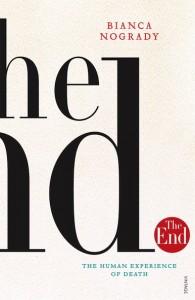
Bianca Nogrady, The end book coverBianca Nogrady’s The end: The human experience of death (2013) (my review) looks at death from every conceivable angle – medical, sociological, psychological, philosophical, legal and ethical. One of the most intriguing discussions – from a medical and ethical review – in the book concerns defining death. It’s not as easy as it might first appear! Nogrady is an Australian science journalist, and in this book she treads a fine line between expert opinion and anecdote, not letting either run away with the book to the detriment of the other. The anecdotes breathe life into the book, while the experts bring us back to earth!

Fred Watson’s Star-craving mad (2013) was described by the Sun Herald reviewer as “a lighthearted romp through the cosmos … [which] tackles the big questions about our place in the universe without ever being pompous, condescending, boring or baffling”. I haven’t read this book, but I included it because I have heard Watson, live, most recently at this weekend’s Griffyn Solo concert focussing on Urmas Sisask’s astronomy-inspired music. Watson is an astronomer who is well recognised as a communicator, winning, in 2006, the Australian Government’s Eureka Prize for Promoting Understanding of Science.

Christine Kenneally’s The invisible history of the human race (2014) was shortlisted for this year’s Stella Prize. Kenneally, a science journalist, draws on scientific research into genetics and DNA to explore who we are, where we’ve come from and where we might be going. Little questions like that. I haven’t read it, but some bloggers I respect (Resident Judge and Adventures in Biography) have, and loved it for its lucid presentation of complex ideas. I really should read it.

If you’re Australian, did you take part in any Science Week activities, like perhaps the Stargazing World Record event? And, if you’re not (or even if you are), do you have any non-fiction books about scientific matters that you’d like to recommend?

Monday musings on Australian literature: Novels about scientists

It’s National Science Week (15-23 August) here down under and, while science is not my area of expertise, my mind is always opened by the breadth of events and discussions that take place. I don’t, I admit, get to many events, but I do enjoy the increased focus on science on my favourite radio station, ABC Radio National. For example, a program this weekend on the art of (scientific) taxonomy fascinated my librarian-archivist mind!

And then it occurred to me that I could do my own little “program” here – a post on novels featuring scientists. I’m going to mostly avoid the obvious – science fiction, where scientists often abound – and suss out more general fiction. It’s not easy and this is necessarily a selection of course. I’d love to hear of any novels you love about scientists. As always, although my focus here is, by definition, Australian, you can spread your thoughts as widely as you like!

I’m listing the books in the order they were published. I have read them all, but many before I started blogging.

Geraldine Brooks’ Year of wonders (2001) is set in a village in England in the 17th century during the time of the plague. Its main character, a widow and housemaid, learns how to use herbs for medical purposes, after previous owners of the herb garden had been murdered for practising witchcraft. Science, it’s clear, has not always been respected! Another Brooks’ novel, The people of the book, 2008, has as its main character a museum paper conservator, a job which relies heavily on scientific knowledge and principles.

Sue Woolfe’s The secret cure (2003) is set in a hospital science lab. The main character is a cleaning lady, secretly, searching for a cure for her autistic daughter. She, during the course of the book, has to deal with researchers and other scientific professionals, who don’t always show science and scientists in the most positive light as they grapple for fame and recognition. The novel is partly narrated by another worker in the hospital – a repair and maintenance man who, himself, seems to suffer from a form of autism. The novel explores, broadly, what being human means, and is one of the first novels I read about autism/Asperger Syndrome.

Carrie Tiffany’s Everyman’s rules for scientific living (2006) was inspired by Victoria’s Better Farming Train, which, between the Great Depression and the Second World War, traveled through small country towns to provide practical advice of all sorts to farming people. The train’s staff, in the novel, included a nurse and seamstress, a chicken expert, and the scientist Robert Pettigrew, a soil expert with indefatigable faith in value of superphosphates. It was a time when science was seen as the answer to all challenges, but … well, if you haven’t read this, I recommend it to you. It’s a little treasure.

Jordan Fall Girl

Fall girl cover (Courtesy: Text Publishing)

Eva Horning’s Dog boy (2009) (my review) is about a young boy who, after the disappearance of his parents, is taken in by a pack of dogs. It’s a feral child story, and the first part focuses on his experience as a “dog”. He is eventually reintroduced to the human world and becomes a subject of interest for husband-and-wife scientists, psychiatrist Dimitry and paediatrician Natalya, who start to wonder whether, for all that humans “know”, the boy may have been better off with his dog family.

Toni Jordan’s Fall girl (2010) (my review) is a comic novel about Ella Canfield, an evolutionary biologist who seeks funding to prove that the extinct Tasmanian Tiger still exists – except that Dr Canfield is not who she appears. She is in fact a con-artist, trying to snare Daniel Metcalfe, or at least his money! Things don’t though, go as she expected, and various tables, as you might expect, are turned as Jordan spoofs scientific research and grant seeking, among other targets.

Graeme Simsion’s The Rosie project (2013) (my review) is a romantic comedy about genetics professor Don Tilman and his search for a wife. Genetics plays a role when he puts his “wife project” on hold to help bartender-turned-student Rosie with her “father project”.

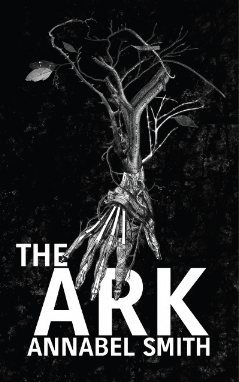
Annabel Smith. The arkAnnabel Smith’s The ark (2014) (my review) is a dystopian novel in the relatively new genre of cli-fi. “The Ark” is a seed bank aimed at preserving seeds for the future. Built into a remote mountain-side, it is populated by people selected for their skills, which include of course scientists and technologists. Most of the novel takes place between 2041 an 2043 in a post peak oil crisis world, and explores explores the tensions that develop as power undermines trust in a small community where co-operation is critical to survival. In this case, while science could be seen to be both the cause of and solution to the situation the world has found itself in, for this group science turns out to be the least of their problems, because once again, as in Dog boy, humans find themselves facing some uncomfortable truths about, yes, humans.

Have you noticed that several of these “scientists” are not quite what you’d expect? We have a cleaning lady seeking a cure for her daughter, a housemaid becoming a herbalist during the plague, a con artist pretending to be a scientist to lure a wealthy donor … I will avoid, however, drawing simplistic conclusions from this, and simply ask if you would like to recommend any novels featuring scientists!

Monday musings on Australian literature: Ernestine Hill

Regular readers of my musings will know by now that I sometimes use this spot to explore and share things that I don’t know much about. This post is one such. It was inspired by an article I read a year ago in Inside Story, Swinburne University of Technology’s online journal about current affairs and culture. The article was titled “How American servicemen found Ernestine Hill in their kit bags”, and was written by Anna Johnson, an academic from the University of Tasmania.

My love must wait 2002 cover

Cover for A&R Classics edition

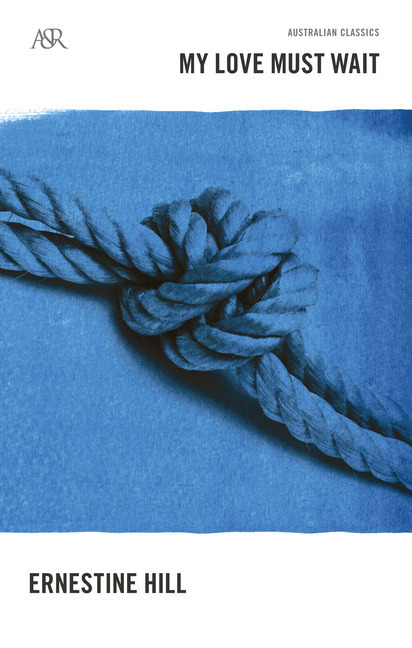
Ernestine Hill (1899-1972) first came to my attention as a teenager with her novel, My love must wait, about Matthew Flinders. Although it was published in 1941, long before my teens, it was still popular at a time when young adult fiction had not come into its own. Primarily a journalist and travel writer, she only wrote that novel. And it’s not, I must clarify, the book that found its way into American servicemen’s kit bags! That book was Australian frontier, published in Australia in 1937 as The great Australian loneliness. Johnson doesn’t spend much time on these kitbags, but the story is that America’s non-profit Council on Books in Wartime, which believed books were “weapons in the war of ideas”, sent “stimulating reading [in Armed Services Editions*] to soldiers so that their leisure time was both educational and enjoyable”. I hadn’t known about this.

Johnson’s focus though is Hill, whom she describes as a “middlebrow” writer. She writes:

Although these so-called middlebrow writers [such as Ion Idriess and Frank Clune] have been frequently scorned by critics and neglected by subsequent Australian literary history, they were very influential cultural brokers who mediated debates about place, race, and culture for the interested general reader.

Hill’s books, says Johnson, were widely popular because they “were perfectly pitched between a sentimental attachment to late nineteenth-century ideas about the bush [..] and great excitement about modern technology and enterprise”. The Great Australian Loneliness, she writes, treads a fine line between lamenting “the passing of the old bushmen and their way of life” and celebrating “pilots and planes whose mail runs ‘have brought the Great Australian Loneliness well on to the map’.” Her writing was often condemned by critics “as romanticised purple prose” but Johnson suggests her books “forged bonds … between people who were geographically, socially and culturally dispersed”.

Hill’s popularity meant that booksellers loved her and promoted her, to the detriment of Australia’s more literary writers. Miles Franklin wrote in her diaries (ed. Paul Brunton) about a dinner held by Ell’s (a Newcastle bookseller) in September 1949:

I was able to note that booksellers, or representatives of publishers know little of the contents of the books they vend. They have not the taste, the ear, or the capacity. Take the case under observation, A & R [Angus and Robertson] boosted Idriess, an old steady, & Timms who is a thruster and insister & whom a person with Dr Mackaness’s literary standards considers an important Australian writer. But they did not bother about my books. I was there because invited by the cultural committee of Newcastle. My book continues to sell steadily though I’ve never had a Christmastide sale, was denied editions during the war boom in favour of E. Hill, who has powerful boosters behind her. I’ve never had a window or even a counter display.

Poor Miles. Hopefully not all booksellers and publishers were the same, but it’s a reminder that being a literary author has never been easy. I wonder how many people read Ion Idriess and EV Timms today?

Anyhow back to Hill. Reflecting her times, she was uneasy about multiculturalism, and wanted more white women, to support white men, in the outback. Johnson writes that her “vision of white Australia was common in the 1930s” and that she was “rarely complimentary to Aboriginal, Chinese, Malay, or Afghan Australians”, although she apparently filled her books with colourful vignettes about the lives of these people. She was, however, more positive about indigenous Australians. Johnson writes that she

attested to violent colonial conditions and lamented the passing of Indigenous lives and histories whose formative role in the nation had largely gone unrecorded. Her books and journalism joined others in modernising attitudes, which eventually saw the liberalisation that benefited Aboriginal people from the late 1960s onwards, even if her ‘modern’ opinions now seem uncomfortably tainted with colonialism.

So, a mixed bunch in terms of her attitudes. Regarding her book being published in America, she was thrilled. Articles by her were also published there. She wrote, in the 1940s, that she was encouraged “to rush my best and most arresting articles on this country to America to make them conscious of what a loss we’d be. Britain has never realised that. We must call Americans here.” Fascinating to see Hill’s vision of the power of literature, and its critical role, as Johnson describes it, in “securing the nation’s geopolitical future”.

Hill was a complex woman. She was also a friend of Daisy Bates, and, according the Australian Dictionary of Biography (link above), there was some controversy over Hill’s contribution to some of Bates’ writing.

Unfortunately, I couldn’t find any e-texts of Hill’s books, but once again Trove came to the rescue. Here is an excerpt of the foreword from The great Australian loneliness:

It was in July 1930 that I first set out, a wandering ‘copy-boy’ with swag and typewriter, to find what lay beyond the railway lines. Across the painted desert and the pearling seas, by aeroplanes and camel and coastal ship, by truck and lugger and packhorse and private yacht, the trail has led me on across five years and 50,000 miles, a trail of infinite surprises. I have interviewed men living in wurlies of paperbark who read Gibbon and wrote Greek and danced in corroboree, witch-doctors of the Warramunga, lepers and the dying, deep sea divers and prospectors for gold. I have attended Japanese feasts of lanterns, Chinese banquets, black fellow burials, and Greek weddings. Many of the notes have been taken by the flickering of the camp fire—the typewriter has always been with me, dangling from a camel-saddle jingling on a truck, covered with a camp sheet in the rains.” (The Shepparton Adviser, 31/3/1937)

Another book to add to the TBR list.

* A complete list of the 1322 titles is available online.

Monday musings on Australian literature: Explorers’ journals

In last week’s Monday Musings post I quoted from some explorers’ journals. There’s something wonderful about reading early impressions of a place – which in the case of Australia means the impressions of Anglo-European explorers, by sea in the late 17th and 18th centuries, and by sea and land in the nineteenth centuries. The impressions of our indigenous inhabitants who have been here 40,000 or more years, depending on which region we are talking about and which scientist you listen to, are not written, but passed on orally and in rock art. I won’t be discussing them in this post, but of course theirs is a significant part of our historical record.

I’ve mentioned Project Gutenberg Australia before. Just to recap, it’s a sister (why do we say sister not brother? is sibling better?) site to Project Gutenberg. It provides access to international texts that are in public domain – in Australia. This means you’ll find non-Australian texts here, including, due to different copyright legislations, some texts not yet available via Project Gutenberg. However, its main value is that it provides an entrée to Australian material, through various sections which organise the content by subject/type. One of these sections is the Library of Australiana. Last time I wrote about this I focused primarily on Australian fiction and poetry. This time it’s the Explorers’ Journals.

PGA introduces this section by describing how “the map of the inland of the continent was drawn, first with the discovery, by Blaxland Lawson and Wentworth, of a way across the Blue Mountains”, and then by explorers like Sturt, Oxley, Eyre, Stuart, Giles, Leichhardt, and Burke and Wills, while the continent’s outline was “mapped by navigators including Cook, Flinders, King and Stokes”. PGA continues:

At the time of their discoveries there was great interest in the exploits of these explorers and it was a was a common practice for them to prepare a journal of their expeditions for publication in England. Then, for more than a century afterwards, their exploits were taught in schools.

A reassessment has since taken place, where settlement is seen as invasion and exploration is seen as expropriation. Of course, these were men of their time and as such behaved in a way which would be unacceptable to us now. However, their courage, determination and curiosity shine through in their writing. Furthermore, in reading their journals we are able to take part in the journeys which they made. Sue Asscher, who prepared many of the ebooks listed below, summed it up very well when she commented “I do love and hate the explorers [my emph]: they kill anything that moves, turn turtles over, poke through graves, look up grass skirts, take things for further examination never to be returned, scoff at anything superstitious, etc. taking notes all the time…and then call, with a sneer, some native girls who come to take a look at them, the explorers, ‘the inquisitive sex'”.

And so, for the modern reader, these journals have multiple interest. They tell us about:

  • the landscape as it was (or as it was understood) at the time of exploration;
  • meetings with local indigenous people and how communication with them went; and
  • attitudes, of both the specific explorers and, by a degree of extrapolation, of the times.

This is all important. More than the specific names and dates, it’s useful to know what the country looked like (compared with now, for example) and how those early contacts went. It surely helps us better understand and manage the present and prepare for the future. I wonder how much of this is taught in schools, today. In my day it was more the “heroic” stuff – the first to discover this (path, lake, river, mountain, or whatever it was), the tragedy of the near miss, and so on. We learnt little of the details and the experience.

PGA contains the journals of nearly 30 explorers, some well-known, and others less so. They are listed alphabetically, starting with Gregory Blaxland (chronicling his trip across with Blue Mountains in 1813 with William Wentworth and William Lawson) and ending with William John Wills (member of the tragic Burke and Will expedition). His journal, edited and published by his father in 1863, is poignantly titled, Successful exploration through the interior of Australia, from Melbourne to the Gulf of Carpentaria. From the journals and letters of William John Wills. It was successful, measured by its goal of reaching the Gulf, but not so if your measure of success includes the safe return of the party!
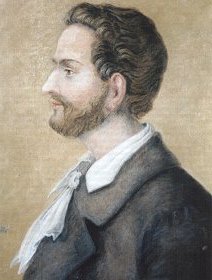
"Ludwig Leichhardt" by Friedrich August Schmalfuß (1791–1876), (Leichhardt-Museum, Trebatsch) - http://www.nvn-cottbus.de/themen/t_leichhardt.htm. Licensed under Public Domain via Wikimedia Commons

“Ludwig Leichhardt” by Friedrich August Schmalfuß (1791–1876), Licensed under Public Domain via Wikimedia Commons

Another tragic explorer was Ludwig Leichhardt. I’ve chosen him for my example because of his link to literature – he was the inspiration for Patrick White’s wonderful novel Voss – and because for a few years in my childhood, I lived in a town on the Leichhardt River. Unlike Wills’ posthumously published journal, this one by Leichhardt is for a trip from which he returned – Journal of an overland expedition in Australia: From Moreton Bay to Port Essington, a distance of upwards of 3000 miles, during the years 1844-1845. (Don’t you love the long, descriptive titles of these journals!).

Leichhardt prefaces his journal with a quote from Goethe:

Die Götter brauchen manchen guten Mann
Zu ihrem Dienst auf dieser weiten Erde.

(“The upper powers – Gods?- need many a good man for their service on this wide earth”.)

Presumably Leichhardt saw himself as, or aimed to be, such a good man, and saw his exploration as “service”. In chapter 2, he describes a meeting with “friendly natives” in southern Queensland:

On the 30th October, towards evening, we were hailed by natives, from the scrub; but, with the exception of one, they kept out of sight. This man knew a few English words, and spoke the language of Darling Downs; he seemed to be familiar with the country round Jimba; and asked permission to come to the camp: this, however, I did not permit; and they entered the scrub, when they saw us handle our guns, and bring forward two horses to the camp. On the 3rd of November they visited us again, and communicated with us, behaving in a very friendly way: they pointed out honey in one of the neighbouring trees, assisted in cutting it out and eating it, and asked for tobacco; it was, however, impossible to make any presents, as we had nothing to spare. They particularly admired the red blankets, were terror-struck at the sight of a large sword, which they tremblingly begged might be returned into the sheath, and wondered at the ticking of a watch, and at the movement of its wheels. The greater part were young men of mild disposition, and pleasing countenance; the children remained in the distance, and I only saw two women.

According to their statements, the scrub extends to the Condamine.

Intersting … the continuing friendly disposition despite what seems to be little coming back from the explorers.

There are many references to such meetings, and learnings, from “the natives”. Here are excerpts from chapter 5:

The natives had, in my absence, visited my companions, and behaved very quietly, making them presents of emu feathers, bommerangs, and waddies. Mr. Phillips gave them a medal of the coronation of her Majesty Queen Victoria, which they seemed to prize very highly. They were fine, stout, well made people, and most of them young; but a few old women, with white circles painted on their faces, kept in the back ground. They were much struck with the white skins of my companions, and repeatedly patted them in admiration. Their replies to inquiries respecting water were not understood; but they seemed very anxious to induce us to go down the river. (from Feb 27)

In consequence of the additional fatigues of the day, I allowed some pieces of fat to be fried with our meat. Scarcely a fortnight ago, some of my companions had looked with disgust on the fat of our stews, and had jerked it contemptuously out of their plates; now, however, every one of us thought the addition of fat a peculiar favour, and no one hesitated to drink the liquid fat, after having finished his meat. This relish continued to increase as our bullocks became poorer; and we became as eager to examine the condition of a slaughtered beast, as the natives, whose practice in that respect we had formerly ridiculed. (from Feb 29)

So interesting … and so wonderful that this material is now available for reading by anyone with access to the internet.