Monday musings on Australian literature: Annual anthologies

This post would possibly be better done at the end of the year given that its subject – annual anthologies – relates most commonly to end-of-year publishing. However, not all such anthologies are published at year’s end, and, anyhow, I was inspired to write this post because my reading group is about to do one of these publications. Why not strike while the inspiration is upon me?

I’m going to share just a few that I’ve come across in recent years – ordered by publisher.

Black Inc
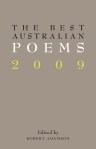
BestOf2009PoemsBlackIncMelbourne publisher Black Inc is the company which has made, in recent years anyhow, the biggest contribution to this form. I’m not sure when they started their “Best Australian” series but I’ve found titles going back to 2007 at least. They currently publish three annual editions: Best Australian stories, Best Australian poems and Best Australian essays. I’ve received, or given as gifts, various of these volumes over the years. Their editors change regularly, though not necessarily annually, so, for example, the 2016 edition of Best Australian stories will be selected by Charlotte Wood (whose The natural way of things won this year’s Stella Prize, among other awards). Previous editions have been edited by writers like Amanda Lohrey and Kim Scott. Recent Best Australian poems have been edited by poets Geoff Page, Lisa Gorton and Robert Adamson, and recent Best Australian essays by essayists Geordie Williamson and Robert Manne. These three annual anthologies are books that many of us Australians start looking for as the year draws to an end – and they do make good Christmas gifts for the reader who has read everything!

Griffith Review

The Queensland-based literary quarterly, the Griffith Review, published for several years (issues 26, 30, 34, 38 and 42) an Annual Fiction Edition (though the first one was called the Fiction Issue). The last of these, issue 42 published in 2013, was edited by Griffith Review’s editor Julianne Schultz and author Carmel Bird, and contained stories by recognised writers including Cate Kennedy, Arnold Zable, Tony Birch, Marion Halligan, Margo Lanagan and Bruce Pascoe. These editions focus on fiction, as their name implies, but they also include a smattering of pieces written in other forms, such as essays and poems.

However, in the last couple of years, Griffith Review seems to have abandoned this series, and has published instead what it calls The Novella Project. Numbered II (issue 46) and III (issue 50), these built on what was initially a one-off edition, issue 38 published in 2012. The novellas published were chosen from submissions to novella competitions run by the Review. One of last year’s winners was Nick Earls whom I featured in an earlier post this week. Issue 50 was published in October last year. I have no idea what Griffith Review plans for its last issue of 2016, but it would be lovely if it were a similarly focused “annual”.

Margaret River Press
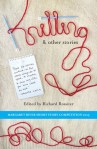
Richard Rossiter, Knitting

Courtesy: Margaret River Press

For four or five years now, Western Australia’s Margaret River Press has been running an annual short story competition, the conclusion of which is the publication of the winning and shortlisted titles in an anthology, usually edited by the judges. I have reviewed, and thoroughly enjoyed, a couple of these anthologies, the 2013 titled Knitting and other stories, edited by Richard Rossiter, and the 2014 one titled The trouble with flying and other stories, edited by Richard Rossiter and Susan Midalia.

The competition attracts both new and established short story writers. In 2015, they received 323 entries, of which 24 were shortlisted for inclusion in the anthology. This initiative represents a wonderful commitment by a small publisher to the short story form.

New South Books

New South Wales based New South Books contributes something a little different to this annual anthology arena – and this is the one my reading group will be discussing next month. I’m talking their Best Australian Science Writing anthology. We will be reading the 2015 edition which was edited by science journalist Bianca Nogrady whose book about death, No end, I’ve reviewed. The 2015 edition is the fifth they’ve published but, not surprising, given my main reading interests, I had not heard of it. However, I’m looking forward to being introduced to, as its promo says, “the knowledge and insight of Australia’s brightest thinkers in examining the world around us”. Its subjects apparently range from “our obsession with Mars to the mating habits of fish”. I’m intrigued. One thing I know is that I’ll be introduced to a whole bunch of writers I’ve never read before! Like Black Inc, New South Books is already promoting this year’s edition. It’s being edited by Jo Chandler, and promotion for it says:

Good writing about science can be moving, funny, exhilarating or poetic, but it will always be honest and rigorous about the research that underlies it.

Do you read annuals? If so, I’d love to know which one/s and why. 

(PS I should add here that I did buy, about a decade ago, one of the O Henry Prize Stories anthologies. It was great reading.)


Monday musings on Australian literature: Miles Franklin Award, the third decade (1978-1987)

Miles Franklin

Miles Franklin, c. 1940s (Presumed Public Domain, via Wikipedia)

Today’s post is the third in my little sub-series of posts looking at the Miles Franklin Award by decade.

As before, I don’t plan to list all the decade’s winners, as you can find them on the Award’s official site. Instead, I’ll share some interesting snippets, inspired by my Trove meanders.

Women writers on the rise?

The late 1970s and 1980s saw, I believe, a flowering of Australian women writers, similar to that we saw in the 1920s-1940s with the likes of Katharine Susannah Prichard, Marjorie Barnard/Flora Eldershaw, Eleanor Dark, and Christina Stead, not to mention Miles Franklin herself. This flowering is partly evidenced by the fact that while just five awards were made for books by women in the first two decades, another four were made to women in this third decade. These were Jessica Anderson’s Tirra Lirra by the river (1978) and her The impersonators (1980), Elizabeth Jolley’s The well (1986), and Glenda Adams’ Dancing on coral (1987).

In 1979, The Australian Women’s Weekly announced Jessica Anderson’s win under the headline “Women take honours in literature, fashion”. It seems the awards were handled differently then, with the winner being advised before the presentation. The Weekly describes Anderson’s reaction:

“I was thrilled,” she said. “Like all Australian writers, I think we owe a tremendous debt to our predecessors. The award does encourage writers. You feel someone out of the past has spoken to you.”

One of the Award judges, the well-known and successful publisher-editor, Beatrice Davis, said of Anderson’s book that “It has an unpretentious elegance, an individual quality so different from the realistic documentary that still dominates the field in Australian novels.” But Jessica Anderson told The Weekly that, the book’s content annoyed a lot of people, particularly men:

“I didn’t mean it to be a liberationist gesture,” she said. “Men recorded their experiences for hundreds of years and women read them with admiration.”

Hmmm … this is fascinating, and an issue that we still confront, I believe. Meanwhile, if you haven’t read Tirra Lirra by the river, add it to your list. It’s a great read. I read it before blogging, but Lisa has posted her thoughts on her blog.

Incomprehensible or outstanding?

David Ireland won the award in 1980 for the third time with A woman of the future. Ireland said at the time that it had been initially rejected by Macmillan because it was “too incomprehensible”. The judges called it “outstanding”. Well, four of them felt it was. The fifth, Colin Roderick, called it “literary sewage”, The Canberra Times reported.

A few months after it won, a long article giving “a feminist perspective” appeared in Woroni, the ANU’s student paper. The writer, Andrea Mitchell, starts by discussing Ireland’s previous novels in which women appear as “domestic or sexual adjuncts”. Ireland, she argues, does not dissociate himself in these novels from his male characters’ poor treatment of women, but, she writes

A Woman of the Future offers a different and more rewarding perspective on women in society. A complete turnabout, Ireland presents a woman’s life and experience in the first person.

It’s an in-depth analysis, but I’ll just share her assessment of what she thinks he is doing, because I love it:

I would suggest that Ireland is not only satirizing sexism, but levelling criticism at a certain style of feminism epitomized by German Greer’s A Female Eunuch: That is, that in order to change the subservient position of women, women must become as ruthlessly self-oriented and competitive as men have traditionally been. Ireland reasonably sees the same danger for women as for men who pursue social power: a less than full human existence, and alienation in their personal lives.

Here come the men!

Peter Carey, BlissIf this decade saw a flowering of Australia’s women writers, it was also when some of the men who are now among Australia’s top male writers won their first awards. I’m talking Peter Carey, who won the first of his three Miles Franklin Awards with his debut novel Bliss, and Tim Winton who won the first of his four awards with his second novel Shallows.

The Canberra Times reported judge Beatrice Davis as saying that

Carey was an “effortless stylist” who “gives a sense of immediacy to every vivid scene and compels belief in every character no matter how bizarre”.

While I haven’t loved every Carey I’ve read, I do love the fact that you never know what form or “style” he’s going to produce next. He is exciting to read.

Tim Winton won the 1984 award with his novel Shallows. The award was not made for 1983 (see below) so I was intrigued to read the following statement by the judges quoted in The Canberra Times report:

The merit of Winton’s novel is reflected by the high quality of the 29 books considered this year for the $5,000 award … Among the other books entered were David Malouf’s Harland’s half acre, Elizabeth Jolley’s Milk and honey, Thomas Shapcott’s The white stag of exile, Nicholas Hasluck’s The Bellarmine jug (The Age Book of the Year), David Ireland’s Archimedes and the seagle, Alan Gould’s The man who stayed below and Olga Masters’s Loving daughters.

Interesting.

Now, I’m a Winton fan but when I read Shallows not long after it came out I clearly remember feeling it overdid the imagery a bit, that it was a little “overwritten” (which is something I’ve just read Helen Garner felt about his first novel). Still, the judges saw “ample proof of a developing talent” and I certainly wouldn’t disagree with that. The judges also said:

The merits of this novel are perhaps most evident in the strength of the characterisation — these characters stand on their own — and in Winton’s ability to bring the early history of whaling into an intelligible relationship with present-day attitudes to the whaling industry.

Fair enough. Winton is great at writing character, and setting. He, like, Carey, is always exciting to read.

Another interesting winner this decade was Rodney Hall, with his wonderful Just relations, but I just don’t have time to share everything I found.

No award (again)

As happened in the second decade, there was a year in this third decade, 1983, in which no award was made. The Canberra Times reported that most of judges for the 1983 Miles Franklin Literary Award “felt the standard too poor to justify presenting it”. The report continued that “if no novel of sufficient quality is available, the author of a play for stage. radio, television ‘or such other medium as may develop’ can be the recipient but few scripts are received”.

In 1983, novels were published by people like Brian Castro, Sara Dowse, Elizabeth Jolley, and Peter Kocan. Interestingly Peter Kocan’s The cure won the NSW Premier’s Literary Award and Elizabeth Jolley’s Mr Scobie’s riddle won The Age Book of the Year Award. There were also short story collections – but these, unlike plays and scripts, are not eligible it seems – by Carmel Bird, Robert Drewe, Beverley Farmer, amongst others. I’m not saying any of these should have won, but in the light of what the judges said the following year – including highlighting The Age Book of the Year as indicative of quality – it does make me wonder.

Past posts in the series

Monday musings on Australian literature: Spotlight on Larissa Behrendt

Courtesy: Annette Marfording

Courtesy: Annette Marfording

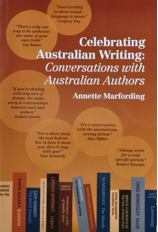
This is the fourth in my occasional series of Spotlight posts inspired by Annette Marfording’s Celebrating Australian Writing: Conversations with Australian Authors, and this time I’m featuring an indigenous author to coincide with Lisa’s (ANZLitLovers) Indigenous Literature Week.

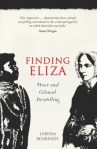
Larissa Behrendt is the perfect subject for what is also NAIDOC Week, not only because she has a few books under her belt, but also because her new book published earlier this year, Finding Eliza, explores how colonisers have written about indigenous people. Behrendt is a Eualeyai/Kamillaroi woman, and in her interview with Marfording describes herself as a Type A person. Looking at what she has achieved in her less that 50 years I can well believe it. She is currently Professor of Indigenous Research and Director of Research at the Jumbunna Indigenous House of Learning at the University of Technology, Sydney. She has won awards for her fiction, and been on the boards of various arts organisations including the Sydney Writers Festival, Bangarra Dance Theatre and the Museum of Contemporary Art. She was the National NAIDOC Person of the Year in 2009 and NSW’s Australian of the Year in 2011. As a lawyer, she has served on many boards, review committees and land councils, most of them indigenous-related. The list is impressive.

Marfording’s interview occurred in August 2010. As she does with each of her interviews, Marfording commences with a brief biography of her subject at the time of the interview, and follows the interview with a biography update to the time of publication. It’s nicely done.

I particularly loved this interview not only because Marfording asks, as she does in all the interviews, thoughtful, relevant questions showing her understanding of the subject, but because in this interview she covers some issues of particular interest to me. More on that anon.

Marfording asked Behrendt, as she tends to ask all award-winners, what winning awards means to her. Behrendt admits that it is affirming to win an award but also says that the richest prize is when a reader tells her that a book “touched” them or that it’s “like me and I never see myself in a book”.

Some of the questions Marfording asked relate to the autobiographical nature of her work, as her two novels, Home (2004) and Legacy (2009), both draw strongly on her family, with Home looking particularly at the stolen generation issue and Legacy being more specifically about her father and her relationship with him. She said that although Home was heavily fictionalised, her father found it hard to read. “It was flattering to me as a writer,” she said, “because it meant I’d got it right.”

Marfording also questioned Behrendt about the fact that her two novels also tend to be issue-based. As a fiction reader, I loved Behrendt’s response. She said that, as a lawyer, she has advocated and written factual pieces on many of the same issues, but that

telling a story that actually explains how a policy can impact on somebody’s life so personally, telling that story from a really human point of view, can influence more people than the most eloquent legal argument, especially when you can talk to somebody through the universals that they understand, like the love between siblings, the love between parents, etc.

I love this reference to universals – to the things that bring us all together. She mentions them again later in the interview, but here I want to share her gorgeous language. She said:

I’ve got very strong opinions, and I think it was a real learning process to learn that sometimes it’s through the whisper of a story that you can influence people more than through the louder, shouting style of activism.

There were other questions too, but I want to conclude on two that focused on her as an indigenous writer, one on labelling, and the other on the issue of non-indigenous people writing about indigenous people (which, as you know, I’ve raised here a few times).

Regarding labelling, Behrendt described it as a complex question. While she has no problem being identified as an indigenous writer, she said it can become problematical when writers are pigeonholed. For example, at the Byron Bay Writers Festival she was invited on a panel discussing “fathers”, a panel that recognised the diversity of perspectives, but in many festivals indigenous writers are lumped together on a panel about indigenous writing. She said that:

What we like to say is that within our writing – and I think that’s true of every Aboriginal author – there are universal themes about family, about love, about betrayal, about hurt, about anger and jealousy, and these are the things that actually unite us.

It’s a problem, in other words, when indigenous authors are seen to be writing only about indigenous subjects. Love it. The comment reminded me of Ellen van Neerven’s Heat and light (my review) in which some of the stories didn’t focus on or clarify race or ethnicity of the characters. They were just about people. For Behrendt, any story – whether the focus is an indigenous issue or not – is, essentially, about universals.

Larissa Behrendt, Finding ElizaAnd finally, that issue about non-indigenous writers writing on indigenous people. Again Behrendt is thoughtful rather than dogmatic. She says she’s always interested in how non-indigenous people portray indigenous people – hence, obviously, Finding Eliza – but that it’s difficult for them to do it authentically because they don’t know enough about Aboriginal life and culture. The reverse is a little different because Aboriginal people are “so bombarded with the dominant culture”. She identifies some writers who have not done it well – albeit she respects their hearts – and then names some who have impressed her. Kate Grenville in The secret river is one. Grenville, she says, doesn’t try an Aboriginal point of view. Instead

through using her non-indigenous characters, by showing their ignorance, their violence, their sense of entitlement, their fear, she tells a very strong story about Aboriginal experience. You read her book and you know exactly what it was like for Aboriginal people.

Grenville talks in Searching for The secret river about the issue of presenting the indigenous perspective. It was something she thought carefully about. Nice to see she’s been vindicated, in the eyes of Behrendt anyhow. The other effective portrayal she offers is Liam Davison’s The white woman. (Davison was tragically killed in the MH-17 disaster, and Lisa reviewed The white woman, as well as his other novels, as a tribute to him.) Behrendt says that Davison tells the story of massacres in Gippsland but relates

the story from the perspective of somebody who goes out as part of those hunting parties, and by getting into the psyche of the kind of person that can actually commit the most brutal aspects of a colonisation of a land, he tells a very strong story about Aboriginal people.

So, while she doesn’t see it as a no-go zone for non-indigenous writers, she does believe that the level of ignorance makes it a difficult challenge.

Another great interview with a writer who’s been in my list of must-reads for a long time. I’ll be starting soon with a short story. Watch this space.

Previous Spotlight posts:

Annette Marfording
Celebrating Australian Writing: Conversations with Australian Authors
Self published, 2015
273pp.
ISBN: 9781329142473

Note: All profits from the sale go to the Indigenous Literacy Foundation. To find out where you can purchase this book, please check Marfording’s website.


Monday musings on Australian literature: Recent books by Indigenous Australians

Next week, from 3rd to 10th of July, Lisa at ANZLitlovers is running her now annual Indigenous Literature Week. While she usually holds it during or near Australia’s NAIDOC Week in order to support that program’s goal of increasing awareness and understanding of indigenous Australian culture, she does in fact accept reviews of works by any indigenous authors worldwide. In other words, you don’t have to be or read Australian to join in, so if you’d like to raise awareness of an indigenous culture near (or not so near) you, do head over to her blog (link above) and make your contribution.

Lisa has included links to lists of indigenous Australian books, including her own, to get people started, so I’m not going to repeat that. But, for my own benefit as well as to support Lisa’s week, I thought I’d suss out and share some works – across genres and forms – that have been published in the last 12 months or so. It’s a serendipitous list:

  • Tony Birch, Ghost riverLarissa Behrendt’s Finding Eliza: Power and colonial storytelling (UQP, 2016): historical analysis of how indigenous people – in Australia and elsewhere – have been portrayed in stories by the colonisers.
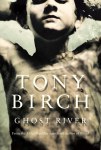
  • Tony Birch’s Ghost river (UQP, 2015) (my review): novel set in working class Melbourne in 1960s; long-listed for the 2016 Miles Franklin Award.
  • Ali Cobby Eckermann’s Inside my mother (Giramondo, 2015): poetry collection.
  • Lizzie Marrkilyi Ellis‘ Pictures from my memory: My story as a Ngaatjatjarra woman (Aboriginal Studies Press, 2016). (Yvonne’s Stumbling through the past review): memoir by a Central Australian woman.
  • Stan Grant’s Talking to my country (Lisa’s ANZlitLovers review): memoir, exploring the complicated experience of growing up black in a white dominated world.
  • Ambelin Kwaymullina’s The foretelling of Georgie Spider (Walker Books, 2015): the last in her Young Adult fantasy series, the Tribe trilogy, set in a post-apocalyptic world in which Aboriginal culture and philosophy play a significant role.
  • Marie Munkara’s Of ashes and rivers that flow to the sea (Vintage, 2016): memoir about her search for her origins. (I read her David Unaipon award-winning Every secret thing, and loved her voice)
  • Lesley and Tammy Williams’ Not just black and white (UQP, 2015) (Lisa’s ANZLitLovers review): won the David Unaipon Award in 2014

I decided to focus just on 2015 to 2016, but in my research I included the new biennial Indigenous Writers Prize in the New South Wales Premier’s Literary Awards, and found that the 2016 joint winners were books published in 2014, so I’m including them too:

  • Bruce Pascoe’s Dark Emu (Magabala Books, 2014) (Lisa’s ANZLitLovers review): analyses pre-colonial indigenous Australian culture suggesting that it was more “settled” than the common “hunter-gatherer” assumption. (I’ll be reading this with my reading group later this year.)
  • Ellen van Neerven’s Heat and light (UQP, 2014) (my review): collection of stories, some connected, some not, and including a longform speculative story, about living as an indigenous person in contemporary Australia.

But what am I hoping to read? First up, an older book, Ali Cobby Eckermann’s Ruby Moonlight, followed by, if I have time, a newer one, Stan Grant’s Talking to my country.

Do you make a point of reading indigenous literature? And do you have favourites?

Monday musings on Australian literature: My Aussie reads of 1996

Today, I’m having a bit of fun – a little trip down memory lane, in fact. I was inspired in this by Canadian blogger Debbie (ExUrbanis) who recently wrote a post on her past reads. Ever on the lookout for ideas for Monday Musings, I leapt at this one. (I do a few ideas running around my head, but I’m going to let them gel there a little longer and go for a simple post today!)

Debbie posted about 1997, but I thought I’d go for the even two decades ago. The only trouble is that I didn’t start my reading database until 1998, so it took a little bit of sleuthing through other records to discover what I read in 1996. Consequently, my list is probably not complete, but is complete enough I think for today’s purposes. I’ll start, though, with a brief look at what books and authors were “trending” (to use current jargon) in 1996 literary Australia.

1996 in Australian literature

As I only want to provide a little context, I’m just going to look at some of the major awards. Seven books were shortlisted for the Miles Franklin Award, of which four were by women, but the winner was Christopher Koch’s Highways to a war. In other awards, Sue Woolfe won the Christina Stead Prize for Fiction with Leaning towards infinity, Thea Astley The Age Book of the Year with The multiple effects of rain shadow (my review), Richard Flanagan the Adelaide Festival Award with Death of a river guide, and Amanda Lohrey won Victoria’s Vance Palmer Prize for Fiction with Camille’s bread. 

Besides these authors, other Australian writers making their mark in the early to mid 1990s included, to name just a few, Helen Garner, Peter Carey, Roger McDonald, David Malouf, Drusilla Modjeska, and Frank Moorhouse. It’s encouraging to know that all of these particular writers are still writing and publishing twenty years later.

My 1996 Australian reading

I discovered a fascinating, though not completely surprising, thing about the Aussie books I read in 1996. They were ALL by women. Actually, there was one exception, John Marsden, but that related to my reading children’s and young adult books with my children.

This was in stark contract to my non-Australian reading where male writers far outnumbered the women. I read T Coraghessan Boyle, David Guterson, Kazuo Ishiguro, Henry James, Michael Ondaatje and Salman Rushdie. The only non-Australian women I read, besides a couple of children’s authors again, were Kate Atkinson and the Japanese writer Fumiko Enchi. Although overall this is probably fairly typical of my overall practice, it is a little unusual because I have always read Aussie males too – like, back then, Peter Carey, David Malouf, and Tim Winton.

Anyhow, here is my Aussie list for 1996 as best as I can ascertain it …

Helen Garner, Cosmo cosmolinoFiction (Adult)

  • Blanche d’Alpuget, Turtle beach
  • Helen Garner, Cosmo Comolino (shortlisted for Miles Franklin Award in 1993) (read again and reviewed for this blog in 2008)
  • Yasmine Gooneratne, Changing skies
  • Janette Turner Hospital, The ivory swing
  • Sue Woolfe Leaning towards infinity (won the 1996 Christina Stead Prize for Fiction, New South Wales Premier’s Literary Awards)

Non-fiction

  • Jill Ker Conway, True north (Memoir)
  • Katie Holmes, Spaces in her day (History)
  • Pat Lovell, No picnic  (Memoir)

This is not a huge list, and is not, as I’ve already said, all that I read in 1996, but it contains most if not all of the adult Australian literature I read then. It was a time when I was working, and had two young children, so had little time and energy for reading. Even so, most of these books are still vivid in my mind.

janette Turner Hospital, The ivory swing

Janette Turner Hospital, The ivory swing

Janette Turner Hospital’s The ivory swing, published in 1982, was her first novel. I read several of her novels, before and after this, and most of them are still memorable. She’s such a powerful, evocative writer. The ivory swing, like many first novels, has a strong autobiographical element, drawing from her experience as a young wife in southern India. It won a significant Canadian award, the Seal Award for Best First Novel. Queensland-born, Janette Turner Hospital was, for several years, the Carolina Distinguished Professor of English at the University of South Carolina. Coincidentally, another writer I read in 1996, the also triple-named Jill Ker Conway, made her career primarily in the USA, where she was the first female President of Smith College.

But the book that has probably stayed with me most from this list is, surprisingly, a non-fiction work, Katie Holmes’ Spaces in her day. Subtitled Australian women’s diaries of the 1920s and 1930s, it grew out of Holmes’ PhD. I was fascinated by the stories of women’s lives – how they felt about their relationships, the way the single female relation would be expected to give up her own life when family needed help, how they managed washing day – because these were lives of my grandmothers and aunts. In my notes, still in the book, I comment that Holmes emphasises social constructs almost exclusively over other factors, particularly in her discussion on ageing where I suspect natural or biological issues are also at play, but this didn’t then, and still doesn’t, affect the power of this book, because the women’s voices are so strong and because, regardless of other factors, they were indeed constricted by the rules and expectations of their society.

Do you know what you read twenty years ago, and if so I’d love to know your standouts.

Monday musings on Australian literature: Australian writers, loquacious?

It’s a brave person who tries to characterise a nation’s literature. But this is apparently what Australian-French writer Jean-Francois Vernay has done in his book A brief take on the Australian novel (published this year by Wakefield Press). I haven’t read the book, but Lisa (ANZLitLovers) is currently reading it, and she challenged me to write this post. So, yes ma’am, here I am!

To be fair, Lisa’s challenge came from my comment on her blog to Vernay’s statement that there’s

a certain loquaciousness among Australian writers… accustomed to large geographical sweeps of land … and not inclined to deprive themselves of fictional space.

Now, dear readers, I contest this! Perhaps Vernay is not meaning to sound as sweeping about it as I am reading him, but it does sound a bit like the pot calling the kettle black or, to put it in perspective, like Victor Hugo calling Henry Handel Richardson long-winded! I mean really! I’m not sure this even warrants an investigation, but I’m going to take the opportunity to point out that Australians can write tight, spare prose, neat novellas and short novels with the best of them. Our country might be sprawling and all over the place, but our writers certainly aren’t – unless it is warranted. Because of course we do have long books – Henry Handel Richardson’s magnum opus, The fortunes of Richard Mahoney trilogy is an example, as is Xavier Herbert’s Poor fellow, my country. Peter Carey has been known to go on a bit too (in books like Illywhacker) and Winton’s Cloudstreet is not particularly short either.

But, before I continue, perhaps I should define my terms, particularly regarding “loquaciousness” and “fictional space”. According to most dictionaries, “loquacious” means “wordy” or “excessive talk”, meanings which carry a value judgement regarding quality (or lack thereof). “Fictional space” is not the sort of concept you find in dictionaries, but I’m understanding it to refer primarily to physical quantity, that is to “big” or long books. Now I contend that just because a book is big, just because it takes up fictional space, doesn’t mean it is excessive, that is, “loquacious” (and therefore of poorer quality). So, there are two arguments to be had here. One is whether Australian books that take up fictional space are or aren’t loquacious. The other is whether Australian books take up fictional space, in the first place, that is, whether Australian authors are capable of depriving themselves of this largesse that’s apparently open to them! It’s this latter that I’m going to briefly tackle (emulating Vernay’s idea of a “brief take”) in what’s left to me of this post. (Yes, I know that I can make the rules about how much is left to me in my own blog, but far be it from me to sprawl over this essentially limitless space I have here! I know how to be tight. Don’t comment on that!)

Photo: Courtesy Fremantle Press

Photo: Courtesy Fremantle Press

I want to tackle the second argument because, of course, like most literary cultures, we do have our long books (including, admittedly, some big, baggy – and potentially loquacious – monsters). Without taking time here to research examples for you, I’d argue that the majority of the longer Australian books I’ve read have tended to make good use of the words they’ve used. However, it doesn’t take much research for me to argue against the idea that Australians aren’t “inclined to deprive themselves of fictional space”. I just need to point to our long tradition of novellas.

I have many posts tagged “novellas“, some for specific books (not all Australian) and some for posts about the form. Very early in this blog, in fact, I wrote a post titled Little treasures. In that post I listed some of my favourite novellas to that time, and included  several Australians:

  • Thea Astley’s A kindness cup
  • Murray Bail’s Eucalyptus
  • Helen Garner’s The children’s Bach (my review)
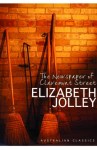
  • Elizabeth Jolley’s The newspaper of Claremont Street
  • David Malouf’s Fly away Peter
  • Carrie Tiffany’s Everyman’s rules for scientific living

And these are just a small sample.

Since then, I’ve read many more Australian novellas. But beyond them, my reading experience is that Australian novels are, overall, relatively short. A quick survey of the last 30 Australian novels I’ve read reveals that only five had more than 350 pages, which seems a reasonable marker in my mind for shorter versus longer books. Interestingly, four of those five were by male writers. Is there another hypothesis here, either regarding who writes the longest books, or, whether there’s a gender preference in the books Vernay based his statement on? I appreciate that my little survey is by no means scientific, but even non-scientific research can form the basis of an hypothesis can’t it?

I found online in The Age a discussion back in 2009 of the original French version (Panorama du roman australien) of Jean-Francois Vernay’s book that Lisa is reading. The article’s author, Simon Caterson, reports on his interview with Vernay:

Vernay says that Panorama, which covers early convict novels such as Quintus Servinton and For the Term of His Natural Life through to the work of contemporary authors such as Christos Tsiolkas and Alexis Wright …

Well, there you have it … these four books/authors used by Vernay to exemplify his research represent the more fictionally spacious end of Australian writing! I rest my case!

Seriously though, I’ve just had a little bit of fun here. I haven’t read Vernay. I don’t know how or whether he qualifies his statement. But, I did find it fascinating that he made his statement at all and wanted to tease it out a little, scientifically or not. So, whether or not Australia’s long novels are loquacious – and I’d say in general they’re not – my prime point is that we don’t produce an inordinate number of long (fictionally spacious) novels in the first place. What say you?

Monday musings on Australian literature: Dystopian fiction

For some reason, I’m often drawn to dystopian fiction. In my younger days I read Nevil Shute’s On the beach (probably my first book of this ilk) and then, of course, George Orwell’s 1984, Aldous Huxley’s A brave new world, moving later on to books like Margaret Atwood’s A handmaid’s tale and Cormac McCarthy’s The road, to name a few. But when I look at this list, and think about my reading, I realise that very few are Australian. Perhaps we are indeed “the lucky country”! Hmmm …

There are, in fact, Australian dystopias. Nevil Shute’s novel is set in Australia, and my latest read (to be reviewed this week), Charlotte Wood’s The natural way of things, is also. But, in researching this topic, I was surprised to discover that by far the greatest number of dystopian novels written in Australia seem to be Young Adult (YA) novels, and that they’ve really gained in popularity since the 1980s. John Marsden’s Tomorrow, when the war began series – some of which I read and enjoyed with my children – is an example. But there are many others, such as Isabelle Carmody’s Obernewtyn series (loved by my daughter), Victor Kelleher’s Taronga, Ruth Park’s My sister Sif, and they keep coming apparently with increasing frequency. Says something surely about the current zeitgeist.

However, while YA fiction is popular and worth exploring, I want to focus here, because it’s what I read, on adult fiction. So, I did a bit more delving and came across a few books and articles, such as Roslyn Weaver’s book Apocalypse in Australian fiction and film: A critical study and Russell Smith’s article “The literary destruction of Canberra: Utopia, Apocalypse and the national Capital”. I was only able to scan the works I found but between them, they have come up with several “types” of Australian dystopias:

  • effect of white colonisation on indigenous people
  • futuristic dystopias, including post-nuclear and apocalyptic scenarios, technocratic stories, government collapses
  • ecological thrillers (including some cli-fi fiction, I’d add)
  • fear of invasion
  • fear of the outback

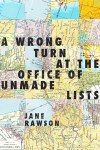
RawsonWrongTurnTransitFor those who just want a quick starter list, here are a few that I’ve read, know of or have come across in my research:

  • M. Barnard Eldershaw’s Tomorrow and tomorrow  (1947, a controversial novel in its time, set in the 24th century, and only published in full – as Tomorrow and tomorrow and tomorrow – in 1983)
  • Andrew McGahan’s Underground (2006, commentary on the “war on terror”)
  • Jane Rawson’s A wrong turn at the Office of Unmade Lists (2013, my review)
  • Annabel Smith’s The Ark (2014, my review)
  • Andrew Sullivan’s A sunburnt country (2003, Sullivan was – still is? – an expert in Bushfire Dynamics at the CSIRO!)
  • George Turner’s The destiny makers (1993, about overpopulation, food shortages and economic collapse)
  • Ellen van Neerven’s Heat and light (2014, my review, includes a dystopian longform story in its central section)
  • Sam Watson’s The Kadaitcha sung (1990, Roslyn Weaver writes that “Watson has reworked the notion of a dead heart [of Australia] … by populating the land with the spirits of murdered Indigenous people and also presenting the landscape, and particularly Uluru, as the sacred setting of power and restoration”)
  • Charlotte Wood’s The natural way of things (2015, review coming soon)

The two main characters in Steve Toltz’s Quicksand engaged in a lot of satirical repartee. One example I quoted in my review included the statement that:

‘You know how while we’re enjoying reading dystopian fiction, for half our population this society is dystopia?’

Toltz’s character is not talking about climate change, or terror attacks, or other apocalyptic scenarios. He’s talking about ordinary lives that are tough, lives that made the Sydney Morning Herald describe Kate Jennings’ Snake (my review) as a “domestic dystopia”. You don’t have to look hard, in other words, for dystopias!

At the 2013 Perth Writers Festival, there was a session (not that I was there) on “The Rise of the Apocalypse”. The question posed in the program was: “Is the recent increase in dystopian fiction due to our concern about what lies ahead with global warming and other environmental catastrophes or does it just make really good fiction?”

Do you read dystopian fiction, and if so, do you have favourites?

Monday musings on Australian literature: Spotlight on Charlotte Wood

Courtesy: Annette Marfording

Courtesy: Annette Marfording

This is the third in my occasional series of Spotlight posts inspired by Annette Marfording’s Celebrating Australian Writing: Conversations with Australian Authors. (See the end of this post for links to the first two.) Since Charlotte Wood won this year’s Stella Prize, the Christina Stead Prize for Fiction (NSW Premier’s Literary Awards), and has just been shortlisted for the Miles Franklin Literary Award for her latest novel The natural way of things, who better to choose for my third post.

Charlotte Wood is no stranger to awards. She has written five novels to date, and each of them has won or been shortlisted for awards, which is a pretty impressive achievement. She has also written a non-fiction work on food, Love and hunger, and edited an anthology, Brothers & sisters. Oh, and she has numerous essays, and newspaper and journal articles under her belt too. She is about to publish another book, The Writer’s Room, which will contain interviews with Australian writers selected from the digital magazine of the same name that she edited for three years.

And this makes a good place to segue to Annette Marfording’s interview with her, which took place back in 2010. Marfording’s first question was about awards. Wood indicated that she was “anti-awards” and that the book she thought was her best, The children (at that time she’d published three novels), had received the least notice in awards listings. She says:

I guess it’s easy when you’ve been shortlisted a couple of times to start dismissing it, but the whole prize culture is kind of damaging to literature, I think. It turns books into a horserace and it’s not good for writers and it’s not good for writing either.

This is not an uncommon view, and I do understand her point. The arts are not something that can be objectively measured like, say, a 50m freestyle swim or a high jump, but the money and recognition can, on the other hand, be very helpful to careers, particularly, I suspect, early ones. Wood admits that the money is useful, and can help writers keep writing.

Charlotte Wood (Courtesy: Wendy McDougall)

Charlotte Wood (Courtesy: Wendy McDougall)

Marfording then asks Wood about some of the ideas that recur in her novels – family, and abuse and violence. Regarding family, Wood says that it’s because “the intensity of human relationships plays out so well in families”. She doesn’t think that abuse and violence are strong themes – in those first three books – though agrees that there’s an abusive relationship in Pieces of a girl, and there is psychological warfare in her books. As she says “A story without any friction is not a story.” True!

Some questions naturally come up in most interviews with writers – recurrent themes being one. Another relates to the writing process, use of research, drawing from other people’s lives, and so on. Marfording asked Wood about these as well. Regarding her process, Wood said that “I start writing and see what happens”. She doesn’t plan, so sometimes the shape of the book comes quickly, other times not so. She doesn’t do a lot of research she says, but may check out the odd specific thing.

And then of course there’s that issue of writing from the perspective of other, such as a male point of view. Wood said that she used to worry about this, but her view is that, despite gender, we are not all that different in the way we think. So, she tries to avoid focusing on the physical issues – which are different – and keeps instead to the mental space.

They also discussed her writing, which is often described as “lyrical”. Wood says that with more experience she had become “sparer”, that at first she was “so lyrical that it kind of made you throw up”. Imagery, it seems, comes easily to her. In this she reminded me of Thea Astley who also found imagery easy and did put some readers off. She too became a little more spare in her later years, though perhaps not to the degree that Wood describes herself doing. Wood talks of actively focusing on character, plot and structure, and balancing that with her interest in language and lyricism.

Other topics discussed included the anthology, Brothers & sisters that she edited, and the place of short fiction in Australia. Re the latter, Wood said she felt things were improving, with new works by Cate Kennedy, Paddy O’Reilly, Robert Drewe, Tony Birch and Nam Le recently appearing. Wood says that:

a short story is perceived as a step to a novel, and there is nothing less true. I find them so hard to write that I hardly ever write them.

The interview concludes with some discussions about the “business end” of writing – publishing, editing and writing courses – topics which always interest me, even though I have no plans to write a novel, memoir or any other book!

A question they didn’t really cover, but which was asked by Booktopia in their Q&A with her in 2011, was which writers she admires. She tells them:

I admire any writer who has the courage to push through the barriers of ambition and vanity to get to the real thing – truth and beauty. Some of the best writers I know are struggling to get published, but they keep going because they are real artists. For the same reasons – truth and beauty – I respect and admire Alice Munro, Helen Garner, Anne Enright, Marilynne Robinson, Kim Scott, Richard Ford, Joan London, William Maxwell and Nina Bawden, among others.

What a lovely range of writers – they give a great sense of her writerly values don’t they?

Wood comes across as calm and level-headed – and I have heard other writers say that she’s generous in mentoring others. I have decided that my next book has to be The natural way of things.

Previous Spotlight posts:

Annette Marfording
Celebrating Australian Writing: Conversations with Australian Authors
Self published, 2015
273pp.
ISBN: 9781329142473

Note: All profits from the sale go to the Indigenous Literacy Foundation. You can purchase the book from its distributor, lulu.com.


Monday musings on Australian literature: Explorer’s journals (1, Edward John Eyre)

I have delved before into Australian explorer’s journals when researching posts, but I must admit that I’ve never read one right through. However, I don’t think that prevents my sharing some of the things they have to offer …

Project Gutenberg Australia (PGA), which I’ve described before, is a rich resource of a wide variety of copyright-free works, including, not surprisingly, Australiana. And a special subset of this Australiana area is its Journals of Australian Land and Sea Explorers and Discoverers collection. This is, they say, “one of the most comprehensive collections [in e-book form] in the world of the journals of Australian explorers”. The earliest journal is from Abel Tasman in 1642, and the latest seems to be from David Carnegie who “led one of the last great expeditions in the exploration of Australia” at the end of the nineteenth century.

Most of you know that Australia was first settled (invaded, as indigenous people with valid reason call it) in 1788, but sightings and brief landings had been occurring for well over a century before that. PGA writes:

In March 1606 Willem Janszoon, on board the Duyfken, charted about 300 km of the west coast of Cape York Peninsula in Queensland. He is the first authenticated discoverer of Australia.

White discoverer, that is, as indigenous Australians had found it long before that. But, here’s the thing, all this European exploration really only touched the coast, so when the first settlers landed they knew nothing about the interior – and they wanted, needed, to find out what was here. Was it arable, was there water, and could we build tracks, telegraph lines etc through it? Did they also want to know, with any seriousness, “who” beyond the idea that there were “natives” who might help or hinder what they wanted to achieve?

I will probably write a few posts (not sequentially or chronologically) on these journals over time, but in this post I want to share some of explorer Edward John Eyre’s (1815-1901) comments on indigenous Australians. (For an overview of his expeditions, you can check out his entry in the Australian dictionary of biography.)

The invasion of those ancient rights …

Edward John Eyre, c. 1870

Edward John Eyre, c. 1870, by Henry Hering, (The Caribbean Photo Archive) [Public domain], via Wikimedia Commons

I was inspired to write this post when I was looking at Eyre’s journal for last week’s Lake Eyre post, and noticed references to “natives” in the chapter summaries, such as “Plundered by the natives” for Chapter 8. The journal was published in 2 volumes in 1845, with the second volume comprising “an account of the manners and customs of the Aborigines and the state of their relations with Europeans”. This was partly based on his experience, from 1841 to 1844, as a resident magistrate and protector of Aborigines, at Moorundie, on the Murray River.

He summarises his views regarding indigenous people in the preface which he addresses to Lieut.-Colonel George Gawler “under whose auspices, as Governor of South Australia, the expeditions… were undertaken”:

For the account given of the Aborigines the author deems it unnecessary to offer any apology; a long experience among them, and an intimate knowledge of their character, habits, and position with regard to Europeans, have induced in him a deep interest on behalf of a people, who are fast fading away before the progress of a civilization, which ought only to have added to their improvement and prosperity. Gladly would the author wish to see attention awakened on their behalf, and an effort at least made to stay the torrent which is overwhelming them.

It is most lamentable to think that the progress and prosperity of one race should conduce to the downfall and decay of another (my emph); it is still more so to observe the apathy and indifference with which this result is contemplated by mankind in general, and which either leads to no investigation being made as to the cause of this desolating influence, or if it is, terminates, to use the language of the Count Strzelecki, “in the inquiry, like an inquest of the one race upon the corpse of the other, ending for the most part with the verdict of ‘died by the visitation of God.'”

He supports his views and experience, he says, with “the testimony of others … those who are, or who have been resident in the Colonies, and who might therefore be supposed from a practical acquaintance with the subject, to be most competent to arrive at just conclusions”. He believes that “the interests of two classes”, that is, the “Settlers”, and the “Aborigines”, need to be provided for, and argues that

it is thought that these interests cannot with advantage be separated, and it is hoped that it may be found practicable to blend them together.

That sounds not only humane but pretty enlightened to me. He proposes “blending” interests which seems a long way from later ideas of “assimilation”, though I don’t know exactly what he means by “blending”.

Concluding his own experience, he writes, that:

During the whole of the three years I was Resident at Moorundie, not a single case of serious injury or aggression ever took place on the part of the natives against the Europeans; and a district, once considered the wildest and most dangerous, was, when I left it in November 1844, looked upon as one of the most peaceable and orderly in the province.

Then we get to Volume 2 where he writes that the “character of the Australian native has been so constantly misrepresented and traduced, that by the world at large he is looked upon as the lowest and most degraded of the human species”. He supports his opposing view to this with Lord Stanley’s statement that the “fault [re different experiences] lies with the colonists rather than with the natives”. A little later he quotes a Mr. Threlkeld, who, in a speech to the Auxiliary Aborigines’ Protection Society in New South Wales, stated that “the whites were generally the aggressors”.

He continues in this vein throughout, picking up arguments that are negative to indigenous people and beating them down. Here is another quote he includes to support his view, this one from Gawler, himself, responding to a man “who objected to sections of land being appropriated for the natives, before the public were allowed to select”:

The invasion of those ancient rights (of the natives) by survey and land appropriations of any kind, is justifiable only on the ground, that we should at the same time reserve for the natives an AMPLE SUFFICIENCY for THEIR PRESENT and future use and comfort, under the new style of things into which they are thrown; a state in which we hope they will be led to live in greater comfort, on a small space, than they enjoyed before it occurred, on their extensive original possessions.

Not perfect, and paternalistic, but some recognition at least of entitlement! These quotes – or testimonies of others – are included as “notes” and all are cited as to who said them and where.

This is getting long, but I do want to share his thoughtful comment on the application of law:

In addition to the many other inconsistencies in our conduct towards the Aborigines, not the least extraordinary is that of placing them, on the plea of protection, under the influence of our laws, and of making them British subjects. Strange anomaly, which by the former makes amenable to penalties they are ignorant of, for crimes which they do not consider as such, or which they may even have been driven to commit by our own injustice …

These are all from Volume 2, Chapter 1. In the succeeding chapters, he documents the “appearance, habits, mode of life, means of subsistance [sic], social relations, government, ceremonies, superstitions, numbers, languages, etc” of indigenous Australians, noting the impact of Europeans on them. Records like these must surely be useful to indigenous people looking for lost histories not to mention proof of attachment to land.

As for Eyre, after leaving Australia, he had various roles in the colonies, including governor-in-chief of Jamaica where things went rather pear-shaped when he declared martial law in response to a rebellion. He was criticised, back in England, for his harshness back in England, with a Royal Commission, writes ADB historian Geoffrey Dutton, finding “that Eyre had acted with commendable promptitude but unnecessary rigour”. Dutton suggests mitigating circumstances but concludes that “the poignant contrast remains between the … humane protector of the Aboriginals in Australia, and ‘the monster of Jamaica’.”

Monday musings on Australian literature: Let’s get physical – Kati Thanda-Lake Eyre

Last week I wrote my fifth “Let’s get physical” post, and chose Adelaide because visiting there was bookending our trip last week to Kati Thanda-Lake Eyre. You’ll understand, therefore, why I’ve chosen the subject I have for this week!

Lake Eyre was named for explorer Edward John Eyre, the first European to see it in 1840, but in 2012 its official name was changed to combine its English name with its indigenous one, Kati Thanda. This recognition of indigenous place names is happening around Australia and is so important – not only to help reconciliation, but because these names mean something to the land we live in. 

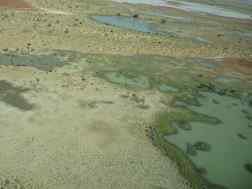
Lake Eyre aerial view

Lake Eyre Basin aerial view, 2016

Lake Eyre, for my non-Australian readers, is a large shallow lake in remote and very dry South Australia, approximately 700 km north of Adelaide. It contains Australia’s lowest natural point, around 15 m (49 ft) below sea level. When it fills, albeit this is a rare event, it is also Australia’s largest lake.

There are many stories associated with the lake – indigenous ones, of course, and settler ones. It was the subject of intense exploration in Australia’s early colonial days – by those looking for an inland sea – and was where major land speed record attempts were made in the mid 1960s. Importantly, native title over it was granted to the local Arabana people in 2012. There are some tensions, particularly regarding water activities, between the indigenous desire to respect its sacredness and its role as a tourist destination.

Early reports

The first person to write about the lake was Eyre. His writings, Journals of expeditions of discovery into Central Australia and overland from Adelaide to King George’s Sound in the years 1840-1, were published in England in 1845. They can now be read at Project Gutenberg Australia. Here he is writing about the region – very dry one day and then rain the next:

Lake Eyre, aerial viewyre Ba

Lake Eyre Basin aerial view, after 2016 rains

In passing through the plains, which were yesterday so arid and dry, I found immense pools, nay almost large reaches of water lodged in the hollows, and in which boats might have floated. Such was the result of only an hour or two’s rain, whilst the ground itself, formerly so hard, was soft and boggy in the extreme, rendering progress much slower and more fatiguing to the horses than it otherwise would have been. (August 31, 1840)

Crossing many little stony ridges, and passing the channel of several watercourses, I discovered a new and still more disheartening feature in the country, the existence of brine springs. Hitherto we had found brackish and occasionally salt water in some of the watercourses, but by tracing them up among the hills, we had usually found the quality to improve as we advanced, but now the springs were out in the open plains, and the water poisoned at its very source.

Occasionally round the springs were a few coarse rushes, but the soil in other respects was quite bare, destitute of vegetation, and thickly coated over with salt, presenting the most miserable and melancholy aspect imaginable. (September 2, 1840)

Warburton River aerial view

Warburton River aerial view

This is desert, an area, that is, of very low and very erratic rainfall. The problem was that in the early days of settlement, explorers sometimes happened to visit areas like Lake Eyre at a rare wet time and drew conclusions that later, of course, proved false. In 1858 explorer Peter Egerton Warburton thought that “the abundant and sure supply of water” would make the region easy to occupy. The fact that the biggest towns here – Birdsville and Marree, for example – have permanent populations of 100 people or less rather puts paid to that forecast.

In 1887, a bore was sunk at the Coward Springs railway siding. A contemporary magazine, Pictorial Australian, reported that:

Acres of nearly level table-land were turned in a few hours to a swamp … it is only a matter of weeks before miles of country will be covered with water. (from an interpretive panel at Coward Springs)

Wetlands were created – and breeding grounds for birds and other wildlife ensued. Indeed Lake Eyre is  famous for its birdlife and its breeding grounds. Ornithologist Captain SA White undertook “an ornithological trip” to the area in 1914 to collect bird specimens. He wrote about the artesian bore at Coward Springs where the pipes had corroded, so that the water

now flows out at the surface and finds its way across the the plain, where for many acres it forms a swamp, mostly covered in green rushes trimmed down by the stock. Amidst this short vegetation many water-loving birds find a home and feeding ground. (from an interpretive panel at Coward Springs)

I don’t pretend to understand how water works here. We saw some water courses/ponds/springs that are permanent, and others that are caused by recent rains and will evaporate or otherwise dissipate very quickly. The critical point is that there is not enough – in quantity and quality – to support regular, intensive farming, though there are cattle stations in the area.

More recent writing

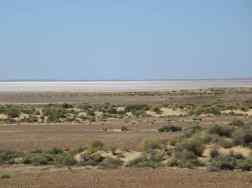
Lake Eyre South

Lake Eyre South (viewed from the ground)

Not surprisingly for such a fascinating place, many non-fiction books have been published over the years about it – by scientists, journalists, and travellers – but not much fiction. Given its remoteness you’d think it would provide excellent inspiration for novelists, but not so it seems. Arthur Upfield who, in the mid twentieth century, wrote crime fiction set in Central Australia did set one in the Lake Eyre region, Bony buys a woman, and another of his, Death of a lake, is about a fictitious lake that could be based on Lake Eyre.

As for non-fiction, I found a useful list of recommendations, including a trilogy by Roma Dalhunty who travelled in the region with her geologist husband. The books are The spell of Lake Eyre (1975), When the dead heart beats Lake Eyre lives (date?), and The rumbling silence of Lake Eyre (1986).

My own favourite work about the area is, however, a movie, the 1954 Shell-sponsored docudrama The back of beyond. It chronicles the trip made between Marree and Birdsville every fortnight, from 1936 to the late 1950s, by mailman Tom Kruse. Scripted mainly by its director John Heyer, the final narration was co-written by Australian poet Douglas Stewart. Marree is described as a “corrugated iron town shimmering in the corrugated air” and Birdsville as “seven iron houses burning in the sun between two deserts”. The drama of life in the region is described through lines like “Who passes or perishes, only the dingo knows”.

I’m sorry I don’t have anything more exciting for you, but at least you now know where I was last week!

Meanwhile if you know of any fiction set in Lake Eyre, please to tell.