Those of you who read my December Six Degrees meme will know that the starting book was Stephen King’s It. Not surprisingly, a couple of bloggers – Kate (booksaremyfavouriteandbest) and Lisa (anzlitlovers) – made their first link Stephen King’s On writing. Lisa then went on to link to an Australian book on writing, Kate Grenville’s The writing book.
Now, I’ve written about Aussie writers on writing before, so I thought that in this post I’d share some books containing interviews with Aussie writers, which I’ll list in order of publication.
Jennifer Ellison’s Rooms of their own (1986)
Ellison’s book, of course, takes its title from Virginia Woolf’s wonderful, pleading book on behalf of women creators. It comprises interviews Ellison conducted with significant writers at the time: Blanche d’Alpuget, Jessica Anderson, Thea Astley, Jean Bedford, Sara Dowse, Beverley Farmer, Helen Garner, Kate Grenville, Elizabeth Jolley, Gabrielle Lord, Olga Masters, and Georgia Savage.
Naturally, the gender issue is explored, but other issues relating to writing, publishing and the role of writers in society are also discussed. I often refer to it.
Candida Baker’s Yacker: Australian writers talk about their work, Vols 1, 2 and 3 (1986, 1989 and 1990)
 The three volumes of Yacker were the result of author-editor-festival director Candida Baker’s multi-year interview project which was inspired by the Paris Review’s “on writing” interviews. By the end of the project she had interviewed 36 Australian writers, representing a wonderful resource – both on writers no longer with us, and on the early or mid-careers of writers still here. Her interviewees were:
- Yacker: Christina Stead, Peter Carey, Nicholas Hasluck, David Foster, Helen Garner, Blanche D’Alpuget, Dorothy Hewett, Elizabeth Jolley, David Malouf, Thomas Shapcott, Thea Astley and David Williamson.
- Yacker 2: Jessica Anderson, Marjorie Barnard, Sumner Locke Elliot, Barbara Hanrahan, Jack Hibberd, Thomas Keneally, Ray Lawler, Roger McDonald, Gerald Murnane, Les A. Murray, Janette Turner Hospital and Kath Walker (Oodgeroo Noonuccal).
- Yacker 3: Randolph Stow, A.D. Hope, Glenda Adams, Kate Grenville, Peter Porter, Robert Drewe, Peter Corris, Louis Nowra, John Tranter, Frank Moorehouse, C.J. Koch and Gwen Harwood.
Kate Grenville and Sue Woolfe’s Making stories: How ten Australian novels were written (1993)
This book takes a slightly different tack to the other books in today’s post in that it comprises authors discussing a particular book, demonstrating their creative process. The authors and books included are: Jessica Anderson’s The commandant (my review), Peter Carey’s Oscar and Lucinda, Helen Garner’s The children’s Bach (my review), Kate Grenville’s Lilian’s story, David Ireland’s A woman of the future, Elizabeth Jolley’s Mr Scobie’s riddle, Thomas Keneally’s The chant of Jimmie Blacksmith, Finola Moorhead’s Remember the tarantella, Patrick White’s Memoirs of many in one, and Sue Woolf’s Painted woman.
Annette Marfording’s Celebrating Australian Writing: Conversations with Australian Authors (2015)
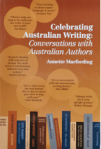 Regular readers here might remember this book, as I’ve published several posts inspired by the interviews contained within. Marfording was, for several years program director for the Bellingen Writers Festival. She was also a radio presenter for the Bellingen community radio station, 2 bbb fm, on which these interviews were aired from around 2009 to 2014. Her aim was, she said,
not to produce interviews “like those commonly done, focusing primarily on an author’s latest book. I wanted to inform listeners of their body of work, strengths – as I saw them – writing methods and work associated with their lives as authors, such as judging literary awards, editing short story collections, reviewing other writers’ works.”
Her interviewees are: Robert Dessaix, Cate Kennedy, David Malouf, Gregory Day, Charlotte Wood, Georgia Blain, Kate Howarth, Kristina Olsson, Larissa Behrendt, Debra Adelaide, Alex Miller, Kevin Rabalais, Di Morrissey, Peter Goldsworthy, Robert Drewe, Jon Bauer, Bryce Courtenay, Chris Womersley, Marele Day, Michael Robotham, and Barry Maitland.
In a really lovely, generous gesture, Marfording has directed that all profits from the sale of the book go to the Indigenous Literacy Foundation. A worthy cause and one that I support too.
Charlotte Wood’s The writer’s room: Conversations about writing (2016)
Wood’s book draws on interviews she did for her digital or on-line journal, also called The writer’s room, which ran from 2013 to December 2015. She, like Baker, was inspired by the Paris Review, and wanted to use their model which allowed writers to review and change the edited transcript of their interview. Her reason was that “having been interviewed about my own work so many times and then been embarrassed by my awkward words in print, I wanted ‘my’ writers to know that they would have complete and final control over anything that appeared in the magazine.” In the end, she says, they changed very little, mainly making “small but important clarifications” or expanding something “they’d been oblique about” or making statements or opinions more “definite”.
Because her project started in 2013, her interviewees include very recent writers on the Australian scene. The book contains a selection of the interviews she did: Tegan Bennett Daylight, James Bradley, Lloyd Jones (New Zealand writer), Malcolm Knox, Margo Lanagan, Amanda Lohrey, Joan London, Wayne Macauley, Emily Perkins, Kim Scott, Craig Sherbourne and Christos Tsiolkas.
*****
So, seven books containing interviews with writers, books that I believe provide a valuable contribution to Australia’s literary culture. And yet Marfording, in the Introduction to her self-published book, writes that publishers told her that “books of interviews don’t sell”. Who says, I want to know. I have bought three of the seven books I’ve listed here and wish that I’d bought them all!
What about you? Are you interested in reading interviews with authors?





 Whispering Gums