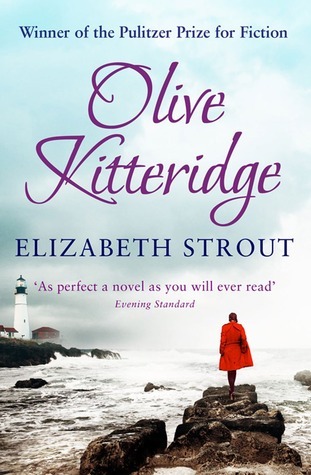
Elizabeth Strout’s Pulitzer prize winning novel Olive Kitteridge has been around for 17 years, but it’s only now that I have managed to read it. And that’s because my reading group scheduled it as our June read. It’s not that I didn’t want to read it – I really did – but other books kept getting in the way. I realise now that I should not have let that happen because Olive Kitteridge is a wonderful read.
Now, how to describe it? The first thing is its form. It’s more like a collection of linked stories, or what its Wikipedia article calls a short story cycle. Although I’ve read many linked short story collections, I haven’t come across this term before. I’d like to explore it some time, but not now, because I’m keen to talk about the book. I will say, though, that some in my reading group found the episodic form somewhat disconcerting at first. However, despite this, almost all of us thoroughly enjoyed the book. Why? Well, as it turned out, the form is partly what makes it such a strong and moving read.
As most of you will know, the novel is set mostly in the late 20th and very early 21st centuries in the fictional small-town of Crosby, in coastal Maine. It comprises 13 chapters – or stories – that explore the life of retired schoolteacher Olive Kitteridge and her relationships with family and friends. In some of the chapters Olive is front and centre, but in others she makes a cameo appearance, sometimes just as a passing reference. The end result is as much a picture of a small town as it is of Olive, though Olive is our lynchpin. As one of my reading group members said, her question as she read each story was, “Where’s Olive?”
everyone thinks they know everything and no one knows a damn thing. (“River”)
So, while my reading group talked about the form and the gorgeous writing, we mostly focused on the picture painted of a small town – which, said one, provides an antidote to the “apple-pie” image we typically get of small-town America – and on the character of Olive. She is complex and not easy for readers to like, but we found her real, and most of us did like her. The opening story, “Pharmacy”, doesn’t pull any punches in its depiction of Olive. She comes across as curmudgeonly, uncompromising. She is cutting about her husband Henry’s new young pharmacy assistant and unwilling empathise with her. She is prickly and vengeful with her son’s new bride, Suzanne (“A Little Burst”), while Bob in “Winter Concert” wonders how Henry can “stand” her.
However, there are many occasions where Olive is kind and compassionate, where she sees need in others and helps or offers to help, where, as Henry describes it, “all her outer Olive-ness” is stripped away. For example, ex-student Julie remembers Olive telling a class
“Don’t be scared of your hunger. If you’re scared of your hunger, you’ll just be one more ninny like everyone else.” (“Ship in a bottle”)
And Rebecca recollects Olive saying to her at school, “if you ever want to talk to me about anything you can” (“Criminal”). Olive also quietly talks a young man, an ex-student, down from suicide (“Incoming tide”) and she and the truly “nice” Daisy try hard to help the young anorexic Nina (“Starving”).
Olive, too, can be insightful. In “Security”, for example, we read that sometimes she had “a sense of just how desperately hard everyone in the world was working to get what they needed”. And she suffers, especially from a “rupture” with her beloved son, and from grief over husband Henry’s massive stroke.
So, what we have is a character who can be tough and acerbic – even engage in a little schadenfreude – but also be sensitive and empathetic. This led me to see the book as being about more than a picture of a small town, much as that is a central and engaging part of it. The form – the interconnected short stories about life in the town – supports this view of the novel. However, this form also supports another way of looking at it, one encompassing something fundamental about our humanity.
In each story, we see characters confronting some crisis or challenge in their lives – some big ones, some quieter ones. We never see these stories fully through. They are vignettes, even those featuring Olive. This made me think about how little we know others, and perhaps even ourselves? We never fully know what others think of us, or what impact we have on others, but in this book – largely because of its form – we do see, for example, how Olive is, or has been, viewed or remembered, both positively and negatively. No one perspective is right, but each contributes to a picture of a person. This is how life goes. We see little parts of people’s lives, and sometimes we are little or big parts of people’s lives, but what do we truly know?
A bleak interpretation of this could be that it exposes our essential aloneness, but a more positive perspective is that it reminds us that we are all “real” people with good and bad, hard and soft selves. Books like Olive Kitteridge encourage us to look around corners, to not take one aspect of a person at face value, to be generous to others and ourselves. It also reminds us that we never stop learning about ourselves (or others). Certainly, at the end of this book, Olive, in her early 70s, is still discovering things about herself and her feelings. She isn’t giving up, no matter how tough things have become.
In my group’s opening discussion, I said that I thought the novel offered many truths, albeit often uncomfortable ones. For example, in “Tulips”, which is a story about things going terribly wrong, Olive reflects, “There was no understanding any of it”. But, my favourite occurs in “Security”, when some rapprochement is being made with her son, and Olive thinks
whatever rupture had occurred… It could be healed. It would be leaving its scars but one accumulated these scars.
One surely does!
There’s so much more to talk about in this book – the spot-on descriptions, the quiet humour, the many beautifully wrought characters and their trials, and the political references such as to 9/11 and George W Bush which provide context. But the main story is the human, the personal. The novel closes with Olive reflecting deeply on her life and her choices, on how much had been “unconsciously squandered”. She realises that, while
It baffled her, the world. She did not want to leave it yet.
I love getting inside the heads of characters like Olive, and so I loved Olive Kitteridge. I’ll be reading more Strout I’m sure.
Brona and Kate both read and enjoyed this long before I did!
Elizabeth Strout
Olive Kitteridge
London: Simon & Schuster, 2008
270pp.
ISBN: 9781849831550
 Whispering Gums
Like you, this has been on my reading list for far too long. I have started in on the Lucy Barton books, though, and feel I need to see those through before moving onto Olive.
I understand that Teresa. I thought I would just read them in order of when she wrote them, from here. But I don’t know when that will be!
There’s always so much to read! Strout is excellent though, I enjoy her writing immensely.
There sure is, you’re right … I think Strout is quite quick to read so I’m going to try to read more.
She is quick, yes. I need to remember that and crack on with some of them!
Haha Theresa!! Even quick takes time.
It’s a testament to Strout’s skill that I’ve become so fond of this prickly, outspoken and, to use your word, curmudgeonly woman whose exterior hides a warm heart. I’m not a fan of adaptations but Frances McDormand’s portrayal of her is pitch perfect in HBO’s miniseries.
Thanks Susan. I read a review of the adaptation and, while I love Frances McDormand, I didn’t like how they described the adaptation … it didn’t sound like the book I read. But McDormand usually gets it right so I’d see it if I could.
Shame on you Sue – lol. A wonderful writer is Elizabeth Strout. She certainly gets into character heads and the times.
Haha Meg, So many wonderful writers so little time!
I seem to have read Strout’s novel’s in somewhat backward order including her later one in which the character of Olive appears as one of several in the town where Lucy, the protagonist of the ‘Lucy’ series, comes to stay. I’ve thoroughly enjoyed all these books for the same reason: their insightful glimpses of ordinary lives and places and skilful storytelling. Strout is a beautiful writer.
Thanks Denise. I’m really glad you agree though I’m not surprised. I’m going to try to read more over the coming years.
It’s always NICE when you review something you really like, ST ! 🙂
Haha, thanks MR … most of what I review I like. But some I REALLY like.
Delighted you have finally found the right reason to read Olive, she’s a gem of a character. The TV series with Frances McDermand and Bill Murray was wonderul, although Frances was not quite as curmudgeony as I had pictured her. Worth watching out for though on whayever subscription service it is on these days.
Thanks for the link as well – I’m sure you may have picked this up elsewhere, but the Lucy books and The Burgess Brothers are also partly set in the same town/area of Maine, so at times there are crossovers between her characters, which is fun.
Thanks bery much Brona… yes I had picked that up. So I know I’ve got much to draw on if I can find the time!
I’d like to see the miniseries as I love Frances McDormand but I don’t subscribe to and services besides AppleTV so chances are slim I think.
I think I first saw it on SBS, but they may no longer have the rights.
I don’t think they do … there seems to be lots of trailers and snippets on YouTube so I will look at some of those to get a sense of what they did at least.
I liked it a lot, but I found it a bit… disjointed. The TV series was more cohesive.
I can understand that Davida…
I don’t mind disjointed if it’s connected short stories like this. It goes with the form I think. But then, I do like short stories and I live the challenge of different structures to telling stories.
I’m a huge fan of short stories, and I do appreciate books whose structure is a bit out of the ordinary. Maybe I didn’t care for Olive in the book, but I love Frances McDormand so… But I adore all the Lucy Barton books.
Yes, I must admit that when I wrote that I thought, but I think Davida does like short stories! I’ll have to read Lucy Barton.
It was a great pleasure to read your knowledgeable and insightful take on this beloved book. I have read all of her books and I believe this is the best one, though I have thoroughly enjoyed most of the others.
Thank you for taking me back to this lovely book and for a bright moment in my morning.
Thanks so much Charlotte. I rather love that you’ve read and loved them all but think this one is the best. I really can’t understand why it has taken me so long to read it given it’s the sort of book I would like but I am going to try to read more – and soon! One person in my reading group didn’t like it at all but everyone else did.
I’m glad my review gave you pleasure. I love reading reviews of books I have loved in the past too.
I can’t understand why it’s taken you so long either, particularly as it was given to you by your favourite brother so long ago!
I know, very disrespectful of me!!
I have only read one Elizabeth Strout, being Lucy Barton, but I do want to read more… This sounds like a lovely book!
Lovely may not be the right word “literally” Rach! But I do think it’s a great book. I must read more, including Lucy Barton.
I watched the series when it first came out – Milly was watching it and I happened to be around – and that made me look out for the book, which of course is excellent though I don’t seem to have written a review.
I rather imagined that you’d have liked it, Bill. I can be wrong about your tastes but I think I know them reasonably well. A shame you didn’t write it up.
You mentioned that Olive didn’t like her son’s partner, so I wondered if the big rupture came from that. I don’t understand why parents feel the need to get involved in their children’s love lives. It never ends well and the child just resents his or her parents forever as a result. I was happy that my folks always let us figure out relationships for ourselves. Nick’s mom did not, and guess who we haven’t seen in probably a decade because there is no trust or love there now.
I agree with you Melanie … we were like your parents. As my parents were before us. The end result is that we’ve had good family relationships. And you’re right, that was a big part of the break with her son.
I love Olive. There was an excellent series of this book awhile back but haven’t heard of it since. Frances McDormand played Olive brilliantly.
I understand that Pam … she’s a great character isn’t she? I’d like to see the series as I do love Frances McDormand too.
Olive is available on Apple tv for 3.49. The whole series I believe. If you don’t have Apple you can always sign up for a free trial or a month then cancel. Haha
Oh thanks a bunch Pam … I do have Apple TV … the only streaming service we have besides iView and SBS On Demand.
I have this on the TBR shelf. Seeing as I do like interconnected stories generally, I suppose I should not take 17 years to get to it! 🙂
Haha fourtriplezed. It’s 17 years old but I only had it for 11 years on my shelves! Can do better than that?
No 😂
Haha! That makes me happy!!
I loved these stories–and there’s a second one about Olive! https://necromancyneverpays.wordpress.com/2019/11/15/olive-again/
Unlike other commenters here, I’m not a big fan of the Lucy Barton books (or The Burgess Boys).
Thanks Jeanne. Yes I knew there was a second one. I plan (probably) to read in the order she published after Olive Kitteridge just to have any interweaving characters in the order she wrote them. Interesting that you don’t like the Lucy Barton ones.
I have read Strout’s books … but it’s been a long while since I read Olive Kitteridge. Still she is the lynchpin of Strout. (I like how you used lynchpin for Olive.) I recall Olive being quite acerbic in the original and maybe that’s a bit off-putting …. but later by the time of Olive, Again (2019) she has aged and softened quite a bit. And Olive even makes an appearance in Strout’s latest novel Tell Me Everything (2024) … when she meets Lucy Barton. Over time Olive’s become a hero of sorts and an endearing protagonist.
Thanks Susan. I like your idea of her being “the lynchpin of Strout”. Someone in my reading group wondered whether she was Strout’s muse. She thought that perhaps Strout often thinks, what would Olive do?
I have heard of this novel, but I don’t think I’ve actually read anything by this author. I’ll make a note to take a look at her.
I really enjoyed reading both your thoughts and the comments on this lovely book. I don’t think Olive is the lynchpin for Strout so much as she is the lynchpin for Strout’s readers because it’s often been Olive who has pulled folks in. But she’s been interconnecting her characters since Amy and Isabelle and Abide with Me (which came before Olive). In its day, A&I was considered quite the discovery, and the mother-daughter focus is really interesting to compare to Olive’s family dynamics. If you can read them in order, I’m sure you’d love the little layers that emerge. I have fallen behind on purpose. Periodically I reread from the start, thinking I’ll read on, but I never catch up. (I bet you’ll find the novels read more quickly…no effort expended in reorienting between stories.)